




Day trading in the US is a fast-paced and high-risk form of trading where you buy and sell financial instruments within the same day, aiming to capitalize on small price fluctuations to make profits.
The US stock market is the largest globally, with daily volumes over $2 billion, the dollar is involved in around 89% of forex trades, while the country’s $28 trillion economy provides a broad backdrop for active traders.
Ready to start day trading in the US? This guide for beginners will get you started.
Quick Introduction
- The Securities and Exchange Commission (SEC) and Financial Industry Regulatory Authority (FINRA) primarily oversee securities, while the Commodity Futures Trading Commission (CFTC) supervises derivatives. All are ‘green tier’ bodies in DayTrading.com’s Regulation & Trust Rating, enforcing stringent rules to protect US traders.
- The Pattern Day Trader (PDT) rule, implemented by the SEC and FINRA, historically required traders in the US with less than $25,000 in their margin account to limit their day trades. However, the SEC approved FINRA’s shift to intraday margin rules, removing the $25,000 PDT minimum and the day-trade counting test. The new intraday margin rules took effect on 4 June, 2026, although broker-dealers have until 20 October, 2027 to fully complete the transition.
- The US hosts the world’s two largest stock exchanges: the New York Stock Exchange (NYSE) and NASDAQ. The NYSE is renowned for its blue-chip companies, while the NASDAQ is known for its tech-heavy listings. Additionally, the Chicago Board Options Exchange (CBOE) is a leading market for options and futures trading.
- In the US, day traders typically pay short-term capital gains taxes at ordinary income rates, ranging from 10% to 37%, with payments made to the Internal Revenue Service (IRS).
Top 4 Brokers in the United States
After testing around 500 platforms, these 4 regulated brokers stand out as the best for day traders in the US:
-
1
 Interactive BrokersRegulated by: SEC, FINRA, CFTC, NFA, CIRO, FCA, CBI, ASIC, SFC, SEBI, JFSA, MAS
- Demo account
- Min. deposit: $0
- Min. trade: $1
-
- Demo account
- Instruments: Stocks, Options, ETFs, Crypto
- Regulator: SEC, FINRA
eToro USA LLC and eToro USA Securities Inc.; Investing involves risk, including loss of principal; Not a recommendation -
- Demo account
- Instruments: Stocks, Options, ETFs, ADRs, OTCs
- Regulator: SEC, FINRA, MAS, SFC, ASIC, CIRO, JFSA, SC
-
- Regulator: SEC, FINRA
- Platforms: Firstrade Invest 3.0, TradingCentral
- Min. deposit: $0


Learn how we test brokers and why you can trust our ratings.
Day Trading Platforms in the US
What Is Day Trading?
Day trading refers to the buying and selling of financial instruments within the same day. All positions are closed before the market closes, and no positions are held overnight to avoid negative price gaps and holding fees.
Day traders typically use leverage to magnify results (profit and loss) and short-term trading strategies to capitalize on small price movements in highly liquid assets.
US traders have access to a wide array of highly liquid, volatile markets, both domestically and globally, that suit active trading styles, including:
- Stocks spanning the NYSE and NASDAQ, such as Apple and Meta, that are known for their massive daily trading volumes and large price swings.
- Indices like the S&P 500 (500 biggest companies listed in the US), Dow Jones (30 large, publicly traded firms) and Russell 2000 (tracks the performance of 2,000 smaller stocks).
- Commodities like West Texas Intermediate (WTI) crude oil, natural gas, corn, wheat and soybeans, given that the US is a huge producer globally.
- Forex trading in the US with the ‘major’ currency pairs all including the US dollar (EUR/USD, USD/JPY, GBP/USD, USD/CHF, USD/CAD, AUD/USD, NZD/USD), exhibiting significant trading volumes.
Is Day Trading Legal In The US?
Day trading is legal in the US and supervised by some of the most stringent regulations globally that are designed to protect investors and maintain market stability.
The SEC, FINRA and CFTC are the primary regulatory bodies overseeing short-term trading activities, ensuring a secure and fair trading environment.
One key regulation has historically been the PDT Rule. Under the legacy framework, if you execute four or more day trades within five business days in a margin account, you are classified as a Pattern Day Trader.
To continue day trading under this classification, you have historically needed to maintain a minimum account balance of $25,000. However, the SEC approved FINRA’s move to replace this framework with intraday margin requirements, meaning brokers will instead monitor whether your account has enough equity for your intraday market exposure.
You must also follow the rules related to margin trading. The Federal Reserve’s Regulation T (Reg T) permits you to borrow up to 50% of the purchase price of securities on margin. Still, you are often subject to stricter margin requirements to mitigate the risks of your frequent trading.
How Is Day Trading Taxed In The US?
Trading taxes in the US depend on the holding period of your investments.
Short-term capital gains – profits from assets held for one year or less – are typically taxed by the Internal Revenue Service (IRS) at ordinary income tax rates ranging from 10% to 37%, depending on your income bracket.
Long-term capital gains for assets held longer than a year are taxed at lower rates of 15% or 20%.
Day traders typically pay higher short-term capital gains tax rates. However, you may deduct certain expenses if you qualify for Trader Tax Status (TTS).
Since trading taxation in the US is complex and evolving, I recommend consulting a local tax professional to ensure compliance with all applicable tax laws and that returns are submitted on time (15 April the following year).
 Christian HarrisAuthor
Tax Traps and Nuances in US Day Trading
The wash sale rule prevents you from deducting losses if you repurchase a substantially identical security within 30 days.
Trader Tax Status, if active traders qualify, allows certain expense deductions (e.g., technology, equipment, software, education, research, borrowing costs).
Traders can elect mark-to-market accounting (Section 475), but the election must generally be made by April 15 of the prior tax year.
Futures and certain index options fall under Section 1256, taxed 60% long-term and 40% short-term regardless of holding period.
Brokers issue Form 1099-B to report trading activity, but traders remain responsible for accurate reporting.
Note that state taxes may apply in addition to federal taxes.
Getting Started
Starting day trading in the US can be a straightforward process when broken down into three steps:
- Choose a top US day trading platform. Prioritize a brokerage regulated in the US, low trading fees as costs can cut into profits for frequent traders, and user-friendly charting platforms with advanced tools and real-time data. Also look for excellent educational materials if you’re a beginner and a demo account to test strategies before depositing any dollars.
- Set up your account. You must complete an online application by providing personal and financial information. You’ll also need to verify your identity by submitting supported documents, such as a copy of your State ID Card or Social Security Card, and proof of address. Finally, you’ll need to review and accept the broker’s terms and conditions before you can start online trading.
- Deposit US dollars. Once your account is approved, you can fund it using your preferred payment method, such as a debit card, Automated Clearing House Transfer (ACH), or Automated Customer Account Transfer Service (ACATS). Also consider using a USD trading account (offered by over 95% of the brokers we’ve evaluated). This can reduce currency conversion fees and simplify your accounting and tax reporting.
A Day Trade In Action
Let’s consider a scenario where I day trade the S&P 500, an index tracking the stock performance of 500 of the largest US companies listed on stock exchanges.
The S&P 500 is popular with short-term traders due to its high liquidity, volatility, and representation of the broader US economy.
Event Background
Gold prices sharply dropped approximately 1.95% in a single day, its most significant daily loss in a few years.
Historically, when gold prices fall, investors tend to move away from safe-haven assets like gold and into riskier assets such as equities, causing the S&P 500 to rise.
I focused on the S&P 500 as it typically reacts to significant movements in the gold market.
Trade Entry & Exit
As the news about the gold market hit, I noticed a quick increase in the S&P 500, driven by initial uncertainty. However, as gold declined, investors began reallocating funds into equities, causing a shift in market sentiment.
I saw this as an opportunity to enter a long (buy) position on the S&P 500. I anticipated the index would rally as capital flowed from gold and into stocks.
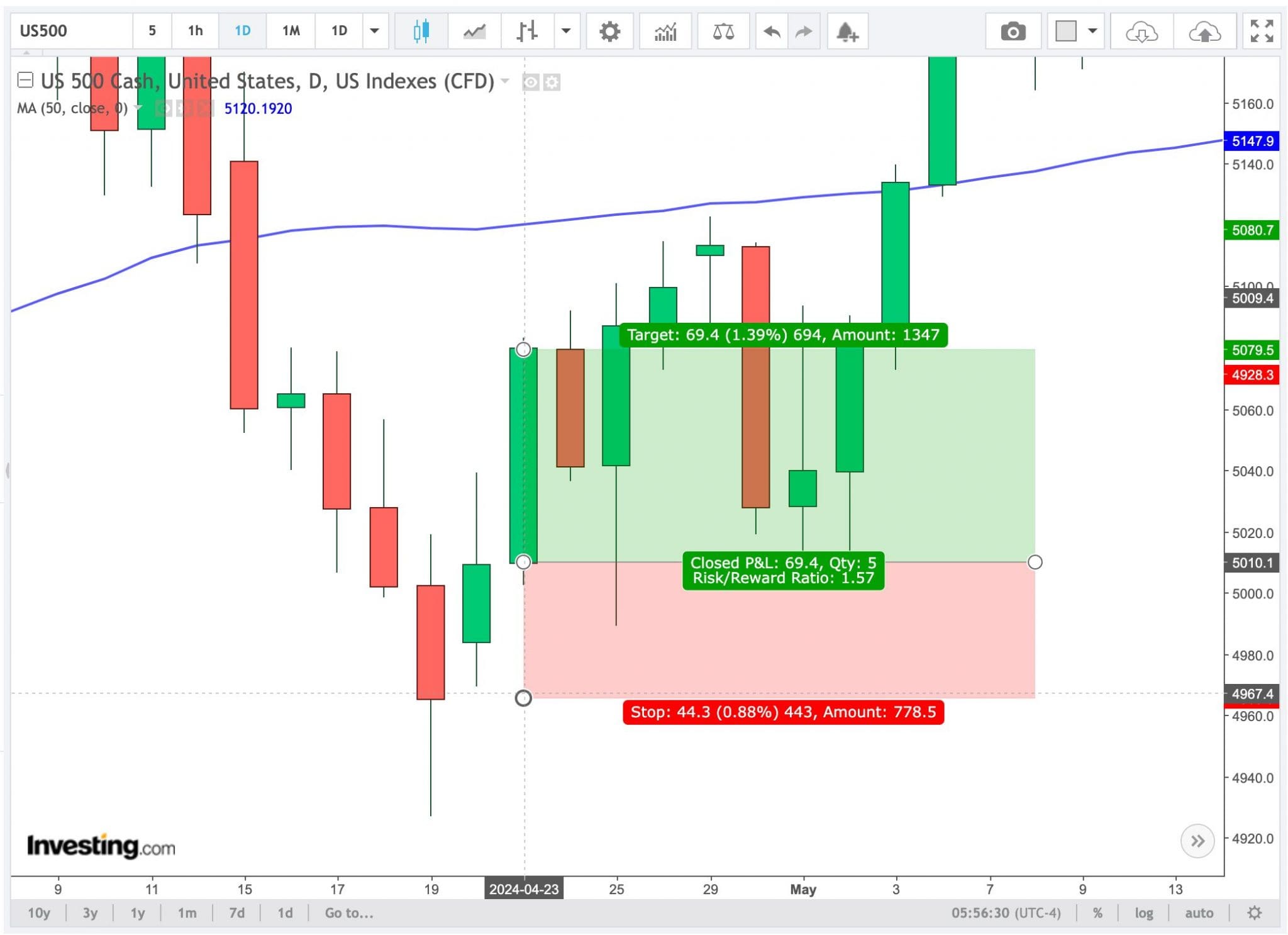
Once the trading session following the sharp decline in the price of gold opened, I entered a long position at 5,010. As expected, the index began to climb steadily throughout the day, increasing buying volume and further validating my decision.
I didn’t set a target price because I planned to hold the trade open for the entire day and close it manually near the end of the US trading session. I didn’t want to hold the trade overnight due to volatility and overnight fees.
I set a stop near the low of the previous trading day, risking 0.88% to make 1.39%.
Noticing a slight weakening in momentum, I decided to exit my position just before the final hour of the US trading session, securing my profits before any potential pullback could occur.
This trade highlighted the impact that commodity markets, like gold, can have on the broader equity market.
I capitalized on the S&P 500’s reaction to movements in the gold market, demonstrating the interconnectedness of global financial markets.
Christian HarrisAuthorHow Much Money Do You Actually Need to Day Trade in the US?
Under the old FINRA rules, there was a $25,000 minimum equity requirement for unrestricted margin day trading.
If you fell below that amount while your broker still applies the legacy framework, you may have been restricted from making new day trades – i.e., to “closing-only” trades until the account balance is brought back up above the $25,000 level.
If you’re starting with smaller amounts, it’s important to have realistic expectations.
With under $5,000, frequent intraday stock trading may be limited until your broker has implemented the new intraday margin framework, unless you use a cash account or trade products that are not subject to the PDT rule.
Under the legacy framework, pattern day traders typically receive up to 4:1 intraday buying power. So, a $25,000 account may control up to $100,000 during market hours.
After regular market hours, buying power has typically dropped to 2:1 leverage. So, a $25,000 account could control up to $50,000 in positions overnight.
Brokers have historically monitored PDT compliance automatically, and traders don’t always get warnings before being flagged. Under the new framework, brokers will instead monitor intraday margin deficits based on market exposure.
Smaller accounts tend to struggle because transaction costs, bid-ask spreads, and slippage take up a larger percentage of capital.
Cash Account vs. Margin Account for US Day Traders
A cash account allows you to trade with settled funds only. The proceeds from stock sales generally settle on a T+1 basis, or one business day after the trade date.
Using unsettled funds can lead to restrictions, in what is commonly called a good faith violation.
Margin accounts allow you to borrow from your broker to increase buying power. Under the older PDT framework, this has typically been 4:1 for pattern day traders, and margin interest charges apply if held overnight using borrowed funds.
Many beginners benefit from a US trading account that is in cash to reduce risks associated with leverage.
Realistic Win Rates and Risk of Loss
Most retail day traders lose money over time, as a result of market competition, costs, and emotional decision-making.
Many traders conceptualize profitability as a matter expectancy – i.e., a combination of win rate and the reward-to-risk ratio.
Even if a trader wins only 50% of the time, if wins are larger than losses, the trader can expect to win over time.
Transaction cost go beyond commissions. Spreads are a major transaction cost and reduce profitability in short-term day trading strategies.
Overtrading means increasing exposure to noise than basing trading decisions on clear signals that have logically shown to be profitable over time – to go along with quality risk management, such as limited position sizes and stop-losses that predefined downside.
Emotional trading decisions, like revenge trading, generally damage long-term performance and often permanently impair capital.
Best Markets for Beginning Day Traders (Ranked by Accessibility)
Large-cap US stocks provide strong liquidity and tighter bid-ask spread, which can reduce execution risk and transaction costs.
ETFs that track major indices can diversify compare to individual stocks (e.g., SPY, QQQ, IWM).
Options can provide leverage. But the spreads are higher and comes with a nonlinear payoff profile with unique nuances that can take time to understand.
Micro futures contracts are a possibility for those with smaller account sizes, as they allow smaller position sizes than standard futures contracts. These require understanding the specific nuances, as they embed leverage via the roll costs and the small capital outlay relative to the amount of exposure they give means basic moves can wildly swing the account equity.
US-regulated forex gives access to major currency pairs, but comes with leverage caps.
CFDs aren’t permitted for US retail traders.
Risk management and realistic expectations are ultimately what’s most important.
| Rank | Market | Accessibility for Beginners | Why |
|---|---|---|---|
| 1 | Large-Cap US Stocks | Very High | Strong liquidity, tight bid-ask spreads, transparent pricing, and wide availability across brokers. Execution risk and slippage are generally lower than in smaller stocks. |
| 2 | Broad Market ETFs (e.g., SPY, QQQ, IWM) | High | Provide diversification compared to single stocks, trade like equities, and typically have high volume and tight spreads. These are suitable for beginners who want exposure to major indices and want to limit single-stock risk. |
| 3 | Micro Futures Contracts | Moderate | Smaller contract sizes than standard futures reduce capital requirements. Leverage is embedded, and futures markets move quickly. These require solid risk control. |
| 4 | US-Regulated Forex | Moderate to Low | Access to major currency pairs with deep liquidity. Leverage increases risk. Regulatory leverage caps apply. |
| 5 | Options | Low | Offer leverage and flexibility. But spreads are wider and payoff structures are nonlinear. Requires understanding volatility, time decay, and contract specifications. |
| — | CFDs | Not Available | Retail CFD trading isn’t permitted for US residents, per domestic regulation. |
Day Trading vs. Swing Trading in the US
Day trading in the truest sense involves closing all positions before market close to avoid overnight risk.
Swing trading involves holding positions for days or weeks to give more time for trades to develop and take advantage of longer-term premia or setups. Overnight news and earnings releases off-hours can impact swing positions.
The legacy PDT rules affected intraday trading in margin accounts. They don’t affect swing trading frequency.
Swing trading requires less screen time than day trading and can be less time-demanding during the trading day.
Day trading and certain styles of day trading, like scalping, accumulate transaction costs faster due to higher trade frequency.
How US Trading Regulations Differ From Other Countries
Notably, retail CFD trading is prohibited in the United States.
US leverage limits also tend to be lower than those in offshore jurisdictions.
The legacy PDT rule applied to US equity margin accounts but not others, and is being replaced by intraday margin requirements.
Depending on the product offered, brokers must register with the SEC, FINRA, CFTC, and/or NFA.
Reporting requirements and settlement cycles are strictly enforced.
Risk disclosures are standardized.
Offshore brokers that offer higher leverage may not provide US regulatory protections.
Common Beginner Mistakes in Day Trading
Many beginners start with insufficient capital relative to strategy.
Ignoring legacy PDT rules or your broker’s new intraday margin requirements is a common way to become restricted unexpectedly.
Leveraging up without understanding downside risk is an easy way to create unnecessary drawdowns.
Strategies should be assessed after all fees, costs, and taxes.
Trading illiquid instruments with wide spreads is difficult for a day trader due to the shorter duration of the trades.
Position sizing rules and predefining your downside are commonly not used by beginners. Trying to make back losses by increasing position sizes generally compounds the problem.
Be wary of the financial and trading advice you receive. Market are probabilistic, not deterministic. Be careful with guaranteeing certain returns or making overly sure claims.
New traders often trade without a documented plan or performance review process.
Psychological biases
Psychological biases are another major source of losses. Everyone, even professional traders, fall prey to the downsides of our own cognitive machinery. The difference with professional traders is that they’ve learned from prior lessons, are more self-aware of their own psychology, and have systems in place to protect themselves.
Many traders overestimate their skill after a few early wins. This is a form of overconfidence bias that can lead to oversizing positions and relaxing discipline. Markets can seem easy on the good days, but with enough experience they realize that it’s not an easy game.
Loss aversion involves traders holding onto losing positions longer than planned. The idea is that they’ll return to breakeven rather than accepting a small, controlled loss.
Some things are sunk costs. Sticking with a bad decision because you have already invested time, money, or emotion into it doesn’t necessarily mean you should continue. We all make bad trades and mistakes and cutting bait is better than holding on if our thesis was invalidated or we have better opportunities.
Recency bias leads traders to assume that what just happened will continue. This can cause them to chase momentum without evaluating broader context.
Confirmation bias is a popular one and even most professional traders concede they still fall victim to it. It encourages traders to look for information that supports what they already think while ignoring data that contradicts it.
The fear of missing out can push beginners to enter trades after a rally, often near short-term highs, at the point at which risk-reward deteriorates.
Revenge trading after a loss shifts traders from process to negative emotion. It has the effect of increasing trade frequency and reducing selectivity.
Anchoring bias may cause traders to fixate on a specific price for an asset, which can distort decision-making. Successful trading requires a) recognizing these cognitive tendencies and b) building structured rules that limit their influence.
For example, having written plans, predefined risk limits, and consistent post-trade reviews can help reduce the impact of emotional decision-making.
| Bias | What It Looks Like in Trading | Why It’s Dangerous |
|---|---|---|
| Overconfidence Bias | Overestimating skill. | Leads to oversized trades, relaxed discipline, and large drawdowns when markets shift. |
| Loss Aversion | Holding losing positions longer than planned to avoid realizing a loss. | Small losses turn into larger ones. Tends to damage the overall risk-reward structure. Also commonly leads to holding positions for reasons outside of what you originally held them for. |
| Sunk Cost Fallacy | Continuing a bad trade because time, money, or emotion has already been invested. | Prevents objective reassessment; keeps capital tied up in low-probability ideas instead of better opportunities. |
| Recency Bias | Assuming recent market behavior will continue indefinitely. | Encourages momentum chasing without broader or historical analysis. |
| Confirmation Bias | Looking for information that supports an existing view while ignoring contradictory data. | Reinforces flawed trade theses and reduces adaptability. |
| Fear of Missing Out (FOMO) | Entering trades after sharp rallies out of fear of being left behind. | Often results in poor risk-reward entries near short-term highs. |
| Revenge Trading | Increasing trade frequency after a loss to quickly recover capital. | Shifts focus from process to emotion, increasing impulsive decisions and further losses. |
| Anchoring Bias | Fixating on a specific price level (entry, target, or past high). | Distorts judgment and prevents objective evaluation of current market conditions. |
Bottom Line
Day trading in the US is legal but highly regulated, overseen by the SEC and FINRA.
Rules like PDT have historically required a minimum account balance of $25,000 for frequent margin day traders, but this framework is being replaced by intraday margin requirements. Short-term traders in the US often use margin accounts, so they face stricter requirements due to the risks involved.
Profits from day trading are typically taxed as short-term capital gains at ordinary income rates. However, you may benefit from additional tax deductions if you qualify for TTS.
Despite its profit potential, active trading in the United States demands a deep understanding of financial markets, quick decision-making, disciplined risk management, and strict compliance with the latest regulations. Also be aware you could lose all the money you invest.
To get started, see DayTrading.com’s selection of the best US brokers for day trading.
Article Sources
- Financial Industry Regulatory Authority (FINRA)
- Securities and Exchange Commission (SEC)
- US Equities Market Volume Summary - Cboe
- US GDP - International Monetary Fund
- Chicago Board Options Exchange (CBOE)
- New York Stock Exchange (NYSE)
- NASDAQ
- Internal Revenue Service (IRS)
- Pattern Day Trader - FINRA
- World Gold Council
- List of Countries by Stock Market Capitalization - Wikipedia
- Regulation T (Reg T) - Investopedia
- US Taxes on Personal Income - PWC
- Trader Tax Status (TTS) - Forbes
The writing and editorial team at DayTrading.com use credible sources to support their work. These include government agencies, white papers, research institutes, and engagement with industry professionals. Content is written free from bias and is fact-checked where appropriate. Learn more about why you can trust DayTrading.com