





The USD/CHF currency pair, also known as ‘Swissy’, is popular in the forex space despite coming with certain challenges. This page will break down the history of the USD/CHF relationship, including its benefits and risks. We also look at how to start trading the USD/CHF in 2026, by capitalising on volume and volatility with charts, strategy, signals and trading hours.
USD/CHF Trading Brokers
-
- Demo account
- Min. deposit: $0
- Min. trade: $1

Learn how we test brokers and why you can trust our ratings.
Chart
Breaking Down ‘USD/CHF’
Firstly, what does USD/CHF mean? The exchange rate you see is simply how many Swiss francs (the quote currency) it will cost to buy one US dollar (the base currency).
USD/CHF is a widely traded major pair, reflecting the US dollar’s dominant role in FX turnover and the Swiss franc’s position among the more actively traded currencies. The CH stands for ‘Confoederatio Helvetica’. This is Latin for Switzerland. Whilst the F stands for ‘franc’.
But what makes this pairing so interesting?
- The US dollar is the world’s most traded currency. In the 2025 BIS Triennial Survey, the US dollar was on one side of 89% of all FX trades.
- The Swiss franc is closely linked to Switzerland’s role as a global wealth-management hub. Switzerland is widely cited as the world’s leading centre for cross-border private wealth management, with market share commonly estimated at around a quarter in recent years.
It’s also worth bearing in mind that Switzerland is not the only country to use the Swiss franc. Liechtenstein, located between Switzerland and Austria, also uses the Swiss franc as its official currency under a long-standing currency arrangement with Switzerland (population roughly 40,000).
Why Day Trade USD/CHF?
With so many currency pairings available, why does the USD/CHF currency pair deserve your attention?
- Liquidity – USD/CHF is generally liquid with tight spreads during active market sessions, though it can be less liquid than pairs like EUR/USD. Price action is typically driven by interest-rate expectations, macroeconomic data, risk sentiment, and central-bank communication from the Federal Reserve (Fed) and Swiss National Bank (SNB).
- Cross-pair similarities – If you already trade major FX pairs, USD/CHF can be easier to follow because it’s heavily influenced by scheduled data releases and central-bank decisions. That said, each pair has its own volatility profile, so treat any cross-pair ‘similarities’ as hypotheses to test, not rules.
- Diverse trading instruments – Due to volume and volatility, you have several different USD/CHF trading vehicles at your disposal. From ETFs to futures, and options, including E-micro USD/CHF futures.
- Stable price information – Due to the regular and consistent flow of economic data from the US, Switzerland, and Europe, conducting fundamental analysis is comparatively easy.
- Availability of resources – Access to charting, data, and education tools is broader than it used to be (though profitability is never guaranteed). You have access to plenty of chart strategies, market data and research, not to mention forums full of advice from experienced traders.
Drawbacks & Risks
Although the USD/CHF pair comes with a number of benefits, there are also certain drawbacks and risks you should be aware of. The most significant of which are:
- Safe haven dilemma – In times of crisis, the US dollar is the world’s dominant reserve currency, while the Swiss franc is often treated as a safe-haven currency and is held by some central banks in much smaller amounts.
- Dangers of leverage – Leverage and margin trading allow you to borrow capital to increase your position size. Whilst this may boost potential profits, it can also substantially increase losses, as warned in the CFTC/NASAA Investor Alert.
- Volatility – Compared to some currency pairs, including many of the majors, the USD/CHF simply does not promise the same levels of volatility. The result of this is fewer significant spikes and drops, and therefore, fewer opportunities to generate profits.
- Automated competition – Profiting from the USD/CHF today means battling with an increasing number of sophisticated algorithms. Even with monthly charts to hand, live streaming data is being analysed and acted upon almost instantaneously by any number of trading bots.
Influences on Movement
Trading the USD/CHF currency pair relies on a detailed understanding of what influences changes in prices and rates. Unfortunately, candlestick charts cannot give you the context that can often prove invaluable.
So, what affects movement in the USD/CHF exchange rate?
- Monetary policy – The actions of both the Fed and SNB will impact price action. The SNB’s mandate is to ensure price stability while taking due account of economic developments. It can adjust its policy rate and, when needed, use other measures to ensure appropriate monetary conditions, including interventions in the foreign exchange market. So, keep an eye out for the quarterly SNB announcements on interest rates and policy.
- Swiss economic data – Economic strength and weakness cause price movements. So, there are some specific announcements that can cause USD/CHF spikes. These include the Swiss Purchasing Managers’ Index (PMI), the Swiss Consumer Price Index (CPI), plus the KOF Economic Barometer. The KOF Economic Barometer is a composite leading indicator built from a large pool of variables and is designed to track the Swiss business cycle at short horizons.
- US economic data – The strength of the US economy will influence the currency pair. So, there are certain reports to keep track of. Employment data, jobless claims, retail sales growth, plus PMI data can all cause shifts in USD/CHF rates.
- Wars & natural disasters – Events that affect trading partners of either country or that directly impact the two respective countries can all be felt in the USD/CHF currency pair. This highlights the need to keep abreast of live news updates.
USD/CHF Currency Correlations
Currency pairs don’t move independently, and correlations can help with risk management (e.g., avoiding accidental overexposure to the same theme). However, correlations are not fixed and can change materially by regime (risk-on/risk-off, rate differentials, commodity shocks, central-bank divergence).
Instead of assuming a pair is ‘positively’ or ‘negatively’ correlated because USD is the base/quote currency, traders should check rolling correlations over the timeframe they trade (e.g., 30/90 trading days) and treat them as an input, not a rule.
USD/CHF often moves differently from EUR/USD during certain regimes (for example, when the Swiss franc behaves as a haven). But the relationship can weaken or flip depending on interest-rate expectations, euro-area developments, and SNB policy. Always verify with up-to-date rolling correlation data.
Switched-on day traders will use this information to their advantage. Looking at other currency pairs may allow you to make more accurate short-term projections as to the movements of the USD/CHF.
USD/CHF Day Trading Strategy
Timing
One of the things that appeals about forex trading and investing is that forex markets trade 24 hours a day during the week (roughly 24/5). For many retail platforms, trading is typically available from Sunday ~5:00 pm ET to Friday ~5:00 pm ET. Liquidity in USD/CHF tends to be strongest during the European session and the London–New York overlap.
You will find both highs and lows during each 24-hour cycle, but bid-ask spreads will widen during quieter periods, then narrow during active periods. So, when is the best time to trade the USD/CHF pair?
The biggest daily moves often take place when Eurozone and Swiss economic data is released, plus at opening hours for equity, options and futures exchanges. Many Swiss and Eurozone releases land in the early US morning hours, while key US releases often occur in the 08:30–10:00 ET window. Exact times vary by indicator and calendar.
The periods preceding and following these releases can trigger price action. So, many strategies may benefit from focussing their attention on these time periods.
Traders should also note that forex action often drops significantly around the US lunch hour.
Example
If you’re looking for a simple, straightforward USD/CHF day trading strategy, then consider the example below.
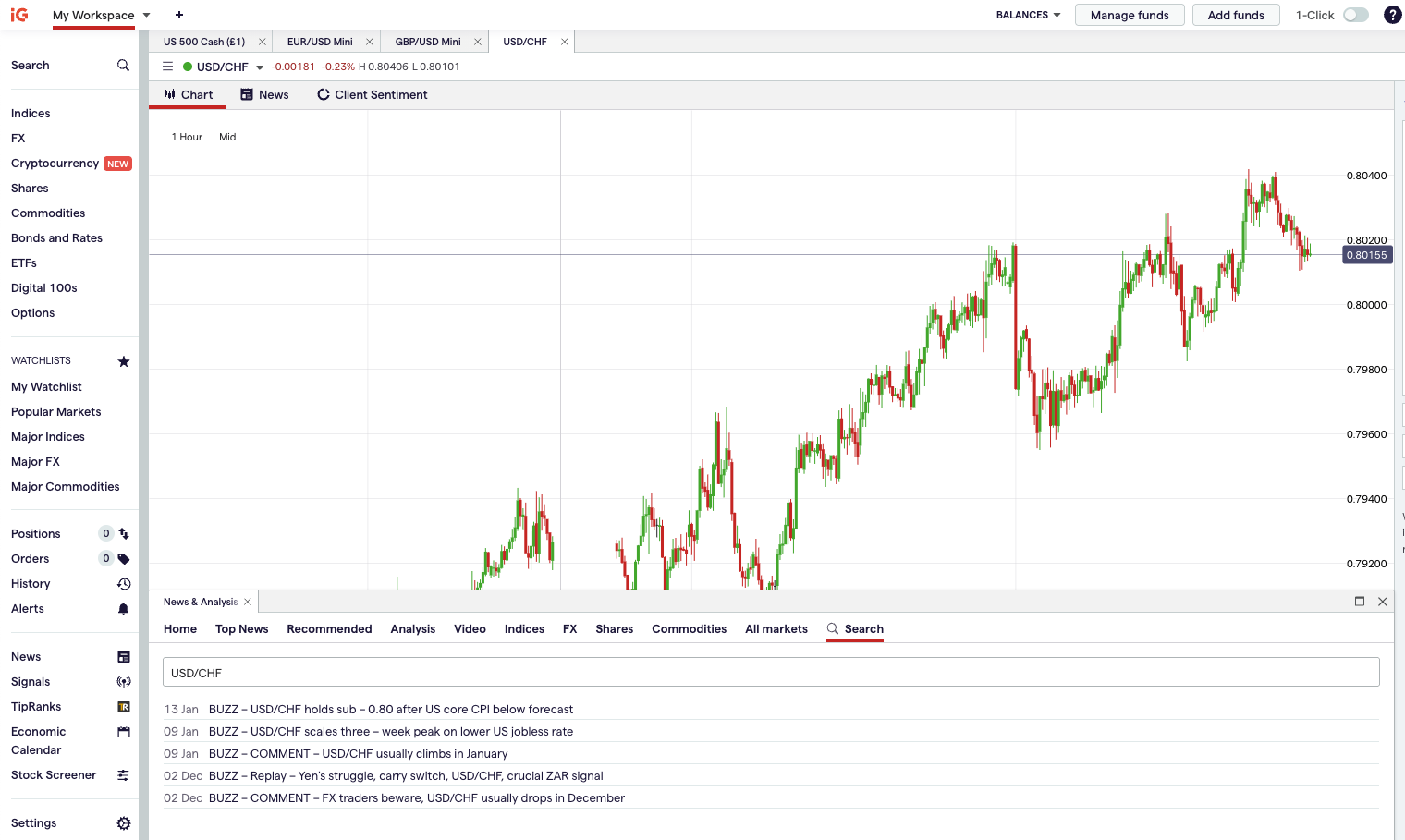
Whilst some traders prefer a 5-minute or 15-minute real-time chart, for this basic strategy, a 1-hour chart is recommended.
You then simply need to mark the high and low of each candle of the trading day. Then your pending order buy should be entered 10 pips above the high. Whilst your pending order sell should be entered 10 pips below the low.
You will also need to minimise your risk and protect against substantial losses. So, place a stop-loss 30 pips from your buy/sell order.
This is a simplified illustration. Test it in a demo account and backtest across different market conditions before risking capital. If you are looking for more detailed strategies, take a look at our strategy page.
News
Some people prefer day trading the USD/CHF currency pair using historical price charts and complex data. Whereas some focus on trading breaking news. News updates can quickly influence market sentiment.
However, to profit from these announcements, you need to be tuned in and ready to react at a moment’s notice. Plus, you need access to reliable and thorough sources.
Below you will find some of the most popular and relevant news resources:
- Google Finance
- Yahoo Finance
- Forex factory
- Bloomberg
- Reuters
- CNBC
On top of breaking news announcements, these sources can also provide several other useful services:
- Forecasts for this coming week
- Exchange forecasts and daily analysis
- USD/CHF specific trading definitions
- Price history reviews and yearly averages
- Alternative trend views and perspectives
- Long-term data, from 20 years to 30 years worth of charts
- Technical outlook and latest analysis from experienced traders
So, if day trading on the USD/CHF using the news is part of your plan, all of the above are resources worth exploring.
History
Early History
Since the Swiss franc was introduced in 1850, it has developed a reputation as a stable currency, and USD/CHF (Swissy) is now a widely traded major pair.
The US and Switzerland also have deep investment links. For example, the US foreign direct investment position in Switzerland has been reported in the hundreds of billions of dollars in recent years (definitions and values vary by source and year).
These trade and investment connections shaped much of the USD/CHF relationship for many years. Today, however, current prices and forex live charts respond to more current events.
Recent History
Modern USD/CHF dynamics have been heavily influenced by Swiss National Bank (SNB) policy, especially during periods of intense safe-haven demand for CHF.
A key episode occurred on 15 January 2015, when the SNB discontinued the minimum exchange rate of CHF 1.20 per euro (the ‘EUR/CHF floor’ introduced in 2011). The franc appreciated sharply immediately after the announcement, with intraday moves on the order of 25–30% reported in chaotic early trading.
It is clear then that the SNB plays a vital role in Switzerland’s monetary conditions and can materially affect CHF exchange rates.
Role of the US Dollar
Whether your day trading strategy relies on support and resistance levels, daily pivot points, or breaking news, having a feel for the staggering role the US dollar plays will help you anticipate future price movement.
Below are some of the key roles the US dollar plays:
- Some countries adopt the US dollar instead of their own or peg their own currency to its value.
- The US is consistently among the world’s largest trading nations by total trade value.
- Oil transactions by OPEC countries are often quoted in US dollars.
- Central banks around the world hold a large share of their reported foreign exchange reserves in US dollars.
- The US accounts for roughly a quarter of global GDP in nominal terms (the exact share varies by year and methodology).
- The US dollar is the most popular traded currency in FX markets, on one side of 89% of all FX trades in 2025.
- It is commonly used to settle international transactions.
Just a brief look at a long-term USD/CHF chart will show you how prices and average daily ranges shift when announcements are made about the US dollar.
To understand whether the US dollar will strengthen or weaken against the Swiss franc then, you will need to consider a number of important economic indicators.
The most important of which are as follows:
- Consumer Price Index (CPI)
- Producer Price Index (PPI)
- ISM Non-manufacturing
- Federal Reserve Minutes
- Industrial Production
- ISM Manufacturing
- Non-farm payrolls
- Trade Balance
- Retail Sales
So, USD/CHF technical analysis and forecasts for today should take note of important data releases in the economic calendar.
The Federal Open Market Committee (FOMC) holds eight scheduled meetings per year. The Federal Reserve releases meeting minutes about three weeks after each scheduled decision, and it publishes the Summary of Economic Projections (SEP) four times a year. All will result in the US dollar moving sharply against other currencies, including the Swiss franc.
Role of the Swiss Franc
Getting to grips with USD/CHF day trading means understanding what drives the Swiss economy and the franc. Switzerland is known for its long-standing policy of armed neutrality, which has helped support perceptions of stability in the currency. It is also surrounded by the Alps and considered a stable, isolated nation. This has resulted in the Swiss franc becoming a safe-haven currency when turmoil strikes.
This reputation is bolstered by their role in private banking. Despite rules loosening somewhat in the last ten years, Switzerland remains a huge global player in the private banking, insurance, and investment management sectors. Following the 2023 acquisition of Credit Suisse by UBS, the sector is more consolidated than in the past.
However, focussing on economic activity in the Eurozone, which influences US movements, is perhaps more useful. The EU is Switzerland’s most important trading partner: 51% of Switzerland’s exports go to the EU, and 70% of its imports come from the EU, as of 2024.
This means the SNB is often more concerned with its currency vs the euro than the US dollar. It usually only steps in if the franc is too weak or strong vs the euro. Why? Because this will benefit Swiss export businesses, which are mainly involved in trading with neighbouring countries.
To a certain extent, then, the role of the Swiss franc and the size of the economy are determined by the successes of their major exporting industries. You will know of two of their big exporting industries, watches and pharmaceuticals.
Overall, your daily forex analysis will be influenced by the huge role the Swiss franc plays as a stable, safe-haven currency. Not to mention the support of the formidable banking system it has behind it.
Final Word on USD/CHF Trading
USD/CHF can offer periods of strong liquidity and clear macro-driven moves, but trading outcomes vary and losses are common, especially when using leverage. However, generating profits can prove challenging as the Swiss franc is seen as a safe-haven currency.
You will need to use in-depth technical analysis, calling on charts, patterns, the latest foreign exchange news, plus a range of economic resources and indicators. It is also important that you find the best forex trading platform for your needs, which will facilitate fast and cost-effective trading.
For more guidance, see our forex page.
FAQ
What Is USD/CHF?
USD/CHF is one of the most popular traded currency pairs in the forex market, also known as the ‘Swissy’. The pair represents the exchange rate of how many Swiss francs (quote currency) it will cost to buy one US dollar (base currency).
Why Is Trading The USD/CHF So Popular?
USD/CHF is followed because it links the world’s most traded currency (USD) with a currency often treated as a safe haven (CHF). It can react strongly to Fed and SNB policy expectations, inflation and jobs data, and shifts in risk sentiment.
What Are The Benefits Of Trading USD/CHF?
USD/CHF is less volatile than other pairs and also relatively liquid. Due to its stability, it is also fairly easy to apply technical and fundamental analysis when trading the currency pair. Traders can also enjoy a range of trading vehicles, such as futures, options and ETFs.
What Are The Risks Of Trading USD/CHF?
Due to less volatility than other pairs, traders may not have as many opportunities to profit from price swings. In addition, using leverage and margin when trading can carry some substantial risks.
How Can I Start Trading USD/CHF?
To start trading USD/CHF, you will need to register at an online broker. This will allow you to make a deposit and use the available trading platforms, such as MetaTrader 4. If you’re new to trading, it’s advised to start practising in a demo account first, which is usually offered for free.