
Best Dow Jones Brokers 2026



The Dow Jones was founded in 1882 by Charles Dow, Edward Jones and Charles Bergstresser. Over the next century, the company grew into one of the biggest players in the financial and business news industry. The firm has also created various market averages, the most famous of these being the Dow Jones Industrial Average (DJIA). This guide ranks the best brokers with access to the Dow Jones in 2026 based on our hands-on tests. We explain what to consider when comparing providers, walk through a step-by-step guide to placing a Dow trade, and answer the most common questions.
Best Brokers With Access To The Dow Jones
After reviewing and testing brokers, these are our top picks for trading Dow Jones-linked markets:
-
1
 eToro USAeToro USA LLC and eToro USA Securities Inc.; Investing involves risk, including loss of principal; Not a recommendation
 -
2
 FOREX.com
What Makes These The Best Dow Jones Brokers?
Here is a short overview of each broker's pros and cons
- eToro USA is the best broker with access to the Dow Jones in 2026 - eToro is a social investing platform that offers short-term and long-term trading on stocks, ETFs, options and crypto. The broker is well-known for its user-friendly community-centred platform and competitive fees. With FINRA and SIPC oversight and millions of users across the world, eToro is still one of the most respected brands in the industry. eToro securities trading is offered by eToro USA Securities, Inc.
- FOREX.com - Founded in 2001, FOREX.com is now part of StoneX, a financial services organization serving over one million customers worldwide. Regulated in the US, UK, EU, Australia and beyond, the broker offers thousands of markets, not just forex, and provides excellent pricing on cutting-edge platforms.
How Secure Are The Best Dow Jones Brokers?
We examined the protections, safeguards and oversight in place at these brokers:
| Broker | Trust Rating | Guaranteed Stop Loss | Negative Balance Protection | Segregated Accounts |
|---|---|---|---|---|
| eToro USA | ✘ | ✘ | ✔ | |
| FOREX.com | ✘ | ✘ | ✔ |
Are The Best Dow Jones Brokers Suitable For New Traders?
We looked at how easy these brokers are to use for traders getting started with Dow Jones markets:
| Broker | Demo Account | Minimum Deposit | Minimum Trade | Education Rating | Support Rating |
|---|---|---|---|---|---|
| eToro USA | ✔ | $50 | $10 | ||
| FOREX.com | ✔ | $100 | 0.01 Lots |
Do The Top Dow Jones Brokers Suit Active Traders?
Active traders often need strong platforms, fast execution and advanced tools for Dow Jones markets - here’s how the top providers compare:
| Broker | Automated Trading | VPS | AI | Pro Account | Leverage | Low Latency | Extended Hours |
|---|---|---|---|---|---|---|---|
| eToro USA | ✘ | ✘ | ✔ | ✘ | - | ✔ | ✔ |
| FOREX.com | Expert Advisors (EAs) on MetaTrader | ✔ | ✔ | ✘ | 1:50 | ✔ | ✘ |
Detailed Ratings For The Leading Dow Jones Brokers
Compare how the top Dow Jones brokers performed across our core assessment areas:
| Broker | Trust | Platforms | Assets | Mobile | Fees | Accounts | Research | Education | Support |
|---|---|---|---|---|---|---|---|---|---|
| eToro USA | |||||||||
| FOREX.com |
Community Sentiment
See how users rate these brokers based on the average customer ratings submitted on DayTrading.com, plus ratings from Trustpilot, the Apple App Store and Google Play.
| Broker | Our Users' Rating | Trustpilot Score | Trustpilot Reviews | iOS App Rating | Android App Rating |
|---|---|---|---|---|---|
| eToro USA | 32078 | ||||
| FOREX.com | 2496 |
Which Dow Jones Trading Platforms Are The Most Popular?
We reviewed client numbers across our highest-rated providers:
Why Trade The Dow Jones With eToro USA?
"eToro remains a top pick for traders looking for leading social investing and copy trading services. With a low deposit, zero commissions and an intuitive platform, the broker will meet the needs of newer day traders."
Jemma Grist, Reviewer
eToro USA Quick Facts
| Demo Account | Yes |
|---|---|
| Instruments | Stocks, Options, ETFs, Crypto |
| Regulator | SEC, FINRA |
| Platforms | eToro Trading Platform & CopyTrader |
| Minimum Deposit | $50 |
| Minimum Trade | $10 |
| Account Currencies | USD |
Stock Exchanges
eToro USA offers trading on 3 stock exchanges:
- Dow Jones
- New York Stock Exchange
- S&P 500
Pros
- The broker's Academy offers comprehensive learning materials for beginners to advanced-level investors
- eToro USA Securities is a trustworthy, SEC-regulated broker that is a member of FINRA and SIPC
- A free demo account means new users and prospective day traders can try the broker risk-free
Cons
- There's no MetaTrader 4 platform integration for traders who are accustomed to using third-party charting tools
- Average fees may cut into the profit margins of active traders
- There's a narrower range of day trading instruments available compared to competitors, with only stocks, ETFs, options, and cryptos
Why Trade The Dow Jones With FOREX.com?
"FOREX.com remains a best-in-class brokerage for active forex traders of all experience levels, with over 80 currency pairs, tight spreads from 0.0 pips and low commissions. The powerful charting platforms collectively offer over 100 technical indicators, as well as extensive research tools."
Christian Harris, Reviewer
FOREX.com Quick Facts
| Demo Account | Yes |
|---|---|
| Instruments | Forex, Futures and Options on Metals, Energies, Commodities, Indices, Bonds |
| Regulator | NFA, CFTC |
| Platforms | WebTrader, Mobile, MT4, MT5, TradingView |
| Minimum Deposit | $100 |
| Minimum Trade | 0.01 Lots |
| Account Currencies | USD, EUR, GBP, CAD, AUD, JPY, CHF, PLN |
Stock Exchanges
FOREX.com offers trading on 14 stock exchanges:
- Australian Securities Exchange (ASX)
- Borsa Italiana
- CAC 40 Index France
- DAX GER 40 Index
- Dow Jones
- Euronext
- FTSE UK Index
- Hang Seng
- Hong Kong Stock Exchange
- IBEX 35
- Japan Exchange Group
- Nasdaq
- S&P 500
- SIX Swiss Exchange
Pros
- The in-house Web Trader continues to stand out as one of the best-designed platforms for aspiring day traders with a slick design and over 80 technical indicators for market analysis.
- There’s a wealth of educational resources including tutorials, webinars, and a stacked YouTube channel to help you get educated in the financial markets.
- With over 20 years of experience, excellent regulatory oversight, and multiple accolades including runner-up in our 'Best Forex Broker' awards, FOREX.com boasts a global reputation as a trusted brokerage.
Cons
- The group being FOREX.com, GAIN Capital Group LLC, had to pay a $700k fine to NFA for improperly handling some client accounts.
- Demo accounts are frustratingly time-limited to 90 days, which doesn’t give you enough time to test day trading strategies effectively.
- FOREX.com's MT4 platform offers approximately 600 instruments, significantly fewer than the over 5,500 available on its non-MetaTrader platforms.
How We Chose The Best Brokers With Access To The Dow Jones
To find the best trading brokers for accessing Dow Jones markets, we:
- Checked which brokers in our database support Dow Jones-linked instruments. This involved opening accounts with brokers, reviewing their product lists, and, where possible, logging into their trading platforms to confirm access to Dow Jones indices, ETFs, futures, options or other related markets.
- Scored Dow Jones brokers using our overall ratings framework. Our ratings draw on more than 200 data points, covering the breadth of Dow Jones products, pricing, regulation, platform usability, execution quality, research tools and account features, as well as the views of our expert reviewers after spending hours testing each provider.
How To Compare Dow Jones Brokers
Consider the following features when choosing between online brokers that support Dow Jones trading:
Platforms & Add-Ons
Execution speed generally matters slightly less for the Dow than for the Nasdaq‘s volatile tech names, but it still matters. The DJIA is price-weighted, so a handful of high-priced components drive most of the index’s daily movement. When these stocks gap on earnings or macro news, slippage on retail-routed orders can erase a quality trade before it starts.
Direct Market Access (DMA) brokers route your order straight to an exchange or ECN. Retail-routed brokers sell your order flow to wholesalers like Citadel or Virtu, who fill you at or near the National Best Bid and Offer (NBBO) and the spread becomes their profit. For buy-and-hold traders the difference is negligible. For active Dow traders working tight intraday ranges, it can mean a tick or two per trade.
The best platforms offered by Dow Jones brokers is, of course, a matter of personal preference. However, having the choice between third-party terminals or proprietary tools is worth looking out for.
In-built indicators such as the relative strength index (RSI), moving average convergence divergence (MACD) or stochastic oscillator may be useful when identifying patterns in the Dow Jones index.
The MetaTrader 4 platform, for example, offer 30+ integrated technical indicators without the need for separate downloads. Being able to simply plot these onto graphs and charts within one interface will be advantageous when speculating on the Dow Jones.
Availability Of Dow-Specific Instruments
This a prominent global index and so Dow Jones brokers may offer a range of trading products.
The simplest and often most cost-effective way to trade the Dow Jones is via an exchange-traded fund (ETF) or index-linked fund. Trading these funds requires a smaller initial cash outlay whilst still providing a performance that mirrors that of the Dow Jones.
The SPDR Dow Jones Industrial Average ETF (DIA) is the most liquid option, with tight spreads and deep order books throughout the US session. Leveraged alternatives include ProShares UltraPro Dow30 (UDOW) and its inverse counterpart SDOW, both of which target three times the daily DJIA move. Because of tracking error from the daily resets, these leveraged products are for day traders (trading within the day), not for buy-and-hold.
Alternatively, look out for Dow Jones brokers that also offer individual stocks. You should be able to trade shares of the 30 companies included in the Dow Jones.
Fractional share capability also matters here, as some Dow components trade at hundreds per share. Being able to buy partial shares lowers the barrier for traders looking to build positions.
For futures traders, the CME Group offers the E-mini Dow ($5) contract (YM) and the Micro E-mini Dow (MYM) at one-tenth the size. This helps makes more meaningful Dow positions accessible to smaller accounts.
Extended Hours Trading
Roughly 11.5% of all US equities activity now occurs outside the 9:30-16:00 ET core session, according to NYSE data. That share keeps climbing as extended hours trading keeps expanding, both due to increased retail access and more institutional trading occurring off hours. This can help trade earnings releases and macro news. Pre-market (04:00-09:30 ET) and after-hours (16:00-20:00 ET) sessions on the DIA ETF and individual Dow stocks let active traders position around gaps before the broader retail flow arrives.
Not every broker offers the full extended session. Also, traders should expect wider spreads and thinner liquidity outside regular hours. For this reason, limit orders are strongly preferred (if not required) over market orders in these sessions. Even then, transaction costs may be notably higher.
Level II Data & Depth-Of-Book
Level I quotes show the best bid and offer, which is standard.
Level II shows the full order book – every bid and offer stacked at each price level. For active Dow traders, Level II shows you where large buyers and sellers are sitting (depth-of-market (DOM) ladders), which can help time entries and place stops outside obvious liquidity pools. Of course, Level II data is dynamic and this information changes quickly.
Not all brokers include Level II by default. Some charge a separate market data subscription (typically $10-$25 per month for Nasdaq TotalView or NYSE OpenBook).
Regulation
The best Dow Jones brokers will be regulated by top-tier financial authorities, notably ‘green tier’ bodies in our regulator directory. Regulated brokers are considered the most secure option and will provide capital protection and safeguarding initiatives for all retail traders.
Many Dow Jones brokers are registered with the US Securities and Exchange Commission (SEC) and FINRA for equities, or with the CFTC and NFA for futures. Examples include Interactive Brokers. Check whether your online broker is a member via the official website.
Fees & Commissions
Commissions and spreads can make a big difference to your overall profit.
As well as direct fees, Dow Jones brokers with low non-trading costs such as deposit and withdrawal charges, inactivity fees, and account maintenance costs should rank highly. Additionally, if you are trading with Dow Jones brokers that only permit account denominations in USD, you may be liable for currency conversion fees.
News & Research
Access to live data and the latest company news is important for all index trading. However, the association of the Dow Jones group with well-regarded publications is a significant advantage. Dow Jones brokers that provide retail clients with free access to Dow Jones Newswires should be a key consideration.
The company publishes daily news items, including exclusive content from The Wall Street Journal, Barron’s, and MarketWatch covering all asset classes and markets worldwide. Having this information directly available via your broker’s platform will save time and hassle.
Interactive Brokers, for example, integrates Dow Jones stock market insights and financial analysis into its service offering.
Dow Jones – Headlines
- The Dow Jones Industrial Average (DJIA) tracks 30 blue-chip US companies. It has the unique feature of being price-weighted, so higher-per-share-priced stocks carry more influence. This is different from standard market cap-weighted indices like the S&P 500.
- Dow vs. S&P 500 vs. Nasdaq
- Dow contains 30 names, industrial-leaning but now diversified and contains what are considered to be leading companies representative of the broader economy (US-focused).
- The S&P 500 became the US’s standing equity benchmark during the 1970s and 1980s. Has a more balanced risk/reward profile.
- The Nasdaq is tech-focused, and the most sensitive to interest rates and innovation cycles.
- The easiest way to trade the Dow is via the SPDR Dow Jones Industrial Average ETF (DIA), futures contracts (YM E-mini Dow or MYM micro E-mini Dow), or CFDs if available in your jurisdiction.
- Execution speed, Level II data, and extended-hours access are features that commonly matter most for active Dow traders, especially around earnings releases from heavyweight components.
- Practicing on a demo account before going live is the fastest way to test a broker’s order routing on instruments like DIA and Dow futures without risking real money.
- A trading journal can help with reviewing how your Dow trades perform.
- Charting platforms like TradingView are an easy way to track DJIA components and plot any indicators.
- Find out why the Dow Jones isn’t all it seems and can be misleading.
How To Place A Trade On The Dow Jones
Placing a trade on the Dow is straightforward once you understand the steps. The workflow below applies whether you’re on one broker or another.
Step 1: Open and Fund Your Account
I have an account with one of the brokers from the toplist relevant to my country (the US) above (Interactive Brokers). The registration process is relatively quick. Most brokers will ask for basic personal information and identity verification before you can fund a live account. If you’re just looking to test and try out a broker at first, a demo account can be funded with simulated capital and lets you practice without risking real money.
Step 2: Search For A Dow Ticker
Inside the platform, I can search for a ticker. Let’s look at Nvidia, one of the Dow’s 30 components. It normally has a bid-ask spread of just $0.01 during regular hours during normal market activity.
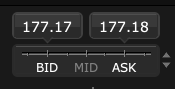
The ticker appears along with a price chart, bid-ask spread, and basic company information.
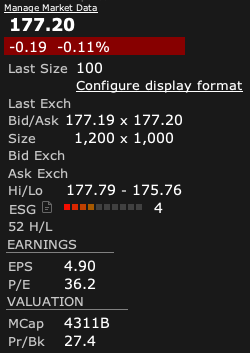
In our testing, searching for the major Dow instruments was fast and responsive. I also searched for several of the other Dow components to compare.
The spread on GS, as an example, was also tight (typically one cent during core hours), which reflects the institutional volume. This is typical for the largest Dow names, but lower-volume Dow components can still show slightly wider spreads outside the busiest hours of the session.
Step 3: Analyze The Spread
For DIA, the most popular Dow ETF, the bid-ask spread was tight at just one cent. The ETF’s massive daily trading volume and is comparable to S&P 500 ETFs like SPY and VOO.
It will nonetheless widen out after market hours.
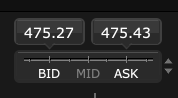
For individual Dow components, the spread can vary. Heavyweight names like Goldman Sachs, Microsoft, and UnitedHealth generally offer the tightest spreads during normal market hours during non-news digestion and other non-volatility-inducing events. Smaller-weighted Dow components can widen out a touch, especially times around the open and close.
If you’re trading individual Dow stocks rather than the DIA ETF, account for the wider spread as an additional cost every time you get in and out of the trade. And the larger the trade, the bigger the cost – not only because you’re moving more shares but because you’re soaking up more inventory.
Step 4: Select Your Order Type
I placed a limit order rather than a market order. (Note: I rarely use any type of market order to better control the price).
On the Dow, where heavyweight components (based on their per-share price) like Goldman Sachs can move the index hundreds of points on a single earnings release, a limit order protects you from getting filled at a price worse than expected. The platform displayed the various order options: market order, limit order, and more.
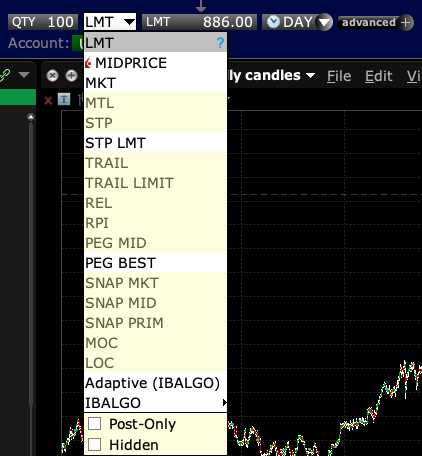
For reference on what these mean:
- LMT: Limit
- MIDPRICE: Midpoint (between bid and ask)
- MKT: Market
- MTL: Market-to-Limit
- STP: Stop
- STP LMT: Stop Limit
- TRAIL: Trailing Stop
- TRAIL LIMIT: Trailing Stop Limit
- REL: Relative
- RPI: Retail Price Improvement
- PEG MID: Pegged to Midpoint
- PEG BEST: Pegged to Best Price
- SNAP MKT: Snapshot Market
- SNAP MID: Snapshot Midpoint
- SNAP PRIM: Snapshot Primary
- MOC: Market on Close
- LOC: Limit on Close
- Adaptive (IBALGO): Adaptive Algo
- IBALGO: IB Algorithmic Orders
- Post-Only: Add Liquidity Only (allowing you to capture maker rebates)
- Hidden: Non-Displayed Order
For most intraday Dow trading, limit orders are the safest default, especially during the first 15-30 minutes after the opening bell when prices can sometimes swing faster than you can keep up.
Step 5: Confirm and Execute
Before submitting, the platform displayed an order confirmation screen showing the ticker, order type, quantity, limit price, estimated commission, margin requirements (initial and maintenance margin), and total estimated cost.
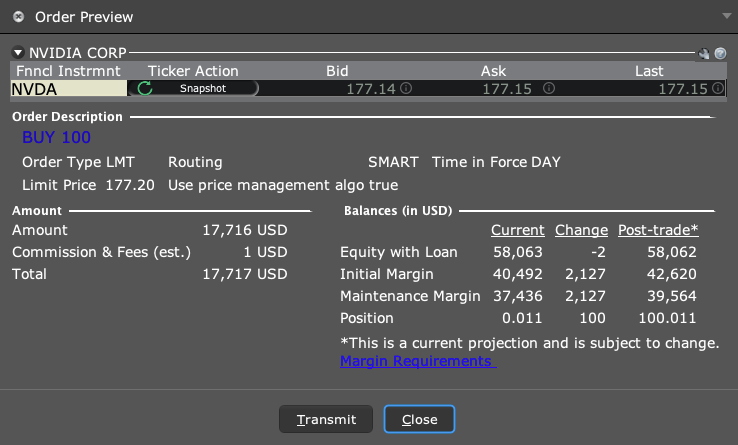
I reviewed these details and clicked confirm. The order filled during the regular session once it met my limit price. This confirmation step is important because it gives you a final check before your capital is committed.
Step 6: Monitor and Manage The Position
After it filled, the position appeared in my portfolio view with a real-time P&L.
The same goes for any options positions on Dow components (example below showing daily P/L on the very left, then the position type, number of contracts long or short, current value, and initial price at entry).

If you’re an active trader, you can set a stop-loss order below your entry to manage your downside risk. The platform also allows me to set price alerts on DIA or individual Dow components. That way you can track the position without staring at the screen throughout the day.
What Is The Dow Jones?
Dow Jones is known for founding one of the most prominent indices: the Dow Jones Industrial Average. The DJIA is formed of 30 significant companies listed on stock exchanges in the United States.
The company also created and runs the Wall Street Journal, which remains one of the most influential financial publications to this day. One of the co-founders, Charles Dow, wanted to give investors and market speculators predictions that would help to show whether the stock market was rising or falling.
The first index created by Dow consisted of 12 companies and the first recorded value of the Dow Jones Index, 40.94, was calculated by taking a market average of these firms.
Dow also believed that it was possible to predict the movement in stocks based on the price movement of different types of equities. According to Dow Theory, an increase in industrial stocks will result in a similar trend in transportation stocks, for example. These averages can be used to try and predict the movement in share prices across various industries.
History
In 1882, Dow Jones was owned by its three founders Charles Dow, Edward Jones and Charles Bergstresser. Ownership then changed in 1902 when Dow died and the company was bought by Jessie Waldron and Clarence Barron. This pair eventually passed control to the Bancroft Family, who retained ownership until 2007 when Dow Jones and company was bought by News Corp.
Key milestone history dates include:
- 1896 – The start of the Dow Jones Industrial Average. At this time, it consisted of 12 companies: General Electric Co, Laclede Gas Light Co, National Lead, North American Co, Tennessee Coal, American Cotton Oil, American Sugar Refining Co, American Tobacco, Chicago Gas, Distilling & Cattle Feeding Co, U.S. Rubber, U.S. Leather and Iron and Railroad Co
- 1903 – U.S Steel Corp joins the DJIA. It is the largest company in the nation at the time
- 1916 – The industrial average expands to 20 stocks
- 1928 – The calculation for Dow is changed – a special divisor is used instead of dividing by the number of stocks. It is still referred to as an average
- 1929 – Dow falls 23% over two days from the economic crash and recession
- 1972 – Dow closes above 1000
- 1987 – In another crash, Dow posts its worst-ever percentage loss of 22% over one day (19th October)
- 1999 – Dow first closes above 10,000
- 2008 – Dow’s biggest-ever trading percentage gain of 11% (13th October)
- 2020 – Salesforce, Amgen and Honeywell join the DJIA, replacing ExxonMobil, Pfizer and Raytheon
- 2024 – Amazon replaces Walgreens Boots Alliance (February); Nvidia replaces Intel and Sherwin-Williams replaces Dow Inc. (November)
- 2026 – The DJIA crosses 50,000 for the first time
Note, head to the official website for details on quarterly returns and daily trade volumes.
Trading The Dow vs. Other US Markets
The Dow Jones, S&P 500, and Nasdaq Composite overlap in many ways and have higher correlations to each other. But they provide distinct slices of the US equity market. Understanding the differences can help you pick the right index for your strategy.
The Dow is price-weighted, which is a unique quirk. Share price doesn’t mean anything on its own, though the Dow rewards that.
The Dow doesn’t hold as many companies as is standard in most indexes today, at just 30 “blue-chip” names (i.e., major, well-established companies of the era), so a single high-priced stock can swing the index disproportionately.
The S&P 500 is market-cap-weighted, which is more standard as it rewards higher-value companies. It holds 500 companies, which gives broader diversification but more concentration in mega-cap companies, which are generally tech in this day and age.
The Nasdaq 100 holds 100 of the largest non-financial companies listed on the Nasdaq. The Nasdaq Composite holds 3,000+ stocks, which are heavily skewed toward technology and biotech. The long-duration nature of the cash flow of components of the Nasdaq makes it the most volatile of the three.
For active traders, this means the Dow tends to show steadier intraday moves than the Nasdaq. But it’s more sensitive to single-stock news — an earnings miss from a high-priced stock like Goldman Sachs can move the DJIA several hundred points while leaving the S&P 500 relatively untouched. The Dow also has slightly lower average daily realised volatility than the Nasdaq-100, so that makes it a more forgiving index for newer traders learning to size positions and manage stops.
Rebalancing & Composition Changes
The Dow’s 30 components are selected by a committee from S&P Dow Jones Indices and The Wall Street Journal.
Changes make headlines, as they’re rare but meaningful. There’s also a clubby, “prestige” element because of the history involved, as the Dow was the first widely recognized stock index specifically tracking industrial companies to measure American economic health.
Nvidia replaced Intel in November 2024, Sherwin-Williams replaced Dow Inc. at the same time, and Amazon replaced Walgreens Boots Alliance in February 2024. Each change triggers heavy volume in the affected stocks. There’s also brief distortion in the index’s day-over-day moves as the Dow Divisor is recalculated based on the component’s share prices.
Index rebalancing is considered a strategy in itself. This involves knowing the criteria for inclusion in the Dow (among other indices) and anticipating moves in advance before other traders catch on. Active traders watch the S&P Dow Jones Indices press releases for advance notice of composition changes. Good brokers handle the rebalance days smoothly — index ETFs like DIA experience elevated volume as fund managers rebalance holdings. Spreads can momentarily widen on the incoming and outgoing names as the market adjusts to the mandatory reclassification flows.
Trading Hours
Dow Jones is open from 9:30 am – 4 pm Monday to Friday in New York Time. In UK time, opening hours are 2:30 pm – 9 pm (GMT).
Outside of regular market hours, there is also industrial pre-market trading running from 4 am to 9:30 am (ET) and after-hours trading from 4 pm to 8 pm (ET) though not all Dow Jones brokers will offer this.
Other Indices & Publications
Outside of the DJIA, other indices and publications are currently or were previously owned by the Dow Jones company.
Indices:
- Dow Jones Industrial Average
- Dow Jones Transportation Average (Includes 20 transportation companies)
- Dow Jones Utility Average (Includes 15 US utility stocks)
Dow Jones and company no longer directly control these three indices that they originally founded. In 2012, S&P Dow Jones Indices LLC bought all three. This company is a collaboration between the CME Group and S&P Global.
Publications:
- The Wall Street Journal
- Financial News
- MarketWatch
- Barron’s
Strategies
Various trading strategies can be employed to speculate on the Dow Jones via brokers that offer the index. Popular examples include:
- Top ten – This strategy involves making a balanced allocation to the 10 Dow Jones stocks with the highest dividend yield at the start of the year. After holding these stocks for the rest of the year they can be sold following the same pattern. This strategy is known to have favourable results over the longer-term. Many Dow Jones brokers support this system
- Swing trading – This involves making trades that last a couple of days up to several months. The purpose is to take advantage of an anticipated price move to make a profit and usually involves buying the stock at the top of a cup in a price chart with a stop-loss order placed at the most recent low in the cup
- Scalping – This is a fast-paced strategy that involves making numerous small profits from minor price changes that occur throughout the day
- Range trading – By paying attention to live trading charts and graphs it’s possible to make predictions on Dow Jones futures and use this to determine buy and sell decisions
- News-based trading – This strategy involves buying and selling stocks based on the news and media announcements surrounding respective companies. If a stock receives attention it is likely to fluctuate depending on if the news is positive or negative
- High-frequency trading (HFT) – These strategies involve using algorithms to take advantage of small or short term changes in the market to make a profit
Note, that the best Dow Jones strategy will depend on your individual trading objectives and risk appetite. Every strategy involves significant risk to your capital.
Bottom Line
The Dow Jones Industrial Average compares and ranks 30 major companies listed on stock exchanges in the US. As well as the popular index, the organization also set up various financial news brands. This guide has provided an introduction to the Dow and explained how to compare brokerages and platforms that offer trading on the Dow Jones.
Use our list of the best platforms and brokers with access to the Dow Jones to get started.
FAQs
How Do You Trade The Dow Jones At Online Brokers?
The easiest way to trade Dow Jones via online brokers is through an exchange-traded fund (ETF). ETFs are known for being less volatile than individual stocks since large swings in the performance of specific equities will have a limited impact on the overall index average. As well as being lower risk, ETFs also help diversify portfolios. You can check what instruments Dow Jones brokers offer before signing up.
What Time Does The Dow Jones Start Trading At Online Brokers?
Standard trading hours begin at 09:30 ET which will be shown in broker’s platforms.
When Does The Dow Jones Stop Trading At Online Brokers?
Typical closing times are 16:00 ET which will be reflected via broker’s platforms. Note, that closing hours may vary with Christmas and public holidays.
Is Dow Jones A Price-Weighted Index?
Yes, the components of Dow Jones with the most value will have more influence. The best Dow Jones brokers offer detailed statistics and data on the constituents of the index.
What Is the Cheapest Way to Trade the Dow Jones?
The DIA ETF is usually the cheapest way to trade the Dow for US traders. Spreads are typically at 1 cent during regular hours.
For futures traders, the Micro E-mini Dow (MYM) offers Dow exposure with day-trading margins around $50 per contract. This makes it accessible to smaller accounts. The standard YM E-mini Dow contract is available for traders who want to take on larger size.
CFDs on the Dow typically cost 1-2 points in spread, but aren’t available to US traders.
When Is The Best Time To Trade The Dow Jones With Major Brokers?
Regular trading of Dow Jones begins early at 9:30 am EST. The hour ending at 10:30 am EST is often the best time of day. This is when the biggest changes occur in the shortest amount of time. Many professional day traders will prioritize this time to make the most of the high volatility in prices.
What returns more: the Dow Jones, S&P 500, or Nasdaq? Which has the highest or lowest risk?
Let’s look at what the stats say, their relative volatilities, and correlations using the DIA, SPY, and QQQ ETFs.
| Name | Ticker | DIA | SPY | QQQ | Annualized Return | Daily Standard Deviation | Monthly Standard Deviation | Annualized Standard Deviation |
|---|---|---|---|---|---|---|---|---|
| State Street SPDR Dow Jones Industrials ETF | DIA | 1.00 | 0.94 | 0.72 | 8.20% | 1.16% | 4.25% | 14.72% |
| State Street SPDR S&P 500 ETF | SPY | 0.94 | 1.00 | 0.84 | 8.07% | 1.22% | 4.35% | 15.06% |
| Invesco QQQ Trust | QQQ | 0.72 | 0.84 | 1.00 | 9.90% | 1.70% | 6.68% | 23.15% |
(Asset correlations for the period 04/01/1999 to 03/31/2026 were based on monthly returns.)
From this we can see that the Dow Jones and S&P 500 have returned comparably. The Dow is a tad less volatile.
The Nasdaq has the highest return by close to 2 percentage points annually but comes with higher volatility.
Past performance is of course no guarantee of future performance. The Nasdaq is the most rate sensitive and tied to tech innovation, so you should expect bigger boom and bust dynamics.