



Only trade with the best regulated brokers – anything less is a risk. A trusted license ensures security, fair trading conditions, and scam protection. We’ve verified the regulatory credentials of every trading platform below.
Top 6 Regulated Brokers 2026
Our tests show these 6 regulated brokers and trading platforms in Iran are the best in October 2026:
-
- Demo account
- Regulator: FCA, ASIC, FSCA, VFSC, CIMA
- Min. deposit: $50
-
- Demo account
- Regulator: ASIC, CySEC, JSC, FSA, CMA-Kenya
- Platforms: MT4, MT5
-
- Demo account
- Min. deposit: $0
- Min. trade: 0.01 Lots
-
- Demo account
- Regulator: FCA, ASIC, CySEC, SCA, SCB, CMA-Kenya
- Platforms: Web Platform, MT4, TradingView
-
- Demo account
- Instruments: Stocks, ETFs, Options, Pink Sheets, Warrants
- Regulator: SEC, FINRA, CIRO, AFM, SCB
-
- Demo account
- Regulator: FCA, DFSA
- Platforms: HYCM Trader, MT4, MT5, TradingCentral





Learn how we test brokers and why you can trust our ratings.
Why Are These The Best Regulated Brokers?
Here’s a quick rundown on why these regulated brokers made the cut:
- Vantage is the best regulated broker in Iran in 2026 4.7/5 Founded in 2009, Vantage offers trading on 1000+ short-term CFD products to millions of clients. You can trade Forex CFDs from 0.0 pips on the RAW account through TradingView, MT4 or MT5. Vantage is ASIC-regulated and client funds are segregated. Copy traders will also appreciate the range of social trading tools.
- Ingot Brokers 4.3/5 Ingot Brokers is a multi-regulated brokerage established in 2006. The broker offers CFD trading opportunities on 1000+ instruments including forex, stocks, indices, commodities and cryptocurrencies. The broker supports the MetaTrader 4 and MetaTrader 5 platforms and offers both raw spreads and commission-free account options.
- IG 4.8/5 Founded in 1974, IG is part of IG Group Holdings Plc, a publicly traded (LSE: IGG) brokerage. The brand offers a top-tier selection of 17,000+ markets, with a range of user-friendly platforms and investing apps. For 50 years, IG has maintained its position as an industry leader, excelling in all key areas for traders.
- Capital.com 4.0/5 Established in 2016, Capital.com initially focused on CFDs across forex, indices, stocks, commodities, and crypto, aimed squarely at active traders. Over the years it has added more instruments, obtained multiple regulatory licenses, improved its charting tools, and introduced an 1X account that lets you trade without using margin (borrowed funds), now catering to a diverse mix of traders worldwide.
- TradeZero 3.8/5 TradeZero is a stock and ETF broker established in the Bahamas in 2015. Though the global entity is regulated offshore, the US subsidiary is overseen by FINRA with SIPC registration. The powerful proprietary trading software makes it a popular choice for active day traders.
- HYCM 3.8/5 HYCM is an online broker with authorization from four international bodies including the FCA. The broker offers short-term CFD trading on forex, shares, commodities, indices, ETFs and Bitcoin, and supports the MT4 and MT5 platforms, as well as Trading Central analysis.
Compare The Top Regulated Brokers On Key Metrics
Find the right regulated brokerage for you with our comparison of key features:
| Broker | Regulators | Instruments | Platforms | Minimum Deposit |
|---|---|---|---|---|
| Vantage | FCA, ASIC, FSCA, VFSC, CIMA | CFDs, Forex, Stocks, Indices, Commodities, ETFs, Bonds | ProTrader, MT4, MT5, TradingView, TradingCentral, DupliTrade | $50 |
| Ingot Brokers | ASIC, CySEC, JSC, FSA, CMA-Kenya | CFDs, Commodities, Stocks, Indices, ETFs, Forex, Cryptocurrencies | MT4, MT5 | $10 |
| IG | CFTC, NFA, FCA, BaFin, ASIC, FINMA, MAS, JFSA, FMA, DFSA, BMA | CFDs (not in US), Forex, Stocks, Indices, Commodities, ETFs, Futures, Options, Crypto, Spread Betting (UK only) | Web, L2 Dealer, MT4, TradingView, AutoChartist, TradingCentral, ProRealTime | $0 |
| Capital.com | FCA, ASIC, CySEC, SCA, SCB, CMA-Kenya | CFDs on Forex, Stocks, Indices, Commodities, ETFs, Crypto | Web Platform, MT4, TradingView | $20 |
| TradeZero | SEC, FINRA, CIRO, AFM, SCB | Stocks, ETFs, Options, Pink Sheets, Warrants | TZ1, ZeroPro, ZeroFree, ZeroMobile, TradingView | $2,500 (US), $500 (International), $250 (Europe) |
| HYCM | FCA, DFSA | CFDs, Forex, Stocks, Indices, Commodities, ETFs | HYCM Trader, MT4, MT5, TradingCentral | $20 |
How Safe Are These Regulated Trading Providers?
See how secure the top regulated brokers are and how they safeguard your funds:
| Broker | Trust Rating | Guaranteed Stop Loss | Negative Balance Protection | Segregated Accounts |
|---|---|---|---|---|
| Vantage | ✘No | ✔Yes | ✔Yes | |
| Ingot Brokers | ✘No | ✔Yes | ✔Yes | |
| IG | ✔Yes | ✔Yes | ✔Yes | |
| Capital.com | ✔Yes | ✔Yes | ✔Yes | |
| TradeZero | ✘No | ✘No | ✔Yes | |
| HYCM | ✘No | ✔Yes | ✘No |
Compare Mobile Trading
Here's how these regulated trading apps measure up for mobile users:
| Broker | Mobile Apps | iOS Rating | Android Rating | Smart Watch App |
|---|---|---|---|---|
| Vantage | iOS & Android | ✘No | ||
| Ingot Brokers | iOS & Android | ✘No | ||
| IG | iOS & Android | ✔Yes | ||
| Capital.com | iOS & Android | ✘No | ||
| TradeZero | iOS & Android | ✘No | ||
| HYCM | iOS & Android | ✘No |
Are The Top Regulated Brokers Good For Beginners?
As well as a secure, regulated broker, beginners should look for key features that new traders need:
| Broker | Demo Account | Minimum Deposit | Minimum Trade | Education Rating | Support Rating |
|---|---|---|---|---|---|
| Vantage | ✔Yes | $50 | 0.01 Lots | ||
| Ingot Brokers | ✔Yes | $10 | 0.01 Lots | ||
| IG | ✔Yes | $0 | 0.01 Lots | ||
| Capital.com | ✔Yes | $20 | 0.01 Lots | ||
| TradeZero | ✔Yes | $2,500 (US), $500 (International), $250 (Europe) | $1 | ||
| HYCM | ✔Yes | $20 | 0.01 Lots |
Are The Top Regulated Brokers Good For Advanced Traders?
Experienced traders know regulation is just one piece of the puzzle, alongside key features for pros:
| Broker | Automated Trading | VPS | AI | Pro Account | Leverage | Low Latency | Extended Hours |
|---|---|---|---|---|---|---|---|
| Vantage | Myfxbook AutoTrade, Expert Advisors (EAs) on MetaTrader | ✔Yes | ✘No | ✘No | 1:500 | ✘No | ✘No |
| Ingot Brokers | Expert Advisors (EAs) on MetaTrader | ✘No | ✘No | ✘No | 1:500 | ✘No | ✘No |
| IG | Expert Advisors (EAs) on MetaTrader, build your own on ProRealTime | ✔Yes | ✔Yes | ✔Yes | 1:30 (Retail), 1:250 (Pro) | ✔Yes | ✔Yes |
| Capital.com | Expert Advisors (EAs) on MetaTrader | ✘No | ✔Yes | ✔Yes | 1:30 | ✔Yes | ✘No |
| TradeZero | TradeZero Developer | ✘No | ✘No | ✘No | 1:2 (U.S), 1:6 intraday/1:2 overnight (International), 1:3 (Europe) | ✔Yes | ✔Yes |
| HYCM | Expert Advisors (EAs) on MetaTrader | ✘No | ✘No | ✔Yes | 1:301:500 | ✔Yes | ✘No |
Compare The Ratings Of The Top Regulated Trading Platforms
Explore how the top regulated day trading platforms compare in every vital area based on our hands-on tests:
| Broker | Trust | Platforms | Assets | Mobile | Fees | Accounts | Research | Education | Support |
|---|---|---|---|---|---|---|---|---|---|
| Vantage | |||||||||
| Ingot Brokers | |||||||||
| IG | |||||||||
| Capital.com | |||||||||
| TradeZero | |||||||||
| HYCM |
Compare Trading Fees
Fees can significantly impact your costs - here’s how the top regulated providers compare on pricing:
| Broker | Cost Rating | Fixed Spreads | Inactivity Fee |
|---|---|---|---|
| Vantage | ✘No | $0 | |
| Ingot Brokers | ✘No | $0 | |
| IG | ✘No | $12 | |
| Capital.com | ✘No | $10 | |
| TradeZero | ✘No | $0 | |
| HYCM | ✘No | $10 |
Community Sentiment
See how users rate these brokers based on the average customer ratings submitted on DayTrading.com, plus ratings from Trustpilot, the Apple App Store and Google Play.
| Broker | Our Users' Rating | Trustpilot Score | Trustpilot Reviews | iOS App Rating | Android App Rating |
|---|---|---|---|---|---|
| Vantage | 15615 | ||||
| Ingot Brokers | 56 | ||||
| IG | 10134 | ||||
| Capital.com | 15186 | ||||
| TradeZero | - | 3092 | |||
| HYCM | - | 139 |
How Popular Are These Regulated Trading Brokers?
Many traders gravitate toward the regulated brokers with the highest client sign-ups:
Why Trade With Regulated Vantage?
Vantage remains an excellent option for CFD traders seeking a tightly-regulated broker with access to the reliable MetaTrader platforms. The fast sign-up process and $50 minimum deposit make it very straightforward to start day trading quickly.
 Jemma Grist, Reviewer
Vantage quick facts
- Demo Account
- ✔Yes
- Instruments
- CFDs, Forex, Stocks, Indices, Commodities, ETFs, Bonds
- Regulator
- FCA, ASIC, FSCA, VFSC, CIMA
- Platforms
- ProTrader, MT4, MT5, TradingView, TradingCentral, DupliTrade
- Minimum Deposit
- $50
- Minimum Trade
- 0.01 Lots
- Account Currencies
- USD, EUR, GBP, CAD, AUD, NZD, JPY, HKD, SGD, PLN
Pros
- It’s quick and easy to open a live account – taking less than 5 minutes
- Vantage maintains its high trust score thanks to its strong reputation and top-tier regulation from the FCA and ASIC
- The app was upgraded in 2026 with wider asset visibility bringing together balances across Contract, Copy, and Funding accounts on one screen
Cons
- It's a shame that some clients will need to register with the offshore entity, which offers less regulatory protection
- The average execution speeds of 100ms to 250ms are slower than alternatives based on tests
- A steep $10,000 deposit is needed for the best trading conditions, which include the $1.50 commission per side
Why Trade With Regulated Ingot Brokers?
Ingot Brokers is a good choice for day traders looking for a no-frills broker with a wide range of instruments. Experienced traders will appreciate access to the advanced MT5 platform, although beginners may be disappointed in the lack of educational resources.
 William Berg, Reviewer
Ingot Brokers quick facts
- Demo Account
- ✔Yes
- Instruments
- CFDs, Commodities, Stocks, Indices, ETFs, Forex, Cryptocurrencies
- Regulator
- ASIC, CySEC, JSC, FSA, CMA-Kenya
- Platforms
- MT4, MT5
- Minimum Deposit
- $10
- Minimum Trade
- 0.01 Lots
- Account Currencies
- USD, EUR, GBP, AUD
Pros
- Multiple free payment methods are available, including bank transfers and crypto payments
- Traders can access the market-leading MT4 and MT5 platforms, collectively offering dozens of advanced technical indicators and charting tools for detailed analysis
- Ingot Brokers offers a copy trading service with passive income opportunities for experienced strategy providers
Cons
- Despite improvements in the Resources Hub, the broker’s education and market research still trail many competitors
- The range of 30+ currency pairs is below the industry average and won’t be sufficient for serious forex traders
- The ECN account offers fewer assets than the other account types
Why Trade With Regulated IG?
IG continues to provide a comprehensive package with an intuitive web platform, best-in-class education for beginners, advanced charting tools bolstered by its recent TradingView integration, real-time data, and robust trade execution for experienced day traders.
 Christian Harris, Reviewer
IG quick facts
- Demo Account
- ✔Yes
- Instruments
- CFDs (not in US), Forex, Stocks, Indices, Commodities, ETFs, Futures, Options, Crypto, Spread Betting (UK only)
- Regulator
- CFTC, NFA, FCA, BaFin, ASIC, FINMA, MAS, JFSA, FMA, DFSA, BMA
- Platforms
- Web, L2 Dealer, MT4, TradingView, AutoChartist, TradingCentral, ProRealTime
- Minimum Deposit
- $0
- Minimum Trade
- 0.01 Lots
- Account Currencies
- USD, EUR, GBP, CAD, AUD, JPY, ZAR, SEK, DKK, CHF, HKD, SGD
Pros
- As a well-established broker, IG operates under strict regulatory guidelines in multiple jurisdictions, maintaining a high level of trust.
- IG obtained a crypto asset license from the FCA, allowing it to re-enter the UK market to provide buying, selling and storing opportunities on 55+ digital tokens with fees from 1.49%, and all within an FCA-licensed environment.
- The ProRealTime advanced charting platform is free as long as certain modest monthly trading activity requirements are met.
Cons
- Beginners might find IG’s fee structure complex, with various fees for different types of trades or services, potentially leading to confusion or unexpected charges.
- IG applies an inactivity fee of $12-$18 per month after 2 years, deterring casual investors.
- IG has discontinued its swap-free account, reducing its appeal to Islamic traders.
Why Trade With Regulated Capital.com?
Capital.com is a great match for day traders with its thousands of CFDs, SmartFeed providing tailored market updates, and TradingView charts for advanced technical indicators paired with Capital.com’s fast and reliable order execution.
Christian Harris, Reviewer
Capital.com quick facts
- Demo Account
- ✔Yes
- Instruments
- CFDs on Forex, Stocks, Indices, Commodities, ETFs, Crypto
- Regulator
- FCA, ASIC, CySEC, SCA, SCB, CMA-Kenya
- Platforms
- Web Platform, MT4, TradingView
- Minimum Deposit
- $20
- Minimum Trade
- 0.01 Lots
- Account Currencies
- USD, EUR, GBP, AUD, SEK, NOK, DKK, CHF, HKD, PLN, CZK, AED, HUF, MXN
Pros
- The Capital.com app performed excellently during testing, with smooth orders, trade management and alerts, while it sits among the highest rated trading apps on the App Store for iOS users.
- Traders who prefer robust charting can connect their Capital.com account directly to TradingView. This lets you use TradingView’s advanced tools and community ideas alongside Capital.com’s execution, blending a popular charting platform with a regulated broker’s access.
- Capital.com has an especially strong selection of forex (120+), commodities (70+) and cryptos (500+ pairs), catering to traders interested in these asset classes and needing depth.
Cons
- Capital.com offers primarily a standard CFD account and a professional account (subject eligibility) with higher leverage, but it lacks ECN/raw spread accounts or tiered pricing, which can limit trading flexibility for high-volume scalpers.
- While Capital.com supports MT4, it lacks MT5 integration, limiting access to advanced trading features, including additional timeframes, indicators, and order types.
- The broker’s research resources focus on educational content and in-house analysis but do not currently include third-party tools such as Trading Central, Autochartist, sentiment indicators, and professional-level screeners that some top competitors offer.
Why Trade With Regulated TradeZero?
TradeZero is best for experienced stock day traders, especially those trading momentum in small-caps or those chasing opportunities in pre- and after-hours sessions. It also suits short sellers needing hard-to-borrow locates and active options traders thanks to its direct routing tools and Level 2 data, though these typically require a paid platform subscription (ZeroPro or ZeroWeb).
 James Barra, Reviewer
TradeZero quick facts
- Demo Account
- ✔Yes
- Instruments
- Stocks, ETFs, Options, Pink Sheets, Warrants
- Regulator
- SEC, FINRA, CIRO, AFM, SCB
- Platforms
- TZ1, ZeroPro, ZeroFree, ZeroMobile, TradingView
- Minimum Deposit
- $2,500 (US), $500 (International), $250 (Europe)
- Minimum Trade
- $1
- Account Currencies
- USD
Pros
- TradeZero’s short-selling setup is one of the strongest we’ve tested, with pre-borrows, single-use locates, regular locates, and credit back on eligible unused locates - providing access to an inventory many legacy brokers simply don't.
- TradeZero Europe is bolstering its regional footprint and local trading services by now accepting clients in Belgium, Luxembourg, Norway, and Denmark.
- TradeZero’s 4:00 AM to 8:00 PM ET market access is excellent for those looking to capitalize on pre-market momentum and post-earnings volatility on U.S. equities.
Cons
- The TradingView integration disappointed during our tests and is supported by wider user feedback, with access issues, freezes and occasional order-processing problems that make it harder to trust for frequent live execution.
- It doesn't use a true 'no commission' model - free trading really applies to non-marketable limit orders of 200+ shares above $1, while marketable orders, OTC names, options, locates, borrow and data still add up fast. It charges a $0.99 flat fee on trades under 200 shares.
- TradeZero was charged by the US SEC in 2022 over misleading statements concerning its meme-stock purchase halts, plus it had a $250k fine from FINRA in 2024 over compliance failures, and a $175k fine from CIRO in 2025 for inadequate supervision of client trading.
Why Trade With Regulated HYCM?
Traders looking for a multi-asset broker with good platform support, extra analysis features and strong regulation will want to consider HYCM. The competitive raw-spread accounts will also serve scalpers and high-volume traders.
Christian Harris, Reviewer
HYCM quick facts
- Demo Account
- ✔Yes
- Instruments
- CFDs, Forex, Stocks, Indices, Commodities, ETFs
- Regulator
- FCA, DFSA
- Platforms
- HYCM Trader, MT4, MT5, TradingCentral
- Minimum Deposit
- $20
- Minimum Trade
- 0.01 Lots
- Account Currencies
- USD, EUR, GBP, RUB, AED
Pros
- Rather than a flat leverage cap, HYCM's leverage model reduces automatically as position volume increases — protecting traders from runaway exposure on large positions without requiring manual margin management. Most retail brokers apply a fixed leverage ceiling and leave risk management entirely to the trader. The dynamic model adds a structural risk layer that's particularly relevant for less experienced traders building larger positions incrementally.
- HYCM has operated continuously since 1977 — through Black Wednesday, the 2008 financial crisis, the SNB shock, and multiple FCA overhauls that eliminated or restructured many competitors. Most brokers marketing FCA regulation acquired it recently. HYCM has held it long enough for an entire generation of retail traders to have come and gone. That's a verifiably different category of track record.
- Most retail CFD brokers stop at gold, oil, and silver. HYCM extends into agricultural soft commodities from a standard account with no elevated minimum deposit or professional classification required. For traders wanting genuine commodity diversification beyond metals and energy, that access is structurally rare at this entry level.
Cons
- The restriction only surfaces in HYCM's terms and conditions. Traders who fund a Fixed or Classic account, develop a short-term strategy, and start executing fast in-and-out trades can have their profits confiscated and their accounts suspended without prior warning. The Raw account permits tighter execution styles, but the policy boundary between permitted and prohibited trading frequency is never clearly defined in plain language anywhere on hycm.com.
- MT4, MT5, and a proprietary mobile app are the same infrastructure HYCM offered half a decade ago. No TradingView integration, no cTrader, no social trading, no copy trading, no PAMM. For a broker with nearly five decades of history and FCA authorization, the absence of any platform development signals that technology investment isn't a priority, which matters increasingly as competitors bundle TradingView natively and build out social trading ecosystems that attract a new generation of retail traders.
- Brokers like eToro, Pepperstone, and IC Markets have built entire client acquisition channels around social and copy trading. HYCM has none of it. For newer traders who want to allocate capital to experienced strategies while they develop their own, or for experienced traders who want to monetize their track record by managing external capital, HYCM offers no pathway. That's an entire category of retail trader HYCM cannot serve.
How Did We Choose The Best Regulated Brokers?
To find the best regulated trading brokers, we:
- Took our database comprizing 143 online brokers and trading platforms;
- Pinpointed those that are regulated after verifying their credentials on the respective regulator’s databases;
- Sorted them by their rating which balances 200+ data entries with the personal observations of our testers.
Do I Need A Regulated Broker?
Yes. If you want to trade on a secure trading platform then selecting a regulated broker is a no-brainer.
Sometimes traders may opt for an unregulated broker to access trading promotions or high leverage that aren’t permitted in tightly regulated jurisdictions, but we do not recommend this, especially for newer traders.
There are three key reasons why you should choose a regulated broker:
- Protection: Many regulators require authorized brokers to provide retail traders with access to compensation in the event the firm is unable to meet its financial obligations, negative balance protection to prevent traders losing more than their deposited funds, and to operate segregated accounts so client funds cannot be misused. For example, the Securities Investor Protection Corporation (SIPC) in the US provides up to $500,000 per person and the Financial Services Compensation Scheme (FSCS) in the UK provides up to £85,000.
- Transparency: Regulators normally require brokers to be transparent about trading fees, order execution, and risks, all of which are critical considerations for day traders. For example, in the European Union (EU), regulated brokers are required to publish the percentage of losing traders on their website, especially when using complex products like contracts for difference (CFDs), which are popular with active traders.
- Security: Regulated brokers are often required to implement systems to protect your data, notably encryption protocols and security audits. For example, the ASIC in Australia requires multi-factor authentication for digital transactions while the FCA in the UK requires brokers to adhere to strict rules under the General Data Protection Regulation (GDPR).
For these reasons, I only deposit funds with regulated brokers. As a UK-based investor, this means I hold my capital with FCA-regulated trading platforms.
James BarraAuthorAre All Brokers Created Equal?
Where things get slightly tricky is that simply choosing any ‘regulated broker’ isn’t enough.
This is because not all regulatory bodies offer the same levels of protection. There is a common misconception that financial agencies supervise brokers across numerous jurisdictions. However, often regulatory remit is limited to those brokers with a license issued within the regulator’s jurisdiction.
Therefore, bodies outside your financial jurisdiction may not provide such extensive legal recourse should there be an issue, be it access to investor compensation or formal dispute channels. For example, the JFSA in Japan offers up to ¥10,000,000 per investor through its Investor Protection Fund (IPF), however it’s primarily available to residents.
Equally, financial agencies enforce varying degrees of regulations. For instance, all FCA brokers must segregate trader’s funds. Whereas offshore bodies like the FSC of Mauritius may not enforce this regulation. Furthermore, FCA brokers must automate and process client withdrawals promptly, while offshore brokers have been known to delay withdrawals, which can be extremely frustrating.
To help you understand which regulators are ‘good’ and crucially – which aren’t, we’ve drawn upon our collective decades working in the trading industry and personal experiences using various trading platforms to classify regulators based on the level of protection they provide:
- Green Tier: These regulators provide the strongest investor safeguards and actively oversee authorized brokers. Notable examples include the SEC in the US, FCA in the UK and ASIC in Australia.
- Yellow Tier: These regulators still provide strong investor safeguards and monitor authorized brokers but not always to the same degree as ‘green tier’ regulators. Notable examples include the FSCA in South Africa, the SEBI in India, and the DFSA in Dubai which is becoming increasingly popular as established brokers like Plus500 have been looking to expand their presence in the Middle East.
- Orange Tier: These regulators provide limited investor safeguards and scrutiny of authorized brokers, requiring caution before signing up. Notable examples include the BMA in Bermuda, the BOB in Botswana and the BCE in Ecuador.
- Red Tier: These regulators provide little to no investor safeguards and we consider them high-risk. Notable examples include the VFSC in Vanuatu, the FSA in Seychelles, and the SCB in the Bahamas.
I recommend extreme caution when dealing with brokers registered with ‘red tier’ regulators. They are sometimes used by scammers to strip traders of any legal protections they may be afforded in well-regulated regions.
In one high-profile case, the bad actors behind trading firm EverFX, convinced aspiring investors to move their funds to offshore entities where there was little to zero regulatory oversight.
The global scamming network is estimated to have made off with up to an eye-watering $1 billion.
James BarraAuthorHow Can I Check If My Broker Is Regulated?
Checking whether a broker is regulated is incredibly straightforward, with an increasing number of financial bodies operating digital, publicly accessible databases where you can input a trading firm’s details.
You’ll normally need to follow a few simple steps:
- Navigate to the respective regulator’s database (usually searchable on the agency’s website)
- Enter the broker’s company name or license number (often found at the bottom of the broker’s website)
- Read the search results to confirm they are authorized (check which investment services and where they are permitted to do business)
I have personally checked the regulatory details of hundreds of brokers on countless regulators’ databases, from the US and UK to Europe, Australia and beyond.
To show you how it’s done, below you can see the results of a search I ran on XTB, which claimed to be authorized by the CySEC.
James BarraAuthor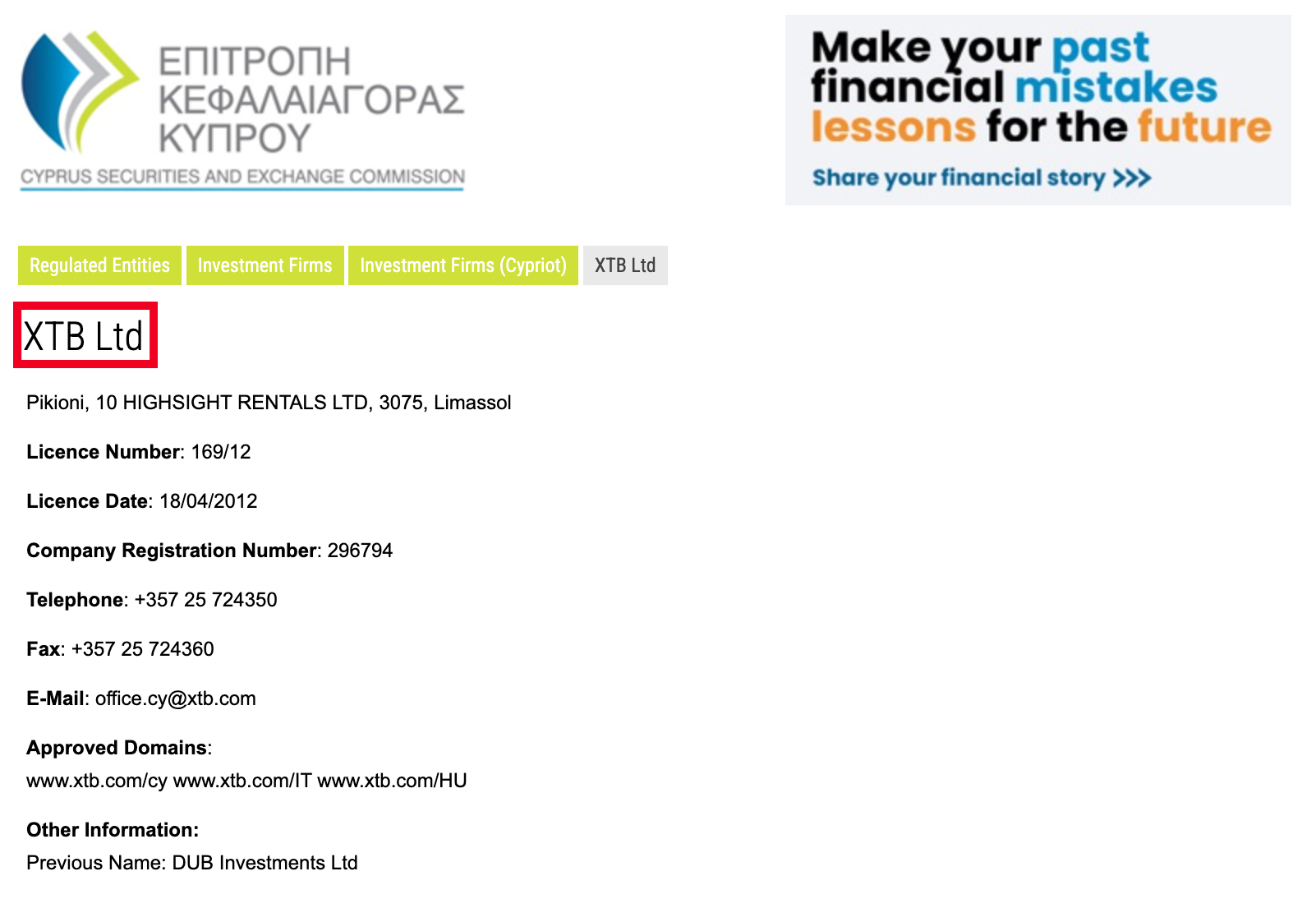
Bottom Line
Choosing a regulated trading platform should be your first priority. It’s a win-win for both traders and brokers.
For traders, it’s the best indication a firm can be trusted to operate in a fair manner. For brokers, regulatory oversight helps build a solid reputation and reduces the need to constantly try and undercut competitors in areas like leverage limits.
Picking a regulated broker is also especially important given the increasing sophistication of trading scams we’ve been witnessing with alarm in recent years, capitalizing on the growing class of ‘finfluencers’ and interest in artificial intelligence (AI).
Use our list of top regulated day trading platforms to be sure a broker is regulated.
FAQ
What Is Trading Regulation?
Regulatory bodies and watchdogs supervise financial markets and online brokers. They enforce a range of rules and regulations to protect retail traders.
The Markets in Financial Instruments Directive (MiFID), since replaced by MiFID II, is the closest the world has got to an overarching regulatory system. It was brought into the UK in 2007 and has been the bedrock of Europe’s financial regulatory systems since.
What Is A Regulated Broker?
Regulated brokers receive a license to operate within that jurisdiction, so long as they adhere to specific rules and regulations, often designed to protect retail traders and the functioning of financial markets.
What Is An Unregulated Broker?
Unregulated brokers operate without having to adhere to a set of guidelines. Arguably, therefore, they do not have the same interest in safeguarding your interests. This allows them to offer attractive features like high leverage and welcome bonuses, but the catch is limited legal protection for your funds.
Which Is The Best Regulated Broker?
Use our list of the top regulated brokers to find a trading platform in Iran that best suits your needs. Our experts have independently verified the regulatory credentials of every broker recommended.
Article Sources
The writing and editorial team at DayTrading.com use credible sources to support their work. These include government agencies, white papers, research institutes, and engagement with industry professionals. Content is written free from bias and is fact-checked where appropriate. Learn more about why you can trust DayTrading.com