
Responsible Day Trading



Day trading can be exciting, but for some it can also be mentally exhausting, compulsive, and harmful. Constant price movements, fast feedback, and the temptation to place ‘one more trade’ may lead some retail investors to stray from disciplined trading into gambling-type behavior.
We created this guide to promote responsible day trading. That means putting your wellbeing first, having firm boundaries, and knowing where to get support if trading starts to damage your mental health.
Quick Introduction
- The speed and volume of intraday trading, with some positions lasting seconds and some users placing hundreds of trades a session can be intense, pushing some into compulsive trading.
- One study found 4.4% of traders surveyed met their criteria for ‘compulsive gambling’, while 3.6% met their criteria for the slightly less severe ‘problem gambling’, and found more frequent trading styles were linked to gambling-related harms.
- Other research has highlighted similarities between day trading and online gambling, with sudden price changes likening it to analyzing sports statistics before placing sports bets. Also, like gambling, some day traders may be enticed by “thrill-seeking”.
- Financial regulators, such as the Securities & Exchange Commission (SEC) in the US, have warned that “day trading is an extremely stressful job…and demands great concentration”, illustrating that it’s not the right fit for some retail investors.
- How you approach and manage day trading is essential to trading responsibly, with risk management tools like stop losses, setting daily limits, and cooldown rules all practical ways to instil a structure.
- If day trading starts feeling unhealthy, for example, you feel compelled to place more trades, chase losses, are losing sleep, or worried about debt, then stop and seek help using some of the resources below.
This article is educational only and isn’t a substitute for professional medical health or financial advice.
Why Mental Health Is Important In Day Trading
Day trading compresses the emotional cycle of risk into minutes and sometimes just seconds. For some, that can amplify stress and make emotion-driven decision making feel rational in the moment.
The evolution of trading platforms and apps also hasn’t helped some retail investors, with regular push notifications, gamification features, and increasingly intuitive app designs encouraging frequent use.
Two Triggers That Can Cause Damage
Our team includes experienced day traders who are the first to acknowledge that the fast-paced nature of intraday trading can feel intense and requires discipline. They’ve pointed to two common pitfalls:
- Chasing losses: It can be tempting to increase position size, force trades, or extend sessions to ‘get back to even’. Losses are inevitable – it’s how you handle them that’s key to protecting your mental health.
- Overtrading: If you’re placing trades because you’re bored, stressed, or seeking excitement that’s a red flag. Responsible day trading requires following a carefully devised trading plan.
Responsible Trading Framework
Limits
We’ve devised a simple system with three guardrails to encourage responsible trading:
| Limit | What It Is | Example Setting | Why It Helps |
|---|---|---|---|
| Loss limit | The maximum amount you are willing to lose in a day. | A fixed currency or percentage amount like 0.5%. | Prevents spiral days and revenge trading. |
| Time limit | The maximum time you will spend actively trading. | 60 – 120 minutes total per day (can vary depending on strategy). | Stops fatigue, impulsivity, and just ‘one more trade’ temptations. |
| Trade limit | The maximum number of trades in a session. | 2-10 planned setups (can vary depending on strategy). | Prevents excessive one-click trading and boredom entries. |
Checklist
We’ve created some simple stage gates retail investors can go through before beginning a trading session:
| Checkpoint | Pass/Fail | If You Fail - Do This |
|---|---|---|
| Do I feel rested and clear-headed? | Yes/No | If not: reduce size or skip. |
| Am I within my daily loss limit and calm? | Yes/No | If not: stop for the day. |
| Do I have a plan for the session with setup criteria? | Yes/No | If not: articulate before trading. |
| Am I trading within my planned window? | Yes/No | If not: stop and review later. |
| Would I take this trade if I hadn’t just won/lost? | Yes/No | If not: walk away. |
Tools
There are various tools that you can use to ensure you operate within clear parameters and to help reduce impulse-driven trading:
- Stop loss and take profit: A stop loss will automatically close a trade when it reaches a predefined loss level, while a take profit does the same for winning positions. The majority of brokers we’ve tested offer these, alongside other order types, such as a guaranteed stop loss, which will close trades even in highly volatile market conditions and gaps, though you pay for the privilege.
- Trading journal: Tracking your results and emotions in a trading journal can be a helpful way to monitor your P&L and identify particular trading sessions, setups, or emotions that correlate with losses and overtrading.
- Platform lock-outs: While rare, some trading platforms, particularly in the crypto space, have self-exclusion features where you can effectively restrict your access to a platform or app for a period.
- Turn off alerts: In the notifications settings of many client areas you can turn off features like price alerts, signals, and push notifications which may keep you engaged and trading.
- Position sizing calculators: There are many free trading calculators which you can use to carefully plan trades and work out position sizes, fees, and margin requirements, helping you avoid wild speculation.
When To Stop
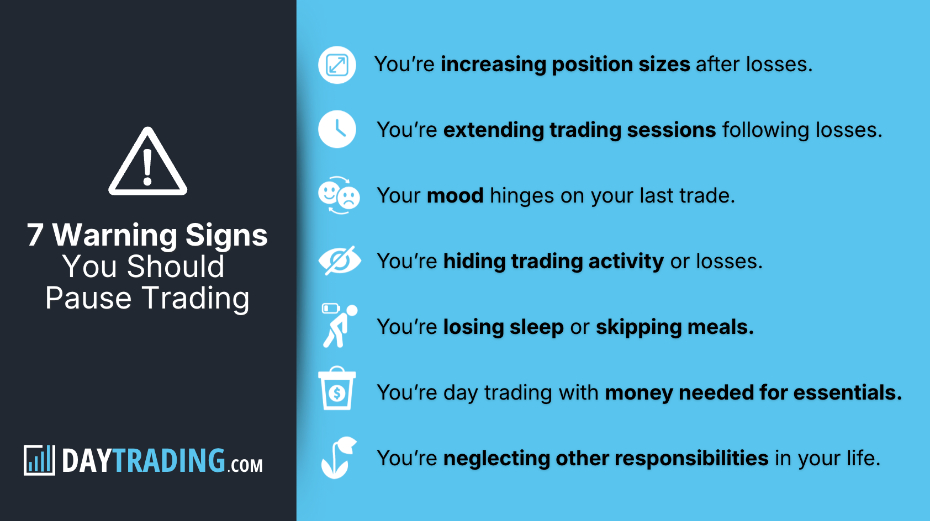
If short-term trading is creating distress, debt, relationship problems, or compulsive behavior, then you should stop trading and seek help.
Where To Go For Help
We have collated the details for useful, independent organizations that can support with trading-related gambling and mental health issues.
| Region | Gambling-Style Support | Mental Health Support | Debt Support |
|---|---|---|---|
| Global | Gambling Therapy (free global online support from Gordon Moody) | Find local, verified support via Find A Helpline | Start with non-profit/government debt advice locally; if unsure, begin via Find A Helpline |
| United States | National Problem Gambling Helpline (24/7; call/text 1-800-522-4700) | 988 Suicide & Crisis Lifeline (24/7 call/text/chat) + NAMI HelpLine | National Foundation for Credit Counseling (NFCC) |
| United Kingdom | GamCare (National Gambling Helpline + chat) + National Gambling Support Network | Samaritans (116 123) + NHS mental health services | StepChange Debt Charity + MoneyHelper |
| Canada | Local gambling/addiction support varies by province; start with a service finder such as ConnexOntario (Ontario) | 9-8-8: Suicide Crisis Helpline (Canada) | Credit Counselling Canada |
| Australia | Gambling Help Online (24/7 support) | Lifeline (13 11 14). | National Debt Helpline |
If you feel at risk of harming yourself or you’re in immediate danger, contact your local emergency number.
FAQ
Can Day Trading Be Done Responsibly?
It can, but only with hard boundaries. Responsible trading is structured: fixed risk per trade, daily loss limits, time limits, breaks, and a detailed plan.
How Do I Know If My Day Trading Is Unhealthy?
Look for warning flags in your behavior: chasing losses, sizing up emotionally, staying glued to the screen, mood swings based on outcomes, secrecy, sleep loss, and debt. If present, pause and seek support.
What’s A Sensible Daily Limit When Day Trading?
A practical starting point is: a fixed daily loss cap, a fixed time window, and a maximum number of trades. The goal is to protect your decision quality and reduce compulsive trades – not chase losses.
Do Responsible Day Traders Still Lose Money?
Yes. Losses are unavoidable with day trading, like most forms of online trading. Responsible trading is about preventing losses from turning into spirals that harm your mental health and financial stability.