




The Securities and Exchange Commission (Comissão de Valores Mobiliários, or CVM) is the primary regulatory body overseeing the securities market in Brazil, including the activities of stock exchanges, public companies, financial intermediaries, and online traders.
Established in 1976, the CVM is an independent agency operating under the Central Bank of Brazil. It plays a crucial role in ensuring Brazil’s financial markets’ integrity, transparency, and efficiency.
In addition to overseeing the B3 stock exchange and over-the-counter markets, the CVM is a staunch defender of investors’ rights. It acts as a shield, protecting traders from fraudulent securities issuance and illegal market activities, earning it ‘yellow-tier’ status in our Regulation & Trust Rating.
However, the CVM does not maintain a public directory of authorized brokers. Instead, we’ve listed the top brokers operating internationally and who are regulated by other reputable financial bodies.
Best Regulated Brokers For Brazilian Traders
Following hands-on testing, these 1 regulated trading platforms emerged as the best:
-
- Demo account
- Min. deposit: $0
- Min. trade: $1
Learn how we test brokers and why you can trust our ratings.
This is why we think these brokers are the best in this category in 2026:
- Interactive Brokers 4.3/5 Interactive Brokers (IBKR) is a premier brokerage, providing access to over 170 markets across 40 countries, along with a suite of comprehensive investment services. With over 40 years of experience, this Nasdaq-listed firm adheres to stringent regulations by the SEC, FCA, CIRO, and SFC, amongst others, and is one of the most trusted brokers for trading around the globe.
Brokers Comparison
| Broker | Minimum Deposit | Markets | Platforms | Leverage |
|---|---|---|---|---|
| Interactive Brokers | $0 | Stocks, Options, Futures, Forex, Funds, Bonds, ETFs, Mutual Funds, Cryptocurrencies | Trader Workstation (TWS), IBKR Desktop, GlobalTrader, Mobile, Client Portal, AlgoTrader, OmniTrader, TradingView, eSignal, TradingCentral, ProRealTime, Quantower | 1:50 (major forex pairs), 1:2-1:4 (equities) |
Community Sentiment
See how users rate these brokers based on the average customer ratings submitted on DayTrading.com, plus ratings from Trustpilot, the Apple App Store and Google Play.
| Broker | Our Users' Rating | Trustpilot Score | Trustpilot Reviews | iOS App Rating | Android App Rating |
|---|---|---|---|---|---|
| Interactive Brokers | 5530 |
Interactive Brokers
Interactive Brokers is one of the best brokers for advanced day traders, providing powerful charting platforms, real-time data, and customizable layouts, notably through the new IBKR Desktop application. Its superb pricing and advanced order options also make it highly attractive for day traders, while its diverse range of equities is still among the best in the industry.
 Christian Harris, Reviewer
Interactive Brokers quick facts
- Demo Account
- ✔Yes
- Instruments
- Stocks, Options, Futures, Forex, Funds, Bonds, ETFs, Mutual Funds, Cryptocurrencies
- Regulator
- SEC, FINRA, CFTC, NFA, CIRO, FCA, CBI, ASIC, SFC, SEBI, JFSA, MAS
- Platforms
- Trader Workstation (TWS), IBKR Desktop, GlobalTrader, Mobile, Client Portal, AlgoTrader, OmniTrader, TradingView, eSignal, TradingCentral, ProRealTime, Quantower
- Minimum Deposit
- $0
- Minimum Trade
- $1
- Account Currencies
- USD, EUR, GBP, CAD, AUD, INR, JPY, SEK, NOK, DKK, CHF, AED, HUF
Pros
- IBKR is one of the most respected and trusted brokerages and is regulated by top-tier authorities, so you can have confidence in the integrity and security of your trading account.
- Interactive Brokers was named 'Best US Broker' for 2025 by DayTrading.com, recognizing its long-standing commitment to US traders, ultra-low margin rates, and global market access at minimal cost.
- While primarily geared towards experienced traders, IBKR has made moves to broaden its appeal in recent years, reducing its minimum deposit from $10,000 to $0.
Cons
- TWS’s learning curve is steep, and beginners may find it challenging to navigate the platform and understand all the features.
- IBKR was fined $11.8m by the US OFAC in 2025 for providing services in sanctioned jurisdictions. It was also fined $125k by FINRA in 2025 for municipal bond disclosure failures.
- IBKR provides a wide range of research tools, but their distribution across trading platforms and the web-based 'Account Management' page lacks consistency, leading to a confusing user experience.
How Can I Check A Broker Is Regulated By The CVM?
While the CVM is the regulatory authority for online brokers in Brazil, verifying their authorization can be more complex than in some other jurisdictions.
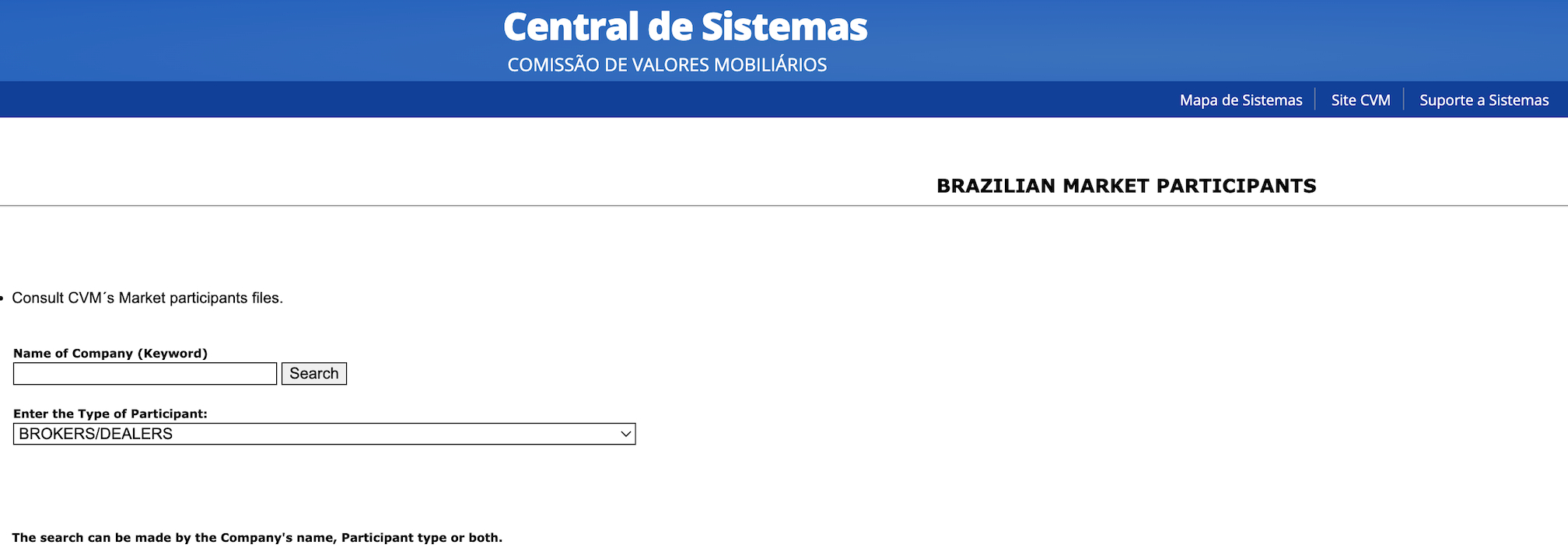
Unlike some regulators, such as the FCA in the UK or CySEC in Europe, the CVM does not maintain a publicly accessible list of licensed brokers and trading platforms.
Instead, you can inquire about a broker’s authorization status through a formal request to the CVM. We have submitted a request to the CVM to enquire about authorized brokers and will update this page with our findings when we receive a response.
What Rules Must CVM-Regulated Brokers Follow?
Only authorized institutions can trade foreign exchange and derivatives in Brazil, according to Law 6,385/76.
While the law doesn’t explicitly classify forex as a security, it mandates CVM oversight for “the issuance and distribution of other derivative contracts, regardless of the underlying asset.” This effectively brings forex trading under the CVM’s regulatory umbrella.
Here are some fundamental rules and requirements that CMV-regulated brokers must follow:
- Brokers must be registered with the CVM and comply with its regulatory requirements to operate legally in Brazil.
- All foreign exchange transactions must be conducted through institutions authorized by the Central Bank of Brazil.
- Brokers must submit regular reports to the CVM detailing their financial status, client transactions, and other relevant information.
- CVM mandates that brokers implement robust risk management systems to protect clients’ funds and ensure market stability.
- Brokers must provide transparent information to clients about the risks associated with online trading and the costs involved.
What Powers Does The CVM Have?
The CVM wields broad authority to not only establish market regulations but also investigate, prosecute, and penalize violations.
When suspicions arise, the CVM can launch an investigation, gathering information, testimonies, and evidence to pinpoint the source of illegal activity. Throughout this process, those accused retain full rights to defend themselves in court.
In 2020, the CVM demonstrated its commitment to maintaining the market’s integrity by cracking down on unauthorized trading activity. It issued a ‘Stop Order’ against Pepperstone Group, an Australian broker, for allegedly operating in Brazil without authorization, reassuring the market of its vigilance.
Bottom Line
Brazilian laws do not explicitly prohibit online trading, but domestic broker options are limited. The CVM doesn’t provide a list of authorized brokers, either, meaning Brazilian traders often seek trustworthy brokers regulated overseas.
Fortunately, many leading players accept and cater to Brazilian clients with Portuguese language support and websites. Additionally, the convenience of using a broker that accepts deposits in Brazilian real (BRL) is a factor to consider for many day traders in Brazil.
Article Sources
- Securities and Exchange Commission (Comissão de Valores Mobiliário)
- Central Bank of Brazil
- B3 stock exchange
- CVM Regulatory Framework
- Market participants files - CVM
- LAW 6.385 (7 DECEMBER 1976) - CVM
- 'Stop Order' against Pepperstone Group - Reuters
The writing and editorial team at DayTrading.com use credible sources to support their work. These include government agencies, white papers, research institutes, and engagement with industry professionals. Content is written free from bias and is fact-checked where appropriate. Learn more about why you can trust DayTrading.com