
Marketing vs Statistical Reality in Trading



- The Marketing
- The Statistics
- Survivorship Bias
- Influencer Marketing
- The Gamification of Trading
- The Institutional Disadvantage (The “Unfair” Fight)
- Examples of Psychological Biases and Logic Fallacies That Can Deplete Your Trading Account
- Taking Trading Seriously
- The One Percent Reality
- The Counter-Productive Glorification of The Grind Mindset
- Piercing the Mirage
- FAQs
Online, trading is often presented as a shortcut to big wins, luxury lifestyles, and easy money. However, the reality is that the majority of retail investors lose money and do so quietly, while those who win are more visible. Compounding the problem is that influencers are often remunerated, in part at least, through commercial arrangements with trading providers.
Yet it is also too simplistic to assume that profitable traders are just lucky. Success in the long term is heavily influenced by a trader’s approach to developing a repeatable edge, maintaining discipline, and following risk management. Loss statistics are also likely skewed by the large numbers who approach trading platforms like a casino.
In this analysis, we look at the truth behind advertising. We compare the narrative with the numbers to find out: how profitable is trading really?
The Marketing
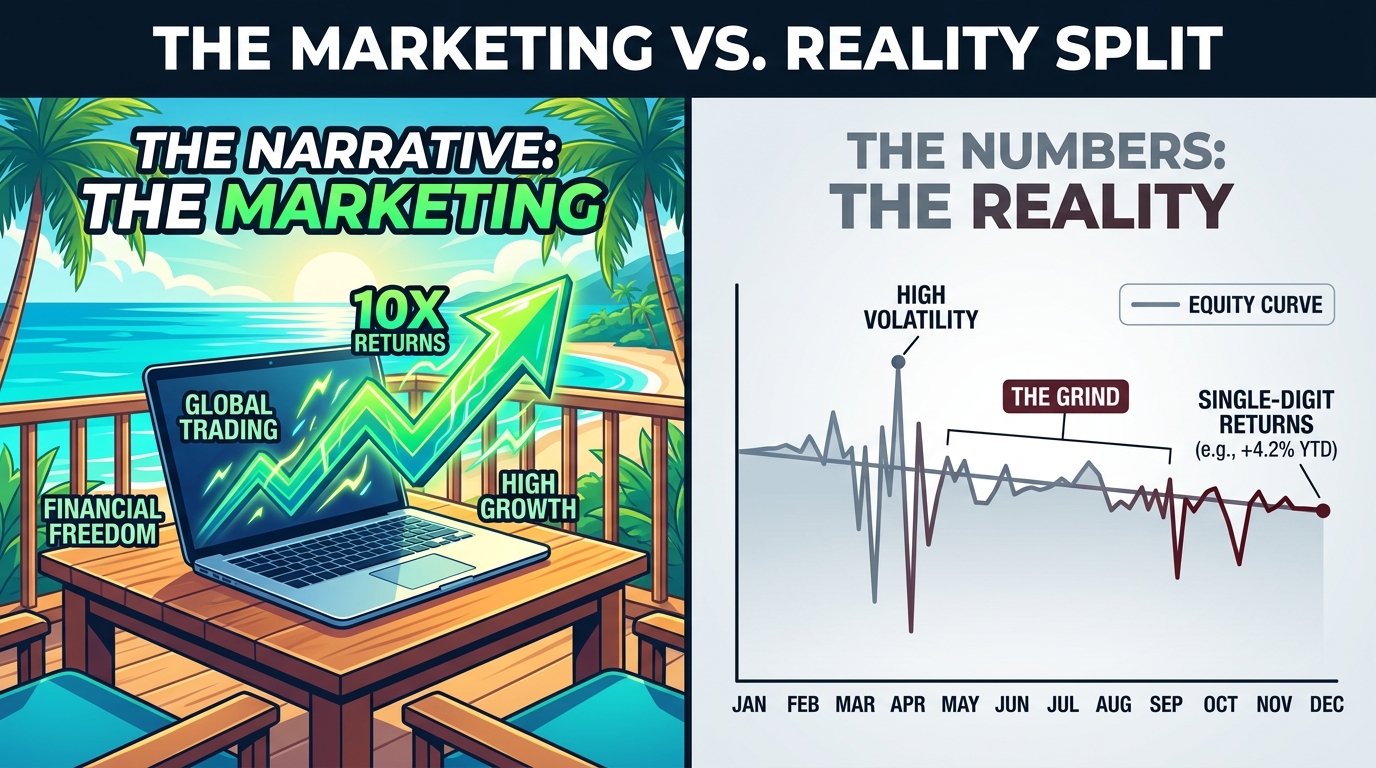
Modern online retail trading is sold with a very simple promise: trade from anywhere, gain financial freedom, and be your own boss. The pictures are familiar. A laptop on a balcony, a chart on a phone next to a pool, a car that costs more than most people’s houses. None of this tells you anything about slippage or margin calls, but it does something much more important for marketing: it sets a mental anchor.
When an industry repeats the same pictures and slogans often enough, new traders start making decisions and expect outcomes based on that anchor instead of looking at the actual distribution of outcomes. If every ad you see suggests that trading means spending a few hours daily day trading and through this quickly attain a lifestyle that looks like a travel vlog, then a more realistic outcome, such as grinding out a single digit annual return with large swings on the way will feel like failure.
The hook works because it lines up with real frustration. Around the world, a lot of people are tired of slow salary growth, inflation, long hours, and relentless commutes. A trading app that offers instant access, bright colors, and the promise that you can “put your money to work” speaks directly to that frustration. Your phone already delivers quick hits of feedback and novelty, and now the same screen says it can deliver income as well.
The key point is that marketing is about human emotions. Financial markets, on the other hand, are about probabilities and risk management.
The Statistics
Once you step away from adverts and look at regulatory data, the rosy picture shifts fast. In the European Union, analyses by national regulators collected by European Securities and Markets Authority (ESMA) showed that between 74 and 89 percent of retail accounts trading contracts for difference (contract for difference, known as CFDs, are a derivative product that let traders bet on whether an asset’s price will rise or fall without taking actual ownership of it) were loss making over the period studied, with average losses per client in the thousands of euros.
Those figures were important enough that ESMA pushed through leverage caps, margin close out rules, and standardized risk warnings for retail CFD products.
In the United Kingdom, risk warnings on broker websites still commonly state that around three quarters of retail clients lose money on spread bets and CFDs, even after those rules. One public example notes that about 70 percent of retail accounts lose money with a major UK CFD provider. More recent commentary from the Financial Times on CFD supervision reports that the Financial Conduct Authority (FCA) estimates roughly 75 percent of retail customers lose money on these products.
And Europe is by no means an exception. The same patterns repeat across the globe. In Australia, a 2026 review by the Australian Securities and Investments Commission (ASIC) found that 68 percent of retail clients trading CFDs in the 2024 financial year recorded net losses, with total losses above 458 million AUD, including 73 million in fees.
In India, a study from India’s market regulator found that 91 percent of individual traders in equity derivatives lost money in the 2024–2025 financial year.
An academic work on day trading in Taiwan shows that more than three quarters of day traders quit within two years, with very few ever achieving consistent profitability.
The exact percentages move slightly by region and product, but they cluster around the same uncomfortable truth: most retail traders who play actively in short term, high turnover, margin exposed products lose money, and they lose at a rate that regulators consider a serious consumer protection problem.
| Regulator and Region | Timeframe and Scope | Estimated Retail Loss Rate | Key Finding |
|---|---|---|---|
| ESMA (European Union) | Multi-year review | 74% – 89% | Average losses per client were in the thousands of euros, helping justify strict leverage caps. |
| FCA (United Kingdom) | Current estimates | ~75% | Loss rates are consistently high across major UK CFD and spread betting providers. |
| ASIC (Australia) | 2024 Financial Year | 68% | Total retail client losses exceeded AUD 458 million, including fees. |
| SEBI (India) | 2024-2025 Financial Year | 91% | Extremely high retail loss rate in equity derivatives trading. |
| Academic (Taiwan) | Long-term study | >75% quit within 2 years | Median day trader loses money after costs, and sustained profitability is very rare. |
Survivorship Bias
If the numbers are that bad, why does trading still look like a success story on social media? Part of the answer is survivorship bias. The minority who do well are visible and noisy. The majority who stop, delete the app and move on rarely post long threads about their experience. And if they do, it is more likely to be an angry review of a particular broker than a glossy post that goes viral on social media.
When research finds that 70-80 percent of day traders quit within two years, and only around 7 to 13 percent are still active after three to five years, it implies that most of the accounts you see online are either very new or very lucky (or simply lying). You do not hear from the person who privately blew up a five thousand dollar account in 2023 and then went back to a simple index fund. You hear from the one trader who turned a meme stock run or a crypto bull cycle into a big win and is now selling a course.
Survivorship bias distorts not only success stories, but also your sense of risk. If your feed is filled with people who appear to be “making it” by trading, you start assigning a higher probability to that outcome for yourself than the population data supports. Marketing knows this very well. It does not need to lie about the existence of successful traders; it only needs to present them as if they were common, rather than rare.
Influencer Marketing
On top of survivor bias, we also need to take the nature of modern influencer marketing into account. Let’s circle back to the previous question: “If the numbers are that bad, why does trading still look like a success story on social media?” Because they lie. Or at the very least, they take great liberties with the truth.
Many of the seemingly successful traders you see on social media are actually not successful traders; they are successful influencers/marketers. They do not earn the bulk of their revenue from trading; it comes from paid partnerships with brokers and other vendors within the trading ecosystem. They can, for instance, earn a commission when people sign up and deposit through affiliate links, or be paid outright to make veiled promotional material.
Up-and-coming influencers hoping to make it big sometimes go the “fake it until you make it” route and pretend to be living a life in luxury from trading profits. In reality, what you see might be a car rented for an hour, a manipulated photo, or carefully cherry-picked material that makes their life seem much more luxurious than it is. There are even photo studios available for rent for influencers who need to look as if they are darting around the world in a private jet.
The Gamification of Trading
App Design as a Trap
Many modern trading apps targeting inexperienced retail traders are built to simulate a gaming experience rather than old-school trading. Many modern mobile brokers use what regulators call “digital engagement practices”. Confetti animations when you complete a trade, animated push notifications whenever a price moves sharply, trader leaderboards, badges, prize draws, and more.
It all exists to pull you back into the app, keep you active, and make you feel rewarded even when you are strictly not being profitable. When we get “rewarded” for simply opening a position, the risk of overtrading increases.
Research commissioned by the UK FCA on trading apps found that these design features tend to increase trading frequency and encourage risk-taking relative to a more neutral interface. Similar studies made for Canadian and European regulators have shown that gamified features, especially social and competitive elements, can push people into more frequent trades and into instruments that do not match their stated risk tolerance.
A recent French media summary of these studies reported that gamified features led to double digit percentage increases in trading volume and risk taking among inexperienced investors.
The effect size is not enormous in any single trade. Some experiments find only a mid single-digit percentage increase in high risk trading behavior when gamification is switched on, with the strongest impact on younger men. But trading is a repeated game. A small push towards more frequent, more leveraged positions, multiplied across months, compounds into a much higher chance of serious losses.
The irony is that the same design tricks used to keep people practicing language on an app or tracking runs on a fitness platform are now applied to high risk financial products. From a firm’s point of view, that means more trades and more revenue. From a trader’s point of view, it means a subtle nudge away from more deliberate decision-making.
The Casino Overlap
It is not accidental that trading platforms and sports betting apps now look similar. Bright colors, swipe gestures, odds-style displays, and live tickers are drawn from the same playbook. The line between placing a bet on a football match and “buying the dip” in a meme stock or a leveraged ETF on your phone has become very thin.
Behaviorally, this matters. When the interface makes a trade feel like a quick move in a casino game, your brain starts treating the capital like points. Small losses feel like rounds rather than part of a long term distribution. The easier it becomes to reload, the harder it is to maintain the mental frame that this is rent money, not play money.
Once that shift happens, the statistical wall from earlier sections becomes more, not less, likely to apply to you.
The Institutional Disadvantage (The “Unfair” Fight)
High Frequency Trading and Algorithms
Retail traders like to say they are “trading the market”. In practice, they are often trading against machines and not against other flesh-and-blood traders making human decisions.
High frequency trading systems operate on time scales that are hard to picture. Orders are placed, canceled and modified in microseconds, sometimes positioned physically close to exchange servers to reduce delay. Algorithmic strategies scan hundreds of instruments for patterns in order flow, pricing anomalies and liquidity gaps that a human staring at a 15 minute chart will never see.
This does not mean every move against a retail position is “manipulation”, but you need to take into account that the other side of the trade often has better tools, faster execution, and more precise hedging options at their disposal.
If you are entering and exiting in seconds or minutes based on basic chart patterns, you are playing a game designed by people whose infrastructure is vastly superior to yours.
Information Asymmetry
An individual trader with a free chart package and a delayed news feed is operating with a very different toolkit than an institutional desk with a Bloomberg L.P. terminal, alternative data feeds, and dedicated analysts. Alternative data covers everything from satellite imagery of oil storage tanks to credit card transaction aggregates and shipping flows.
When you buy a stock because an influencer on X or YouTube says it looks “ready for a breakout”, there is a good chance that any serious news or flow related to that name has already been analyzed, priced and arbitraged by desks that saw it first. By the time it reaches your feed, the information edge is gone, leaving you with the noise.
| Feature | The Retail Trader | The Institutional Desk |
|---|---|---|
| Execution Speed | Seconds or minutes via mobile or web app. | Microseconds with co-located servers and low-latency infrastructure. |
| Market Data | Delayed feeds, basic charting packages, and social-media-driven information. | Bloomberg terminals, direct exchange feeds, and raw order-flow visibility. |
| Alternative Data | Usually none. | Satellite imagery, credit card aggregates, and real-time shipping flow data. |
| Trading Costs | Wider spreads, slippage, and sometimes payment for order flow. | Direct market access and wholesale-style volume pricing. |
The Cost of “Free” Trading
In retail markets, many brokers advertise zero commission trading. But brokers still need to make money, and when they don’t charge you a commission, they do other things to bring in the profits. Wider spreads are common, but also fairly easy to detect and compare.
What is more complicated for a retail trader to notice, and grasp the significance of, is “payment for order flow”, which occurs when market makers pay brokers for the right to execute their retail clients’ orders. The U.S. Securities and Exchange Commission (SEC) has noted that this structure creates incentives that may not align with best execution for customers, because brokers are paid by the firms on the other side of the trade.
Academic work on the “actual retail price” of equity trades finds that higher payments from wholesalers to brokers tend to be offset by worse execution prices for clients. Greater payment for order flow is associated with systematically worse prices after all fees and price improvements are taken into account.
So the cost of “free” is not necessarily zero. You may save a visible five-dollar commission while losing a few cents per share in wider spreads and/or invisible execution slippage. Over thousands of trades, that difference adds up. And with the payment for order flow model, it adds up in favor of the professional counterparty buying your orders.
Examples of Psychological Biases and Logic Fallacies That Can Deplete Your Trading Account
Loss Aversion
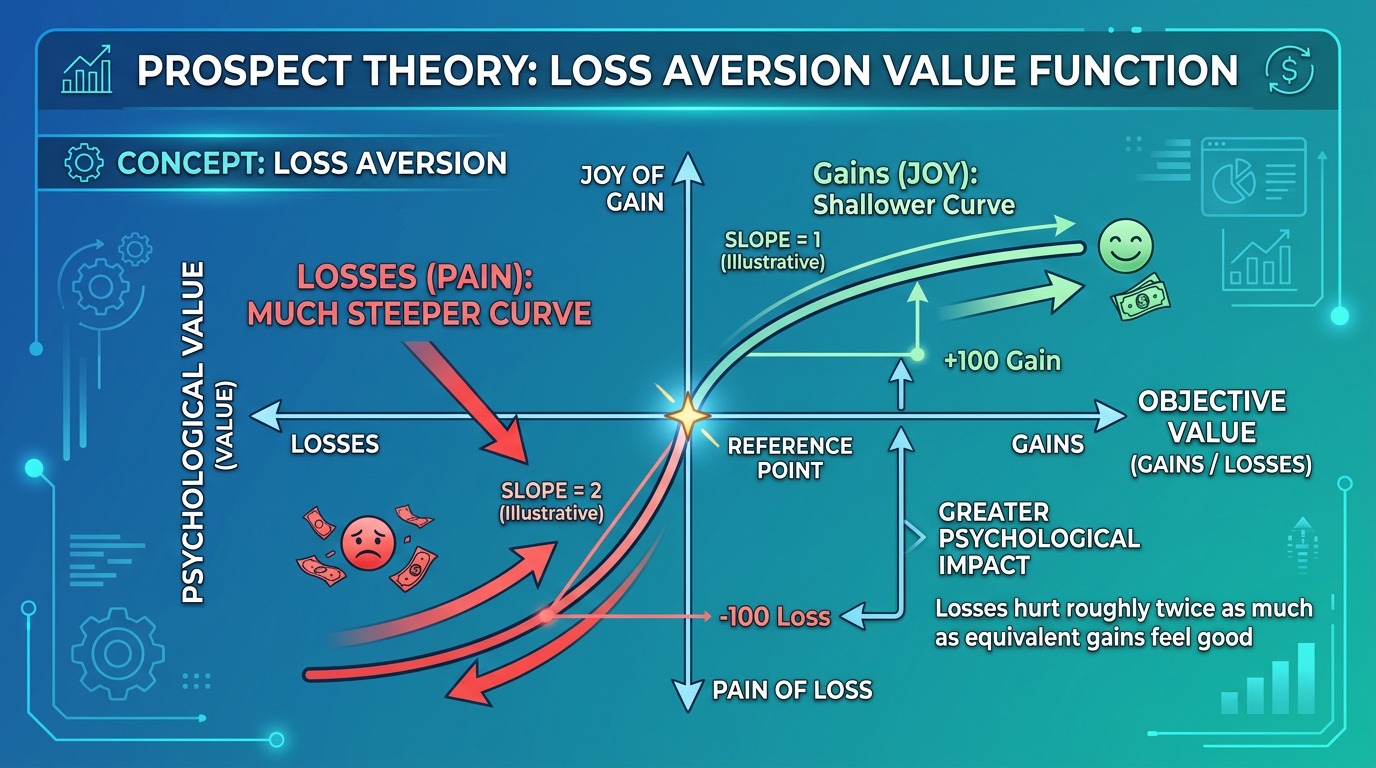
Loss aversion is the tendency to feel the pain of a loss much more strongly than the pleasure of a gain of the same size. Behavioral research suggests that, on average, a loss hurts about twice as much as a gain feels good. In trading, this shows up as the well-known pattern of “cutting winners, holding losers”.
Studies of retail accounts in equities, forex and options all find that investors tend to realize profits more readily than losses, even when tax and strategy considerations would favor the opposite. You take a 10 percent gain quickly because you want to lock it in. You hold a 20 percent loss, because closing it would make the pain real. This behavior distorts the distribution of your results.
A strategy that might have looked fine on paper with symmetric wins and losses turns bad in practice because the winners are truncated and the losers are allowed to expand.
Loss aversion can also lead to “throwing good money after bad” when it comes to trading and investments. Instead of accepting the loss, you dig yourself in even deeper. Instead of accepting that this alt coin wont take off, you invest even more money into it “while the price is still low”.
The Gambler’s Fallacy
The gambler’s fallacy is the belief that a random process “should” even out in the short term. If a coin comes up heads five times in a row, people feel tails is now “due”, even though each flip is independent. The coin has no memory. It does not know it has come up heads five times in a row.
In markets, the gambler’s fallacy shows up as comments like “it has gone down for five days, it must bounce soon” or “this stock has had three red earnings in a row, the next one will surprise to the upside”. There is a subtle comfort in believing that the market owes you mean reversion on your timetable.
Reality does not care about your streak. Price series often show long runs in one direction without any reason to expect an immediate reversal. Professional traders may bet on mean reversion, but when they do, they usually define very clear points at which they accept they were early or wrong.
Inexperienced retail traders influenced by the gambler’s fallacy often increase position size after a series of losses, reasoning that each additional loss makes the eventual win more likely. That is how one bad week becomes a blown account.
You sometimes see the martingale strategy touted as a “fail-safe” trading system online, and the gambler’s fallacy can make it seem very smart on the surface. The martingale system is a strategy originally designed for gambling, and the basic idea it to double your stake after every loss. The strategy was first popularized in France for almost even-odds bets on the roulette, e.g. red/black, high/low, and even/odd.
Example: You are betting on red at the roulette table.
- Bet $1 → lose
- Bet $2 → lose
- Bet $4 → lose
- Bet $8 → win
- Net result: $7 down + $8 up = a $1 total profit
Traders adapted martingale by applying the same “double after loss” logic to trading. If a trade loses → increase position size on the next trade. Continue increasing until a winning trade occurs. The winning trade should (in theory) recover all prior losses.
In reality, the martingale strategy can quickly wipe out a trading account, since the losses grow very fast. $100 → 200 → 400 → 800 → 1600 → 3200 → 6400 → 12800 → 25600. If you start with a $100 dollar trade size, it only takes a few losses in a row to bring you up to a $25k+ trade size. The martingale system assumes you have infinite resources at your disposal and can keep doubling for a very long time.
Some inexperienced traders think they will be able to use leverage to increase trade size for as long as it takes, and get a hard reality check when they run into to margin requirements, retail leverage caps, and forced liquidations.
| Trade Number | Outcome | Trade Size Required | Cumulative Net Loss (Before Win) |
|---|---|---|---|
| Trade 1 | Lose | $100 | -$100 |
| Trade 2 | Lose | $200 | -$300 |
| Trade 3 | Lose | $400 | -$700 |
| Trade 4 | Lose | $800 | -$1,500 |
| Trade 5 | Lose | $1,600 | -$3,100 |
| Trade 6 | Lose | $3,200 | -$6,300 |
| Trade 7 | Lose | $6,400 | -$12,700 |
| Trade 8 | Lose | $12,800 | -$25,500 |
| Trade 9 | Win | $25,600 | Result: $100 Total Profit |
Overconfidence
A widely cited study of retail day traders in Taiwan found that over 75 percent of traders quit within two years and that the median trader lost money after costs, while only a tiny minority earned large profits. Yet surveys consistently show that a majority of active traders believe they are above average.
Recent research on retail options trading around earnings in the United States finds that small traders on average lose between 5 and 14 percent on these trades, largely because they buy options that are too expensive given the actual volatility that materializes. Many of these positions are placed in the belief that the trader has “done the research” or “understands the story”.
Overconfidence leads people to trade too often, to size too aggressively, and to ignore base rate statistics because they are convinced they will be in the minority who beat the odds.
Taking Trading Seriously
Many people get into trading because they think it will be easier than holding down a conventional job. This idea is boosted by heavy marketing campaigns that stress how nice it is to be your own boss, leisurely watching price charts from a beach bar in Bali. In reality, successful traders typically approach trading as a serious task that requires knowledge, continuous learning, and the ability to stick to strict risk-management routines even when emotions are running high. It takes a lot of time and effort to build a valid trading strategy, including risk-management rules, and then continuously monitor and evaluate it.
Successful traders know that the margin of error is thin, and that attitude shows up in how they talk. They focus less on “setups that never lose” and more on expected value, risk-adjusted return and capital preservation. A trading strategy that is based on “never lose” is not a trading strategy that is rooted in reality.
The basic question is simple: Do you have an edge? An edge is a repeatable statistical advantage. It might be a pattern that leads to a small positive expectancy after costs over hundreds of trades, or a process for finding mispriced assets with better than benchmark risk adjusted returns.
Without an edge, trading is speculation with negative expected value once costs and mistakes are included. That does not mean you will never have winning streaks. It means that across enough time and trades, the accumulated costs of spreads, commissions, swap charges, fees, and your own behavioral errors will pull you down.
Viewing trading as a serious task makes you aware of how much unglamorous work it involves. You need records, position logs, tagged screenshots and performance summaries. You need to know which setups work for you, in which markets and conditions, rather than relying on whatever indicator combination is trending on social media this month.
Expectation is where many traders lose before they start. If your implicit goal is to turn a small account into a life-changing sum in a year, the strategies you gravitate towards will usually be high turnover and high risk, and you are more likely to fall for some trendy get-rich-quick scheme.
Your behavior will reflect your goal, with large position sizes in relation to your account balance, pressure to trade every day, and a constant feeling that you are behind schedule. Serious traders with a longer-term perspective often aim for something much less dramatic in percentage terms. Beating a savings account or a basic index by a few percentage points per year after costs, with tolerable drawdowns, is already a demanding target when you factor in real-world constraints.
Reframing the goal from “get rich quick” to “avoid ruin and slowly compound” changes which opportunities look attractive. It also changes how you respond to the long, dull stretches where the best trade is no trade. You might even realize that trading is not the right choice for you at this stage of your life, and that putting parts of your monthly paycheck into a low-cost index fund is actually a better decision, all things considered.
The One Percent Reality
When traders talk about the “one percent” of consistently profitable participants, the discussion often drifts to secret indicators or special order flow tools. In practice, a lot of that small group shares a more boring habit: they treat risk per trade as the main variable they control.
Many serious and long-term profitable traders cap risk per position at a small fraction of account equity, commonly at one percent, though some of our team are more conservative, and opt for closer to half a percent in their own trading.
But the number itself is not magical. The discipline is. A strict 1% or 1.5% or even 2% cap means you can survive longer losing streaks, learn from them and still have capital left to deploy when conditions turn.
Contrast that with the behavior of new traders who regularly risk five or ten percent of their account on a single idea because they “really believe in this one”. With that sizing, a run of bad luck or poor judgment pushes the account into a hole that is mathematically very hard to climb out of.
This is the boring reality behind so many of the success stories. The small group of traders who remain in the game for years, making consistent profits, did not get there by believing their “gut feeling” or “special trading signals” would prevent them from ever losing money on any trade. They got there by making sure no single loss, or cluster of losses, could push them out of the game.
The Counter-Productive Glorification of The Grind Mindset
In our articles about trading, we talk a lot about the importance of putting in the time effort, doing your homework, and consistently work to evaluate your strategy and become a better trader. Regrettably, some novice traders will interpret that as “trade as much as possible, and the markets will reward your hard work”.
This is a type of presenteeism that you might have grown up with, and that can be hard to walk away from. The idea that someone who works 12+ hours is automatically more productive than someone who works 8 hours, and that the universe will somehow magically reward you for your efforts. This type of thinking can become extremely counterproductive for inexperienced traders to who hear “you need to work hard” and translate it into “I need to do 12+ hour trading sessions”.
There are a lot of blogs, forums, YouTube channels and general social media influencers who glorify “the grind mindset” and make that trading lifestyle sound both smart and somehow morally superior, when they actually just want you to trade a lot because it makes more money for the broker and consequently the affiliate marketers.
A lot of traders who are smart enough to realize that the Bali Beach Bar trading adverts are rubbish will, regrettably, fall for the grind mindset marketing. Instead of spending time and effort to actually learn more and evaluate their actions, they fall into the mirage of an oversimplified version of the “work harder” theme, where they think that each hour spent in front of the screen, actively trading, will bring them closer to their financial goal.
Trading is not a job where you get paid by the hour and showing up is the most important thing. It is about placing yourself in a position where you can distinguish between a good setup and a bad one, and execute in accordance with your trading strategy.
Some of your absolutely most important decisions will be the ones about walking away. Walking away from a setup that does not match your strategy even though your gut feeling would love for you to jump in. Walking away from the screen because you are too tired, sick, or preoccupied to trade at the top of your game today.
Piercing the Mirage
Your broker earns each time you trade, since each trade generates an income for the broker. You only earn when you trade well. Those two goals line up only occasionally. For your broker, you trading frequently is better than you carefully waiting for exactly the right conditions that matches your detailed trading strategy.
It is therefore not surprising to see that a lot of broker marketing pushes traders towards more trades with emotional stories, luxury imagery, and app features that feel like games. Piercing the mirage does not have to involve walking away from trading entirely. It means dropping the idea that the influencer promoting a certain broker or strategy, or the confetti that appears when you open a position, has anything to do with your odds of long-term success.
Before opening another account or funding the one you have, it is worth asking yourself some hard questions:
- Am I here because a brand and a story made this look attractive? Or am I here because I can point to a specific, tested statistical edge, and a risk process that keeps me around long enough to let that edge play out?
- Am I here because I believe I will get rich quick, or because I am willing to put the effort into becoming a long-term profitable trader over time, even if it never turns me into a millionaire?
The honest answers to these questions will help you decide your next step.
FAQs
What Percentage Of Retail Traders Lose Money On CFDs And Active Trading?
According to data collected by the European Securities and Markets Authority (ESMA), between 74% and 89% of retail accounts lose money trading CFDs.
This pattern holds globally: the UK’s Financial Conduct Authority (FCA) estimates roughly 75% of retail customers lose money on these products, while Australia’s ASIC reported a 68% loss rate among retail clients in the 2024 financial year.
The success rates for other financial instruments are similar to the success rates for CFDs..
If The Failure Rate Is So High, Why Does Trading Look So Successful On Social Media?
The perception of widespread success is heavily distorted by survivorship bias and influencer marketing. The vast majority of traders who lose money simply quit quietly, while the small minority who win (or get lucky) are highly visible. Furthermore, many trading influencers generate their wealth through broker affiliate commissions and paid partnerships rather than actual trading profits, creating a financial incentive to project a false lifestyle of luxury.
However, it is inaccurate to assume that the small minority who succeed are merely lucky. Long-term profitability is heavily dependent on strict discipline and risk management. A large percentage of the failure rate consists of novice participants who are lured by marketing and enter the market without a tested strategy or an understanding of the work required.
While success is never guaranteed – even for those who put in genuine effort – the overall statistical failure rate is undoubtedly dragged down by a massive influx of participants treating the market like a casino rather than a serious discipline.
You can significantly improve your chances of success by applying effort, strict discipline, and risk management, especially compared to those who jump into trading without applying that same level of dedication and control.
Why Do Modern Trading Apps Encourage Users To Trade More Often?
Many modern trading platforms use digital engagement practices, or gamification, to increase trading frequency. Features like confetti animations, badges, and push notifications simulate a gaming environment that rewards the act of opening a position, regardless of its profitability.
Studies show these design choices systematically push inexperienced investors toward higher-volume, higher-risk trading behavior, which ultimately generates more commission revenue for the broker.
Are “Zero-Commission” Trading Platforms Actually Free?
No. Brokers offering zero-commission trading typically generate revenue through alternative methods, such as wider bid-ask spreads or “payment for order flow” (where market makers pay brokers for the right to execute retail orders).
This structure often results in worse execution prices for the retail trader. Over thousands of trades, these hidden costs create a significant statistical drag on an account’s performance.
What Is The Main Difference Between A Gambler And A Serious Trader?
A serious trader operates based on mathematical probability and strict risk management, whereas a gambler is often driven by emotion and logic fallacies like the “gambler’s fallacy” (the belief that a losing streak must inevitably end).
Consistently profitable traders typically cap their risk to a very small fraction of their account equity – often around 1% per trade – ensuring that a normal sequence of losses cannot destroy their capital.