
Best Capital Markets Authority (CMA) Brokers 2026


Kenya’s Capital Markets Authority (CMA) was established in 1989 as a statutory agency under the Capital Markets Act Cap 485A. Operating under the National Treasury, the CMA’s primary mandate is to promote market integrity, protect traders, and foster fair and efficient capital markets in Kenya.
The CMA licenses and oversees various trading brokers, ensuring they comply with the legal and regulatory framework. A growing number of brokers have sought authorization from the CMA in recent years, including IC Markets and Pepperstone, as Kenya emerges as the leading centre for forex and CFD brokers in Africa.
We’ve assigned the CMA ‘yellow-tier’ status in line with our Regulation & Trust Rating, meaning it provides “strong investor protection”, especially for Kenyan traders, though it’s not as robust as ‘green-tier’ regulators.
We’ve pinpointed the best brokers regulated by the CMA. Our experts have verified the credentials of every recommended platform on the regulator’s List of Licensees.
Best CMA Brokers
Sorry, there are no brokers that accept traders from your location (United States). If this location is incorrect, please change it.
Methodology
To identify the top brokers regulated in Kenya, we:
- Scoured our directory of 142 brokers to find those who claim to be regulated by the CMA.
- Put their company credentials through the List of Licensees to verify they were authorized.
- Ranked them by their rating, combining 200+ data entries with the observations of our testers.
How Can I Check A Broker Is Regulated By The CMA?
Confirming whether a broker is regulated by the CMA is straightforward:
- Navigate to the CMA’s List of Licensees.
- Expand the drop-down section ‘NON-DEALING ONLINE FOREIGN EXCHANGE BROKER.’
- View regulated broker details, including company and trading name, registered address, and license number.
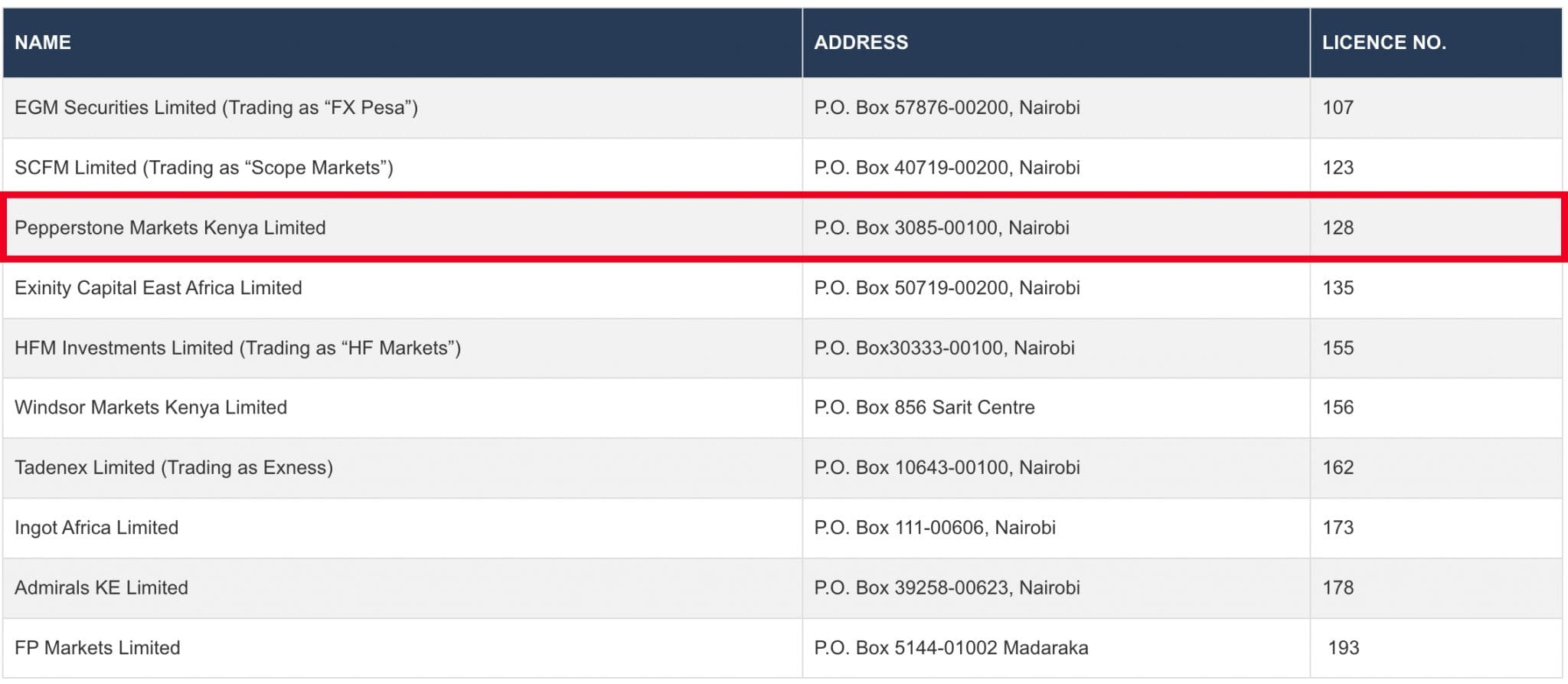
To show you how this works in practice, below are the results of a search I did to check that Pepperstone, a terrific broker for day trading featuring lightening-fast execution and razor-sharp spreads, is authorized to operate in Kenya.
What Rules Must CMA-Regulated Brokers Follow?
Brokers in Kenya must obtain a license from the CMA to operate legally in the country. The licensing process is rigorous and ensures that brokers meet high financial stability, integrity, and competence standards.
It involves a thorough review of the broker’s financial records, operational structure, and business practices. The CMA also conducts background checks on the broker’s key personnel to ensure they have the necessary qualifications and experience.
At the time of writing, the CMA has licensed 10 non-dealing forex brokers to operate in Kenya, with the largest brands including firms like Pepperstone and FP Markets. That said, the List of licensed brokers fluctuates as the CMA grants new licenses and revokes non-compliant ones.
The CMA establishes clear criteria for online brokers seeking a Kenyan license. The fundamental rules and requirements that CMA-regulated brokers must follow encompass financial stability, operational structure, and responsible business practices:
- The CMA has a minimum capital adequacy requirement set at 30 million Kenya shillings, ensuring brokers possess sufficient financial resources to operate responsibly.
- All licensed brokers must maintain a physical presence within Kenya to facilitate oversight, with nearly every CMA-regulated broker we’ve evaluated maintaining an office in the capital, Nairobi.
- The CMA mandates qualified leadership with a solid financial background, promoting responsible management of client funds.
- Obtaining a CMA license can take several months, reflecting the thoroughness of the CMA’s review process.
- Regulations dictate that all business in Kenya is conducted in the local currency, the Kenyan shilling.
Yet while the CMA provides strong trader protections, especially for Kenyan traders, it’s not yet as robust as other prominent regulators, such as the FCA in the UK or ASIC in Australia.Its shortcomings centre around its relatively limited resources to enforce rules, sometimes slow and inconsistent penalties, and the country’s less developed financial markets.
What Powers Does The CMA Have?
The CMA plays a vital role in safeguarding Kenyan traders. They achieve this by recommending that new traders only participate with brokers licensed by the CMA.
The CMA’s regulations extend to Kenyan soil, and some offshore brokers continue to solicit Kenyan investors despite needing a CMA license. While these overseas brokers might be regulated elsewhere, the CMA has advised many times over the years against using them due to the lack of CMA oversight.
The CMA actively monitors and enforces compliance among licensed brokers. In recent years, it has taken several enforcement actions, including imposing fines and penalties on brokers who violate regulatory requirements.
For instance, In October 2018, Kenyan authorities issued a cease and desist order to Pesos Capital Markets Limited. The order alleged that the firm was operating as a fund manager and an online foreign exchange dealer without the necessary licenses required by the Capital Markets Act.
Public notices and investor alerts are regularly issued to inform the public about unlicensed entities and potential scams.
Bottom Line
The CMA is the guardian of Kenya’s capital markets, ensuring their integrity and fostering growth. This includes regulating brokers to promote fair and transparent practices.
The CMA implements a licensing process that only qualified firms can pass. They maintain constant vigilance through ongoing monitoring of licensed brokerages, ensuring adherence to regulations. Additionally, the CMA can take decisive enforcement against any broker violating the established rules.
When choosing a CMA-licensed broker, you benefit from the CMA’s regulations to safeguard Kenyan traders. Trading with an unlicensed broker removes these protections, leaving Kenyan traders with limited avenues to seek compensation or resolve disputes.