
Safety Hub



- Safety Is a Process
- Regulation, License/Authorization, and Broker Verification
- What Happens to Your Trading Account Assets If Your Broker Becomes Insolvent?
- Account Security, Phishing, and Social Media Risk
- Execution Quality, Slippage, and Conflicts of Interest
- Marketing vs. Statistical Reality in Retail Trading
- Common Scams
- Scam warnings
- Reporting Suspicious Activity to DayTrading.com
- Recommended Reading
This Safety Hub is the central reference point for the part of trading that matters more than actual strategy and product choice. If you do not take steps to protect your safety as an online trader right from the start, you are much more likely to end up losing money in ways that no trading plan can outpace.
There are many important questions that need to be answered long before you make a deposit or share any sensitive personal data. Regrettably, many inexperienced traders do not fully understand the importance of these questions until something has already gone wrong and they are fighting in vain to get their money back.
Examples of issues that we will cover in this section:
- Broker regulation and licensing, and why it is so important.
- Why you need to pay close attention to exactly which legal entity is your contractual counterpart when you sign on with a broker.
- How money and other assets in your trading account will be treated if the brokerage company fails. This includes topics such as mandatory client fund separation, capital requirements for financial services firms, and third-party investor protection schemes.
- Where does a complaint go when the broker’s support department stops answering you or is clearly just making excuses and stalling for time?
- Rules regarding leverage and negative account balance protection, and how they can differ depending on jurisdiction and your classification as a retail trader vs. a professional trader.
- How a lot if seemingly unbiased “advice” directed at retail traders is actually just a marketing funnel.
- How many social media fintech profiles work hard to give inexperienced traders unrealistic expectations and ignore safety measures.
- How a conflict of interest between you and your broker can increase the risk of platform and price feed manipulation. Is this slippage normal market behavior or something worse? Can this price feed actually be trusted?
- How will this broker and platform safeguard my money and information from hacker attacks and similar threats?
- How can I know I am dealing with the real brokerage company and not with an impostor?
These are all examples of questions that sound much more boring than learning about trading strategies and leverage utilization, but skipping this step of the vetting process can be really harmful. A broker can look really polished and come recommended by various high-profile finfluencer but still be a really poor choice.
A global brand holding licenses from top-tier financial authorities can re-route and nudge you to sign up with a company based in a jurisdiction with much weaker trader protection laws. A reputable brokerage company can have its website copied by a clone site scammer. A famous broker can have poor execution practices, weak account security controls, or support that goes quiet at exactly the wrong moment. None of these issues is adequately compensated by glossy branding, finfluencer bonus codes, or a low minimum deposit.
This hub exists on DayTrading.com to make the layers of trader safety and security easier to assess. The aim is to explain things such as which legal, technical, and practical protections that do exist for traders, their scope and limits, how legal recourse will differ by jurisdiction, and how a trader can verify the important points in a reliable way.
We aim to cover a wide range of subjects, including regulation, account security routines, scam risks, finfluencers and social media promotions, conflicts of interest, client fund protection, digital security, execution transparency, complaints handling, and official reporting paths.
Each section below explains the part of trader safety it covers, why it matters, and what a careful trader should be looking for. Some readers will come here before opening an account. Others will come after a withdrawal issue, a suspicious call, or a trade that filled badly. Both are normal. Comprehensive safety work is rarely only about prevention or only about damage control after the fact. It will instead consist of a careful combination of both, and traders frequently find themselves doing both tasks to protect their money and peace of mind.
Safety Is a Process
The safest way to use a broker is to never assume that one positive signal settles the matter. Regulation is important, but it has to be verified with the applicable financial authority, and you should never rely solely on information from the broker (we certainly don’t).
- A badge on a site is not proof of anything.
- Segregated accounts matter, but they are not the whole answer to insolvency risk.
- Compensation schemes can be helpful, but they have limits and conditions.
- Negative account balance protection comes with both pros and cons.
- Two-factor authentication improves security, but not if the user hands over control to a fake support agent.
- And so on.
That is why this Safety Hub is organized as a multi-step process rather than as a quick-fix tool. Relying on a single factor, e.g. the fact that the brokerage brand is well known, is never enough. You need to go through the boring steps and check every detail, and then remain vigilant.
This will involve things such as verifying the entity, checking the protections that actually apply to that entity, securing account access, understanding how the broker handles orders and where conflicts may sit, learning about common scams and how to spot warning signals, keeping records that you store independently from the trading platform, and escalating through the right paths when something goes wrong. Continue to learn and stay on your toes, because selecting a trustworthy broker is only part of the program, as security awareness and routines need to be present at all times.
That is the logic behind this central page and the wider hub. Safety is not one badge, one license number, one trust score, or one warning label. It is the habit of checking the parts that usually go unchecked. That habit is much more burdensome than simply following an affiliate link posted by a high-profile finfluencer, but it is also far more useful.
Regulation, License/Authorization, and Broker Verification
This section of the hub deals with questions that should be settled before anything else. Who exactly is this broker, exactly which legal entity will be your counterpart, and where is that entity based and licensed?
This matters because broker branding is often simpler than the brokerage company group structure. A single trading brand may operate through a network of many different legal entities across different jurisdictions. This is not a warning signal in itself, as it can actually be a good sign. Reputable brands often hold licenses from several different financial authorities, and they can use different companies to ensure that each company can comply with the specific applicable legislation.
What causes problems for inexperienced traders is when the official brand’s website leans heavily on showcasing their badge from one respected regulator, while the account agreement assigns the client to a different company operating under a different financial authority. We cannot tell you how many times we have seen this while testing brokers.
It is also common for foreign traders to believe that if they just sign on with a UK FCA-licensed company, they will get exactly the same protection as a trader actually living in the UK. This is not automatically the case, and handling jurisdictional complexity can be difficult even for seasoned traders.
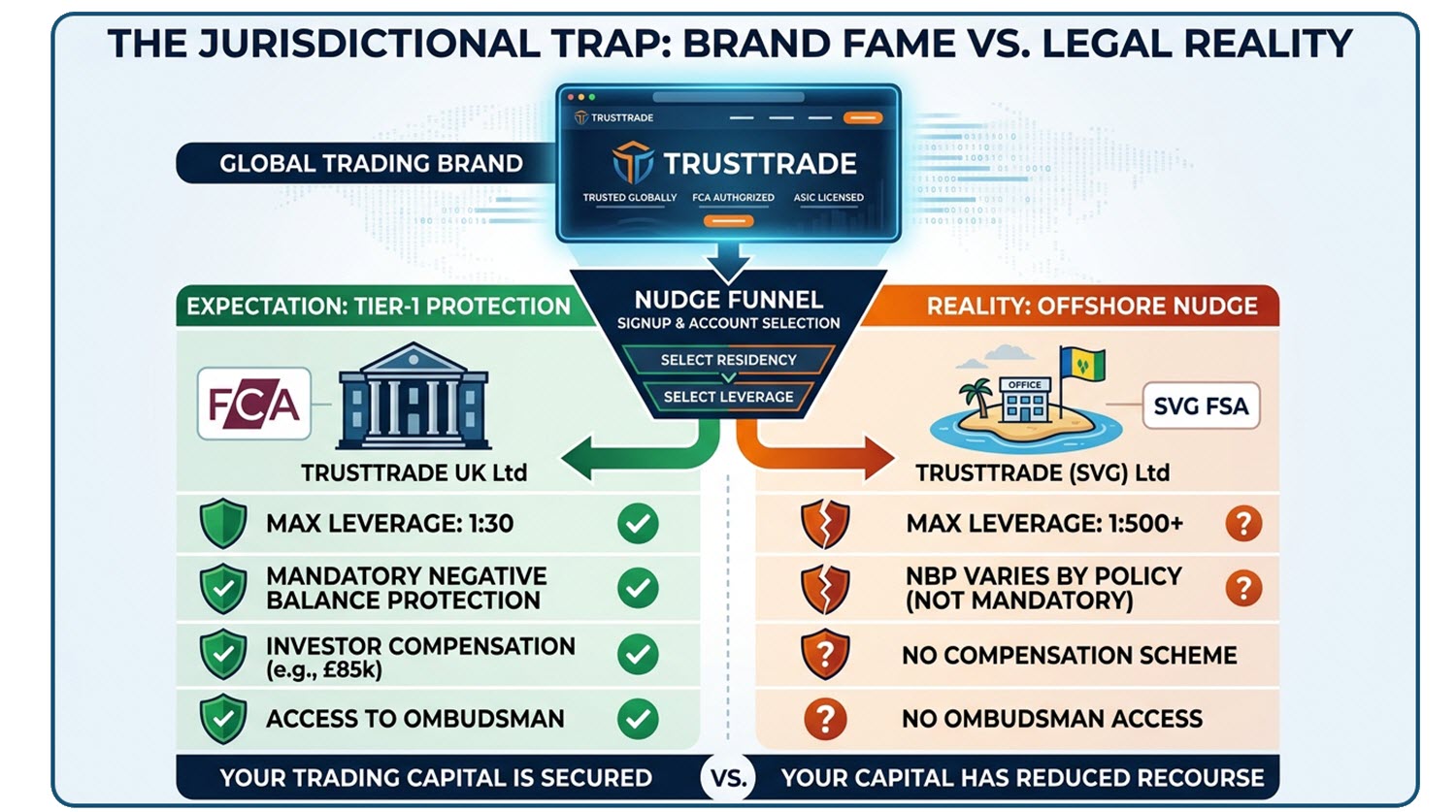
It is important to understand that exactly where a company is based, regulated and licensed matters a lot when something goes wrong. Many broker groups segment clients by factors such as country, region, client category, product type, or marketing campaign, and send them through different funnels.
A user might read reviews of a well-known Australian arm, but then be nudged onto a company (under the same brand) based in the Seychelles or Belize because of residence or selected leverage preferences. The logo is the same, but applicable regulation and access to legal recourse are not, and the compensation scheme covering traders in your home country may not be accessible to you when you have signed up with a company based abroad. The verification process needs to pay close attention to entity-level disclosure rather than just brand-level reputation.
Verify With the Applicable Financial Authority
It is important to verify legal status at the source (the licensing authority) rather than believing information posted on the broker’s own website. Focus on the official register, not marketing claims.
A proper broker verification process should not stop at the license number printed on the broker’s website. It should compare the legal entity name, the license or registration details, the website domain (very important), and the contact details actually being used in emails, phone calls, and onboarding documents.
Traders need to know what to compare:
- They should check whether the name on the account agreement matches the name on the register.
- They should check whether the domain on the website and the contact details in the onboarding flow line up with the authorized firm.
- They should check whether the permissions are relevant to the service being offered.
- They should check whether the firm is authorized for retail business or whether the permissions are narrower than the marketing implies.
Avoid Clone Scams
By following the website domain posted in the official registry (the one kept by the applicable financial authority), you can prevent falling into the claws of a clone firm, i.e. a scammer who has copied a reputable broker website (including the correct license number) and published it on a similar domain.
Clone scams manage to bypass many of the more rudimentary checks, since the scammer simply steals the name and license number of a reputable firm that holds a real license. The safest course of action is therefore to go to the broker website that you find in the financial authority’s list of licensed brokers.
Please note that AI all too often links to clone websites instead of the official website.
During our studies, we have found that it is relatively common for AIs to reference and link to clone versions of broker websites in their replies. This is very dangerous, as you get the link with an expectation of it being trustworthy while you’re being presented with nothing more than a scam. This is especially common when the entity name and the official website name are different.
Clone firms steal the details of genuine firms to look legitimate, and this type of trading scam has increased a lot in recent years. Only use the contact details on the official registry and do not trust details in a suspicious email, advert, or unsolicited call. This is one of the most important habits a trader can build. A scammer wants the victim to verify the name, not the contact path. If the victim does only half the job, the scam still works. This is a point that many traders only learn the hard way: a real license number can appear on a fake site.
Examples From Around the World
United Kingdom
In the UK, the FCA provides both the Financial Services Register and the FCA Firm Checker. The Register is the fuller public record. The Firm Checker is a consumer tool that helps users confirm whether a firm is authorized and whether it has permission to offer the products or services being pitched. We have used the FCA registers to verify brokers’ UK credentials and permissions more than 560 times.
The FCA also notes that the simpler checker does not include every detail, such as some restrictions, historic fines, the right to handle client money, or permissions aimed only at professionals. That distinction matters because a superficial search result can look reassuring while the deeper register entry tells a more mixed story.
The FCA is considered a ‘green tier’ body in our regulator classification system, offering very strong retail safeguards and supervision of authorized brokers.
Australia
In Australia, the starting point is ASIC’s Professional Registers Search. ASIC states that users can search several registers at once and check whether a person or organization is registered or licensed to provide a service.
We have used this extensively in the years we’ve been assessing brokers’ regulatory authorizations in Australia, with more than 460 checks of ASIC’s registers performed by our team.
The ASIC is considered a ‘green tier’ body in our regulator classification system.
South Africa
In South Africa, you should verify with the Financial Sector Conduct Authority (FSCA). Use the FSCA Financial Service Providers (FSP) search to find out if a firm or individual is licensed as a Financial Services Provider (FSP). You can review license status, approved categories of financial services, and key individuals and firm representatives.
We have verified the FSCA details of online brokers more than 130 times. The search facility has been revamped and improved over the years – now even absolute beginners should have no issues using it before opening a trading account.
The FSCA is considered a ‘yellow tier’ body in our regulator classification system, offering fairly strong retail safeguards and supervision of authorized brokers.
What Happens to Your Trading Account Assets If Your Broker Becomes Insolvent?
Once the legal entity has been identified, the next question is straightforward and serious: what happens to client money if the broker fails, e.g. files for bankruptcy or corporate restructuring?
This part of the hub covers minimal capital requirements, segregated accounts, compensation schemes, and related insolvency questions. A strict financial authority that takes trader protection seriously will typically take a multi-prong approach. There will be minimal capital requirements for brokerage companies, mandatory client asset segregation, strict rules for reporting and auditing, and an independent investor compensation scheme that can step in if the other safety mechanisms fail because a broker violates the rules.
Minimum Capital Requirements for Brokerage Firms
Many financial authorities will require a brokerage company to keep its own capital above a certain limit, and inform the authority (often within 24h) if the capital drops below this level.
Minimum capital requirements exist because a broker isn’t just a middleman; it temporarily holds client money, processes trades, and absorbs operational risks. Regulators want to make sure the firm has enough of its own financial cushion to handle problems without putting clients at risk.
When a company has enough money, it is better equipped to absorb losses and shocks. Brokers can face losses from operational errors, technology failures, market gaps, or counterparty defaults. A properly capitalized broker is less likely to break the rules and dip into client funds to survive hurdles.
A well-capitalized broker is also more likely to survive through conditions where thinly capitalized firms would collapse, and this helps ensure operational continuity. The authorities want brokerage firms to continue to run normally even during moments of stress. Last but not least, requiring significant upfront capital makes it harder for underfunded or bad actors to open and maintain licensed brokerage firms, and this raises the overall quality of brokers.
Mandatory Separation of Company Assets From Client Assets
Strict financial authorities will typically require that client (trader) assets are kept completely separated from company (broker) money. In short, money that does not belong to the company should not be co-mingled with money that does belong to the company. The segregation rules protect ownership of client funds, while the capital requirements we explained above protect the financial health of the broker itself. Together, they reduce both the likelihood of failure and the damage if a failure occurs.
Mandatory segregation of client funds has several benefits. It reduces the risk of mistakes and deliberate embezzlement, and it also makes it much easier for traders to get their money back if the firm becomes insolvent. The idea is to never allow client funds to be used as ordinary working capital (not even temporarily) or in any way become entangled with the firm’s own finances.
In most legal systems, trader assets that have been kept segregated from company funds will automatically be treated as belonging to the trader if the firm runs into insolvency issues. Segregated funds are not part of the bankruptcy estate because, in legal terms, the firm is holding that money in a custodial or trust-like capacity. Creditors of the firm (banks, suppliers, etc.) generally have no claim to those assets since they can only claim company money. Typically, mandatory segregation also comes with very strict accounting rules, so bankruptcy administrators can easily identify who owns what without lengthy disputes.
When trader money and company money have been co-mingled, the situation gets much messier. Traders still have their claims, but they have to stand in line with everyone else. And some of the entities in that line can have a claim with a higher priority, e.g. a bank that has given a secured loan to the firm. After creditors with priority have been paid, whatever remains is distributed proportionally across all the remaining creditors, including the traders. In reality, this often results in traders receiving only a fraction of their funds or nothing at all. After all, if there had been enough assets within the company to cover all claims, it would not have filed for bankruptcy.
In some jurisdictions, clients can try to “trace” their funds through accounts even after co-mingling, but this process tends to be complex, costly, and often unsuccessful if the money has been moved or spent.
In short, segregation preserves legal ownership and traceability, which lets clients recover their money directly. Co-mingling destroys that clarity, turning clients from owners into creditors, which significantly weakens their position in insolvency.
Within this context, it can also be good to remember that a reputable broker can tell you where your money will be held. We often see vague claims such as “tier 1 bank segregation” posted in broker promotional materials, but what does this really entail? The choice of banking partner matters, and a broker should be able to explain in plain words where client money is held, under what client money rules, and how the segregation works. A safety page that just repeats “top-tier banking” without explaining the legal and operational context does not give much clarity.
Investor Compensation Schemes
Regrettably, minimal capital requirements and mandatory account segregation do not eliminate every type of risk and inconvenience tied to broker insolvency. They do not mean client money becomes instantly accessible the moment a firm fails. They do not mean there can never be a shortfall, an administration process, or a delay while records are reconciled. A reader using this hub should come away with the right framing: segregation is important, but it is not the same as a blanket guarantee.
In some cases, rules about segregation have been broken, and the money simply isn’t there any more. That is when the next layer of trader protection becomes important: the investor compensation scheme. In many countries (but definitely not all), some type of investor compensation scheme is available. You might already be familiar with the governmental bank guarantee that exists in many countries, where individuals who put their money into an authorized bank will get it back from the government if the bank fails to honor its obligations. Bank guarantees of this type were put in place by governments around the world to prevent so-called bank runs, which are when depositors worried about a bank potentially failing rush to take out all their money at once, pretty much guaranteeing that the bank will actually fail. Bank runs were common in the past but are unusual now, since depositors tend to trust the governmental bank guarantee even in stormy times.
The investor guarantee is similar to the bank guarantee, but instead of covering money in a bank, it covers client assets held by an authorized broker. There are typically several conditions in place, and these are important to know about before you sign up with a broker. They will vary depending on jurisdiction, so make sure you investigate the right one.
- Investor guarantees will typically only cover assets held by a broker that is licensed by the local financial authority.
- Investor guarantees can be limited to retail (non-professional) traders/investors only.
- Investor guarantees can be limited to traders/investors who reside within the jurisdiction.
- Investor guarantees are typically capped, paying only up to a certain amount per individual, per broker. Example: If the cap is €10,000 and you have €30,000 at broker A and €30,000 at broker B, you can get €10,000 + €10,000 if both brokers fail, but you can not get more than €10,000 if only one broker fails.
It is important to read the fine print, since investor compensation schemes can vary significantly from one jurisdiction to the next. In the UK, the Financial Services Compensation Scheme covers eligible claims against authorized financial services firms that have failed and cannot honor their obligations to traders/investors. The exact scope depends on a variety of factors, including the product, the firm, and client eligibility, and it is important to understand that not every loss connected to an insolvent broker will be covered automatically.
Investor compensation schemes are mandatory within the European Union, which means that all EU member countries have some type of investor compensation scheme. One example is Cyprus, where the Investor Compensation Fund can pay out up to €20,000 per claim.
In the United States, the Securities Investor Protection Corporation (SIPC) protects customers of failed brokerage firms, up to $500,000 in total per customer, but with a $250,000 limit for cash. SIPC is not a government agency; it is a nonprofit corporation created by U.S. law (under the Securities Investor Protection Act), and membership is mandatory for most U.S. broker-dealers. The members (brokerage firms) pay fees into a fund, and the fund also earns money from its investments. While being privately funded, SIPC operates under federal oversight. If the money in the fund is not enough to pay all eligible claims, SIPC has a line of credit with the U.S. Treasury.
These examples from the UK, Cyprus, and the USA, respectively, are just three of the many different investor compensation schemes that exist around the world.
Complaint Routes
Where your brokerage entity is actually registered and licensed will have a big impact on which pathsf are accessible for you if there is ever an issue.
In jurisdictions with strong trader protections, you can typically complain directly to the financial authority, and they will provide a mediation service. If this step is not enough, a clear path will be available for escalation, and the financial authority itself will have extensive legal powers to investigate the situation and enforce the rule book.
In severe cases, the financial authority can also facilitate a connection with the broader legal system, e.g. in cases of suspected fraud that needs to be handled by the police.
These paths work best when you are using a broker that is licensed within your own jurisdiction. If you step outside that framework, you are introducing jurisdictional complexity, and recourse can be more difficult or impossible to obtain.
Examples:
- You live in Country A, but use a broker based in Country B. While Country B has a strong protection framework in place for traders, you are less well-protected than traders who actually live in Country B. The financial authority of Country B might be able to help out a bit, but the situation is not as clear-cut as for traders residing in Country B.
- You live in Country A, but use a broker based in Country C. Country C does not have strong trader protection. When you try to file a complaint in Country A, you find out that your account is governed by the rules of Country C, and you are told to contact the authorities in Country C. When you contact the financial authority in Country C, they turn out to be less than helpful, and your complaint is brushed of or ignored, or you are told that the broker’s behavior is actually legal in Country B. Alternatively, you are told that you need to open your own civil or criminal case against the broker and move through the legal system of country C without any help from the financial authority.
Escalation Path and Record Keeping
A part of trader safety is knowing in advance how to move forward if an issue can not be resolved directly between you and your broker. It is a very good idea to know at least the basics about how to build a record, where to start, and how to escalate.
In many jurisdictions, the trader generally needs to complain to the financial firm first. One example of such a jurisdiction is the UK, where the normal steps are:
- Complain to the financial business
- Get a final response
- Bring the complaint to the UK Financial Ombudsman Service if the matter is unresolved
AFCA in Australia says roughly the same thing in simpler form: complain directly to the financial firm first, using its internal dispute resolution process, because many complaints can be resolved quickly once the firm has been given the chance to address them.
To make your case stronger, it is a good idea to put together the relevant information right from the start and present it in a clear way. A level-headed approach backed by evidence is more likely to succeed than an angry and haphazard email filled with expletives. Build your case by identifying the correct legal entity, stating the issue clearly, and attaching any relevant records, e.g. account statements, trade logs, withdrawal request screenshots, chat transcripts, and copies of any marketing that matters. Complaints often fail or become unnecessarily dragged out because the user is wrong about the legal entity, vague about the timeline, or relying on memory instead of records.’
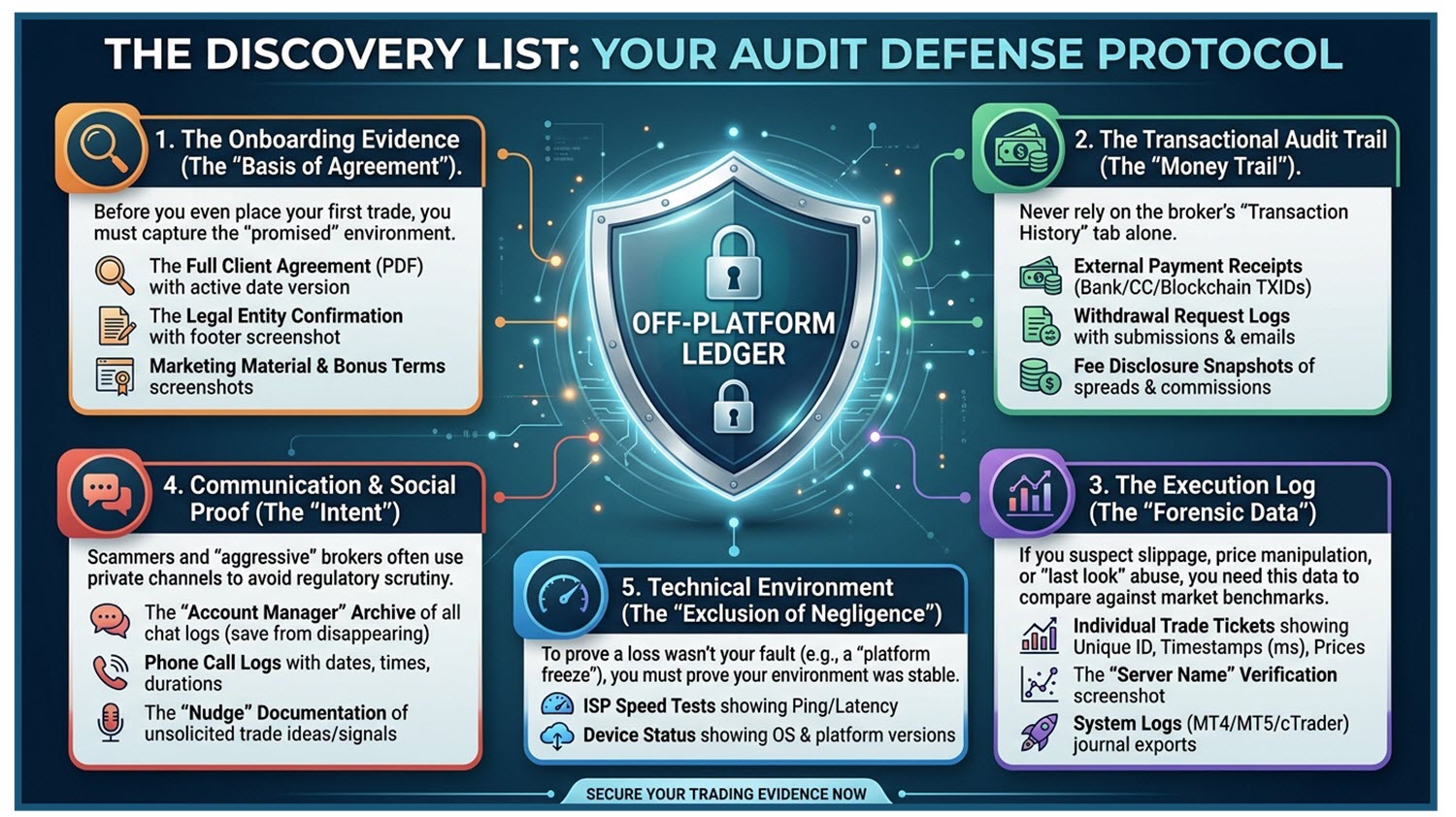
As a legal professional, I recommend maintaining the following Discovery List for every account you fund.
The Trader’s Discovery List: The “Audit Defense” Protocol
1. The Onboarding Evidence (The “Basis of Agreement”)
Before you even place your first trade, you must capture the “promised” environment.
- The Full Client Agreement (PDF): The exact version of the Terms & Conditions you signed. Brokers update these frequently; you need the version active on your sign-up date.
- The Legal Entity Confirmation: A screenshot of the footer showing exactly which company (e.g., Broker Name SVG Ltd vs. Broker Name UK Ltd) is holding your account.
- Marketing Material & Bonus Terms: Screenshots of any “Welcome Bonus” or “Risk-Free” claims. These are often used as leverage in “unfair promotion” complaints.
2. The Transactional Audit Trail (The “Money Trail”)
Never rely on the broker’s “Transaction History” tab alone.
- External Payment Receipts: Bank transfer confirmations, credit card statements, or blockchain transaction hashes (TXIDs) for every deposit and withdrawal.
- Withdrawal Request Logs: A screenshot of every withdrawal request before you click “Submit,” and the automated “Request Received” email that follows.
- Fee Disclosure Snapshots: A record of the advertised spreads and commissions at the time of your largest trades.
3. The Execution Log (The “Forensic Data”)
If you suspect slippage, price manipulation, or “last look” abuse, you need this data to compare against market benchmarks.
- Individual Trade Tickets: Screenshots or exports of trade confirmations showing:
- Unique Trade ID / Ticket Number
- Exact Timestamp (to the millisecond if possible)
- Requested Price vs. Executed Price
- The “Server Name” Verification: A screenshot of your platform’s “About” or “Connection” box showing exactly which server you are connected to (e.g., Live-01 vs. Demo-04).
- System Logs (MT4/MT5/cTrader): Periodic exports of the “Journal” or “Logs” tab from your terminal. These logs record server messages, re-quotes, and connection drops that the web dashboard often hides.
4. Communication & Social Proof (The “Intent”)
Scammers and “aggressive” brokers often use private channels to avoid regulatory scrutiny.
- The “Account Manager” Archive: Save all chat logs from WhatsApp, Telegram, or Skype. If they use “disappearing messages,” take photos of the screen with a secondary device.
- Phone Call Logs: A record of the date, time, and duration of every “Compliance” or “Support” call. If your jurisdiction allows, record these calls (always check local wiretapping laws first).
- The “Nudge” Documentation: Records of any unsolicited “trade ideas” or “signals” provided by the broker or their affiliates.
5. Technical Environment (The “Exclusion of Negligence”)
To prove a loss wasn’t your fault (e.g., a “platform freeze”), you must prove your environment was stable.
- ISP Speed Tests: Occasional screenshots of your internet stability (Ping/Latency) during active trading hours.
- Device Status: A record of your OS version and platform version to prove you were running updated, “supported” software.
Exactly what the problem is will impact how it can be escalated. There is a difference between noticing that a licensed broker has charged you a double withdrawal fee and realizing that you have been depositing money to a clone firm scammer. Different complaints travel different routes as they escalate. A clone scam, for example, is a type of fraud (criminal case) that may require reporting to the regulator, payment provider, bank, and police channels, while a dispute with a real authorized broker may need to go through internal complaints (complain to the broker) first and then to the relevant ombudsman or financial authority.
Negative Balance Protection For Your Trading Account
Negative balance protection is another area where inexperienced traders regularly conflate several different ideas. Negative balance protection simply means that even if you are using leverage, your account balance cannot drop below zero due to the market moving against you.
Some traders think negative balance protection is pointless because they use stop-loss orders. But remember that having a stop-loss order in place is not a guarantee for getting the position closed at that level. When markets suddenly go crazy, slippage can be brutal, and you may end up seeing the position close far below the stop-loss point. If the market gaps violently and a position blows through the account, negative balance protection can stop the retail client from ending up in debt. It does not undo the slippage or restore the account; it only protects the account from going into a negative balance.
Many financial regulators around the world have made it mandatory for brokers to give retail trading accounts negative balance protection. It is important to check the details to find out exactly if/how your account is covered, for which products, and in which situations.
These questions also come into play when a retail client is considering applying for a professional trader classification. In many jurisdictions, a professional client will not automatically have the same negative balance protection. The protections available may depend on jurisdiction, client classification, and product type, and the same gap event can therefore lead to very different legal outcomes for different positions and traders. A retail client may be protected from ending up owing more than the account balance, while a professional client may not be. Same market physics, different liability outcome.
This part of the hub is also where readers are reminded to think at the entity level again. Compensation scheme coverage, client money rules, and negative balance protection do not follow the logo. They follow the legal entity, the client type, and the applicable rule set. That is why safety research starts with verification and only then moves into protection. Get the first part wrong, and the rest may not apply the way the user thinks.
The risk of ending up in debt to a broker is not hypothetical. Without Negative Balance Protection, extreme volatility (gaps, flash crashes, illiquid markets) can absolutely push leveraged trader accounts below zero even when stop-loss orders are in place, leaving traders owing money to their broker. It did, for instance, happen to many traders during the Swiss franc shock in 2015, and some traders were saddled with very large debts as a result. Current ESMA/ASIC product intervention measures were born directly from the failures of that era.
My Account Has Negative Balance Protection – What Does That Mean For Me As A trader?
This is not possible to answer in general terms, since it can vary depending on factors such as jurisdiction, trader classification, products, and broker policy. It is therefore important that you find out what it means for your specific account and trading strategy.
One of the points that needs to be considered closely is the relationship between Negative Balance Protection (NBP) and the automated forced-closure of open positions. While NBP is generally seen as beneficial for the trader, it also comes with its own set of challenges that need to be accounted for in your strategy. Brokers will not just happily accept that they are obligated to eat your losses. Instead, they will take steps to try to prevent your account from ever becoming negative. Chiefly, they do this through a combination of margin requirements and stop-out levels. The stop-out means that orders to liquidate one or more positions will go out automatically when your account equity falls below a certain point.
This is something that can catch the inexperienced trader unaware. During stormy market events, prices can move sharply and briefly, and the broker’s automated system will automatically close your positions when a stop-out is triggered, even if the drop is likely to be very temporary. It hurts to see the market rebound within minutes or even faster when your positions have been closed automatically due to the NBP stop-outs. Your positions are gone, and you have realized the losses. If you had been trading manually, without any broker intervention, you could have allowed the asset price to drop briefly and then rebound, without realizing any losses in your account.
NBP stop-outs do not care if you would prefer to hold through volatility, accept temporary drawdowns, and avoid having positions closed by what are clearly short-lived spikes. The broker’s system will act automatically to ensure you get the legally required Negative Balance Protection.
With NBP, you are protected from a red account balance, but you will have less flexibility to steer your ship through extreme volatility.
Account Security, Phishing, and Social Media Risk
A broker can be real, licensed, and solvent, and the user can still lose control of the account through weak security or social engineering. That is why this hub treats account protection as part of broker safety rather than as a separate technical afterthought.
Does This Broker Offer Two-Factor Authentication?
The most basic control is still two-factor authentication. Pick a broker that offers this and make sure you turn on the feature if necessary. The point is to make account takeover harder. A password reused across services, an exposed email account, or a leaked phone number can all become entry points. Two-factor authentication does not make theft impossible, but it does make it more difficult.
WiFi Risks
A WiFi or other internet connection you are not in control of is a security problem, and public WiFi connections are known to be especially risky. The issue is not that every public network is instantly hostile. The issue is that public or poorly controlled networks create more room for poor device hygiene, rogue access points, credential theft attempts, and routine carelessness.
For trading accounts, that is enough. Logging in, changing payment details, resetting passwords, or uploading identity documents on a public network is an unnecessary risk unless it is absolutely needed and there is no alternative.
Communication Discipline
Many broker-related scams do not begin with a fake trading platform or sketchy brokerage. They begin with a scammer sending messages that look familiar enough to lower the trader’s guard. That could, for instance, be a “support email” asking for a document re-upload, a fake compliance call asking for password verification, a payment instruction that arrives after a routine-looking chat with an “account manager”, or a “withdrawal assistance message” that asks the client to install remote access software to make sure the withdrawal gets processed correctly. Once the user is operating through the attacker’s channel, the scam becomes much easier to run.
This section of our hub is where broker safety becomes more about human knee-jerk social behaviors and less about the fine print in a contract. Accounts are frequently lost through documents sent to a scammer’s inbox, passwords being reused across services, pressure calls that sound official, remote access requests, and social proof that is easy to fake. This is why it is so important to stick to confirmed contact channels. That single habit closes off a large share of phishing and clone approaches in the online broker space. A user who independently verifies the phone number, email address, or website domain is forcing the situation back onto ground that the attacker does not control.
Social Media
The social media section sits right beside phishing because the mechanics overlap. Traders are now routinely approached through Telegram, WhatsApp, Instagram, Discord, X, TikTok, YouTube, and similar channels. Sometimes the path starts with a signal group. Sometimes with a “mentor”. Sometimes with copy trading. Sometimes with a broker introduction disguised as education. Scammers are using many different methods to gain your trust through social media.
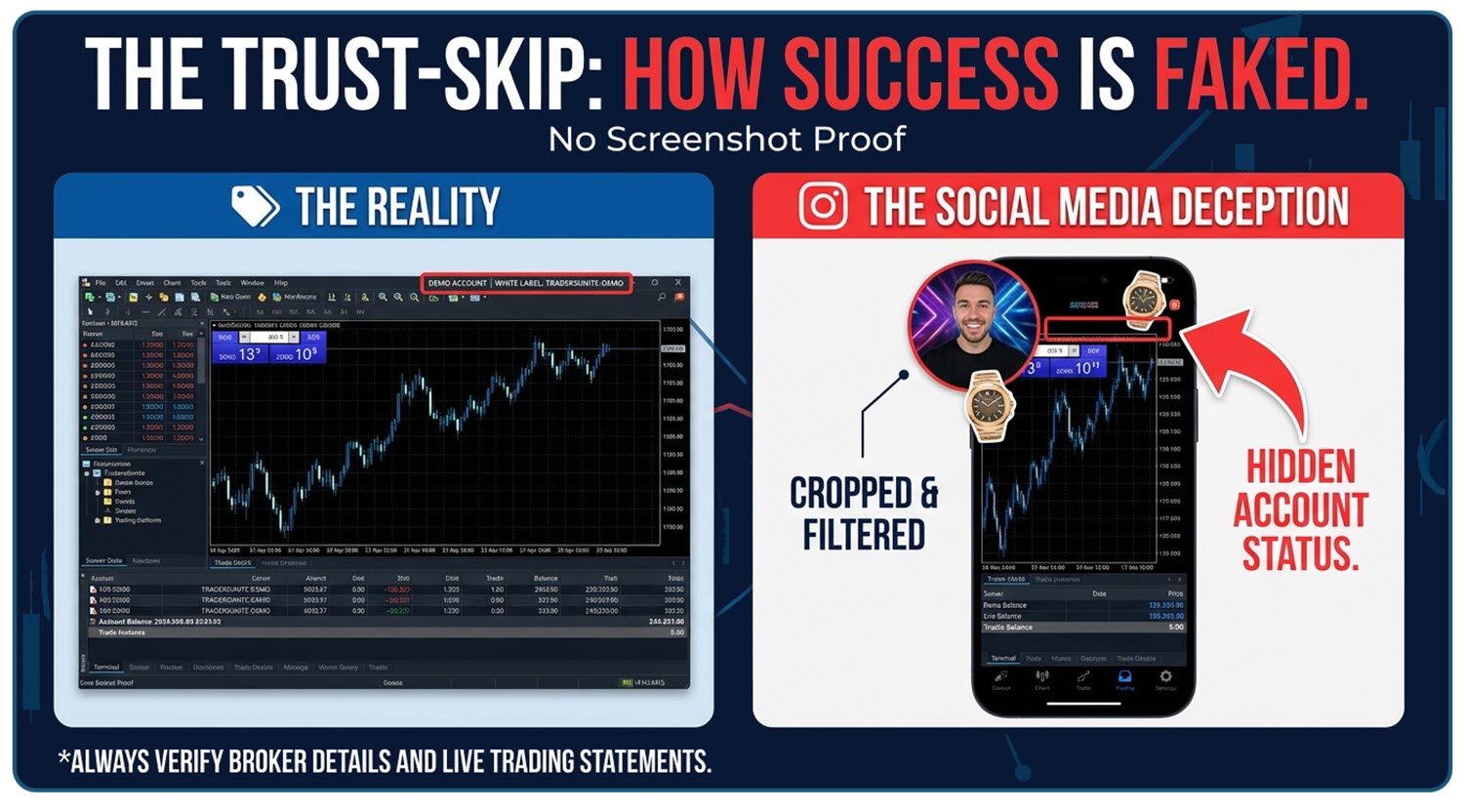
The problem is that social media finfluencers and similar have a tendency to make people evaluate trustworthiness in unsuitable ways. A few screenshots, some purchased followers and testimonials, paid ads, and a private chat can make us skip the sort of checks that we would normally do in another setting. The feeling of “knowing” this particular social media personality is dangerous.
Execution Quality, Slippage, and Conflicts of Interest
Safety in trading is not only about whether the firm is real, it is also about how the firm handles the order once it is placed, how transparent it is about its execution model, and where conflicts of interest may sit and how they are managed.
This section of the hub covers things such as dealing desk versus no dealing desk structures, internalization of orders, STP and ECN claims, slippage, re-quotes, order size versus market depth, and the difference between normal execution friction and unfair treatment.
Execution Models
The main broker categories based on execution model are:
- Market maker (MM) / Dealer desk (DD) brokers
- Straight Through Processing (STP) brokers
- Electronic Communications Network (ECN) brokers
- Direct Market Access (DMA) brokers
- Hybrid brokers that combine two or more models
Execution model labels are useful, but not self-proving. Better questions are whether the broker clearly discloses how orders are handled and matched, where the liquidity comes from, and how the broker makes money. The main safety question is not “which label is the best” but “what evidence is there that the broker’s execution reality matches its marketing”? Safe and trustworthy brokers are available in all categories.
What is important to keep in mind is that the interests of the broker and client do not always align perfectly. With an MM/DD broker, the broker is also your counterpart in your trade, instead of sending your order straight into outside liquidity. That automatically creates a conflict that traders should understand. It is not automatically a bad idea to pick this type of broker, and many of the brokers that are great for inexperienced and small-scale traders are actually MM/DD brokers.
The important thing is how the broker is supervised and how it manages risk. A broker can reduce the conflict of interest by hedging its own risk properly, and a broker that is supervised by a strict financial authority is less likely to exploit the conflict of interest for its own gains. Also, a strict financial authority wants you to report suspicious behaviors that indicate that a broker might not be handling the conflict of interest correctly.
In an STP, ECN or DMA environment, you are not trading against your broker, but this does not automatically mean that these brokers are a better choice than the MM/DD brokers. When brokers do not make money by taking the other side of the trade, they can widen spreads and increase commissions instead. This is not a problem in itself, but you need to be aware and make sure your trading strategy is suitable for the cost structure. And you can still face weak liquidity, poor routing, last look rejections, or marketing claims that stretch beyond the actual setup. Be aware that even brokers in these categories can get pushy about encouraging frequent trading or big positions, because they make money when you are active. You making a single trade each quarter, and withdrawing the profits is not the ideal pattern for them.
This creates a significant “Trust Gap”: an ECN-style account sounds identical to a true ECN account, but the underlying risk is different. Traders are often misled into believing they are matched with third-party participants when, in reality, they are still trading against the house.
A broker can be profitable in several legitimate ways. The safety question is whether those revenue sources are explained honestly and whether the order handling policy is specific enough to be meaningful. Vague promises about best execution with no practical detail are not very helpful. A proper execution policy should tell the client what factors matter, how the broker weighs them, and what type of venue or model is being used.
| Model | Counterpart | Revenue Source | Core Conflict |
|---|---|---|---|
| Market Maker (MM) | The Broker | Spreads + Client Loss | Direct conflict; broker profits when you lose. |
| STP/ECN | External Liquidity | Commissions + Markups | Volume conflict; broker profits when you trade often. |
| STP/ECN Style | The Broker | Commissions + Markups and/or Spreads + Client Loss | Direct conflict; broker profits when you lose. External pricing provides some trader protection. |
| Hybrid | Mixed | Mixed | Opaque; broker decides which trades to internalize. |
Slippage
Slippage might not feel like a safety issue, but we have elected to include it in the safety hub since it is such an important aspect of trading, and alleged slippage is also the veil that protects certain types of broker fraud.
Slippage is the difference between the expected price (e.g. your market order, take-profit order, or stop-loss order) and the executed price. It can be negative or positive. It can happen due to various reasons, e.g. because the market moved, because there was not enough size at the visible price, because the order traveled through several systems before reaching final liquidity, or because conditions were thin or volatile. The risk of slippage is built into the logic of market execution, and slippage occurring is not a sign of broker misconduct on its own.
At the same time, sketchy brokers sometimes manipulate results for their own gain and blame it on “market conditions”. This can be difficult to spot, and even harder to prove, because it looks very similar to true slippage. Still, there are some warning signs that you can look out for as you try to distinguish between ordinary friction and suspicious patterns. One-sided slippage that consistently harms the client, persistent re-quotes in ordinary market conditions, unexplained execution delays, or platform behavior that seems materially different from comparable brokers can all justify closer scrutiny.
We recommend that you read our full guide to slippage and understanding slippage to get more in depth understanding of how slippage work and the causes of slippage.
Re-Quotes
A re-quote is not the same as market execution at a different price. It is effectively a refusal of the original quoted price, followed by an invitation to accept a new one.
- In calm conditions, the difference may feel small.
- In fast conditions, it can be enough to distort the result of the trade or leave the trader chasing a moving market.
Traders should make sure they understand the mechanism before they put any money on the line.
Order Book and Market Depth
The order book and market depth help explain why larger orders can fill at worse average prices even when the screen looked fine. A visible top price does not mean infinite size exists there. If the order consumes the liquidity available at the best level, the remaining size fills at lower bids or higher offers.
Again, that is market structure, not misconduct. But users who do not understand it tend to misdiagnose the problem and then miss the real questions.
Last-Look
“Last look” is a feature in institutional forex trading where a liquidity provider (like a bank or market maker) gets a very short window (usually a few milliseconds) after receiving your order to decide whether to accept or reject it at the quoted price.
In essence, you see a price and send an order. The liquidity provider receives the order. The liquidity provider takes a final “last look” at the market before making a decision. If the price is still good, they will fill your trade, but if the market has moved or risk has changed, they can decide to reject the order or reprice.
The last look feature helps liquidity providers manage risk from ultra-fast price changes, and protects them from being picked off by faster traders or stale quotes.
The practice is controversial because it creates asymmetry. The liquidity provider gets extra time, but you don’t. You saw a price, but you might not get it; you might get rejection or a reprice instead.
The last look feature helps explain why a price can appear visible and still produce a rejected or changed fill when the final acceptance point is reached. For retail traders, this is often hidden behind the broker interface.
Marketing vs. Statistical Reality in Retail Trading
In marketing, online trading is frequently presented as a shortcut to a luxury lifestyle. In reality, the majority of new retail investors do not become profitable. Understanding this gap is an important part of trader safety, since people who wholeheartedly buy the hype are more likely to fall prey to unscrupulous marketing and get-rich-quick schemes.
I recommend that you read our in-depth guide to marketing versus the statistical reality of trading to get a better understanding of your true chance of success.
A field that has really exploded in recent years is the so-called finfluencers, and regulators are watching this area more closely now compared to 10 years ago. In the UK, the FCA has warned firms and finfluencers that financial promotions on social media must be lawful, fair, clear, and not misleading. In Australia, ASIC said in June 2025 that it had issued warning notices to 18 social media finfluencers suspected of unlawfully promoting high-risk financial products and providing unlicensed financial advice. In March 2026, ASIC also urged younger Australians to sense check money information seen on social media, as more young users in the country now rely on those channels for financial decisions.
This is no longer a fringe issue and the financial authorities are struggling to keep up. For that reason, we have included a dedicated page on social media and finfluencer red flags. It focuses on transparency and independent verification.
A few examples of pertinent questions to ask:
- Does this account owner or owners disclose whether they get paid by a broker?
- Do they identify the legal entity actually running the account?
- Are they clear about risk disclosures?
- Are they quickly moving users into private messaging to avoid the prying eyes of financial authorities?
- Do they nudge users toward cryptocurrency deposits or wire transfers?
- Is onboarding associated with high-pressure sales tactics and manufactured urgency?
- Do they promise easy withdrawals without discussing the jurisdiction or complaint route? ‘
Those are examples of small details that tend to reveal whether the operation is educational, promotional, or outright predatory.
Copy trading belongs in the same part of this hub and is often promoted through social media channels. Our message is not that all copy trading is bad. It is that a trader should not outsource risk assessment to a leaderboard and a few performance screenshots. The real questions are about things such as regulation, legal responsibilities, drawdowns, concentration risk, survivorship bias, fee incentives, and general transparency.
Common Scams
As a trader, it is a good idea to learn about common scam techniques targeting traders and find out how to spot the warning signs early. Here are a few examples of suggested articles:
Trading Scams
Broker Clone Scams
Forex Trading Scams
Binary Options Scams
Social Media and Finfluencer Scams and Misleading Information
Red flags for FinFluences Scams
TikTok Scam Report
Recovery scams
Scam warnings
Our legal analyst panel, led by William Berg, continuously tracks cross-border financial operations, regulatory blacklists, and high-risk algorithmic applications targeting retail capital. Below you find of the currently most prevalent scams from our active enforcement directory.
| Entity Name | Risk Classification | Primary Watchdog Action | Safety Verdict |
|---|---|---|---|
| FinUp.ai | High-Risk Automated Software | CNMV (Spain) / FMA (New Zealand) Alerts | Read Safety Audit → |
| Gift of Legacy | P2P Gifting Pyramid Matrix | Bank of Russia Blacklist / FSCA Public Warning | Read Safety Audit → |
| BiKing Exchange | Unregistered Crypto Platform | Ontario Securities Commission (OSC) Directive | Read Safety Audit → |
| NovaForex.trading | Unregistered Forex Platform | None; Platform & Technical Red Flags | Read Safety Audit → |
Reporting Suspicious Activity to DayTrading.com
In addition to reporting problematic brokers and suspected fraud to the relevant authorities, you are welcome to report them to us here at DayTrading.com by sending us an email. You can report sketchy brokers, suspicious domains, cloned websites, regulator numbers being misused, fake support emails, unexpected entity switches, aggressive sales tactics, and recovery scam approaches for review.
This can help give our editorial team early notice of patterns that regulators may only publish later, after receiving enough reports and completing their checks. By reporting a scam to us, you might help us be able to warn our readers earlier and before any regulators issue a warning.
Note that we will investigate all reports, but not all reports may result in us publishing a warning. It depends on the situation and whether we can verify a scam.
Please provide us with relevant records and details to make the case clearer, e.g. the exact website used, the contact method, screenshots, claimed license number, payment path, dates, and the exact promises made.