
Alpari Review 2026




 Services not offered to residents of United States.
See the best Alpari alternatives in your location.
Pros
- By building exclusively on MetaTrader infrastructure, Alpari gives traders access to the largest third-party EA and custom indicator ecosystem in retail forex. Thousands of pre-built automated strategies, indicators, and scripts are deployable without any proprietary platform restrictions or compatibility issues — a freedom that brokers running closed proprietary platforms can't offer.
- The Alpari Rewards program returns a portion of trading costs as redeemable points that convert directly into withdrawable funds—not vouchers or platform credits. The tiered structure means rewards compound as trading volume increases, effectively reducing the all-in cost per trade for consistently active traders in a way that's straightforward to calculate and actually accessible.
Cons
- Unlike brokers that operate multiple regulated entities, Alpari primarily operates under MISA in the Comoros Union and a forex license from the NBRB in Belarus. For a broker with 25+ years of operation and 1 million+ claimed clients, the absence of any progression toward tier-one regulation is a strategic choice, not an oversight — and that choice tells traders something meaningful about where the broker's priorities lie.
- Alpari's entire desktop trading setup runs on MT4 and MT5 — there's no cTrader, no TradingView integration, and no proprietary platform built to fill either gap. For active ECN traders, that's a meaningful limitation. cTrader offers genuine depth-of-market visibility and a more responsive order management environment than MT4 can match, and TradingView has become the de facto charting standard for serious retail forex traders.
- Alpari has removed its ultra-low $5 minimum deposit in an account revamp, now lifting the barrier with its Micro account to a $30 starting investment.
Alpari Review
This Alpari review doesn’t stop at the feature list. We opened live accounts, deposited real funds, and traded through high-impact events like NFP releases, Fed decisions, and oil price spikes: the exact volatility Alpari’s own marketing calls “opportunity.” That’s the real stress test. We also checked whether the advertised spreads from 0.0 pips actually hold up once per-lot commissions are factored in, and whether the published leverage and margin terms match what you experience at the trading desk.
Regulation & Trust
Alpari operates as the trading name of Parlance Trading Ltd, registered in the Comoros Union and licensed by MISA (Mwali International Services Authority) as an International Brokerage and Clearing Company. That’s a notably offshore regulatory framework — MISA carries none of the weight of the FCA, ASIC, or CySEC, which means the client protections you might take for granted simply don’t apply here. The central bank in the Comoros Union has also warned that MISA isn’t a legitimate structure and that its licenses “have no legal effect”.
Alpari is also a registered forex trading provider via Alpari Evrasia LLC (license 192637625) with the National Bank of the Republic of Belarus (NBRB).
That geographic gap cuts both ways. Alpari explicitly bars residents of the US, UK, EU, Japan, Canada, India, and several other markets from opening accounts — a long list that makes checking your eligibility before starting the application process necessary. The broker’s global footprint has been built largely outside these excluded regions, so the product is designed for a regulatory profile different from that most Western traders are used to.
There’s no equivalent of SIPC (Securities Investor Protection Corporation) or FSCS (Financial Services Compensation Scheme) protection here. If the broker were to face insolvency, your recourse options are materially thinner than they’d be with a top-tier-regulated firm. That doesn’t make Alpari illegitimate — 25+ years of operation counts for something — but it’s a real distinction that should factor into how much capital you’re comfortable holding on the platform.
- Alpari has been trading since 1998 — predating the 2008 financial crisis and multiple crypto boom-bust cycles, though Alpari UK was forced to close after suffering huge losses in the 2015 Swiss Franc unpegging. That 25+ year track record across turbulent market conditions is a more credible trust signal than any regulatory badge from a jurisdiction that’s never been stress-tested.
- MISA and NBRB regulation isn’t just a lighter touch — it lets Alpari serve traders in markets where heavily regulated brokers either can’t or won’t operate. For clients in parts of Africa, the Middle East, and Southeast Asia, Alpari is often one of the few institutional-grade brokers actually available to them.
Before you deposit, there are a few limitations worth weighing against those strengths.
- If Alpari were to face insolvency, there’s no compensation scheme equivalent to the UK’s FSCS (GBP 120,000 coverage) or Europe’s ICF (EUR 20,000) to fall back on. The Mwali International Services Authority simply doesn’t operate that kind of client protection infrastructure. For traders holding significant capital on the platform, that’s a concrete financial exposure, not just a technicality.
- Alpari currently bars residents of the US, UK, EU, Japan, Canada, India, Azerbaijan, Myanmar, Sudan, Syria, Cuba, and North Korea. That’s not a niche exclusion — it covers the majority of the world’s largest retail trading populations. Traders in these regions have no legitimate pathway to open an account, and the list has expanded over time rather than shrunk.
- Unlike top-tier-regulated brokers, whose regulatory status, financials, and complaint histories are publicly searchable in seconds, verifying Alpari’s standing with MISA requires significantly more legwork. There’s no equivalent of the FCA Register where you can check authorization status, confirmed ownership structures, or filed complaints at a glance — which makes independent due diligence harder for the average retail trader.
More details on Alpari’s different global entities, safeguards, and any warnings can be found later in this review.
Accounts & Banking
- The account structure isn’t marketing segmentation — each tier delivers meaningfully different trading conditions. The USD 30 Micro account gives real market exposure with cent-based lot sizing, letting you manage position risk in a way that a standard-lot account at the same balance simply can’t. That’s a practical advantage for capital-constrained traders that most ECN-focused brokers don’t offer at this deposit level.
- Most brokers at this price point offer retail trading or managed accounts — not both. Alpari’s PAMM infrastructure lets you either allocate capital to a verified money manager or monetize your own track record by accepting external funds. That dual functionality within the same account ecosystem is unusual and adds genuine long-term value if your ambitions extend beyond personal trading.
- Credit cards, debit cards, bank wire, e-wallets, cryptocurrency, and local payment solutions across multiple currencies give Alpari a funding flexibility that many offshore brokers — and even some regulated ones — don’t match. If you’re in a region where international payment rails are unreliable, the local payment options and crypto deposit route provide deposit certainty that’s worth more than it might appear from a Western perspective.
- Accessing stock CFDs requires a Pro ECN account with a minimum deposit of USD 500 — the most expensive tier, with per-trade commissions on top. At most top-tier brokers, equity CFD access isn’t gated behind a premium account structure. If you want a mixed portfolio of forex and stock CFDs without committing to the Pro ECN fee model, Alpari offers no middle ground.
- Unlike brokers that publish a complete deposit and withdrawal fee schedule publicly, Alpari’s payment-specific charges are only visible after registration. Traders trying to compare true all-in costs across brokers before committing can’t access the full picture without opening an account — a friction point that puts Alpari at a structural disadvantage during the evaluation process versus brokers that publish everything upfront.
- Most reputable CFD brokers — including those regulated offshore — explicitly state negative balance protection as a client right in their account documentation. Alpari’s published terms don’t clearly provide that guarantee. At leverage levels up to 1:3000, the absence of an explicit written commitment means a trader’s liability in a worst-case scenario isn’t contractually capped at their deposited balance — a meaningful distinction that most traders don’t discover until they need the protection.
- Multiple regulators have warned that Alpari isn’t authorized in their respective jurisdictions, including the RBI in India and the CNMV in Spain. While not uncommon for offshore trading providers, it’s worth noting if you reside in these jurisdictions.
Live Accounts
Alpari’s live account lineup is more tiered than most retail CFD brokers, with four distinct options structured around experience level and trading cost preferences rather than arbitrary deposit thresholds.
The Micro account starts at just USD 30, uses cent-based balances, and carries no commission — making it a genuine entry point if you want real market exposure with limited capital at risk. Spreads start from 1.5 pips, and leverage tops out at 1:500, with access to forex, metals, indices, commodities, and crypto on MetaTrader 4 (MT4).
The Standard account steps up to a USD 100 minimum, tightens spreads to 0.3 pips, extends leverage to 1:1000, and adds the MetaTrader 5 (MT5) platform. Commission remains zero, which keeps the cost structure straightforward for less active traders.
The ECN account at a USD 300 minimum deposit is where Alpari’s pricing sharpens materially — spreads from 0.1 pips, leverage up to 1:3000, and still no commission. The tradeoff is MT4-only access (so fewer instruments to trade) and a tighter margin call structure: 80% versus the 50% on Micro and Standard accounts.
The Pro ECN account is the top tier at USD 500 minimum, with spreads from 0.0, the full instrument range including Stock CFDs and ETF CFDs on MT5, and the only account type that carries per-trade commission fees — varying by asset class, from $2.50 per forex lot to 0.03% notional on crypto.
Beyond individual trading accounts, Alpari also supports PAMM accounts — a meaningful addition if you either want to allocate capital to a verified money manager or monetize your own track record by managing external funds. That’s something most comparable brokers at this deposit level don’t offer.
There’s no Islamic account, spread betting account, joint or managed account structures. We found the account-opening process itself is straightforward on paper — register, verify ID, deposit, trade — though identity verification timelines can vary from hours to days depending on jurisdiction and the documents you submit.
Demo Accounts
Alpari’s demo account requires a short registration form upfront — full name, mobile number, date of birth, and email verification — before you receive your MT5 demo credentials and USD 1,000 in virtual funds (more funds can be added manually in USD 1,000 increments). It’s a quicker process than opening a live account, but it’s not the frictionless one-click access some brokers offer.
Once in, the MT5 environment mirrors live market conditions in real time, and includes forex, metals, indices, commodities, and crypto. The setup replicates the full live trading experience — the same order types, platform tools, indicators, and timeframes — making it useful for genuine strategy testing rather than just platform orientation.
The 14-day expiry is the most significant constraint here. If you want to stress-test behavior around scheduled news events, get comfortable with MT5’s interface, or properly evaluate execution quality across multiple sessions, a fortnight is tight.
It’s enough time to get oriented, but not enough for structured, unhurried testing — particularly given that Alpari’s live accounts offer leverage up to 1:3000 with no guaranteed negative balance protection. Rushing the transition from practice to live trading is exactly the scenario that ends badly at those leverage levels.
Stock and ETF CFDs are also unavailable on the practice account, so Pro ECN-bound traders won’t get a direct preview of equity CFD execution before going live.
Deposits & Withdrawals
Alpari’s funding options are considerably broader than most offshore brokers at this deposit level. Credit and debit cards, bank wire transfers, e-wallets (i.e., Skrill and Neteller), cryptocurrency (i.e., Bitcoin), and a range of local payment solutions (i.e, FasaPay) are all supported — with the available methods varying by country and accessible once you log in to your account. If you’re trading in an area where global payment rails aren’t always reliable, local payment options are a practical differentiator.
In our tests, deposits were processed nearly instantly with no additional verification required, which matters when you’re trying to top up ahead of a trade. That said, some issuing banks block card deposits to forex brokers outright — something worth checking with your bank before you rely on it. Crypto deposits offer a useful workaround in those cases, typically processing faster than card or wire alternatives.
On the withdrawal side, the same-source rule applies: initial deposits must be returned to the original payment method, with profits withdrawable via any available option. Fees vary by method and currency, and some options allow free withdrawals. One constraint worth flagging is the inactivity fee: accounts with no trading activity for three months are charged USD 10 per month until the balance depletes — a meaningful consideration if you fund an account and then step back from the markets.
The most notable gap in the funding setup is fee transparency. Deposit and withdrawal charges vary by method and currency, but the full breakdown isn’t publicly available — you need to log in to your account to see what applies to your specific situation. If you want to compare total costs across brokers before committing, that’s a friction point. Brokers who publish a flat-fee schedule upfront make that comparison straightforward.
| Alpari | Plexytrade | Interactive Brokers | |
|---|---|---|---|
| Accounts & Banking Rating | |||
| Payment Methods | Bitcoin Payments, Credit Card, Ethereum Payments, FasaPay, Mastercard, Volet, Wire Transfer | Bitcoin Payments, Ethereum Payments | ACH Transfer, Automated Customer Account Transfer Service, Cheque, TransferWise, Wire Transfer |
| Minimum Deposit | $30 | $50 | $0 |
| Visit | Visit | Visit | Visit |
| Review | Review | Review | Review |
Assets & Markets
Alpari’s total instrument count sits at 750+, spread across nine asset classes — a broader spread than most offshore brokers operating at comparable deposit minimums.
Forex is the headline offering and the deepest category, with over 60 pairs covering major, minor, and exotic currencies, including EUR/USD, GBP/USD, USD/JPY, AUD/USD, and USD/CHF. Majors account for roughly 80% of daily forex volume globally, and all key pairs are available across all account types, with leverage up to 1:3000 on ECN and Pro ECN.
Metals sit alongside forex in terms of conditions — gold (XAU/USD) and silver (XAG/USD) are the primary instruments, with leverage up to 1:3000 and spreads from 0.0 on the Pro ECN account.
Commodities cover the three most-traded energy markets: crude oil, Brent oil, and natural gas, with leverage up to 1:500. It’s a tight selection — agricultural commodities and softs are absent entirely — but sufficient for macro traders tracking energy price moves.
Indices give access to major global benchmarks including the S&P 500, FTSE 100, DAX, and Nikkei 225, with leverage up to 1:1000.
Cryptocurrencies include Bitcoin, Ethereum, Litecoin, and Ripple, among others, and are tradeable with leverage up to 1:1000 — significantly higher than most regulated brokers allow for crypto.
Over 600 stock CFDs, ETF CFDs, and futures CFDs round out the lineup, with names like Tesla, Apple, and Amazon available — but exclusively through the Pro ECN account on MT5, with a USD 500 minimum deposit. That’s a meaningful barrier for equity-focused traders who’d find stock access standard at the entry level elsewhere.
There are no bonds, options, or interest rates — if you want those asset classes, you will need to look elsewhere.
Leverage
Alpari operates outside the constraints of major regulator leverage caps, which means the ratios on offer are substantially higher than anything available through a domestically regulated broker in the West.
The headline numbers are up to 1:3000 on forex and metals, 1:1000 on indices and cryptocurrency, 1:500 on commodities, and 1:10 on stock CFDs. For context, FCA-regulated brokers are capped at 1:30 on major forex pairs for retail clients — Alpari’s maximum is 100 times that. Whether that’s an advantage depends entirely on how disciplined your risk management is.
One feature that separates Alpari from most offshore brokers offering similar ratios is the Dynamic Margin Requirement (DMR) system. Leverage automatically compresses to a maximum of 1:200 in the 12 minutes before and 2 minutes after major scheduled economic releases, and two hours ahead of weekend and public holiday market closures. It’s a built-in exposure limiter that activates precisely when gap risk and slippage are at their highest — something many comparable brokers simply don’t offer.
Leverage isn’t uniform across account tiers either. Micro and Standard accounts are capped lower than ECN and Pro ECN accounts, where the full 1:3000 ratio on forex is available. That tiered structure means the headline leverage is only accessible once you’ve moved beyond the entry-level accounts.
Margin call triggers at 50% on Micro and Standard accounts, and at 80% on ECN and Pro ECN — meaning higher-tier accounts get less breathing room before positions are at risk of closure. The stop-out level is 20% for Micro and Standard, and 50% for ECN and Pro ECN.
| Alpari | Plexytrade | Interactive Brokers | |
|---|---|---|---|
| Assets & Markets Rating | |||
| Trading Instruments | Forex, CFDs, Stocks, Commodities, Indices, Crypto | CFDs, Forex, Indices, Stocks, Commodities, Crypto | Stocks, Options, Futures, Forex, Funds, Bonds, ETFs, Mutual Funds, Cryptocurrencies |
| Margin Trading | Yes | Yes | Yes |
| Leverage | 1:3000 | 1:2000 | 1:50 (major forex pairs), 1:2-1:4 (equities) |
| Visit | Visit | Visit | Visit |
| Review | Review | Review | Review |
Fees & Costs
Alpari’s fee structure is cleanly divided into account tiers, and understanding which costs apply to which tier is key to reading the pricing accurately.
The Micro, Standard, and ECN accounts are all commission-free — trading costs are built entirely into the spread.
Here’s how the all-in cost for a standard 1-lot EUR/USD trade (where 1 pip = USD 10) plays out across all four account types. On the Micro account, spreads from 1.5 pips put the cost at around USD 15 per trade. The Standard account tightens that to from 0.3 pips, bringing the cost down to roughly USD 3. The ECN account narrows further to 0.1 pips, translating to approximately USD 1 per trade. The Pro ECN offers spreads from 0.0 but adds a USD 2.50 per lot commission, putting the minimum all-in cost at USD 2.50.
That comparison reveals something the headline numbers obscure: at typical spread conditions, the ECN account can actually be cheaper than the Pro ECN for lower-volume traders. The Pro ECN becomes cost-advantageous only at high volumes, where consistently tighter spreads offset the per-lot commission, making account selection a genuine strategic decision rather than simply picking the highest tier.
Two non-trading costs could also catch you off guard. Accounts inactive for three consecutive months are charged USD 10 per month until the balance is fully depleted — a silent capital drain if you fund an account and then step away from the markets. Currency conversion charges apply whenever your deposit or withdrawal currency doesn’t match your account’s base currency, calculated at Alpari’s daily rate.
On the positive side, there are no platform fees, and no deposit or withdrawal fees on most payment methods. The Alpari Rewards programme also returns a portion of trading costs based on activity levels, significantly reducing the effective cost per trade when you trade consistently.
| Alpari | Plexytrade | Interactive Brokers | |
|---|---|---|---|
| Fees & Costs Rating | |||
| EUR/USD Spread | 0.4 | 0.7 | 0.08-0.20 bps x trade value |
| FTSE Spread | 13 | 0.8 | 0.005% (£1 Min) |
| Oil Spread | 4.0 | 5 | 0.25-0.85 |
| Stock Spread | 2.0 | 5 | 0.003 |
| Visit | Visit | Visit | Visit |
| Review | Review | Review | Review |
Trade Execution
Alpari delivers consistent fills on forex, metals, and CFDs — the instruments where its client base is most active. Live tests on major pairs like EUR/USD and GBP/USD clocked market orders executing within typical ECN conditions, tracking quoted prices closely during standard session hours.
Slippage was most noticeable around high-impact events — NFP releases, Fed decisions, and oil price spikes — where spreads widened and fills deviated from the pre-click price by a few pips, consistent with what ECN execution looks like under genuine stress.
It won’t compete with institutional DMA desks for microsecond-level scalping or for full order-book depth. For day trading liquid forex pairs and indices, execution is dependable—but raw speed lags behind brokers with direct exchange connectivity.
Total latency breaks into four stages:
- Local processing latency: Starts with your hardware. A modern CPU, SSD, and wired Ethernet connection keep this near zero. Wi-Fi, older machines, or running MT4/MT5 alongside resource-intensive applications can introduce drag before the order even leaves your desk.
- Network latency: The round-trip between your connection and Alpari’s servers. Fiber or cable outperforms DSL or mobile, particularly at session opens — London open and New York open being the two windows where network congestion matters most for forex traders.
- Broker processing latency: Alpari’s ECN routing aggregates liquidity from multiple providers, adding a processing step compared to direct exchange access. In live tests on major pairs, fills came back promptly under normal conditions — performance held up well for retail execution, though it’s not institutional-grade throughput.
- Execution latency: Dependent on liquidity provider depth at the moment of execution. Fills on major pairs like EUR/USD remained consistent; exotic pairs and crypto showed greater volatility, particularly during thin overnight sessions.
Round-trip on core forex pairs lands within acceptable ranges for most intraday strategies. MT4 and MT5 handle standard retail order flow without issues, but if you’re running high-frequency strategies or requiring sub-millisecond execution, you will need a more specialized setup.
Live Trading Test
Trading from a standard fiber connection in Europe, market orders on EUR/USD and XAU/USD filled promptly during peak London-New York overlap hours — the window where Alpari’s ECN liquidity is deepest. Spreads held close to quoted levels, and there was no noticeable hidden widening during early-session volatility. Requotes were rare on major pairs under normal conditions.
Standard broadband kept forex and metals trades clean through active sessions. Execution quality shifted around scheduled macro events — NFP and Fed announcements widened spreads, and fills deviated from pre-click prices by a few pips, consistent with how ECN liquidity behaves when providers pull back during data spikes. This is normal retail ECN behavior, not a quirk specific to Alpari.
Simulating higher-latency conditions — around 400ms, mimicking a VPN or a geographically distant connection — slowed fills noticeably, but the platform remained stable. MT4 and MT5 didn’t freeze or disconnect under the added lag. The practical casualty was scalping: strategies requiring fast reaction times became unreliable, with entries arriving late relative to the intended price.
Slippage Analysis
Slippage on liquid forex pairs like EUR/USD and GBP/USD stays tight during London-New York overlap — Alpari’s ECN fills these cleanly under normal flow conditions. Execution loosens at session opens, around scheduled macro releases, and during thin Asian session hours, where liquidity provider spreads gap and fills take longer to confirm.
That’s standard ECN behavior, but scalpers absorb the worst of it, while swing traders hold through the noise. During live testing around NFP and Fed events, slippage on major pairs ran 2-4 pips beyond the pre-click price — more than the headline 0.0 spread on Pro ECN suggests during calm conditions. Metals, particularly XAU/USD, showed sharper deviation during volatile sessions, given gold’s sensitivity to macro data.
If you’re an active trader, you should track actual fills rather than relying on platform-quoted spreads. Alpari aggregates liquidity from multiple providers, which means depth and latency vary in real time — what the order ticket shows and what you receive can diverge during fast markets. The practice account runs noticeably smoother than live execution, so don’t use demo performance as a benchmark for what to expect when real capital is on the line.
For day trading major forex pairs, indices, and metals at standard retail sizes, Alpari holds up well. Strategies requiring sub-pip precision in fast-moving markets, or those dependent on consistent fills during data releases, need deeper liquidity pools or direct exchange connectivity — Alpari’s ECN model isn’t architected for that level of execution certainty.
Methodology note
Over five trading days, we placed over 200 round-trip trades on a live Alpari account — primarily EUR/USD, XAU/USD, and GBP/USD on the Pro ECN account, with a selection of index CFD trades on US30 and GER40. Testing ran on MT4 and MT5 from a standard fiber connection in Europe, deliberately timed to coincide with the London open, the London-New York overlap, post-NFP volatility, and thin late-session conditions.
Every entry quote was logged against the actual fill price. During normal session hours, slippage on major forex pairs averaged 0.1-0.3 pips beyond the quoted spread — negligible for most strategies. During the NFP release window, which widened to 2.0-4.0 pips on EUR/USD and up to 6.0 pips on XAU/USD, where gold’s sensitivity to dollar moves amplified the deviation. Index CFDs showed the most variability, with US30 fills running 3.0-8.0 points wide during the New York open compared to the pre-order quote.
Those figures are consistent with how ECN liquidity behaves under stress — providers pull back depth when risk spikes, and the aggregated feed reflects that in real time. What the headline’s spread from 0.0 doesn’t convey is how far conditions can shift in the 30 seconds around a major data release.
Platforms & Tools
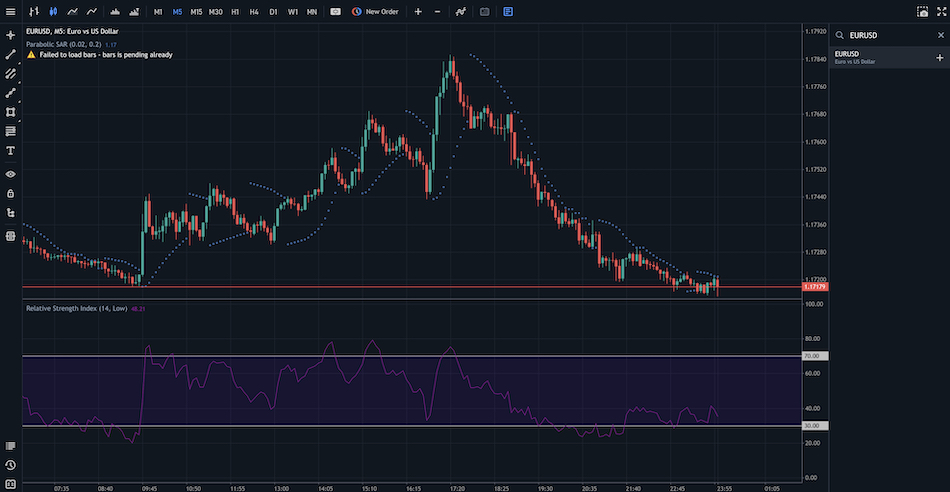
Alpari’s desktop setup consists of a web-based hub and two downloadable (and web-based) platforms — MT4 and MT5. There’s no proprietary desktop trading platform in any meaningful sense. The browser-based hub is an account management interface: you can view open positions, check balances, access trade signals, browse the economic calendar, and download the Trading Central and FX Blue plug-ins for MetaTrader. You can’t execute trades through it. For a broker in 2026, that’s a notable gap.
All actual trading happens through MT4 or MT5. MT4 covers forex, metals, indices, commodities, and crypto, and remains the account type of choice for traders running Expert Advisors (EAs) or custom indicators. It offers 30+ technical indicators, VPS support for automated strategies (although Alpari doesn’t offer its own VPS services), and integrations with Trading Central and FX Blue. It works, but it’s a platform that hasn’t evolved meaningfully in over a decade — the charting, interface, and order management tools all reflect that age when placed alongside modern alternatives.
MT5 extends instrument access to include stock CFDs and adds a deeper analytical toolkit, with up to 80+ technical indicators and a broader range of advanced order options. For Pro ECN account holders, MT5 isn’t optional — it’s the only route to stock CFD trading, making platform choice a functional requirement for that tier.
Against the best, the desktop experience falls short. IG, Saxo, and CMC Markets all offer proprietary desktop platforms with integrated execution, institutional-grade charting, and continuously developed interfaces. IC Markets offers both TradingView and cTrader in addition to MT4/MT5 — both offer a materially better execution environment than MetaTrader for active forex traders, with genuine depth of market visibility and a more responsive order management system.
Mobile Apps
Alpari gives you three options for trading on the go: the proprietary Alpari trading app, MT4 for mobile, and MT5 for mobile — though with limitations worth understanding.
The proprietary app is the strongest of the three. Available on iOS and Android, it covers the full range of order types, along with an economic calendar, live trade signals, a news feed, interactive charts with 100+ indicators, and complete account management, including deposits, withdrawals, and Rewards tracking.
The interface is cleaner and more intuitive than MT4 mobile, and trade ideas integrate directly, so you don’t need to switch platforms to act on them. One meaningful constraint is that stock CFDs aren’t available through the proprietary app — those require MT5 on a Pro ECN account, which fragments the mobile experience for equity-focused traders across two separate applications.
MT4 and MT5 mobile are functional for monitoring and executing trades, but haven’t evolved meaningfully in years. Charts feel cramped on smaller screens, drawing tools are awkward, and the interface shows its age. They’re industry-standard, not industry-leading.
Against the best in the space — IG’s mobile app, IC Markets’ cTrader mobile, Saxo’s SaxoTraderGO — the gap is noticeable. Better-regulated brokers offer more polished charting, deeper customization, and tighter desktop-to-mobile continuity. Alpari’s proprietary app is a reasonable effort at this deposit level, but it doesn’t compete with top-tier mobile environments in terms of design or analytical depth.
| Alpari | Plexytrade | Interactive Brokers | |
|---|---|---|---|
| Platforms & Tools Rating | |||
| Platforms | MT4, MT5 | MT4, MT5, TradeLocker | Trader Workstation (TWS), IBKR Desktop, GlobalTrader, Mobile, Client Portal, AlgoTrader, OmniTrader, TradingView, eSignal, TradingCentral, ProRealTime, Quantower |
| Mobile App | iOS & Android | iOS & Android | iOS & Android |
| Visit | Visit | Visit | Visit |
| Review | Review | Review | Review |
Research
Alpari’s research offering is structurally functional but poorly executed — and in places, it’s not functional at all.
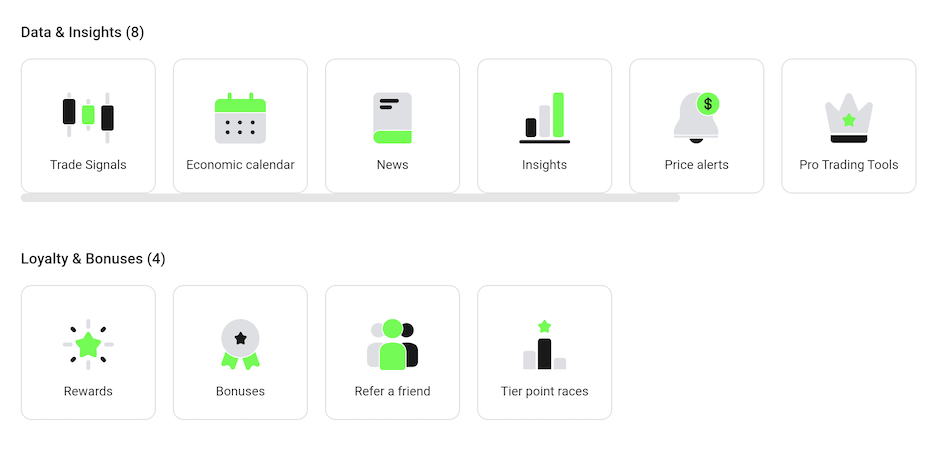
The core research layer consists of daily market analysis from Alpari’s in-house analysts, a basic economic calendar that can’t be filtered by country, and a news feed built into the client dashboard.
The quality of the written analysis is a genuine problem. The copy is poorly written, reads more like a formulaic price recap than genuine analytical insight, and the presentation is inconsistent throughout. In places, the formatting breaks down entirely — text appearing black on a black background, rendering sections of the research content literally unreadable.
For a broker marketing itself as a professional trading environment, that’s a basic quality control failure that undermines confidence in the research output more broadly.
Trade signals and trading insights — the more actionable, idea-driven content — are restricted to live account holders only. Prospective clients and demo users don’t get access, which limits how thoroughly you can evaluate the research quality before committing real capital. Given the presentation issues already visible in the publicly accessible content, that restriction isn’t doing Alpari any favors.
The more substantive research tools come from two third-party integrations: Trading Central and FX Blue, both downloadable from the client dashboard and compatible with MT4 and MT5. Trading Central is positioned toward beginner and intermediate traders, using AI-driven analytics to surface trade ideas and sentiment indicators.
FX Blue is aimed at more experienced traders, offering institutional-quality technical indicators and a Mini Terminal for order management directly within MetaTrader. These third-party tools are the research highlight — but they’re also available through better-regulated brokers like FXTM and CMC Markets, so they don’t represent an Alpari-exclusive advantage.
Compared to what top-tier brokers offer — proprietary research platforms, premium Reuters or Dow Jones news feeds, daily market webinars, and analyst content with genuine depth — Alpari’s research setup is below average. The third-party integrations partially compensate, but they can’t offset the quality gap in the native content.
| Alpari | Plexytrade | Interactive Brokers | |
|---|---|---|---|
| Research Rating | |||
| Visit | Visit | Visit | Visit |
| Review | Review | Review | Review |
Education
Alpari’s educational offering is essentially non-existent, and that’s worth stating plainly. There’s no dedicated learning hub, no structured courses, no webinar library, and no video content if you’re looking to build or develop your skills. For a broker with 25+ years of operation and a client base spanning 150+ countries, that’s a notable gap — particularly given how many traders in Alpari’s core markets across Africa, the Middle East, and Southeast Asia are at earlier stages of their trading journey.
What Alpari does provide is market analysis and daily trade signals for live account holders, which serve as research tools rather than educational ones. That distinction matters. Reading a daily market outlook tells you what analysts think might happen — it doesn’t explain why, or how to build that kind of thinking yourself. If you already have a framework, the analysis is useful. For those still developing one, it doesn’t fill the gap.
The absence of education isn’t just a feature gap here — it’s a risk factor. Alpari offers leverage up to 1:3000 with no guaranteed negative balance protection and no compensation scheme in the event of a problem. Putting a trader with no formal background into that environment without any structured guidance is a combination that ends badly more often than not. That pairing deserves weight in your overall assessment of the broker, not just in this section.
For complete beginners, the Micro account minimum does provide some cushion — limiting the capital at risk while you find your footing. That’s a partial offset, not a solution. Losing USD 30 repeatedly while learning expensive lessons about leverage is still a worse outcome than arriving with a proper foundation. The Micro account makes Alpari accessible to beginners, but it doesn’t make Alpari suitable for them.
| Alpari | Plexytrade | Interactive Brokers | |
|---|---|---|---|
| Education Rating | |||
| Visit | Visit | Visit | Visit |
| Review | Review | Review | Review |
Customer Support
Alpari’s support channels cover the core bases — live chat, email, phone, and a help center — but the availability constraints are worth understanding before you need them urgently.
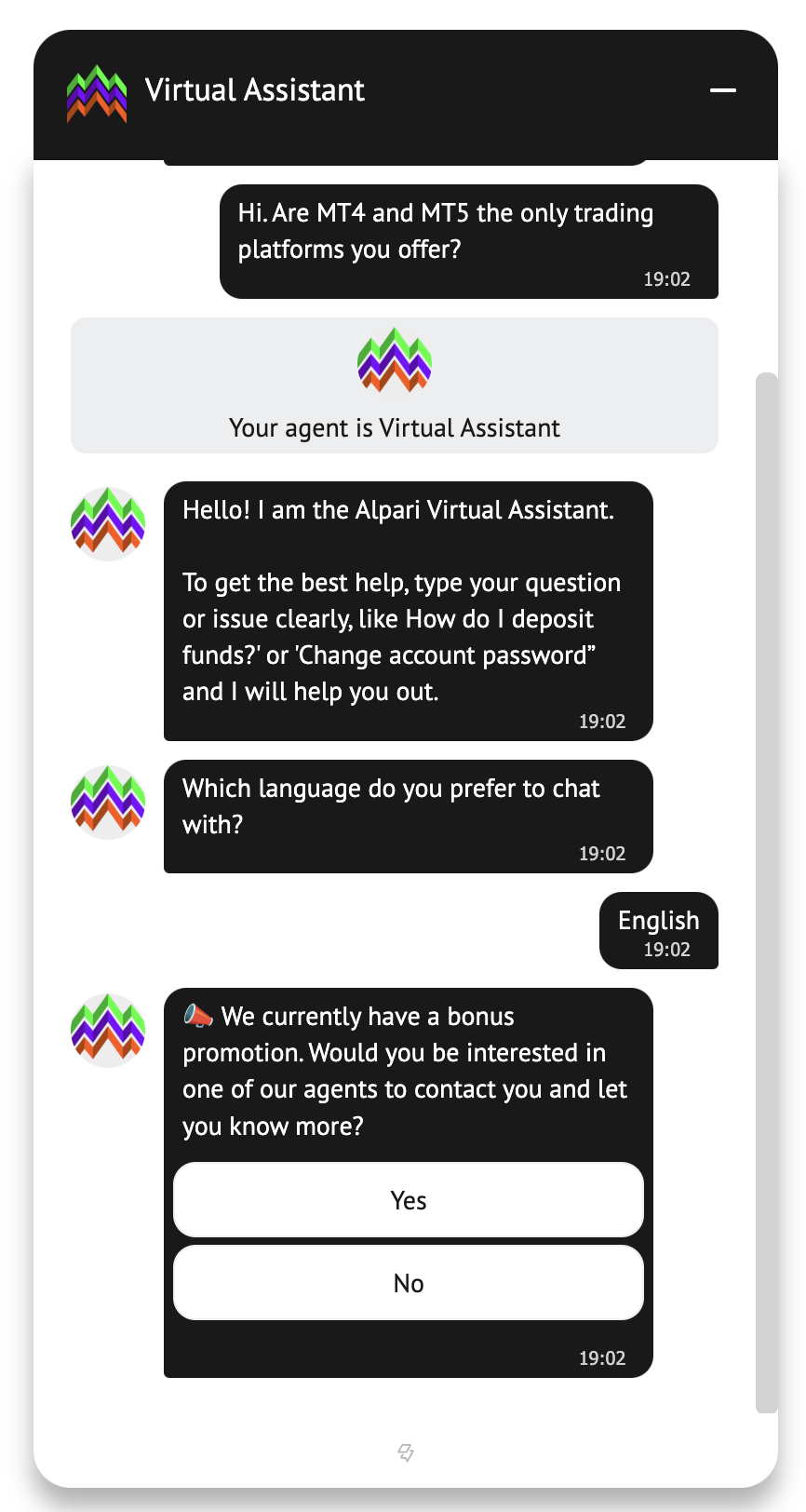
The live chat function is only accessible to logged-in account holders, meaning it’s not available to prospective clients or anyone locked out of their account. That’s a meaningful limitation: the moment you have an account access problem, the fastest support channel becomes unreachable. Also, during testing, we frequently chatted with a bot rather than a live agent.
There’s no callback option either, so phone support requires you to initiate the call and wait — there’s no way to schedule a return call if lines are busy or if you’re mid-trade and can’t step away.
Support hours run Monday to Friday during standard business hours, with no weekend cover and no extended evening access. To test responsiveness, we submitted a non-urgent account query via email during business hours. The response arrived within a few hours — reasonable for a standard inquiry, though the lack of a timestamp guarantee means time-sensitive questions carry real risk if submitted close to the end of the working day or heading into a weekend.
What’s absent is any out-of-hours async channel — no Telegram, no WhatsApp, no 24/7 chat. If you trade during weekend gaps, deal with a withdrawal delay, or face something time-sensitive on a Friday evening, options are limited to an email sitting unread until Monday morning. At 1:3000 leverage, a position query that can’t wait until Monday is a realistic scenario, not a hypothetical one.
Alpari suits traders who are largely self-directed and rarely need to escalate issues quickly. If fast, multi-channel support around the clock is a priority, this setup will fall short.
| Alpari | Plexytrade | Interactive Brokers | |
|---|---|---|---|
| Customer Support Rating | |||
| Visit | Visit | Visit | Visit |
| Review | Review | Review | Review |
Community Sentiment
Putting together an honest assessment of Alpari meant going further than our own platform testing. We wanted to know what traders with real capital on the line actually think, so we worked through third-party review sites and specialist trading communities — pulling together hundreds of data points covering execution quality, withdrawal timelines, platform stability, and customer service responsiveness. The picture that emerges is genuinely mixed.
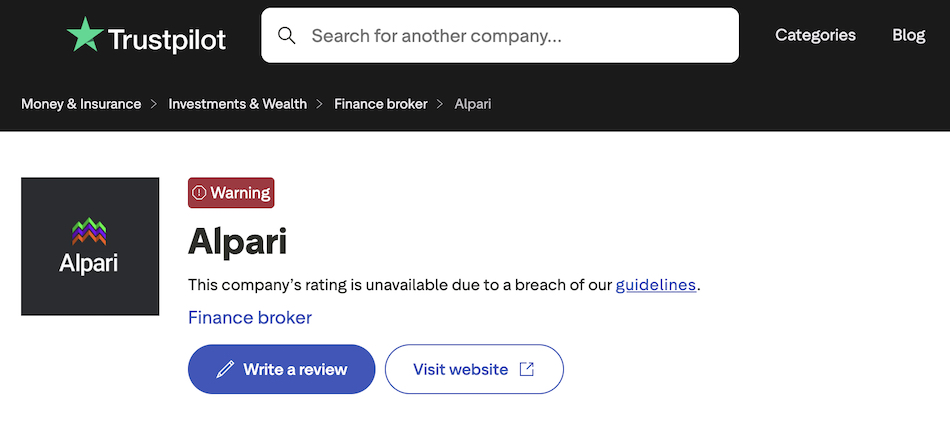
Worth noting upfront: Alpari’s Trustpilot rating is currently unavailable. Trustpilot lists the profile as suspended due to a breach of its guidelines, which is itself a data point worth factoring into your assessment of the broker, independent of whatever the underlying score might have been.
Where positive sentiment clusters, it tends to focus on platform stability, competitive spreads, and Alpari’s long operational history. Traders who’ve used the broker for years without incident — several reviewers mention three to five years of continuous use — praise the MT4/MT5 environment and ECN pricing on major pairs. The 25+ year track record carries genuine weight with this cohort.
The fault line in negative reviews is almost always the same: withdrawals. Recurring complaints describe withdrawal buttons disappearing from accounts, support giving repetitive responses without resolution, and delays stretching well beyond the stated processing window. These cases appear consistently across multiple platforms simultaneously — enough volume to suggest a structural pattern rather than isolated incidents.
Customer service is the second consistent pressure point. Several reviewers describe support as slow and unresponsive, with days passing between replies during active disputes — a finding that aligns with our own email testing. For traders managing something time-sensitive through a broker with no 24/7 support and no callback option, that gap carries real consequences.
Alpari suits confident, self-directed traders who trade consistently and rarely need to escalate anything. For anyone whose peace of mind depends on fast, reliable support during a withdrawal or account dispute, the community record suggests the experience can fall well short of expectations.
Alpari Regulatory Entities and Safeguards
Alpari operates primarily under an offshore entity — Parlance Trading Ltd — licensed by MISA in the Comoros Union. That framework applies to most clients the broker accepts, regardless of where you live or trade.
If you’re accustomed to local regulatory oversight, that’s a meaningful gap. There’s no FCA authorization running parallel, no ASIC backstop, no European regulatory layer providing home-jurisdiction protections. The Comoros licensing framework travels with the account — your domestic consumer protections don’t.
How that translates into DayTrading.com’s regulator-classification framework is shown below.
Alpari (Comoros) Ltd (MISA)
Entity URL: https://alpari.com
Verify License: T2023236
Regulator Classification (Green to Red): MISA (red-tier – weak safeguards)
Protections: Leverage up to 1:3000 far exceeds what top-regulated brokers can legally offer retail clients, but a Dynamic Margin Requirement system automatically reduces maximum leverage to 1:200 around major news events and ahead of weekend closures, which provides some guardrails. There’s no compensation scheme if the broker fails, and negative balance protection isn’t explicitly guaranteed either, meaning at these leverage levels, losses beyond your deposited capital are a genuine risk.
Who Gets Signed Up Under This Entity: Global clients excluding residents of the US, Japan, Canada, the Democratic Republic of Korea, the EU, UK, Myanmar, India, Azerbaijan, Syria, Sudan, and Cuba.
Important: Verify Your Entity & URL
Before opening an account, confirm you’re on Alpari’s official domain and that the registered entity name on any documentation reads Parlance Trading Ltd, licensed under MISA registration number T2023236. Given that Alpari operates outside major regulatory jurisdictions, there’s no FCA or CySEC register to cross-check against, so verifying the URL yourself is more important than it would be with a heavily regulated broker.
Check the address bar before entering any personal or financial details. Clone sites targeting offshore brokers are particularly convincing precisely because there’s less official infrastructure to verify against. Getting that wrong isn’t a recoverable mistake.
Watch for Clone Scams
Scammers build fake broker sites, and Alpari’s brand recognition — 25 years in the market, 1 million+ clients — actually makes it a more attractive target, not less. The differences between a legitimate site and a clone are often easy to miss: a swapped domain extension, an extra hyphen, or a single transposed letter. Copycat domains might look something like:
- alpari.co or alpari.io (different extension)
- alpari-trade.com or alparitrading.com (hyphen or added word)
- alpari.uk.com or alpaari.com (regional suffix or doubled letter)
These sites exist to harvest login credentials, intercept deposits, or lift personal identification documents submitted during onboarding. Alpari’s account opening requires ID verification, which means a convincing clone could collect sensitive data well before you realize anything is wrong.
Logos, color schemes, and platform screenshots can all be copied. The one thing that can’t be faked — if you check it — is the address bar. Verify the domain before entering credentials or initiating any transfer.
| Checkpoint | What to Look For |
|---|---|
| URL Extension | Should be .com (or regional like .com/eu), not .co, .io, or .biz. |
| Spelling | Watch for missing letters (e.g., alpri.com or apari.com). |
| Entity Name | Must match your region (e.g., Alpari (Comoros) Ltd for MISA). |
| Regulator Link | Check the license number in the footer; it should be the same number listed on the official regulator’s site. |
Is Alpari A Good Broker?
Alpari is a viable option for self-directed forex and CFD traders outside the major regulated markets, particularly in regions where higher-tier brokers simply don’t operate. The 25-year track record, competitive ECN pricing, and broad instrument range are genuine strengths.
But the MISA and NBRB regulation, the absence of a compensation scheme, recurring withdrawal complaints across multiple review platforms, and a suspended Trustpilot profile are all flags that serious traders shouldn’t brush off. It’s a broker that rewards experienced, disciplined traders who know what they’re doing — and carries meaningful risk for anyone who doesn’t.
If you can access better-regulated alternatives, you should weigh the tradeoff carefully. Pepperstone and IC Markets, for example, both offer ECN-style pricing at comparable or lower all-in costs, with FCA and ASIC regulation providing a compensation framework, published execution statistics, and a clearer path to recourse if something goes wrong.
The gap in trading conditions between Alpari and those brokers is narrow — the gap in client protections is not.
How We Tested Alpari
We tested Alpari on a live account across multiple account types, using the broker’s published fee schedules, contract specifications, leverage documentation, and regulatory disclosures as our reference points. We examined how trades are routed across the Micro, Standard, ECN, and Pro ECN configurations, and worked through the available deposit and withdrawal paths using real funds.
- We ran hands-on checks across MT4 and MT5 on both desktop and mobile. We opened and closed positions across major forex pairs, gold, indices, and crypto CFDs; monitored execution behavior during high-impact sessions, including NFP and Fed decision windows; compared live fill prices against quoted spreads to verify whether advertised conditions hold under pressure; and tested how the charting and order management tools perform across both short-term scalping setups and longer swing trade positions.
- We cross-referenced Alpari’s published claims on spreads, commissions, leverage limits, and withdrawal timelines against trader feedback from specialist trading communities. That process helped us identify where Alpari delivers genuine value — competitive ECN pricing, broad instrument access, and a stable MT4/MT5 environment — and where factors like MISA regulation, withdrawal friction, limited support hours, and the absence of a compensation scheme create risks that aren’t immediately visible from the product page alone.
FAQ
How To Connect Alpari To MT5?
Download MT5 from Alpari’s website or the MetaQuotes website, then open the platform and select “File > Open an Account.” Search for Alpari in the broker list, enter your Pro ECN account credentials, and you’re connected. MT5 is only available on Standard and Pro ECN accounts — ECN and Micro accounts run on MT4 only.
Is Alpari Legal In India?
No. Alpari explicitly excludes Indian residents from opening accounts. Attempting to trade through a VPN doesn’t change the legal or contractual position — if discovered, your account can be closed and funds withheld pending compliance review.
Is Alpari A Good Broker?
For self-directed traders in markets where better-regulated brokers aren’t accessible, Alpari offers competitive ECN pricing and a stable platform. The regulatory framework and recurring withdrawal complaints are genuine concerns that more cautious traders shouldn’t overlook.
How To Trade In Alpari?
Open an account, complete identity verification, deposit funds, and download MT4, MT5, or the mobile app, depending on your account type. Alternatively, use the web-based versions of MT4/5 that don’t require any software installation. From there, select an instrument, set your position size, choose your order type, and execute. The practice account is worth using first, given the leverage levels on offer.
Is Alpari Legit?
Yes, in the sense that it’s a real, operational broker with a 25+ year history and a MISA and NBRB license. It’s not a traditional scam. However, its regulatory framework offers materially weaker client protections than those of top-tier-regulated brokers, which is a meaningful distinction.
What Is Alpari?
Alpari is the trading name of Parlance Trading Ltd, a forex and CFD broker licensed by the Mwali International Services Authority in the Comoros Union. Founded in 1998, it claims to have served over 1 million clients across 150+ countries and offers trading in forex, metals, indices, commodities, crypto, and stock CFDs via MT4 and MT5.
Does Alpari Accept US Clients?
No. US residents are explicitly excluded, along with clients from the UK, EU, Japan, Canada, India, and several other jurisdictions. This is a hard restriction, not a soft guideline.
Is Alpari Broker Regulated?
Yes, by the Mwali International Services Authority (MISA) in the Comoros Union under license number T2023236. That’s an offshore framework — it carries none of the oversight standards or client compensation infrastructure of the FCA, ASIC, or CySEC.
Alpari also has a forex trading license from the National Bank of the Republic of Belarus (NBRB), under the corporate entity Alpari Evrasia LLC (License number: 192637625).
Is Alpari Safe?
Partially. Client funds are held separately from company funds, and the broker has operated continuously for over 25 years. However, there’s no compensation scheme if the broker fails, negative balance protection isn’t explicitly guaranteed, and the Trustpilot profile is currently suspended for guideline breaches. Risk exists, and it should be weighed accordingly.
What Happened To Alpari?
Alpari UK collapsed in January 2015 following the Swiss National Bank’s sudden removal of the EUR/CHF floor, which triggered catastrophic losses across leveraged forex positions across the industry. The UK entity entered special administration, but the broader Alpari group survived and restructured. The current incarnation operates as Parlance Trading Ltd under MISA regulation, having exited the UK and EU markets entirely.
Best Alternatives to Alpari
Compare Alpari with the best similar brokers that accept traders from your location.
- Plexytrade – Established in 2024 and headquartered in Saint Lucia, Plexytrade is an ECN/STP broker. Geared towards active traders, it supports four account options, crypto deposits and withdrawals, plus very high leverage up to 1:2000 made possible by its unregulated status.
- Interactive Brokers – Interactive Brokers (IBKR) is a premier brokerage, providing access to over 170 markets across 40 countries, along with a suite of comprehensive investment services. With over 40 years of experience, this Nasdaq-listed firm adheres to stringent regulations by the SEC, FCA, CIRO, and SFC, amongst others, and is one of the most trusted brokers for trading around the globe.
Alpari Comparison Table
| Alpari | Plexytrade | Interactive Brokers | |
|---|---|---|---|
| Rating | 3.3 | 3.9 | 4.3 |
| Markets | Forex, CFDs, Stocks, Commodities, Indices, Crypto | CFDs, Forex, Indices, Stocks, Commodities, Crypto | Stocks, Options, Futures, Forex, Funds, Bonds, ETFs, Mutual Funds, Cryptocurrencies |
| Demo Account | Yes | Yes | Yes |
| Minimum Deposit | $30 | $50 | $0 |
| Minimum Trade | 0.01 Lots | 0.01 | $1 |
| Regulators | MISA, NBRB | – | SEC, FINRA, CFTC, NFA, CIRO, FCA, CBI, ASIC, SFC, SEBI, JFSA, MAS |
| Bonus | 30% up to $100 (terms apply) | 120% Cash Welcome Bonus | – |
| Platforms | MT4, MT5 | MT4, MT5, TradeLocker | Trader Workstation (TWS), IBKR Desktop, GlobalTrader, Mobile, Client Portal, AlgoTrader, OmniTrader, TradingView, eSignal, TradingCentral, ProRealTime, Quantower |
| Leverage | 1:3000 | 1:2000 | 1:50 (major forex pairs), 1:2-1:4 (equities) |
| Payment Methods | 7 | 2 | 5 |
| Visit | – | Visit | Visit |
| Review | – | Plexytrade Review |
Interactive Brokers Review |
Compare Trading Instruments
Compare the markets and instruments offered by Alpari and its competitors. Note some markets may only be available via derivatives, and availability may vary based on region and entity.
| Alpari | Plexytrade | Interactive Brokers | |
|---|---|---|---|
| CFD | Yes | Yes | No |
| Forex | Yes | Yes | Yes |
| Stocks | Yes | Yes | Yes |
| Commodities | Yes | Yes | Yes |
| Oil | No | Yes | No |
| Gold | Yes | Yes | Yes |
| Copper | No | No | No |
| Silver | Yes | Yes | No |
| Corn | No | No | No |
| Crypto | Yes | Yes | Yes |
| Futures | No | No | Yes |
| Options | No | No | Yes |
| ETFs | No | No | Yes |
| Bonds | No | No | Yes |
| Warrants | No | No | Yes |
| Spreadbetting | No | No | No |
| Volatility Index | No | No | No |
Alpari vs Other Brokers
Compare Alpari with any other broker by selecting the other broker below.
The most popular Alpari comparisons:
Customer Reviews
3 / 5This average customer rating is based on 1 Alpari customer reviews submitted by our visitors.
If you have traded with Alpari we would really like to know about your experience - please submit your own review. Thank you.
I’ve day traded on Alpari and they’re good but not great. I swerved their standard account cos the ECN account has much tighter spreads. Trading platform ok, but they could do more in terms of investor sentiment data when they say they have over a million users. Sometimes platform loads really slow and they rebrand every five minutes which is annoying.