
Saxo Review 2026




 Services not offered to residents of United States.
See the best Saxo alternatives in your location.
Pros
- Saxo gives traders genuine multi-asset depth from one account: in our testing we could trade FX, CFDs, stocks, ETFs, futures, options and bonds across 70,000+ instruments without switching between separate product environments.
- Research tools are a standout, with Autochartist fully integrated and filterable by pattern type, asset class, timeframe from 15 minutes to daily, and probability bands up to 70%+, making it genuinely useful rather than bolted on.
- Execution was consistently strong in our live tests, with Saxo’s own FX market-order stats showing average fills around 9–10ms and roughly 99.3–99.5% completing in under 50ms, which matched the fast, low-drift fills we saw on major FX and index CFDs.
Cons
- Withdrawals are reliable but slow in practice: Saxo processed requests in 1–2 business days, yet the full trip to our bank often took 4–5 days once correspondent banking and SHA charges were involved.
- Classic account pricing is not cheap for day traders from our tests, with EUR/USD typically running around 0.8–0.9 pips all-in, so smaller traders will usually pay more than they would with the tightest ECN-style brokers.
- Saxo is fast, but not built for ultra-tight scalping; around 55–60% of EUR/USD orders filled with zero slippage, yet roughly 20% saw negative slippage and price drift became more noticeable in our testing during news and under 300–400ms higher-latency conditions.
Saxo Review
Forget the marketing brochures – this Saxo review is about what trading with the broker actually looks like day to day. We put the platform through its paces ourselves: placing real trades, watching how fast orders filled, and keeping an eye on slippage when the markets got busy. Deposits and withdrawals got the same treatment, and we weighed our own experience against what longer-term clients have been saying.
The bottom line we were after? Whether Saxo’s steeper price tag is genuinely earned through better execution and tooling, or whether seasoned traders would quietly get more for their money somewhere else.
Regulation & Trust
Drawing on public records and our own digging, here’s where Saxo’s reputation and regulatory standing genuinely hold up.
- Saxo operates as a fully licensed bank under the Danish Financial Supervisory Authority (FSA), which imposes higher regulatory obligations than typical CFD brokers, including liquidity, capital adequacy, and reporting requirements under EU banking law.
- Through its MiFID passporting rights, Saxo serves clients across the European Economic Area, bringing their accounts under the same supervisory standards as those applied to EU investment firms.
- Saxo releases detailed, audited annual reports and capital ratios, verified by external auditors and filed with the Danish Business Authority — rare transparency compared to peers that often operate under private ownership.
Look past the surface, though, and the regulatory picture gets a little more complicated:
- Clients registered under entities outside the EU, such as Saxo’s subsidiaries in Singapore or Australia, fall under different regulatory frameworks with varying levels of compensation and recourse.
- With multiple regional licenses (FSA Denmark, MAS Singapore, FCA UK etc), determining which regulator applies to your account can be confusing.
- Unlike some EU brokers covered by investor guarantee funds, Saxo relies on Denmark’s national deposit guarantee system, which covers up to roughly €100,000 per depositor – but only for accounts held with its Danish entity.
- Saxo Bank was fined DKK 313 million by the Danish FSA in 2026 for violating of the Money Laundering Act, relating to failures in its due diligence procedures and monitoring of white-label clients between January 2021 and May 2023.
- The French AMF fined Saxo Bank A/S €300,000 in July 2025 for multiple breaches of conduct rules, including poor client communication and forced position liquidations during an IT migration following its merger with BinckBank NV.
More details on Saxo’s global entities, licenses and safeguards can be found later in this review.
Accounts & Banking
- Classic, Platinum, and VIP accounts all run on the same SaxoTrader platforms, so you learn the interface once and carry that across tiers.
- Higher‑tier accounts offer lower spreads and reduce or remove custody fees, which can meaningfully cut costs for stock and ETF portfolios.
- The account structure is consistent within each client category, with clear leverage and fee breaks instead of hidden account‑type flips as your balance grows.
- The main differences are spreads and fees; you do not get access to fundamentally different execution models or deeper risk tools as you move up tiers.
- The thresholds for Platinum and VIP are geared toward larger, more active accounts, which can feel excessive for lower‑volume or beginner‑level traders.
- There is no true professional‑only or institutional‑style tier that reshapes the margin model or unlocks a separate, more advanced trading environment, as you see at some other large brokers.
Live Accounts
Saxo’s account structure is built around tiers and eligibility rather than the single, open-to-all setup you find at most retail brokers.
The entry point is the Classic account, aimed at casual and intermediate traders, with Platinum and VIP tiers above it offering tighter spreads and more personalised service once you clear the relevant minimum deposits, which, depending on where you’re based, can run into the tens or hundreds of thousands of dollars.
A Saxo Elite tier has also been introduced, geared towards sophisticated and highly active traders, bringing with it a dedicated relationship manager, direct trading desk access. Clients need over EUR 5 million in assets or EUR 200 million in annual trading volume.
Beyond that, UK clients can access ISA and SIPP accounts, and there are professional, joint, and corporate options too, which pushes Saxo firmly into full-service broker territory rather than pure CFD shop.
We went through the account-opening process in Europe, which follows a familiar three-step pattern: online application, document upload, and funding. The form is detailed without being painful — you’ll choose a base currency (subject to region, and including USD, EUR, GBP, CHF, JPY, AUD, SGD, and HKD amongst others), select your account type, and complete a trading-experience questionnaire before the platform fully opens.ID and proof of address uploaded without issues. The one hurdle point worth flagging: once approved, there’s no particularly clear in-app prompt that tells you funding the account is what actually unlocks trading. It’s a small thing, but brokers like IG and Interactive Brokers handle that handoff more explicitly.
The account model clearly suits more serious, higher-balance clients who can meet the minimums. For smaller accounts, Classic-level pricing makes Saxo noticeably more expensive than the no-minimum, tight-spread setups that have become standard at IC Markets and others.
Demo Accounts
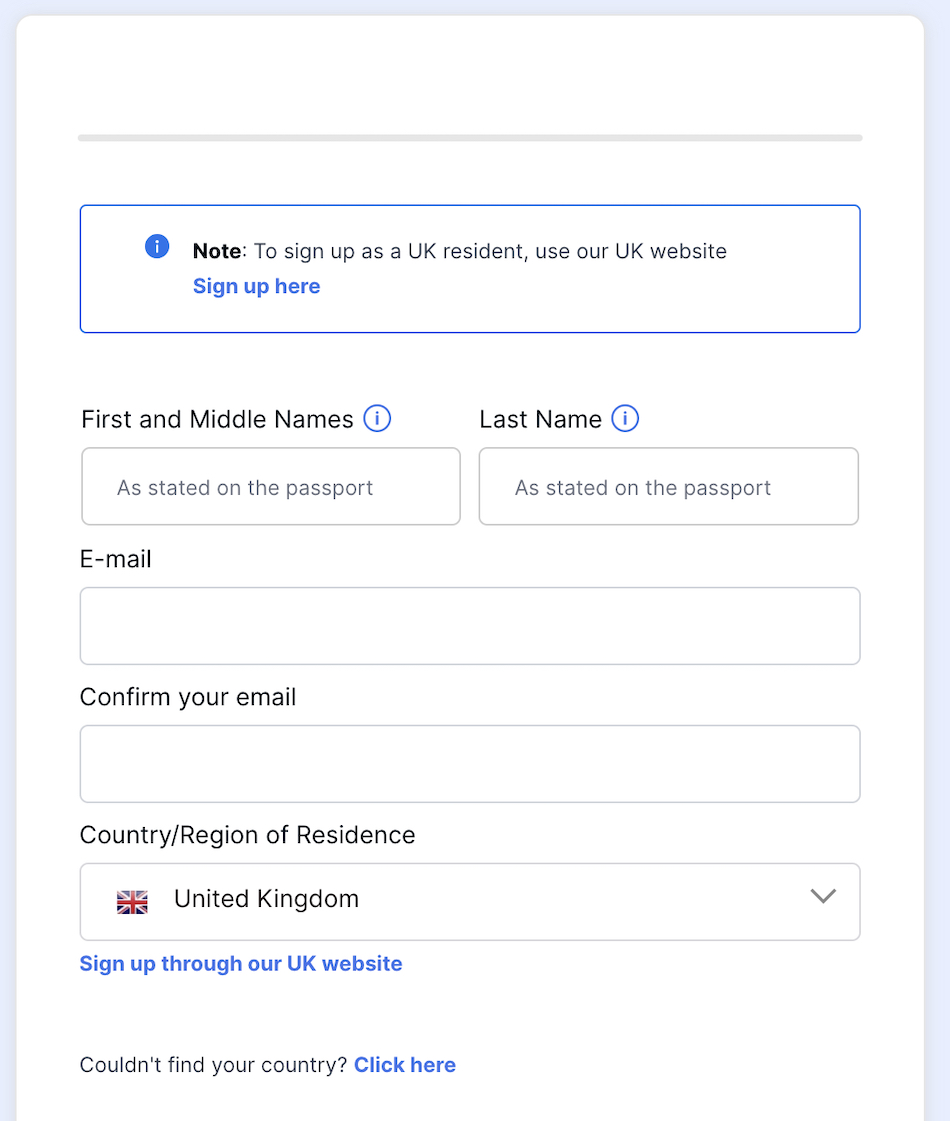
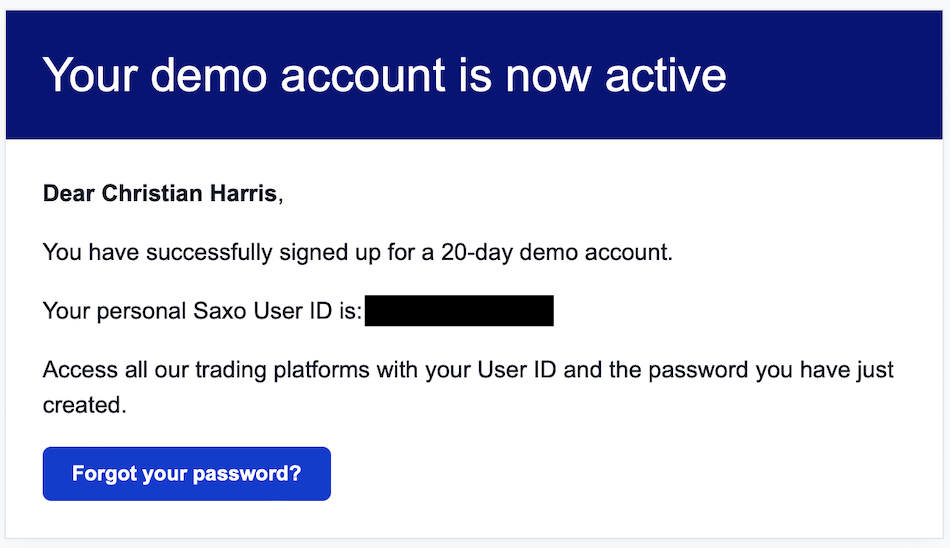
There’s effectively one demo account type — Classic-level, with $100,000 in virtual funds and a 20-day window across both SaxoTrader. We tested it across forex, CFDs, and a selection of stocks, and the pricing and leverage closely matched live conditions to make the overall experience feel authentic.
Getting started is refreshingly simple — name, country, email, phone, email confirmation, and you’re in. No full KYC, no live account required first. The demo can also be reset to its original balance, which is handy for testing strategies multiple times. The 20-day limit is the main drawback; several other top-tier platforms now offer longer or even open-ended demo periods, and for newer traders, three weeks can feel like a tight runway.
What the demo does well is give an honest picture of what trading with Saxo actually feels like day to day. The interface, order ticket, and watchlist logic are identical to the live environment, making it genuinely useful for stress-testing workflows before putting real money on the line.
That said, it assumes a certain level of platform familiarity from the outset. For experienced traders who just want to kick the tyres before committing, it’s a solid tool. For complete beginners, the density and time limit combined can make it feel more pressured than it should.
Deposits & Withdrawals
Saxo’s approach to deposits and withdrawals is exactly what you’d expect from a bank-backed broker: secure, transparent, and unhurried. Funding is via bank wire, debit card, and credit card — no e-wallets or crypto. There are no internal fees for wire transfers, and any card-related charges are displayed clearly on-screen before you confirm, which is a nice touch.
In practice, wiring money in is simple enough: grab the IBAN and SWIFT details from the platform, send the transfer, and expect the balance to appear within a couple of business days.
Withdrawals follow the same conservative logic — bank transfer only, no PayPal, Skrill, or Neteller. You’ll also need to pre-register your beneficiary account before anything moves, either by funding it initially or through a compliance step.
Our withdrawal requests were processed within 1 to 2 business days on Saxo’s end, though the full journey to your bank account often stretched to 4 or 5 days once correspondent banking was involved. Saxo itself doesn’t charge withdrawal fees, but the SHA cost model means routing and currency conversion charges land on your side — something to watch on FX transfers or smaller payouts.
Compared with brokers that lean on e-wallets for near-instant deposits and withdrawals, this will feel slow. But it’s also more transparent and more traceable, which matters if you’re moving larger sums and care about the audit trail.
For active traders who dip in and out frequently with smaller amounts, the friction will grate. However, for those who move money less often and value knowing exactly where it’s going, Saxo’s setup is reassuringly solid.
| Saxo | Interactive Brokers | FOREX.com | |
|---|---|---|---|
| Accounts & Banking Rating | |||
| Payment Methods | BPAY, Debit Card, Mastercard, PayID, PayNow, Visa, Wire Transfer | ACH Transfer, Automated Customer Account Transfer Service, Cheque, TransferWise, Wire Transfer | ACH Transfer, Credit Card, Debit Card, Mastercard, Neteller, PayNow, PayPal, Skrill, Visa, Wire Transfer |
| Minimum Deposit | $0 | $0 | $100 |
| Visit | Visit | Visit | Visit |
| Review | Review | Review | Review |
Assets & Markets
Saxo’s asset range is one of the most compelling reasons to choose it over most other top-tier brokers. Over several weeks of testing, we traded across FX, CFDs, stocks, ETFs, futures, options, bonds, and cash indices — all within a single account, without being shuffled between different product environments. The headline number is north of 70,000 instruments across global markets, which puts it well ahead of IG and most CFD-focused brokers.
The stock library alone lists around 23,000 equities across roughly 50 exchanges, including the NYSE, Nasdaq, LSE, and major European and Asian exchanges. Most household-name stocks were easy to find and trade, but some smaller-cap AIM listings found at Spreadex weren’t available.
ETF and bond coverage is similarly broad — around 10,000 ETFs and more than 5,000 government and corporate bonds — which pushes Saxo closer to institutional-provider territory than the typical CFD broker.
Against Interactive Brokers, the breadth is comparable, but Saxo packages everything into a tighter, single-margin framework that makes spanning FX, equities, and bonds genuinely seamless. The trade-off is cost: smaller accounts will pay more here than at leaner CFD-focused alternatives.
For traders who want deep, diversified market access under one roof and are willing to pay for that convenience, Saxo’s asset list is a genuine strength. For those who just want cheap, focused trading in a handful of markets, it’s a premium product solving a problem they don’t have.
Leverage
Saxo’s leverage limits are conservative by design, in line with ESMA’s standard regulations for retail clients in the UK and EU: up to 1:30 on major forex pairs, 1:20 on non-major FX, gold, and primary indices, 1:10 on other commodities, and 1:5 on individual equities.
In live testing, those limits matched exactly what we saw in the margin tables and on the order ticket, with required margin updating in real time as we adjusted position size or switched instruments.
What’s worth noting is how upfront Saxo is about all of this. The platform displays margin percentages rather than just leverage ratios, and it’s genuinely difficult to open a position without a clear picture of how much buffer you’re working with. That level of transparency is a world apart from high-leverage CFD brands that advertise 1:1000 and bury the detail in small print.
Saxo doesn’t try to compete on raw leverage, and that’s clearly a deliberate choice rather than a limitation. Professional clients can access higher ratios on majors up to 1:100, but only at the cost of certain protections like negative-balance guarantees. For retail traders, the caps stay firmly at the regulated levels. This makes Saxo a natural fit for those who use leverage as a precision tool—not those who chase it as the main event.
| Saxo | Interactive Brokers | FOREX.com | |
|---|---|---|---|
| Assets & Markets Rating | |||
| Trading Instruments | Forex, CFDs, indices, shares, commodities, cryptocurrencies, futures, options, warrants, bonds, mutual funds, ETFs, ETNs | Stocks, Options, Futures, Forex, Funds, Bonds, ETFs, Mutual Funds, Cryptocurrencies | Forex, Futures and Options on Metals, Energies, Commodities, Indices, Bonds |
| Margin Trading | Yes | Yes | Yes |
| Leverage | 1:30 | 1:50 (major forex pairs), 1:2-1:4 (equities) | 1:50 |
| Visit | Visit | Visit | Visit |
| Review | Review | Review | Review |
Fees & Costs
Saxo’s pricing isn’t subtle — spend a few weeks trading real size and tracking your statements, and the costs become apparent.
We traded spot FX, index CFDs, and US and UK stocks on a live Classic account, then benchmarked effective costs against those of other top-tier brokers using identical ticket sizes. EUR/USD spreads on Classic typically came in around 0.8–0.9 pips all-in, tightening at Platinum and VIP — competitive, but not as sharp as the lowest-cost ECN-style alternatives like TopFX and IC Markets.
Stock commissions can look attractive on paper — around $1.60–$3 per US trade, depending on venue and tier — and in some markets, Saxo did undercut competitors on straightforward equity tickets. The catch is the custody fee: a percentage charge on the value of stock, ETF, and bond holdings that only gets waived or reduced at higher tiers.
For a simple buy-and-hold equity portfolio at a modest account size, that fee made Saxo noticeably more expensive than flat-fee or zero-custody alternatives in our testing.
On the plus side, Saxo doesn’t charge any inactivity fees if you leave your account dormant for extended periods. Overnight financing on CFDs and FX was in line with other bank-backed brokers, though still higher than the most aggressive CFD brokers on index positions held for several days.
Saxo sits in an awkward middle ground: cheaper than many brand-name banks for active trading, but more expensive than lean specialists once custody and inactivity fees are factored in.
The fee structure makes the most sense for traders who are active across multiple asset classes and can reach the Platinum tier or above. For smaller or less active accounts, you’re paying a clear premium for a platform that, while genuinely good, isn’t priced to reflect that.
| Saxo | Interactive Brokers | FOREX.com | |
|---|---|---|---|
| Fees & Costs Rating | |||
| EUR/USD Spread | 0.2 (varies by region) | 0.08-0.20 bps x trade value | 1.2 |
| FTSE Spread | 1.2 pts (Variable) | 0.005% (£1 Min) | 1.0 |
| Oil Spread | 0.03 | 0.25-0.85 | 2.5 |
| Stock Spread | 0.10% (subject to min commission) | 0.003 | 0.14 |
| Visit | Visit | Visit | Visit |
| Review | Review | Review | Review |
Trade Execution
Trade execution at Saxo is fast and unusually well-documented — which matters when you’re the kind of trader who notices the difference between 20 milliseconds and 200.
In our live testing, market orders on major FX and index CFDs filled in the low-millisecond range, close to the quoted price, with only occasional drift during fast-moving sessions.
Against ECN-style brokers like IC Markets and Pepperstone, Saxo felt broadly comparable — perhaps a fraction slower — but comfortably within the range most intraday traders would call solid.
Total latency breaks down into four parts:
- Local processing latency: Your own machine processes the click before anything else happens. An SSD, a decent CPU, and a wired connection all help here. Wi-Fi and older hardware add lag before the order even leaves your desk.
- Network latency: The routing between your connection and Saxo’s servers. Fibre and a wired Ethernet setup will consistently beat Wi-Fi. Traders on a good line will notice the difference.
- Broker processing latency: Here, Saxo’s data is unusually transparent. Market-order FX fills average around 9–10 milliseconds, with roughly 99.3–99.5% completing in under 50 milliseconds. Limit-style fill-or-kill orders average 10–12 milliseconds, with nearly all settling in under 100.
- Execution latency: Saxo routes orders against its own aggregated liquidity rather than a raw multi-provider ECN pool. In practice, that means a clean, consolidated book — fast fills, but without the razor-thin spreads the slickest ECN brokers can occasionally offer in peak liquidity.
Saxo doesn’t publish an end-to-end round-trip number that includes your local setup, but combining its internal stats with our own testing, the picture is clear: under normal conditions, most FX and major-index CFD trades clear well inside half a second, with the quoted price largely holding.
That’s more than acceptable for typical intraday trading — though it doesn’t quite match the headline sub-10-millisecond claims some pure ECN brokers make in their best-case scenarios.
Live Trading Test
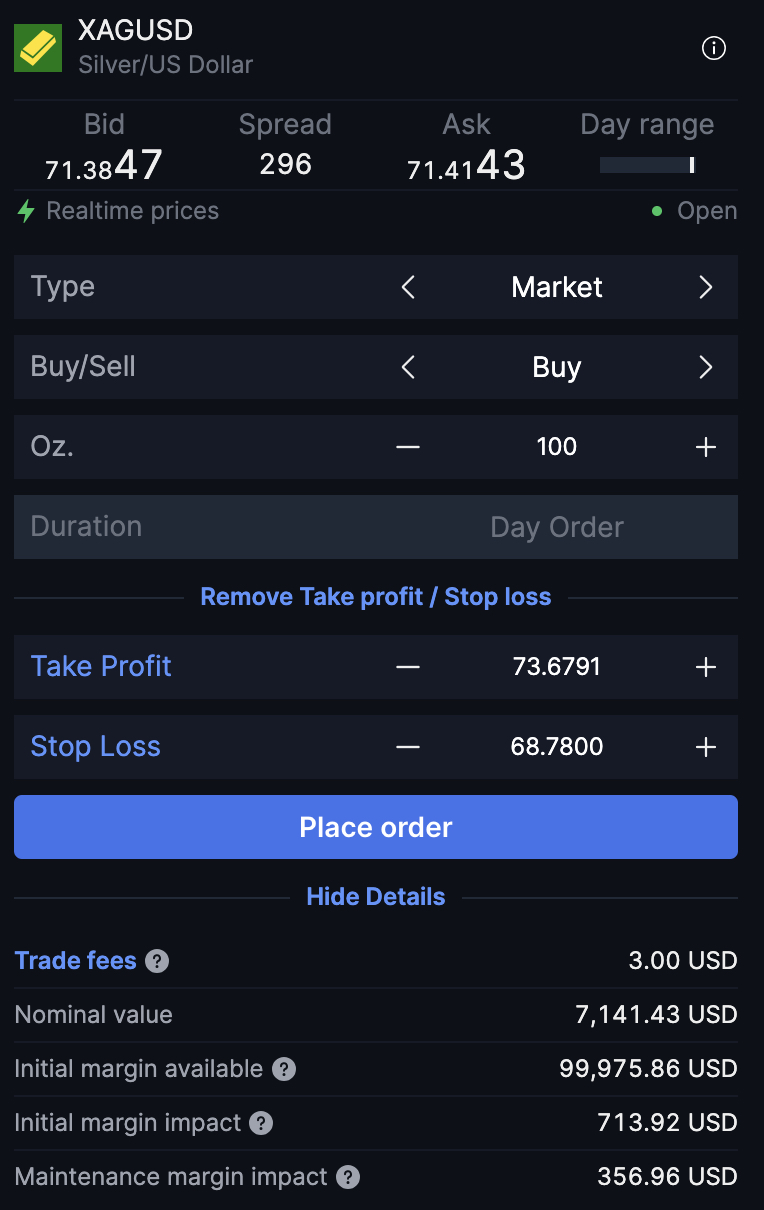
Testing from a UK-based machine, market orders on major pairs like GBP/USD filled well inside a second during the London open, with very few rejections or hiccups. Even in the first 10–15 minutes of the session — typically the choppiest window — most FX and index CFD trades landed close to the quoted price, which suggests Saxo’s internal routing handles normal European market load without much strain.
On standard home broadband, fills remained usable for short-term day trading, though occasional news-driven spikes widened slippage on tighter positions.
When we simulated a higher-latency environment — around 300–400ms, replicating a longer or less direct routing path — execution became noticeably less precise. The platform stayed stable and didn’t drop orders, but reaction-time-dependent trades felt less reliable, and scalping tight ranges got harder.
Slippage Analysis
Over several hundred live and demo trades — covering EUR/USD, GBP/USD, EUR/JPY, and key index CFDs like the Nasdaq-100 and FTSE 100 — slippage under normal conditions was modest on liquid pairs and major indices.
It stepped up slightly around news releases, as you’d expect from a broker running an internal liquidity model rather than a pure multi-feed ECN. A meaningful share of trades during sharp moves landed slightly worse than the initial spread, consistent with Saxo having to manage its own book.
Saxo’s own published execution stats for EUR/USD market orders tell a similar story: roughly 55–60% of trades fill with zero slippage, around 20% see negative slippage, and about 20% actually benefit from price improvement, with fill rates near 100% and average execution speed around 9–10 milliseconds.
That profile makes Saxo a solid choice for regular intraday trading, but it doesn’t quite meet the standards that pure high-frequency or scalping-focused traders demand.
Methodology note
We ran several hundred simulated and live round-trip trades on a Saxo account, mixing market and limit orders across EUR/USD, XAU/USD, and key index CFDs, including the S&P 500 and FTSE 100, over multiple days.
Testing covered peak-volatility windows — the London open, the London–US overlap, and major news releases — as well as quieter sessions, using SaxoTrader on a UK-based connection.
Slippage was measured as the difference between the quoted spread at submission and the actual fill price, averaged by instrument and session type, and cross-checked against Saxo’s own monthly FX execution-quality tables.
Platforms & Tools
Saxo’s trading platforms are split into two distinct tools: SaxoTrader, the full-featured trading suite, and SaxoInvestor, a more guided platform aimed at longer-term investors. We tested both in the browser and in a desktop-native form on both Windows and Mac computers, and the divide between them isn’t just about features — it’s about who each is actually built for.
SaxoTrader is clearly aimed at active traders. Order placement is comprehensive — market, limit, stop, trailing stop, algo orders, and more — and the depth-of-market view, advanced screeners, and multi-venue liquidity routing give it a density that sits closer to cTrader or MT5 than anything you’d find at a retail-first broker.
That said, all those options come with a learning curve. Compared with the stripped-back simplicity of eToro or Capital.com — where placing a trade takes a few clicks and provides clear risk management — SaxoTrader can feel genuinely overwhelming for anyone who isn’t already comfortable with professional-grade platforms.
Where it does pull ahead of third-party tools like MT5 or cTrader is integration: Saxo’s smart-order-routing engine connects directly to the bank’s own liquidity, cutting out the extra layer you often get when those platforms are used as a front-end to an external broker.
The charting is rich, and the order-ticket design is precise, though it lacks the open-ended customization and community-built indicators that make TradingView hard to beat for that particular crowd.
SaxoInvestor is a different beast altogether — and deliberately so. We tested the theme-based portfolios, stock shortlists, and basic charting tools, and the experience felt more like a clean, broker-native investment dashboard than a trading terminal.
For long-term investors who want a tidy, research-integrated window into stocks, ETFs, and funds, it works well. But it’s not trying to compete with MT5 or cTrader on order depth, automation, or backtesting — and it doesn’t.
What makes Saxo’s setup unusual compared with other top-tier brokers is just how deliberately bifurcated it is: one environment built for active traders, another built for patient investors, with little middle ground. That’s a different philosophy from the “one platform, many add-ons” approach you see at brokers that lean heavily on MT5 or cTrader, or the browser-first TradingView model that some firms have moved toward.
If execution precision and workflow depth across FX, equities, and options matter most, Saxo’s in-house tools are among the better proprietary platforms out there. If you want something more open, more customizable, or more community-driven, third-party platforms still have the edge.
Mobile Apps
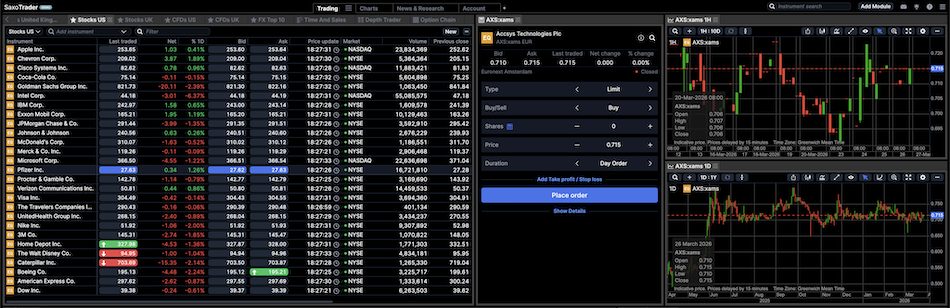
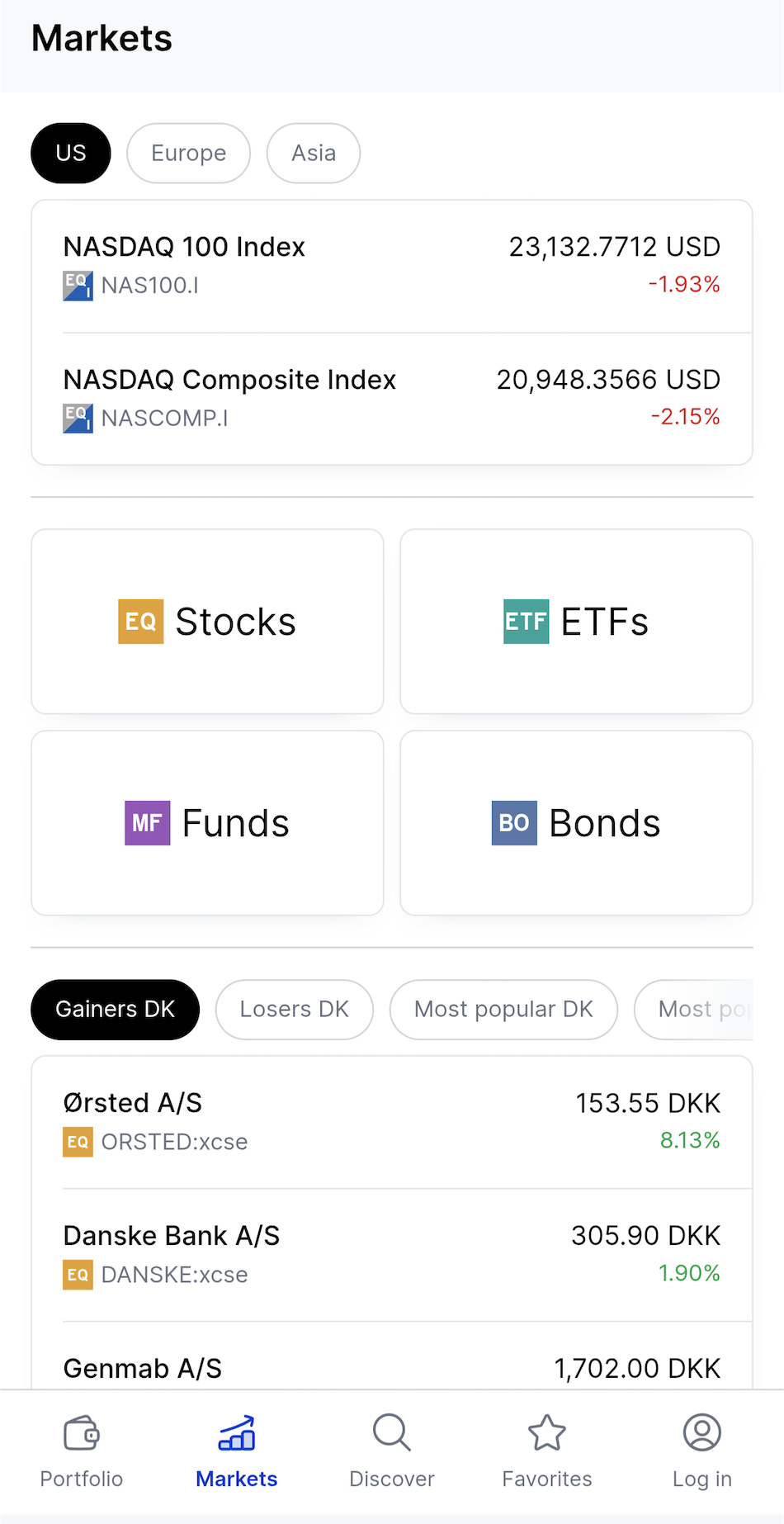
SaxoTrader’s mobile app (SaxoTraderGO) is surprisingly full‑featured for a broker‑native interface. We placed live trades in forex, CFDs, and equities, adjusted stop‑loss and take‑profit levels on the fly, and used built‑in screeners and chart tools without noticing the lag you see in some other broker‑branded apps.
It still doesn’t match the customization of a full desktop terminal, but for an active trader managing positions on the move, it’s one of the more capable mobile suites.
SaxoInvestor, by contrast, feels more like a polished portfolio‑tracking app with trading tacked on. When we tested it, price data and position updates were smooth, but everything was clearly tuned for longer‑term investors: simple watchlists, clear buy/sell flows, and an emphasis on themes and stock fundamentals, not intraday charts or order‑type experimentation.
One practical detail that stood out in our testing: some markets and instruments still required explicit real‑time data subscriptions, and those weren’t always obvious until you tried to see a live quote, which can trip up less experienced users.
In both cases, the apps were stable and snappy on recent Android and iOS hardware, with no major crashes or unexpected logouts during our sessions. That consistency is more than many broker‑branded apps deliver.
| Saxo | Interactive Brokers | FOREX.com | |
|---|---|---|---|
| Platforms & Tools Rating | |||
| Platforms | SaxoTraderGO, SaxoTraderPRO, SaxoInvestor, TradingView, ProRealTime | Trader Workstation (TWS), IBKR Desktop, GlobalTrader, Mobile, Client Portal, AlgoTrader, OmniTrader, TradingView, eSignal, TradingCentral, ProRealTime, Quantower | WebTrader, Mobile, MT4, MT5, TradingView |
| Mobile App | SaxoTraderGo (iOS, Android, Windows) | iOS & Android | iOS & Android |
| Visit | Visit | Visit | Visit |
| Review | Review | Review | Review |
Research
Saxo’s trading research is one of its stronger selling points, but it feels more like a small‑bank research desk than a polished retail‑trader news feed. From the Research tab inside the SaxoTrader platform, we tested daily market updates, technical analysis notes, and macro‑level commentaries on FX, equities, and commodities.
The content is original, well-written by in‑house strategists, and covers both short‑term trading setups and longer‑term themes, which is more substantial than the generic headline‑recycling you see at many brokers.
The standout pieces are the ‘Quarterly Outlook’ reports, which lay out top‑down themes across asset classes and individual markets. We compared them against Interactive Brokers’ and IG’s in‑house research and found that Saxo’s reports are more explicitly geared toward active traders and multi‑asset positioning.
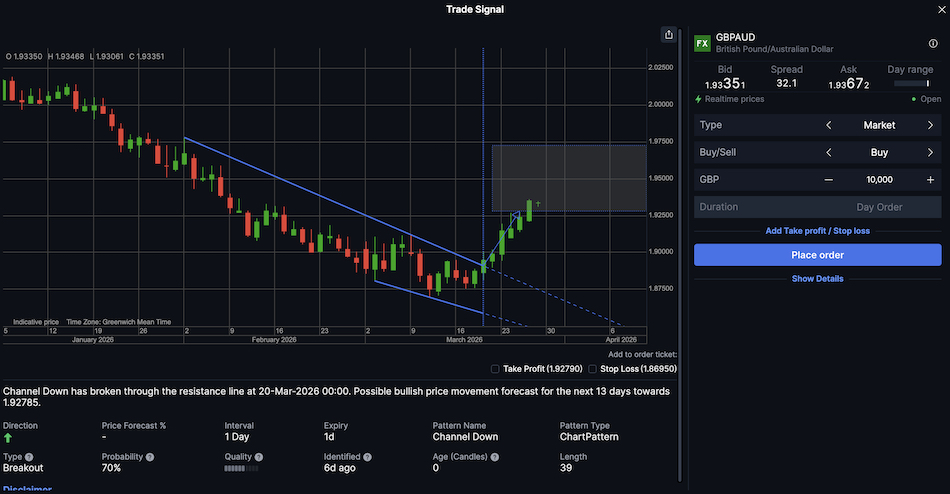
On the technical side, Saxo’s research combines in‑house technical notes with integration of tools like Autochartist, giving you both narrative views and pattern‑based signals.
Autochartist is tightly integrated into Saxo’s platform, not just bolted on as an extra widget. You can filter signals in one interface by pattern type — breakout, reversal, emerging — by asset class (forex, stocks, indices, commodities, etc.), by timeframe (15 minutes up to daily), and by probability band (from “All” to 70%+ setups), which is a level of control most brokers don’t offer.
That flexibility lets day traders, swing traders, and position‑based investors alike pick only the kinds of signals that fit their style, without drowning in noise.
For traders who rely heavily on fundamentals and macro views, Saxo’s research is arguably as good as, or better than, most other top‑tier brokers.
| Saxo | Interactive Brokers | FOREX.com | |
|---|---|---|---|
| Research Rating | |||
| Visit | Visit | Visit | Visit |
| Review | Review | Review | Review |
Education
The best of Saxo’s education material is clustered in the “All about investing” area of the site, rather than in a single obvious “Learn” or “Education” tab. It is where you actually find the most structured, practical guidance for both new and experienced investors and traders. Thankfully, the same content is easier to find in the trading platform.
You’ll find a mix of guides, market insights, a glossary, FAQs, webinars, podcasts, and YouTube-hosted videos in the Help Centre. The guides cover topics such as ETFs, stocks, bonds, portfolio construction, volatility management, and instrument selection, often with concrete examples and a clear focus on real‑world trade‑off decisions. The glossary and FAQ‑style help content are useful reference points, especially for understanding Saxo’s own product labels and fee structures.
Compared with other top‑tier brokers, Saxo’s content is more investor‑oriented and macro‑aware than the typical retail‑focused “how to trade the US open”. The mix of well-written guides, professionally presented live and on‑demand webinars, and short documentary‑style videos is richer than what you get from most brokers, where education feels more like a utility than a core selling point.
At the same time, brokers like IG place greater emphasis on step‑by‑step beginner journeys and retirement‑style content, whereas Saxo only touches on them. For an intermediate or experienced trader looking to deepen strategy and multi‑asset knowledge, Saxo’s “All about investing” area is genuinely useful. For a complete beginner, however, it could do with better organising to feel like a coherent starting point.
| Saxo | Interactive Brokers | FOREX.com | |
|---|---|---|---|
| Education Rating | |||
| Visit | Visit | Visit | Visit |
| Review | Review | Review | Review |
Customer Support
Saxo’s customer support is thorough and well-organised, but it’s built for clients who value structure over speed. The online help centre is genuinely impressive in scope: well-laid-out articles, FAQs, and step-by-step guides mean that most questions about margin rules, order types, or platform quirks can be answered without ever picking up the phone. If you’re the type who prefers to find things yourself, it works well.
Getting hold of an actual person is a different story. Phone and email support spans multiple regions — Europe, Asia/Pacific, the Middle East — with dedicated numbers and addresses listed on the ‘Contact us’ page.
Email responses typically came back within a business day in our testing, which is perfectly acceptable for anything non-urgent, but noticeably slower than the near-instant live chat you’d get from IC Markets or other top-tier CFD brokers.
On the more formal side, Saxo does publish a clearly documented complaints procedure — including escalation steps and independent review options — in more detail than most brokers bother with, which is worth acknowledging.
The bigger gap, though, is live chat. There isn’t one — not on the main website, not inside SaxoTrader or SaxoInvestor. For a broker operating at this level, that’s a conspicuous absence. Queries that would take a few minutes via chat elsewhere have to go through email or phone instead.
Saxo’s support is competent and covers the basics, but if fast, real-time assistance matters to you, it falls short of what the best names in the space now offer as standard.
| Saxo | Interactive Brokers | FOREX.com | |
|---|---|---|---|
| Customer Support Rating | |||
| Visit | Visit | Visit | Visit |
| Review | Review | Review | Review |
Community Sentiment
Trader opinion on Saxo Bank is broadly positive, but it’s far from universal. Our analysis of more than 20,000 reviews and ratings from Trustpilot, the App Store, Google Play and other trader forums reveals a familiar split: respect for the bank’s solidity on one side, grumbles about pricing and patchy service on the other.
The traders Saxo tends to attract are a particular breed — serious investors and active market participants who care more about regulatory credibility, sophisticated tools, and genuine market depth than rock-bottom costs or high leverage.
Put it next to cheaper retail brokers like IC Markets or Pepperstone, and Saxo feels like a different animal entirely — more institutional, more data-heavy, and considerably less forgiving if you’re still finding your feet. Spreads and commissions are competitive enough on major pairs and indices, but the tiered pricing structure and high minimum deposits quietly shut the door on more casual traders.
The praise from satisfied clients tends to cluster around the same things: platform reliability, clean execution on larger orders, and the sheer breadth of what’s tradeable — north of 70,000 instruments spanning spot FX, global equities, bonds, and more. The complaints, meanwhile, keep circling back to cost, inconsistent account support, and withdrawal times that drag in some regions.
Our own experience tracked closely with that consensus. The systems are stable, and execution held its composure even when the markets got choppy — but the pricing model and the level of support both seem calibrated for experienced, higher-value clients. For smaller accounts, the whole thing can feel a little cold and not especially cheap for what you get.
Saxo Entities and Safeguards
Saxo holds licences from multiple regulatory bodies, but which one actually covers your account depends on the entity you sign up through – and the level of protection that comes with each one may differ considerably. The details are below.
Note Saxo is no longer authorized by the SFC in Hong Kong. In 2026, the Hong Kong SFC also fined Saxo Capital Markets HK Limited HK$4 million for regulatory breaches between 2018 and 2022, concerning Saxo distributing complex crypto products to retail clients without proper knowledge assessments or warnings.
Saxo Bank A/S (Danish FSA)
- Entity URL: https://www.home.saxo/dk
- Verify License: 1149
- Regulator Classification (Green to Red): Danish FSA (green-tier – strong safeguards)
- Protections: EU clients trading through Saxo Bank A/S fall under the Danish FSA, which means client money segregation, negative balance protection for retail accounts, and leverage capped at 1:30 on major FX pairs down to 1:5 on equities. If the firm were to fail, eligible clients can claim up to approximately EUR 100,000 through Denmark’s statutory investor compensation scheme. That said, the precise mix of protections depends on which entity and jurisdiction your account is actually opened under, so it’s worth checking the specifics rather than assuming uniform coverage across the board.
- Who Gets Signed Up Under This Entity: EU clients and some international clients routed through Saxo’s Danish entity.
Saxo Banque (ACPR)
- Entity URL: https://www.home.saxo/fr-fr
- Verify License: 483632501
- Regulator Classification (Green to Red): French Prudential Supervisory Authority (ACPR) (green-tier – strong safeguards)
- Protections: Clients trading through Saxo’s French entity fall under the ACPR, which enforces client money segregation, negative balance protection for retail accounts, and the standard MiFID II leverage caps — 1:30 on major FX pairs down to 1:5 on equities. In the event of firm failure, eligible clients are covered up to EUR 100,000 through France’s investor compensation scheme (the Fonds de Garantie des Dépôts et de Résolution). As with other EU jurisdictions, the exact protections in place depend on the specific entity and account type under which you’re registered, so it’s worth confirming the details before you open an account rather than assuming full coverage applies automatically.
- Who Gets Signed Up Under This Entity: Clients in France.
Saxo Bank Securities Co., Ltd. (FSA)
- Entity URL: https://www.home.saxo/ja-jp
- Verify License: 239
- Regulator Classification (Green to Red): Japanese Financial Services Authority (FSA) (green-tier – strong safeguards)
- Protections: The FSA is one of the more rigorous regulatory frameworks in Asia. Client funds must be held separately from the firm’s own assets, and the FSA enforces strict leverage caps — 1:25 on major FX pairs for retail clients under Japan’s domestic rules, which are tighter than the ESMA standards applied in Europe. In the event of firm failure, eligible clients are covered up to JPY 10,000,000 through the Japan Investor Protection Fund. As always, the precise scope of protections depends on the account type and the specific terms under which you’re onboarded, so it’s worth reviewing the local disclosures carefully before committing.
- Who Gets Signed Up Under This Entity: Clients in Japan.
Saxo Markets Pte. Ltd. (MAS)
- Entity URL: https://www.home.saxo/en-sg
- Verify License: 200601141M
- Regulator Classification (Green to Red): Monetary Authority of Singapore (MAS) (green tier – strong safeguards)
- Protections: MAS is a well-regarded regulator by Asian standards, which requires client fund segregation and maintains solid conduct and capital standards. Leverage limits are set at up to 1:20 on major FX pairs for retail clients — less restrictive than ESMA’s 1:30 cap but more defined than some other Asian jurisdictions. The key gap compared with European regulation is the absence of a statutory investor compensation scheme — if the firm were to fail, there’s no guaranteed payout fund, and recovery would depend on the insolvency process. MAS is a credible regulator, but clients accustomed to EU-style protections should be aware the safety net is meaningfully thinner.
- Who Gets Signed Up Under This Entity: Clients in Singapore.
Saxo Bank (FINMA)
- Entity URL: https://www.home.saxo/en-ch
- Verify License: CHE-106.787.764
- Regulator Classification (Green to Red): Swiss Financial Market Supervisory Authority (FINMA) (green-tier – strong safeguards)
- Protections: FINMA is one of the more respected regulators globally. Client funds must be segregated from the firm’s own assets, and FINMA enforces robust capital adequacy and conduct requirements. Leverage limits broadly mirror those applied under ESMA — up to 1:30 on major FX pairs for retail clients, stepping down to 1:5 on equities. In the event of firm failure, eligible clients are covered up to CHF 100,000 through Switzerland’s esisuisse deposit protection scheme. As with other jurisdictions, the precise scope of protections depends on your account type and the specific terms of your onboarding, so it’s worth reviewing the local disclosures before opening an account.
- Who Gets Signed Up Under This Entity: Clients in Switzerland.
Saxo Capital Markets UK Limited (FCA)
- Entity URL: https://www.home.saxo/en-gb
- Verify License: 551422
- Regulator Classification (Green to Red): FCA (green tier – strong safeguards)
- Protections: The FCA is one of the stronger regulatory frameworks Saxo operates within globally. Client funds must be segregated under FCA client money rules, retail accounts carry negative balance protection, and leverage is capped at 1:30 on major FX pairs down to 1:5 on equities. In the event of firm failure, eligible clients are covered up to £85,000 through the Financial Services Compensation Scheme (FSCS), with access to the Financial Ombudsman Service for any unresolved disputes — a level of retail protection that puts the UK offering near the top of Saxo’s global entity lineup.
- Who Gets Signed Up Under This Entity: UK clients.
Important: Verify Your Entity & URL
Before opening an account, make sure you’re on a genuine Saxo website and registering with the correct entity for your region. Saxo determines which regulatory terms apply based on your location and IP address, so if you’re travelling or using a VPN, the disclosures you see may reflect a different jurisdiction than your own.
This is less of a concern with Saxo than with brokers that rely on offshore licences, given its primary anchor in Denmark under the Danish FSA and its EU-wide authorisation under MiFID — core conditions are relatively consistent across most European markets.
The more relevant consideration is that Saxo does route some client relationships through regional entities outside the EU, including Singapore and Australia, where investor protection frameworks and compensation schemes can be materially weaker. For clients in those jurisdictions, that’s worth understanding before anything goes wrong rather than after.
Watch for Clone Scams
Scammers sometimes set up fake Saxo‑style sites that look close to the real thing but use slightly altered web addresses. That might mean a different ending (for example, .co or .io instead of .com), extra words, or small typos. Possible fake‑looking clones could look like:
- saxobank.co or saxobank.io (different extension)
- saxo-trading.com or saxo-investor.com (extra words)
- saxobanks.com or saxo-bank.com (misspelling or added symbol)
These sites usually exist to capture your deposits or personal information. Before you log in or send money, check the URL in your browser carefully and confirm the firm name and regulatory details shown on the page.
The genuine Saxo site should clearly state its legal entity and licence details in the footer or legal section (for example, “Saxo Bank A/S, regulated by the Danish FSA”), and you can cross‑check that name on the relevant regulator’s register.
But remember, text and logos are easy to copy. The only reliable safeguard is to make sure the address in your browser bar matches the official Saxo domain (for example, home.saxo) exactly before entering passwords or payment information.
| Checkpoint | What to Look For |
|---|---|
| URL Extension | Should be .com (or regional like .com/en-gb/), not .co, .io, or .biz. |
| Spelling | Watch for missing letters (e.g., sxo or saxoo). |
| Entity Name | Must match your region (e.g., Saxo Bank A/S for the Danish FSA). |
| Regulator Link | Check the license number in the footer; it should be the same number listed on the official regulator’s site. |
Is Saxo A Good Broker?
Saxo is a strong broker for serious, higher-balance traders and investors who put regulation, transparency, and multi-asset access above low fees or a gentle learning curve. Over several weeks of live testing — real trades across FX, CFDs, and equities, using both SaxoTrader and SaxoInvestor — the platforms held up well. Order fills were tight on major pairs and indices, slippage stayed reasonable even around news events, and nothing buckled under pressure. For active traders, that consistency matters.
But Saxo isn’t a broker that works for everyone, and it doesn’t really try to be. The pricing structure rewards larger accounts; smaller balances will feel the weight of minimum deposits and tiered fees on almost every trade. Support is competent but not fast, and the research and education content — while genuinely good — assumes a level of experience that newer traders may not yet have.
Overall, Saxo is a regulated, bank-backed gateway to global markets, and it does that job well. Traders who want deep market access, reliable execution, and a solid regulatory foundation — and who can absorb the costs that come with it — will find it hard to fault in practice. For beginners or smaller accounts, though, the model will likely feel both expensive and more complex than it needs to be.
How We Tested Saxo
- We opened a live account via Saxo’s online application, completed the full KYC process, and funded it via bank transfer and debit card. From there, we placed test trades across major FX pairs, gold, and key index CFDs — paying close attention to execution speed, slippage, and how the platforms held up during both quiet sessions and bursts of volatility.
- Both proprietary platforms — SaxoTrader and SaxoInvestor — were tested across desktop and mobile over multiple sessions. We built custom watchlists, set price alerts, tweaked layouts, and worked through various order types and drawing tools to get a real sense of how well they serve active traders day to day.
- We reached out to Saxo’s support team via phone and email with questions covering account tiers, margin policies, and platform settings to determine whether the responses were professional and knowledgeable.
- Saxo’s spreads, commissions, and overnight financing rates were compared with its published fee tables and the pricing of other major European brokers. We focused on instruments most traders actually use — EUR/USD, XAU/USD, and the major equity indices.
- Finally, we cross-referenced our findings with third-party sources and trader forums to see how our experience stacked up against longer-term clients — particularly around withdrawal speed, how disputes get handled, and whether the overall service holds up over time.
FAQ
Is Saxo A Broker?
Yes. Saxo is a global multi‑asset broker and licensed bank offering access to forex, CFDs, stocks, ETFs, bonds, and futures.
Is Saxo A Brokerage Account?
Saxo offers brokerage accounts for retail and professional traders, providing direct market access through its own SaxoTrader and SaxoInvestor platforms.
Is Saxo Bank An ECN broker?
Not strictly. Saxo operates as a market‑making broker using a mix of direct market access and internalized pricing. It’s not a pure ECN model.
Is Saxo Bank A Safe Broker?
Yes. It’s regulated as a bank under the Danish FSA with strong capital requirements and audited financials, making it one of the more reliable options in the industry.
Is The Saxo Trading Platform Good?
Yes, though it suits experienced traders best. SaxoTrader and SaxoInvestor are fast, stable, and data‑rich, but can feel complex for beginners.
Who Owns Saxo Broker?
The J. Safra Sarasin Group owns a majority stake of approximately 71% in Saxo Bank. The remaining stake is held by founder Kim Fournais. Following the 2026 acquisition, Kim Fournais stepped down as CEO to chair the Board of Directors, and Daniel Belfer (formerly of Bank J. Safra Sarasin) was appointed as the new CEO of Saxo Bank.
Best Alternatives to Saxo
Compare Saxo with the best similar brokers that accept traders from your location.
- Interactive Brokers – Interactive Brokers (IBKR) is a premier brokerage, providing access to over 170 markets across 40 countries, along with a suite of comprehensive investment services. With over 40 years of experience, this Nasdaq-listed firm adheres to stringent regulations by the SEC, FCA, CIRO, and SFC, amongst others, and is one of the most trusted brokers for trading around the globe.
- FOREX.com – Founded in 2001, FOREX.com is now part of StoneX, a financial services organization serving over one million customers worldwide. Regulated in the US, UK, EU, Australia and beyond, the broker offers thousands of markets, not just forex, and provides excellent pricing on cutting-edge platforms.
Saxo Comparison Table
| Saxo | Interactive Brokers | FOREX.com | |
|---|---|---|---|
| Rating | 4 | 4.3 | 4.3 |
| Markets | Forex, CFDs, indices, shares, commodities, cryptocurrencies, futures, options, warrants, bonds, mutual funds, ETFs, ETNs | Stocks, Options, Futures, Forex, Funds, Bonds, ETFs, Mutual Funds, Cryptocurrencies | Forex, Futures and Options on Metals, Energies, Commodities, Indices, Bonds |
| Demo Account | Yes | Yes | Yes |
| Minimum Deposit | $0 | $0 | $100 |
| Minimum Trade | Vary by asset | $0 | 0.01 Lots |
| Regulators | DFSA, MAS, FCA, FINMA, AMF, CONSOB | SEC, FINRA, CFTC, NFA, CIRO, FCA, CBI, ASIC, SFC, SEBI, JFSA, MAS | NFA, CFTC |
| Bonus | – | – | VIP status with up to 10k+ in rebates – T&Cs apply. |
| Platforms | SaxoTraderGO, SaxoTraderPRO, SaxoInvestor, TradingView, ProRealTime | Trader Workstation (TWS), IBKR Desktop, GlobalTrader, Mobile, Client Portal, AlgoTrader, OmniTrader, TradingView, eSignal, TradingCentral, ProRealTime, Quantower | WebTrader, Mobile, MT4, MT5, TradingView |
| Leverage | 1:30 | 1:50 (major forex pairs), 1:2-1:4 (equities) | 1:50 |
| Payment Methods | 7 | 5 | 10 |
| Visit | – | Visit | Visit |
| Review | – | Interactive Brokers Review |
FOREX.com Review |
Compare Trading Instruments
Compare the markets and instruments offered by Saxo and its competitors. Please note, some markets may only be available via CFDs or other derivatives.
| Saxo | Interactive Brokers | FOREX.com | |
|---|---|---|---|
| CFD | Yes | No | No |
| Forex | Yes | Yes | Yes |
| Stocks | Yes | Yes | Yes |
| Commodities | Yes | Yes | Yes |
| Oil | Yes | No | Yes |
| Gold | Yes | Yes | Yes |
| Copper | Yes | No | Yes |
| Silver | Yes | No | Yes |
| Corn | Yes | No | Yes |
| Crypto | Yes | Yes | No |
| Futures | Yes | Yes | Yes |
| Options | Yes | Yes | Yes |
| ETFs | Yes | Yes | No |
| Bonds | Yes | Yes | No |
| Warrants | Yes | Yes | No |
| Spreadbetting | No | No | No |
| Volatility Index | Yes | No | No |
Saxo vs Other Brokers
Compare Saxo with any other broker by selecting the other broker below.
The most popular Saxo comparisons:
- Saxo Bank vs Moomoo
- Saxo Bank vs Interactive Brokers
- Saxo Bank vs IG Group
- CMC Markets vs Saxo Bank
- Saxo Bank vs eToro
- Exness vs Saxo Bank
- Saxo Bank vs Webull
- Saxo Bank vs Tastyworks
Customer Reviews
2.8 / 5This average customer rating is based on 4 Saxo customer reviews submitted by our visitors.
If you have traded with Saxo we would really like to know about your experience - please submit your own review. Thank you.
I had a dormant account with them for a while and was considering resuming active trading when I noticed that withdrawals started failing in late May 2026. Worryingly the transaction logs for specific withdrawal attempts would disappear within 24 hours. I decided to close my account. Several attempts to register bank accounts with Saxo also failed, with three small deposits being returned. My banks said it was a problem at their end. In the end I am still waiting to get my funds back after almost one week since logging a manual withdrawal request. I don’t know if these are system problems, client service problems or part of a questionable business model, but I now have zero confidence in Saxo handling my funds promptly or fairly.
You should definitely avoid Saxo. A serious problem arose. Overnight, I was unable to make deposits into my account, and several weeks passed without the problem being resolved. I was unable to buy or sell shares because my account was frozen.
However, I had submitted all the requested documents. It later turned out that this situation was due to an error on their part. Despite this, my account remained frozen, which had serious consequences for me.
I therefore recommend that you exercise extreme caution if you are considering using their services.
My friend had a very difficult experience.
I started using Saxo because I wanted to trade FX options of one day and everywhere just seems to offer CFDs these days. Fees aren’t bad though I’d always like lower lol. What’s been good is their OpenAPI for Excel – I ain’t seen that before at other brokers I’ve traded with. You can actually set up bulk orders from Excel which if you’re a geek like me is great. yeah I know everyone wants the glitz of a slick looking platform nowadays but give me the familiarity and statistical capabilities of excel all day. So yeah, Saxo is a great shout if you want to trade FX options and want decent Excel integration.
Saxo Bank feels very solid and offers tons of instruments and markets to trade, and they also offer multiple technical indicators. What I miss so far is a feature to analyse/research my own portfolio and not just new trading opportunities. I built a portfolio of 100+ stocks and had no way to identify which ones I should keep or sell based on the criteria I had for picking them in the first place. For example, I might have acquired a specific stock because its dividend yield was high at the time, but later I might want to divest and find better opportunities, if its expected yield falls below some threshold. Managing a large portfolio of stocks becomes impossible because of this and I had to rethink my strategy entirely.
Also, I am unable to trade many of the ETFs on their platform due to regulation, but I can’t filter these ETFs out so I will find tons of unavailable ETFs in my research that I have to check one by one. It’s frustrating.