



If you’re a day trader, every fraction of a pip counts. That’s why brokers with low spreads can be a game-changer, helping you pocket more of what you earn and keeping you competitive in fast-moving markets.
Let’s dig into our lowest spread brokers, tested and rated by industry experts and active traders.
Best Low Spread Brokers
We've been recording and analyzing spreads for 7+ years, and these 6 brokers offer the tightest spreads:
-
- Demo account
- Regulator: FCA, CySEC, FSA, DFSA, FSCA
- Platforms: Tickmill Webtrader, MT4, MT5, TradingView
-
- Demo account
- Regulator: ASIC, FSCA, FSA, FSC, CMA-UAE
- Min. deposit: $20
-
- Demo account
- Regulator: ASIC, VFSC
- Platforms: MT4, MT5, TradingView, AutoChartist
-
- Demo account
- Regulator: FSC
- Platforms: WebTrader, MT5
-
- Demo account
- Platforms: TradeLocker, MT5, TradeLocker
- Min. deposit: $5
-
- Demo account
- Instruments: CFDs on Forex, Stocks, Indices, Commodities
- Regulator: FSCA, FSC






Learn how we test brokers and why you can trust our ratings.
Here is a short summary of why we think each broker belongs in this top list:
- Tickmill 4.0/5 Tickmill is a global broker authorized by trusted regulators including the CySEC and the FCA. Hundreds of thousands of traders have opened an account with the firm with more than 530 million trades executed. Advanced trading tools, educational content and low fees make this broker stand out from competitors.
- PU Prime 4.5/5 PU Prime is a forex and CFD broker offering direct market access on forex, commodities, stocks, bonds, indices, and ETFs. With four account types (Cent, Standard, Prime, ECN) and multiple platforms, from MetaTrader to its own PU Prime app, it’s built for active traders at every level.
- Global Prime 3.8/5 Global Prime is a multi-regulated trading broker offering 150+ markets. Traders can get started with no minimum deposit and trade with leverage that varies depending on your region. The firm also has a high trust score and a good reputation with a license from the ASIC.
- TabTrade 3.0/5 Established in 2026, TabTrade is a CFD broker based in Saint Lucia. It offers a choice of three accounts (Standard, Edge, VIP) with spread-only and spread plus commission pricing, access to over 1,000 tradeable assets, and leverage up to 1:1000.
- HeroFX 3.3/5 Established in 2022, HeroFX is an offshore forex and CFD broker based in Saint Lucia. It offers MT5 and TradeLocker trading platforms with forex, stocks, indices, commodities, crypto, and high leverage up to 1:500. The minimum deposit is $5, and it supports scalping and automated trading.
- LHFX 3.5/5 Established in 2020 and formerly known as LonghornFX, LHFX is a forex and CFD broker offering over 170+ instruments. It stands out for accepting fast crypto transactions and its ECN account for active traders featuring spreads from 0.0 pips with a competitive $6 per lot commission.
Fee Comparison At Low Spread Brokers
| Broker | EUR/USD Spread | FTSE Spread | Oil Spread | Stock Spread | Crypto Spread |
|---|---|---|---|---|---|
| Tickmill | 0.1 | 0.9 | 0.04 | N/A | Variable |
| PU Prime | 0.2 pips (ECN) | 23 (ECN) | 2.2 (ECN) | 4.2 (Amazon) | 27.5 (BTC) |
| Global Prime | 0.16 | 0.84 | 1.6 | Variable | Floating |
| TabTrade | 0.03 | 1.0 | 0.04 | 0.14 (Apple) | 27.42 (BTC/USD) |
| HeroFX | 1.1 (observed in HeroFX Zero account) | 3.30 (observed in HeroFX Zero account) | 0.035 (observed in HeroFX Zero account) | Variable | 30.50 - BTC/USD (observed in HeroFX Zero account) |
| LHFX | 0.08 | 1170 | 106 | Apple (210) | 185119.9 (BTC) |
Community Sentiment
See how users rate these brokers based on the average customer ratings submitted on DayTrading.com, plus ratings from Trustpilot, the Apple App Store and Google Play.
| Broker | Our Users' Rating | Trustpilot Score | Trustpilot Reviews | iOS App Rating | Android App Rating |
|---|---|---|---|---|---|
| Tickmill | 1190 | ||||
| PU Prime | 1878 | ||||
| Global Prime | 565 | ||||
| TabTrade | - | 31 | |||
| HeroFX | - | 67 | |||
| LHFX | 133 |
Tickmill
Tickmill is a stellar choice for day traders, especially if you opt for the Raw account which delivers near-zero pip spreads and impressively fast order execution during testing.
 Christian Harris, Reviewer
Tickmill quick facts
- Demo Account
- ✔Yes
- Instruments
- Forex, CFDs, stocks, indices, commodities, cryptocurrencies, futures, options, bonds
- Regulator
- FCA, CySEC, FSA, DFSA, FSCA
- Platforms
- Tickmill Webtrader, MT4, MT5, TradingView
- Minimum Deposit
- $100
- Minimum Trade
- 0.01 Lots
- Account Currencies
- USD, EUR, GBP, ZAR
Pros
- Tickmill’s multiple licenses with authorities like the FCA and CySEC aren’t just paperwork - they translate to real-world benefits. Your money is kept separate in secure accounts, and the broker offers negative balance protection. In practice, this means you won’t be on the hook for more than you deposit, providing peace of mind when markets get volatile.
- Based on our actual trading experience, Tickmill consistently processes orders quickly - averaging ~59 milliseconds - with very few instances of slippage or requotes. For a day trader, that means you can trust your entry and exit prices without worrying about delays that might cost you money in fast markets.
- When using the Raw Spread account, you’ll notice how tight the spreads are - sometimes even zero pips - paired with a transparent per-trade commission. This setup helps keep your overall trading costs low, which is a significant advantage when you’re making frequent trades and want to avoid hidden fees that cut into your profits.
Cons
- Tickmill primarily focuses on forex pairs, select stock CFDs, indices, and a few commodities. If you like switching between many different asset classes, like crypto or a broader range of stocks, you’ll find the choices limited compared to brokers with thousands of instruments.
- If you’re used to cTrader’s modern layout and sophisticated order types, you’ll miss that here. Tickmill sticks with MetaTrader 4 and 5, as well as TradingView and its own proprietary platform, so there’s no cTrader option. This might slow down traders who rely on cTrader’s workflow or specific tools, such as cTrader Copy.
PU Prime
PU Prime is a great fit for experienced, high-volume traders with its ECN account offering tight spreads from 0.0 pips and low commissions from $1/side. The addition of an easy-to-use copy trading app, alongside the stacked Trading Academy with progression levels, also makes PU Prime a strong option for aspiring traders.
 Tobias Robinson, Reviewer
PU Prime quick facts
- Demo Account
- ✔Yes
- Instruments
- CFDs, Forex, Stocks, Indices, Commodities, Metals, Crypto, Bonds, ETFs, Pre-IPOs, Synthetic Indices (region-dependent)
- Regulator
- ASIC, FSCA, FSA, FSC, CMA-UAE
- Platforms
- PU Prime App, PU Web Trader, PU Social, MT4, MT5, AutoChartist
- Minimum Deposit
- $20
- Minimum Trade
- 0.01 Lots
- Account Currencies
- USD, EUR, GBP, CAD, AUD, NZD, JPY, HKD, SGD
Pros
- Prime and ECN pricing can be very competitive for active traders, and in our tests spreads tightened notably in liquid sessions to hit ~0.0 pips.
- PU Prime has upped its game over the years, including launching its PU Social app in 2022, securing ASIC authorization for its Australian entity in 2025, and adding over 200 trading instruments, bringing the total to 1,000+, while 2026 brought around-the-clock share CFDs on prominent US stocks.
- There’s a great suite of tools for short-term traders, from practical margin and position sizing calculators to economic calendars and strong technical insights via Autochartist.
Cons
- The ECN account’s $10,000 minimum deposit puts the best pricing out of reach for some active retail traders who may end up paying more for spreads and commissions on Prime, Standard or Cent accounts.
- The in-house market updates are useful for a quick read, but they’re generally high-level and don’t go deep enough for serious strategy building or advanced analysis.
- While PU Prime holds licenses in Australia (ASIC) and South Africa (FSCA), its offshore entities have been flagged by UK, North American, and European regulators for providing services without local authorization.
Global Prime
Global Prime is suitable for both beginners and seasoned traders with excellent market access, low fees and a range of tools including copy trading.
Tobias Robinson, Reviewer
Global Prime quick facts
- Demo Account
- ✔Yes
- Instruments
- Forex, indices, commodities, cryptocurrencies, shares, bonds
- Regulator
- ASIC, VFSC
- Platforms
- MT4, MT5, TradingView, AutoChartist
- Minimum Deposit
- $0
- Minimum Trade
- 0.01 Lots
- Account Currencies
- USD, EUR, GBP, CAD, AUD, SGD
Pros
- Wide range of deposit options with zero fees
- Low latency with execution speeds from 10ms
- Swap fees have been reduced by over 50% through a partnership with BidFX
Cons
- Clients from US and some Canadian provinces like Ontario are not accepted
- Narrow range of account options
TabTrade
TabTrade is best suited to retail traders who are comfortable using MT5, want broad CFD access, and can deposit at least $250 for the Edge account to get the raw-spread pricing that makes the broker attractive for frequent, short-term trading.
 James Barra, Reviewer
TabTrade quick facts
- Demo Account
- ✔Yes
- Instruments
- CFDs on Forex, Stocks, Indices, Commodities, Metals, Crypto, ETFs
- Regulator
- FSC
- Platforms
- WebTrader, MT5
- Minimum Deposit
- $0
- Minimum Trade
- 0.01 Lots
- Account Currencies
- USD, EUR, GBP, CAD, AUD, CHF, SGD
Pros
- TabTrade's support team, especially live chat, performed excellently during our second round of tests with 100% of queries answered sufficiently and in under 60 seconds.
- What impressed us for a new broker was the presence of infrastructure aimed at serious traders, with VPS hosting, FIX API access and Equinix-linked execution, helping active traders deploy fast-paced setups across global markets.
- The MT5 platform, available on desktop, web and mobile, gives experienced traders the tools they actually need - one-click dealing, custom indicators, EAs and execution as low as 20ms on some accounts. cTrader and TradingView are also coming soon (not available when we checked the platform area in July and again in September 2026).
Cons
- Some of the broker’s strongest selling points are gated behind higher tiers, with the VIP account requiring a punchy $25,000 deposit and priority support locked behind the TabTrade+ monthly subscription plan.
- Research and education resources need work, with more of a focus on onboarding and account setup than on the kind of market analysis, sentiment data, or strategy development many active traders want.
- Although it secured an FSC license in 2026, TabTrade is still based offshore where mandated regulatory safeguards are weaker than in tightly regulated regions, meaning clients don't receive protections like access to an investor compensation scheme.
HeroFX
HeroFX is best for algo traders who want to deposit and withdraw in crypto and are willing to sacrifice regulatory protections for raw spreads from 0.0, high leverage up to 1:500, and access to the powerful charting package from TradeLocker or Expert Advisors on MT5. It also suits demo traders with competitions offering cash prizes and a $1M virtual balance – the highest we’ve seen.
Christian Harris, Reviewer
HeroFX quick facts
- Demo Account
- ✔Yes
- Instruments
- CFDs, Forex, Stocks, Indices, Commodities, Crypto
- Platforms
- TradeLocker, MT5, TradeLocker
- Minimum Deposit
- $5
- Minimum Trade
- 0.01 Lots
- Account Currencies
- USD
Pros
- HeroFX's MT5 handled detailed technical analysis during testing with 21 timeframes, market depth, an economic calendar and stable EA execution, while TradeLocker’s TradingView-powered charts, drag-and-drop layout and SL/TP risk slider make it feel fast and flexible for intraday trades.
- Free demo accounts allow for multiple simultaneous setups on MT5 or TradeLocker with Raw, Zero, Islamic or Contest configurations and up to $1,000,000 in virtual balance per account, letting high-leverage day trading ideas be trialled, though no stocks are available in the MT5 demo.
- The Raw Spread account delivered spreads from 0.0 pips with $1-per-lot commissions during our use, which undercuts the ~$3-per-lot charge we've seen at many mainstream brokers and noticeably outperformed the Zero Commission account on busy market days.
Cons
- The product range is average at best, with around 70 FX pairs (five majors), nine indices, seven metals, three energy markets, around 60 stock CFDs and a dozen or so crypto pairs, enough for newer traders but sparse next to multi-asset brokers that offer hundreds of FX pairs and thousands of shares.
- Customer support is limited to email tickets and a basic AI chatbot with no phone or human live chat, so platform or account issues during live market hours means waiting in a queue, which may deter day traders who might need urgent assistance. And while initial email replies were fast in our tests, at under 3 hours, follow-up replies took more than 12 hours.
- There’s no in-house economic calendar, news feed, market commentary or education hub, forcing all research and learning to be sourced externally and leaving newer traders with zero structured support.
LHFX
LHFX is a top choice for short-term crypto traders seeking an MT5 broker with ECN execution. After expanding its range of digital tokens in 2024 and enhancing the payment solutions in 2026, it now enables multiple crypto deposits and withdrawals in just 30 minutes - putting it among the fastest for providing access to funds.
Christian Harris, Reviewer
LHFX quick facts
- Demo Account
- ✔Yes
- Instruments
- CFDs on Forex, Stocks, Indices, Commodities
- Regulator
- FSCA, FSC
- Platforms
- MT5
- Minimum Deposit
- $10
- Minimum Trade
- 0.01 Lots
- Account Currencies
- USD, EUR, GBP
Pros
- LHFX’s top-performing area in testing was its low fees, featuring 0.0-pip spreads and a competitive $6 commission per lot. Its ECN model ensures direct market access, tight spreads, and fast execution - ideal for scalpers and day traders.
- LHFX provides round-the-clock customer service via live chat, email, a callback service, and social media platforms like Facebook, X, and Instagram, with fast if not fairly basic responses from agents during testing.
- LHFX improved its research offering in 2026, bringing in market research releases Monday, Wednesdays and Fridays, as well as a wider choice or crypto payment options, plus card-to-crypto via Apple Pay and Google Pay, providing more funding flexibility.
Cons
- LHFX only supports MT5 with no add-ons available at firms like Admirals. And with no alternative software like cTrader or a proprietary app, the limited selection could prove restrictive for many traders.
- LHFX still lacks key research tools like an economic calendar and currency converters, while we encountered error messages accessing its market analysis.
- LHFX operates primarily with crypto-based deposit and withdrawal systems, meaning that deposits made in USD, EUR, or GBP are automatically converted to cryptos. This lack of direct fiat banking options can be a hassle for traders who prefer the simplicity of traditional solutions.
Methodology
To rank the brokers with the best spreads, we
- Evaluated spreads on forex, stocks, indices, crypto, and commodities for 142 brokers as of November 2026;
- Combined these with the overall ratings we assigned brokers because you need more than just low spreads;
- Ranked these providers to reveal the brokers with the lowest spreads AND the best trading experience.
What Is A Spread?
A spread is the difference between the bid (selling) price and the ask (buying) price of a financial instrument – essentially, the cost your broker charges for executing a trade. Think of it as a toll booth on your trading highway.
Let’s break it down with an example:
Imagine you’re trading EUR/USD (the Euro against the US Dollar), and your broker quotes:
- Bid price (Sell): 1.1000
- Ask price (Buy): 1.1002
The spread here is 2 pips (1.1002 – 1.1000 = 0.0002).
Here’s how it works in action:
- You decide to buy one standard lot (100,000 units) of EUR/USD at the ask price of 1.1002.
- As soon as your trade is executed, if you were to sell it immediately, you’d sell at the bid price of 1.1000.
- That means you’d start with a -2 pip loss, which is the spread.
To break even on this trade, the price must move in your favor by at least 2 pips. If the price goes beyond that, you’re in profit.
For those with a short-term trading strategy, like day trading or scalping, this cost directly impacts your bottom line.
Low spreads mean you can hit profitability faster, especially when making multiple trades a day.
 Paul HolmesAuthor
What Influences Spreads?
Not all spreads are created equal, and understanding what makes them widen or shrink can give you an edge in choosing the right broker.
Here are the key factors that come into play:
Broker Markups
Your broker has to make money. That’s where markups come in. Some brokers like IC Markets offer raw spreads (essentially the market spread) and charge a commission, while others roll their fees into wider spreads.
Example: A raw spread on EUR/USD might be 0.2 pips, but a broker could add 1 pip as their markup, making your spread 1.2 pips.
Market Volatility
Spreads tend to widen in fast-moving markets. This is because prices are jumping around, and brokers increase spreads to manage their risk.
Example: During a significant news release like Non-Farm Payrolls, spreads can skyrocket as liquidity providers struggle to quote stable prices.
Asset Liquidity
High-liquidity assets like EUR/USD or major indices like the S&P 500 generally have lower spreads because there’s a lot of buying and selling.
On the other hand, exotic currency pairs or niche stocks often have wider spreads due to lower trading activity.
Example: EUR/USD might have a spread as low as 0.1 pip, while USD/TRY could have a spread of 10+ pips.
Time Of Day
Markets aren’t equally active 24/7. Spreads are usually tight during peak trading hours (like the London-New York overlap) and wider during quieter periods, like the Asian session for non-Asian markets.
Type Of Broker
- Market Maker: These brokers set their own spreads and can widen them based on market conditions or internal policies.
- ECN broker/STP broker: These brokers pass on market spreads directly, which can be tighter but may charge a commission.
Knowing these factors can help you spot when and why spreads change – and, more importantly, which brokers and trading times are better for minimizing your costs.
What To Look For In A Low-Spread Broker
Low spreads are great, but they’re not the only thing that matters when choosing a broker. A flashy claim of “spreads as low as 0.0 pips” might sound tempting, but there’s more to the story.
Here’s what you should be looking for:
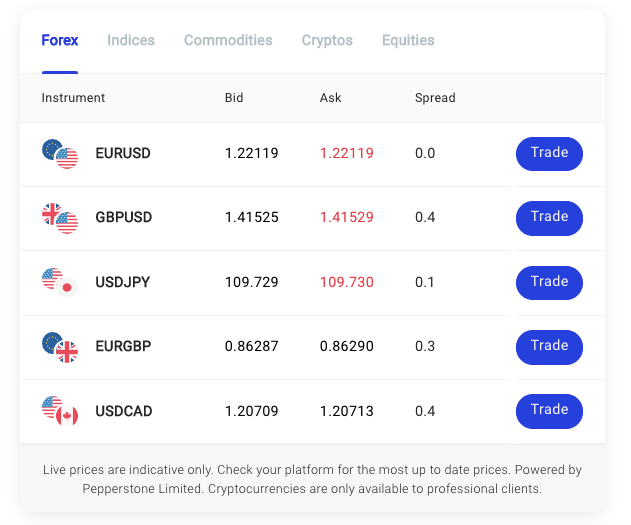
Transparent Average Spreads
Ignore the marketing hype about minimum spreads. Those ultra-low numbers often apply under perfect conditions that rarely happen.
Instead, focus on brokers like Pepperstone that provide their average spreads across key trading hours and assets.
Reliable Execution
Low spreads mean nothing if you can’t enter or exit trades at the prices you see. A good broker should offer fast and reliable trade execution, especially during high-volatility periods when the market is moving quickly.
Why it matters: Slippage (getting a worse price than expected) can cancel out the benefits of low spreads.
BlackBull impresses with speeds of less than 75 milliseconds.
Powerful Platforms And Tools
A low-spread broker should also equip you with the tools to trade effectively.
Look for platforms like MetaTrader 4, MetaTrader 5, or TradingView available at providers like FOREX.com with features like:
- Advanced charting and analysis tools.
- Automated trading support.
- Risk management tools like stop-loss and take-profit orders.
Market Data And Insights
A broker that provides real-time market data, economic calendars, and regular insights can help you make smarter trading decisions.
It’s a massive plus if these come free of charge, which you can find at firms like Fusion Markets.
No Hidden Costs
A broker with low spreads might offset them with other fees like:
- Commissions on trades (especially with raw spread accounts).
- High withdrawal fees or inactivity charges.
- Wide spreads during off-peak hours.
Strong Regulation
Choose a broker like Vantage which is regulated by reputable authorities, including the FCA and ASIC. Low spreads are only worth it if your funds are secure and the broker operates transparently.
DayTrading.com’s Regulation & Trust Rating can help here. We’ve classified a growing list of over 65 regulators depending on their reliability and safeguards, from ‘green tier’ bodies like the UK’s Financial Conduct Authority (FCA) through to ‘red tier’ bodies like the Vanuatu Financial Services Commission (VFSC).
Liquidity And Asset Variety
The more liquid the broker’s offering, the tighter the spreads you’ll see. Make sure they offer a good range of assets, especially the ones you trade most, whether that’s major currency pairs, indices, or commodities.
By focusing on these factors, you’ll enjoy low trading costs and a smooth and reliable trading experience. Remember, a low-spread broker is about the complete package, not just a single number.
Paul HolmesAuthorWhat Type Of Broker Offers The Best Spreads?
Raw spreads are the tightest possible spreads – straight from the interbank market, with no markup.
Electronic Communication Network (ECN) brokers like IC Markets and Pepperstone typically provide access to these raw spreads by directly connecting you to liquidity providers.
While raw spreads often come with a commission fee per trade, they can still be cost-effective for active traders like us. Here’s why:
Ultra-Low Spreads
ECN brokers provide raw spreads as low as 0.0 pips on major pairs like GBP/USD or EUR/USD. This significantly lowers your trading costs, especially for high-frequency traders who make multiple trades daily.
Imagine:
- You trade GBP/USD with an ECN provider offering a raw spread of 0.1 pip.
- The commission is $7 per round trip (buy and sell) on a standard lot.
- The total cost is $7 + the 0.1 pip spread, much lower than a broker with a fixed spread of say 2 pips.
Direct Market Access
ECN firms connect you directly to the market, meaning you’re trading against other participants (banks, hedge funds, etc) rather than the broker.
This helps reduce potential conflicts of interest, as the broker doesn’t profit from your losses, though it depends on the provider’s execution and renumeration arrangements.
Better Execution Speed
ECN brokers generally offer faster trade execution, which is crucial for day traders who rely on quick entries and exits.
Fewer requotes during volatile conditions means more reliable trading.
Transparency
You see actual market prices without hidden markups, giving you confidence that you’re getting a fair deal.
However, there are things to keep in mind:
- Commissions Add Up: While spreads are minimal, commission fees per trade can add up for smaller-volume traders. Ensure your strategy can cover these costs.
- Volatility Risks: Raw spreads can widen during high-volatility events. Even with an ECN account, be prepared for occasional spread spikes.
- Minimum Deposit Requirements: ECN accounts often have higher minimum deposits than standard accounts.
Bottom Line
Choosing the right broker with low spreads can make a big difference in your trading profitability, especially for active traders like day traders.
However, look beyond flashy “minimum spread” claims and focus on brokers offering transparent average spreads.
For high-frequency traders, ECN brokers with raw spreads may be worth considering. Lower costs and direct market access can outweigh commission fees.
Ultimately, the best broker for you isn’t just about spreads – it’s about the whole package: reliable execution, helpful trading tools, and a trustworthy, regulated platform.
Find the right low-spread trading platform for your needs.