




Contract for difference (CFD) trading offers a flexible way to speculate on the price movements of global and Middle Eastern assets like stocks, commodities, and indices – without owning them.
In the UAE, CFDs have gained popularity, especially among investors interested in digital assets. According to Investment Trends, 24% of new CFD traders in the Emirates start with cryptocurrencies.
This beginner’s guide will explore the risks and rewards of CFD trading in the UAE, taking you through a detailed trade to help you make smarter decisions.
Quick Introduction
- With CFDs, you don’t actually own the asset you’re trading, for example shares in First Abu Dhabi Bank. This can be a big advantage, as it means you avoid many of the costs and complexities of ownership.
- CFDs let you trade with leverage, meaning you can open larger positions with a smaller amount of capital. This magnifies both potential profits and losses, giving you more flexibility but requiring strict risk management.
- One of the big draws of CFDs is that you can make money whether the market is going up or down. You’re not tied to just buying and waiting for prices to rise; you can also “short” the market if you think prices will fall.
Best CFD Brokers In The UAE
As of November 2026, we've reviewed 143 providers and found these to be the top 6 CFD brokers in the UAE:
-
- FTSE Spread: 1.10
- GBPUSD Spread: 0.4
- Stocks Spread: 0.17 (Apple)
84.6% of retail CFD accounts lose money. -
- FTSE Spread: 1.4
- GBPUSD Spread: 0.8
- Stocks Spread: 1.79 (Apple)
76.15% of accounts lose money when trading CFDs with this provider. -
- FTSE Spread: 0.5
- GBPUSD Spread: 1.5
- Stocks Spread: 0.13
-
- FTSE Spread: 1.0
- GBPUSD Spread: 0.23
- Stocks Spread: 0.02
-
- FTSE Spread: 1.0
- GBPUSD Spread: 0.4
- Stocks Spread: 0.02
73-89% of retail investor accounts lose money when trading CFDs with this provider. -
- FTSE Spread: 17.5
- GBPUSD Spread: 0.4
- Stocks Spread: 0.01






Learn how we test brokers and why you can trust our ratings.
Here is a short overview of each broker's pros and cons
- FXCC 4.6/5 FXCC offers a range of CFDs beyond forex with a modest selection of metals, energies, indices, but hundreds of equities and more than two dozen cryptos. The ECN XL account has no restrictions on CFD trading strategies and MetaTrader offers robust charting tools and risk management, including take profit and stop loss orders.
- XM 4.8/5 XM delivers for CFD traders with flexible leverage and a huge range of markets, including bespoke thematic indices for exposure to popular sectors like artificial intelligence. The MT4/MT5 platforms are also fast and dependable while a free VPS is available to qualifying XM traders running algo trading strategies.
- AvaTrade 4.9/5 AvaTrade's 1250+ leveraged CFD products span a wide range of asset classes including stocks, indices, commodities, bonds, crypto, and ETFs. What we love is that you can speculate on rising and falling prices in the broker’s feature-rich web and mobile platforms with market-leading research tools to help you discover short-term trading opportunities.
- IC 4.8/5 You gain access to over 2,250 CFDs, available for trading 24/5 across popular markets such as forex, commodities, indices, stocks, and bonds. Utilizing deep liquidity and advanced bridge technology, IC ensures optimal conditions for scalpers, hedgers, and algo traders alike.
- Pepperstone 4.8/5 Pepperstone maintains its position as one of the fastest and most dependable CFD brokers during our latest round of testing. With execution speeds averaging around 30ms and an outstanding fill rate of 99.90%, the broker ensures a seamless trading experience without requotes or dealing desk interference. It also provides ample trading opportunities across over 1,300 assets.
- RoboForex 4.3/5 RoboForex offers a growing suite of over 12,000 CFDs, encompassing forex, stocks, indices, commodities, futures and ETFs. With an initial deposit of $10 and micro lot trading through to margin access, RoboForex caters to a broad range of derivative traders. On the downside, analysis reveals execution speeds of 1-3 seconds, noticeably slower than IC Markets at 0.35 seconds, and suboptimal for fast-paced strategies like scalping.
CFD Trading In The UAE Comparison
| Broker | CFD Leverage* | Minimum Deposit | Minimum Trade | Regulators |
|---|---|---|---|---|
| FXCC | 1:1000 | $0 | 0.01 Lots | CySEC, MISA |
| XM | 1:1000 | $5 | 0.01 Lots | CySEC, DFSA, FSCA, SCA, FSA, FSC-Belize, FSC-Mauritius, CMA-Kenya, CMA-UAE |
| AvaTrade | 1:30 (Retail) 1:400 (Pro) | $100 | 0.01 Lots | ASIC, CySEC, FSCA, ISA, CBI, JFSA, BVI, FSRA/ADGM, AFM, CMA-Kenya, CIRO (via Friedberg Direct) |
| IC | 1:5000 | $200 | 0.01 Lots | ASIC, CySEC, FSA, SCB, CMA-Kenya |
| Pepperstone | 1:30 (Retail), 1:500 (Pro) | $0 | 0.01 Lots | FCA, ASIC, CySEC, BaFin, DFSA, SCA, SCB, CMA-Kenya |
| RoboForex | 1:2000 | $10 | 0.01 Lots | FSC |
*Maximum leverage on any instrument. Actual leverage can vary by asset, client type, entity and country.
Community Sentiment
See how users rate these brokers based on the average customer ratings submitted on DayTrading.com, plus ratings from Trustpilot, the Apple App Store and Google Play.
| Broker | Our Users' Rating | Trustpilot Score | Trustpilot Reviews | iOS App Rating | Android App Rating |
|---|---|---|---|---|---|
| FXCC | 231 | ||||
| XM | 3101 | ||||
| AvaTrade | 13752 | ||||
| IC | 4 | ||||
| Pepperstone | 3734 | ||||
| RoboForex | 777 |
FXCC
FXCC continues to prove itself an excellent option for day traders with a particularly strong selection of 70+ currency pairs, ultra-tight spreads from 0.0 pips during testing, and a free VPS for qualifying traders.
 Jemma Grist, Reviewer
FXCC quick facts
- FTSE Spread
- 1.10
- GBPUSD Spread
- 0.4
- Stocks Spread
- 0.17 (Apple)
- Leverage
- 1:1000
- Regulator
- CySEC, MISA
- Platforms
- MT4, MT5
- Account Currencies
- USD, EUR, GBP, CAD
Pros
- FXCC has stepped up its offering over the years, adding MT5 to its suite of platforms, hundreds of stocks and more cryptos to its product line-up, plus a copy trading feature and greater margin trading opportunities.
- FXCC’s ECN XL account has been built with active traders in mind, featuring spreads from 0.0 with no commission, while also passing our execution speed benchmark for day traders.
- The free VPS for qualifying traders and the ability to build or buy EAs on MetaTrader make FXCC a strong option for algo traders.
Cons
- Although the economic calendar has benefited from a facelift, FXCC still offers very little in terms of market research beyond basic daily technical analysis and aggregated market news, with no tools like Autochartist or social sentiment data.
- Although regulated by the CySEC, FXCC’s offshore entity operates with weak regulatory oversight from MISA and may not provide safeguards like investor compensation in the event of broker insolvency.
- Although FXCC has bolstered its range of markets with US, European and Asian stocks, the choice of metals and energies is light, and there are no soft commodities.
XM
With a low $5 minimum deposit, advanced charting platforms in MT4 and MT5, expanding range of markets, and a Zero account offering spreads from 0.0, XM provides all the essentials for active traders.
 Christian Harris, Reviewer
XM quick facts
- FTSE Spread
- 1.4
- GBPUSD Spread
- 0.8
- Stocks Spread
- 1.79 (Apple)
- Leverage
- 1:1000
- Regulator
- CySEC, DFSA, FSCA, SCA, FSA, FSC-Belize, FSC-Mauritius, CMA-Kenya, CMA-UAE
- Platforms
- MT4, MT5, TradingCentral
- Account Currencies
- USD, EUR, GBP, JPY, ZAR
Pros
- XM stands out for its commitment to trader education, with a wealth of well-presented resources, including webinars, tutorials, and even real-time trading sessions through XM Live.
- XM’s customer support has delivered over years of testing, with 24/7 assistance in 30 languages, response times of under 2 minutes and a growing Telegram channel.
- XM secured a category 5 license from the Securities and Commodities Authority (SCA) of the United Arab Emirates in late 2025, strengthening its regulatory credentials and making it a strong option for traders in the Middle East.
Cons
- Although trusted and generally well-regulated in some regions, XM also has global entities registered with the weak regulators like FSC (Belize) and FSA (Seychelles), whilst UK clients are no longer accepted, reducing its market reach.
- XM is falling behind the curve by not offering cTrader, which is favored over MetaTrader by some serious traders for its smoother user experience and superior charting package.
- XM relies solely on the MetaTrader platforms for desktop trading, so there’s no in-house downloadable solution for a more beginner-friendly user experience with unique features.
AvaTrade
Celebrating 20 Years in the industry, AvaTrade offers active traders everything they need: an intuitive WebTrader, powerful AvaProtect risk management, a smooth 5-minute sign-up process, and dependable support you can rely on in fast-moving markets.
Jemma Grist, Reviewer
AvaTrade quick facts
- FTSE Spread
- 0.5
- GBPUSD Spread
- 1.5
- Stocks Spread
- 0.13
- Leverage
- 1:30 (Retail) 1:400 (Pro)
- Regulator
- ASIC, CySEC, FSCA, ISA, CBI, JFSA, BVI, FSRA/ADGM, AFM, CMA-Kenya, CIRO (via Friedberg Direct)
- Platforms
- WebTrader, AvaTradeGO, AvaOptions, AvaFutures, MT4, MT5, AlgoTrader, TradingView, TradingCentral, DupliTrade
- Account Currencies
- USD, EUR, GBP, CAD, AUD, ZAR
Pros
- AvaFutures traders can now use TradingView for 100+ indicators, screeners and a calendar, the sharing of trade ideas, commissions from $0.45, intraday margins from $60, and access to exchanges like CME and EUREX.
- Years on, AvaTrade remains one of the few brokers offering a bespoke risk management tool, AvaProtect, that insures losses up to $1M for a fee and is easy to activate on the platform.
- AvaTrade launched AvaFutures to offer low-margin access to global markets, then expanded in 2025 as one of the first brokers to add CME’s Micro Grain Futures.
Cons
- The AvaSocial app is good but not great – the look and feel, plus the navigation between finding strategy providers and account management needs upgrading to rival category leaders like eToro.
- While signing up is a breeze, AvaTrade lacks an ECN account like Pepperstone or IC Markets, which provides the raw spreads and ultra-fast execution many day traders are looking for.
- AvaTrade’s WebTrader has improved, but work is still needed in terms of customizability – frustratingly widgets like market watch and watchlists can’t be hidden, moved, or resized.
IC
IC (formerly IC Markets) offers superior pricing, exceptionally fast execution and seamless deposits. The introduction of advanced charting platforms, notably TradingView, and the Raw Trader Plus account, ensures it remains a top choice for intermediate to advanced day traders.
Christian Harris, Reviewer
IC quick facts
- FTSE Spread
- 1.0
- GBPUSD Spread
- 0.23
- Stocks Spread
- 0.02
- Leverage
- 1:5000
- Regulator
- ASIC, CySEC, FSA, SCB, CMA-Kenya
- Platforms
- MT4, MT5, cTrader, TradingView, TradingCentral, DupliTrade, Quantower
- Account Currencies
- USD, EUR, GBP, CAD, AUD, NZD, JPY, CHF, HKD, SGD
Pros
- IC offers fast and dependable 24/7 support based on firsthand experience, particularly when it comes to accounts and funding issues.
- You have access to over 2,250 CFDs across various markets, including forex, commodities, indices, stocks, bonds, and cryptocurrencies, allowing for diversified trading strategies.
- IC offers among the tightest spreads in the industry, with 0.0-pip spreads on major currency pairs, making it especially cost-effective for day traders.
Cons
- Despite four industry-leading third-party platforms, there is no proprietary software or trading app built with new traders in mind.
- There are fees for certain withdrawal methods, including a $20 wire charge, which can eat into profits, especially for frequent withdrawals.
- The breadth and depth of tutorials, webinars and educational resources still need work, trailing alternatives like CMC Markets and reducing its suitability for beginners.
Pepperstone
Pepperstone stands out as a top choice for day trading, offering razor-sharp spreads, ultra-fast execution, and advanced charting platforms for experienced traders. New traders are also welcomed with no minimum deposit, extensive educational resources, and exceptional 24/5 support (18h a day on weekends).
Christian Harris, Reviewer
Pepperstone quick facts
- FTSE Spread
- 1.0
- GBPUSD Spread
- 0.4
- Stocks Spread
- 0.02
- Leverage
- 1:30 (Retail), 1:500 (Pro)
- Regulator
- FCA, ASIC, CySEC, BaFin, DFSA, SCA, SCB, CMA-Kenya
- Platforms
- Pepperstone Trading Platform, MT4, MT5, cTrader, TradingView
- Account Currencies
- USD, EUR, GBP, CAD, AUD, NZD, JPY, CHF, HKD, SGD
Pros
- After adding spread betting through TradingView, Pepperstone provides a seamless, tax-efficient trading experience with advanced analysis tools for financial spread bettors in supported countries.
- Pepperstone provides trading in pre-IPO perpetual futures, including adding Anthropic in October 2026, giving traders 24/7 opportunities to speculate on anticipated share prices using cash-settled CFDs.
- Pepperstone emerges as a low-cost broker, especially for serious day traders with spreads from 0.0 in the Razor account and rebates up to 30% (index and commodities) and $3/lot (forex) through the Active Trader program.
Cons
- Despite improvements to its range of markets, crypto CFD offerings are still fairly limited compared to other brokers who focus on this area, such as Eightcap, and there's no option to invest in real coins.
- Execution may not feel as reliable in fast markets as headline speeds suggest. In our own testing, execution was fast at desired prices, but some community complaints focus on slippage, stop-loss fills and spread-sensitive order triggers during volatile conditions.
- Pepperstone has removed support for several tools that elevated the trading experience for active retail traders, notably Autochartist, Capitalise.ai and a free VPS for qualifying traders (now only pro traders in some countries).
RoboForex
RoboForex is great if you want a vast range of 12,000+ day trading markets with ECN accounts, powerful charting and loyalty promotions. It also stands out for stock traders with its user-friendly R StocksTrader platform, featuring 3,000+ shares, fees from $0.01 and sophisticated watchlists.
Christian Harris, Reviewer
RoboForex quick facts
- FTSE Spread
- 17.5
- GBPUSD Spread
- 0.4
- Stocks Spread
- 0.01
- Leverage
- 1:2000
- Regulator
- FSC
- Platforms
- R StocksTrader, MT4, MT5, TradingView
- Account Currencies
- USD, EUR
Pros
- RoboForex offers over 12,000 instruments, providing more short-term trading opportunities than the vast majority of online brokers, with forex, stocks, indices, ETFs, commodities, and futures.
- The broker offers two commission-free withdrawals each month in the Free Funds Withdrawal program, helping day traders to minimize transaction costs.
- In 2026, RoboForex introduced swap-free trading across eligible accounts and regions, removing overnight interest charges, and potentially appealing to swing forex traders, though spreads and commissions may still apply.
Cons
- RoboForex provides a variety of account types, which, while offering flexibility, can be overwhelming for newer traders trying to choose the most suitable option for their trading style. Alternatives, notably eToro, provide a smoother entry into online trading with one retail account.
- While RoboForex offers competitive spreads, some of its account types come with high trading commissions up to $20 per lot, trailing the cheapest brokers, such as IC Markets.
- Despite 15+ years in the industry and registering with the Financial Commission, RoboForex is authorized by one ‘Red-Tier’ regulator – the FSC in Belize, lowering the level of regulatory protections for traders.
How Does CFD Trading Work?
CFD trading allows you to trade financial markets without the added expense of owning the actual assets.
Leverage is an attractive element of CFD trading. It lets you open larger positions while only committing a fraction of the total value or margin needed to buy the equivalent amount of shares listed on UAE stock markets, for example.
Consider a potential trading scenario using a CFD to trade a popular UAE index. The ADX General Index is a leading share market index and contains the top Abu Dhabi Securities Exchange companies by float-adjusted market capitalization.
If you believe the FTSE ADX will rise, you enter a CFD buy (long) position. Suppose each contract is valued at AED 9,300, and your brokerage requires a 5% margin, then taking a position on 10 contracts. In that case, you’d need a margin requirement of United Arab Emirates dirham (AED) of 4,650 (9,300 per contract x 10 contracts x 5%).
If the FTSE ADX rises to 9,400, the price increase would yield AED 100 per contract. By closing your position, you could bag a total profit of AED 1,000 (10 contracts x AED 100), excluding any brokerage fees.
Alternatively, if the index falls to AED 9,200, you could lose AED 1,000, illustrating the risks involved with CFD trading; despite getting to control significant size with leverage, gains and losses are amplified.
Knowing how margin and leverage work is crucial to your future success.
If you’re new to CFD trading, consider opening a demo trading account before committing to trading real funds. Demos are an excellent introduction to the complexities of CFD trading before you take on financial risk.
 Paul HolmesAuthor
What Can I Trade?
CFDs offers many trading opportunities on various financial markets, both in UAE and internationally:
- Stock CFDs – You could trade individual UAE stocks listed on the ADX using CFDs without the extra commitment of buying the shares.
- Index CFDs – The ADX General Index (FTSE ADX) is the UAE’s leading share market index. Traders often prefer to trade index CFDs to capitalize on a stock exchange’s overall market performance rather than trade in individual shares. Alternatively, you might want to consider trading CFDs on global indices like the Dow Jones or the NASDAQ, as the trading costs are generally very competitive.
- Forex CFDs – The United Arab Emirates dirham (AED) can be traded as a minor/exotic currency pair in the foreign exchange market. Currency pairs involving AED include USD/AED and EUR/AED. However, due to the lack of liquidity and availability, the cost of trading such pairs can be uneconomical, and trading conditions are more volatile than those of major pairs like GBP/USD and EUR/USD.
- Commodity CFDs – Critical commercial commodities like gold, silver, and crude oil can be traded as CFDs, allowing you to speculate on the price movements of these vital resources.
- Crypto CFDs – The fascination surrounding digital asset trading is particularly prominent in the UAE, attracting many newcomers. You can trade cryptocurrency CFDs like Bitcoin and Ethereum, allowing access to the volatile and exciting world of crypto.
Is CFD Trading Legal In The UAE?
CFD trading is legal in the UAE but governed by strict regulations to ensure investors’ safety and the market’s transparency.
The Securities And Commodities Authority (SCA) regulates financial markets in the UAE, including CFD trading. It ensures that brokers follow rules designed to protect investors and monitors the activities of CFD providers to ensure they provide fair and transparent services.
The Dubai Financial Services Authority (DFSA) is the regulatory body for the Dubai International Financial Centre (DIFC), a free zone that operates as a financial hub within the UAE.
The DFSA creates regulations for companies and brokers based in this free zone. These regulations are typically aligned with international standards, adding another layer of protection for traders.
The Abu Dhabi Global Market (ADGM) is another important financial hub within the UAE, similar to DIFC, and regulates its own set of CFD brokers.
Any broker offering CFD trading in the UAE must be licensed by one of these regulatory bodies: the SCA for brokers operating in the broader UAE market or the DFSA for those operating within the DIFC. Some of the key requirements for licensed firms include:
- Brokers must offer transparent pricing on CFD trades, meaning you should be able to see the costs associated with your trades (such as spreads or commissions).
- Reputable brokers must separate client funds from their operating funds. This protects your money in case the brokerage faces financial difficulties.
- Brokers must clearly warn traders about the nature of CFD trading, including the high risk of losing money due to leverage. Many also offer educational resources to help traders understand the market better.
Is CFD Trading Taxed In The UAE?
One of the significant advantages for traders in the UAE is its tax-friendly environment.
The UAE does not impose personal income tax or capital gains tax on profits from trading, including CFDs.
There are a few things to keep in mind:
- No Capital Gains Tax: Since there is no tax on capital gains, any profit you make from CFD trading, including from short-term positions, won’t be subject to taxation.
- No Income Tax: The UAE also doesn’t have a personal income tax, so even if CFD trading becomes a significant source of income for you, it remains untaxed.
- Corporate Tax: From June 2023, the UAE introduced a corporate tax of 9%, but this applies only to businesses generating over AED 375,000 in profit annually. If you are trading as an individual, this tax won’t apply to you. However, if you are trading CFDs through a registered business or company structure, you may want to consult a tax advisor to understand if corporate tax applies.
- Stamp Duty and Other Fees: Since CFDs don’t involve ownership of the underlying asset (such as shares or commodities), you typically avoid additional costs like stamp duty, which would otherwise apply to physical asset ownership in some countries.
An Example Trade
Here, I will examine an opportunity to trade a popular index in UAE, the ADX General Index (FTSE ADX).
If you’re unfamiliar with a specific stock market and its shares, trading a leading index can be an excellent alternative. Providers generally offer reasonable trading costs for indices, and the liquidity can be high.
Fundamental Analysis
The fundamental analysis you’ll apply to trading an index is similar to that of trading forex pairs and commodities.
For example, I look at global macroeconomic events and the country-specific events listed on my economic calendar. I also consider metrics like unemployment, GDP, government borrowing, inflation, etc., as you would with currency pairs.
Technical Analysis
When trading an index, I usually do so on a swing trading basis. So, I typically apply technical indicators on my chart that work best to identify trend, momentum, volatility, entry/exit points, velocity, and oversold/overbought conditions.
The stochastic oscillator, MACD, and RSI provide all this feedback, especially when paired with a candlestick option like Heikin Ashi (HA), which clearly illustrates price action.
4 Hour Timeframe
If I analyze the chart below, we can see two well-defined periods, the downtrend and the uptrend. The uptrend has paused and entered a ranging (holding) period. I’m concentrating on this current market condition as I’m convinced the ranging period is nearing its end.
In the previous downtrend, the technical analysis was textbook perfect. The Heikin Ashi candles were full and bearish with small shadows (wicks), indicating that the bearish sentiment gained momentum.
The signal to enter short would have been when the stoch lines crossed after the MACD moving averages crossed and the RSI crossed the median 50 level in a downward motion.
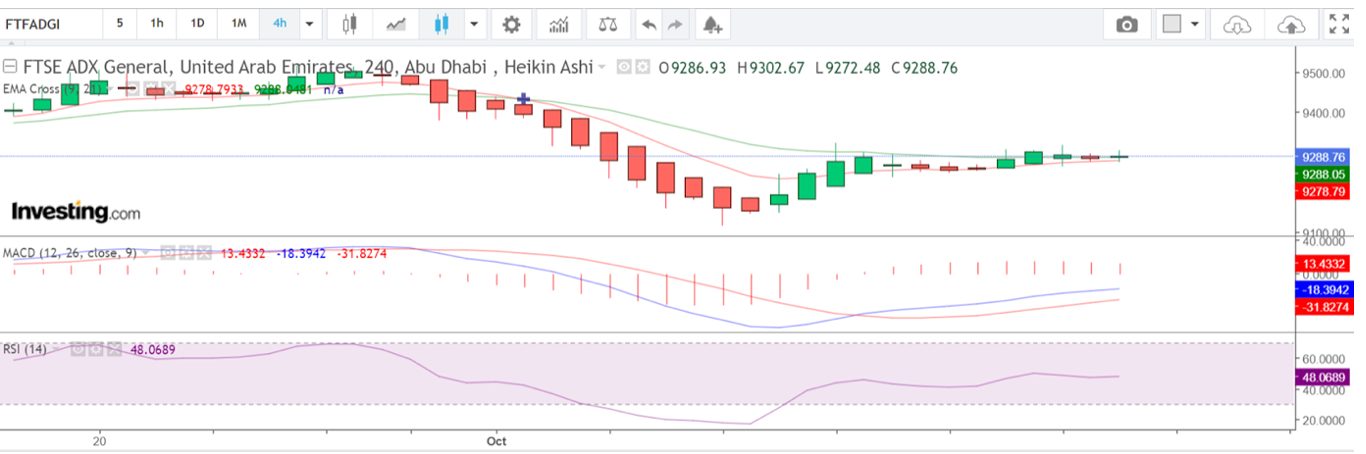
I’m waiting for the signal to enter the long trade based on a complete reversal of the conditions for a short trade; I need the stoch lines, MACD moving averages, and the RSI to align to take the trade.
This is especially critical when the market ranges, as it has been over recent trading sessions. I’m waiting for the stoch lines (%K: The primary, faster-moving line and %D: A three-period moving average of the %K line) to cross before entering the market.
Remember that if you create a trading plan that includes your rules to enter and exit, you shouldn’t breach them. Trading discipline is critical to long-term success. Without rules and a plan, you’re reducing trading to guessing.
I will risk no more than 1% of my trading account on this trade and must commit a 5% margin.
To buy 10 full contracts, I need roughly AED 9,300 x 10 x 5% = AED 4,650, approximately $1,270.
Paul HolmesAuthorMy stop loss will be positioned at 9115, the recent low and the point at which my trade direction analysis will be proven wrong.
But bear in mind that if the long trade doesn’t go my way, this stop may be cancelled early if I receive a signal via my technical indicators to reverse and go short.
Bottom Line
CFD trading offers a flexible and potentially profitable way to access global markets from the UAE, with benefits like leverage, diverse asset classes, and tax-free profits. However, it’s crucial to trade cautiously, as leverage can magnify gains and losses.
Use a regulated broker (SCA or DFSA) to protect your investments and ensure you understand the risks involved. The UAE provides a favorable and well-regulated environment for CFD trading, but informed, responsible decision-making is key to success.
To get going, make use of DayTrading.com’s pick of the top platforms for day trading CFDs.
Article Sources
- UAE Leverage Trading Report - Investment Trends
- Abu Dhabi Securities Exchange
- Securities And Commodities Authority (SCA)
- Dubai Financial Services Authority (DFSA)
- Dubai International Financial Centre (DIFC)
- Abu Dhabi Global Market (ADGM)
The writing and editorial team at DayTrading.com use credible sources to support their work. These include government agencies, white papers, research institutes, and engagement with industry professionals. Content is written free from bias and is fact-checked where appropriate. Learn more about why you can trust DayTrading.com