




Available from a range of brokers and third-party providers, trading signals are an increasingly popular tool, providing a prompt to buy or sell a particular asset.
Explore the best signal providers following our hands-on tests. We also explain how to choose signals and how you can incorporate them into your trading strategy to improve your understanding.
Best Brokers For Trading Signals 2026
These 6 brokers with signals achieved the highest overall ratings following our latest in-depth reviews. They offer a large pool of signals with clear performance metrics, making them stand-out options:
-
- Demo account
- Min. deposit: $100
- Min. trade: 0.01 Lots
-
- Demo account
- Platforms: MT4, MT5, TradingCentral
- Min. deposit: $5
-
- Demo account
- Regulator: FCA, ASIC, CMVM , FSCA, SCB, FSA
- Platforms: TN Trader, MT4, TradingView
-
- Demo account
- Min. deposit: $0
- Min. trade: 0.01 Lots
73-89% of retail investor accounts lose money when trading CFDs -
- Demo account
- Instruments: CFDs, Forex, Indices, Shares, Commodities
- Regulator: ASIC, CySEC, FSCA, FSC
-
- Demo account
- Regulator: FMA, FSA
- Min. deposit: $0






Learn how we test brokers and why you can trust our ratings.
Why Are These The Best Providers For Trading Signals?
Here’s a concise summary of why we believe these brokers are best for trading signals:
- AvaTrade is the best signal provider in Norway in 2026 4.9/5 During our tests, Vantage’s signal tools stood out for their integration with MT4/MT5, offering clear, real-time trade ideas that actually aligned with market conditions. The signals were actionable, reliable, and a strong aid for short-term strategy execution.
- XM 4.8/5 When we tried XM’s trading signals, the appeal was their clarity and consistency across multiple timeframes. Delivered through MT4/MT5, the signals felt practical rather than generic, with solid risk levels attached. We noticed stronger reliability on major FX pairs, making them genuinely useful for active traders needing structure.
- Trade Nation 4.4/5 While using Trade Nation, its Signal Centre really impressed: free daily trade-ideas (FX, indices, commodities), combining technical and fundamental insights. The in-dashboard signals in TN Trader are timely; chart signals pair nicely with TradingView integration. We found it solid for those who want guided ideas rather than full automation.
- Pepperstone 4.8/5 In our hands-on signal tests, Pepperstone excelled with its pattern alerts (e.g. triangles, wedges) and through MT4/MT5/cTrader, plus Myfxbook AutoTrade and SignalStart, it delivers flexible signal-following. Great for traders who value reliability and fast market filtering.
- FBS 4.3/5 Founded in 2009, FBS is an award-winning CFD broker operating in over 150 countries with a client base exceeding 27 million traders. Traders are supported at every stage of their journey with 24/7 assistance, market analytics, trading calculators, and competitive pricing with zero commissions.
- BlackBull 4.5/5 When we tested BlackBull, its CopyTrader stood out as a solid signal-tool: you can mirror elite fund managers, see their track record, and set risk rules. Plus the broker includes Acuity-powered AI news & sentiment feeds and signals in cTrader as part of its suite.
How Safe Are These Trading Signal Providers?
Discover the reliability of the top real-time trading signal providers and how they safeguard your funds:
| Broker | Trust Rating | Guaranteed Stop Loss | Negative Balance Protection | Segregated Accounts |
|---|---|---|---|---|
| AvaTrade | ✘No | ✔Yes | ✔Yes | |
| XM | ✘No | ✔Yes | ✔Yes | |
| Trade Nation | ✘No | ✔Yes | ✔Yes | |
| Pepperstone | ✘No | ✔Yes | ✔Yes | |
| FBS | ✘No | ✔Yes | ✔Yes | |
| BlackBull | ✘No | ✔Yes | ✔Yes |
Compare Mobile Trading Signals
See how these brokers measure up for mobile trading signals:
| Broker | Mobile Apps | iOS Rating | Android Rating | Smart Watch App |
|---|---|---|---|---|
| AvaTrade | iOS & Android | ✘No | ||
| XM | iOS, Android & Windows | ✘No | ||
| Trade Nation | iOS & Android | ✘No | ||
| Pepperstone | iOS & Android | ✘No | ||
| FBS | iOS & Android | ✘No | ||
| BlackBull | iOS & Android | ✘No |
Are The Top Automated Trade Signal Providers Good For Beginners?
Beginners should use trading signals alongside other key tools for new traders:
| Broker | Demo Account | Minimum Deposit | Minimum Trade | Education Rating | Support Rating |
|---|---|---|---|---|---|
| AvaTrade | ✔Yes | $100 | 0.01 Lots | ||
| XM | ✔Yes | $5 | 0.01 Lots | ||
| Trade Nation | ✔Yes | $0 | 0.1 Lots | ||
| Pepperstone | ✔Yes | $0 | 0.01 Lots | ||
| FBS | ✔Yes | $5 | 0.01 Lots | ||
| BlackBull | ✔Yes | $0 | 0.01 Lots |
Compare The Ratings Of Top Signal Trading Brokers
Discover how the leading brokers for trading signals rate across key areas after our in-depth evaluations:
| Broker | Trust | Platforms | Assets | Mobile | Fees | Accounts | Research | Education | Support |
|---|---|---|---|---|---|---|---|---|---|
| AvaTrade | |||||||||
| XM | |||||||||
| Trade Nation | |||||||||
| Pepperstone | |||||||||
| FBS | |||||||||
| BlackBull |
Compare Trading Fees
Trading costs, including mark-ups on signals, can add up fast - here is how the top providers compare:
| Broker | Cost Rating | Fixed Spreads | Inactivity Fee |
|---|---|---|---|
| AvaTrade | ✔Yes | $50 | |
| XM | ✘No | $5 | |
| Trade Nation | ✔Yes | $0 | |
| Pepperstone | ✔Yes | $0 | |
| FBS | ✘No | $0 | |
| BlackBull | ✘No | $0 |
Community Sentiment
See how users rate these brokers based on the average customer ratings submitted on DayTrading.com, plus ratings from Trustpilot, the Apple App Store and Google Play.
| Broker | Our Users' Rating | Trustpilot Score | Trustpilot Reviews | iOS App Rating | Android App Rating |
|---|---|---|---|---|---|
| AvaTrade | 13545 | ||||
| XM | 3130 | ||||
| Trade Nation | 2142 | ||||
| Pepperstone | 3666 | ||||
| FBS | 10166 | ||||
| BlackBull | 3515 |
How Popular Are These Brokers With Trading Signals?
Many traders favor signal brokers with the highest number of registered clients:
Why Use Trading Signals From AvaTrade?
AvaTrade offers active traders everything they need: an intuitive WebTrader, powerful AvaProtect risk management, a smooth 5-minute sign-up process, and dependable support you can rely on in fast-moving markets.
 Jemma Grist, Reviewer
AvaTrade quick facts
- Demo Account
- ✔Yes
- Instruments
- CFDs, Forex, Stocks, Indices, Commodities, ETFs, Bonds, Crypto, Spread Betting, Futures
- Regulator
- ASIC, CySEC, FSCA, ISA, CBI, JFSA, BVI, FSRA/ADGM, AFM, CMA-Kenya, CIRO (via Friedberg Direct)
- Platforms
- WebTrader, AvaTradeGO, AvaOptions, AvaFutures, MT4, MT5, AlgoTrader, TradingView, TradingCentral, DupliTrade
- Minimum Deposit
- $100
- Minimum Trade
- 0.01 Lots
- Account Currencies
- USD, EUR, GBP, CAD, AUD, ZAR
Pros
- Support at AvaTrade performed excellently during testing, with response times of 3 minutes and localized support in major trading jurisdictions, including the UK, Europe and the Middle East.
- AvaTrade launched AvaFutures to offer low-margin access to global markets, then expanded in 2025 as one of the first brokers to add CME’s Micro Grain Futures, and then later in the year went further by integrating with TradingView.
- The WebTrader excelled in our hands-on tests, sporting a user-friendly interface for beginners, complete with robust charting tools like 6 chart layouts and 60+ technical indicators.
Cons
- While signing up is a breeze, AvaTrade lacks an ECN account like Pepperstone or IC Markets, which provides the raw spreads and ultra-fast execution many day traders are looking for.
- AvaTrade’s WebTrader has improved, but work is still needed in terms of customizability – frustratingly widgets like market watch and watchlists can’t be hidden, moved, or resized.
- The AvaSocial app is good but not great – the look and feel, plus the navigation between finding strategy providers and account management needs upgrading to rival category leaders like eToro.
Why Use Trading Signals From XM?
With a low $5 minimum deposit, advanced charting platforms in MT4 and MT5, expanding range of markets, and a Zero account offering spreads from 0.0, XM provides all the essentials for active traders, even earning our ‘Best MT4/MT5 Broker’ award in recent years.
 Christian Harris, Reviewer
XM quick facts
- Demo Account
- ✔Yes
- Instruments
- CFDs, Forex, Stocks, Commodities, Indices, Thematic Indices, Precious Metals, Energies
- Regulator
- CySEC, DFSA, FSCA, SCA, FSA, FSC-Belize, FSC-Mauritius, CMA-Kenya, CMA-UAE
- Platforms
- MT4, MT5, TradingCentral
- Minimum Deposit
- $5
- Minimum Trade
- 0.01 Lots
- Account Currencies
- USD, EUR, GBP, JPY, ZAR
Pros
- XM’s growing roster of 1,400+ instruments provides diverse short-term trading opportunities, with unique turbo stocks, fractional shares, and more recently thematic indices.
- XM secured a category 5 license from the Securities and Commodities Authority (SCA) of the United Arab Emirates in late 2025, strengthening its regulatory credentials and making it a strong option for traders in the Middle East.
- XM’s Zero account is ideal for day trading with spreads from 0.0 pips, 99.35% of orders executed in <1 second, and no requotes or rejections.
Cons
- XM is falling behind the curve by not offering cTrader, which is favored over MetaTrader by some serious traders for its smoother user experience and superior charting package.
- XM relies solely on the MetaTrader platforms for desktop trading, so there’s no in-house downloadable solution for a more beginner-friendly user experience with unique features.
- Although trusted and generally well-regulated in some regions, XM also has global entities registered with the weak regulators like FSC (Belize) and FSA (Seychelles), whilst UK clients are no longer accepted, reducing its market reach.
Why Use Trading Signals From Trade Nation?
Trade Nation suits discretionary traders who want to speculate on major indices like the US 500 or liquid FX pairs, and want the predictable all-in costs of fixed spreads. In tests, we found the fixed-spread TN Trader environment particularly useful for trading around scheduled economic releases owing to its reliable charting environment and because published spreads stayed capped.
Christian Harris, Reviewer
Trade Nation quick facts
- Demo Account
- ✔Yes
- Instruments
- CFDs, Forex, Indices, Shares, Commodities, Futures, Bonds, Spread Betting (UK and Ireland only), Cryptos (Bahamas entity only)
- Regulator
- FCA, ASIC, CMVM , FSCA, SCB, FSA
- Platforms
- TN Trader, MT4, TradingView
- Minimum Deposit
- $0
- Minimum Trade
- 0.1 Lots
- Account Currencies
- USD, EUR, GBP, AUD, ZAR, SEK, NOK, DKK
Pros
- Trade Nation's 2026 partnership with Volt has sped up payments for Australian traders, who can now make instant deposits and withdrawals using PayID, with the faster payout capabilities planned for clients in the UK and EU.
- The demo comes with a $5,000 practice account and you can request a one-on-one platform walkthrough by callback - this level of personal help is rare.
- In testing of the TN Trader account under normal market conditions, fixed spreads held while fills were prompt on major forex pairs, with a slight drift in the entry level as price ticked between click and fill.
Cons
- Offshore SCB and FSA entities allow retail clients up to 1:200 and 1:500 leverage compared to 1:30 in regions like the UK, Europe and Australia, so an FSA client can have 16 times the exposure of a UK retail client on the same trade, but with less oversight and no compensation scheme.
- There is no raw or ECN pricing tier, which are often prefered by day traders. No matter how much you deposit or trade, you use the same fixed (or variable on MT4) pricing as beginners, making it unsuitable for scalpers especially.
- Withdrawals can take up to five business days, which is around the industry average but slower than the 1-3 days we’re increasingly seeing brokers offer in an attempt to quash withdrawal complaints from retail investors.
Why Use Trading Signals From Pepperstone?
Pepperstone stands out as a top choice for day trading, offering razor-sharp spreads, ultra-fast execution, and advanced charting platforms for experienced traders. New traders are also welcomed with no minimum deposit, extensive educational resources, and exceptional 24/5 support (18h a day on weekends).
Christian Harris, Reviewer
Pepperstone quick facts
- Demo Account
- ✔Yes
- Instruments
- CFDs, Forex, Currency Indices, Stocks, Indices, Commodities, ETFs, Crypto CFDs, Spread Betting
- Regulator
- FCA, ASIC, CySEC, BaFin, DFSA, SCA, SCB, CMA-Kenya
- Platforms
- Pepperstone Trading Platform, MT4, MT5, cTrader, TradingView
- Minimum Deposit
- $0
- Minimum Trade
- 0.01 Lots
- Account Currencies
- USD, EUR, GBP, CAD, AUD, NZD, JPY, CHF, HKD, SGD
Pros
- Pepperstone has started providing trading in pre-IPO perpetual futures like SpaceX (SPCX.US-PERP) in select regions, such as the UAE.
- Pepperstone has greatly improved the deposit and withdrawal experience in recent years, adding Apple Pay and Google Pay in 2025, as well as PIX and SPEI for clients in Brazil and Mexico in 2024.
- Pepperstone emerges as a low-cost broker, especially for serious day traders with spreads from 0.0 in the Razor account and rebates up to 30% (index and commodities) and $3/lot (forex) through the Active Trader program.
Cons
- Despite improvements to its range of markets, crypto CFD offerings are still fairly limited compared to other brokers who focus on this area, such as Eightcap, and there's no option to invest in real coins.
- Execution may not feel as reliable in fast markets as headline speeds suggest. In our own testing, execution was fast at desired prices, but some community complaints focus on slippage, stop-loss fills and spread-sensitive order triggers during volatile conditions.
- Overnight holding fees are higher than that found with some Market Maker brokers (usually Benchmark + 2.5%). This makes pepperstone an ideal broker for day traders and forex scalpers but less suitable for swing traders who often keep position open overnight.
Why Use Trading Signals From FBS?
FBS is an excellent choice for day traders at every level and budget, with just a $5 minimum deposit and intensive academy for aspiring traders alongside access to MT4 and MT5.
Christian Harris, Reviewer
FBS quick facts
- Demo Account
- ✔Yes
- Instruments
- CFDs, Forex, Indices, Shares, Commodities
- Regulator
- ASIC, CySEC, FSCA, FSC
- Platforms
- FBS App, MT4, MT5
- Minimum Deposit
- $5
- Minimum Trade
- 0.01 Lots
- Account Currencies
- USD, EUR, AUD, JPY
Pros
- 24/7 customer support that performed excellently during testing is available, alongside a $5 minimum deposit, and a huge variety of 200+ funding options, making it ideal for traders with small accounts.
- The trading firm has picked up over 90 awards and amassed more than 27 million clients, making it one of the largest and most established brokers globally.
- FBS strikes the balance between robust features and ease of use, with a sign-up process taking <10 minutes, an intuitive app, advanced research through Market Analytics & more recently VIP Analytics, plus immersive education through the FBS Academy and Trader’s Blog.
Cons
- There are only four base currencies available - EUR, USD, AUD and JPY (region dependant) - which isn't practical for minimizing currency conversion fees for many global traders, and is especially striking given the broker’s user base spans over 150 nations.
- Despite enhancing the selection of currency pairs, now providing over 70, FBS still trails industry leaders like BlackBull Markets in its market offering with a particularly narrow selection of commodities and indices.
- Although the FBS app offers a terrific mobile trading experience for aspiring traders and MT4/MT5 cater to advanced traders, the absence of cTrader and TradingView, which are increasingly offered by alternatives like Pepperstone, will deter day traders familiar with these platforms.
Why Use Trading Signals From BlackBull?
After improving its trading infrastructure with Equinix servers in London, reducing latency for traders, BlackBull is an obvious choice if you want to day trade stock CFDs with ECN pricing. With competitive spreads and no commission on a growing roster of digital tokens paired with USD, BlackBull also works for active crypto traders.
Christian Harris, Reviewer
BlackBull quick facts
- Demo Account
- ✔Yes
- Instruments
- CFDs, Stocks, Indices, Commodities, Futures, Crypto
- Regulator
- FMA, FSA
- Platforms
- BlackBull Invest, BlackBull CopyTrader, MT4, MT5, cTrader, TradingView, AutoChartist
- Minimum Deposit
- $0
- Minimum Trade
- 0.01 Lots
- Account Currencies
- USD, EUR, GBP, CAD, AUD, NZD, JPY, ZAR, SGD
Pros
- With two ECN-powered accounts (Standard and Prime), plus Prime+ - an active trader rewards program offering trading rebates - BlackBull accommodates beginners through to high-volume active traders.
- BlackBull is a much greater fit for aspiring traders following the overhaul of its ECN Prime account, now featuring improved spreads averaging 0.16 on EUR/USD and a more accessible minimum deposit of $0 compared to the old $2,000.
- BlackBulls’s research is superb, especially the daily ‘Trading Opportunities’ articles that break down complex market movements into easy-to-understand insights, making it simpler to capitalize on emerging trends.
Cons
- Unlike most top brokers, BlackBull charges an irritating $5 withdrawal fee, which can detract from the overall cost-effectiveness, especially for active traders who frequently move funds.
- Although the Education Hub now features improvements like webinars and tutorials, the courses we’ve explored need more focus on explaining the wider economic factors influencing prices.
- Despite a growing selection of 2,180+ assets, including additions to its Asia Pacific indices, they are mainly stocks with an average selection of currency pairs and indices.
Alternatively, for traders who want signals that can be used with any broker, these 3 independent providers really impressed our experts out of the 10+ firms we’ve put through their paces:
Best Independent Signal Providers
- Autochartist is a technical analysis tool that assists with trade set up and patterns, as well as providing signals, market reports and other useful features.

How To Choose A Signal Provider
Choosing a signal provider can be challenging, especially with the level of misinformation out there. That’s why we, and you, should consider the following factors when selecting a provider:
Safety
Prioritize the safety and reliability of signal providers as you would when choosing an online broker.
We’ve found that not all signal providers have the same expertise, and many firms lack regulation from trusted bodies like the UK Financial Conduct Authority (FCA) or Australian Securities & Investments Commission (ASIC), making it challenging to identify trustworthy companies.
The rationale behind the limited regulation of signal providers stems from their lack of access to customer portfolios. Often operating anonymously, these services do not establish a conventional customer/provider relationship, exempting them from being classified as financial services providers similar to brokerages.
Still, the absence of regulatory oversight increases the risk of falling victim to scams, with instances of commission scammers targeting investors being reported.
For example, several thousand young traders subscribed to a WhatsApp group for regular messages with updates on assets and trading opportunities, many of whom lost considerable sums.
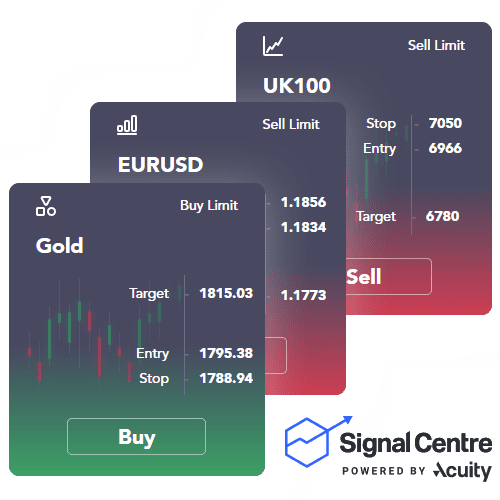
- FXTM is a trusted broker that provides access to Signal Centre, which stands out as a regulated signalling platform under the UK’s FCA.
Performance
Evaluate signal providers based on their historical performance.
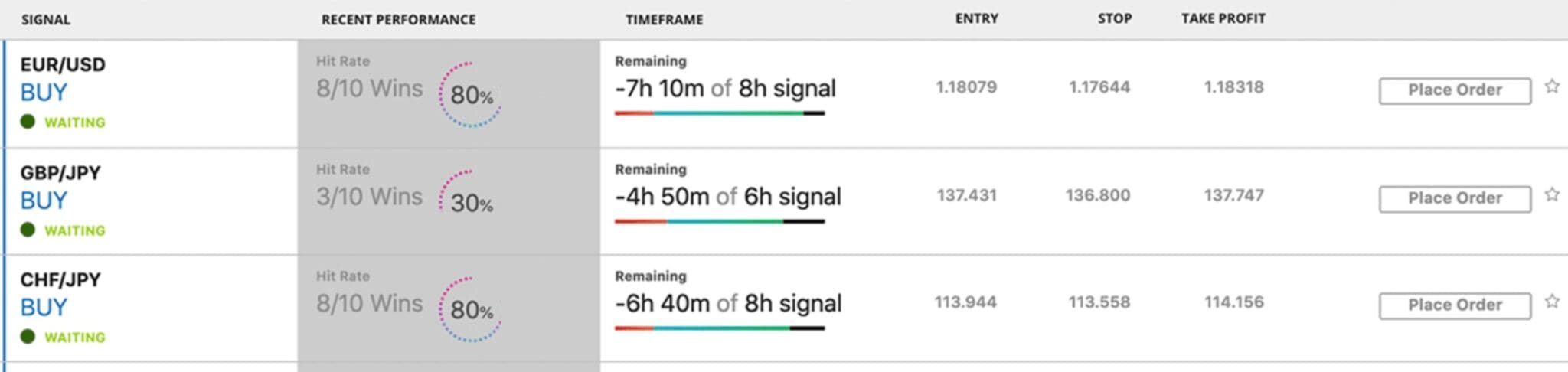
The top providers publish reports highlighting signals’ success over a period. Consider elements such as how many signals were published, which assets the provider has distributed the maximum number of accurate prompts, and how profitable these ideas have been.
Importantly, we recommend reviewing historical performance over a longer period, for example a year, as unexpected price volatility may blur an outlook.
Be careful, though, as some providers may doctor their results to try and entice new customers. See if reviews match up to the claims made by the firm to be safe.
- FOREX.com excels with its user-friendly dashboard that shows the performance of signals with a hit rate out of 10.
Cost
While the most affordable trading signals might be appealing, you must recognize that cost often correlates with quality.
We’ve observed that free signals, while not always the case, frequently originate from untrustworthy sources with hidden agendas.
Many signal providers opt for a monthly subscription fee rather than a one-time (lifetime) usage charge. These fees can range from $10 per month to exceeding $500. Some brokers, however, may cover these costs for retail traders.
We recommend checking the forecasted (or historical) performance of a provider and apply it to your account capital to see how much you will be able to afford and whether a more expensive service will be worth it.
- IG is a broker I personally use and it offers complimentary trading signals on forex, index and commodity markets to registered clients. There is no extra cost to act on signals.
Markets
Choose signals based on your preferred market, trading session, or even diversify across multiple markets to align with your trading strategies and risk preferences.
Signals can offer insights into potential trading opportunities in individual stocks, forex, cryptocurrencies like Bitcoin and Ethereum, commodities such as gold and oil, and derivatives like CFDs.
- City Index offers a top-rate solution called SMART Signals, which scans 36 global markets across hundreds of thousands of data points to find daily trading opportunities.
Alerts
Select a provider that distributes trading signals through a convenient contact method, such as SMS.
If you are happy receiving signals through whatever means, then this may not be a massive issue. However, some traders may not want to provide their email address or mobile number to a signals provider, instead preferring another contact method.
If you are looking for maximum ease of use or automated execution, filter through trading signals providers by requiring that they integrate with your trading platform. This can be done directly or through an API offered by the firm, though this may require a little extra work on your end to set it up.
5 Tips For Choosing Signals
Once you have chosen a broker with trading signals or an independent platform, consider our 5 top tips when choosing individual signals:
- Look for signals with a proven history of account growth, as this could greatly impact the success of your trades.
- Gain a comprehensive understanding of the methodology behind the signals to ensure they align with your trading goals and risk tolerance.
- Evaluate how the signals manage risk by considering the risk-reward ratio, stop-loss mechanisms, and overall risk management strategies embedded within the signals to safeguard your capital.
- Determine if the signals provide real-time analysis, as signals that offer current and relevant information will be more valuable for making informed decisions.
- Assess whether the signals can be customized to suit your trading preferences and if they’re compatible with your chosen trading platform.
What Are Trading Signals?
Trading signals are indications or alerts generated by either human analysts or automated systems (using algorithms or AI) that suggest potential entry or exit points for trading financial assets.
Signals provide quick insights into potential market opportunities, allowing you to act promptly on identified signals without spending extensive hours studying charts and market data.
Christian HarrisAuthorSignals are usually based on technical analysis, fundamental analysis, or a combination of both, aiming to guide you in making informed decisions.
They can be derived from various sources, such as price patterns, moving averages, volume trends, market sentiment, economic indicators, or specific mathematical algorithms.
Trading signals aim to identify opportunities where the probability of a successful trade is deemed higher based on historical patterns or current market conditions.
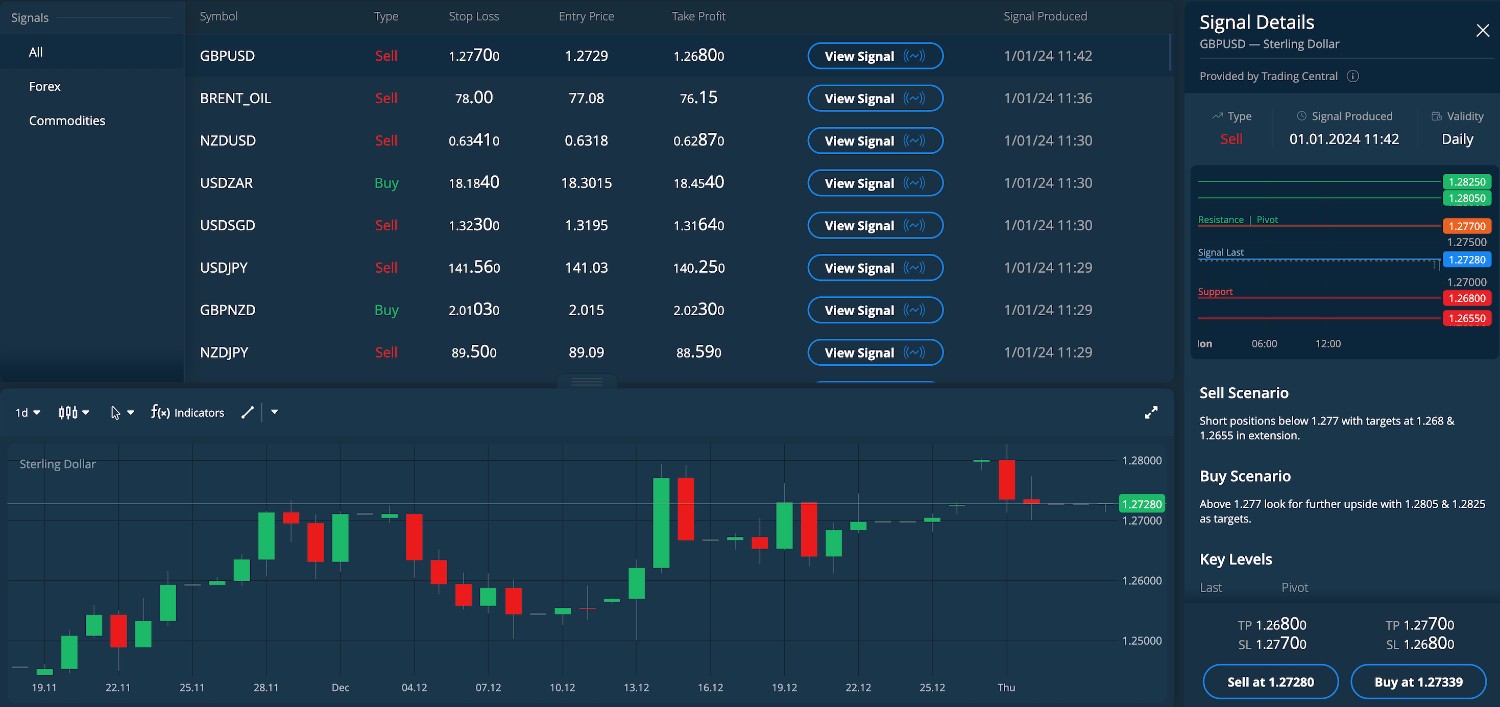
These signals typically specify:
- Asset & Timeframe: The asset (stocks, forex, cryptocurrencies, etc.) and timeframe (daily, hourly, etc.) the signal applies to.
- Entry Points: Suggested levels or conditions at which to enter a trade (buy or sell).
- Exit Points: Indications of when to close a trade to secure profits or limit potential losses (take-profit or stop-loss levels).
How Do Trading Signals Work?
Here’s a breakdown of how trading signals typically function:
- Data Collection & Analysis: Signal providers gather and analyze market data from various sources. This includes price movements, volume trends, chart patterns, moving averages, support and resistance levels, and possibly news or fundamental indicators related to specific assets or markets.
- Signal Generation: Based on the analysis, predefined criteria, or algorithms, the system generates signals. These criteria could involve specific technical indicators crossing certain thresholds, trend confirmations, or patterns emerging on charts (e.g., head and shoulders patterns, moving average crossovers).
- Delivery: Signals are then distributed to signal subscribers through various means. This could be via email, SMS, mobile apps, or within trading platforms. Some signal providers offer real-time updates, while others might offer periodic updates based on market conditions or preset time intervals.
- Interpretation: When receiving these signals you should evaluate them alongside your own strategies, risk tolerance, and market understanding. You should assess the credibility and relevance of the signals before deciding whether to act upon them.
- Execution Of Trades: Based on the received signals and your own assessment, you can execute trades or not. Signals often specify entry points (buy/sell), exit points (take-profit, stop-loss), and sometimes even recommended position sizes.
- Continuous Monitoring & Adjustment: You should monitor the market and adjust your positions based on how the market evolves. This includes managing trades by adjusting stop-loss levels, taking profits, or exiting positions if market conditions change.
It’s important to note that while trading signals can be valuable tools, they’re not foolproof. Market conditions can change quickly, leading to unexpected results.
Treat signals as a supplementary tool rather than an absolute directive.
Bottom Line
Utilizing trading signals can offer a beneficial avenue for capitalizing on gains, but it’s crucial to acknowledge that profits aren’t guaranteed.
These signals amalgamate technical, fundamental, and quantitative analyses to predict and forecast market or asset movements. Yet, these forecasts don’t always materialize, necessitating robust risk management systems. Furthermore, numerous scammers target inexperienced traders with misleading signals.
Nevertheless, following our guidelines above can help you get started with trusted signals providers and minimize associated risks.
FAQ
Are Trading Signals Legal?
Yes, trading signals are generally legal. They are essentially market analyses or recommendations provided by individuals, analysts, or automated systems, which are legal means of conveying information and strategies to assist you in making informed decisions.
However, the legality might vary based on the region and compliance with financial regulations governing investment advice and services.
How Do I Get The Most Out Of Trading Signals?
Generally, you can filter the signals that you receive with a large number of variables. For example, you could specify the assets for which you are notified of opportunities.
You can also limit the timeframes over which the signals should require a position to be open. Shorter-term day traders and scalpers may request one or five-minute signals, while others may prefer hourly or eight-hour chart notifications.
Who Gives The Best Trading Signals?
Determining the ‘best’ trading signals provider is subjective and can vary based on your individual preferences, accuracy, and compatibility with trading strategies.
Some well-regarded sources include professional analysts, reputable financial institutions, and established trading signal platforms with a track record of accuracy and reliability.
Researching and trialling various sources will help you to identify the most profitable signals for your specific trading styles and goals.
Why Do Providers Give Free Signals?
Signal providers often offer free signals to attract followers, build credibility, or as a marketing strategy to promote premium services or products.
It’s a way for signal providers to showcase their expertise, gain a larger audience, and potentially convert free users into paying subscribers for more advanced or exclusive signal offerings.
Are Trading Signals Scams?
In our experience, the majority of trading signals are either junk or scams. However, a few good ones try to help people understand trading better.
Trading signals aren’t inherently bad and often come from technical analysis, market data, or ‘expert’ opinions. The goal is to help you make smarter trading decisions.
However, the problem lies with a lot of signal providers (mainly forex) who make unrealistic promises. They might guarantee huge profits or claim an unrealistically high success rate. These tactics are often used to lure unsuspecting traders into expensive subscriptions.
To protect yourself, always do your due diligence. Research the signal provider, verify their track record, and be wary of claims that seem too good to be true.
What Are The Benefits Of Using Trading Signals?
You can use signals to enhance decision-making and save time through pre-analyzed market insights, complementing existing trading strategies.
You can access expert analyses, remove emotional biases, and use signals as a learning opportunity to improve strategies and gain insights into market dynamics and technical analysis.
What Are The Risks Of Using Trading Signals?
Using trading signals carries risks, including potential errors or inefficiencies, and reliance on historical data may not adapt well to sudden market shifts or unexpected events.
Additionally, subscription costs, overdependence without understanding underlying analysis, and lack of customization to individual preferences or trading styles can further pose challenges.
Should I Act On A Trading Signal?
When you retrieve a trading signal, it is up to you whether you follow through with the suggestion.
Some traders might assess the perceived risk (usually included in the notification) as too high or have carried out their own fundamental or technical analysis that leads them to believe the signal may not be successful.
If you have unwavering faith in the signals that are sent to you and use a program that integrates with your platform, you can automate your response. This will mean that there is less delay between the opportunity being recognized and the position being opened, likely improving the extent of any profits that are made.
However, if you implement this, you will not be able to reject signals on a case-by-case basis.
Article Sources
The writing and editorial team at DayTrading.com use credible sources to support their work. These include government agencies, white papers, research institutes, and engagement with industry professionals. Content is written free from bias and is fact-checked where appropriate. Learn more about why you can trust DayTrading.com