
BitMEX Review 2026




 Services not offered to residents of United States.
See the best BitMEX alternatives in your location.
Pros
- BitMEX invented the perpetual swap in 2016 and had been running a single-focus derivatives exchange until 2026. That depth of institutional knowledge — covering how the platform handles liquidations, funding mechanics, and order book management under extreme conditions — was genuinely difficult for generalist exchanges building derivatives as a secondary product to replicate.
- BitMEX launched pre-IPO linear futures contracts with 5x leverage in 2026, starting with SpaceX (SPCXUSDT), before closing later in the same year.
- Most exchanges publish proof of reserves at best monthly, and some only do so under external pressure. BitMEX published Proof of Reserves and Proof of Liabilities data twice per week, with figures that are independently verifiable on-chain. Where exchange solvency has become a genuine due diligence question rather than a theoretical concern, that publication frequency and the ring-fenced, non-lent fund structure behind it represented a transparency standard most competitors haven't matched.
Cons
- The platform made no concessions toward accessibility — the density of the interface, the non-intuitive relationship between mark price and liquidation mechanics, and the absence of guided onboarding created genuine friction for traders arriving from spot exchanges. In a market where competitors have invested heavily to reduce that friction, BitMEX's learning curve posed a meaningful attrition risk.
- The permanent exclusion of US residents extended beyond market size — it kept US institutional flows, retail volume, and market-making activity permanently outside BitMEX's ecosystem. That had tangible consequences for liquidity depth on newer and thinner contracts that competitors with US access didn't face to the same degree.
- Every interaction with BitMEX required crypto — deposits arrived in crypto, profits left in crypto, and fiat conversion occurred entirely off-platform through third parties. Traders managing capital that originated or terminated in a bank account carried conversion costs, exchange rate exposure, and operational friction that simply didn't exist on platforms with native fiat rails.
BitMEX Review
BitMEX ceased providing exchange and trading operations on 23 September 2026. Existing clients have been advised to withdraw their balance when practical. BitMEX is no longer accepting new clients. The review below is provided for historical purposes.
This BitMEX review goes beyond the spec sheet. We created live accounts, executed real perpetual swap and futures trades, and stress-tested order fills during some of crypto’s most volatile windows — including major macro announcements and liquidation cascades — to see how the exchange actually performed when the market was moving fast. We also dug into whether BitMEX’s advertised funding rates, leverage tiers, and fee structures held up against what traders actually pay at execution.
Regulation & Trust
BitMEX was operated by HDR Global Trading Limited, incorporated in the Seychelles and worked through transitional provisions from the Seychelles Financial Services Authority (FSA). It was one of the older names in crypto derivatives, but its regulatory history carried weight — the platform reached a $100 million settlement with US authorities in 2022 following CFTC and DOJ allegations, and it was always explicitly closed to US residents. In January 2025, BitMEX was then criminally sentenced in New York and fined for violating the Bank Secrecy Act and failing to implement an adequate AML program.
That geographic restriction was real and enforced. Unlike the Robinhood situation, where non-US users hit friction, BitMEX ran the opposite way — US-based traders were blocked outright, and the platform was built around an international client base.
What BitMEX didn’t offer was the kind of institutional-grade regulatory backstop that traders from heavily regulated markets might expect. There was no SIPC equivalent, no FCA authorization for UK users, and no MiFID II (Markets in Financial Instruments Directive II) protections for European clients.
The Seychelles FSA license, albeit temporary, provided a degree of legal operating framework, but it fell well short of the oversight standards set by bodies such as the FCA, ASIC, CySEC, or MAS. In fact, some regulators like the FCA warned BitMEX wasn’t authorized in their respective jurisdictions, with other European bodies following suit. For traders prioritizing regulatory depth over access to leverage, that gap mattered.
- BitMEX made identity verification mandatory for all users—a significant shift from its post-2020 anonymous trading model. While some traders saw this as friction, it actually signaled that BitMEX was positioning itself as an institutionally credible platform rather than a regulatory grey-zone operation. For traders who care about counterparty legitimacy, that mattered.
- BitMEX used MPC custody with no single private key held in a single place, kept over 95% of funds in cold storage, and published Proof of Reserves twice a week in a format that was independently verifiable. Critically, client funds were not lent out or staked — a genuine differentiator at a time when exchange insolvency risk was front of mind for traders post-FTX.
- BitMEX went through one of crypto’s most high-profile regulatory ordeals and came out the other side with a documented compliance overhaul. Working with Chainalysis, BitMEX reduced its on-chain AML risk exposure from 1.7% in 2019 to just 0.2% in 2024 — an 88% reduction, putting it 35% below the global industry average. That was a verifiable metric, not a promise.
- BitMEX operated outside Tier-1 regulatory oversight, thereby reducing the reliability and oversight available to traders. There was no FCA cover for UK clients, no ASIC protection for Australians, and no MiFID II framework for Europeans — regardless of where you were based, you were trading without a regulatory safety net.
- BitMEX’s own risk disclosure acknowledged that new laws governing blockchain technology and digital assets would emerge, with no assurance that they wouldn’t adversely affect the platform’s services. With MiCA active in the EU and other jurisdictions tightening oversight, further access restrictions were a real possibility.
- BitMEX pleaded guilty to criminal violations of the Bank Secrecy Act in July 2024 and was fined $100 million — on top of $100 million in earlier civil penalties — bringing total penalties to over $200 million. A presidential pardon followed, but the guilty plea stayed on the public record.
Regulatory Entities and Safeguards
BitMEX operated under a single offshore entity — HDR Global Trading Limited, licensed by the Seychelles FSA through a temporary regime — and that’s the only regulatory framework that traveled with your account, wherever you were based.
For international clients, that meant there was no local backstop. No FCA authorization if you’re in the UK, no ASIC oversight if you’re in Australia, no MiFID II protections if you’re in Europe. Seychelles rules govern the account — your home jurisdiction’s protections didn’t.
How that translated into DayTrading.com’s regulator-classification framework is shown below.
HDR Global Trading Limited (FSA Seychelles)
- Entity URL: https://www.bitmex.com/
- Verify License: 148707
- Regulator Classification (Green to Red): Seychelles FSA (red-tier – weak safeguards)
- Protections: Client funds were held separately from BitMEX’s operational capital under Seychelles FSA rules, and leverage could reach 1:100 on certain contracts. Negative balance protection wasn’t guaranteed, and there was no compensation scheme — no equivalent to the UK’s FSCS or Europe’s investor protection funds — if the platform failed. The Seychelles FSA framework provided a legal operating structure, but it didn’t offer the deposit safeguards that traders in more tightly regulated markets may be used to.
- Who Gets Signed Up Under This Entity: Global clients.
Important: Verify Your Entity & URL
Before you signed up, you had to confirm you were on BitMEX’s official domain and that the entity name on any registration documents read HDR Global Trading Limited. Given that BitMex operated through a single offshore entity with no local regulatory presence in most jurisdictions, there was no secondary layer of verification to catch mistakes.
You needed to take a few seconds to check the URL before entering personal or financial details. Clone sites targeting crypto derivatives traders are convincing and well-resourced — the consequences of landing on the wrong one aren’t worth the cost of a lapse in attention.
Watch for Clone Scams
Scammers occasionally build fake sites that mimic crypto derivatives platforms, and BitMEX was a high-profile enough target to attract them. The differences were often small enough to miss at a glance — a swapped domain extension, an extra word, or a subtle misspelling. Copycat domains might have looked something like:
- bitmex.co or bitmex.io (different extension)
- bit-mex.com or bitmexchange.com (hyphen or added word)
- bitmex.uk.com or bltmex.com (regional suffix or swapped letter)
One real example was BitMEX Crypto Mining, which the FCA warned about. These sites exist to steal deposits or personal information. Before logging in or sending funds, you always had to check the URL in your browser carefully — logos and official-looking designs can be faked, but the address bar doesn’t lie if you know what to look for.
The only reliable check was confirming the exact official domain before entering any credentials or financial details.
| Checkpoint | What to Look For |
|---|---|
| URL Extension | Should be .com (or regional like .com/eu), not .co, .io, or .biz. |
| Spelling | Watch for missing letters (e.g., bitmx.com or btmex.com). |
| Entity Name | Must match your region (e.g., HDR Global Trading Limited for FSA Seychelles). |
| Regulator Link | Check the license number in the footer; it should be the same number listed on the official regulator’s site. |
Accounts & Banking
- Sub-accounts were built into the platform, and volume from all of them rolled up into a single VIP tier calculation. For systematic traders running multiple strategies, this meant isolated margin per strategy without sacrificing the fee and tier benefits of consolidated volume — a structure that most retail-focused exchanges don’t offer without an institutional account setup.
- Multi-asset margining let you use more than just BTC and USDT as collateral. ETH, SOL, USDC, and RLUSD were all supported as collateral via Multi Asset Margining, which meant you didn’t have to liquidate held positions in other assets just to post margin. That flexibility reduced forced conversion costs and maintained the portfolio structure when opening derivatives positions.
- Small withdrawals — under a certain threshold — were processed every 15 minutes rather than waiting for the daily batch window. Smaller BTC withdrawals were processed every 15 minutes, while larger BTC withdrawals ran on a once-daily schedule. If you were managing day-to-day capital movement rather than large periodic transfers, that near-continuous processing window was a meaningfully faster experience than the daily batch cycle suggested.
- All withdrawals exited as crypto — there was no fiat withdrawal route whatsoever. Profits had to be withdrawn from the platform as BTC, USDT, or another supported asset, then converted to fiat elsewhere. If you wanted to move gains directly into a bank account, that added an extra conversion step, an extra fee layer, and exposure to price movement during the transfer window.
- Network selection on deposits and withdrawals carried permanent loss risk. Sending funds to the wrong network — for example, USDT on ERC20 when the address expected TRC20 — resulted in funds that are unrecoverable and cannot be guaranteed to be retrieved. Unlike a bank transfer reversal or card chargeback, there was no safety net. One misclick during a fast deposit could wipe the transfer entirely.
- Withdrawals were locked behind mandatory 2FA via Google Authenticator. If you lost access to your authenticator — a lost phone, a failed device migration — withdrawals were blocked until access was restored through BitMEX’s account recovery process. For active traders moving capital at speed, that dependency on a single authentication app was a single point of failure that most people didn’t consider until it became a problem.
Live Accounts
BitMEX kept its account structure straightforward — there was one standard individual account, and the entry bar was low. The minimum deposit was tied to each product’s initial margin requirement rather than a fixed dollar threshold, so there was no artificial funding floor that blocked access.
Where BitMEX differentiates was through its VIP Programme, a five-tier structure that rewarded high-volume traders with progressively better conditions. Entry started at VIP 1 with USD 10M monthly volume or 50,000 BMEX (the utility token of the BitMEX ecosystem) staked, scaling up to VIP 5 for traders hitting USD 250M — with benefits ranging from a dedicated relationship manager and priority withdrawals at VIP 1, through to the best possible trading rates, 10 free daily withdrawals, and invitation-only global events at VIP 5.
Physical gifts were tied to each tier too, from a Ledger Nano X at VIP 1 to an Omega Speedmaster at VIP 5.
Traders from other exchanges could also apply for instant VIP status matching by submitting proof of their current tier on platforms such as Binance or Bybit. Sub-account volumes counted toward VIP tier calculations, which was useful for systematic traders running multiple strategies.
Beyond the standard account, there were no joint accounts, PAMM, or managed account structures. If you were looking to allocate to a money manager or run external funds, BitMEX wasn’t the right fit unless you found success with its in-house copy trading service.
KYC was mandatory for all users and, from our experience, was typically processed within a day. It was not a heavy process, but it was not instant either.
Demo Accounts
BitMEX’s demo environment — called Testnet — was one of the platform’s more practical tools, and it was free with no time limit. Strangely, it operated from a separate web address (testnet.bitmex.com) and required its own registration, independent of any live BitMEX account you may already have held.
Testnet was a sandbox version of the real platform, letting you explore the service without the risks of live trading — and used a green version of the classic BitMEX logo so you always knew which environment you’re in. We were pleased to see that it carries all the functions of the full trading platform, just in a consequence-free environment using Testnet Bitcoin.
Each new Testnet account was automatically funded with 0.01 Testnet XBT, with additional funds available via faucets linked directly from the deposit page. It was not a polished onboarding experience — you were manually requesting virtual funds through external faucets rather than being handed a clean virtual balance — but it worked.
Testnet was ideal for stress-testing strategies, building and debugging automated bots, and testing before going live. You could test algorithms and trading bots against simulated market data, which was a more substantive use case than simply clicking around the interface. The absence of a time limit meant testing could be as thorough as you want, rather than being raced against a 30- or 90-day clock like at some CFD brokers.
The only limitation we encountered was liquidity. Market conditions on Testnet didn’t always reflect the real platform — slippage and spreads could differ meaningfully, which matters if you were validating a strategy where execution quality was part of the edge. Testnet told you whether your logic works, but it wouldn’t tell you exactly how fills would behave under live market pressure.
Deposits & Withdrawals
Funding a BitMEX account was clean in terms of fees but limited in terms of methods. The platform supported deposits across over 40 cryptocurrencies, with BTC and USDT as the primary margining currencies. BitMEX charged no deposit fees, which kept the funding process cost-efficient — though blockchain network fees on the sending side were outside the platform’s control.
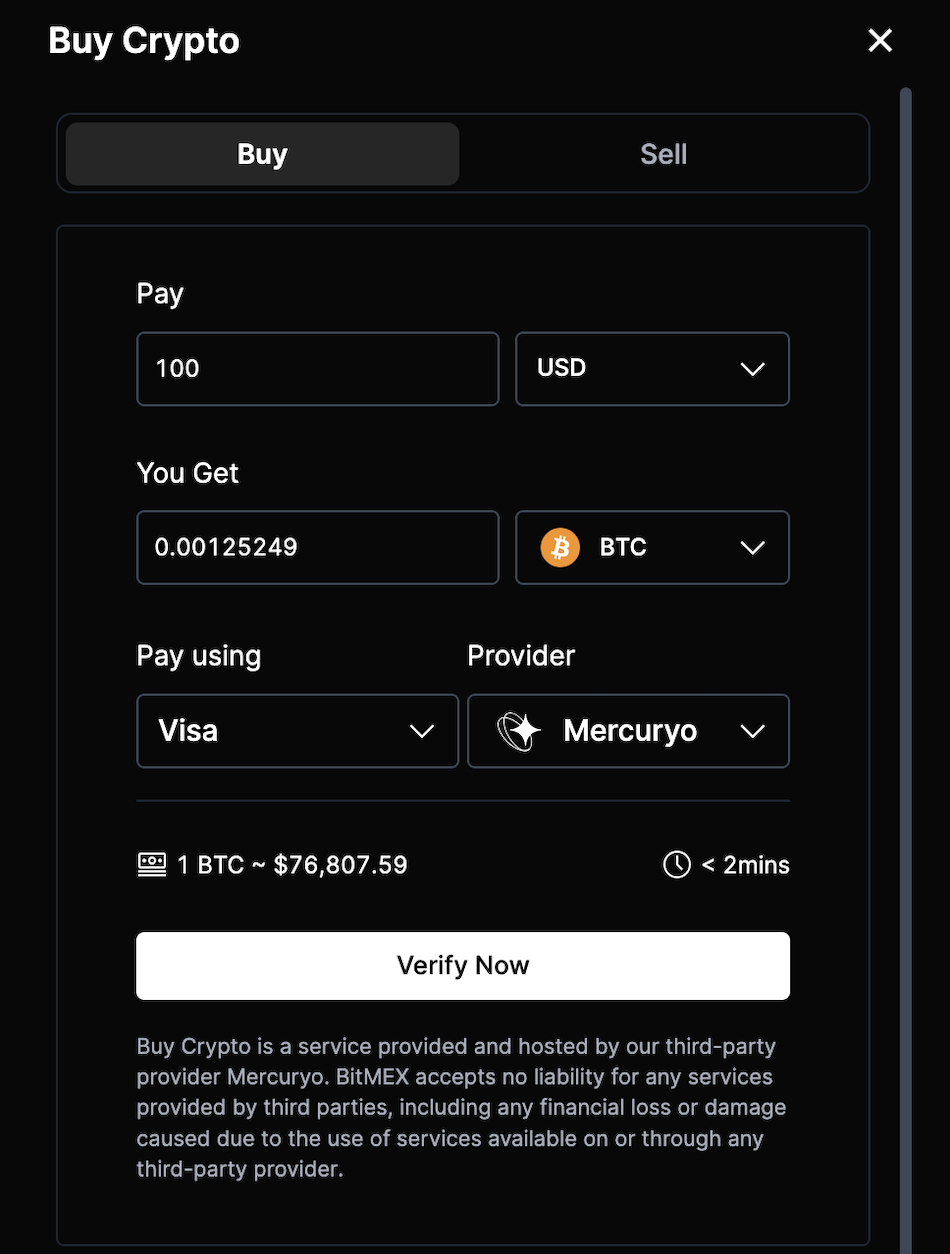
BitMEX offered a “Buy Crypto” tab that routed fiat purchases through third-party providers, accepting credit and debit cards, Google Pay, Apple Pay, and services like Revolut, but these incured third-party processing costs that could vary by currency and amount. It was a workaround rather than a native fiat on-ramp. BitMEX also added support for Banxa.
On the withdrawal side, the picture was generally positive. In testing, we found that BTC withdrawals typically completed within 15 minutes of email confirmation. BitMEX didn’t charge a platform withdrawal fee for Bitcoin — only the network fee paid to miners, which was set dynamically based on network conditions and didn’t go to BitMEX.
For other assets, fixed fees applied at the point of withdrawal — USDT via TRC20 carried a flat fee of USDT 1.5, while SOL withdrawals cost USD 1, and ERC20 transfers ran USD 1.50. If you were staking BMEX, you may have been eligible for network fee refunds, which depended on your staking tier.
The one friction point worth knowing was withdrawal scheduling. Large BTC withdrawals were processed once daily at a scheduled time rather than on demand — a batching system that improved security by limiting hot wallet exposure, but meant you couldn’t always access funds immediately when timing mattered. Smaller withdrawals were processed more frequently.
| BitMEX | Interactive Brokers | OKX | |
|---|---|---|---|
| Accounts & Banking Rating | |||
| Payment Methods | Apple Pay, Banxa, Bitcoin Payments, Credit Card, Ethereum Payments, Google Pay | ACH Transfer, Automated Customer Account Transfer Service, Cheque, TransferWise, Wire Transfer | Apple Pay, Banxa, Bitcoin Payments, Credit Card, Ethereum Payments, Google Pay, Mastercard, PayPal, Simplex, Visa, Wire Transfer |
| Minimum Deposit | $0.01 | $0 | 10 USDT |
| Visit | Visit | Visit | Visit |
| Review | Review | Review | Review |
Assets & Markets
BitMEX covered considerably more ground than its reputation as a pure Bitcoin derivatives exchange suggests. The platform supported over 120 derivatives contracts alongside spot trading across 84+ coins, spanning perpetual swaps, dated futures, and a range of TradFi products.
The crypto derivatives core included perpetuals and futures on BTC, ETH, SOL, XRP, and a broad range of altcoins, with leverage running up to 1:100 on BTC contracts and varying limits across other assets. Spot trading covered 20+ pairs if you wanted direct exposure without leverage.
Where the product range expanded most sharply was in TradFi Perps — perpetual swap contracts on traditional assets, settled in crypto with no fiat required. BitMEX offered over 30 TradFi contracts spanning three categories.
Equities included Apple, Tesla, and Nvidia, plus SPY and QQQ ETFs, with up to 1:20 leverage. Forex covered major pairs like GBP/USDT and USDT/JPY with up to 1:100 leverage, and commodities include gold, silver, Brent crude, and natural gas with up to 1:25 leverage.
The core appeal of these contracts was 24/7 access. US stock markets close at 16:00 ET and shut on weekends — with equity perps, you could react to earnings, Fed announcements, or geopolitical events in real time rather than waiting for the opening bell. These were synthetic instruments, however, so there was no share ownership, no dividends, no shareholder rights — purely directional or hedging exposure on price.
BitMEX’s limits showed up outside derivatives. There were no structured products, options, or fund-style instruments. Unlike at eToro, if you want a single platform for both active derivatives trading and longer-term portfolio construction, you would hit a ceiling. BitMEX was a specialist venue — the 200+market count reflected depth within derivatives rather than breadth across asset classes.
Leverage
BitMEX operated well outside US regulatory leverage limits, and the numbers reflect that. Leverage ran up to 1:100 on perpetuals — compared to the 1:4 intraday cap that US-regulated brokers work within under Reg T. Altcoin perpetuals carried lower limits depending on contract specifications, equity perps topped out at 1:20, FX perps at 1:100, and commodity perps varied by asset at around 1:20. The ceiling was high, but the actual cost of holding leveraged positions shouldn’t be underestimated.
Rather than a fixed margin interest rate, BitMEX used a funding rate mechanism on perpetuals — an 8-hourly payment exchanged between longs and shorts to keep the contract price anchored to spot.
At 0.01% per 8-hour interval, that annualized to roughly 10.95% for a long position held continuously — modest in isolation, but a material cost if you held positions over days or weeks during high-sentiment markets when rates spiked above baseline.
For perpetuals at maximum leverage, the maintenance margin requirement sat at 0.5% — meaning a 0.5% adverse price move at 1:100 leverage could trigger liquidation. During rapid market moves, final liquidation prices may have differed from calculated levels due to slippage and order book depth. Both isolated and cross-margin modes were available — isolated capped the loss to a single position, while cross-margin drew on the full account balance to prevent liquidation, with the trade-off being that one bad position could affect all others.
During our testing, we found that BitMEX exhibited some of the most stable funding rates among major exchanges, with funding rates anchored at baseline more consistently than those on Binance or Hyperliquid. For basis traders and funding rate arbitrageurs, that predictability was a structural advantage. For directional traders simply carrying long exposure, it meant carry costs were relatively contained outside of euphoric market conditions — but that’s when positions were typically largest, and costs hurt the most.
| BitMEX | Interactive Brokers | OKX | |
|---|---|---|---|
| Assets & Markets Rating | |||
| Trading Instruments | Crypto, FX Perpetual Swaps, Equity Perpetuals, Pre-IPO Perpetuals | Stocks, Options, Futures, Forex, Funds, Bonds, ETFs, Mutual Funds, Cryptocurrencies | Spot, Futures, Swaps, Options, X-Perps |
| Margin Trading | Yes | Yes | Yes |
| Visit | Visit | Visit | Visit |
| Review | Review | Review | Review |
Fees & Costs
BitMEX’s fee structure rewarded liquidity providers and punished market order traders — and that split mattered more here than on most platforms, given the leverage and position sizes involved.
On derivatives, the base taker fee was 0.075%, and makers received a rebate of -0.025% — meaning limit orders that rest in the book didn’t just trade for free, they generated a small credit. The taker fee of 0.075% sat above most competitors, making it less cost-effective for retail traders executing market orders, but for systematic traders running limit-heavy strategies, the rebate structure worked in their favor on every fill.
At the highest-volume tier — above $5 billion in 30-day volume — taker fees dropped to 0.050%, while maker rebates increased to -0.050%.
Spot fees were cut significantly in late 2025. Standard maker and taker spot fees then started at a flat 0.05% for all users — half the previous rate — with VIP traders earning maker rebates of up to -0.0150%, meaning the platform paid its highest-volume liquidity providers to trade. That 0.05% base spot rate compared favorably against the industry average of 0.15% for makers and 0.194% for takers.
TradFi equity perps carried their own fee structure. From 21 April 2026, both maker and taker fees on all equity perpetual contracts were set at 0.05%, with tier-based discounts applied on top. For equity perps, the maker rebate sat at -0.025% — meaning BitMEX paid traders to provide liquidity on these contracts, which was unusual in a product category where competitors typically charge both sides.
The cost that accumulated fastest — and that many traders underestimate — is funding. A position held for one week incured 21 funding payments, potentially totalling 0.21% to 2.1% in costs depending on market conditions, far exceeding the initial trading fee impact. During trending markets when funding spiked above baseline, holding a leveraged long became materially more expensive than the headline taker fee suggested.
Non-trading fees were lean. Deposits were free, there was no platform fee, no inactivity fee, and no account maintenance charge. Bitcoin withdrawals carried only the miner network fee, which went to the blockchain rather than BitMEX, with BMEX stakers eligible for fee refunds depending on their staking tier.
The overall cost picture was competitive for active traders — but the gap between maker and taker economics was wide enough that trading style has a bigger impact on total costs here than on most competing platforms.
| BitMEX | Interactive Brokers | OKX | |
|---|---|---|---|
| Fees & Costs Rating | |||
| Visit | Visit | Visit | Visit |
| Review | Review | Review | Review |
Trade Execution
BitMEX delivered solid fills on BTC and ETH perpetuals—the contracts that matter most to the platform’s core user base. During normal market hours, market orders on XBT/USDT and ETH/USDT executed at or very close to the quoted price, with slippage widening meaningfully only during liquidation cascades or major macro events when order book depth thins rapidly.
It wouldn’t compete with co-located HFT infrastructure for microsecond execution, but for active derivatives traders placing directional or hedging orders, it handled retail and mid-tier institutional volume without drama. Following the August 2025 migration to AWS Tokyo, BitMEX achieved measurable reductions in both order placement and orderbook latency across all major contracts.
Total latency breaks into four stages:
- Local processing latency: Starts with your own setup. A modern CPU, SSD, and wired Ethernet connection keeps this near zero — Wi-Fi, a VPN, or older hardware adds drag before your order even leaves your machine.
- Network latency: The round-trip between your connection and BitMEX’s servers. Since migrating to AWS Tokyo, BitMEX’s infrastructure was physically closer to Asian markets, reducing round-trip times for traders in those markets. European and US-based traders would see higher baseline network latency given the geographic distance.
- Engine processing latency: BitMEX capped worst-case queue latency at 3–5 seconds under peak load by capping the order queue depth — orders were refused immediately rather than left sitting in a backed-up queue, keeping execution predictable even during high-traffic moments.
- Execution latency: Post-migration liquidity improvements of over 185% across flagship perpetuals like XBT/USDT and ETH/USDT led to tighter spreads and better fills, as more market-making participants came onto the platform. Thinner altcoin contracts still saw wider spreads, particularly outside peak trading hours.
Round-trip performance on the core BTC and ETH perpetuals was competitive for active derivatives trading. Algorithmic traders running latency-sensitive strategies could have considered co-locating scripts on AWS instances close to BitMEX servers — it was the fastest practical way to close the gap without institutional co-location arrangements.
Live Trading Test
From a UK connection routed to AWS Tokyo, market orders on XBT/USDT and ETH/USDT filled cleanly during peak Asian and European overlap hours. Slippage on BTC perpetuals stayed tight against quoted prices in normal conditions — no hidden widening between the displayed price and the actual fill on standard position sizes.
Standard fiber internet remained steady, and spot trades were crisp across active sessions. The picture changed during liquidation cascades — a sharp BTC move of 2–3% within minutes pushed fill prices noticeably away from the pre-order quote, consistent with how order book depth behaves on any leveraged derivatives venue under stress, not a platform-specific flaw.
We simulated elevated latency at 400ms to replicate overseas connections or VPN drag. Fills slowed as expected, but BitMEX held stable — no lockups, no order rejections outside the queue cap. Under peak load, BitMEX refused orders immediately if the queue exceeded its depth threshold rather than letting them stack, which means you got a clean rejection rather than a stale fill — a more honest outcome for fast-moving markets.
Slippage Analysis
Slippage on BTC and ETH perpetuals stayed tight during peak hours — XBT/USDT and ETH/USDT fills tracked quoted prices closely on standard retail sizes. Things shifted during funding resets, macro events, or liquidation cascades, where spreads widened and market order fills landed noticeably off the pre-click quote.
We saw 5–15 basis-point slips on BTC market orders during volatile windows — wider than the 0.075% taker fee implies, once you account for where the fill actually lands versus the mark price at submission.
Post-migration liquidity improvements have tightened spreads on flagship contracts, but thinner altcoin perpetuals and newer TradFi perp contracts still showed wider spreads outside peak hours. Testnet ran cleaner under stress than live.
For directional trades on BTC, ETH, or the major TradFi perps, execution held up well at retail sizes. Tight scalping during liquidation cascades or major macro prints was a different story — limit orders and careful position sizing mattered far more than they do on traditional brokers.
Methodology note
Over five trading days, we placed 150+ round-trip trades on a live BitMEX account — primarily BTC and ETH perpetuals, with a selection of TradFi equity and commodity perps. Testing ran from a UK fiber connection routed to the AWS Tokyo server, timed across Asian open, European overlap, peak US hours, and post-close sessions when liquidity thins.
We logged entry quotes against actual fill prices on every trade. Slippage on BTC and ETH perpetuals averaged 2–8 basis points during normal flow, widening to 15–30 basis points on market orders placed during a sharp BTC move and one significant liquidation cascade.
TradFi equity perps showed wider spreads consistently outside US market hours — fills on limit orders held tighter, reinforcing that market orders carry a real execution cost on this platform beyond the headline taker fee.
Platforms & Tools
BitMEX gave you three access points rather than one — the web platform, the mobile app, and a full TradingView integration, which covered more ground than the single-platform model most exchanges operate on. There was no proprietary downloadable desktop terminal, which matters to a subset of professional traders, but the TradingView integration addressed much of what a dedicated desktop application would offer. In 2026, Bitmex also partnered with COLLYBUS, elevating its tooling and trading infrastructure for serious active traders.
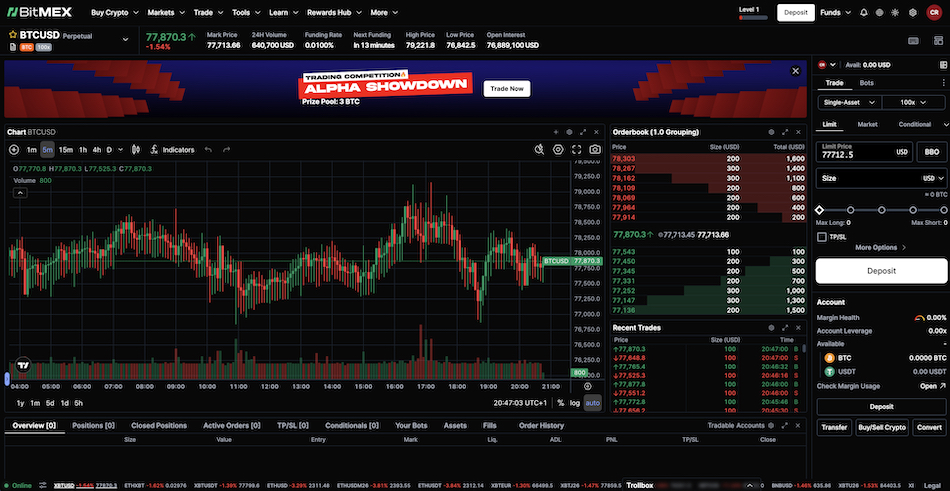
The native web platform was purpose-built for derivatives trading. The interface was dense rather than designed for casual use — funding rates, mark price, liquidation levels, order book depth, and position data were all visible simultaneously in a layout that assumed you knew what you were looking at.
Order types covered the full range needed for derivatives trading: limit, market, stop-market, stop-limit, trailing stop, and reduce-only orders, with isolated and cross-margin selectable per position. For an experienced derivatives trader, that was a complete execution environment. For someone arriving from a simpler spot exchange, the learning curve was real.
The TradingView integration let you place spot, futures, and perpetual swap trades directly from TradingView charts, combining execution with its charting and analytics tools in a single workflow. The integration also supported Pine Script for custom strategy development and webhooks for automated execution, making it a meaningful upgrade for algorithmic traders who wanted to connect TradingView signals directly to live orders without third-party routing.
If you were already working in TradingView, this was the most natural way to use BitMEX — the charting quality and community indicator library stayed intact, and execution happened without switching windows.
Beyond the core platforms, BitMEX ran a trading bot marketplace where you could deploy automated strategies without writing code, and copy trading let you mirror positions from others on the platform’s leaderboard. These are additive tools rather than differentiators — useful for the right user but unlikely to be the primary reason an experienced derivatives trader chose the platform.
The absence of a standalone desktop terminal may have been a drawback for some professional traders who prefer a dedicated application over a browser-based interface. For most active traders, though, the combination of the native web platform and TradingView integration covered the practical bases without requiring a download.
Mobile Apps
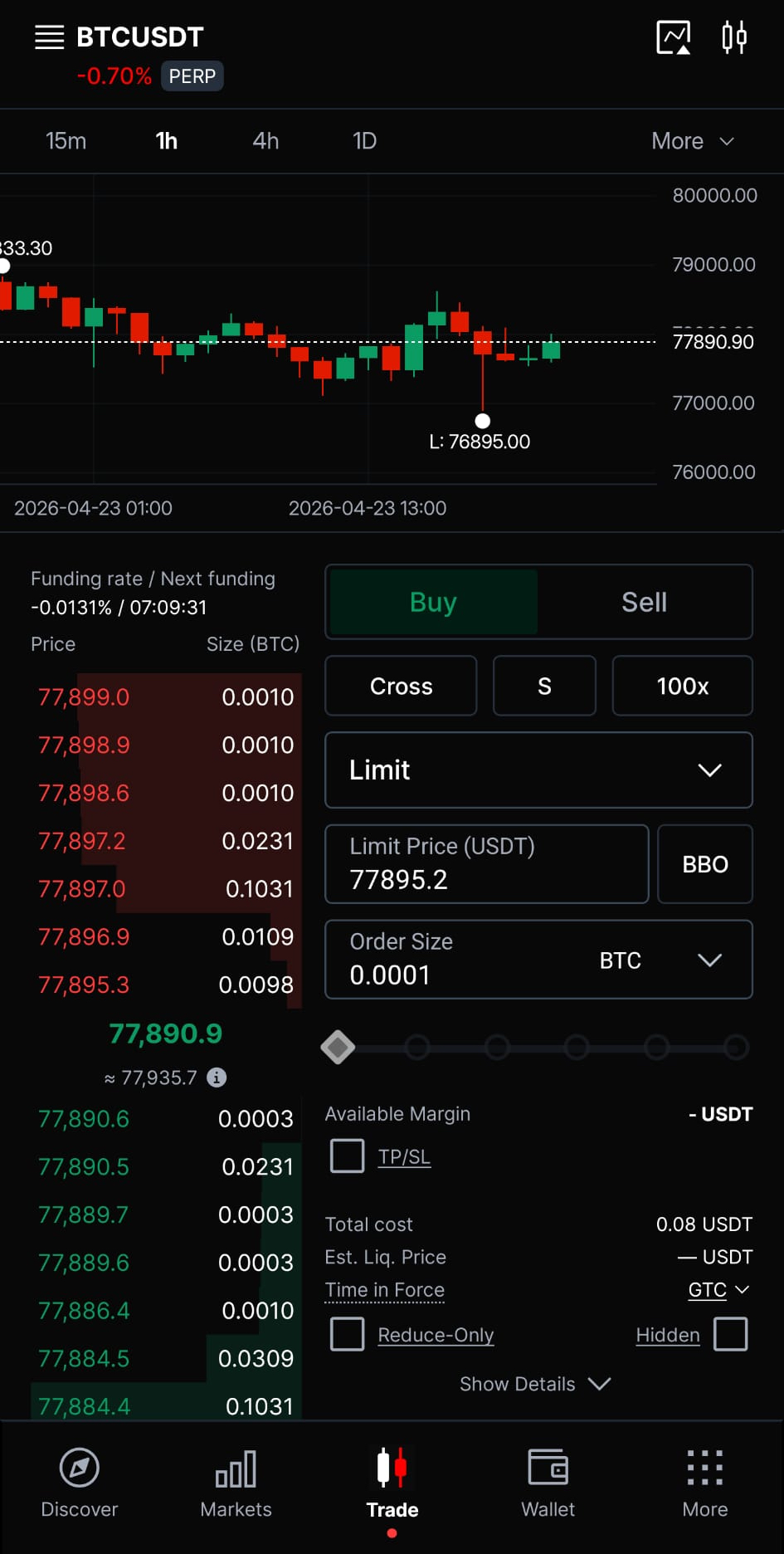
BitMEX’s mobile app was available on both iOS and Android, and unlike some exchange apps that are effectively portfolio viewers with an order button bolted on, this one was built specifically for active derivatives trading on the move.
The app mirrored the desktop platform’s liquidity and performance and was engineered to deliver low-latency execution rather than a stripped-down monitoring experience. That last point matters — fill quality and order routing in the mobile app matched what you’d get on the web platform, not a degraded version.
For day-to-day use, the execution experience was deliberately streamlined. A swipe-to-close function let you shut positions in a single gesture, one-swipe navigation moved between markets and menus, and one-click fiat purchases were built in alongside streamlined KYC for new users.
The interface design was intentionally distinct from the desktop — less information-dense, built around speed of action rather than maximum data visibility. That was a reasonable trade-off for mobile, though if you relied on simultaneous chart analysis and order management, you would still find the desktop or TradingView integration more comfortable for complex setups.
Copy trading and bot access were both available in the app, so if you were running automated or mirrored strategies, you didn’t need to switch to a desktop to monitor or adjust them. Secure deposits and withdrawals were also supported directly in-app, so capital management didn’t require a browser session.
Where the app showed its limits was on deep analytical work — multi-contract position management across several open perpetuals, detailed funding rate monitoring, and complex order setups were all better handled on the web platform or through TradingView.
The mobile app was a genuine execution tool for traders who already knew what they wanted to do, not an environment for building or reviewing a strategy.
| BitMEX | Interactive Brokers | OKX | |
|---|---|---|---|
| Platforms & Tools Rating | |||
| Platforms | BitMEX Web Platform, COLLYBUS, AlgoTrader, TradingView, Quantower | Trader Workstation (TWS), IBKR Desktop, GlobalTrader, Mobile, Client Portal, AlgoTrader, OmniTrader, TradingView, eSignal, TradingCentral, ProRealTime, Quantower | AlgoTrader, Quantower |
| Mobile App | iOS & Android | iOS & Android | Android & iOS |
| Visit | Visit | Visit | Visit |
| Review | Review | Review | Review |
Research
BitMEX’s research output was the standout element of its content offering — and unlike most exchange-produced material, a meaningful portion of it was genuinely independent from the platform’s commercial interests.
The centerpiece was BitMEX Research, a dedicated channel on the site that produced evidence-based analysis on Bitcoin, broader crypto markets, and macro financial themes.
The research team published reports on on-chain data, market structure, and financial history — work that was cited outside crypto circles and carried a reputation for rigor that most exchange research didn’t match. It wasn’t not designed to drive trading decisions on BitMEX specifically; it was analytical output that stood on its own terms.
Alongside that sat the Crypto Trader Digest, co-founder Arthur Hayes’ market commentary series. Hayes wrote with a macro lens — connecting crypto price action to broader monetary policy, geopolitical shifts, and liquidity cycles — and the Digest had developed a readership well beyond BitMEX’s user base.
If you think about crypto within a macro framework, it was one of the more substantive free resources available anywhere in the space. BitMEX Alpha rounded out the content stack with more tactical trading ideas and shorter-form market insights aimed directly at active traders on the platform.
The research suite also included quarterly derivatives reports tracking market structure across perpetual swaps, funding rate trends, open interest, and the fast-developing TradFi perp category. BitMEX’s Q1 2026 derivatives report, for example, tracked the growth of TradFi perpetual swaps from near zero to $30.7 billion in weekly volume — data directly useful to traders active in those markets.
What’s absent was real-time research tools integrated into the trading interface — no screeners, no built-in technical analysis research from third-party providers, and no options analytics layer. BitMEX’s research lived in the blog and report ecosystem rather than inside the platform itself, which meant pulling insights into actual trade decisions required an extra step.
If you already operated with an external research workflow, that was workable. If you were expecting research to be woven into the execution environment, it wasn’t.
| BitMEX | Interactive Brokers | OKX | |
|---|---|---|---|
| Research Rating | |||
| Visit | Visit | Visit | Visit |
| Review | Review | Review | Review |
Education
BitMEX’s educational offering was more substantial than a pure trading venue, but it was still firmly pitched at traders who already had a foundation, not those starting from scratch.
The platform maintained a dedicated crypto trading guides section covering crypto basics, how-tos, and platform-specific tips. Topics spanned perpetual futures mechanics, leverage and margin management, liquidation dynamics, funding rate behavior, and risk management — the exact concepts that trip up traders new to derivatives.
We found the quality was generally solid and written by people who understand the products, not generic financial content recycled from elsewhere.
Beyond the guides, BitMEX ran two distinct content streams worth knowing about. BitMEX Research published evidence-based reports on Bitcoin, cryptocurrency, and broader financial markets — analytical work that sat closer to institutional research than educational content, covering on-chain data, market structure, and macro themes.
Separately, the Crypto Trader Digest provided market commentary and macro analysis that developed a following beyond BitMEX’s own user base. Neither was designed to teach someone how to trade — both assume the reader already keew what they were doing.
The gap was structured learning. There were no video courses, no webinars, no interactive tools that walked you through position sizing or stop placement step by step. The Testnet filled some of that role — letting you practice on a live-replica environment without real capital — but it was a sandbox, not a curriculum.
BitMEX was therefore best understood as a platform for traders who have already done the foundational work elsewhere. For that audience, the research output and trading guides added genuine value. For anyone expecting a learning environment that builds competence from the ground up, the content available here wouldn’t cover that ground on its own.
| BitMEX | Interactive Brokers | OKX | |
|---|---|---|---|
| Education Rating | |||
| Visit | Visit | Visit | Visit |
| Review | Review | Review | Review |
Customer Support
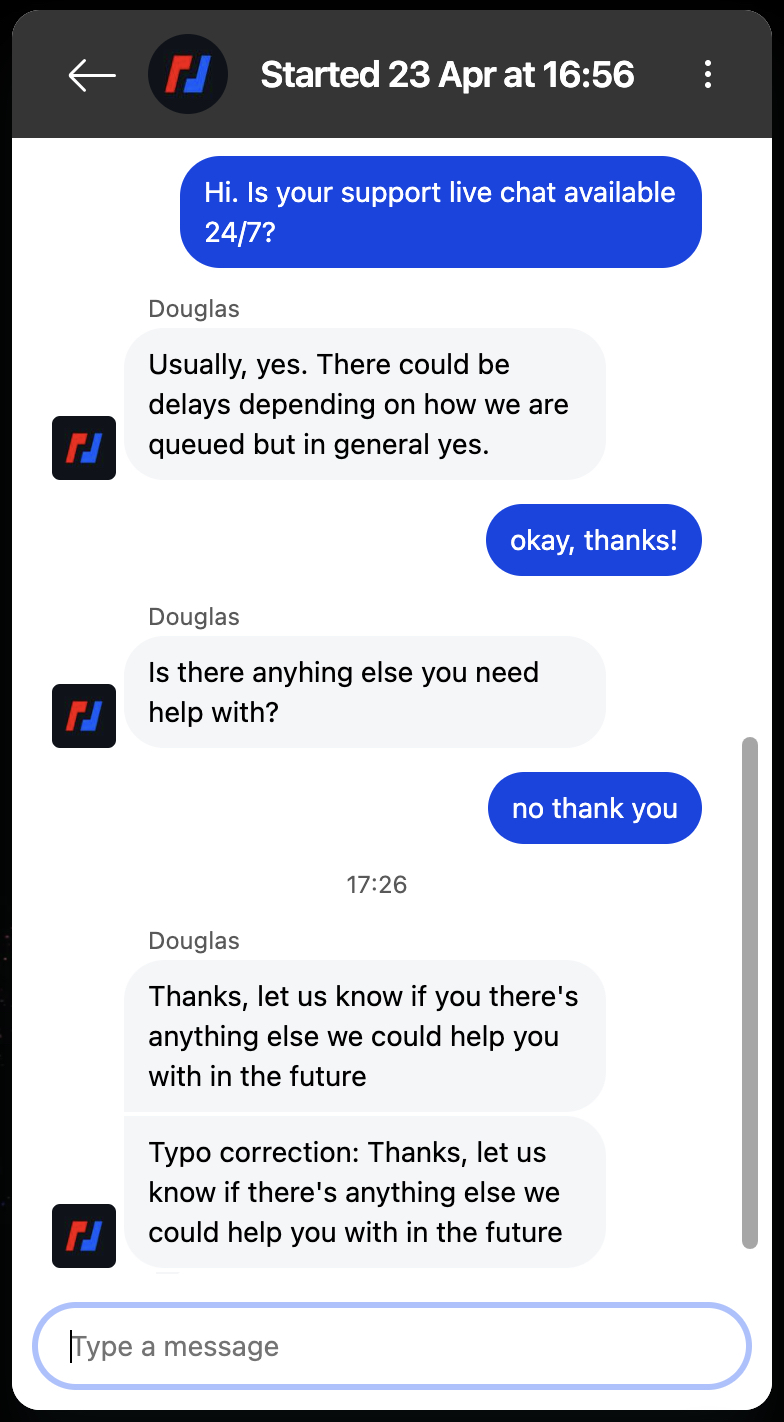
BitMEX’s support setup was more accessible than most brokers at this tier. The team was available 24/7 and handled queries in English, Chinese, Turkish, and Russian — a meaningful commitment for a platform that served traders across dozens of time zones with no US access. There was no phone line, but for a crypto derivatives exchange, that was standard rather than a gap.
The primary channels were 24/7 live chat, email, a ticketing system, and a dedicated complaints form on the site. Live chat was available without logging in, which matters if you were evaluating the platform before signing up or had been locked out of your account.
In our own tests, live chat response times ran 5–10 minutes — functional, but not the sub-minute experience the “instant” framing implies. Email replies typically landed within 24 hours, with priority handling for security and account lockout issues. For traders with serious security concerns or those who prefer encrypted communication, BitMEX also offered Pretty Good Privacy (PGP) — an uncommon option at this level that signaled a degree of operational seriousness beyond what most retail-facing exchanges provide.
Beyond direct support, BitMEX maintained active communities on Telegram, Discord, and X — monitored channels that provided a faster informal layer for common queries and platform updates, without replacing the ticket queue for anything account-specific.
VIP users got a step up: from VIP 1 onwards, a dedicated relationship manager handled the account directly — a meaningful differentiator for high-volume traders who wanted a named contact rather than a shared queue.
The limitation was consistency under pressure. During calm conditions, we found the 24/7 chat held up well enough. During high-volatility events or compliance review waves, wait times extended, and the gap between what the support structure promises and what it delivers could widen. For a self-sufficient trader who rarely needs intervention, it was adequate. For anyone navigating a frozen account or a time-sensitive dispute, adequate may not be enough.
Community Sentiment
Building an accurate picture of how BitMEX is perceived meant going beyond our own live testing. We pulled sentiment from Trustpilot, Reviews.io, Reddit, G2, and specialist crypto trading communities — gathering several hundred data points covering everything from withdrawal experiences to platform reliability during volatile sessions. The picture that emerged was divided.
On Trustpilot, BitMEX held a 4.3 score across 106 reviews, but the distribution was polarised — 42% five-star and 43% one-star, with almost nothing in between. That kind of split typically signals a platform that works well until it doesn’t, rather than one delivering a consistently average experience. On Reviews.io the picture was harsher, with 297 reviews averaging 1.6 out of 5.
Positive sentiment clustered around execution quality on BTC and ETH perpetuals, competitive fees, and customer support responsiveness — with some reviewers specifically praising the support team’s speed and persistence.
Negative reviews told a different story. The most frequent complaint across platforms involved frozen funds, with several accounts reporting suspensions during compliance reviews and capital being locked for extended periods without clear communication. Reddit threads add context — KYC verification disputes and interface complexity came up repeatedly, particularly from traders who came to BitMEX from simpler spot exchanges.
The fault line in community sentiment wasn’t the trading engine — it was what happened when an account hit a compliance flag or a withdrawal got held. For traders who never encounter those situations, BitMEX appeared to run smoothly. For those who do, the gap between the problem arising and a satisfactory resolution could be wide.
For a self-sufficient, experienced derivatives trader who manages their own risk and rarely needs platform intervention, community sentiment broadly supported BitMEX as a functional, well-established venue. For anyone who expects consistent support quality when something goes wrong at an inconvenient time — during a fast-moving market or a large withdrawal — the review record suggests managing those expectations carefully before committing significant capital.
Was BitMEX A Good Broker?
BitMEX was a well-suited platform for experienced derivatives traders who wanted deep BTC and ETH liquidity, a transparent fee structure that rewards limit order flow, and access to a wide range of TradFi perpetuals covering equities, commodities, and FX — all tradable 24/7 with crypto collateral.
However, it wasn’t the right fit for everyone. The offshore regulatory structure, criminal history, and absence of investor protection schemes meant traders carried more counterparty risk than they would on a Tier-1 regulated venue. New traders would also find the learning curve steep — leverage up to 1:100, funding rate mechanics, and liquidation dynamics all required a genuine understanding before real capital was at stake.
For the trader it was designed for — someone comfortable with derivatives, confident in risk management, and looking for a specialist platform with competitive costs and an actively expanding product range — BitMEX was a credible and well-established choice.
How We Tested BitMEX
- We tested BitMEX on a live account using the platform’s official fee schedules, contract specifications, and published regulatory disclosures as our reference points. We examined how orders route across perpetual swaps, dated futures, spot pairs, and TradFi perp contracts, and worked through the available deposit and withdrawal paths using both BTC and USDT.
- We ran hands-on checks across the BitMEX web platform, API, and mobile app. We opened and closed positions across BTC, ETH, and a selection of TradFi equity and commodity perpetuals; monitored execution behavior during high-volume sessions; compared live fill prices against quoted mark prices to verify slippage and fee accuracy; and tested how the order management tools, charting interface, and risk controls handle both short directional trades and multi-day leveraged positions.
- We cross-referenced BitMEX’s published claims on trading fees, funding rates, withdrawal processing times, and VIP programme benefits with trader feedback from independent forums and review sites. That process helped us identify where the platform delivers reliable execution and deep liquidity on its core contracts — and where factors like funding rate carry costs, altcoin spread width, TradFi perp oracle behavior outside market hours, or the offshore regulatory structure can create friction for active traders.
FAQ
What Was BitMEX?
BitMEX was a crypto derivatives exchange that had been operating since 2014 through to September 2026, specializing in perpetual swaps, futures, and spot trading across major cryptocurrencies. The platform expanded significantly into TradFi perpetuals — covering equities like Apple and Nvidia, commodities including gold and crude oil, and FX pairs — all tradable 24/7 using crypto as collateral. It was built for experienced traders rather than beginners. It closed in 2026.
Was BitMEX Legit?
BitMEX was a legitimate and long-established exchange that had been operating since 2014 without a single security breach or loss of customer funds. Following its 2020–2025 legal proceedings, the platform undertook a full compliance overhaul, introduced mandatory KYC, and published independently verifiable Proof of Reserves twice weekly. Its criminal history was a matter of record, but the platform that existed after operated under a materially different compliance framework than the one that attracted enforcement action. It since shut its operations.
WasIs BitMEX Safe?
From an operational security standpoint, BitMEX had a strong track record — MPC custody ensured that no single private key exists in a single location, over 95% of client funds were held in cold storage, and client funds were ring-fenced and never lent or staked. From a regulatory standpoint, the picture was more nuanced: the Seychelles FSA transitional license provided a legal framework but carried no investor compensation scheme if the platform were to fail.
Where Was BitMEX Located?
BitMEX was operated by HDR Global Trading Limited, registered at Global Gateway 8, Rue de la Perle, Providence Mahé, Seychelles, under the International Business Companies Act of 1994. The Seychelles registration underpined the platform’s offshore regulatory structure, which is why it could offer high leverage to international traders but could not serve US residents. While BitMEX has team members across multiple locations globally, the Seychelles was its legal domicile.
Who Owned BitMEX?
BitMEX was owned by HDR Global Trading Limited, the company co-founded by Arthur Hayes, Ben Delo, and Samuel Reed in 2014. Following the legal proceedings that resulted in guilty pleas and fines for the founders, day-to-day leadership passed to CEO Stephan Lutz, who led the platform’s compliance transformation and product expansion. Hayes remained publicly associated with BitMEX through his Crypto Trader Digest commentary series.
Did BitMEX Require KYC?
BitMEX required KYC verification for all users before any trading, deposit, or withdrawal activity was permitted — a policy introduced in 2021 in response to regulatory pressure. The process required a government-issued photo ID, proof of address dated within the past three months, and a short video verification. Processing typically completed within a few minutes to one business day, depending on document quality and verification volumes.
How Big Was BitMEX?
BitMEX, when it was still operational, was one of the oldest and most recognized names in crypto derivatives, handling billions in daily trading volume across 125 markets covering 54 cryptocurrencies. The platform pioneered the perpetual swap in 2016 — the instrument that now accounts for the majority of global crypto derivatives volume — giving it a foundational place in the market’s structural history. But it ceded market share to newer entrants and eventually closed.
How Did BitMEX Work?
BitMEX worked by allowing you to deposit crypto — primarily BTC or USDT — post it as margin, and open leveraged positions on perpetual swaps, dated futures, or spot pairs without ever holding the underlying asset. Perpetual contracts used an 8-hourly funding rate mechanism that transfers payments between longs and shorts to keep the contract price anchored to the spot index. All profits, losses, and settlements occured in the deposited collateral currency, meaning gains and losses were realized in crypto rather than fiat.
When Was BitMEX Founded?
BitMEX was founded in 2014 by Arthur Hayes, Ben Delo, and Samuel Reed — three former banking professionals who built the platform to offer leveraged Bitcoin derivatives to a global audience. The platform launched the world’s first perpetual swap contract in 2016, an instrument that permanently reshaped the architecture of crypto derivatives markets.
Is BitMEX Still Operating?
No, BitMEX closed on 23 September 2026.
Best Alternatives to BitMEX
Compare BitMEX with the best similar brokers that accept traders from your location.
- Interactive Brokers – Interactive Brokers (IBKR) is a premier brokerage, providing access to over 170 markets across 40 countries, along with a suite of comprehensive investment services. With over 40 years of experience, this Nasdaq-listed firm adheres to stringent regulations by the SEC, FCA, CIRO, and SFC, amongst others, and is one of the most trusted brokers for trading around the globe.
- OKX – OKX is a respected cryptocurrency firm, established in 2017, that offers a large suite of products, from trading to NFTs. Traders can access over 400 crypto tokens via OTC trading and derivatives. With an excellent web platform, developer tools and dynamic charts, OKX is a popular choice for technical traders.
BitMEX Comparison Table
| BitMEX | Interactive Brokers | OKX | |
|---|---|---|---|
| Rating | 3.2 | 4.3 | 4.1 |
| Markets | Crypto, FX Perpetual Swaps, Equity Perpetuals, Pre-IPO Perpetuals | Stocks, Options, Futures, Forex, Funds, Bonds, ETFs, Mutual Funds, Cryptocurrencies | Spot, Futures, Swaps, Options, X-Perps |
| Demo Account | Yes | Yes | Yes |
| Minimum Deposit | $0.01 | $0 | 10 USDT |
| Minimum Trade | Variable | $0 | Variable |
| Regulators | FSA | SEC, FINRA, CFTC, NFA, CIRO, FCA, CBI, ASIC, SFC, SEBI, JFSA, MAS | FinCEN, VARA |
| Bonus | – | – | $10 in BTC |
| Platforms | BitMEX Web Platform, COLLYBUS, AlgoTrader, TradingView, Quantower | Trader Workstation (TWS), IBKR Desktop, GlobalTrader, Mobile, Client Portal, AlgoTrader, OmniTrader, TradingView, eSignal, TradingCentral, ProRealTime, Quantower | AlgoTrader, Quantower |
| Leverage | – | 1:50 (major forex pairs), 1:2-1:4 (equities) | – |
| Payment Methods | 6 | 5 | 11 |
| Visit | – | Visit | Visit |
| Review | – | Interactive Brokers Review |
OKX Review |
Compare Trading Instruments
Compare the markets and instruments offered by BitMEX and its competitors. Please note, some markets may only be available via CFDs or other derivatives.
| BitMEX | Interactive Brokers | OKX | |
|---|---|---|---|
| CFD | No | No | No |
| Forex | No | Yes | No |
| Stocks | No | Yes | No |
| Commodities | No | Yes | No |
| Oil | No | No | No |
| Gold | No | Yes | No |
| Copper | No | No | No |
| Silver | No | No | No |
| Corn | No | No | No |
| Crypto | Yes | Yes | Yes |
| Futures | Yes | Yes | No |
| Options | No | Yes | No |
| ETFs | No | Yes | No |
| Bonds | No | Yes | No |
| Warrants | No | Yes | No |
| Spreadbetting | No | No | No |
| Volatility Index | No | No | No |
BitMEX vs Other Brokers
Compare BitMEX with any other broker by selecting the other broker below.
The most popular BitMEX comparisons:
Customer Reviews
5 / 5This average customer rating is based on 7 BitMEX customer reviews submitted by our visitors.
If you have traded with BitMEX we would really like to know about your experience - please submit your own review. Thank you.
pulled a couple years of tick data from the bitmex api for a backtest last month. clean data, no gaps, no reformatting headaches. other exchanges i’ve tried made this way more painful than it needed to be
the bitmex api documentation is actually maintained. spent a weekend building a small script, expected to hit walls constantly. the docs were current and the examples worked first try.
No hidden fees. everything is transparent on bitmex from the moment you open the order book 🔥As a quantitative trader, I find the bitmex API endpoints to be some of the most stable in the industry. The WebSocket feed handles high-frequency data updates without lagging even during extreme delta moves in the BTC perpetuals
opened three positions from my phone during a volatile session yesterday. App didn’t skip a beat. Clean execution every time.
the interface on bitmex is built for trading 👌 no clutter, no distractions. everything is where it should be and works exactly as expected.
Copy trading feature is well implemented. Following experienced traders and learning from their positions at the same time is genuinely useful.
tried a bunch of exchanges before and bitmex just stuck. the 100x leverage is there if you want it but I stick to 10x, risk management is key