
Hyperliquid Review 2026



 Services not offered to residents of United States.
See the best Hyperliquid alternatives in your location.
Pros
- All trades settle on-chain, so you can check open positions, liquidation levels, and the exchange’s vault balances whenever. Many centralized brokers don’t offer this level of transparency.
- The platform has expanded to offer more than just crypto. You can trade builder-deployed contracts on Nvidia, gold, oil, and a licensed S&P 500 index, all with the same USDC balance. Trading is open on weekends when regulated markets are closed.
- Execution costs are low. In our tests, a $10,000 BTC round trip cost $9.00 at the base tier, or $3.00 if both sides were limit orders. There are no fees for placing, moving, or canceling orders.
Cons
- Leverage is decided by individual markets than a typical account-wide setting. Switching from a major pair (e.g., BTC at 1:20) to a mid-cap altcoin perp auto-adjusts the ticket's leverage without showing the user a warning, which nearly resulted in us opening a position three times larger than intended during testing.
- Customer support was very weak in our tests. There is no phone or live chat. The ticket system tries to reply within 48 hours, but it can take longer on weekends.
- Funding is charged every hour (unlike the standard 8-hour intervals on traditional CEXs), making it hard to dodge costs by closing positions right before the hour. On stressed pairs, carry drag can erode between 9% to 36% of position margin over a three-day hold.
- Hyperliquid has no license in any country. There are no rules for fund segregation, no compensation scheme, and no regulator to contact. It cannot be considered trusted or safe.
- The TradingView chart integration does not sync saved layouts or price alerts across sessions or devices, making for a frustrating user experience after continued use.
Hyperliquid Review
If you have traded CFDs or futures before, Hyperliquid will feel familiar in some ways and different in others. You get an order book, market and limit orders, visible depth, maker/taker pricing, and leverage. But there is no traditional account. Instead, you connect a wallet, sign a gasless message, and your collateral stays in the protocol, not with a typical broker.
This Hyperliquid review looks at one main question: Do the fees, funding system, and lack of oversight make Hyperliquid better than a regulated derivatives account, such as those offering perps?
How We Tested Hyperliquid:
- We rated eight areas out of 5: regulation, accounts, markets, costs, platform, research, education, and support.
- We funded an account and traded major pairs and HIP-3 perpetuals over several days. We pushed a position into the maintenance band to see how liquidation works, tested the Android app and two third-party front ends, and timed a withdrawal.
- We reviewed the restricted-persons clause and all major incident reports. We checked the number of markets using the exchange’s API instead of marketing numbers and calculated costs from Hyperliquid’s fee tables.
Regulation & Trust
Hyperliquid is not trusted. It does not have a license in a well-regarded jurisdiction like the US, EU, UK, or anywhere else for that matter.
Safety Considerations
| Feature | Detail |
|---|---|
| Regulator | None |
| Custody | Non-custodial, collateral sits against your own key |
| Fund handling | No segregation, no client money protection, no compensation scheme |
| Bridge trust | USDC is natively minted on the L1, and the legacy Arbitrum bridge holds under 10% of supply |
| Blocked | US (all states), Ontario, sanctioned territories |
| Recourse | Discord, X, or email ticket, up to 48 hours. Terms place all risk on the user |
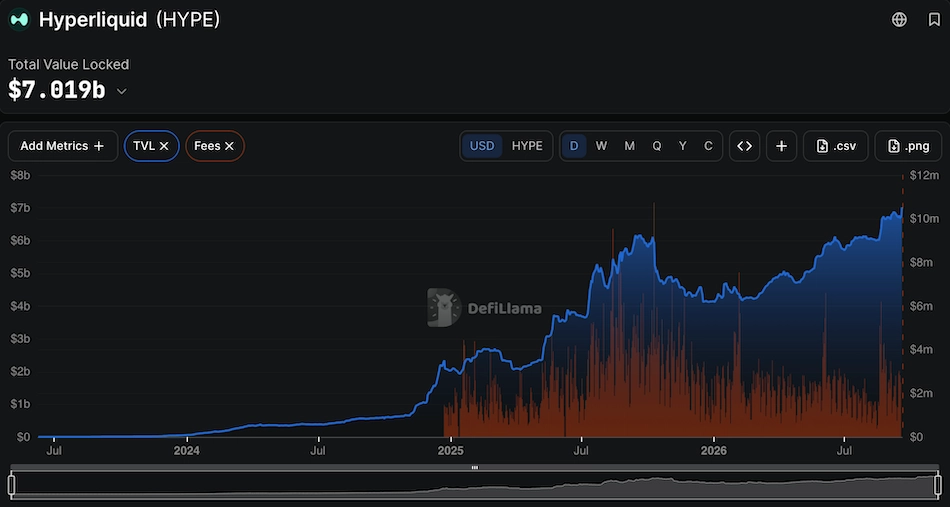
There is a real counterpoint. Since everything settles on-chain, you can check the platform’s solvency yourself, which is more than some failed brokers allowed. DefiLlama showed $7.01 billion locked when I checked. The documentation says fees go to HLP, the assistance fund, and market deployers, not insiders. HYPE tokens the fund buys are permanently burned.
The Incidents That Define The Risk
At the time of writing, no confirmed protocol exploit has occurred. Governance and liquidation events provide more useful lessons.
| Date | Event | Lesson |
|---|---|---|
| March 2025 | A whale forced liquidation of a 160,000 ETH long keeping ~$1.8m while the vault absorbed ~$4m | Mechanics were gameable, BTC cut to 1:40 |
| March 2025 | Validators delisted JELLY and settled it at $0.0095 rather than the $0.50 the oracles were feeding | A small validator set can override the market |
| July 2025 | A 37-minute API outage froze positions, with $1.99m refunded afterwards | Access is a single point of failure |
| October 2025 | ~$19bn liquidated market-wide, $10bn+ here as open interest fell 57% | Cascades are the business model |
| January 2026 | The “Hyperunit whale” realised a ~$250m ETH loss leaving $53 in the account | Size is a liability |
Watch For Fakes
Without KYC or account recovery, phishing is a key risk. Its own support guide makes this clear. It warns that scammers create fake websites, using ‘hyperliguid.xyz’ as an example, and says you should assume anyone who contacts you directly is a scammer. Support is only available by email, X, and through the official Discord ticket channel, never by direct message.
Where The Rules Are Heading
On 29 May 2026, the CFTC approved Kalshi’s Bitcoin perpetual as a futures contract. CME sued in June, arguing a contract with no expiry is a swap, and the CFTC moved to dismiss on 2 September. At the time of initial testing, Hyperliquid is lobbying for a domestic route, seeding the Hyperliquid Policy Center with one million HYPE under Jake Chervinsky and petitioning both agencies. Nothing has changed yet. There is no application, no registration, and the geo-block is still live.
Competitors are on both sides. Polymarket Perps is also unregulated, not available in the US, and does not require KYC. Kalshi, by contrast, is a CFTC-regulated market with segregated funds and identity checks.
| Hyperliquid | OKX | Nexo | |
|---|---|---|---|
| Regulation & Trust Rating | |||
| Regulators | FinCEN, VARA | SEC & CFTC (via Bakkt) | |
| Segregated Client Accounts | No | No | No |
| Negative Balance Protection | No | No | No |
| Visit | Visit | Visit | Visit |
| Review | Review | Review | Review |
Accounts & Banking
Onboarding during testing was fast. I connected Rabby, signed the gasless ‘Enable Trading’ action, and was ready to trade in under five minutes, with no documents or approval wait. There is also an email login option that creates a wallet for you.
Funding Options
| Method | Direction | Fee | Notes |
|---|---|---|---|
| USDC on Arbitrum, Ethereum, Base or Polygon | In & out | Source-chain gas | Arrives as USDC on HyperCore |
| Circle CCTP from other chains | In | Source-chain gas | Needs the native gas token to send |
| BTC, ETH, SOL, AVAX, MON, XPL, ZEC via Unit | In & out | Protocol fee | Sell into a quote asset once credited |
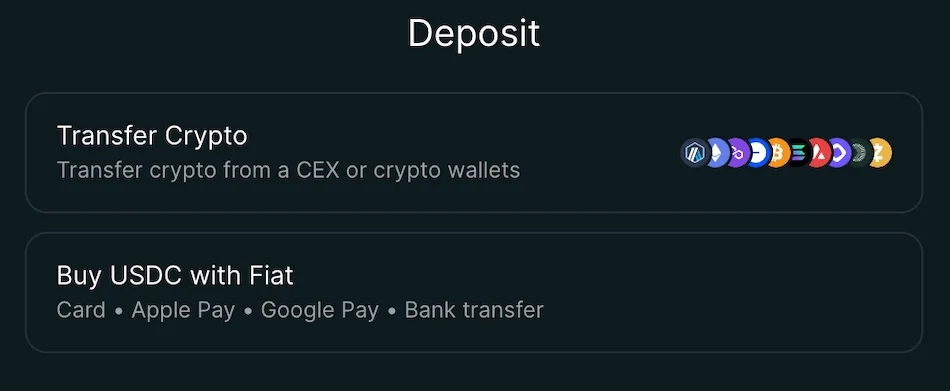
| Card and bank via Swapped.com | In | Swapped’s own fees | Third-party on-ramp, supported in-app |
I ran into two issues. Bridged USDC.e is not the same as native USDC and will not be credited, so my first deposit was stuck until I realized I used the wrong token. The old Arbitrum bridge also drops deposits under 5 USDC, so be careful if you are testing with small amounts. My withdrawal took just over four minutes. The documentation says withdrawal fees depend on the chain and method, not a fixed amount.
You can deposit fiat using a Swapped.com on-ramp built into the deposit screen. This is a third-party service with its own fees and support. Hyperliquid’s documentation sends you to Swapped for any problems. Treat card funding as an external service you access through the app, not as a direct payment to Hyperliquid. You also can’t deposit if you’re in an unsupported country.
| Hyperliquid | OKX | Nexo | |
|---|---|---|---|
| Accounts & Banking Rating | |||
| Payment Methods | Bitcoin Payments, Debit Card, Ethereum Payments, Wire Transfer | Apple Pay, Banxa, Bitcoin Payments, Credit Card, Ethereum Payments, Google Pay, Mastercard, PayPal, Simplex, Visa, Wire Transfer | Apple Pay, Bitcoin Payments, Credit Card, Debit Card, Google Pay, Wire Transfer |
| Minimum Deposit | Varies by asset/network, e.g. 0003 BTC, 0.007 ETH and 0.12 SOL | 10 USDT | $10 |
| Fast Withdrawals | Yes | No | No |
| Demo Account | Yes | Yes | No |
| Visit | Visit | Visit | Visit |
| Review | Review | Review | Review |
Assets & Markets
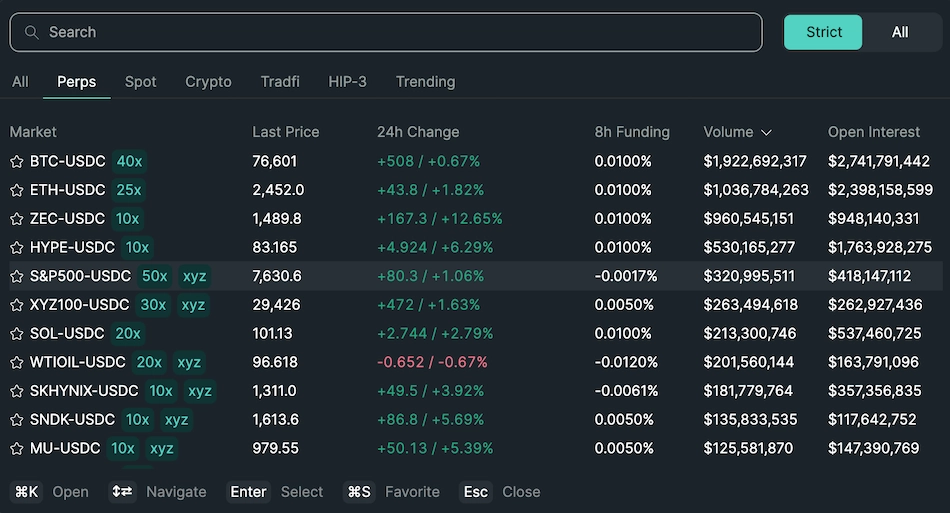
The core exchange had 177 active validator-operated perpetual markets when I checked the API, plus a spot book. Each asset has its own leverage cap, which steps down as position size grows. BTC allows 1:40 up to $150 million and 1:20 above that, ETH 1:25 up to $100 million then 1:15, SOL 1:20 up to $70 million then 1:10, and most smaller markets 1:10, halving to 1:5.
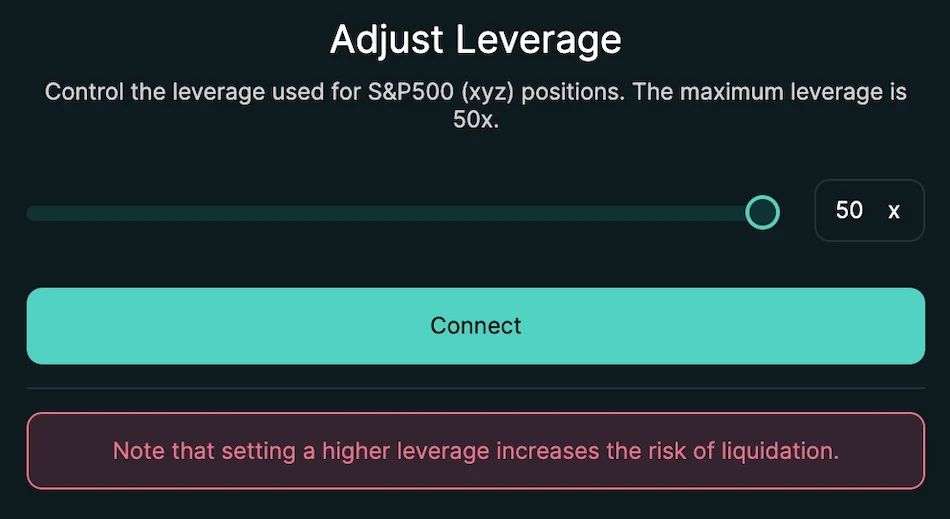
Builder-deployed markets set their own ceilings up to 1:50, and the S&P 500 contract uses the full amount, so the most leveraged market on the platform is an equity index, not Bitcoin.
| Category | Notes for active traders |
|---|---|
| Crypto majors | Deepest books, a $100k order barely moved top of book |
| Long-tail perps | Wider spreads, largest funding dislocations versus CEXs |
| Equity and index perps | HIP-3, trade NVDA earnings or the S&P 500 while cash markets are shut |
| Commodity perps | Gold, silver and oil, benchmarked to COMEX front-month, plus softs like wheat and corn, and other metals like platinum |
| Pre-IPO and outcome markets | SpaceX passed $50m OI before its S-1, HIP-4 settles at 0 or 1 |
Perpetual Futures — And Why Wall Street Is Paying Attention
Perpetuals are leveraged contracts that never expire. They use funding payments between longs and shorts to keep the price close to spot. Because they never expire, there is no roll, a major revenue source for traditional exchanges. CNBC reported in August that regulated perps cut $18 billion from the combined value of CME, Cboe, ICE, and MIAX in two days.
Trailing 30-day volume here was $229bn against $632bn across all on-chain venues, giving 36% of volume and 55% of open interest, with Aster ($68bn) and Lighter ($53bn) the nearest rivals. The structural point is HIP-3, which lets anyone staking 500,000 HYPE deploy a market on the same engine. By late August, 10 builder venues ran 144 markets with $3.78bn open interest. Polymarket Perps lists 67 markets by comparison, and Kalshi 13.
| Hyperliquid | OKX | Nexo | |
|---|---|---|---|
| Assets & Markets Rating | |||
| Trading Instruments | Perpetual Futures, Spot Crypto | Spot, Futures, Swaps, Options, X-Perps | Cryptos, Perpetual Futures |
| Margin Trading | Yes | Yes | Yes |
| Visit | Visit | Visit | Visit |
| Review | Review | Review | Review |
Fees & Costs
Perpetuals start at 0.045% for takers and 0.015% for makers, dropping to 0.024% and zero at tier six if you trade over $7 billion in 14 days. Spot trades start at 0.070% and 0.040%, and count double toward your tier. Staking HYPE gives a 5% discount at 10 tokens, up to 40% at 500,000, and a referral discount applies to your first $25 million.
Active Trading Fee Scenario ($10,000 BTC position, entry tier)
| Trade | Setup | Total fee | Result |
|---|---|---|---|
| Scalp, taker both sides | Market in and out | $9.00 | 0.09% round-trip drag |
| Scalp, maker entry | Post-only in, market out | $6.00 | Drag cut a third for waiting |
| Patient, maker both sides | Post-only in and out | $3.00 | 0.03% round trip |
| Diamond staker, taker both sides | 500,000 HYPE staked | $5.40 | Needs a ~$38m token position |
The staking discount deserves skepticism, since the top tier requires holding 500,000 HYPE with a seven-day unbonding period. For most traders, posting a limit order saves more than climbing the entire volume ladder.
The real cost is carry. Funding is charged every hour, so you can’t avoid it by closing just before the hour. I had to unlearn that habit.
Funding Cost On A $10,000 Position With $1,000 Margin
| Hourly rate | 3-day cost | % of margin |
|---|---|---|
| 0.00125% (fixed interest component) | $9.00 | 0.9% |
| 0.0125% (elevated premium) | $90.00 | 9% |
| 0.05% (stressed) | $360.00 | 36% |
Two things stand out in the above table. The top row is the fixed interest the protocol always charges, equal to the 0.01% per eight hours that CEXs quote. The bottom row matters because Hyperliquid caps funding at 4% per hour, and its documentation makes it clear this is less aggressive than centralized venues, so carry can add up faster here than on the exchange you might be used to.
HIP-3 markets add a deployer surcharge. The fee scale runs from zero to 300%, so an all-in rate several times the base tier is possible, and deployers keep up to half, while growth mode reverses it to between 0.0045% and 0.009%. Polymarket Perps takes 0.04% with the same 4% hourly cap, and Kalshi funds every eight hours.
| Hyperliquid | OKX | Nexo | |
|---|---|---|---|
| Fees & Costs Rating | |||
| Crypto Spread | Variable | Variable | N/A |
| Inactivity Fee | $0 | $0 | |
| Visit | Visit | Visit | Visit |
| Review | Review | Review | Review |
Platforms & Tools
I traded from app.hyperliquid.xyz/trade over several days, mostly BTC and SOL perps plus some HIP-3 equity and commodity contracts.
The layout is a single screen with no page reloads and feels approachable. A thin top bar shows the market selector, mark price, 24-hour change, open interest, and a countdown to the next funding payment.
The chart sits to the left, with the order book on the right, and the order ticket runs down the far right side, with account value and margin usage above it. Tabs underneath cover balances, positions, open orders, TWAP progress, trade history, and funding. For traders coming from a broker, the interface is not the hard part — the concepts are. The screen itself is simpler than a stock MetaTrader setup.
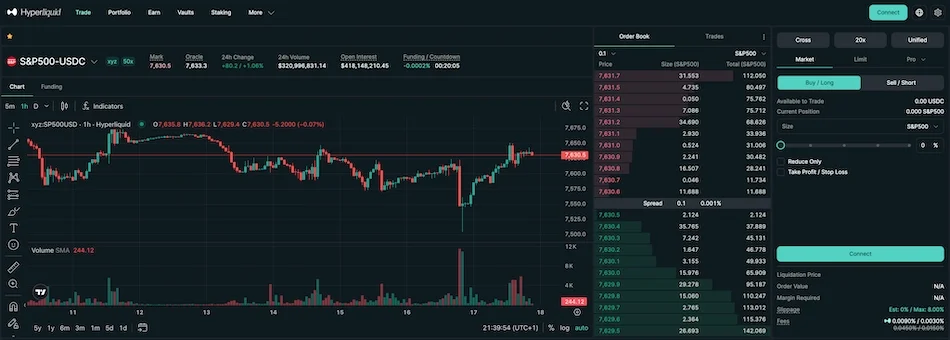
Three things stood out to me while using the platform:
- Leverage is set by the market, not the account: I set 1:20 leverage on BTC, switched to a mid-cap perp, and the ticket showed a leverage I hadn’t chosen for that market, almost opening a position three times bigger than I meant. There is no warning.
- Cancels and re-quotes are free: One morning, I moved a BTC limit order 14 times as the book shifted and paid nothing. On an EVM-based DEX, each move would be a gas transaction. Here, patient maker execution becomes the default.
- The mark price can catch people off guard: Triggers and liquidations use a mark built from a median of external feeds plus Hyperliquid’s own mid, not the last trade on your chart. I placed a stop just under a visible wick low, and it filled before the price printed there. This is different from a broker platform, where the stop tracks your feed.
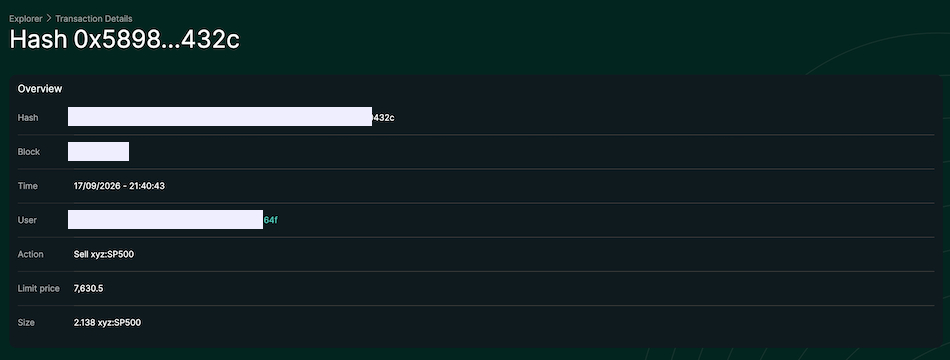
Order types exceeded my expectations. If you flag a limit as Add Liquidity Only, it gets rejected outright instead of quietly converting to a taker fill. TWAP slicing is built into the ticket, and scale orders let you build a ladder in one step. HIP-3 markets have separate books with a deployer prefix on the ticker. When I traded one around 02:00 GMT, an order that would barely move BTC shifted the price several ticks. The platform is open 24/7, but liquidity is not always there around the clock.
Sub-accounts share the master fee tier, though vault volume counts separately and won’t help you climb. The API offers REST and WebSocket endpoints, official Python, Rust, and TypeScript SDKs, and CCXT support, with a minimum order around $10 notional. Charting runs on a TradingView library integration, so the indicators and drawing tools are all there, but there is no account sync for saved layouts or alerts.
| Hyperliquid | OKX | Nexo | |
|---|---|---|---|
| Platforms & Tools Rating | |||
| Platforms | Hyperliquid Web App | AlgoTrader, Quantower | Nexo Pro |
| Mobile App | Android | Android & iOS | iOS & Android |
| Automated Trading | REST and WebSocket API interfaces + Python SDK | Yes | |
| Visit | Visit | Visit | Visit |
| Review | Review | Review | Review |
Mobile App
The Android app is a full trading client, not the cut-down companion its early release notes suggested. I placed orders, managed positions, and switched markets from the phone without opening the Web app once.
The ticket matches desktop, with three dropdowns across the top for order type, margin mode, and leverage, Buy/Long and Sell/Short tabs above a size field that switches between the base asset and USDC, and a percentage slider for sizing off available balance.
Reduce Only and TP/SL sit underneath as checkboxes, and ticking the latter opens paired fields taking either a price or a percentage move. I set a take profit at 77,016, and a stop at 76,250 on a BTC ticket, and both carried into the order, with liquidation price, order value, and margin required updating live below.
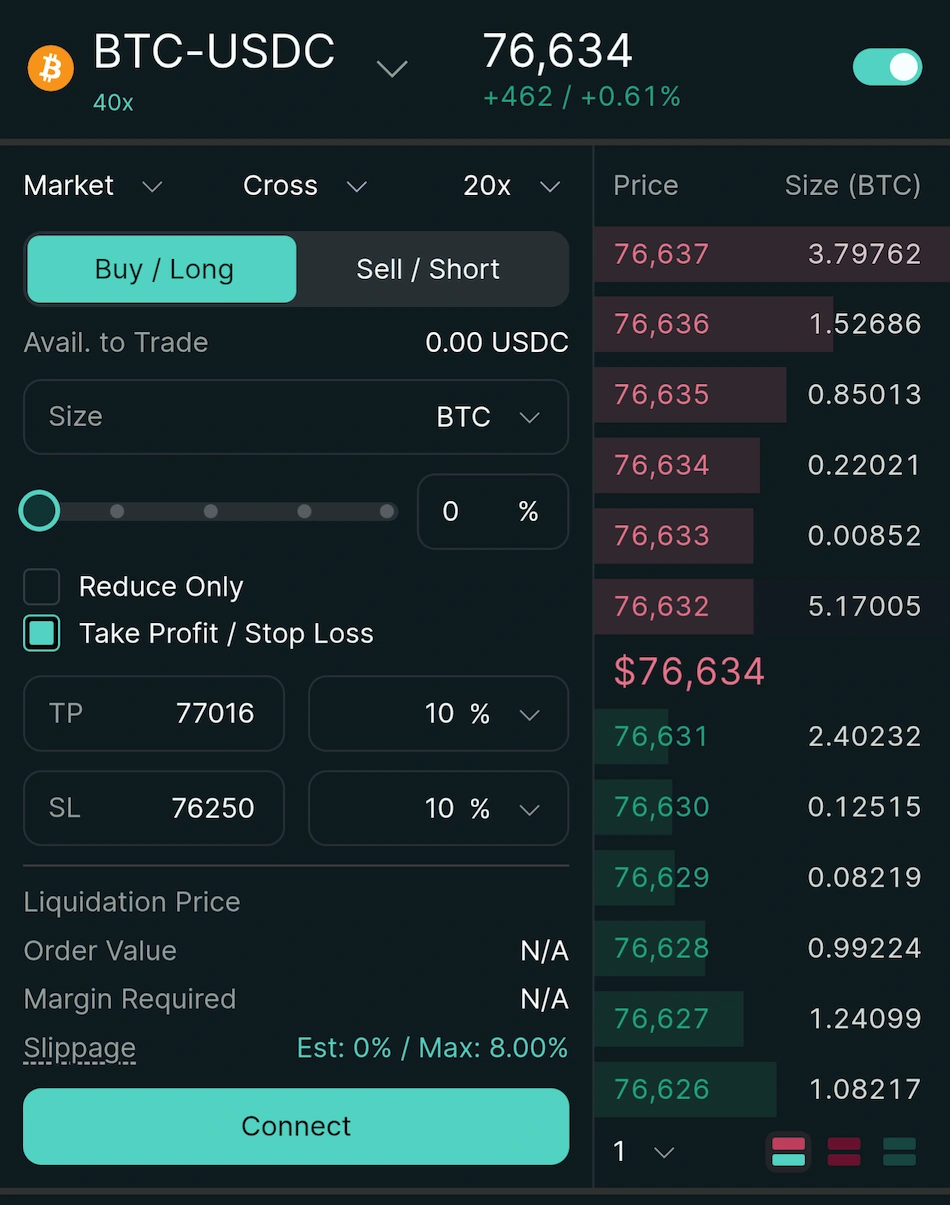
However, one default setting needs attention. Market orders come with maximum slippage set to 8%, which is high enough to be risky on a thin book. I tightened it before trading anything outside the major markets.
Credit to Hyperliquid for risk disclosure. When I opened WTIOIL-USDC, a banner named xyz as the independent deployer appeared, linked to its documentation, and warned about low liquidity, high volatility, and increased liquidation risk. No CFD broker I’ve tested flags a thin instrument that clearly.
On iPhone, you still use a third-party front end, and Hyperliquid’s onboarding page points to Based, Dexari, MetaMask, and Phantom. That convenience comes at a price, since MetaMask charges a flat 0.1% builder fee, costing $10 per side on a $10,000 position, compared to Hyperliquid’s $4.50.
Research
There is no research desk, analyst coverage, news feed, or economic calendar. Hyperliquid gives you a market and expects you to have your own view.
Instead, it offers positional transparency. Every position, liquidation price, and vault balance is visible on-chain through Hyperdash, Hypurrscan, and Arkham. This goes both ways—I could see where leverage was stacked before a catalyst, but my own liquidation level was just as visible to everyone else.
| Hyperliquid | OKX | Nexo | |
|---|---|---|---|
| Research Rating | |||
| Visit | Visit | Visit | Visit |
| Review | Review | Review | Review |
Education
The documentation is precise and unusually open. The fee page shows the full tier grid, including the developer formula, and the margin pages give the actual math.
What’s missing is anything for beginners. There is no primer on what funding does to a three-day hold, and no explanation of why the mark price differs from the last trade—the exact lesson that cost me a stop. That’s a real gap for a venue offering 40x leverage to anyone with a wallet.
| Hyperliquid | OKX | Nexo | |
|---|---|---|---|
| Education Rating | |||
| Visit | Visit | Visit | Visit |
| Review | Review | Review | Review |
Customer Support
Support is better than the platform’s reputation suggests, but still thin. There is a ticketing system through the Discord open-ticket channel or a Zendesk form, with replies aimed within 48 hours, though I found it can take longer on weekends.
The written support guide covers failed deposits on every supported network, missing withdrawals, why a liquidation happened, and TP/SL orders that did not work as expected.
But you won’t get anyone quickly. When my USDC.e deposit failed to credit, I figured it out using the documentation and a block explorer instead of waiting two days. It works for traders who read documentation, but isn’t ideal for anyone expecting a broker to step in.
| Channel | Available? | What it is |
|---|---|---|
| Live chat | No | Does not exist for the exchange itself |
| Phone | No | Does not exist |
| Email ticket | Yes | A Zendesk form that cannot accept files or images |
| Discord ticket | Yes | The “open-ticket” channel, the primary route |
| X and Telegram | Yes | Announcements and incident updates |
| Status page | Yes | Frontend, API and L1 components |
| Hyperliquid | OKX | Nexo | |
|---|---|---|---|
| Support Rating | |||
| Visit | Visit | Visit | Visit |
| Review | Review | Review | Review |
Community Sentiment
There is limited Trustpilot presence worth analyzing at the time of initial testing, though the modest collection of user reviews are negative, citing withdrawal issues and suspicious token listings, amongst other problems.
There’s also no iOS listing, so I looked more at the on-chain community instead of counting stars. Praise is specific, focusing on execution that matches mid-tier centralized exchanges, fee transparency, and a token model where fees buy and burn supply. Market makers rate the book, which matches the depth I saw.
Most criticism focuses on validator centralization, with the JELLY delisting cited as proof the protocol steps in when its vault is at risk. Auto-deleveraging is another issue, and co-founder Jeff Yan defended it against claims that it shifts losses onto liquidity providers. The third concern is the house vault, which dropped from about $269 million in June 2026 to around $184 million. Nobody accuses Hyperliquid of hiding anything.
Is Hyperliquid Good For Active Traders?
For some traders, it could be. If you run systematic strategies, arbitrage funding against centralized venues, or want to trade commodities and equity perps on a weekend, not many platforms offer this depth and cost base — and you keep your keys.
But for everyone else, the case is weaker than the volume suggests. You get no regulatory protection, little support, and a funding drag that can take 9% of your margin in three days, all to save a few basis points on entry. It remains too new, too unproven, too unregulated to be a viable option for most retail investors. Instead, stick to a top-rated broker with perpetual futures.
FAQ
Is Hyperliquid Legit Or A Scam?
It’s a real venue with verifiable on-chain volume, no confirmed exploits, and public post-mortems. But it is unregulated and uninsured, which makes it high risk.
Is Hyperliquid Available In The US?
No. Section 1.6 of the Terms names US and Ontario persons, entities, and citizens of sanctioned territories as Restricted Persons, and the front end blocks US IP addresses. The restriction sits at the interface rather than in the protocol, which is permissionless, but the Terms also prohibit using a VPN to get around it. Nothing has been filed publicly toward a compliant route.
What Leverage And Fees Does Hyperliquid Offer?
You can get up to 1:40 leverage on BTC, 1:25 on ETH, 1:20 on SOL, and 1:10 on most smaller markets, with leverage stepping down as your position size grows. Some builder-deployed contracts go up to 1:50. Fees start at 0.045% for takers and 0.015% for makers, dropping with higher volume and staking. Hourly funding is capped at 4%. Trading does not cost any gas.
Can I Trade Stocks On Hyperliquid?
Yes, but as perpetuals rather than shares. HIP-3 covers US equities, commodities, indices, and pre-IPO names, 24/7, with no KYC required.
Hyperliquid vs Polymarket vs Kalshi For Perps?
They suit different traders. Hyperliquid has the deepest books and widest range but no oversight. Polymarket Perps, live since September 2026, is the closest match with 67 markets and 1:20 leverage, and it also blocks the US. Kalshi is the only CFTC-regulated option, but its handful of crypto perps are US-only.
What Happens If Hyperliquid Fails?
There is no compensation scheme and no regulator. Your outcome rests on what validators decide and what the Hyper Foundation chooses to pay. JELLY holders were made whole in 2025, reimbursed as though their positions had closed at the real market price, but that was a discretionary gesture, not an entitlement anyone could have enforced.
This review of Hyperliquid covers an unregulated, leveraged product unavailable in the US, Ontario, and sanctioned territories. It is general information, not trading or legal advice.
Best Alternatives to Hyperliquid
Compare Hyperliquid with the best similar brokers that accept traders from your location.
- OKX – OKX is a respected cryptocurrency firm, established in 2017, that offers a large suite of products, from trading to NFTs. Traders can access over 400 crypto tokens via OTC trading and derivatives. With an excellent web platform, developer tools and dynamic charts, OKX is a popular choice for technical traders.
- Nexo – Nexo is a centralized crypto exchange founded in 2018 in Bulgaria and today operates across some 200 jurisdictions from its base in Switzerland. It provides services including spot trading, futures trading, cold wallet storage and fiat-on ramps to buy crypto tokens. The crypto firm is registered with some respected financial authorities, such as the ASIC, and offers some fairly unique additional services including a credit card.
Hyperliquid Comparison Table
| Hyperliquid | OKX | Nexo | |
|---|---|---|---|
| Rating | 2.3 | 4.1 | 3.9 |
| Markets | Perpetual Futures, Spot Crypto | Spot, Futures, Swaps, Options, X-Perps | Cryptos, Perpetual Futures |
| Demo Account | Yes | Yes | No |
| Minimum Deposit | Varies by asset/network, e.g. 0003 BTC, 0.007 ETH and 0.12 SOL | 10 USDT | $10 |
| Minimum Trade | ~$10 | Variable | $30 |
| Regulators | – | FinCEN, VARA | SEC & CFTC (via Bakkt) |
| Bonus | – | $10 in BTC | Loyalty scheme with various bonuses, plus referral program and bonus paid to lenders on credit line |
| Platforms | Hyperliquid Web App | AlgoTrader, Quantower | Nexo Pro |
| Leverage | – | – | – |
| Payment Methods | 4 | 11 | 6 |
| Visit | – | Visit | Visit |
| Review | – | OKX Review |
Nexo Review |
Compare Trading Instruments
Compare the markets and instruments offered by Hyperliquid and its competitors. Please note, some markets may only be available via CFDs or other derivatives.
| Hyperliquid | OKX | Nexo | |
|---|---|---|---|
| CFD | No | No | No |
| Forex | No | No | No |
| Stocks | Yes | No | No |
| Commodities | Yes | No | No |
| Oil | Yes | No | No |
| Gold | Yes | No | No |
| Copper | Yes | No | No |
| Silver | Yes | No | No |
| Corn | Yes | No | No |
| Crypto | Yes | Yes | Yes |
| Futures | No | No | Yes |
| Options | No | No | No |
| ETFs | No | No | No |
| Bonds | No | No | No |
| Warrants | No | No | No |
| Spreadbetting | No | No | No |
| Volatility Index | No | No | No |
Hyperliquid vs Other Brokers
Compare Hyperliquid with any other broker by selecting the other broker below.
Customer Reviews
There are no customer reviews of Hyperliquid yet, will you be the first to help fellow traders decide if they should trade with Hyperliquid or not?