
Perpetual Futures



Perpetual futures have changed derivatives trading by offering a futures-like contract without an expiration date. This avoids the hassle of “rolling” contracts forward to keep the position open.
Originally popularized in crypto markets, they provide traders continuous exposure to price movements while using a funding rate mechanism to maintain price alignment with the underlying asset.
The growing adoption of perpetual futures (“perps”) is changing how traders hedge risk and speculate in markets.
Key Takeaways – Perpetual Futures
- No Expiry, Continuous Exposure – Perpetual futures let traders hold positions indefinitely. This eliminates the need to roll over contracts like traditional futures. This provides uninterrupted exposure to price movements and market trends.
- Funding Rates Control Price Alignment – A periodic funding rate payment between long and short positions keeps the contract price in line with the underlying asset. Traders must account for these costs (essentially like positive/negative carry), as they steadily erode capital over time.
- High Leverage, High Risk – Perpetual futures may offer leverage up to 125x in some cases. Mismanagement can be very easy and can lead to liquidation.
- Popular for Speculation and Hedging – Traders use perpetual futures to bet on price swings, hedge against volatility, or exploit arbitrage opportunities.
- Once you understand how perps work, see our full guide to the best brokers for perpetual futures, where we rank providers based on hands-on tests of their perp contracts, fees, funding rates and liquidity.
- We have a glossary of terms commonly used in the Appendix to this article.
Best Brokers For Perpetual Futures




List of top brokers for trading perpetual futures contracts
What Are Perpetual Futures?
Definition and Basic Mechanics
Perpetual futures are a type of derivative contract that mimics traditional futures but with one critical difference: no expiration date.
Unlike standard futures, which settle weekly, monthly (e.g., oil), bi-monthly (e.g., gold), or quarterly (e.g., major stock indexes), perpetual futures allow traders to hold positions indefinitely.
This “perpetual” structure means you can speculate on price movements or hedge risks without worrying about rolling over contracts.
The price of a perpetual future is designed to track the underlying asset’s spot price, anchored by a mechanism called the funding rate (more on that later).
Origins in Crypto Markets
Perpetual futures were popularized by crypto exchanges like BitMEX in 2016 as a way to attract traders who wanted 24/7 markets without expiry hassles.
Bitcoin’s XBTUSD contract became the blueprint. It combined leverage, no expiry, and a funding system to maintain price alignment.
Today, perpetuals are common in crypto trading and they take up over 70% of derivatives volume on platforms like Binance and Bybit.
Key Features of Perpetual Futures
No Expiry Date: Freedom to Hold or Flip
The absence of an expiration date means you don’t need to close and reopen positions periodically.
For example, a trader bullish on Ethereum can hold a long position for weeks, months, or even years, provided they manage margin requirements.
All futures traders know the feeling of having to roll contracts in volatile markets where timing exits is tricky and P/L may be affected simply due to switching contracts.
Funding Mechanism: The Invisible Hand
Perpetual futures use a funding rate – a periodic payment between long and short positions (usually every 8 hours) – to tether the contract price to the underlying asset’s spot price.
If the perpetual trades above the spot price, longs pay shorts.
If below, shorts pay longs.
This creates arbitrage incentives, so the derivative doesn’t drift too far from its benchmark.
Leverage and Margin: Double-Edged Sword
Exchanges may offer leverage up to 125x, letting traders amplify gains (or losses).
Margin requirements act as collateral: a 10x leverage trade requires 10% margin.
Naturally, high leverage increases liquidation risk. If your position loses value beyond the maintenance margin, the exchange will bust your trade automatically.
How Funding Rates Work
Purpose of Funding Rates: Price Stability
Imagine funding rates as a thermostat.
When perpetual prices overheat (i.e., trade above spot), the funding rate incentivizes shorts by making longs pay them, cooling demand.
Conversely, if prices lag, shorts compensate longs, heating up buying activity.
This balance prevents wild deviations from the spot market.
Calculating Funding Payments
Funding rates are calculated using two components:
- Interest Rate Differential – A base rate (often tied to fiat currencies like USD).
- Premium/Discount – The gap between the perpetual’s price and the spot price.
For example, if Bitcoin’s perpetual trades at 62,000 while the spot is 60,000, the premium is 3.3%.
If the funding interval is 8 hours, longs might pay shorts a 0.05% fee.
Impact on Trading Strategies
Funding rates influence behavior:
- Positive rates (longs pay shorts) = Signal bullish sentiment; traders may short to “earn” fees.
- Negative rates (shorts pay longs) = Indicate bearishness; longs receive payments.
Traders factor these in and don’t just focus on nominal price movements.
The Hidden Cost Of Holding: A 30-Day Funding Example
The word “perpetual” makes these contracts sound free to hold for as long as you like. But it’s a bit different in practice.
The funding rate is a running cost (or income) that lands every 8 hours, and over weeks it adds up.
Say you go long $10,000 of notional on a Bitcoin perp. Funding is paid three times a day. Here’s what 30 days costs at a normal rate versus a hot bull-market rate:
| Funding per 8h | Per day (x3) | Over 30 days | Cost on a $10k position |
|---|---|---|---|
| 0.01% (normal) | 0.03% | 0.9% | $90 |
| 0.05% (hot market) | 0.15% | 4.5% | $450 |
Some important nuance to understand…
If you opened that $10,000 position with 10x leverage, you only put up $1,000 in margin.
A $450 funding bill at the hot rate is 45% of your margin gone, before the price has moved. If Bitcoin trades flat for the month, you’re down $450 on funding alone, and the price has to climb about 4.5% just to get you back to break-even.
Funding can also work in your favor. If you’re long while funding is negative, shorts pay you. So check the current rate and the next funding time before you hold a position, not after. This running cost is one reason perps fit short-term trading far better than long-term holding.
Otherwise you may need very high rates of return as a basic hurdle rate that aren’t realistic with enough time.
Centralized vs Decentralized Perps (CeFi vs DeFi)
You can trade perpetual futures on two very different types of venue.
The difference changes who holds your money, how prices are set, and what can go wrong.
Centralized exchanges (CeFi)
Binance, Bybit, OKX, Kraken, Coinbase, and Nexo are centralized. The exchange runs a central order book that matches buyers and sellers, holds your collateral, and operates the matching and liquidation engines.
You usually have to pass identity checks (KYC). The trade-offs are familiar: deep liquidity and fast execution on major pairs, but you hand custody of your funds to the platform.
If it fails, your money is at risk. FTX is the obvious example, where customers lost access to billions when the exchange collapsed in 2022.
Decentralized exchanges (DeFi)
On a decentralized perp venue you keep custody of your funds, trades settle through smart contracts on a blockchain, and many platforms skip KYC.
In return, you take on different risks – smart-contract bugs, oracle failures (bad price feeds), and chain downtime.
DeFi perps don’t all work the same way.
There are three main models, and it’s worth knowing the difference because the popular shorthand that “decentralized exchanges use virtual automated market makers (vAMMs) instead of order books”* isn’t accurate.
*(In other words, this means that instead of matching buyers and sellers through a list of bids and asks, the exchange uses a formula-based system to simulate liquidity and set prices automatically.)
On-chain order book (CLOB)
This works like a centralized exchange. It matches real buy and sell orders, but on-chain or through a decentralized validator set.
Hyperliquid runs this model on its own purpose-built chain and is now the largest perp DEX, handling roughly a third of all DEX perpetual volume in 2026. dYdX moved to its own Cosmos-based chain (v4) that runs a decentralized order book with 60-plus validators.
So dYdX, far from avoiding order books, is the best-known example of a DEX that deliberately uses one.
Liquidity pool (pooled-counterparty) model
Here you trade against a shared pool of assets supplied by liquidity providers. Prices come from external oracles rather than a book. GMX uses this approach.
In GMX v2, liquidity providers deposit into GM pools, earn trading fees, and take the other side of trader positions.
There’s no order book and no order matching. This keeps it simple, but large trades can move the pool and liquidity providers absorb trader profits and losses.
Virtual Automated Market Maker (vAMM)
A vAMM borrows the constant-product formula (x * y = k) from spot AMMs like Uniswap, but holds no real assets in the curve.
It’s a pricing formula only. Your actual collateral sits in a separate vault, and the vAMM just sets the price and moves it as people buy or sell.
Perpetual Protocol pioneered this design. Drift, on Solana, uses a vAMM as a backstop behind its order book, so limit orders fill on the book when liquidity is there. And the vAMM guarantees execution when it isn’t.
For a trader, the practical points are liquidity, cost, and custody. The deepest books, on big centralized venues and on Hyperliquid, give you the tightest spreads and least slippage. Pooled and vAMM models can cost you more slippage on large orders.
Self-custody removes the risk of an exchange going under, but adds smart-contract and oracle risk that a centralized account doesn’t carry. There’s no single best venue type, only the one that fits how much you trade and how much custody risk you’ll accept.
This can all be a bit dense if you’re new to perpetual futures, so below we organize it.
| Venue type | How it works | Main benefit | Main risk | Examples |
|---|---|---|---|---|
| Centralized exchange (CeFi) | Uses a central order book and holds customer collateral. | Deep liquidity, fast execution. | Custody risk if the exchange fails. | Binance, Bybit, OKX, Kraken, Coinbase |
| On-chain order book DEX | Matches real buy and sell orders on-chain or through validators. | Order-book trading with self-custody. | Smart-contract, oracle, and chain risk. | Hyperliquid, dYdX |
| Liquidity pool DEX | Traders trade against a shared pool of assets. | No traditional order book needed. | Pool losses, slippage, and oracle risk. | GMX |
| Virtual automated market maker DEX | Uses a pricing formula rather than real order matching. | Can provide execution when liquidity is thin. | Model risk and higher slippage on large trades. | Perpetual Protocol, Drift |
Use Cases for Perpetual Futures
Speculation: Betting on Price Swings
A trader anticipating a Bitcoin rally can go long with 10x leverage to magnify gains.
Conversely, if they predict a fall or want to use it as a hedge, they short the perpetual.
The lack of expiry lets them ride trends without time pressure.
Hedging: Insuring Against Volatility
Imagine a Bitcoin miner worried about falling prices.
They can short Bitcoin perpetuals to lock in current prices, offsetting potential losses from their mined BTC.
This mirrors how farmers hedge crop prices with futures.
Arbitrage Opportunities: Exploit Price Gaps
If Ethereum’s perpetual trades at a $50 premium to spot, arbitrageurs can:
- Short the perpetual
- Buy Ethereum spot
- Profit as the funding mechanism narrows the gap
How To Trade Perpetual Futures: A Step-By-Step Walkthrough
The first time through, use a demo (paper) account so you can practice the full process with no money at risk.
Here’s a perp trade:
1. Open and fund the account (deposit collateral)
Choose a regulated, well-tested broker, then deposit funds.
Check which collateral the platform accepts, USDT and USDC are common, and some let you post BTC or ETH.
I use Interactive Brokers most of the time and it accepts standard currency while also providing Bitcoin perpetual futures.
If the platform offers a demo account, run a few practice trades here before risking real funds.
2. Find the perpetuals section
Look for “Perpetuals” or “Perps”; some platforms label them “Crypto Futures” instead, and the derivatives area is separate from the spot buying section.
Also use your broker’s search box if that’s the best navigation feature, as it is with many brokers.
If you type in “Bitcoin” you can see the range of products.
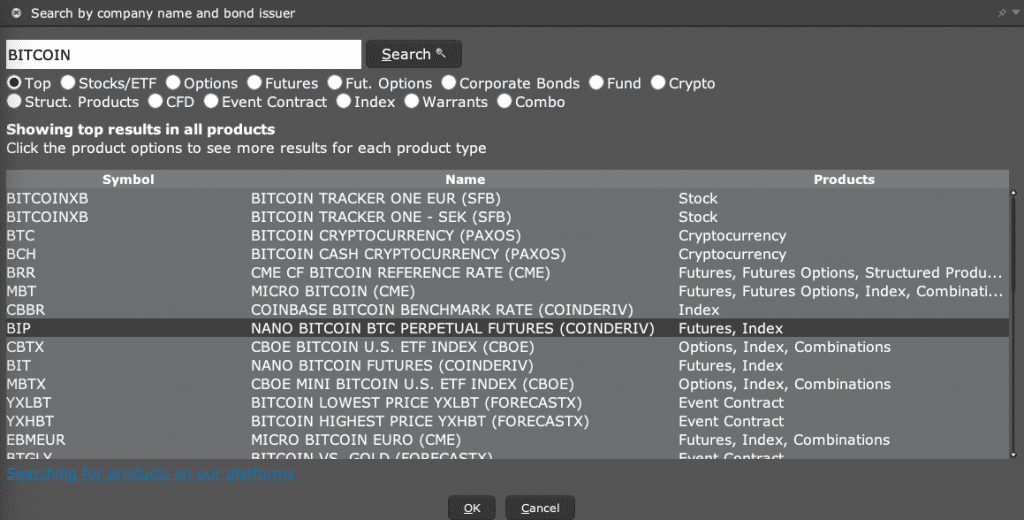
3. Choose your contract and read the key numbers
Pick a contract, for example the BIP perpetual, and open the contract.
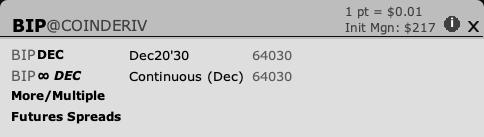
Then look at the chart and order book.
Before anything else, note the current funding rate, the next funding time, the mark price (not just the last traded price), and the leverage on offer.
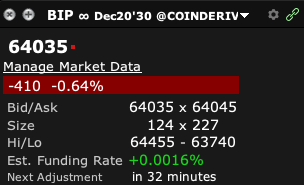
All brokers’ information will be a bit different.
4. Set your margin mode and leverage
Some brokers have more customizability features. If so, choose isolated margin to cap your risk on this single trade, which is the safer default for beginners.
Set a modest leverage, say 2x to 5x rather than 100x. As you change the leverage, the platform updates your liquidation price, so you can see how close to the current price a forced exit would sit.
5. Size the position and set your exits before you enter
Work out your position size so that hitting your stop-loss only risks a small slice of your account, generally around 1% to 2% as is standard practice. Attach a stop-loss and a take-profit.
Use a limit order to control your entry price, or a market order if you need speed (but you give up control of your entry price).

6. Place the trade and confirm it’s open
After you submit, check the open positions or order history panel, usually along the bottom of the screen. Confirm your entry price, size, leverage and liquidation price match what you intended.
If it’s a limit order you’ll find it in queue.

7. Monitor the position
Watch the market price against your liquidation price, and watch funding tick in or out every 8 hours.
8. Close the trade (exit and settlement)
There’s no expiry, so you close manually. Hit close with a market or limit order, or let your stop-loss or take-profit trigger automatically. Your profit or loss settles in your collateral currency. On most platforms you can close in a single tap.
Risks and Challenges
Funding Rate Risk: The Silent Cost
While funding payments seem small (0.01-0.1% per interval), they compound.
Holding a long position during prolonged positive funding can erode profits – like a “hidden fee” for bullish bets.
Liquidation and Leverage Dangers
A 100x leveraged position can liquidate with just a 1% price move against you.
In March 2020, Bitcoin’s 50% crash in 48 hours wiped out $1 billion in perpetual positions.
Always use stop-losses or options (which can be more reliable) and avoid over-leveraging.
The Cascading Liquidation Reality Check
Liquidations chain together, and that chain is the mechanical reason prices can fall 15% quickly when it seems like the fundamental picture has barely moved.
In terms of how it goes:
- When your margin drops below maintenance, the exchange’s liquidation engine market-sells your position to close it.
- That forced sell pushes the price down.
- The lower price drops the next over-leveraged long below their maintenance margin, so they get liquidated too, which means more forced selling, which pushes the price down again. In short you have a feedback loop that continues to feed on itself.
- In a thin order book, each forced sale moves the price further, so the loop speeds up. Stop-losses clustered at round numbers, like $60,000 for Bitcoin, pile more selling onto the same levels.
The clearest recent example is October 10-11, 2025, the largest liquidation event in crypto history.
Around $19 billion in leveraged positions were force-sold in 24 hours, hitting roughly 1.6 million traders.
The trigger was a surprise US announcement of 100% tariffs on Chinese imports. This landed during low-liquidity Asian trading hours, with open interest sitting near record highs. As such, there was an unusual amount of leverage waiting to unwind.
About $7 billion was liquidated in the first hour alone. Longs took the bulk of the damage, roughly $16.7 billion against a much smaller short figure, because most traders were naturally betting on higher prices (i.e., the natural holdings of most markets).
Order books thinned out so badly that Bitcoin traded around $10,000 (about 9%) higher on Kraken than on Coinbase at one point, since each venue’s book had collapsed to a different level. Bitcoin fell from about $122,000 to near $105,000 in hours.
The lesson has to do with the structure of markets. When you overleverage without protecting your downside, it can get bad quickly. Modest leverage, a real stop-loss, and a liquidation price well away from the current price keep you out of the chain of dominoes.
Also note that during these events even a correct directional bet can hurt, because a) the market price can wick through your liquidation level, or b) auto-deleveraging can close part of a winning position.
Market Volatility: Friend and Foe
Volatility creates profit opportunities, but it also heightens liquidation risks.
A sudden 10% flash crash (common in crypto) can obliterate highly leveraged trades.
Counterparty and Platform Risks
Centralized exchanges hold your funds. This exposes you to hacks (e.g., Mt. Gox) or insolvency (e.g., FTX).
Decentralized platforms reduce this risk but may lack liquidity.
Who Perpetual Futures Suit, And Who Should Avoid Them
Perpetual futures fit some traders well and are a poor choice for others.
They suit:
- Active short-term traders (including scalpers and day traders). This is the natural fit for perps. There’s no expiry to roll, liquidity on majors like BTC and ETH lets you get in and out fast, and you can go long or short with one instrument. Over a few hours the funding cost barely registers, so the running cost that punishes long holders is a non-issue for intraday trades who are generally taking advantage of larger intraday swings.
- Swing traders who watch funding. You can hold for days, but you need to track the funding bill (see the 30-day example above) so it doesn’t quietly eat your gains.
- Hedgers. A miner or a longer-term holder can short a perp to offset spot exposure and lock in a price (similar to how futures are used in other business models).
- Experienced traders with strict risk rules. Modest leverage, fixed position sizing, and a stop-loss on every trade.
They don’t suit:
- Beginners looking for high leverage with no stop-loss or downside protection. A 100x position liquidates on a 1% move against you. Start on a demo account and keep leverage low. Even a 10% move, which can easily happen over one or a few days will be devastating at 10x leverage.
- Long-term, buy-and-hold investors. Funding makes holding for months expensive, and leverage adds a liquidation risk a spot holder never faces. If you just want two-year exposure to Bitcoin, buy it on the spot market.
- Anyone trading money they can’t afford to lose, or who can’t watch positions during volatile sessions.
- Traders who want simple, regulated products. Retail access to high-leverage crypto perps is restricted or banned in several places. In the UK, the FCA still bans the sale of crypto derivatives, including perpetuals, to retail consumers. Crypto Exchange-Traded Notes (cETNs) on recognized exchanges (like the London Stock Exchange) are now allowed, but these are tightly controlled, fully backed, non-leveraged instruments. The EU caps leverage on many products. In the US, access is limited and runs mainly through CFTC-regulated venues. Be sure to check the rules where you live before you start.
- More casual traders not up to speed on understanding funding, margin, liquidation, and platform risk. Perps may look like basic price bets, but they behave quite differently than buying spot crypto. The leverage and recurring funding payments are important to grasp.
Ultimately, whether perps are right for you depends on your experience, your goals and your tolerance for risk.
Trading Strategies for Perpetual Futures
Scalping and Day Trading: Quick Profits
Scalpers try to take advantage tiny price movements, opening and closing positions within minutes typically.
For example, using 50x leverage to capture a 0.5% move yields a 25% profit.
Transaction fees and funding costs nonetheless add up.
Swing Trading: Riding Medium-Term Trends
Swing traders hold positions for days or weeks, usually using technical patterns.
A breakout above a key resistance level might signal momentum to this trading style and trigger a leveraged long.
Carry Trade with Funding Rates
If funding rates are negative (shorts pay longs), traders can go long to earn passive income.
This works best in sideways markets where price risk has been low.
Perpetual Futures vs. Traditional Futures
Here’s how perpetual futures sit against spot trading and traditional futures at a glance:
| Feature | Spot Trading | Traditional Futures | Perpetual Futures |
|---|---|---|---|
| Expiry date | None | Fixed (weekly, monthly, quarterly) | None |
| Rollover needed | No | Yes, before each expiry | No |
| Leverage | Usually none (1x) | Yes, set by the exchange | Yes, up to ~100x, historically 125x on some venues |
| Ongoing holding cost | None | None (priced into the contract via basis) | Funding paid or received, usually every 8h |
| What keeps price in line | It is the market price | Basis converges to spot at expiry | The funding rate |
| Go short easily | Hard (need to borrow) | Yes | Yes |
| Own the underlying asset | Yes | No | No |
| Where you trade | Exchanges and brokers | Regulated futures exchanges (e.g. CME) | Crypto exchanges and a growing number of brokers |
| Best suited for | Long-term holders and investors | Hedgers, institutions, defined-horizon bets | Active and short-term traders, hedging, going short |
| Main risks | Price falls | Price moves, expiry timing | Liquidation from leverage, funding drag, platform risk |
Expiry Dates and Settlement
Traditional futures expire monthly, bi-monthly, quarterly, or another regular interval.
This forces traders to “roll” contracts (close and reopen), incurring fees and slippage.
Perpetuals avoid this and give you uninterrupted exposure.
Funding Rate vs. Basis
In futures, the “basis” (futures-spot gap) naturally converges at expiry.
Perpetuals replicate this via funding rates, creating a synthetic expiration.
Market Accessibility and Liquidity
Perpetuals are popular in crypto due to 24/7 trading and high leverage.
Traditional futures thrive in regulated markets (e.g., CME’s Bitcoin futures) but cater to institutional traders.
The Future of Perpetual Futures
Adoption Beyond Crypto
Perpetuals are expanding into forex and commodities.
Platforms like FTX (pre-bankruptcy) offered tokenized stock perpetuals, which hinted at broader potential.
That broader potential is now a reality. A variety of platforms launched pre-IPO and tokenized equity-linked perpetuals, much of it driven by speculation around high-profile listings such as SpaceX, with exchanges like Kraken, Bybit, OKX, Coinbase and Crypto.com adding contracts.
We cover which providers offer these, and how they performed in our tests, in our best brokers for perpetual futures guide.
Regulatory Considerations
Governments are scrutinizing crypto derivatives.
The EU’s MiCA framework may impose leverage caps, while the US CFTC targets unregistered platforms.
Regulation could curb risks but limit accessibility.
Technological Innovations
Decentralized exchanges (e.g., dYdX) are automating perpetuals via smart contracts. This reduces reliance on centralized entities.
Cross-margin systems and new risk monitoring/management systems are also emerging.
FAQs – Perpetual Futures
What is a perpetual futures contract in simple terms?
It’s a contract that tracks the price of an asset like Bitcoin and lets you bet on that price going up or down, with leverage, and with no expiry date (unlike traditional futures that come with an expiration date).
You can hold it for as long as you keep enough collateral in your account.
How is a perpetual future different from buying the actual cryptocurrency?
When you buy spot, you own the actual cryptocurrency.
With a perp you don’t own anything, you simply hold derivative – i.e., a position that tracks the price.
Perps let you use leverage and go short easily, but they carry a funding cost that spot ownership doesn’t.
Do I have to pay to hold a perpetual position?
Often, yes. The funding rate moves between longs and shorts roughly every 8 hours.
If you’re long while funding is positive, you pay. If funding is negative, you receive it.
Over time, this cost (or income) adds up, so check the rate before holding.
It’s less important for day traders than for long-term holders.
What does liquidation mean?
Liquidation is when the platform forces the closure of your position because your margin fell below the maintenance level.
How to risk manage perpetual futures positions?
You reduce and manage the risk by:
- using lower leverage
- setting a stop-loss (note: stop-losses aren’t always honored, especially with gaps in markets and during low/no liquidity periods)
- using options to cut off tail risk
- keeping your liquidation price well away from the current price, and
- adding margin if a position moves against you
What leverage should a beginner use?
Low to none.
Many experienced traders stay in the low single digits. The higher your leverage, the smaller the price move needed to wipe out your margin: at 10x, a basic 10% move against you is enough.
Can I lose more than I put in?
On most crypto perp platforms, isolated margin caps your loss on a trade to the collateral you assigned it.
On top of that, insurance funds plus auto-deleveraging (explained more in the terms and definitions in the Appendix) are designed to stop accounts going negative.
With cross margin you can lose your entire account balance. And in fast-moving markets some venues can leave a negative balance.
Be sure to read your platform’s specific rules.
Are perpetual futures legal where I live?
It depends.
The UK’s FCA bans the sale of crypto derivatives to retail consumers. This includes perpetual futures.
The EU caps leverage on many products.
US access is limited and mostly via CFTC-regulated venues. As a US-based trader, I can access them through CFTC-regulated brokers, like the trade example shown above.
Check your local rules before trading.
Can I practice before risking real money?
Yes. Several platforms offer a demo or paper-trading account. This way you can run through the full process with virtual funds.
Use one until placing, managing, and closing a trade feels routine.
Conclusion
Perpetual futures blend the flexibility of spot trading with the power of leverage.
But it’s vital to learn all the ins and outs of them before committing.
You need to have a strong understanding of funding mechanisms and managing risk.
Whether you’re using them to hedge a portfolio or want amplified exposure, perpetuals offer one solution.
And don’t forget to watch the clock on those funding payments.
Appendix
Key Perpetual Futures Terms
Here are the terms you’ll see on almost every perpetual futures platform. Learn these and you’ll be up to speed.
- Perpetual (perp) – A futures contract with no expiry date. You hold it for as long as you keep enough margin in your account.
- Notional value – The full size of your position. Open a $1,000 position at 10x leverage and your notional value is $10,000. Funding and fees are charged on this larger number, not on the $1,000 you put up.
- Leverage – Borrowed exposure. At 10x leverage, a 1% move in the asset changes your position value by 10%.
- Margin – This is the collateral you post to open and hold a trade. Initial margin is what you need to open it. Maintenance margin is the minimum you must keep before you get liquidated.
- Isolated vs. cross margin – Isolated margin caps your risk on a single trade to the collateral you assign to it. Cross margin shares your whole balance across positions, which can stop one trade liquidating but puts your full account at risk.
- Liquidation – When your margin drops below the maintenance level, the platform force-closes your position so your loss doesn’t run past your collateral.
- Liquidation price – The price at which that force-close happens. Many platforms show it before you confirm the trade.
- Funding rate – A recurring payment between longs and shorts, usually every 8 hours. This keeps the perp price close to the spot price.
- Mark price – The reference price the platform uses to calculate your unrealized profit, loss, and liquidation. It tracks a wider index rather than the last trade on one venue. This stops a single large order triggering unfair liquidations.
- Index price – A spot price averaged across several exchanges. It anchors the mark price.
- Open interest – The total value of contracts currently open. Rising open interest means more money, and more potential liquidations, sitting in the market.
- Maker/taker fees – A maker adds an order to the book and usually pays less. A taker removes liquidity by hitting an existing order and usually pays more.
- Insurance fund – This is a pool the exchange uses to cover positions liquidated below their bankruptcy price. This is so winning traders still get paid.
- Auto-deleveraging (ADL) – An ADL is a backstop where the exchange closes part of a profitable trader’s position to cover a shortfall the insurance fund can’t. It’s rare, but it can nonetheless cut a winning trade short during extreme moves.
- Basis – The gap between the contract price and the spot price. (Related: Basis Trading)