




Ranking high among some of the fastest-growing economies in the European Union over the last 20 years, Poland has one of the most dynamic financial markets in Europe.
The combination of its relatively young and increasingly financially literate population, along with global trends like improved access to technology and volatile markets, is fueling growing interest in day trading across Poland.
Quick Introduction
- Day trading in Poland is regulated by the Polish Financial Supervision Authority (KNF) in line with rules laid down by the European Securities and Markets Authority (ESMA) – ‘green tier’ bodies as per DayTrading.com’s Regulation & Trust Rating.
- The Warsaw Stock Exchange (WSE) lists over 400 stocks and is open from 9:00 am to 4:50 pm (CET), Monday to Friday, while the Polish Zloty (PLN) offers short-term trading opportunities as a currency of an emerging market economy.
- Active traders may need to pay taxes on any profits, typically ranging from 18% to 32%, in line with requirements from Poland’s National Revenue Administration (KAS).
Top 4 Brokers in Poland
After years of hands-on tests, these 4 platforms reign as superior for day traders in Poland:
-
- Demo account
- Platforms: xStation
- Min. deposit: $0
75% of accounts lose money when trading CFDs with this provider. -
- Demo account
- Platforms: MT4, MT5, TradingCentral
- Min. deposit: $5
-
- Demo account
- Min. deposit: $100
- Min. trade: 0.01 Lots
-
- Demo account
- Regulator: FCA, ASIC, CMVM , FSCA, SCB, FSA
- Platforms: TN Trader, MT4, TradingView




Learn how we test brokers and why you can trust our ratings.
Day Trading Platforms in Poland
What Is Day Trading?
Day traders try to profit from short-term price fluctuations by buying and selling securities on the same day.
Using technical analysis and fundamental analysis to forecast short-term trends, traders can buy and sell popular instruments like:
- Stocks such as those listed on the WSE like PKN Orlen and PKO Bank Polski (large and actively traded potentially resulting in competitive fees for day traders).
- Indices such as the WIG20 (formed of the 20 biggest publicly traded companies on Poland’s stock exchange, enabling traders to speculate on the overall health of the Polish economy).
- Currencies such as EUR/PLN and USD/PLN (the Polish Zloty is relatively volatile due to its close links with the Eurozone, plus factors like its limited liquidity compared to currencies like the USD and EUR).
- Commodities such as crude oil and natural gas (Poland is a major importer) plus coal and wheat (Poland is a significant exporter).
Is Day Trading Legal In Poland?
Day trading in Poland is legal, regulated, and supervised by the Polish Financial Supervision Authority (KNF) in line with regulations set by the European Securities and Markets Authority (ESMA).
Polish traders can sign up with brokers authorized by the KNF or another firm with a license to operate in the European Economic Area (EEA), as per the Markets in Financial Instruments Directive II (MiFID II).
By choosing an authorized broker, Polish traders, like their European peers, benefit from key safeguards:
- Negative balance protection so you can’t lose more Polish Zloty than you deposit in your account.
- Leverage limits for retail investors of 1:2 to 1:30 depending on the instrument, for example, cryptos are generally 1:2 and currency pairs like USD/PLN are typically 1:30.
- Segregated accounts so your funds aren’t commingled with company capital, which otherwise could open up opportunities for them to be misused.
- Polish compensation with cover up to €20,100 should your broker become insolvent, though you must choose a KNF-authorized firm.
- Clear risk warnings about the dangers of trading products, notably CFDs for active traders because the use of leverage can lead to thumping losses.
How Is Day Trading Taxed In Poland?
In Poland, short-term traders must report their profits and losses from online trading to the National Revenue Administration (KAS).
Income tax rates generally range from 18% to 32%, depending on the profit earned. Capital gains are taxed at a flat rate of 19%.
The Polish tax year follows the standard calendar year (1 January to 31 December) with returns due by 30 April of the following year.
I recommend consulting a local professional familiar with the latest tax rules in Poland.
Not only will this help ensure you meet your obligations, but they may be able to advise on how to optimize your trading activity for tax purposes.
 Tony KentAuthor
Getting Started
Polish day traders can get started in three straightforward steps:
- Select a broker. Choose a day trading broker regulated by the KNF or elsewhere in the EEA for a secure trading experience. Also consider your trading needs, for example, access to Polish stocks and currency pairs with PLN. Additionally, evaluate the pricing structure as low fees are critical for day traders. Equally, consider the amount of leverage on offer (how much you can borrow on trades).
- Open an account. Signing up for an account is usually straightforward and doesn’t take more than a few minutes, but you will need to verify your identity and pass anti-money laundering regulations. So, have your documents ready, for example a copy of the Polish ID card (Dowód osobisty in Polish) and some utility bills to get through the broker’s KYC (Know Your Client) procedures.
- Deposit funds. Fund your account with a payment method supported by your broker, typically a debit card, wire transfer and sometimes Polish-based Przelewy24, a gateway that integrates directly with Polish banks for near-instant transfers, and which is great for active traders. Brokers with PLN accounts also help make deposits and withdrawals low-cost and convenient for Polish residents.
A Trade In Action
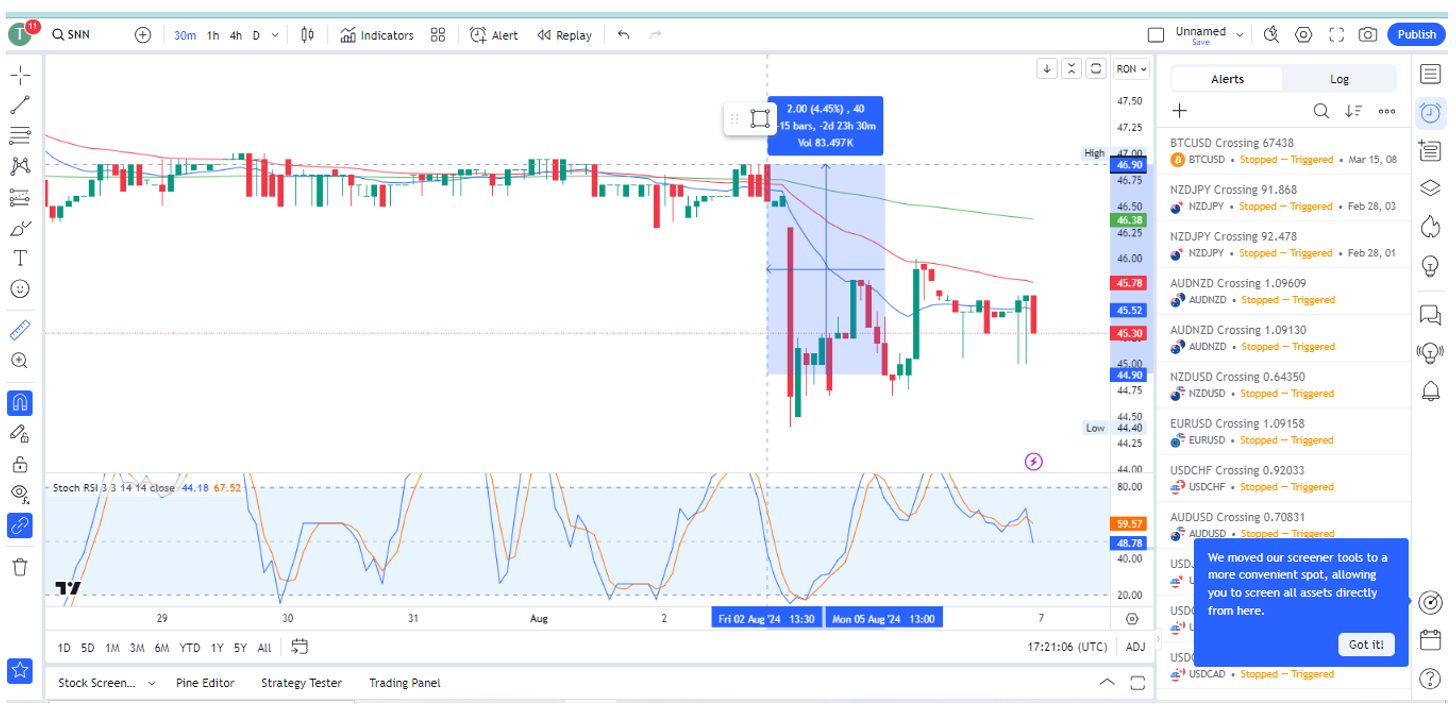
Here is an example of a day trade I executed to show you how online trading in Poland can work in practice. Entering on the 30-minute chart, I shorted a Polish stock Sunway Network (SNN).
Analysis
With price action breaking through the 200 and 50-day moving averages on the daily, 4-hour, and 1-hour time frames, I waited for the first bearish candle to break through the 20-day moving average before entering at the close of the first candle on the 30-minute chart.
I set my take profit at an established daily level (44.95), which had been tested many times before.
Risk Management
Rule number one is always to protect your capital.
I calculate the appropriate position size based on my risk management rules, never risking more than 1% of my account balance and setting a stop-loss order to manage potential losses.
Trade Exit
After monitoring my trade closely and paying attention to established levels on the 1-hour, 4-hour, and daily timeframes, I set my take profit order, allowed my trade to play out as planned, and exited at 4.95.
Bottom Line
Day trading in Poland has the potential for returns for skilled traders.
With solid regulation both inside the country and across the EU, a wide range of tradable assets, and low-cost platforms, day trading in one of the fastest-growing economies sounds like a no-brainer, but having strong risk management and technical analysis skills is a must.
To get started, browse DayTrading.com’s choice of the best platforms for day traders in Poland.
Article Sources
- Polish Financial Supervision Authority (KNF)
- European Securities and Markets Authority (ESMA)
- Warsaw Stock Exchange (WSE)
- National Revenue Administration (KAS)
- Markets in Financial Instruments Directive II (MiFID II)
- Polish Investor Compensation Scheme (KDPW)
- Taxes in Poland - PwC
The writing and editorial team at DayTrading.com use credible sources to support their work. These include government agencies, white papers, research institutes, and engagement with industry professionals. Content is written free from bias and is fact-checked where appropriate. Learn more about why you can trust DayTrading.com