



A broker’s execution speed is the time it takes for the platform to complete a trade – from the moment you place an order, to the moment it is carried out on the live market. Fast execution is critical for day traders in particular, because even slight delays can turn a winning trade into a loss in fast-moving markets like forex.
We’ve conducted hands-on tests and run our own analysis to reveal the top brokers for execution speed. Our team of experienced traders also explain how to get the best execution quality out of your trading platform.
List Of Fastest Brokers In 2026
Our analysis shows that these are the top 6 trading platforms for execution speed and quality in October 2026:
-
- Demo account
- Regulator: ASIC, CySEC, FSCA, BVI FSC
- Platforms: Web Platform, MT4, MT5, TradingCentral
-
- Demo account
- Regulator: FSC-Belize, FSC-Mauritius
- Min. deposit: $10
-
- Demo account
- Regulator: ASIC, FSCA, FSA, FSC, CMA-UAE
- Min. deposit: $20
-
- Demo account
- Instruments: Stocks, Options, ETFs, ADRs, OTCs
- Regulator: SEC, FINRA, MAS, SFC, ASIC, CIRO, JFSA, SC
-
- Demo account
- Regulator: ASIC, VFSC
- Platforms: MT4, MT5, TradingView, AutoChartist
-
- Demo account
- Regulator: FSC
- Platforms: WebTrader, MT5






Learn how we test brokers and why you can trust our ratings.
What Makes These Brokers The Best For Order Execution?
Here are the results of our order execution tests, explaining why these platforms topped our rankings:
- Markets.com is the best broker for trading execution speed in Virgin Islands, U.S. in 2026 4.4/5 Established in 2008, Markets.com is a long-standing, multi-regulated broker with oversight from the CySEC and FSCA. It offers unique features to track hedge fund moves and insider trades, while providing stock signals to alert traders to market opportunities. Its choice of accounts (Classic to Professional) caters to all levels of active trader. 72.3% of retail accounts lose money.
- Axiory 3.6/5 Founded in 2011, Axiory is a regulated forex and CFD broker offering tight spreads and highly leveraged trading on industry-leading platforms: MT4, MT5 and cTrader. The broker has won multiple global awards and is regulated by the FSC in Belize and the FSC in Mauritius.
- PU Prime 4.5/5 PU Prime is a forex and CFD broker offering direct market access on forex, commodities, stocks, bonds, indices, and ETFs. With four account types (Cent, Standard, Prime, ECN) and multiple platforms, from MetaTrader to its own PU Prime app, it’s built for active traders at every level.
- Moomoo 3.2/5 Moomoo is an SEC-regulated app-based investment platform that offers a straightforward and affordable way to invest in Chinese, Hong Kong, Singaporean, Australian and US stocks, ETFs and other assets. Margin trading is available and the brand offers a zero-deposit account as well as several bonuses.
- Global Prime 3.8/5 Global Prime is a multi-regulated trading broker offering 150+ markets. Traders can get started with no minimum deposit and trade with leverage that varies depending on your region. The firm also has a high trust score and a good reputation with a license from the ASIC.
- TabTrade 3.0/5 Established in 2026, TabTrade is a CFD broker based in Saint Lucia. It offers a choice of three accounts (Standard, Edge, VIP) with spread-only and spread plus commission pricing, access to over 1,000 tradeable assets, and leverage up to 1:1000.
Fastest Execution Brokers In 2026 Comparison
Here are the tools our top brokers offer to faclitate fast, reliable, and precise trading execution:
| Broker | Passed Our 'Execution Quality & Efficiency' Benchmark | VPS For Fast Trading | Algo Trading Tools |
|---|---|---|---|
| Markets.com | ✔Yes | ✘No | Expert Advisors (EAs) on MetaTrader |
| Axiory | ✔Yes | ✘No | ✔Yes |
| PU Prime | ✔Yes | ✔Yes | Expert Advisors (EAs) on MetaTrader |
| Moomoo | ✔Yes | ✘No | Moomoo OpenAPI |
| Global Prime | ✔Yes | ✔Yes | ✔Yes |
| TabTrade | ✔Yes | ✔Yes | Expert Advisors (EAs) on MetaTrader, FIX API |
Compare The Detailed Ratings Of The Fastest Day Trading Brokers
See how the top brokers for day trading execution scored in every area of our independent rating system:
| Broker | Trust | Platforms | Assets | Mobile | Fees | Accounts | Research | Education | Support |
|---|---|---|---|---|---|---|---|---|---|
| Markets.com | |||||||||
| Axiory | |||||||||
| PU Prime | |||||||||
| Moomoo | |||||||||
| Global Prime | |||||||||
| TabTrade |
Community Sentiment
See how users rate these brokers based on the average customer ratings submitted on DayTrading.com, plus ratings from Trustpilot, the Apple App Store and Google Play.
| Broker | Our Users' Rating | Trustpilot Score | Trustpilot Reviews | iOS App Rating | Android App Rating |
|---|---|---|---|---|---|
| Markets.com | 1257 | ||||
| Axiory | - | 69 | |||
| PU Prime | 1875 | ||||
| Moomoo | 740 | ||||
| Global Prime | 561 | ||||
| TabTrade | - | 31 |
Why Trust Markets.com For Lightning-Fast Trade Execution?
Markets.com is best suited to retail investors who trade frequently but don’t want to calculate commissions, thanks to its spread-only pricing (EUR/USD around 1.3 pips). It especially appeals to short-term traders who value fast execution, flexible asset choice spanning 2,200+ instruments and proprietary tools like hedge fund confidence indices and insider trade alerts.
 Christian Harris, Reviewer
Markets.com quick facts
- Demo Account
- ✔Yes
- Instruments
- CFDs, Forex, Stocks, Commodities, Indices, Crypto, ETFs, Bonds
- Regulator
- ASIC, CySEC, FSCA, BVI FSC
- Platforms
- Web Platform, MT4, MT5, TradingCentral
- Minimum Deposit
- $200
- Minimum Trade
- 0.01 Lots
- Account Currencies
- USD, EUR, GBP, AUD, ZAR, SEK, NOK, DKK, CHF, PLN, CZK
Pros
- Markets.com’s Hedge Fund Confidence and Insider Trading tools pulls SEC filings into the dashboard within 24 hours of disclosure, helping to spot fund moves and C-suite buys before most retail newsfeeds updated.
- Within the 2,200+ CFDs, Markets.com offers thematic baskets like the Warren Buffett Blend and Cannabis Blend, which behaved like ready-made mini-ETFs during testing, saving the work of balancing weights manually.
- Switching between the proprietary web platform (great for alerts and quick analysis) and MT5 (strong for algorithmic EAs) was smooth in our tests; positions synced across desktop, web, and mobile without gaps or re-quotes.
Cons
- While CySEC and FSCA oversight is solid, the SVGFSA and BVIFSC entities offers 1:500 leverage under a light-touch framework, meaning protections like compensation schemes and strict conduct rules lag behind the strictest regulatory standards.
- Inactivity charges kick in after just 3 months, while variable spreads are wider than top ECN brokers during testing, which may deter day traders and high-frequency traders.
- The proprietary web platform felt a bit basic once we pushed into advanced charting with fewer drawing/indicator options than full TradingView or MetaTrader.
Why Trust Axiory For Lightning-Fast Trade Execution?
Axiory remains a top choice for beginners with its low deposit, unlimited demo account and high-quality education. Experienced day traders will also appreciate the advanced capabilities of the cTrader platform, although the range of 350+ instruments may be too restricting.
 William Berg, Reviewer
Axiory quick facts
- Demo Account
- ✔Yes
- Instruments
- CFDs, Forex, Indices, Commodities, ETFs, Stocks
- Regulator
- FSC-Belize, FSC-Mauritius
- Platforms
- MyAxiory App, MT4, MT5, cTrader, AutoChartist, Quantower
- Minimum Deposit
- $10
- Minimum Trade
- 0.01 Lots
- Account Currencies
- USD, EUR
Pros
- The broker offers best-in-class charting platforms for both novices and serious day traders, including cTrader with over 50 technical indicators
- Axiory offers free, multiple demo accounts in any of the 3 platforms with no expiry, so clients can continuously test their day trading strategies risk-free
- The broker continues to improve its market coverage by introducing real stocks alongside stock CFDs
Cons
- Only USD and EUR are accepted as account base currencies, so many clients may have to pay conversion fees
- Axiory doesn’t hold any top-tier licenses in Europe, the US or the Asia-Pacific region
- The broker’s range of 350+ instruments is much smaller than the hundreds offered by most leading firms
Why Trust PU Prime For Lightning-Fast Trade Execution?
PU Prime is a great fit for experienced, high-volume traders with its ECN account offering tight spreads from 0.0 pips and low commissions from $1/side. The addition of an easy-to-use copy trading app, alongside the stacked Trading Academy with progression levels, also makes PU Prime a strong option for aspiring traders.
 Tobias Robinson, Reviewer
PU Prime quick facts
- Demo Account
- ✔Yes
- Instruments
- CFDs, Forex, Stocks, Indices, Commodities, Metals, Crypto, Bonds, ETFs, Pre-IPOs, Synthetic Indices (region-dependent)
- Regulator
- ASIC, FSCA, FSA, FSC, CMA-UAE
- Platforms
- PU Prime App, PU Web Trader, PU Social, MT4, MT5, AutoChartist
- Minimum Deposit
- $20
- Minimum Trade
- 0.01 Lots
- Account Currencies
- USD, EUR, GBP, CAD, AUD, NZD, JPY, HKD, SGD
Pros
- PU Prime has upped its game over the years, including launching its PU Social app in 2022, securing ASIC authorization for its Australian entity in 2025, and adding over 200 trading instruments, bringing the total to 1,000+, while 2026 brought around-the-clock share CFDs on prominent US stocks.
- There’s a great suite of tools for short-term traders, from practical margin and position sizing calculators to economic calendars and strong technical insights via Autochartist.
- The platform lineup is strong, with the PU Prime Web Trader and app especially smooth to use with a modern design, easy-to-configure order tickets and responsive charts for fast entries and exits.
Cons
- The in-house market updates are useful for a quick read, but they’re generally high-level and don’t go deep enough for serious strategy building or advanced analysis.
- While PU Prime holds licenses in Australia (ASIC) and South Africa (FSCA), its offshore entities have been flagged by UK, North American, and European regulators for providing services without local authorization.
- The ECN account’s $10,000 minimum deposit puts the best pricing out of reach for some active retail traders who may end up paying more for spreads and commissions on Prime, Standard or Cent accounts.
Why Trust Moomoo For Lightning-Fast Trade Execution?
Moomoo remains an excellent choice for new and intermediate stock traders who want to build a diverse investment portfolio. What really stands out is the broker's user-friendly app and the low trading fees.
 Jemma Grist, Reviewer
Moomoo quick facts
- Demo Account
- ✔Yes
- Instruments
- Stocks, Options, ETFs, ADRs, OTCs
- Regulator
- SEC, FINRA, MAS, SFC, ASIC, CIRO, JFSA, SC
- Platforms
- Desktop Platform, Mobile App
- Minimum Deposit
- $0
- Minimum Trade
- $0
- Account Currencies
- USD, CAD, AUD, JPY, MYR, HKD, SGD, CNY
Pros
- The Moomoo AI assistant, found in the desktop software and app, provides genuinely useful market insights to inform active traders
- Moomoo's analytics and insights are impressive and detailed compared to other brands
- The broker offers access to extended pre-market trading hours
Cons
- There is no negative balance protection, which is a common safety feature at top-tier-regulated brokers
- The account range is narrow compared to other brokerages in its class with no managed portfolios or robo-advisor solutions
- Moomoo has faced multiple regulatory penalties in recent years, including fines and orders in 2026 that stopped it temporarily accepting some Japanese and Chinese clients
Why Trust Global Prime For Lightning-Fast Trade Execution?
Global Prime is suitable for both beginners and seasoned traders with excellent market access, low fees and a range of tools including copy trading.
Tobias Robinson, Reviewer
Global Prime quick facts
- Demo Account
- ✔Yes
- Instruments
- Forex, indices, commodities, cryptocurrencies, shares, bonds
- Regulator
- ASIC, VFSC
- Platforms
- MT4, MT5, TradingView, AutoChartist
- Minimum Deposit
- $0
- Minimum Trade
- 0.01 Lots
- Account Currencies
- USD, EUR, GBP, CAD, AUD, SGD
Pros
- Centralized access to the interbank funding market added with increased liquidity distribution via Gold-i Matrix Net, aiding with fast trades
- Swap fees have been reduced by over 50% through a partnership with BidFX
- Low latency with execution speeds from 10ms
Cons
- Narrow range of account options
- Clients from US and some Canadian provinces like Ontario are not accepted
Why Trust TabTrade For Lightning-Fast Trade Execution?
TabTrade is best suited to retail traders who are comfortable using MT5, want broad CFD access with high leverage up to 1:1000, and can deposit at least $250 for the Edge account to get the raw-spread pricing that makes the broker attractive for frequent, short-term trading.
 James Barra, Reviewer
TabTrade quick facts
- Demo Account
- ✔Yes
- Instruments
- CFDs on Forex, Stocks, Indices, Commodities, Metals, Crypto, ETFs
- Regulator
- FSC
- Platforms
- WebTrader, MT5
- Minimum Deposit
- $0
- Minimum Trade
- 0.01 Lots
- Account Currencies
- USD, EUR, GBP, CAD, AUD, CHF, SGD
Pros
- The MT5 platform, available on desktop, web and mobile, gives experienced traders the tools they actually need - one-click dealing, custom indicators, EAs and execution as low as 20ms on some accounts. cTrader and TradingView are also coming soon (not available when we checked the platform area in July and again in September 2026).
- TabTrade's support team, especially live chat, performed excellently during our second round of tests with 100% of queries answered sufficiently and in under 60 seconds.
- What impressed us for a new broker was the presence of infrastructure aimed at serious traders, with VPS hosting, FIX API access and Equinix-linked execution, helping active traders deploy fast-paced setups across global markets.
Cons
- Some of the broker’s strongest selling points are gated behind higher tiers, with the VIP account requiring a punchy $25,000 deposit and priority support locked behind the TabTrade+ monthly subscription plan.
- Research and education resources need work, with more of a focus on onboarding and account setup than on the kind of market analysis, sentiment data, or strategy development many active traders want.
- Although it secured an FSC license in 2026, TabTrade is still based offshore where mandated regulatory safeguards are weaker than in tightly regulated regions, meaning clients don't receive protections like access to an investor compensation scheme.
How DayTrading.com Chose The Fastest Brokers
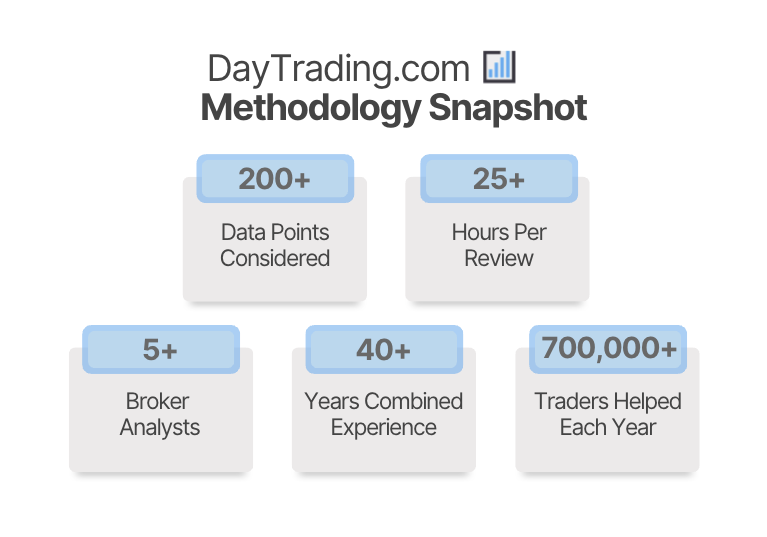
Every broker had to pass our proprietary ‘Execution Quality & Efficiency’ benchmark, which balances speed, reliability, and order quality.
We personally evaluated the order execution of each shortlisted broker, recording key metrics where possible, such as execution time, slippage, and requotes.
We also supplemented our findings with:
- Brokers Statistics – Many of the top brokers publish their execution statistics on their website. This has enabled us to rank many based on the transparency of execution as well as the figures provided.
- Client Feedback – As experts in our field, we regularly seek feedback from our clients and colleagues on their experiences.
- Extensive Research – We keep our finger on the pulse to ensure that the information we’re offering is up-to-date and valuable.
Finally, brokers were ranked based on their overall ratings, with our top-rated platforms offering consistently fast, accurate, and stable trade execution in fast-moving market conditions.
Order Execution Speed Explained
A broker’s execution speed is an important factor to consider when day trading. When the market is at its most volatile, execution speed could mean the difference between profit and loss.
However, some parts of the order execution chain are outside the broker’s control, and there are local factors that you can manage yourself.
But crucially, be aware that the quality of execution may be a better metric for comparing brokers and improving your trading returns.
Order quality covers a number of variables, including speed, price and likelihood of execution, ultimately measuring whether you got the best trade possible.
Why is a Fast Broker with High Execution Speed Important?
The best traders know that execution speed is vital for securing their intended trades in volatile markets. Let’s look at an example scenario to see the effect it can have.
Medium-cap company, Alfresco, has hit the news headlines for securing a deal with the world’s largest e-commerce retailer. As more details trickle through the media outlets, the stock price starts rising dramatically, from $2.00 to $4.00 in a matter of minutes.
You place a buy order for 1000 shares at $4.08, with a stop-loss set at $3.50. A direct market broker may fill your trade at $4.08, meaning when the price jumps to $5, you’ve made a profit of $920 (1000 x $0.92).
If your retail broker was slow to the mark, filling at $4.50 – your profit is only $500 (1000 x $0.50). You’ve lost $420 ($920 – $500) by trading with a broker with poor execution speeds.
Execution speed is measured in milliseconds (with the unit, ms). Anything less than 100 is considered excellent, anything more than 200 is fairly poor and could lead to price slippage or failure.
Should You Be Monitoring Your Broker’s Execution Speed?
Execution times can vary depending on a number of factors:
- Market
- Location
- Time of Day
- Size of Trade
- Connection Speed
- Refresh Rate
- Regulation
- Hardware
- Volatility
- Volume
- Policy
This vast array of factors makes it difficult to assess accurately. In fact, order size and market conditions are crucial elements to take into account, meaning a broker execution speed comparison is almost impossible to perform with any certainty.
This is where execution quality comes in.
Execution quality uses speed as just one metric for assessing a broker’s performance. But it also uses other factors, like price, their business model, and much more.
How The Markets Work
Broker Business Models
There are a few ways that a broker can structure their business and facilitate trading. Depending on their model, they can choose how to route your trade, as long as it fulfils the requirements you’ve set.
Therefore, the model used by your broker can impact execution speed as they may be incentivised to fill your trade through a less efficient route.
- Exchanges – An exchange is a marketplace of buyers and sellers who are matched together to form a trade. Just like an online marketplace for selling second-hand goods, buyers and sellers come together in an exchange to agree on a trade. The company acts as a facilitator only.
- Market Makers – A market maker actually creates, or maintains, the market for a particular asset. This means they have two options to fill a trade:
- Find an interested party on their order book
- If no one else wants to buy what’s being sold, they’ll take the trade to create the marker
- On occasion, a market maker might compensate a broker for sending orders via their market. Referred to as ‘payment for order flow’, these payments may mean a broker is routing your trade through a slower path in order to make extra cash before securing the best prices for their clients. More on this below.
- ECN (Electronic Communication Network) – An ECN trading broker electronically communicates an order to a larger exchange where buyers and sellers are already waiting to take the trade. It is usually quick to process.
Brokers may have different priorities depending on their model and speed of execution may not always be at the top of their list, therefore execution quality may be a better metric.
What Is Payment For Order Flow (PFOF)?
Payment for Order Flow is the fee that a broker receives for routing trades to certain market makers. It’s the transfer of profit to the brokers selling the trades from the market makers who will execute them.
Small trading brokers will usually operate in this way, as it allows them to sell positions to the bigger market makers that specialize in certain assets.
Clients are often not aware that their broker is routing trades in this way, profiting from slowing their trade execution speed – unless they are told by the broker.
For this reason, PFOF has been largely controversial as investors’ best interests are not always the priority.
In 2005, the SEC even went digging into the issue, aiming to increase transparency by introducing Rule 606.
SEC Rule 606
SEC Rule 606 requires that brokers publish a quality report, providing a general overview of their routing practices.
By doing this, investors can discover exactly how brokers make cash from their trades and if any conflicts of interest arise on the way.
Over the years, the requirements on these reports have changed to ensure that investors can access the information they need.
In 2020, the SEC made it mandatory for brokers to publish the net PFOF payments they make each period from market makers. This covers trades executed in S&P 500, non-S&P 500 equity trades, and options.
Financed Information Forum (FIF)
The Financed Information Forum is a group of brokers and market makers that aims to standardize the reporting required as part of the SEC 606 Rule.
The group found that the reports created were not giving retail investors transparent information, so they introduced the following requirements.
Each report should contain the metrics below:
- Average size of orders, in shares, within each range
- Percent of shares in market orders that were executed at current market quote or better
- Percent of shares in market orders that received price improvement
- Savings received on an average order as a result of price improvement
- Average execution speed, in seconds, between order routing and trade execution
Note, you can find a list of the FIF members on their website.
National Best Bid Or Offer (NBBO)
Another SEC mandate aimed at protecting retail investors is the National Best Bid or Offer (NBBO). This regulation requires brokers to trade at the best available ask and bid prices when executing positions for US investors.
The NBBO is calculated from a composite of prices across all exchanges and market makers (excluding alternative markets).
However, due to the nature of live markets, this is extremely difficult to calculate and it is almost impossible to know for sure whether a trader actually received the NBBO, meaning holding brokers accountable to this is tough.
Alternative Trading System
But, one thing to be aware of is that Alternative Trading Systems (or ATS) are not included in the NBBO, so what is an ATS?
An ATS is a venue for trading that has less stringent regulation than an exchange. In Europe, they’re known as multilateral trading facilities.
An example of an ATS is an ECN (electronic communication network) broker – one of the most popular broker types in the US. ECN brokers electronically match buy and sell orders.
Importantly, ATS transactions do not show on national exchange order books, so are often used by traders making large institutional moves to conceal the size of a trade and prevent it from impacting the price of an equity.
Broker vs Market Maker
A broker is a party that facilitates trading by bringing together a buyer and seller. They have the authorization to buy or sell on behalf of their clients from larger institutions that hold the assets.
In most countries, brokers must be regulated by the national body that protects financial services e.g in the UK, this is the Financial Conduct Authority (FCA), or in the US there is Financial Industry Regulatory Authority (FINRA).
A market maker is an organization that creates a market for an asset by taking a trade. Sometimes these firms can facilitate a trade by finding an opposing party on their order book i.e someone else wants to buy what you’re selling. However, crucially, if there’s no one to take the other side, they’ll form the trade themselves.
Note, a market maker can also be a broker, but brokers are not always market makers.
What Impacts Execution Quality?
Now that we understand how markets work, we’ll look at the factors that impact execution quality and speed. These can be variables between brokers, or the trades themselves.
- The Asset – The asset traded can impact the quality of the trade. There are lots of reasons why this might be the case. One example is that legal restrictions on assets in some jurisdictions could mean the best price is not achieved e.g cryptocurrencies are restricted in the US, meaning that traders may not get the best order compared to those in more freely regulated countries. Alternatively, the infrastructure may not be as robust on certain assets, e.g trading an exotic forex pair vs the Cable (GBP/USD), one of the most liquid assets in the world, will not be the same experience.
- The Time – If you’re trading during busy periods, the ‘load’ on the ordering process at your broker may be constrained. Just like your wifi slows when everyone gets home from work and logs on to their home wifi, a broker’s order execution speed may slow during the most liquid times of the day.
- Order Type – Limit orders and market orders will behave differently. In the case of a market order, speed is key and price is less crucial. A market order will go through regardless of price, but the aim is to execute at the market value at the point of order. With a limit order, price is key. The trade will not execute unless the asset’s value meets the price requirement specified. The quality of the trade will depend on what is important to you. Clearly, an unexecuted limit order is poor execution, and a market order processed late and way off the original price is also unacceptable.
- Size – Size of trade and the size of your broker both matter when it comes to order execution time. Put simply, small brokers may struggle to process large trades.
- Volatility – When a market is volatile, prices are moving fast and in large quantities. Even the most experienced brokers may struggle to fill trades to a high standard when this occurs.
- Liquidity – A broker’s liquidity providers could also impact the quality of your trade. Are they backed by institutional partners that will have no problem filling trades even while the market is hot? If not, expect to see downgrades in execution speed and quality during this time.
- Brokers’ Revenue Streams – If we look back at the business models we referenced above, we note that some brokers will have a profit incentive for diverting trades through certain routes. The best execution speeds will not be achieved if this is the case. Therefore, it’s important to understand if your broker receives payment for order flow (PFOF). You’ll be able to identify this by finding their SEC Rule 606 report.
- Likelihood Of Execution – Traders worldwide will know the pain when a stop-loss order fails. The chance of this happening should be low if your broker is operating successfully, but the likelihood of execution is just as important as speed in this instance.
- Price – Ultimately, one of the best indications of execution quality is price. If you’re solely focused on speed, you may be missing that a quick deal does not guarantee the best price.
- Re-quotes – This is where the broker cannot execute the order at the requested price and thus sends you a new quote, impacting your planned execution and desired trading price. Check our dedicated guide to re-quotes in online trading to understand how they can impact trading execution in detail.
What Else Impacts Execution Speed? – Local Factors
On top of the variables above, local factors also impact execution speed. These are unique to you as a trader and not impacted by the broker or the position that you choose.
- Internet Connection – A slow internet connection will inevitably impact whether you get the best execution speed. Measure yours using free services like Fast.com. Anything above 25 Mbps is a sensible internet speed, but 100 Mbps or above is ideal for scalping.
- Spec Of Device – Similarly, if your device’s processor is old and slow, you’ll find it difficult to execute trades quickly. If your internet connection is good and you’re still having trouble, consider updating your device to speed up execution times. Important things to look for are the speed of your CPU (Central Processing Unit), size of RAM (Random Access Memory) and hard disk space.
- Other Software & Services – Issues with software can also make a difference. Make sure all browsers, apps and desktop downloads are operating on the latest versions.
What Can You Do?
- Execution Guarantees – In our investigations, we found that some brokers may offer execution guarantees which mean they promise to fulfil your order. Guaranteed market orders do not ensure you’ll get the price quoted, so slippage can be an issue if the execution speed isn’t lightning fast. Stop-loss guarantees are harder to come by, but they’ll make a significant impact on your strategy if you find them. While they’re not available at many well-known brokers we’ve tested, there are some that provide them on certain assets. IG, for example, allows guaranteed stops on spread bets and CFDs.
- Free Trade If Fails – If your execution cannot be guaranteed, is there another form of compensation that your broker offers? Free trades if an order fails are a great way to make up for the misstep on their part.
- Pick The Right Stocks – Trading the most liquid stocks is more likely to guarantee faster execution speeds, and therefore, better prices. This happens because trades that can be filled from a broker’s own order book do not need to be routed externally. A shorter route means a quicker turnaround. Therefore, if you’re trading Cable or EUR/USD, you’re much more likely to get an order filled quickly than if you’re trading an exotic pair.
- Order Size – Brokers will look at the size of the trade before deciding how to route it. If your trade is too large, some may struggle to fill it straight away and will route it externally. If you do want to trade an illiquid asset, be mindful of the impact your order size has on execution quality.
Bottom Line
Whilst execution speeds are a useful metric to assess, their complexity and exposure to external factors mean they shouldn’t be reviewed in isolation.
Our broker speed assessment looks at more than just how fast they are, instead focussing on quality as a whole. Try out one of our fastest execution brokers to get started.
FAQ
What Does Execution Speed Mean In Trading?
Execution speed is the time it takes for a broker to fulfil a trade order, or more simply, how fast the broker is at carrying out your request. From the moment you press execute on MT4, NinjaTrader, or other trading software, to the moment the trade is placed.
In our experience trading over many years, this can take anywhere from a few seconds to days depending on factors like your broker’s infrastructure, revenue streams, or the specifications of the trade.
Can I Complete My Own Order Execution Speed Comparison?
Yes – many brokers will list their best execution speeds on their website in their marketing material. If you combine this with an investigation into the size of the broker, their liquidity partners, and their revenue model, you can get a good idea of which brokers will have the best execution speed for your trading strategy.
Is High Execution Speed Important When Trading Forex?
While it’s true that fast executions are important when trading forex, it’s not the only factor to consider.
Ultimately, you want the best price possible for an asset, so speed should not be examined alone, execution quality is a fairer metric for ranking a broker.
Article Sources
- Alternative Trading System (ATS) List - SEC
- Payment For Order Flow - SEC
- How Does Payment For Order Flow Influence Markets? - SEC
The writing and editorial team at DayTrading.com use credible sources to support their work. These include government agencies, white papers, research institutes, and engagement with industry professionals. Content is written free from bias and is fact-checked where appropriate. Learn more about why you can trust DayTrading.com