
Best S&P 500 Brokers 2026



S&P 500 brokers provide access to the most popular stock index in the United States, followed closely by the Nasdaq. We’ve tested, rated and ranked the best brokers with access to the S&P 500. Our experts, who themselves have traded the S&P 500, also walk through placing a trade and share their tips for analyzing the US stock exchange.
Best Brokers With Access To The S&P 500
Following our hands-on review and broker analysis, these are the leading brokers for trading the S&P 500:
-
1
 eToro USAeToro USA LLC and eToro USA Securities Inc.; Investing involves risk, including loss of principal; Not a recommendation
 -
2
 FOREX.com
 -
3
 TradeUp
 -
4
 Optimus Futures
 -
5
 Zacks Trade
Why Are These The Top S&P 500 Brokers?
Here is a short overview of each broker's pros and cons
- eToro USA is the best broker with access to the S&P 500 in 2026 - eToro is a social investing platform that offers short-term and long-term trading on stocks, ETFs, options and crypto. The broker is well-known for its user-friendly community-centred platform and competitive fees. With FINRA and SIPC oversight and millions of users across the world, eToro is still one of the most respected brands in the industry. eToro securities trading is offered by eToro USA Securities, Inc.
- FOREX.com - Founded in 2001, FOREX.com is now part of StoneX, a financial services organization serving over one million customers worldwide. Regulated in the US, UK, EU, Australia and beyond, the broker offers thousands of markets, not just forex, and provides excellent pricing on cutting-edge platforms.
- TradeUp - Established in 1986, TradeUp operates as a commission-free broker in the US offering trading for stocks, ETFs and options. Through its web platform and mobile app, clients can trade over 5,000 instruments with cash and margin options, while idle funds can earn interest.
- Optimus Futures - Established in 2004, Optimus Futures specializes in low-cost, customizable futures trading. It provides access to a growing suite of around 70 futures markets spanning micro E-minis, energies, metals, grains, and cryptos. With commission tiers starting at $0.25 per side for micros and the option to choose your own clearing firm (e.g. Ironbeam, StoneX, Phillip Capital), the brokerage offers flexibility. Optimus Futures has also introduced excellent features like multi-bracket orders and journaling, giving active traders more control.
- Zacks Trade - Zacks Trade is a FINRA-regulated US broker offering trading on stocks, ETFs, cryptocurrencies, bonds and more through a proprietary terminal. The broker is geared toward active traders and offers very affordable fees on most assets as well as an app and a vast amount of market data.
How Safe Are The Top S&P 500 Brokers?
We reviewed protections and safeguards to determine how secure these brokers are:
| Broker | Trust Rating | Guaranteed Stop Loss | Negative Balance Protection | Segregated Accounts |
|---|---|---|---|---|
| eToro USA | ✘ | ✘ | ✔ | |
| FOREX.com | ✘ | ✔ | ✔ | |
| TradeUp | ✘ | ✘ | ✔ | |
| Optimus Futures | ✘ | ✘ | ✔ | |
| Zacks Trade | ✘ | ✘ | ✘ |
Are The Top S&P 500 Brokers Good For Beginners?
We evaluated how accessible these brokers are for newer traders:
| Broker | Demo Account | Minimum Deposit | Minimum Trade | Education Rating | Support Rating |
|---|---|---|---|---|---|
| eToro USA | ✔ | $100 | $10 | ||
| FOREX.com | ✔ | $100 | 0.01 Lots | ||
| TradeUp | ✔ | $0.01 | $1 | ||
| Optimus Futures | ✔ | $500 | $50 | ||
| Zacks Trade | ✔ | $250 | $3 |
Are The Top S&P 500 Brokerages Good For Experienced Traders?
Experienced traders often look for advanced tools and market access when trading the S&P 500 - here’s how the leading brokers perform:
| Broker | Automated Trading | VPS | AI | Pro Account | Leverage | Low Latency | Extended Hours |
|---|---|---|---|---|---|---|---|
| eToro USA | ✘ | ✘ | ✘ | ✘ | - | ✔ | ✔ |
| FOREX.com | Expert Advisors (EAs) on MetaTrader | ✔ | ✔ | ✘ | 1:50 | ✔ | ✘ |
| TradeUp | - | ✘ | ✘ | ✘ | - | ✘ | ✔ |
| Optimus Futures | TradingView Pine Script, API Features | ✘ | ✘ | ✘ | - | ✘ | ✘ |
| Zacks Trade | Yes (algos) | ✔ | ✘ | ✘ | - | ✘ | ✘ |
Compare Detailed Ratings Of The Top S&P 500 Brokers
See how the top S&P 500 trading brokers scored across our main testing categories:
| Broker | Trust | Platforms | Assets | Mobile | Fees | Accounts | Research | Education | Support |
|---|---|---|---|---|---|---|---|---|---|
| eToro USA | |||||||||
| FOREX.com | |||||||||
| TradeUp | |||||||||
| Optimus Futures | |||||||||
| Zacks Trade |
How Popular Are The Top Trading Platforms For S&P 500 Access?
We compared client figures across our leading providers:
Why Use eToro USA To Trade The S&P 500?
"eToro remains a top pick for traders looking for leading social investing and copy trading services. With a low deposit, zero commissions and an intuitive platform, the broker will meet the needs of newer day traders."
Jemma Grist, Reviewer
eToro USA Quick Facts
| Demo Account | Yes |
|---|---|
| Instruments | Stocks, Options, ETFs, Crypto |
| Regulator | SEC, FINRA |
| Platforms | eToro Trading Platform & CopyTrader |
| Minimum Deposit | $100 |
| Minimum Trade | $10 |
| Account Currencies | USD |
Stock Exchanges
eToro USA offers trading on 3 stock exchanges:
- Dow Jones
- New York Stock Exchange
- S&P 500
Pros
- The broker's Academy offers comprehensive learning materials for beginners to advanced-level investors
- The online broker offers an intuitive social investment network with straightforward copy trading on cryptos
- eToro USA Securities is a trustworthy, SEC-regulated broker that is a member of FINRA and SIPC
Cons
- There's a narrower range of day trading instruments available compared to competitors, with only stocks, ETFs and cryptos
- Average fees may cut into the profit margins of day traders
- The proprietary terminal doesn't support trading bots and there are no additional stock market analysis tools
Why Use FOREX.com To Trade The S&P 500?
"FOREX.com remains a best-in-class brokerage for active forex traders of all experience levels, with over 80 currency pairs, tight spreads from 0.0 pips and low commissions. The powerful charting platforms collectively offer over 100 technical indicators, as well as extensive research tools."
Christian Harris, Reviewer
FOREX.com Quick Facts
| Demo Account | Yes |
|---|---|
| Instruments | Forex, Futures and Options on Metals, Energies, Commodities, Indices, Bonds, Crypto |
| Regulator | NFA, CFTC |
| Platforms | WebTrader, Mobile, MT4, MT5, TradingView |
| Minimum Deposit | $100 |
| Minimum Trade | 0.01 Lots |
| Account Currencies | USD, EUR, GBP, CAD, AUD, JPY, CHF, PLN |
Stock Exchanges
FOREX.com offers trading on 14 stock exchanges:
- Australian Securities Exchange (ASX)
- Borsa Italiana
- CAC 40 Index France
- DAX GER 40 Index
- Dow Jones
- Euronext
- FTSE UK Index
- Hang Seng
- Hong Kong Stock Exchange
- IBEX 35
- Japan Exchange Group
- Nasdaq
- S&P 500
- SIX Swiss Exchange
Pros
- There’s a wealth of educational resources including tutorials, webinars, and a stacked YouTube channel to help you get educated in the financial markets.
- With over 20 years of experience, excellent regulatory oversight, and multiple accolades including runner-up in our 'Best Forex Broker' awards, FOREX.com boasts a global reputation as a trusted brokerage.
- The in-house Web Trader continues to stand out as one of the best-designed platforms for aspiring day traders with a slick design and over 80 technical indicators for market analysis.
Cons
- There’s no negative balance protection for US clients, so you may find yourself owing more money than your initial deposit into your account.
- FOREX.com's MT4 platform offers approximately 600 instruments, significantly fewer than the over 5,500 available on its non-MetaTrader platforms.
- Demo accounts are frustratingly time-limited to 90 days, which doesn’t give you enough time to test day trading strategies effectively.
Why Use TradeUp To Trade The S&P 500?
"TradeUp is best suited to budget-conscious day traders looking to trade U.S. and global markets with zero commissions on a user-friendly mobile app. Its more than 250 Chinese American Depositary Receipts (ADRs), including Alibaba Group (BABA), also make it suitable for trading Chinese equities."
TradeUp Quick Facts
| Demo Account | Yes |
|---|---|
| Instruments | Stocks, Options, ETFs, Bonds |
| Regulator | SEC, FINRA |
| Platforms | Desktop, Web, Mobile |
| Minimum Deposit | $0.01 |
| Minimum Trade | $1 |
| Account Currencies | USD, EUR, GBP |
Stock Exchanges
TradeUp offers trading on 4 stock exchanges:
- Hong Kong Stock Exchange
- Nasdaq
- New York Stock Exchange
- S&P 500
Pros
- TradeUp runs an integrated and intuitive financial calendar that helps you track earnings, dividends, and IPOs relevant to your watchlist, enabling you to stay ahead of market-moving events.
- TradeUp offers commission-free trading on US stocks and ETFs, and support for fractional shares lets you buy portions of a share for as little as $5.This makes it a cost-effective choice for active day traders who want to minimize trading expenses.
- TradeUp’s platforms work smoothly across multiple devices based on our tests, including mobile apps for iOS and Android, a desktop app for Windows and Mac, and a web-based platform. This allows active traders to switch between devices without losing continuity, whether you’re at home or on the go.
Cons
- TradeUp's educational resources aren't kept updated, and were over 6 months old in our latest tests. While there are articles and tutorials aimed at newcomers, the content is somewhat limited and does not cover more advanced trading strategies or deeper topics.
- The platform's technical indicators have limited customization options from our use. On both mobile and web versions, you can't layer multiple indicators on the same chart simultaneously, which restricts more sophisticated chart analysis.
- TradeUp does not support popular third-party platforms like TradingView or cTrader, so traders who rely on those for advanced charting, automation, or community features won't find that flexibility.
Why Use Optimus Futures To Trade The S&P 500?
"Optimus Futures is best for active futures day traders who want low per-contract costs and the flexibility to build a custom trading setup across platforms like Optimus Flow, TradingView, and Sierra Chart. Its fast order-routing, low day trading margins, depth-of-market and footprint analysis tools, plus the ability to select your own clearing firm, make it especially suited to high-volume traders focused on U.S. and global futures markets."
Optimus Futures Quick Facts
| Demo Account | Yes |
|---|---|
| Instruments | Futures on Indices, Metals, Energies, Softs, Bonds, Cryptos, Options on Futures, Event Contracts |
| Regulator | NFA, CFTC |
| Platforms | Optimus Flow, Optimus Web, MT5, TradingView |
| Minimum Deposit | $500 |
| Minimum Trade | $50 |
| Account Currencies | USD |
Stock Exchanges
Optimus Futures offers trading on 8 stock exchanges:
- Chicago Mercantile Exchange
- DAX GER 40 Index
- Dow Jones
- Euronext
- FTSE UK Index
- Nasdaq
- Russell 2000
- S&P 500
Pros
- Futures commission rates are competitive, and there’s transparent access to trading on major exchanges, while the firm's fee calculator makes it a breeze to estimate trading costs before placing orders, helping to avoid surprises.
- Optimus Futures has added event contracts from CME Group, allowing traders to express a daily market view with a simple yes-or-no position on major futures markets. Only offered by a handful of brokers, these fixed-risk products provide a straightforward way to speculate on a short-term basis.
- The brokerage provides the flexibility to choose your clearing firm, including Iron Beam, Phillip Capital, and StoneX, allowing for direct control over where your funds are held and the associated transaction costs - helpful for customizing the futures trading setup.
Cons
- Live chat support is handled entirely by a bot, so despite several attempts in our tests, it wasn't possible to get access to a human agent, which can be frustrating when urgent or complex questions arise.
- There's no true 'all-in-one' account management dashboard - key functions like risk settings, software downloads, and subscriptions are split across different sections or platforms, so it required extra digging to set everything up during testing.
- There are limited payment options and no toll-free numbers for international support, while withdrawals cost $20 to $60, potentially making frequent withdrawals costly for active traders.
Why Use Zacks Trade To Trade The S&P 500?
"Zacks Trade will suit active day traders with experience using advanced trading software. Fees and margin rates are low while the market research is excellent."
Zacks Trade Quick Facts
| Demo Account | Yes |
|---|---|
| Instruments | Stocks, ETFs, Options, Mutual Funds, Bonds, Warrants, IPOs |
| Regulator | FINRA, SEC |
| Platforms | Zacks Trade Pro (Desktop), Zacks Trader (Web), and Handy Trader (App) |
| Minimum Deposit | $250 |
| Minimum Trade | $3 |
| Account Currencies | USD, EUR, GBP, CAD, AUD, NZD, INR, JPY, ZAR, TRY, SEK, NOK, DKK, CHF, HKD, SGD, PLN, CZK, HUF |
Stock Exchanges
Zacks Trade offers trading on 4 stock exchanges:
- London Stock Exchange
- Nasdaq
- New York Stock Exchange
- S&P 500
Pros
- Most brokers at this price point offer little beyond basic charts and a news ticker. Zacks Trade goes considerably further — standard accounts come with over 20 free research subscriptions, plus access to more than 80 additional paid options spanning providers like Morningstar, Dow Jones, Seeking Alpha, and Thomson Reuters.
- The ability to place trades by phone with a human broker at no additional charge beyond the standard penny-per-share commission is a genuine rarity among discount brokers. Most competitors either don't offer this at all or charge a meaningful premium for it, making it one of the few features here that Zacks Trade genuinely owns.
- While Zacks Trade charges commissions that most competitors have eliminated, it wins back ground on borrowing costs. Its margin rates start at 8.83% — a figure that sits notably below what traders pay at the major household-name brokers — making it a practical choice for anyone who regularly carries leveraged positions overnight. The savings are modest on small balances but compound meaningfully for traders running larger margin books across a full year.
Cons
- Most brokers have dropped stock and ETF trading to $0, making Zacks Trade's penny-per-share fee stand out. For casual traders, the cost is negligible, but a 10,000-share trade costs $100 in commission — and in a market where zero-commission alternatives are everywhere, that's a harder position to defend.
- Traders cannot access forex, cryptocurrencies, commodities, or futures — a meaningful gap for anyone trading across multiple asset classes. Given that the infrastructure runs through Interactive Brokers, which supports all of these, it feels like an artificial ceiling rather than a genuine platform limitation.
- The account-opening process is fully digital but overly complicated, with verification taking more than a week in some cases. Multiple document steps and an experience-assessment stage before approval make this one of the more tedious onboarding processes in retail brokerage, at a time when most competitors have it down to hours.
How We Selected The Best Brokers With Access To The S&P 500
To identify the top trading brokers that provide access to the S&P 500, we:
- Reviewed which brokers in our database offer S&P 500-linked products. We did this by registering with brokers, checking their market lists, and where possible logging into their platforms to verify access to S&P 500 stocks, ETFs, index funds, options, futures or other related instruments.
- Ranked brokers with S&P 500 access by their overall ratings. We calculate this score using more than 200 data points, from the range of S&P 500 products available and trading costs through to regulatory licenses, platform quality, execution, research tools and account features, while also incorporating the findings of our expert reviewers who spend hours testing each firm.
Comparing S&P 500 Brokers
An online broker is a trader’s gateway to the market. Therefore, it is important that you choose S&P 500 brokers that suit your financial goals, risk appetite and trading style. The key factors to consider when comparing S&P 500 brokers include:
Available S&P 500 Instruments
You can trade the S&P 500 in several ways. A major component of the best broker for you will depend on what instruments you need.
ETFs
ETFs are the most popular route for stock-account traders where you can get the whole index in one trade. SPY (State Street), VOO (Vanguard), and IVV (iShares) all track the same index. But they differ in ways that matter.
SPY is one of the oldest ETFs (forming in January 1993) and now has decades of historical data. It has the deepest liquidity and the most active options market, including dailies and options going out over two years. This makes it the strongest choice for short-term trading and hedging.
VOO and IVV charge lower expense ratios (0.03% vs SPY’s 0.09%) and reinvest dividends automatically (SPY can as well on a DRIP plan). As such, VOO and IVV traditionally favor longer holding periods. A good S&P 500 broker should offer all three, plus fractional share capabilities so you can size positions precisely.
Futures
Futures are the preferred instrument for leveraged S&P 500 trading. The CME’s E-mini S&P 500 (ES) contract provides 10x-20x+ leverage versus cash equities and trades nearly 23 hours a day, five days a week (starting Sunday night to Friday night).
The Micro E-mini (MES) is one-tenth the size of the ES and is well-suited to traders with smaller accounts or those who need more precise sizing. Some brokers let you choose your own clearing firm and offer day trading margins well below the exchange minimum.
Options
Options on SPX (index options) settle in cash and receive favorable 60/40 tax treatment under Section 1256 of the US tax code. Cboe now offers SPX, Mini-SPX (XSP, which is 1/10th the size of SPX), and Nano options across nearly 24-hour global trading hours.
But not all brokers provide access to these products. So if index options are part of your strategy, confirm availability before opening an account.
Individual Stocks
Individual stocks within the S&P 500 allow you to isolate specific sectors or trade preferred or high-conviction names. The index spans all 11 GICS sectors. Accordingly, you can trade everything from mega-cap tech to healthcare and energy through one broker, provided the platform supports direct access to the NYSE, Nasdaq, and Cboe exchanges.
Execution Quality And Order Routing
Execution quality is underrated. When you trade high-volume S&P 500 stocks, bid-ask spreads are typically tight (often a penny wide on names like AAPL or MSFT and most large-cap names). But that tightness only helps if your broker routes orders efficiently.
Look for brokers that offer direct market access (DMA) or smart order routing that gives the best available price across multiple venues. Brokers that DMA generally give you better fill prices compared to those relying exclusively on wholesale market makers.
Slippage is also worth monitoring on fast-moving days and during fast-moving periods, in general, when slippage is highest. Many traders logically look for platforms that show full depth of book. This way they can see resting order volume at each price level and manage entries during volatile sessions. FOREX.com, for example, routes equity index trades through its parent company StoneX. This helps give traders visibility into order flow.
Extended And Overnight Trading Hours
The regular S&P 500 equity session runs from 9:30 AM to 4:00 PM ET. But a growing share of price discovery now happens outside those hours. Premarket trading typically opens at 4:00 AM ET and after-hours runs until 8:00 PM ET at most brokers.
For futures traders, the ES and MES contracts trade on the CME’s Globex platform from Sunday 6:00 PM ET through Friday 5:00 PM ET, with only a brief maintenance break from 5:00 PM to 6:00 PM ET daily.
This near-continuous access means you can respond to overnight news, foreign market moves, and economic data releases without waiting for the cash market (i.e., traditional stocks and ETFs) to open. Not all of the brokers above offered the same depth of premarket and after-hours access for equities. Some may restrict traders to normal market hours only. Many restrict extended hours to limit orders only, and liquidity can be substantially thinner with wide bid-ask spreads. If reacting to earnings announcements or overnight developments is part of your approach, be sure to check the specific extended hours policies before signing up.
Data Feeds And Charting
The quality of your data feed can directly affect your decisions. Level I quotes (best bid and ask) are standard with every broker. But active traders benefit from Level II data, which shows the full order book and helps gauge potential buying and selling pressure at each price point. Some brokers include real-time data in the base package, while others charge a monthly subscription.
eToro’s platform is centered on Level I/top-of-book data rather than depth-of-book. For charting, many S&P 500 traders prefer third-party platforms like TradingView, which follows a freemium model. You can look up basically anything and add indicators for free, while additional features come as a recurring subscription. FOREX.com and Optimus Futures both support TradingView integration, which gives you access to 100+ indicators (and custom indicators (example) can be coded in Pine Script), multi-timeframe analysis, and community-built scripts. If you rely heavily on technical analysis, confirm that your broker supports the platform you already use.
Spreads, Commissions, And Total Cost
Trading costs vary depending on the instrument and the broker. For S&P 500 ETFs, several brokers offer commission-free stock and ETF trading, including eToro, TradeUp, and IBKR Lite.
But keep in mind that “commission-free” doesn’t mean cost-free. Payment for order flow (PFOF), bid-ask spreads, and spread markups are the hidden costs in this model. For futures, commission structures are more transparent. Optimus Futures advertises per-side rates starting at $0.25 for Micro E-minis and competitive rates on the full-size ES contract, with the flexibility to choose different clearing firms. FOREX.com charges competitive spreads on CFD-based index products for eligible account types.
Whatever the instrument, add up the round-trip cost of a typical trade (spread plus commission plus any exchange fees) and compare across brokers. Over hundreds of trades per month, even small differences add up.
Platform
The best platform offered by S&P brokers is a matter of personal preference. But key elements to look for when trading the S&P 500 are straightforward volume charts, market indicators (such as 50-, 100-, and 200-day moving average tickers), plus other technical analysis tools. Additionally, it is worth making sure you can access strong trend tracking and comprehensive price history, plus information on company fundamentals.
Some S&P 500 brokers will sometimes facilitate trading on industry-established platforms such as MetaTrader 4 (MT4) or MetaTrader 5 (MT5). Alternatively, traders may wish to use a platform that is independent of their brokerage when trading the S&P 500. Many active traders may prefer to use charts that they are already familiar with from TradingView, for example.
Fees
Active trading can incur various fees, including commissions, deposit and withdrawal charges, plus transaction costs. If you’re trading in high volumes, these fees can reduce your overall yield, erode profits and impact your S&P 500 margin. Some S&P 500 brokers will advertise a $0 fee package when trading the index, but bear in mind that there may be hidden charges that are applied later.
For example, overnight swap charges often apply when holding CFD positions on the index. The best brokers that support S&P 500 trading provide a transparent fee structure and a published pricing schedule available on their website. Prospective traders should be able to research how much it will cost to trade the S&P 500 without needing to create an account with a given provider.
Customer Support
Trading any asset class can be raise questions, so you may rely on the support services of S&P 500 brokers. Reliable and responsive customer service is important here.
During market operating hours, most brokerages will offer comprehensive support, with the best brokers that offer S&P 500 trading providing 24/7 customer service via live chat, telephone, email and social media.
Additional Features
Leading S&P 500 brokers will offer additional features to enhance the user experience. When trading the S&P 500, using a historical data sheet can provide insights into past trends, prices, p/e ratio and dividend history. This data can typically be split out by year or by sector if traders want to research specific stocks rather than the entire S&P 500 index.
Some S&P 500 brokers may also offer trading calculators that can be used before entering a position, or when devising a new trading strategy. These include return or compound interest calculators which allow you to adjust variables, for example, based on whether you’re trading from another country.
Other useful additional features include an economic calendar to keep track of important dates, historical and live price charts, an S&P bot to automate positions, or educational videos that traders can watch on the broker’s website. Live streams with the latest US corporation news can also provide valuable insights to support trading decisions.
Security
When you’re risking your own capital, your funds need to be secure. Most reputable S&P 500 brokers will be regulated by leading financial bodies such as the Securities & Exchange Commission (SEC) in the US or the Financial Conduct Authority (FCA) in the UK. You should always research whether your chosen brokerage is licensed to operate in your jurisdiction, and you can verify this by visiting the website of the financial watchdog.
The level of security offered by the brokers that support S&P 500 trading is also important. Standard security procedures include encrypted data processing, two-factor authentication, and segregated client funds. Some S&P 500 brokers may require additional identification documents when opening accounts to comply with anti-money laundering legislation.
How To Place A Trade On The S&P 500
Placing a trade on the S&P 500 or its components is straightforward once you know the steps. The workflow below applies whether you’re on one broker or another.
Step 1: Open And Fund Your Account
I have an account with Interactive Brokers. The registration process is relatively quick. If you aren’t already signed up, most brokers will ask for basic personal information and identity verification before you can get up and running with a live account. If you’re looking to test out a platform before committing real capital, consider a demo account first.
Step 2: Search For An S&P 500 Ticker
Inside the platform, I can search for a ticker. Let’s look at Nvidia (NVDA), one of the S&P 500’s largest components by weighting. It normally has a bid-ask spread of just $0.01 during regular hours during normal market activity.
The ticker appears along with a price chart, bid-ask spread, and basic company information.
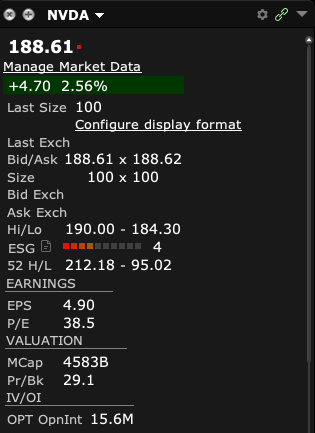
In our testing, searching for the major S&P 500 instruments was fast and easy. I also searched for several of the other top S&P 500 components to compare. The spread on MSFT, as an example, was also tight (typically also $0.01 during core market hours). This is typical for the largest S&P 500 names, but lower-weighted S&P 500 components can still show slightly wider spreads outside the busiest hours of the session.
S&P inclusion requires a market cap above approximately $23 billion, so there’s enough institutional volume to keep most tickers at 1-3 cent spreads throughout normal market hours.
Step 3: Analyze The Spread
For SPY, the most popular S&P 500 ETF, the bid-ask spread was tight at just one cent. The ETF’s massive daily trading volume makes it the most heavily traded ETF in the world, and is comparable to other broad-market funds like VOO and IVV. It will nonetheless widen out after market hours.
For individual S&P 500 components, the spread can vary. Heavyweight names like Apple, Microsoft, and Nvidia generally offer the tightest spreads during normal market hours when there isn’t news or events being digested into the market. Smaller-weighted S&P 500 components can widen out a touch, especially times around the open and close. If you’re trading smaller, individual S&P 500 stocks rather than the SPY ETF, account for the wider spread as an additional cost every time you get in and out of the trade.
Step 4: Select Your Order Type
I placed a limit order rather than a market order. (Note: I rarely use any type of market order to better control the price). On the S&P 500, where mega-cap components have gotten to be a bigger percentage of the overall index, these stocks can move the index dozens of points on a single earnings release, a limit order protects you from getting filled at a price worse than expected.
There are many different order types and nuances. But by and large it comes down to market orders and limit orders.
For most intraday S&P 500 trading, limit orders are the safest default, especially during the first 15-30 minutes after the opening bell when prices can sometimes swing faster than you can keep up. This is also true around quarterly index rebalancing events, when passive funds force concentrated buying or selling in specific names.
Step 5: Confirm And Execute
Before submitting, the platform displayed an order confirmation screen showing the ticker, order type, quantity, limit price, estimated commission, margin requirements (initial and maintenance margin), and total estimated cost. Note that things like margin requirements will be different depending on the account type (e.g., Reg-T, Portfolio Margin) and what other positions you might have in existing or related securities.
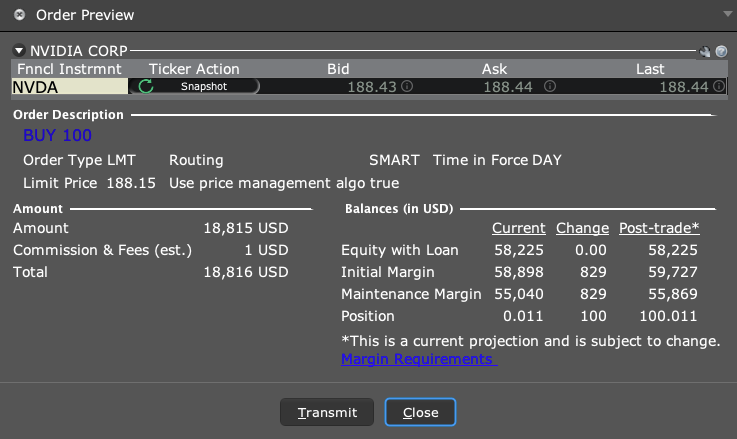
I reviewed these details and clicked confirm.
As a limit order, it shows up in your personal queue.
If you want to adjust the price of your limit order you can. On Interactive Brokers, a popup box showing the adjusted real-time price will often show.
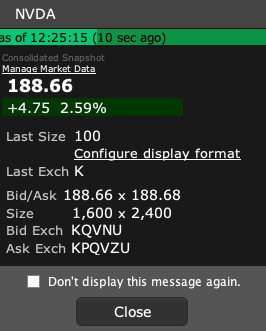
It partially filled at first, executing just 5 shares of the 100 orders. It eventually entirely filled during the regular session once it met my limit price.

This confirmation step is important because it gives you a final check before your capital is committed.
Step 6: Monitor And Manage The Position
After it filled, the position is summarized in your orders section.

And it appeared in my portfolio view with a real-time P&L on the very left, followed by the ticker, total share count owned, market value, average price purchased at, and last price.

What Is The S&P 500?
The Standard and Poor’s 500, commonly known as the “S&P 500”, is the most traded stock market index in the United States. The S&P 500 tracks the performance of the 500 largest US companies which meet the S&P criteria for selection. Because the S&P 500 represents most of the largest businesses in the US, many traders use the index to speculate on the health of the US economy in general. The index is even seen as a definition of the overall global economy.
The S&P 500 was initially introduced in 1957 to make it easier for traders to track the value of major companies trading on both the New York Stock Exchange (NYSE) and the NASDAQ Composite. It was founded by Henry Poor and the Standard Statistics Company in 1941. Since its development, US companies included on the S&P stock list have changed dramatically as firms have risen and fallen.
Note, when day trading with S&P 500 brokers, share prices and are typically denominated in USD.
S&P 500 Criteria Explained
The list of companies included in the S&P 500 is measured by the weightings of market cap and free float. For companies to be eligible for inclusion in the index, they must meet the following criteria:
- Must be a US-based company listed on the NYSE, Nasdaq, or Cboe Market cap of at least $22.7 billion
- Market cap of at least $22.7 billion (as of the time of writing)
- Majority of company shares are available in the public domain
- A minimum of 250,000 company shares have been traded in each of the last six months prior to the evaluation date
- Have positive GAAP earnings for the most recent quarter, and the sum of the prior four quarters’ earnings must also be positive The committee also considers sector balance to keep the index representative of the broader US economy. Importantly, meeting the criteria doesn’t guarantee inclusion. The committee has discretion, which is why some large companies remain outside the index despite qualifying on paper.
Note that not every large company in the US is necessarily included in the S&P as they may not satisfy the inclusion criteria above. This includes companies such as Berkshire Hathaway, Uber and Dell. Fortunately, the best S&P 500 brokers also offer trading opportunities on a range of equities not included on the index.
Trading Hours
The S&P 500 regular hours are aligned to the hours of the New York Stock Exchange and the Nasdaq stock market. The cash session runs 9:30 AM to 4:00 PM EST (1:30 PM to 8:00 PM GMT), excluding market holidays. Additionally, it is possible to engage in premarket trading and after-hours trading, depending on whether your chosen brokerage offers it.
Premarket typically opens at 4:00 AM ET and after-hours extends to 8:00 PM ET, though specific windows vary by broker. E-mini S&P 500 (ES) and Micro E-mini (MES) futures trade on the CME’s Globex platform nearly 24 hours a day, Sunday through Friday, with only a brief daily maintenance break. This near-continuous access is one of the key advantages of trading S&P 500 futures over cash equities.
E-Mini and Micro E-Mini S&P 500
In 1997 the Chicago Mercantile Exchange (CME) began offering the E-mini S&P 500 (ES). This contract offers futures and options based on the S&P 500 index. An E-mini S&P 500 futures contract essentially states that if a trader buys a contract today, they are obligated to either buy or sell the asset at a pre-agreed price on a set date in the future. Each point of movement in the ES contract is worth $50.
In 2019, the CME introduced the Micro E-mini S&P 500 (MES), which is one-tenth the size of the standard E-mini at $5 per point. The Micro contract has become extremely popular with retail traders because it allows participation in S&P 500 futures with significantly less capital and risk per contract.
According to the CME Group, ES futures offer significantly more daily liquidity than all S&P 500 ETFs combined. Traders of the S&P 500 may also deploy a hedging strategy with ES or MES futures to hedge against unexpected price moves that might impact their current positions. Traders can also set alerts for key price movements to stay on top of swings that may compromise their trades.
Getting Started
To get started trading the S&P 500:
Fund Your Account
Once you have selected your broker, you need to deposit funds into your account before you can begin to trade. S&P 500 brokers will offer different payment options. Instant processing and flexible limits should be top of your list. A low minimum deposit requirement should also be a key point to look out for, particularly if you are new to the index.
Recognized methods include VISA & Mastercard debit/credit cards, PayPal, and Skrill. Even cryptocurrency is being accepted as tender at some brokers.
Do Your Research
Before you enter the market, it’s good practice to carry out in-depth analysis and market research on the S&P 500 and the stocks in question. Because it’s the most widely traded index in the US market, there is a significant amount of information available online. The best S&P 500 brokers will provide useful articles about the index on their websites, however third-party platforms can often provide better independent insights.
Traders looking for S&P 500 trading tips that are free of charge can use discussion forums such as Reddit or consult online articles and videos. Other popular sources include Bloomberg and Morningstar. Approach all community tips and insights carefully – do your own research.
Choose Your Asset
Many traders may intend to trade the S&P 500 or the E-mini S&P 500, however there is also the option to trade some of the individual stocks included in the 500-strong list. It’s difficult to have a good understanding of all 500 stocks, as each will have its own market price driven by unique factors and fundamentals.
Despite this, all S&P stocks on the index share two common qualities: volume and volatility:
Volume
The meaning of volume is the number of shares being traded at a specific time. The S&P 500 trading volume is based on all of the shares of the stocks listed under the index. If the chart history of the S&P showed that the index had increased by a daily trade volume of 1,000 transactions since yesterday and decreased by 500 today, then the total volume over the two days would be 500. In this example, the average daily trading volume of the S&P 500 would be 250 (500/2 days).
Traders can use trading volumes to gauge whether other market participants’ interest is increasing or decreasing in the index, which could prompt a move from the trader. This volume trading logic applies to both the entire S&P index as well as individual stocks within the S&P.
Volatility
Volatility is the risk that an asset’s share price can change unpredictably at any given time. The size of any given price movement is relatively unknown, which therefore increases the risk.
Large swings are considered to be highly volatile, whereas smaller swings in an asset’s price are considered to be of low volatility or stable. Typically, day traders thrive when a stock’s price experiences large swings because it means that they can capitalize on volatile price movements.
Choose Your Strategy
Once you have chosen between brokers that support trading on the S&P 500, and the asset you wish you trade, you need to implement a strategy.
There is a range of strategies available depending on your risk tolerance or how active you will be in the market. In all scenarios, being aware of the S&P pre-market price will give traders an insight into the opening value of the asset, which helps with the development of a day trading strategy.
For example, an unusually high close/pre-opening market price might prompt a trader to sell or short the index in anticipation of the price falling when the market opens. This strategy is an example of intraday trading on the S&P 500.
Other traders may analyze the index’s performance over a longer time, which would typically lend itself to a swing trading strategy.
Some market participants trade the S&P 500 and other assets as their full-time jobs, and will often share free advice online on developing a solid strategy. When you are seeking tips online, however, be wary of any paid groups or courses as these are usually “too good to be true” and can sometimes be scams designed to target new traders.
It is also worth checking whether S&P 500 brokers permit certain strategies and trading systems before you sign up. Some S&P 500 brokerages and platforms prohibit scalping, for example.
Bottom Line
The S&P 500 has been traded for over 60 years and remains the leading index in the USA. It is popular with day traders because it gives a good indication as to how the US market is currently performing, which can provide insights into other asset classes.
It is worth noting that the S&P can be heavily influenced by how individual companies with large weighting are performing. For example, if Tesla’s share price falls due to an Elon Musk tweet, then the index might also be slightly affected by this as the market reacts.
Overall, the S&P 500 is a solid asset to have in your portfolio, and due to its popularity, there is a wide range of helpful resources available online. Use our list of the best brokers with access to the S&P 500 to get started.
FAQs
Do S&P 500 Brokers Offer Trading On The Index Via MetaTrader 4?
Yes, trading the S&P 500 is available on MT4 through supporting brokers, typically as a CFD product (not available in certain regions, such as the US). Some brokers that support trading on the S&P 500 also provide premarket trading and charts and tools to help identify key levels. Historical data on returns and dividend yields are also available at the top S&P 500 brokerages.
What Is The Symbol For The S&P 500 At Online Brokers?
The symbol depends on the instrument. The underlying index itself uses the ticker SPX. The most popular ETF tracking the S&P 500 is SPY. For futures, the E-mini S&P 500 uses the symbol ES (which is half the size of SPX), and the Micro E-mini uses MES. (MES is 1/10th of the size of ES). Your broker’s platform may use slight variations when it comes to looking up products, so use the search function and confirm you’re trading the correct product.
What Are The Main Ways To Trade The S&P 500?
There are four primary routes to take:
- ETFs (e.g., SPY, VOO, IVV)
- E-mini and Micro E-mini futures (ES, MES) on the CME
- SPX index options on the Cboe, and
- Individual constituent stocks
ETFs are the simplest for beginners. They’re also great for long-term trading and day trading alike. VOO and IVV are generally recommended for long-term holding while SPY is most commonly used by active traders because of its liquidity.
Futures and options offer leverage and near-24-hour market access for more active traders.
We’ve pulled together a how-to guide to trading and investing in the S&P 500.
When Does The S&P 500 Rebalance?
The index rebalances quarterly on the third Friday of March, June, September, and December. Changes can also occur outside this schedule in response to mergers, acquisitions, or delistings. Rebalancing can create short-term trading opportunities for those who pursue this strategy as passive funds adjust their holdings.
Is The Nasdaq Or S&P 500 Better For Active Trading?
The S&P 500 is a much broader representation of the US market. It includes stocks across all 11 GICS sectors, whereas the Nasdaq 100 is heavily made up of technology stocks (over 50% by weight).
The S&P 500 generally offers more stable intraday price action, while the Nasdaq tends to deliver sharper moves and higher volatility. The Nasdaq has about 40% higher volatility on a daily basis, which doesn’t necessarily mean 40% higher or lower moves.
Below you can see historical return, risk, and correlation statistics:
| Name | Ticker | SPY | QQQ | Annualized Return | Daily Standard Deviation | Monthly Standard Deviation | Annualized Standard Deviation |
|---|---|---|---|---|---|---|---|
| State Street SPDR S&P 500 ETF | SPY | 1.00 | 0.84 | 8.07% | 1.22% | 4.35% | 15.06% |
| Invesco QQQ Trust | QQQ | 0.84 | 1.00 | 9.90% | 1.70% | 6.68% | 23.15% |
(Asset correlations for the period 04/01/1999 to 03/31/2026 were based on monthly returns.)
The right choice should be made based on the trader’s strategy, market knowledge, and risk tolerance. Most S&P 500 brokers also support trading on the Nasdaq.
What Time Does The S&P 500 Start Trading?
The NYSE and the Nasdaq both open at 9:30 AM and close at 4:00 PM EST. The S&P 500 and all of the stocks included in the index are also bound by these timings.
Premarket trading is available from as early as 4:00 AM ET at some brokers, and E-mini futures trade nearly around the clock on weekdays via the CME Globex platform.