




When it comes to active trading, cost matters; whether you’re an experienced trader or a beginner, I know from my time as a full-time trader that fees, commissions, and spreads can make a big difference in your profitability.
Fortunately, we’ve compared and ranked the cheapest brokers in October 2026. Our experts have personally tested the top low-cost providers and listed the best discount brokers with low fees but terrific trading platforms.
Lowest Cost Brokers in Monaco
These are the 6 best discount brokers in Monaco, ranked by lowest total trading costs and overall rating:
-
- Demo account
- Min. deposit: $0
- Min. trade: 0.01 Lots
-
- Demo account
- Regulator: ASIC, CySEC, FSA, SCB, CMA-Kenya
- Min. deposit: $200
-
- Demo account
- Regulator: CySEC, MISA
- Platforms: MT4, MT5
-
- Demo account
- Min. deposit: $0
- Min. trade: 0.01 Lots
73-89% of retail investor accounts lose money when trading CFDs -
- Demo account
- Regulator: FCA, ASIC, FSCA, VFSC, CIMA
- Min. deposit: $50
-
- Demo account
- Regulator: ASIC, VFSC, FSA
- Platforms: MT4, MT5, cTrader, TradingView, DupliTrade






Learn how we test brokers and why you can trust our ratings.
Why Are These The Best Brokers For Affordable Day Trading?
Here is a summary of why we think these are the top low-cost brokers:
- IG is our top-rated cheapest broker in Monaco in 2026 4.8/5 Founded in 1974, IG is part of IG Group Holdings Plc, a publicly traded (LSE: IGG) brokerage. The brand offers a top-tier selection of 17,000+ markets, with a range of user-friendly platforms and investing apps. For 50 years, IG has maintained its position as an industry leader, excelling in all key areas for traders.
- IC 4.8/5 IC Markets (now IC) is a globally recognized forex and CFD broker known for its excellent pricing, comprehensive range of trading instruments, and premium trading technology. Founded in 2007 and headquartered in Australia, the brokerage is regulated by the ASIC, CySEC and FSA, and has attracted more than 200,000 clients from over 200 countries.
- FXCC 4.6/5 FXCC is an established broker that’s been offering low-cost online trading since 2010. Registered in Comoros Union and regulated by the CySEC, it stands out for its ECN trading conditions, no minimum deposit and smooth account opening that takes less than 5 minutes.
- Pepperstone 4.8/5 Established in Australia in 2010, Pepperstone is a top-rated forex and CFD broker with over 830,000 clients worldwide. It offers access to 1,400+ instruments on leading platforms MT4, MT5, cTrader and TradingView, maintaining low, transparent fees. Pepperstone is also regulated by trusted authorities like the FCA, ASIC, and CySEC, helping to ensure a secure environment for day traders at all levels.
- Vantage 4.7/5 Founded in 2009, Vantage offers trading on 1000+ short-term CFD products to millions of clients. You can trade Forex CFDs from 0.0 pips on the RAW account through TradingView, MT4 or MT5. Vantage is ASIC-regulated and client funds are segregated. Copy traders will also appreciate the range of social trading tools.
- Fusion Markets 4.6/5 Fusion Markets is an online broker established in 2017 and regulated by the ASIC, VFSC and FSA. It is best known for its low-cost forex and CFD trading, although its multiple account types and copy trading solutions cater to a range of traders. New clients can sign up and start trading in 3 easy steps.
Comparison Of Costs At Our Cheapest Brokers
Find the right discount brokerage for you with our comparison of key costs for active traders:
| Broker | Cost Rating | Fee on EUR/USD | Fee on FTSE | Fee on Stocks | Fee on Oil | Fee for Inactivity |
|---|---|---|---|---|---|---|
| IG | 0.86 | 1.0 | 0.02 | 2.8 | $12 | |
| IC | 0.1 | 1.0 | 0.02 | 0.03 | $0 | |
| FXCC | 0.1 | 1.10 | 0.17 (Apple) | 0.035 | $5 | |
| Pepperstone | 0.1 | 1.0 | 0.02 | 0.02 | $0 | |
| Vantage | 0.18 | 1.0 | 0.01 | 0.01 | $0 | |
| Fusion Markets | 0.05 | 1.0 | 0.01 | 2.0 | $0 |
How Safe Are These Cheap Brokers?
See how dependable the cheapest day trading brokers are and how they help safeguard your account:
| Broker | Trust Rating | Guaranteed Stop Loss | Negative Balance Protection | Segregated Accounts |
|---|---|---|---|---|
| IG | ✔Yes | ✔Yes | ✔Yes | |
| IC | ✘No | ✔Yes | ✔Yes | |
| FXCC | ✘No | ✔Yes | ✔Yes | |
| Pepperstone | ✘No | ✔Yes | ✔Yes | |
| Vantage | ✘No | ✔Yes | ✔Yes | |
| Fusion Markets | ✘No | ✔Yes | ✔Yes |
Mobile Trading Comparison
See how good these brokers are for low-cost day trading on mobile:
| Broker | Mobile Apps | iOS Rating | Android Rating | Smart Watch App |
|---|---|---|---|---|
| IG | iOS & Android | ✔Yes | ||
| IC | iOS & Android | ✘No | ||
| FXCC | iOS & Android | ✘No | ||
| Pepperstone | iOS & Android | ✘No | ||
| Vantage | iOS & Android | ✘No | ||
| Fusion Markets | iOS & Android | ✘No |
Are The Top Brokers With Low Fees Good For Beginners?
Beginners should use brokers with minimal fees that allow trading with virtual money and support new traders:
| Broker | Demo Account | Minimum Deposit | Minimum Trade | Education Rating | Support Rating |
|---|---|---|---|---|---|
| IG | ✔Yes | $0 | 0.01 Lots | ||
| IC | ✔Yes | $200 | 0.01 Lots | ||
| FXCC | ✔Yes | $0 | 0.01 Lots | ||
| Pepperstone | ✔Yes | $0 | 0.01 Lots | ||
| Vantage | ✔Yes | $50 | 0.01 Lots | ||
| Fusion Markets | ✔Yes | $0 | 0.01 Lots |
Are The Top Brokers With Low Fees Good For Advanced Traders?
See how good these cheap trading platforms are for advanced traders:
| Broker | Automated Trading | VPS | AI | Pro Account | Leverage | Low Latency | Extended Hours |
|---|---|---|---|---|---|---|---|
| IG | Expert Advisors (EAs) on MetaTrader, build your own on ProRealTime | ✔Yes | ✔Yes | ✔Yes | 1:30 (Retail), 1:250 (Pro) | ✔Yes | ✔Yes |
| IC | Expert Advisors (EAs) on MetaTrader, cBots on cTrader, Myfxbook AutoTrade | ✔Yes | ✘No | ✘No | 1:5000 | ✔Yes | ✘No |
| FXCC | Expert Advisors (EAs) on MetaTrader | ✔Yes | ✘No | ✘No | 1:1000 | ✔Yes | ✘No |
| Pepperstone | Expert Advisors (EAs) on MetaTrader, cBots on cTrader | ✘No | ✘No | ✔Yes | 1:30 (Retail - UK, EU, Australia), 1:500 (Pro), 1:200 (Offshore), 1:400 (Kenya) | ✔Yes | ✘No |
| Vantage | Myfxbook AutoTrade, Expert Advisors (EAs) on MetaTrader | ✔Yes | ✘No | ✘No | 1:500 | ✘No | ✘No |
| Fusion Markets | Expert Advisors (EAs) on MetaTrader, cBots on cTrader | ✔Yes | ✘No | ✘No | 1:500 | ✔Yes | ✘No |
Compare The Ratings Of The Cheapest Day Trading Brokers
Uncover how the top inexpensive brokers score in core areas according to our hands-on evaluations:
| Broker | Trust | Platforms | Assets | Mobile | Fees | Accounts | Research | Education | Support |
|---|---|---|---|---|---|---|---|---|---|
| IG | |||||||||
| IC | |||||||||
| FXCC | |||||||||
| Pepperstone | |||||||||
| Vantage | |||||||||
| Fusion Markets |
Community Sentiment
See how users rate these brokers based on the average customer ratings submitted on DayTrading.com, plus ratings from Trustpilot, the Apple App Store and Google Play.
| Broker | Our Users' Rating | Trustpilot Score | Trustpilot Reviews | iOS App Rating | Android App Rating |
|---|---|---|---|---|---|
| IG | 10134 | ||||
| IC | 2 | ||||
| FXCC | 220 | ||||
| Pepperstone | 3678 | ||||
| Vantage | 15615 | ||||
| Fusion Markets | 10051 |
How Popular Are These Budget Brokers?
Many day traders prefer the most popular brokers with low fees (those with the largest user base):
Why Choose IG For Low-Cost Trading?
IG continues to provide a comprehensive package with an intuitive web platform, best-in-class education for beginners, advanced charting tools bolstered by its recent TradingView integration, real-time data, and robust trade execution for experienced day traders.
 Christian Harris, Reviewer
IG quick facts
- Demo Account
- ✔Yes
- Instruments
- CFDs (not in US), Forex, Stocks, Indices, Commodities, ETFs, Futures, Options, Crypto, Spread Betting (UK only)
- Regulator
- CFTC, NFA, FCA, BaFin, ASIC, FINMA, MAS, JFSA, FMA, DFSA, BMA
- Platforms
- Web, L2 Dealer, MT4, TradingView, AutoChartist, TradingCentral, ProRealTime
- Minimum Deposit
- $0
- Minimum Trade
- 0.01 Lots
- Account Currencies
- USD, EUR, GBP, CAD, AUD, JPY, ZAR, SEK, DKK, CHF, HKD, SGD
Pros
- IG offers an extensive collection of professional and engaging educational resources, including webinars, articles, and analysis.
- IG obtained a crypto asset license from the FCA, allowing it to re-enter the UK market to provide buying, selling and storing opportunities on 55+ digital tokens with fees from 1.49%, and all within an FCA-licensed environment.
- The IG app offers a superb mobile trading experience with a clean design that helped it secure Runner Up at our 'Best Trading App' award.
Cons
- IG applies an inactivity fee of $12-$18 per month after 2 years, deterring casual investors.
- IG has discontinued its swap-free account, reducing its appeal to Islamic traders.
- Beginners might find IG’s fee structure complex, with various fees for different types of trades or services, potentially leading to confusion or unexpected charges.
Why Choose IC For Low-Cost Trading?
IC (formerly IC Markets) offers superior pricing, exceptionally fast execution and seamless deposits. The introduction of advanced charting platforms, notably TradingView, and the Raw Trader Plus account, ensures it remains a top choice for intermediate to advanced day traders.
Christian Harris, Reviewer
IC quick facts
- Demo Account
- ✔Yes
- Instruments
- CFDs, Forex, Stocks, Indices, Commodities, Bonds, Futures, Crypto
- Regulator
- ASIC, CySEC, FSA, SCB, CMA-Kenya
- Platforms
- MT4, MT5, cTrader, TradingView, TradingCentral, DupliTrade, Quantower
- Minimum Deposit
- $200
- Minimum Trade
- 0.01 Lots
- Account Currencies
- USD, EUR, GBP, CAD, AUD, NZD, JPY, CHF, HKD, SGD
Pros
- You have access to over 2,250 CFDs across various markets, including forex, commodities, indices, stocks, bonds, and cryptocurrencies, allowing for diversified trading strategies.
- IC offers fast and dependable 24/7 support based on firsthand experience, particularly when it comes to accounts and funding issues.
- As a tightly regulated and widely respected broker, IC prioritizes client security and transparency, helping to ensure a reliable trading experience globally.
Cons
- Interest isn't paid on unused cash, an increasingly popular feature found at alternatives like Interactive Brokers.
- The breadth and depth of tutorials, webinars and educational resources still need work, trailing alternatives like CMC Markets and reducing its suitability for beginners.
- Despite four industry-leading third-party platforms, there is no proprietary software or trading app built with new traders in mind.
Why Choose FXCC For Low-Cost Trading?
FXCC continues to prove itself an excellent option for day traders with a particularly strong selection of 70+ currency pairs, ultra-tight spreads from 0.0 pips during testing, and a free VPS for qualifying traders.
 Jemma Grist, Reviewer
FXCC quick facts
- Demo Account
- ✔Yes
- Instruments
- CFDs, Forex, Stocks, Indices, Metals, Energies, Crypto
- Regulator
- CySEC, MISA
- Platforms
- MT4, MT5
- Minimum Deposit
- $0
- Minimum Trade
- 0.01 Lots
- Account Currencies
- USD, EUR, GBP, CAD
Pros
- Customer support still relies on human agents with response times of under three minutes on live chat during our tests and knowledgeable reps - a welcome break from the frustrating AI chatbots increasingly offered by brokers.
- FXCC’s ECN XL account has been built with active traders in mind, featuring spreads from 0.0 with no commission, while also passing our execution speed benchmark for day traders.
- FXCC has stepped up its offering over the years, adding MT5 to its suite of platforms, hundreds of stocks and more cryptos to its product line-up, plus a copy trading feature and greater margin trading opportunities.
Cons
- Although regulated by the CySEC, FXCC’s offshore entity operates with weak regulatory oversight from MISA and may not provide safeguards like investor compensation in the event of broker insolvency.
- Although the economic calendar has benefited from a facelift, FXCC still offers very little in terms of market research beyond basic daily technical analysis and aggregated market news, with no tools like Autochartist or social sentiment data.
- Although FXCC has bolstered its range of markets with US, European and Asian stocks, the choice of metals and energies is light, and there are no soft commodities.
Why Choose Pepperstone For Low-Cost Trading?
Pepperstone stands out as a top choice for day trading, offering razor-sharp spreads, ultra-fast execution, and advanced charting platforms for experienced traders. New traders are also welcomed with no minimum deposit, extensive educational resources, and exceptional 24/5 support (18h a day on weekends).
Christian Harris, Reviewer
Pepperstone quick facts
- Demo Account
- ✔Yes
- Instruments
- CFDs, Forex, Currency Indices, Stocks, Indices, Commodities, ETFs, Crypto CFDs, Spread Betting
- Regulator
- FCA, ASIC, CySEC, BaFin, DFSA, SCA, SCB, CMA-Kenya
- Platforms
- Pepperstone Trading Platform, MT4, MT5, cTrader, TradingView
- Minimum Deposit
- $0
- Minimum Trade
- 0.01 Lots
- Account Currencies
- USD, EUR, GBP, CAD, AUD, NZD, JPY, CHF, HKD, SGD
Pros
- Award-winning customer support is available via telephone, email or live chat with response times of <5 minutes during testing and friendly agents knowledgeable about its products and trading tools.
- Pepperstone has greatly improved the deposit and withdrawal experience in recent years, adding Apple Pay and Google Pay in 2025, as well as PIX and SPEI for clients in Brazil and Mexico in 2024.
- After adding spread betting through TradingView, Pepperstone provides a seamless, tax-efficient trading experience with advanced analysis tools for financial spread bettors in supported countries.
Cons
- Overnight holding fees are higher than that found with some Market Maker brokers (usually Benchmark + 2.5%). This makes pepperstone an ideal broker for day traders and forex scalpers but less suitable for swing traders who often keep position open overnight.
- Despite improvements to its range of markets, crypto CFD offerings are still fairly limited compared to other brokers who focus on this area, such as Eightcap, and there's no option to invest in real coins.
- Pepperstone has removed support for several tools that elevated the trading experience for active retail traders, notably Autochartist, Capitalise.ai and a free VPS for qualifying traders (now only pro traders in some countries).
Why Choose Vantage For Low-Cost Trading?
Vantage remains an excellent option for CFD traders seeking a tightly-regulated broker with access to the reliable MetaTrader platforms. The fast sign-up process and $50 minimum deposit make it very straightforward to start day trading quickly.
Jemma Grist, Reviewer
Vantage quick facts
- Demo Account
- ✔Yes
- Instruments
- CFDs, Forex, Stocks, Indices, Commodities, ETFs, Bonds
- Regulator
- FCA, ASIC, FSCA, VFSC, CIMA
- Platforms
- ProTrader, MT4, MT5, TradingView, TradingCentral, DupliTrade
- Minimum Deposit
- $50
- Minimum Trade
- 0.01 Lots
- Account Currencies
- USD, EUR, GBP, CAD, AUD, NZD, JPY, HKD, SGD, PLN
Pros
- Vantage maintains its high trust score thanks to its strong reputation and top-tier regulation from the FCA and ASIC
- There are no short-term strategy restrictions with hedging and scalping permitted
- The app was upgraded in 2026 with wider asset visibility bringing together balances across Contract, Copy, and Funding accounts on one screen
Cons
- It's a shame that some clients will need to register with the offshore entity, which offers less regulatory protection
- The average execution speeds of 100ms to 250ms are slower than alternatives based on tests
- A steep $10,000 deposit is needed for the best trading conditions, which include the $1.50 commission per side
Why Choose Fusion Markets For Low-Cost Trading?
Fusion Markets is a standout option for forex traders looking for excellent pricing with spreads near zero, industry-low commissions and recently TradingView integration. It’s a particularly good broker for Australian traders where the company is headquartered and regulated by the ASIC.
Jemma Grist, Reviewer
Fusion Markets quick facts
- Demo Account
- ✔Yes
- Instruments
- CFDs, Forex, Stocks, Indices, Commodities, Crypto
- Regulator
- ASIC, VFSC, FSA
- Platforms
- MT4, MT5, cTrader, TradingView, DupliTrade
- Minimum Deposit
- $0
- Minimum Trade
- 0.01 Lots
- Account Currencies
- USD, EUR, GBP, CAD, AUD, NZD, JPY, CHF, HKD, SGD
Pros
- Average execution speeds of around 37 milliseconds are noticeably faster than many rivals and can help day traders secure optimal prices in fast-moving markets.
- Fusion Markets offers best-in-class support with very fast, friendly and helpful responses during tests and no frustrating automated chatbot to navigate.
- Withdrawal processing times have been slashed to under an hour and can be processed 24/7, making it faster and easier for active traders to withdraw any gains.
Cons
- Traders outside of Australia must sign up with weakly regulated global entities with limited safeguards, though in August 2026 they made negative balance protection available to all eligible accounts.
- The demo account expires after 30 days, limiting its potential as a useful trading tool alongside a real-money account.
- Fusion Market trails alternatives, notably IG, in the education department with limited guides and live video sessions to upskill new traders.
How We Chose The Cheapest Brokers
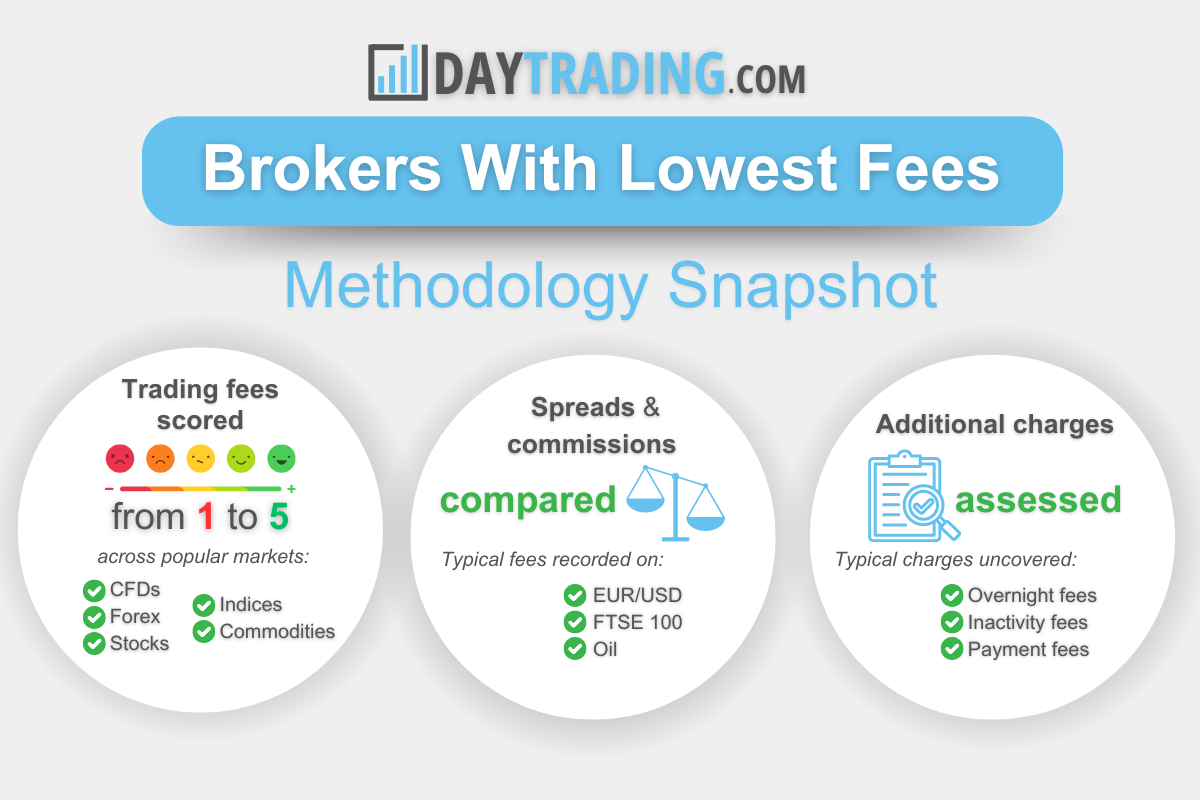
We ranked brokers with the lowest trading fees using two core metrics that draw on nearly 300 data points:
- Cost Rating: We scored each broker from 1 to 5 for their trading fees across popular markets, including forex, stocks, indices, commodities, and CFDs. We then compared everything against industry standards.
- Overall Rating: We gave each broker a 1 to 5 score after testing every inch of their offering. This reflects our belief that low costs must pair with an outstanding trading environment for the best overall experience.
Why Cost Matters In Trading
When it comes to popular instruments with short-term traders like CFDs and forex, every dollar counts.
The allure of trading lies in its potential to multiply small investments into significant profits, but excessive fees can erode your gains, leaving you with little to show for your efforts.
As a day trader making frequent trades, minimizing trading costs is crucial to achieving profitability.
For example:
- A trader executing 50 trades per month with a $10 commission per trade will spend $500 just on commissions.
- Similarly, wide spreads on popular currency pairs like EUR/USD can inflate costs for scalpers and high-frequency traders.
Understanding The Fees You’ll Pay To Trade
Let’s break down the primary costs like spreads and commissions, which are often the most visible costs of short-term trading:
Spreads
This is the difference between the bid (selling) and ask (buying) price of an asset.
- Tight spreads (eg 0.0-0.5 pips for EUR/USD) are ideal for traders, especially scalpers and day traders making frequent transactions.
- Brokers may offer variable or fixed spreads. Variable spreads tend to be lower during normal market conditions but widen during volatility. Fixed spread brokers offer the same price regardless of market conditions.
Commissions
These are charged per trade, usually alongside raw spreads.
Commissions are often preferred by professional traders who value transparency and consistent pricing.
Overnight/Swap Fees
While these can generally be avoided by day traders, if you hold positions overnight, you’ll incur swap fees reflecting the interest rate differential between two currencies.
- Positive swaps: You may earn interest if you hold higher-yielding currency.
- Negative swaps: Most positions result in a fee, which can be substantial for long-term trades.
A long position on EUR/USD may incur a daily fee of $1.50 per standard lot. Over a month, this could total $45, significantly affecting profitability.
Other Hidden Fees
These are less obvious but can still have a significant impact:
- Inactivity Fees: Some brokers charge monthly fees for dormant accounts. Look for brokers, such as Pepperstone, that explicitly avoid such charges.
- Withdrawal Fees: Fees for withdrawing funds vary; some brokers charge a percentage or a fixed amount per transaction. Look for brokers, such as Eightcap, that don’t charge internal withdrawal fees.
- Currency Conversion Fees: These apply when trading in a currency other than your account’s base currency. If you frequently trade in this currency, opt for brokers with multi-currency accounts, such as Swissquote, to minimize conversion losses.
- Leverage Considerations: Leverage lets you control larger positions with less capital, magnifying both profits and losses. Retail traders typically get up to 1:30 leverage in regulated markets (EU, UK, Australia) or up to and beyond 1:500 in less regulated areas. While it increases exposure, it also raises the risk of significant losses and may include extra risk management fees.
Higher spreads or commissions can eat into profits, particularly for short-term traders like us day traders.
I’ve always compared brokers based on all the cost metrics to assess my overall trading fees, and I suggest you do too.
 Paul HolmesAuthor
An Example Trade With The Costs Laid Bare
Let’s bring all the fees you could incur to life by taking a look at a short-term CFD trade on the SPX500 with a price movement from 6,000 to 6,050.
Trade Details:
- Index: SPX500 (S&P 500 Index)
- Account Type: Standard CFD Account
- Position: Buy (Long)
- Lot Size: 1 standard lot (representing $1 per point move in the SPX500 price)
- Opening Price: 6,000
- Closing Price: 6,050
- Duration of Trade: Held for three days (including two overnight periods)
- Leverage: 1:20 (5% margin requirement)
1. Spread Costs
Assume my broker charges a spread of 0.5 points on the SPX500.
Cost:
- Spread = 0.5 points x $1 per point = $0.50.
2. Commission Costs
Many brokers charge commissions in addition to spreads. For example:
- Commission = $4 per round turn per lot.
Cost:
- Commission = $4.00.
3. Overnight/Swap Fees
Holding a leveraged position overnight incurs financing costs (you can avoid this by day trading).
For a long position:
- Typical rate = 3% annualized interest on the borrowed amount.
Calculation:
- Borrowed amount = Position value – Margin = ($6,000 x 1 lot) – ($6,000 / 20 leverage) = $5,700.
- Daily interest = (3% / 365) x $5,700 ≈ $0.47 per day.
Cost For 2 nights:
- $0.47 x 2 = $0.94.
4. Currency Conversion Fees (If Applicable)
If your account currency isn’t USD (over 90% of brokers we’ve evaluated offer a USD trading account), conversion fees might apply. Assuming:
- Fee = 0.5% of profit or trade value.
For simplicity, if you make a $50 profit:
- Conversion fee = 0.5% x $50 = $0.25.
Total Charges
| Charge Type | Cost |
|---|---|
| Spread | $0.50 |
| Commission | $4.00 |
| Overnight Fees (two days) | $0.94 |
| Conversion Fee | $0.25 |
Total Trading Costs: $5.69
Net Profit/Loss Calculation
If the trade moves 50 points in my favor (from 6,000 to 6,050):
- Profit = 50 points x $1 per point = $50.
- After deducting total costs of $5.69:
Net Profit = $44.31.
Why “Cheap” Isn’t Always Better
While finding a low-cost broker is essential, cheaper isn’t always better. Here’s why:
- Hidden Costs: We’ve observed an increasing number of brokers with “zero commission” models, such as Robinhood and Freetrade, but they sometimes widen spreads or impose high overnight fees to compensate.
- Limited Features: Some low-cost brokers cut corners, offering fewer research tools, educational resources, or slower customer service.
- Lack Of Security: A broker advertising unrealistically low fees might skimp on regulatory compliance, putting your funds at risk.
The key is to balance cost and quality. Look for brokers offering competitive pricing without compromising reliability, features, or safety.
What To Look For In A Low-Cost Broker
A “cheap” trading platform must still meet high standards of transparency, flexibility, security, and usability to support a positive trading experience.
Based on my many years of trading, here’s what to prioritize:
- Transparency: Transparent brokers provide upfront details about their costs, allowing traders to make informed decisions. Key areas to check:
- Spreads and Commissions: Look for trading platforms offering clearly defined rates (eg spreads from 0.0 pips with commissions around $3.5 per lot).
- Additional Fees: Ensure clarity on potential charges like:
- Inactivity fees.
- Deposit/withdrawal fees and currency conversion rates.
- Regulatory documents and website FAQs should outline all possible fees.
- Account Flexibility: Options to suit different trading styles. Common options include:
- Standard Accounts: Ideal for beginner traders with zero or low commissions and slightly wider spreads.
- Raw Spread Accounts: Suitable for advanced day traders and professional traders, offering interbank spreads (eg starting at 0.0 pips) paired with a flat commission.
- Micro Accounts: Allow trading with smaller positions (eg 0.01 lots), perfect for those starting with limited capital.
I’ve always looked for brokers that allowed easy switching between account types as my trading strategy evolved.
Paul HolmesAuthorPros And Cons Of Low-Cost Brokers
Pros
- Reduced Trading Costs: Tight spreads and low or zero commissions allow traders to retain more profits, which is particularly beneficial for day traders who make frequent trades. For example, trading like IC Markets providing raw spreads starting at 0.0 pips with minimal commission fees are ideal for high-frequency trading.
- Suitability For Scalping And Frequent Trades: Scalpers, who rely on minute price movements, benefit significantly from brokers with low spreads and fees, such as Fusion Markets. Traders executing dozens of trades daily save considerably when commissions are low or non-existent.
- Accessibility For New Traders: Affordable options like micro or standard accounts let beginners enter the market with lower upfront costs. Lower minimum deposits (some brokers like XM allow as little as $5) encourage broader participation in trading.
- Transparency In Pricing: Many budget brokers like FBS pride themselves on clear, upfront fee structures, helping traders avoid surprises.
Cons
- Limited Features Or Research Tools: Some low-cost brokers like FXCC may sacrifice advanced features like market analysis tools, trading signals, or educational resources to maintain competitive pricing. Full-featured platforms like TradingView integrations may be absent or cost extra.
- Reduced Customer Support: I’ve seen that cost-cutting can extend to customer service. Traders may experience slower response times or limited support hours compared to premium brokers. For example, some brokers like RedMars only offer basic email or ticket-based support rather than 24/7 live chat.
- Hidden Costs: While spreads and commissions may appear low, hidden fees like inactivity charges, withdrawal costs, or currency conversion fees can add up over time. Carefully read the fee structure to avoid unpleasant surprises.
- Compromises In Regulation: Not all low-cost brokers are regulated by top-tier authorities, potentially exposing traders to greater risk. Always prioritize brokers regulated by ‘green tier’ entities in DayTrading.com’s Regulation & Trust Rating like ASIC (Australia) or FCA (UK), even if their costs are slightly higher.
Low-cost brokers offer significant advantages, particularly for traders who maximize profits by minimizing fees.
However, early in my career, I discovered that trading with budget brokers may cause trade-offs that could impact your overall trading experience.
Paul HolmesAuthorBottom Line
When it comes to choosing the cheapest broker for short-term trading, it’s essential to look beyond the surface and evaluate the overall value they provide.
With trading firms increasingly aiming to position themselves as “discount brokers”, featuring attractive low fees and tight spreads, that’s just part of the equation.
A brokerage that aligns with your trading style, offers a user-friendly platform and ensures safety through proper regulation, is just as important. That’s why we blended cost with the overall quality of the trading environment to compile our rankings.
To find the right trading platform for your needs, see DayTrading.com’s choice of the best brokers with low fees.