




Day trading alerts can be a powerful tool in helping to identify short-term trading opportunities and manage risk. For example, you could set an alert in your broker’s app to notify you when the price of Apple (AAPL) stock reaches a certain level, prompting a buy or sell action.
This guide will catalog the different types of trading alerts out there, explain how they can enhance a day trader’s returns, and discuss the key things to consider when choosing an alert provider.
Best Brokers With Day Trading Alerts
Following our hands-on tests, these are the 6 highest-rated brokers with day trading alerts, available through desktop platforms and mobile apps:
-
- Demo account
- Min. deposit: $0
- Min. trade: 0.01 Lots
70% of retail investor accounts lose money when trading CFDs with this provider. You should consider whether you can afford to take the high risk of losing your money. -
- Regulator: FCA
- Platforms: Spreadex Platform, TradingView, AutoChartist
- Min. trade: £0.01
-
- Demo account
- Regulator: FCA, ASIC, CMVM , FSCA, SCB, FSA
- Platforms: TN Trader, MT4, TradingView
-
- Demo account
- Min. deposit: $0
- Min. trade: 0.01 Lots
73-89% of retail investor accounts lose money when trading CFDs -
- Demo account
- Regulator: FMA, FSA
- Min. deposit: $0
-
- Demo account
- Platforms: eToro Web, CopyTrader, TradingCentral
- Min. deposit: $50
61% of retail CFD accounts lose money. eToro is a multi-asset investment platform. The value of your investments may go up or down. Your capital is at risk.





Learn how we test brokers and why you can trust our ratings.
Here is a short summary of why we think each broker belongs in this top list:
- IG 4.8/5 Founded in 1974, IG is part of IG Group Holdings Plc, a publicly traded (LSE: IGG) brokerage. The brand offers a top-tier selection of 17,000+ markets, with a range of user-friendly platforms and investing apps. For 50 years, IG has maintained its position as an industry leader, excelling in all key areas for traders.
- Spreadex 4.5/5 Spreadex is an FCA-regulated broker that offers spread betting opportunities on an impressive 10,000+ CFD instruments including 60 forex pairs. Traders can also take short-term positions on sporting events. The brand has been around for over 20 years and has won multiple awards.
- Trade Nation 4.4/5 While using Trade Nation, its Signal Centre really impressed: free daily trade-ideas (FX, indices, commodities), combining technical and fundamental insights. The in-dashboard signals in TN Trader are timely; chart signals pair nicely with TradingView integration. We found it solid for those who want guided ideas rather than full automation.
- Pepperstone 4.8/5 In our hands-on signal tests, Pepperstone excelled with its pattern alerts (e.g. triangles, wedges) and through MT4/MT5/cTrader, plus Myfxbook AutoTrade and SignalStart, it delivers flexible signal-following. Great for traders who value reliability and fast market filtering.
- BlackBull 4.5/5 When we tested BlackBull, its CopyTrader stood out as a solid signal-tool: you can mirror elite fund managers, see their track record, and set risk rules. Plus the broker includes Acuity-powered AI news & sentiment feeds and signals in cTrader as part of its suite.
- eToro 4.0/5 In our tests at eToro, its CopyTrader™ feature stood out by allowing users to automatically replicate the trades of top-performing investors in real-time - taking trading signals to the next level. Additionally, eToro offers a range of user-friendly technical indicators, such as Bollinger Bands and Keltner Channels, to assist active traders in identifying potential entry points.
Community Sentiment
See how users rate these brokers based on the average customer ratings submitted on DayTrading.com, plus ratings from Trustpilot, the Apple App Store and Google Play.
| Broker | Our Users' Rating | Trustpilot Score | Trustpilot Reviews | iOS App Rating | Android App Rating |
|---|---|---|---|---|---|
| IG | 10185 | ||||
| Spreadex | 2292 | ||||
| Trade Nation | 2170 | ||||
| Pepperstone | 3703 | ||||
| BlackBull | 3519 | ||||
| eToro | 32244 |
IG
IG continues to provide a comprehensive package with an intuitive web platform, best-in-class education for beginners, advanced charting tools bolstered by its recent TradingView integration, real-time data, and robust trade execution for experienced day traders.
 Christian Harris, Reviewer
IG quick facts
- Demo Account
- ✔Yes
- Instruments
- CFDs (not in US), Forex, Stocks, Indices, Commodities, ETFs, Futures, Options, Crypto, Spread Betting (UK only)
- Regulator
- CFTC, NFA, FCA, BaFin, ASIC, FINMA, MAS, JFSA, FMA, DFSA, BMA, CONSOB
- Platforms
- Web, L2 Dealer, MT4, TradingView, AutoChartist, TradingCentral, ProRealTime
- Minimum Deposit
- $0
- Minimum Trade
- 0.01 Lots
- Account Currencies
- USD, EUR, GBP, CAD, AUD, JPY, ZAR, SEK, DKK, CHF, HKD, SGD
Pros
- IG obtained a crypto asset license from the FCA, allowing it to re-enter the UK market to provide buying, selling and storing opportunities on 55+ digital tokens with fees from 1.49%, and all within an FCA-licensed environment.
- The ProRealTime advanced charting platform is free as long as certain modest monthly trading activity requirements are met.
- IG offers an extensive collection of professional and engaging educational resources, including webinars, articles, and analysis.
Cons
- Beginners might find IG’s fee structure complex, with various fees for different types of trades or services, potentially leading to confusion or unexpected charges.
- IG applies an inactivity fee of $12-$18 per month after 2 years, deterring casual investors.
- IG has discontinued its swap-free account, reducing its appeal to Islamic traders.
Spreadex
Spreadex will appeal to UK day traders who are interested in both spread betting on financial markets and placing traditional bets on sports events. Fees are low on short trades and profits are tax-free on spread bets. There's also a powerful proprietary charting platform, plus £0 minimum deposit required to get started.
Christian Harris, Reviewer
Spreadex quick facts
- Demo Account
- ✘No
- Instruments
- Forex, CFDs, Indices, Commodities, Stocks, Crypto, Bonds, Interest Rates, ETFs, Options, Spread Betting
- Regulator
- FCA
- Platforms
- Spreadex Platform, TradingView, AutoChartist
- Minimum Deposit
- £0 (but £5 minimum for standard payment methods)
- Minimum Trade
- £0.01
- Account Currencies
- USD, EUR, GBP, CAD, CHF
Pros
- Spreadex introduced trading signals to its desktop platform, powered by Autochartist, providing real-time, pattern-based insights to help active traders identify potential opportunities.
- In our live tests near London, Spreadex returned 120–200ms round-trip latency across 50+ FTSE and EUR/USD trades, with no requotes and mostly controlled slippage in normal market conditions.
- The web platform works well for active trading from testing, with one-click trading, watchlists, saved layouts, while Force Open all worked smoothly. It was easy to build a clean workspace and manage short-term trade.
Cons
- Execution is decent but not elite from our tests - we recorded 0.2–0.4 pip slippage on liquid markets in calmer periods, but news spikes pushed some fills toward 1 pip, and thinner AIM stocks regularly slipped by 2–4 points.
- CFDs, financial spread bets, sports, and casino activity all sit in one pooled balance. For serious active traders, that means losses outside trading can directly reduce margin available for trading positions.
- There is no MT4, MT5, cTrader, API, VPS, or algo support - leaving Spreadex much better suited to hands-on traders than anyone running automated or custom trading infrastructure.
Trade Nation
Trade Nation suits discretionary traders who want to speculate on major indices like the US 500 or liquid FX pairs, and want the predictable all-in costs of fixed spreads. In tests, we found the fixed-spread TN Trader environment particularly useful for trading around scheduled economic releases owing to its reliable charting environment and because published spreads stayed capped.
Christian Harris, Reviewer
Trade Nation quick facts
- Demo Account
- ✔Yes
- Instruments
- CFDs, Forex, Indices, Shares, Commodities, Futures, Bonds, Spread Betting (UK and Ireland only), Cryptos (Bahamas entity only)
- Regulator
- FCA, ASIC, CMVM , FSCA, SCB, FSA
- Platforms
- TN Trader, MT4, TradingView
- Minimum Deposit
- $0
- Minimum Trade
- 0.1 Lots
- Account Currencies
- USD, EUR, GBP, AUD, ZAR, SEK, NOK, DKK
Pros
- The demo comes with a $5,000 practice account and you can request a one-on-one platform walkthrough by callback - this level of personal help is rare.
- Trade Nation's 2026 partnership with Volt has sped up payments for Australian traders, who can now make instant deposits and withdrawals using PayID, with the faster payout capabilities planned for clients in the UK and EU.
- The broker expanded into Europe with regulated online trading services after securing authorization from Portugal's CVMV, boosting its safety protections for European residents.
Cons
- Withdrawals can take up to five business days, which is around the industry average but slower than the 1-3 days we’re increasingly seeing brokers offer in an attempt to quash withdrawal complaints from retail investors.
- Offshore SCB and FSA entities allow retail clients up to 1:200 and 1:500 leverage compared to 1:30 in regions like the UK, Europe and Australia, so an FSA client can have 16 times the exposure of a UK retail client on the same trade, but with less oversight and no compensation scheme.
- The 2–20% rebate scheme is closed to FCA, CMVM, and ASIC clients, meaning active day traders in these regions who would benefit from transaction rebates cannot claim them.
Pepperstone
Pepperstone stands out as a top choice for day trading, offering razor-sharp spreads, ultra-fast execution, and advanced charting platforms for experienced traders. New traders are also welcomed with no minimum deposit, extensive educational resources, and exceptional 24/5 support (18h a day on weekends).
Christian Harris, Reviewer
Pepperstone quick facts
- Demo Account
- ✔Yes
- Instruments
- CFDs, Forex, Currency Indices, Stocks, Indices, Commodities, ETFs, Crypto CFDs (only Pro clients), Spread Betting
- Regulator
- FCA, ASIC, CySEC, BaFin, DFSA, SCA, SCB, CMA-Kenya
- Platforms
- Pepperstone Trading Platform, MT4, MT5, cTrader, TradingView
- Minimum Deposit
- $0
- Minimum Trade
- 0.01 Lots
- Account Currencies
- USD, EUR, GBP, CAD, AUD, NZD, JPY, CHF, HKD, SGD
Pros
- There’s support for a range of industry-leading charting platforms including MT4, MT5, TradingView, and cTrader, catering to various short-term trading styles, including algo trading.
- Pepperstone emerges as a low-cost broker, especially for serious day traders with spreads from 0.0 in the Razor account and rebates up to 30% (index and commodities) and $3/lot (forex) through the Active Trader program.
- Pepperstone has started providing trading in pre-IPO perpetual futures like SpaceX (SPCX.US-PERP) in select regions, such as the UAE.
Cons
- Despite improvements to its range of markets, crypto CFD offerings are still fairly limited compared to other brokers who focus on this area, such as Eightcap, and there's no option to invest in real coins.
- Overnight holding fees are higher than that found with some Market Maker brokers (usually Benchmark + 2.5%). This makes pepperstone an ideal broker for day traders and forex scalpers but less suitable for swing traders who often keep position open overnight.
- Pepperstone has removed support for several tools that elevated the trading experience for active retail traders, notably Autochartist, Capitalise.ai and a free VPS for qualifying traders (now only pro traders in some countries).
BlackBull
After improving its trading infrastructure with Equinix servers in London, reducing latency for traders, BlackBull is an obvious choice if you want to day trade stock CFDs with ECN pricing. With competitive spreads and no commission on a growing roster of digital tokens paired with USD, BlackBull also works for active crypto traders.
Christian Harris, Reviewer
BlackBull quick facts
- Demo Account
- ✔Yes
- Instruments
- CFDs, Stocks, Indices, Commodities, Futures, Crypto
- Regulator
- FMA, FSA
- Platforms
- BlackBull Invest, BlackBull CopyTrader, MT4, MT5, cTrader, TradingView, AutoChartist
- Minimum Deposit
- $0
- Minimum Trade
- 0.01 Lots
- Account Currencies
- USD, EUR, GBP, CAD, AUD, NZD, JPY, ZAR, SGD
Pros
- BlackBull offers every ingredient for day traders; fast execution speeds of <100ms and tight spreads from 0.0 pips.
- BlackBull is a much greater fit for aspiring traders following the overhaul of its ECN Prime account, now featuring improved spreads averaging 0.16 on EUR/USD and a more accessible minimum deposit of $0 compared to the old $2,000.
- With two ECN-powered accounts (Standard and Prime), plus Prime+ - an active trader rewards program offering trading rebates - BlackBull accommodates beginners through to high-volume active traders.
Cons
- Despite a growing selection of 2,180+ assets, including additions to its Asia Pacific indices, they are mainly stocks with an average selection of currency pairs and indices.
- Unlike most top brokers, BlackBull charges an irritating $5 withdrawal fee, which can detract from the overall cost-effectiveness, especially for active traders who frequently move funds.
- Although the Education Hub now features improvements like webinars and tutorials, the courses we’ve explored need more focus on explaining the wider economic factors influencing prices.
eToro
eToro's social trading platform leads the pack with a terrific user experience and active community chat that can help beginners find opportunities. There are also competitive fees on thousands of CFDs and real stocks, plus excellent rewards for experienced strategy providers.
Christian Harris, Reviewer
eToro quick facts
- Demo Account
- ✔Yes
- Instruments
- CFDs, Forex, Stocks, Indices, ETFs, Smart Portfolios, Commodities, Futures, Crypto, NFTs
- Regulator
- FCA, CySEC, MiCA, MFSA, FSRA, ASIC, FSAS, MAS, GFSC
- Platforms
- eToro Web, CopyTrader, TradingCentral
- Minimum Deposit
- $50
- Minimum Trade
- $10
- Account Currencies
- USD, EUR, GBP, AUD, DKK
Pros
- eToro elevated the social trading experience in 2025, integrating insights from Stocktwits 10M+ users to help gauge market sentiment.
- eToro introduced EUR and GBP accounts, and more recently BTC and ETH payments, cutting conversion fees and providing a localized trading experience.
- There's a comprehensive online training academy with accessible resources, from bitesize articles to comprehensive courses.
Cons
- There is a $30 minimum withdrawal amount and a $5 fee, which will affect novices with low capital.
- The lack of additional charting platforms like MT4 will reduce the appeal for seasoned day traders accustomed to using third-party software.
- There are limited contact methods aside from the in-platform live chat.
What Is A Day Trading Alert?
As a short-term trader, you are presented with many hurdles to overcome. How do you choose between thousands of securities? How do you react to news announcements before the market?
This is where day trading alerts come in. Put simply, they alert you when an event takes place.
This event could be a market development, technical indicators, or reaching a specified price target, for example, a notification if the price of gold declines by 1.5% over a four-hour period.
Armed with this information you’re able to act or react swiftly, increasing your chance of yielding a profit. You may want to pay more attention to a security, or know when to enter or exit a trade.
Alerts will flash up on your trading platform when the conditions are met. They can also be sent by email, SMS, and increasingly by push notification on your mobile phone.
You can get straightforward and free trading signals, that come with your trading platform, and you can get additional, complex alerts that come at a price. The complexity of your notifications will depend on your individual trading style and needs.
 Royston WildAuthor
Types Of Alerts
As technology has rapidly evolved, effective intraday trading alerts can now be found for nearly all markets, including stocks, forex, commodities, and cryptocurrencies.
That said, trading alerts can be broken down into several categories:
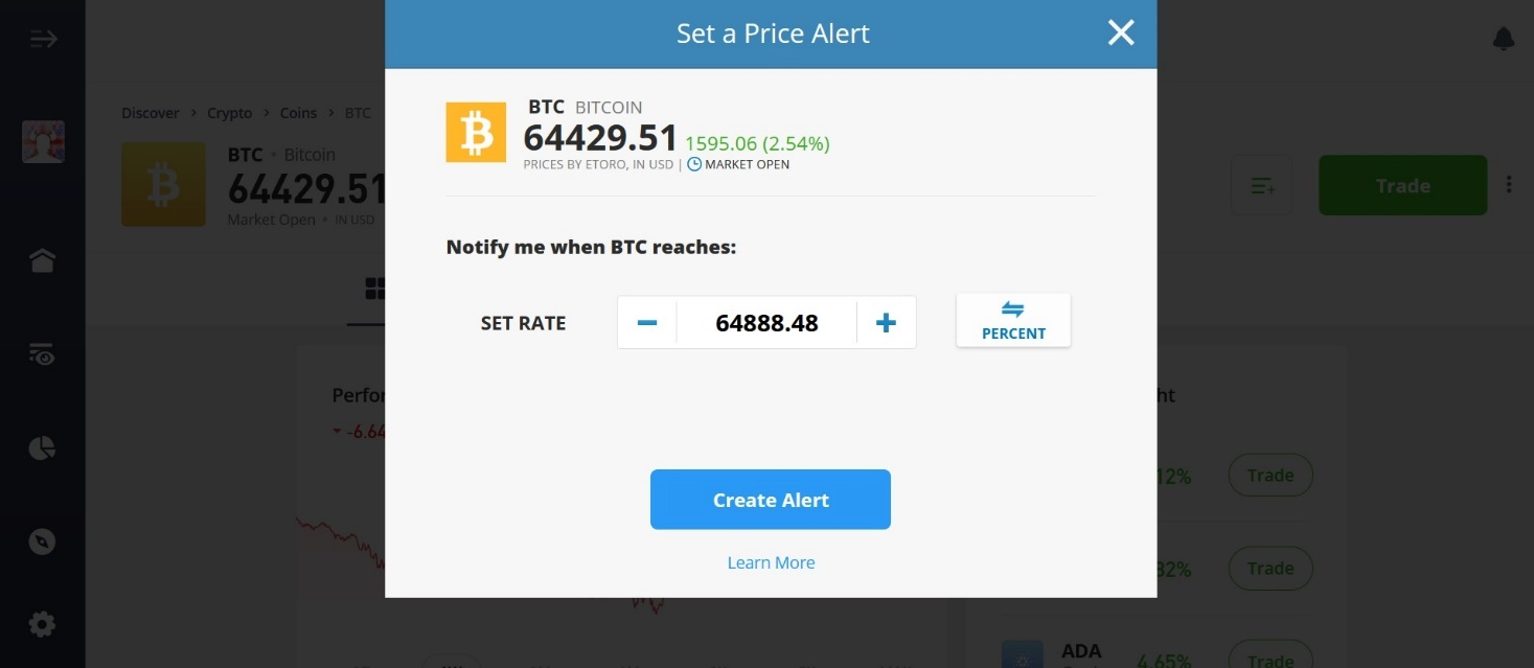
Price Alerts
These inform you when prices move by a certain percentage or hit a specific price level.
They are useful because they can immediately notify you when the market breaches support or resistance levels, or encounters a breakout on a price chart – events that often lead to significant price volatility and opportunity for short-term traders.
Technical Alerts
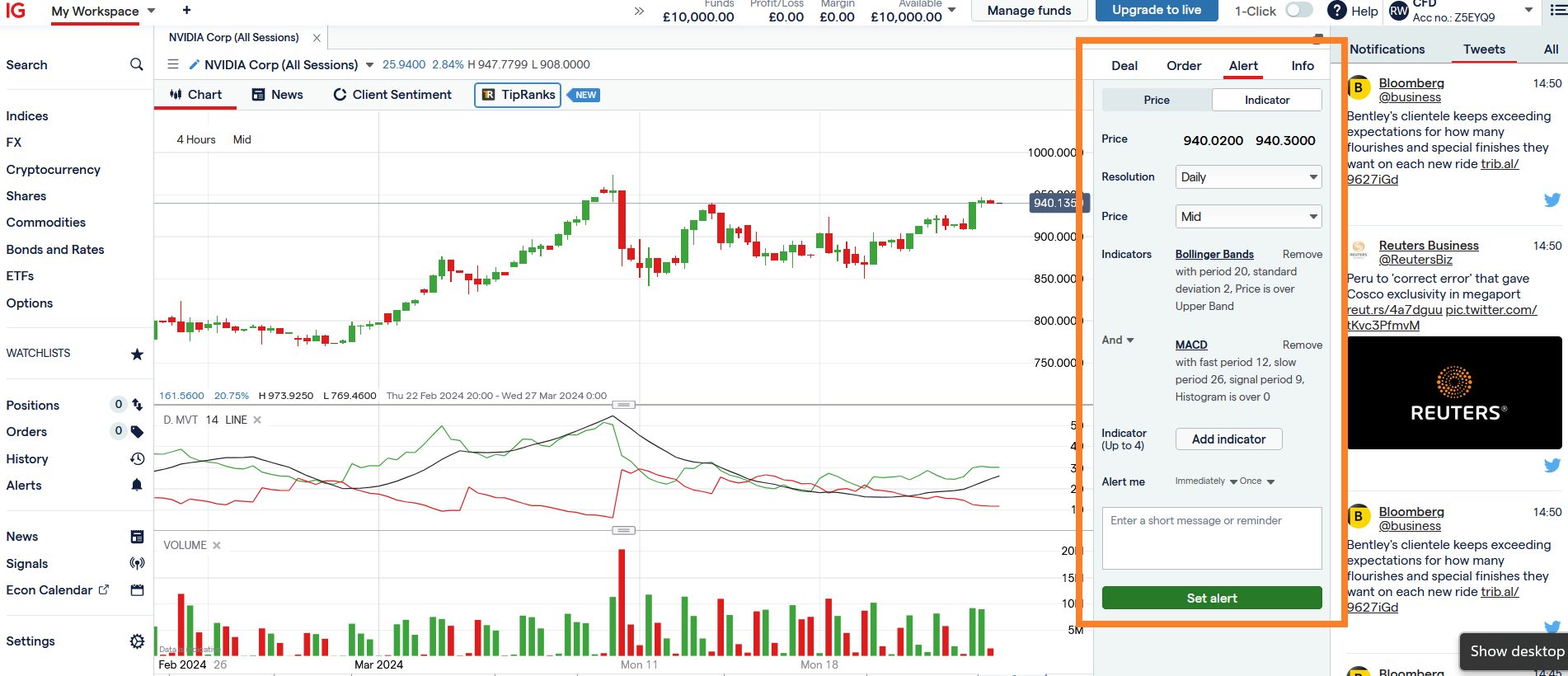
Technical analysis is used extensively by short-term traders, who – after studying charts – can then set up and buy and sell alerts based on an array of popular technical indicators. These include Moving Average Convergence Divergence (MACD), Bollinger Bands, and Ichimoku Cloud.
You can set alerts based on specific conditions or crossovers of these indicators. For instance, I could establish a copper alert on my trading platform to tell me when the MACD line crosses above or below the signal line.
A cross above is a bullish crossover, and an alert in this instance could encourage me to create a buy order for a copper mining stock, such as Rio Tinto (RIO).
News Alerts
Economic reports, geopolitical updates, corporate announcements, market news and other events can have a significant impact on asset prices. Some of the most watched events in the economic calendar include:
- Market-specific supply and demand data (like the weekly US oil rig count)
- Employment data (such as non-farm payrolls in the US)
- Trade numbers (like export data from China)
- GDP data from major economies
- Inflation numbers
News alerts that cover these events – as well as unexpected off-diary occurrences – can help short-term traders stay informed and react to market shifts.
The best news notifications of this sort will come with commentary and analysis to enhance your trading decisions.
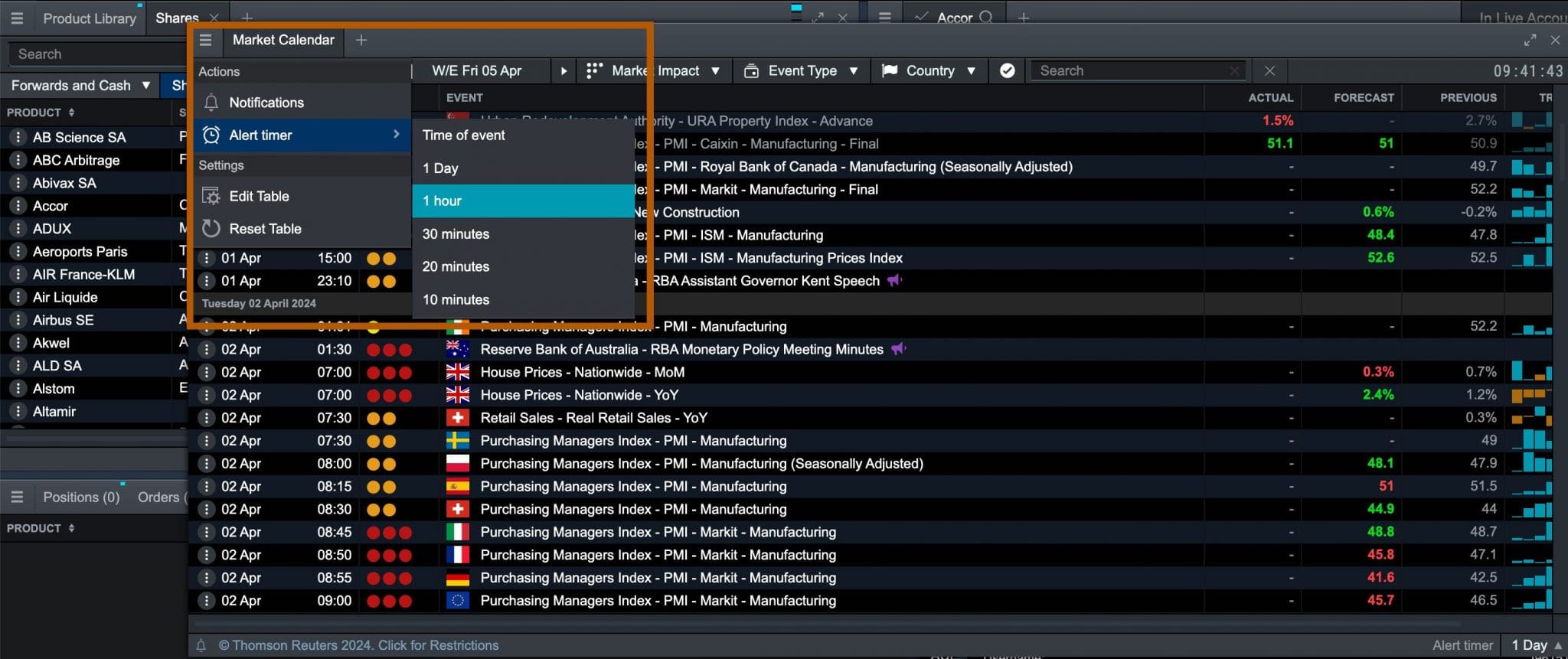
Several platforms also allow you to scroll through a tailor-made economic calendar and then tick the events you’d like to set reminders for. They usually allow you to specify how you’d like to be notified, and how much notice you would like.
Pros And Cons Of Using Trading Alerts
Pros
- Opportunity discovery: By alerting you to certain price movements, technical indicators, or news events, you can identify potential entry and exit points and improve your chances of capturing profitable trades.
- Noise reduction: Alerts can streamline the decision-making process, allowing you to block out random market fluctuations and irrelevant information that can obscure meaningful trends or patterns.
- Time efficiency: By setting up notifications, you don’t have to intensively monitor the markets themselves, giving you time to focus on other tasks and refine your short-term trading strategies.
- Speed and accuracy: Some alert systems are now 100% automated, relying on highly accurate maths and removing the human error margin. This also means that the information you need to make a decision can be provided more quickly.
- Risk management: You can minimize risk to your trades by establishing alerts when markets hit certain thresholds, making them an important tool in your risk management arsenal.
Cons
- Technological problems: While technology is rapidly improving, alerts can still convey incorrect or misleading information that provides false trading signals. Notification delays, platform malfunctions, and connectivity issues may also impact your ability to capitalize on trading opportunities or manage risk.
- Over-dependency: Traders can become excessively reliant on alerts to inform dealing decisions. This may dull your ability to adapt to market conditions, lead to overtrading, and hinder the development of analytical skills.
- Increased trading costs: Many brokers offer free alerts, although you can pay third parties for more sophisticated notification systems. While these tools can boost returns, the associated subscription fees or one-off costs can eat into profits.
Choosing An Alert Provider
Hot competition means that brokerages are all investing heavily to provide the best user experience. This is why many increasingly offer trading alert services to their clients.
But with a lot of different companies operating in this industry, what should you consider when deciding which to use?
Based on our direct experience testing a long row of trading alert providers, there are five key things we, and you, should consider:
- Which asset class are you trading? Some specialist notification companies concentrate on certain markets like currencies, while brokers like CMC Markets provide alerts spanning multiple asset classes, from forex to stocks, indices, and commodities.
- How transparent are they? Only choose a service that provides detailed information on their trading strategies, alert methodologies, and performance metrics, notably win rates and average returns. FOREX.com stands out here with its AI-powered Smart Signals engine that provides short-term trade ideas across 4-, 6-, 8- or 12-hour time intervals with a hit rate out of 10. Whatever you choose, be aware that services provided by brokers licensed by respectable bodies are more likely to be reliable, and read up on the relevant rules and guidance in your jurisdiction.
- Is the alert platform user-friendly? It’s important to select an interface that is easy to use and offers a variety of functions. IG excels here with an intuitive panel in its app that we’ve used to set price alerts, breaking out triggered vs untriggered alerts with accompanying details like price, time and date.
- Do they offer good customer support? Technical problems can be expensive and very frustrating for traders. Try to find out how responsive and effective the provider is in addressing issues, and consider if they provide multiple ways for customers to make contact. XTB has delivered first-class support 24/5 over our years of testing, with integrated live chat in the platform and dedicated account managers.
- What are their fees? Selecting an alert provider requires a trade-off between quality of service and cost. Remember that high fees can take a big bite out of your profits. Opting for a broker with free trading alerts like AvaTrade can help keep fees down. Real-time alerts are available through its web platform and award-winning mobile app.
Many of these questions can only be answered once a provider’s services have been employed. So choosing one that offers a demo account can be a good idea.
Royston WildAuthorWe’ve reviewed a growing list of independent trading alert providers over the years, many of which specialize in specific markets and types of trading notifications…
Specialist Trading Alert Providers
- Autochartist is a technical analysis tool that assists with trade set up and patterns, as well as providing signals, market reports and other useful features.

Disclaimer – the service providers listed here are not endorsed, or guaranteed, by DayTrading.com to be fit for any purpose. Any use of third-party service providers is at the user’s personal risk. We may receive financial compensation from providers listed here.
Bottom Line
Traders who wish to increase their returns and manage their risk effectively can benefit greatly from day trading alerts.
Yet despite these advantages, traders should also be mindful of the associated costs of using these tools, whilst also remembering to guard against overreliance. They should only be employed as part of a balanced approach to decision-making.
To get started, use our list of the best brokers with day trading alerts.
FAQ
How Can I Receive Trading Alerts?
You can receive your alerts in a number of straightforward ways. You can register for notifications that will pop up when you’re actually in your web-based trading platform, say TradingView. They will usually make a sound to inform you an event of interest has occurred.
Alternatively, you can get mobile SMS notifications. These allow you to respond to important market developments even when you’re on the move.
There is even the option of X, formerly Twitter, alerts. That’s right, you can keep up to date with Donald Trump at the same time as receiving crucial trading information. If that isn’t to your fancy you can set up email alerts and absorb data that way.
Technology now allows you to receive your alerts in whichever medium is most suitable for your needs. For example, an intraday trader glued to the screen all day may benefit most from alerts on their web-based platform.
Can You Profit From Trading Alert Services?
Despite the promise of riches alert service providers claim, there remain downsides to stay aware of. Firstly, remember that however many benefits trading signals and alerts offer, they don’t replace experience and they won’t work without an effective strategy.
Secondly, you need to take into account slippage. There will always be some lag in the alert and your ability to make or exit a trade, and when you’re day trading, every second and tick counts.