



While lacking the prestige of gold, frequent price volatility means that silver can be a superior asset for short-term traders. In this silver trading guide, we explain what moves the price of the metal and the different ways you can trade it.
Quick Introduction
- Silver is a malleable metal that plays a major role as both a tradable asset and an industrial commodity.
- Individuals can trade silver using instruments like futures, options, CFDs and ETFs.
- Macroeconomic news, the movement of the US dollar, and gold prices influence the price of silver.
- The gold-silver ratio is a useful tool that can help traders decide if the precious metal is undervalued.
Best Brokers For Trading Silver
Our hands-on tests show that these are the 6 top silver brokers in 2026:
-
- Demo account
- Platforms: MT4, MT5, TradingCentral
- Min. deposit: $5
-
- Demo account
- Min. deposit: $100
- Min. trade: 0.01 Lots
-
- Demo account
- Regulator: FCA, ASIC, CMVM , FSCA, SCB, FSA
- Platforms: TN Trader, MT4, TradingView
-
- Demo account
- Min. deposit: $0
- Min. trade: 0.01 Lots
73-89% of retail investor accounts lose money when trading CFDs -
- Demo account
- Regulator: ASIC, CySEC, FSA, SCB, CMA-Kenya
- Min. deposit: $200
-
- Demo account
- Regulator: FSC
- Min. deposit: $200






Learn how we test brokers and why you can trust our ratings.
This is why we think these brokers are the best in this category in 2026:
- XM 4.8/5 XM is a globally recognized forex and CFD broker with 20+ million clients in 190+ countries. Since 2009, this trusted broker has been delivering low trading fees across its growing roster of 1000+ instruments. It also offers a comprehensive MetaTrader experience that we've observed firsthand placing test trades.
- AvaTrade 4.9/5 Established in 2006, AvaTrade is a leading forex and CFD broker trusted by over 400,000 traders. Operating under regulation in 9 jurisdictions, AvaTrade processes an impressive 2+ million trades each month. Through like MT4, MT5, and its proprietary WebTrader, the broker provides a growing selection of 1,250+ instruments. Whether it’s CFDs, AvaOptions, or the more recent AvaFutures, short-term traders at all levels will find opportunities. With terrific education and 24/5 multilingual customer support, AvaTrade delivers the complete trading experience.
- Trade Nation 4.4/5 Trade Nation is a top FX and CFD broker regulated in multiple jurisdictions including the UK and Australia. The firm offers low-cost fixed and variable spreads on 1000+ assets with robust trading platforms and training materials. The Signal Centre can also be used for trade ideas.
- Pepperstone 4.8/5 Established in Australia in 2010, Pepperstone is a top-rated forex and CFD broker with over 830,000 clients worldwide. It offers access to 1,400+ instruments on leading platforms MT4, MT5, cTrader and TradingView, maintaining low, transparent fees. Pepperstone is also regulated by trusted authorities like the FCA, ASIC, and CySEC, helping to ensure a secure environment for day traders at all levels.
- IC 4.8/5 IC Markets (now IC) is a globally recognized forex and CFD broker known for its excellent pricing, comprehensive range of trading instruments, and premium trading technology. Founded in 2007 and headquartered in Australia, the brokerage is regulated by the ASIC, CySEC and FSA, and has attracted more than 200,000 clients from over 200 countries.
- IC Trading 4.2/5 IC Trading is part of the established IC group (including what used to be 'IC Markets'). Built for serious traders, it boasts some of the most competitive spreads, reliable order execution, and advanced trading tools. The catch is that it’s registered in the offshore financial centre of Mauritius, enabling it to offer high leverage but in a weakly regulated trading setting.
Community Sentiment
See how users rate these brokers based on the average customer ratings submitted on DayTrading.com, plus ratings from Trustpilot, the Apple App Store and Google Play.
| Broker | Our Users' Rating | Trustpilot Score | Trustpilot Reviews | iOS App Rating | Android App Rating |
|---|---|---|---|---|---|
| XM | 3078 | ||||
| AvaTrade | 13616 | ||||
| Trade Nation | 2173 | ||||
| Pepperstone | 3712 | ||||
| IC | 2 | ||||
| IC Trading | 606 |
XM
With a low $5 minimum deposit, advanced charting platforms in MT4 and MT5, expanding range of markets, and a Zero account offering spreads from 0.0, XM provides all the essentials for active traders.
 Christian Harris, Reviewer
XM quick facts
- Demo Account
- ✔Yes
- Instruments
- CFDs, Forex, Stocks, Commodities, Indices, Thematic Indices, Precious Metals, Energies
- Regulator
- CySEC, DFSA, FSCA, SCA, FSA, FSC-Belize, FSC-Mauritius, CMA-Kenya, CMA-UAE
- Platforms
- MT4, MT5, TradingCentral
- Minimum Deposit
- $5
- Minimum Trade
- 0.01 Lots
- Account Currencies
- USD, EUR, GBP, JPY, ZAR
Commodities
XM offers trading of 14 commodities:
- Cocoa
- Coffee
- Copper
- Corn
- Cotton
- Gold
- Natural Gas
- Oil
- Palladium
- Platinum
- Silver
- Soybeans
- Sugar
- Wheat
Pros
- XM’s customer support has delivered over years of testing, with 24/7 assistance in 30 languages, response times of under 2 minutes and a growing Telegram channel.
- XM has rolled out platform upgrades with integrated TradingView charts and an XM AI assistant, delivering faster execution, smarter analysis, and a sleeker, more intuitive trading experience.
- XM’s Zero account is ideal for day trading with spreads from 0.0 pips, 99.35% of orders executed in <1 second, and no requotes or rejections.
Cons
- XM is falling behind the curve by not offering cTrader, which is favored over MetaTrader by some serious traders for its smoother user experience and superior charting package.
- XM relies solely on the MetaTrader platforms for desktop trading, so there’s no in-house downloadable solution for a more beginner-friendly user experience with unique features.
- Although trusted and generally well-regulated in some regions, XM also has global entities registered with the weak regulators like FSC (Belize) and FSA (Seychelles), whilst UK clients are no longer accepted, reducing its market reach.
AvaTrade
AvaTrade offers active traders everything they need: an intuitive WebTrader, powerful AvaProtect risk management, a smooth 5-minute sign-up process, and dependable support you can rely on in fast-moving markets.
 Jemma Grist, Reviewer
AvaTrade quick facts
- Demo Account
- ✔Yes
- Instruments
- CFDs, Forex, Stocks, Indices, Commodities, ETFs, Bonds, Crypto, Spread Betting, Futures
- Regulator
- ASIC, CySEC, FSCA, ISA, CBI, JFSA, BVI, FSRA/ADGM, AFM, CMA-Kenya, CIRO (via Friedberg Direct)
- Platforms
- WebTrader, AvaTradeGO, AvaOptions, AvaFutures, MT4, MT5, AlgoTrader, TradingView, TradingCentral, DupliTrade
- Minimum Deposit
- $100
- Minimum Trade
- 0.01 Lots
- Account Currencies
- USD, EUR, GBP, CAD, AUD, ZAR
Commodities
AvaTrade offers trading of 18 commodities:
- Cannabis
- Cocoa
- Coffee
- Copper
- Corn
- Cotton
- Gasoline
- Gold
- Lithium
- Natural Gas
- Oil
- Palladium
- Platinum
- Precious Metals
- Silver
- Soybeans
- Sugar
- Wheat
Pros
- AvaTrade launched AvaFutures to offer low-margin access to global markets, then expanded in 2025 as one of the first brokers to add CME’s Micro Grain Futures.
- Support at AvaTrade performed excellently during testing, with response times of 3 minutes and localized support in major trading jurisdictions, including the UK, Europe and the Middle East.
- AvaFutures traders can now use TradingView for 100+ indicators, screeners and a calendar, the sharing of trade ideas, commissions from $0.45, intraday margins from $60, and access to exchanges like CME and EUREX.
Cons
- The AvaSocial app is good but not great – the look and feel, plus the navigation between finding strategy providers and account management needs upgrading to rival category leaders like eToro.
- AvaTrade’s WebTrader has improved, but work is still needed in terms of customizability – frustratingly widgets like market watch and watchlists can’t be hidden, moved, or resized.
- While signing up is a breeze, AvaTrade lacks an ECN account like Pepperstone or IC Markets, which provides the raw spreads and ultra-fast execution many day traders are looking for.
Trade Nation
Trade Nation suits discretionary traders who want to speculate on major indices like the US 500 or liquid FX pairs, and want the predictable all-in costs of fixed spreads. In tests, we found the fixed-spread TN Trader environment particularly useful for trading around scheduled economic releases owing to its reliable charting environment and because published spreads stayed capped.
Christian Harris, Reviewer
Trade Nation quick facts
- Demo Account
- ✔Yes
- Instruments
- CFDs, Forex, Indices, Shares, Commodities, Futures, Bonds, Spread Betting (UK and Ireland only), Cryptos (Bahamas entity only)
- Regulator
- FCA, ASIC, CMVM , FSCA, SCB, FSA
- Platforms
- TN Trader, MT4, TradingView
- Minimum Deposit
- $0
- Minimum Trade
- 0.1 Lots
- Account Currencies
- USD, EUR, GBP, AUD, ZAR, SEK, NOK, DKK
Commodities
Trade Nation offers trading of 6 commodities:
- Aluminium
- Copper
- Gold
- Oil
- Silver
- Zinc
Pros
- In testing of the TN Trader account under normal market conditions, fixed spreads held while fills were prompt on major forex pairs, with a slight drift in the entry level as price ticked between click and fill.
- The demo comes with a $5,000 practice account and you can request a one-on-one platform walkthrough by callback - this level of personal help is rare.
- Trade Nation's 2026 partnership with Volt has sped up payments for Australian traders, who can now make instant deposits and withdrawals using PayID, with the faster payout capabilities planned for clients in the UK and EU.
Cons
- Withdrawals can take up to five business days, which is around the industry average but slower than the 1-3 days we’re increasingly seeing brokers offer in an attempt to quash withdrawal complaints from retail investors.
- There is no raw or ECN pricing tier, which are often prefered by day traders. No matter how much you deposit or trade, you use the same fixed (or variable on MT4) pricing as beginners, making it unsuitable for scalpers especially.
- The 2–20% rebate scheme is closed to FCA, CMVM, and ASIC clients, meaning active day traders in these regions who would benefit from transaction rebates cannot claim them.
Pepperstone
Pepperstone stands out as a top choice for day trading, offering razor-sharp spreads, ultra-fast execution, and advanced charting platforms for experienced traders. New traders are also welcomed with no minimum deposit, extensive educational resources, and exceptional 24/5 support (18h a day on weekends).
Christian Harris, Reviewer
Pepperstone quick facts
- Demo Account
- ✔Yes
- Instruments
- CFDs, Forex, Currency Indices, Stocks, Indices, Commodities, ETFs, Crypto CFDs, Spread Betting
- Regulator
- FCA, ASIC, CySEC, BaFin, DFSA, SCA, SCB, CMA-Kenya
- Platforms
- Pepperstone Trading Platform, MT4, MT5, cTrader, TradingView
- Minimum Deposit
- $0
- Minimum Trade
- 0.01 Lots
- Account Currencies
- USD, EUR, GBP, CAD, AUD, NZD, JPY, CHF, HKD, SGD
Commodities
Pepperstone offers trading of 21 commodities:
- Aluminium
- Cocoa
- Coffee
- Copper
- Corn
- Cotton
- Gasoline
- Gold
- Livestock
- Natural Gas
- Nickel
- Oil
- Orange Juice
- Palladium
- Platinum
- Precious Metals
- Silver
- Soybeans
- Sugar
- Wheat
- Zinc
Pros
- After adding spread betting through TradingView, Pepperstone provides a seamless, tax-efficient trading experience with advanced analysis tools for financial spread bettors in supported countries.
- There’s support for a range of industry-leading charting platforms including MT4, MT5, TradingView, and cTrader, catering to various short-term trading styles, including algo trading.
- Pepperstone has greatly improved the deposit and withdrawal experience in recent years, adding Apple Pay and Google Pay in 2025, as well as PIX and SPEI for clients in Brazil and Mexico in 2024.
Cons
- Despite improvements to its range of markets, crypto CFD offerings are still fairly limited compared to other brokers who focus on this area, such as Eightcap, and there's no option to invest in real coins.
- Pepperstone has removed support for several tools that elevated the trading experience for active retail traders, notably Autochartist, Capitalise.ai and a free VPS for qualifying traders (now only pro traders in some countries).
- Overnight holding fees are higher than that found with some Market Maker brokers (usually Benchmark + 2.5%). This makes pepperstone an ideal broker for day traders and forex scalpers but less suitable for swing traders who often keep position open overnight.
IC
IC (formerly IC Markets) offers superior pricing, exceptionally fast execution and seamless deposits. The introduction of advanced charting platforms, notably TradingView, and the Raw Trader Plus account, ensures it remains a top choice for intermediate to advanced day traders.
Christian Harris, Reviewer
IC quick facts
- Demo Account
- ✔Yes
- Instruments
- CFDs, Forex, Stocks, Indices, Commodities, Bonds, Futures, Crypto
- Regulator
- ASIC, CySEC, FSA, SCB, CMA-Kenya
- Platforms
- MT4, MT5, cTrader, TradingView, TradingCentral, DupliTrade, Quantower
- Minimum Deposit
- $200
- Minimum Trade
- 0.01 Lots
- Account Currencies
- USD, EUR, GBP, CAD, AUD, NZD, JPY, CHF, HKD, SGD
Commodities
IC offers trading of 11 commodities:
- Cocoa
- Coffee
- Corn
- Gold
- Natural Gas
- Oil
- Orange Juice
- Silver
- Soybeans
- Sugar
- Wheat
Pros
- IC offers among the tightest spreads in the industry, with 0.0-pip spreads on major currency pairs, making it especially cost-effective for day traders.
- IC secured DayTrading.com's 'Best MT4/MT5 Broker' in 2025 for its seamless, industry-leading MetaTrader integration, refined over years to maximize the platform experience.
- You have access to over 2,250 CFDs across various markets, including forex, commodities, indices, stocks, bonds, and cryptocurrencies, allowing for diversified trading strategies.
Cons
- There are fees for certain withdrawal methods, including a $20 wire charge, which can eat into profits, especially for frequent withdrawals.
- The breadth and depth of tutorials, webinars and educational resources still need work, trailing alternatives like CMC Markets and reducing its suitability for beginners.
- Despite four industry-leading third-party platforms, there is no proprietary software or trading app built with new traders in mind.
IC Trading
With superior execution speeds averaging 40 milliseconds, deep liquidity, and powerful charting software, IC Trading delivers an optimal trading environment tailored for scalpers, day traders, and algorithmic traders.
Christian Harris, Reviewer
IC Trading quick facts
- Demo Account
- ✔Yes
- Instruments
- CFDs, Forex, Stocks, Indices, Commodities, Bonds, Cryptos, Futures
- Regulator
- FSC
- Platforms
- MT4, MT5, cTrader, AutoChartist, TradingCentral
- Minimum Deposit
- $200
- Minimum Trade
- 0.01 Lots
- Account Currencies
- USD, EUR, GBP, CAD, AUD, NZD, JPY, CHF, HKD, SGD
Commodities
IC Trading offers trading of 14 commodities:
- Cocoa
- Coffee
- Corn
- Cotton
- Gold
- Natural Gas
- Oil
- Orange Juice
- Palladium
- Platinum
- Silver
- Soybeans
- Sugar
- Wheat
Pros
- IC Trading provides industry-leading spreads, including 0.0-pip spreads on major currency pairs such as EUR/USD, making it ideal for day traders.
- Trading Central and Autochartist are valuable tools for in-depth technical summaries and actionable trading ideas and are accessible from within the account area or the cTrader platform.
- IC Trading offers unusual flexibility in its accounts, enabling traders to open up to 10 live and 20 demo accounts, meaning you can run separate profiles for different activities, such as manual trading and algo trading.
Cons
- The educational resources are greatly in need of improvement, unless you navigate to the IC.com website, posing a limitation for beginners in search of a comprehensive learning journey, especially compared to category leaders like eToro.
- Despite being part of the trusted IC group, IC Trading is authorized by a weak regulator - the FSC of Mauritius, with limited financial transparency and regulatory safeguards.
- Customer support performed poorly during testing with multiple attempts to connect via live chat and no one available to assist, plus unanswered emails, raising concerns about its ability to address urgent trading concerns.
Understanding The Silver Market
When it comes to precious metals trading, gold is a more popular market:
- Large institutions buy gold as a currency hedge when interest rates and yields on other assets decrease.
- Central banks prioritize buying the yellow metal as a reserve asset to diversify their currency exposure.
- Gold is also more popular with retail traders than its cheaper ‘sister’ metal.
Yet it would be a mistake to describe the silver market as insignificant. Silver is one of the world’s top 10 commodities by trading volume: on the day this guide was written, a whopping 79,972 silver futures contracts changed hands on The Commodity Exchange (COMEX) in the US.
And, while gold is used primarily as an investment asset, silver serves as both a key industrial commodity as well as a store of value.
It is also widely used in the manufacture of jewellery, and cumulative demand for the metal has soared in recent years.
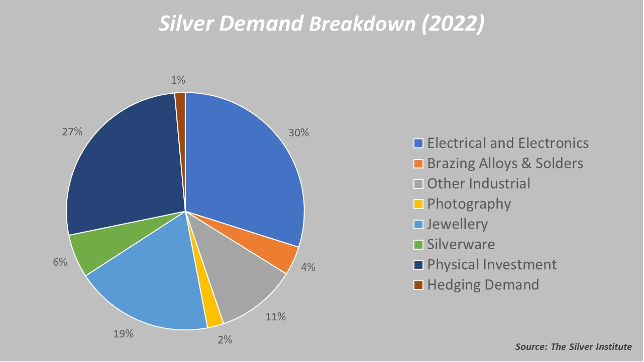
According to The Silver Institute, global silver demand struck a record high of 1.24 billion ounces in 2022, up 18% year on year. Off-take rose across most categories, with physical silver investment rising 22% from the prior year (to 332.9 million ounces).
Pros and Cons Of Trading Silver
Pros
- Volatility – Silver prices can be much choppier than gold, providing superior opportunities for short-term traders to make money from market fluctuations.
- Easy to trade – The silver market is highly liquid, making it easy for day traders to enter and exit positions. Traders also have a wide range of ways they can play the market, from buying physical metal to trading futures contracts, CFDs and company stocks.
- Diversification – Silver’s role as a hedge against inflation helps spread risk and can protect traders’ portfolios from sharp slumps when prices rise.
- Cheapness – The grey metal is much cheaper than other precious commodities like gold and platinum group metals (PGMs). This makes trading it available to a wider range of individuals.
- Dual purpose – Silver’s role as an industrial and investment metal means prices can rise during economic upturns and downturns.
Cons
- Price unpredictability – Silver’s role as an investment and industrial commodity means that prices can move in surprising directions following macroeconomic news. Failure to understand the complex suite of factors that affect values can result in poor decision-making.
- Leverage risks – Many of the securities used to trade silver allow investors to use large amounts of borrowed funds. Whilst this can potentially rev up profits, it may also lead to monster losses.
- Holding costs – Owning silver bars comes with the added cost of vaulting and insuring the precious metal. Short-term traders can avoid this by speculating on silver prices using derivatives.
What Drives Silver Prices?
Like all commodities, prices are subject to the laws of supply and demand and are highly sensitive to macroeconomic and geopolitical conditions.
Signs of excess or deficient mine production also influence silver values.
The malleable metal is extremely versatile and thus has a broad assortment of applications:
- Its conductivity makes it a key component in the manufacture of electronics and solar panels.
- High reflectivity means it is a core material in mirrors and photographic film.
- Its role as a catalyst for various chemical reactions means it is widely used in the chemical industry.
- Silver is a cherished material in jewellery production thanks to its aesthetic qualities (one-fifth of demand).
This all means that silver prices are extremely sensitive to broader economic conditions. As such, news on the following can impact demand and silver trading prices: Global growth, consumer spending, manufacturing output and employment levels.
Silver prices are also highly sensitive to the strength of the US dollar. When the currency rises in value it becomes more expensive to purchase the metal, and vice versa.
Like most commodities, silver is priced using the dollar on global markets.
 Royston WildAuthor
The Gold-Silver Ratio
Just like gold, silver is a safe-haven asset that investors flock to when market confidence sinks. It is used as a store of value during times of inflation, and as a wealth preserver during times of economic stress or uncertainty. For this reason, silver prices often closely track those of gold.
The gold-silver ratio is a historical metric used to appraise the relative value of these precious metals and is calculated by dividing the price of gold per ounce by the price of silver per ounce.
The gold-silver ratio has averaged around 15 to 1, meaning it would take 15 ounces of silver to buy one ounce of gold. Changes in the ratio can affect silver prices by influencing trader behaviour.
A high ratio, for example, can suggest that the grey metal is undervalued in comparison to gold, prompting a rush of buying interest and a surge in prices.
Different Ways To Trade Silver
Physical Silver
As with gold, or many of the other precious metals, physical silver is popular with investors seeking to benefit from appreciating prices.
Silver bars are the most cost-effective way for investors to purchase the metal in large quantities. This is because coins often feature intricate and detailed designs that require extra costs to manufacture.
Many mints and retailers also offer to store silver on behalf of their customers. This, along with taking out insurance to cover against loss and damage, means that investors in actual metal often endure additional expenses.
We recommend these firms if you want to invest in physical silver:
Best Silver Vaults
- BullionVault can be used to buy, sell and store precious metals like gold. Low fees, multiple security measures and a mobile app has made the firm popular with bullion investors.
Spot Contracts
A spot contract involves buying or selling a specified amount of the dual-role metal at the current market price for immediate settlement.
Spot silver agreements are traded by a wide range of individuals and institutions. Mining companies, manufacturers and jewellers, for instance, will buy these contracts to hedge against adverse price movements.
Traders meanwhile can trade them to diversify their portfolios and speculate on price movements.
Future Contracts
Silver is – like most commodities – mostly traded through the exchange of futures contracts.
These financial instruments state that a pre-agreed amount must be bought and sold for a set price and within a specified timescale. The prices of these contracts are based on spot silver values.
Futures are derivative vehicles, which means that they derive their value from the price of an underlying asset.
They are especially effective for commodities trading, as they allow traders to speculate on market movements without having to worry about taking physical delivery.
Silver futures are primarily traded on several major commodity exchanges:
- COMEX in the US
- Multi Commodity Exchange (MCX) in India
- Shanghai Futures Exchange (SHFE) in China
Options Contracts
Options are another common way for individuals to trade silver. As the name implies, they provide owners with the choice as to whether to buy or sell a quantity of the underlying asset later on and at a pre-set price (known as the strike price).
This gives traders much more flexibility, although this advantage over futures contracts attracts a higher price.
As with other types of derivatives, traders can choose to take either a long or a short position with silver options.
In other words, they have a chance to make money when the price of the precious commodity rises or falls in value.
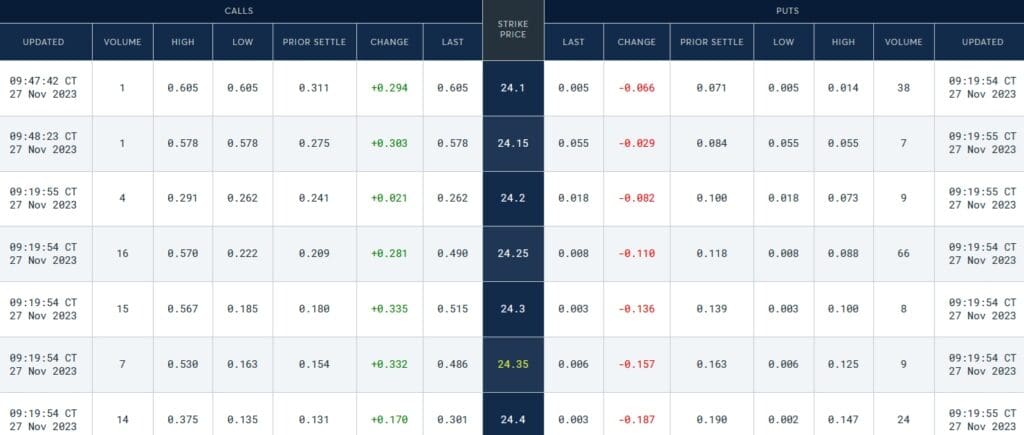
Here you can see a series of quotes on silver futures on COMEX. On the left are prices for call options, which give the contract owner the right to buy the metal. Prices for put options, which allow holders to sell silver on the expiration date, can be seen on the right.
Another reason why futures and options are so popular is because they allow individuals to use substantial levels of leverage, which is effectively a loan from a broker.
By using borrowed funds, you can open a much larger position than if you used just your own funds, which in turn provides the opportunity to make even greater profits.
Royston WildAuthorContracts for Difference (CFDs)
Derivatives known as contracts for difference (CFDs) are especially popular with short-term traders and day traders wishing to use leverage.
Gearing for these financial instruments is especially high, though the maximum leverage available varies according to the broker and the regulatory environment in the specific jurisdiction.
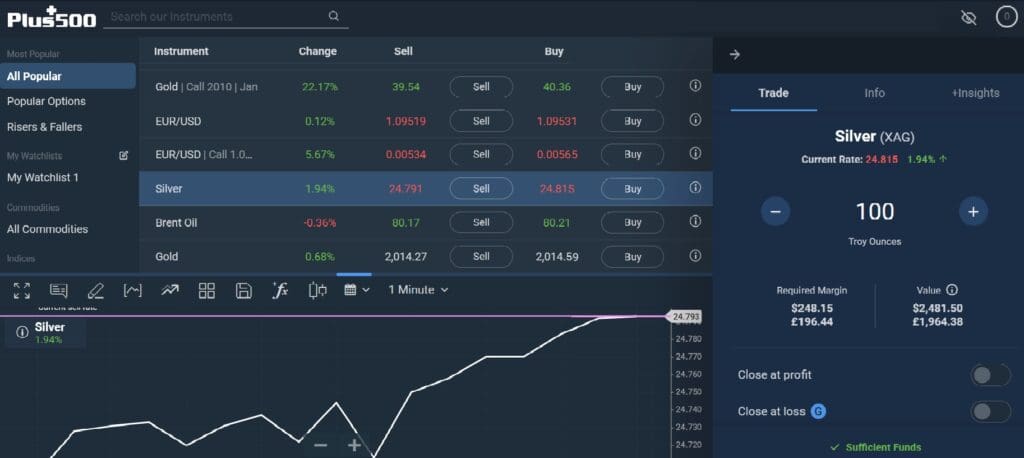
Here you can see an example of a CFD silver trade at Plus500. This broker allowed leverage of 1:10 (or 10%) for this particular trade, meaning that a trader would have to put down an initial deposit (or margin) of just $248.15 to control a position worth a total value of $2,481.50.
Using leverage can be a powerful weapon when you’ve invested correctly on how the silver market will move. However, when prices move in the ‘wrong’ direction traders can end up with thumping losses.
Even small price fluctuations can have a massive impact on the account balance, and traders may have to deposit extra funds to cover losses.
Silver Stocks
Traders can profit from rising metal prices by buying shares in silver-producing stocks.
Alternatively, they can make money when the metal value falls by taking a short position in one or more of these commodities companies.
Silver is rarely found in a pure metallic form. Instead, it is usually extracted alongside other elements including copper, lead, zinc and gold.
As a result, successful trading in silver shares also usually requires these other base and precious metals to rise in price.
The share prices of silver miners often track the value of the underlying metal. You can see this from the graph below which shows the market movement of FTSE 100-listed Fresnillo, the world’s biggest silver miner. When prices rise, shareholders usually see the value of their holdings increase, and vice versa.
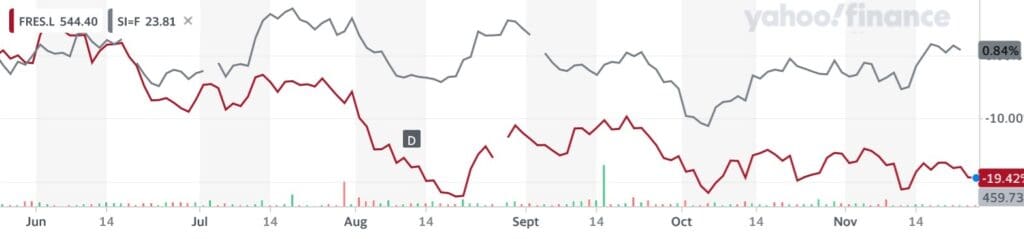
Yet as you can also see above, trading a silver stock doesn’t always pay off, even when prices of the commodity increase. This is because share prices are dependent on operational factors as well as movements in the silver market.
The graph above shows a near-20% decline in Fresnillo’s share price as soaring costs put a squeeze on profits.
Trading mining stocks has one big advantage over those other financial instruments I mentioned: equity investing can provide income as well as capital gains.
Not all silver producers pay dividends, but a large number do.
Royston WildAuthorExchange-Traded Funds (ETFs)
Also traded on stock markets, exchange-traded funds (ETFs) are financial instruments that are designed to track the precious metal price.
If a trader thinks the metal will become more valuable they can buy an ETF like the iShares Silver Trust. When silver prices set by the London Bullion Market Association (LBMA) appreciate, the value of the fund follows suit.
ETFs are highly liquid, cheap to trade, and allow individuals to diversify by getting exposure to a basket of different assets.
ETFs also allow individuals to execute a variety of different trading strategies. For example, someone who thinks silver metal values will fall can go short with the ProShares UltraShort Silver ETF.
Meanwhile, investors who want to get exposure to a selection of silver miners can buy the Global X Silver Miners ETF. At the time of writing, this fund held shares in 32 different silver producers.***
How To Start Trading Silver
- Learn about the silver market – BullionVault and Kitco are a couple of good sources of precious metals news and market information. Organizations like trade body The Silver Institute and metals refiner Johnson Matthey also provide valuable information on silver supply and demand.
- Choose a broker – The key things to consider are the fees and commissions for silver trading and the quality of the platform. Traders should also choose a firm regulated by a trusted body. Importantly, the best brokers offer educational materials and analysis of silver markets to help traders identify opportunities.
- Place a trade – Once you have opened an account, log in to your broker’s platform to make a trade. Day traders may opt for a vehicle like CFDs to profit from short-term changes in silver prices using leveraged funds. Also make use of risk management tools like stop-loss orders to cap your potential losses.
Bottom Line
Online traders have a wide selection of financial instruments they can use to profit from silver. Many of these make use of leverage, too, a tool that can significantly amplify short-term trading profits.
As with any asset class, traders should do plenty of homework before they begin trading silver. And particularly those who adopt the high-risk strategy of using borrowed funds.
* Total trading volumes on 22 November, 2023
** Prices stated as of 24 November, 2023
*** Holdings current as of 24 November, 2023
Article Sources
The writing and editorial team at DayTrading.com use credible sources to support their work. These include government agencies, white papers, research institutes, and engagement with industry professionals. Content is written free from bias and is fact-checked where appropriate. Learn more about why you can trust DayTrading.com