



While lacking the prestige of gold, frequent price volatility means that silver can be a superior asset for short-term traders. In this silver trading guide, we explain what moves the price of the metal and the different ways you can trade it.
Quick Introduction
- Silver is a malleable metal that plays a major role as both a tradable asset and an industrial commodity.
- Individuals can trade silver using instruments like futures, options, CFDs and ETFs.
- Macroeconomic news, the movement of the US dollar, and gold prices influence the price of silver.
- The gold-silver ratio is a useful tool that can help traders decide if the precious metal is undervalued.
Best Brokers For Trading Silver
Our hands-on tests show that these are the 6 top silver brokers in 2026:
-
- Demo account
- Platforms: MT4, MT5, TradingCentral
- Min. deposit: $5
-
- Demo account
- Regulator: FCA, ASIC, CySEC, FSC, SCB, FSA
- Platforms: MT4, MT5, TradingView, TradeLocker
71.28% of retail traders lose money when trading CFDs -
- Demo account
- Instruments: CFDs, Forex, Indices, Shares, Commodities
- Regulator: ASIC, CySEC, FSCA, FSC
-
- Demo account
- Regulator: FMA, FSA
- Min. deposit: $0
-
- Demo account
- Platforms: eToro Web, CopyTrader, TradingCentral
- Min. deposit: $50
61% of retail CFD accounts lose money. eToro is a multi-asset investment platform. The value of your investments may go up or down. Your capital is at risk. -
- Demo account
- Regulator: CySEC, MISA
- Platforms: MT4, MT5





Learn how we test brokers and why you can trust our ratings.
Here is a short overview of each broker's pros and cons
- XM 4.8/5 XM is a globally recognized forex and CFD broker with 20+ million clients in 190+ countries. Since 2009, this trusted broker has been delivering low trading fees across its growing roster of 1000+ instruments. It also offers a comprehensive MetaTrader experience that we've observed firsthand placing test trades.
- Eightcap 4.6/5 Eightcap is a multi-regulated forex and CFD broker established in Australia in 2009. The broker has proven popular with active day traders, providing 800+ instruments with tight spreads and notable improvements in recent years, integrating the leading TradingView platform, alongside AI-powered financial calendars and algo trading tools with zero coding experience required.
- FBS 4.3/5 Founded in 2009, FBS is an award-winning CFD broker operating in over 150 countries with a client base exceeding 27 million traders. Traders are supported at every stage of their journey with 24/7 assistance, market analytics, trading calculators, and competitive pricing with zero commissions.
- BlackBull 4.5/5 BlackBull is a New Zealand-based CFD broker providing diverse trading opportunities on over 2,180 instruments. After undergoing a rebrand in 2023, it now sports a modern look and feel complete with professional-grade trading tools and ultra-fast execution speeds averaging 20ms.
- eToro 4.0/5 eToro is a top-rated multi-asset platform which offers trading services in thousands of CFDs, stocks and cryptoassets. Launched in 2007, the brand has millions of active traders globally and is authorized by tier one regulators, including the FCA and CySEC. The brand is particularly popular for its comprehensive social trading platform. Crypto investments are risky and may not suit retail investors. You could lose your entire investment. Understand the risks here. 61% of retail CFD accounts lose money.
- FXCC 4.6/5 FXCC is an established broker that’s been offering low-cost online trading since 2010. Registered in Comoros Union and regulated by the CySEC, it stands out for its ECN trading conditions, no minimum deposit and smooth account opening that takes less than 5 minutes.
Community Sentiment
See how users rate these brokers based on the average customer ratings submitted on DayTrading.com, plus ratings from Trustpilot, the Apple App Store and Google Play.
| Broker | Our Users' Rating | Trustpilot Score | Trustpilot Reviews | iOS App Rating | Android App Rating |
|---|---|---|---|---|---|
| XM | 3078 | ||||
| Eightcap | 3908 | ||||
| FBS | 10224 | ||||
| BlackBull | 3519 | ||||
| eToro | 32257 | ||||
| FXCC | 223 |
XM
With a low $5 minimum deposit, advanced charting platforms in MT4 and MT5, expanding range of markets, and a Zero account offering spreads from 0.0, XM provides all the essentials for active traders.
 Christian Harris, Reviewer
XM quick facts
- Demo Account
- ✔Yes
- Instruments
- CFDs, Forex, Stocks, Commodities, Indices, Thematic Indices, Precious Metals, Energies
- Regulator
- CySEC, DFSA, FSCA, SCA, FSA, FSC-Belize, FSC-Mauritius, CMA-Kenya, CMA-UAE
- Platforms
- MT4, MT5, TradingCentral
- Minimum Deposit
- $5
- Minimum Trade
- 0.01 Lots
- Account Currencies
- USD, EUR, GBP, JPY, ZAR
Commodities
XM offers trading of 14 commodities:
- Cocoa
- Coffee
- Copper
- Corn
- Cotton
- Gold
- Natural Gas
- Oil
- Palladium
- Platinum
- Silver
- Soybeans
- Sugar
- Wheat
Pros
- XM stands out for its commitment to trader education, with a wealth of well-presented resources, including webinars, tutorials, and even real-time trading sessions through XM Live.
- XM’s growing roster of 1,400+ instruments provides diverse short-term trading opportunities, with unique turbo stocks, fractional shares, and more recently thematic indices.
- XM’s customer support has delivered over years of testing, with 24/7 assistance in 30 languages, response times of under 2 minutes and a growing Telegram channel.
Cons
- Although trusted and generally well-regulated in some regions, XM also has global entities registered with the weak regulators like FSC (Belize) and FSA (Seychelles), whilst UK clients are no longer accepted, reducing its market reach.
- While the XM app stands out for its usability and exclusive copy trading products, the selection of technical analysis tools needs to be improved to meet the needs of advanced traders.
- XM relies solely on the MetaTrader platforms for desktop trading, so there’s no in-house downloadable solution for a more beginner-friendly user experience with unique features.
Eightcap
Eightcap delivers in every area for day traders with a growing selection of charting platforms, education via Labs, and AI-powered tools. Now sporting 120+ crypto CFDs, it's also become a stand-out choice for crypto trading, winning our 'Best Crypto Broker' award two years in a row.
Christian Harris, Reviewer
Eightcap quick facts
- Demo Account
- ✔Yes
- Instruments
- CFDs in Forex, Stocks, Indices, Commodities, Crypto
- Regulator
- FCA, ASIC, CySEC, FSC, SCB, FSA
- Platforms
- MT4, MT5, TradingView, TradeLocker
- Minimum Deposit
- $100
- Minimum Trade
- 0.01 Lots
- Account Currencies
- USD, EUR, GBP, CAD, AUD, NZD, SGD
Commodities
Eightcap offers trading of 7 commodities:
- Gold
- Nickel
- Oil
- Palladium
- Platinum
- Silver
- Zinc
Pros
- With tight spreads from 0 pips, low commission fees, Eightcap provides cost-effective and flexible trading conditions that can accommodate an array of strategies, including day trading and scalping.
- Eightcap stands out with a selection of powerful trading tools and resources, including MT4 and MT5, and more recently the 100-million strong social trading network TradingView.
- Eightcap has brought in GOLD247 for 24/7 trading opportunities on a gold/USD CFD with leverage up to 1:20, minimum trade size of 0.01 lots, and no commission, appealing to weekend traders interested in the precious metal.
Cons
- In spite of an increasing variety of tools, Eightcap doesn't offer industry favorites like Autochartist or Trading Central, which offer cutting-edge charting analytics, live news, and market insights for short-term traders.
- The demo account expires after 30 days and can only be extended upon request - a notable inconvenience compared to the likes of XM with its unlimited demo mode.
- Eightcap needs to continue bolstering its suite of 800+ instruments to match category leaders like Blackbull Markets with its 26,000+ assets, featuring a particularly weak selection of commodities.
FBS
FBS is an excellent choice for day traders at every level and budget, with just a $5 minimum deposit and intensive academy for aspiring traders alongside access to MT4 and MT5.
Christian Harris, Reviewer
FBS quick facts
- Demo Account
- ✔Yes
- Instruments
- CFDs, Forex, Indices, Shares, Commodities
- Regulator
- ASIC, CySEC, FSCA, FSC
- Platforms
- FBS App, MT4, MT5
- Minimum Deposit
- $5
- Minimum Trade
- 0.01 Lots
- Account Currencies
- USD, EUR, AUD, JPY
Commodities
FBS offers trading of 6 commodities:
- Gold
- Natural Gas
- Oil
- Palladium
- Platinum
- Silver
Pros
- FBS offers lightning-fast execution speeds from just 10 milliseconds, placing it among the industry leaders for highly active traders like scalpers who demand rapid order processing.
- FBS strikes the balance between robust features and ease of use, with a sign-up process taking <10 minutes, an intuitive app, advanced research through Market Analytics & more recently VIP Analytics, plus immersive education through the FBS Academy and Trader’s Blog.
- The trading firm has picked up over 90 awards and amassed more than 27 million clients, making it one of the largest and most established brokers globally.
Cons
- Although the FBS app offers a terrific mobile trading experience for aspiring traders and MT4/MT5 cater to advanced traders, the absence of cTrader and TradingView, which are increasingly offered by alternatives like Pepperstone, will deter day traders familiar with these platforms.
- There are only four base currencies available - EUR, USD, AUD and JPY (region dependant) - which isn't practical for minimizing currency conversion fees for many global traders, and is especially striking given the broker’s user base spans over 150 nations.
- Despite enhancing the selection of currency pairs, now providing over 70, FBS still trails industry leaders like BlackBull Markets in its market offering with a particularly narrow selection of commodities and indices.
BlackBull
After improving its trading infrastructure with Equinix servers in London, reducing latency for traders, BlackBull is an obvious choice if you want to day trade stock CFDs with ECN pricing. With competitive spreads and no commission on a growing roster of digital tokens paired with USD, BlackBull also works for active crypto traders.
Christian Harris, Reviewer
BlackBull quick facts
- Demo Account
- ✔Yes
- Instruments
- CFDs, Stocks, Indices, Commodities, Futures, Crypto
- Regulator
- FMA, FSA
- Platforms
- BlackBull Invest, BlackBull CopyTrader, MT4, MT5, cTrader, TradingView, AutoChartist
- Minimum Deposit
- $0
- Minimum Trade
- 0.01 Lots
- Account Currencies
- USD, EUR, GBP, CAD, AUD, NZD, JPY, ZAR, SGD
Commodities
BlackBull offers trading of 16 commodities:
- Aluminium
- Cocoa
- Coffee
- Copper
- Corn
- Gasoline
- Gold
- Lead
- Natural Gas
- Oil
- Palladium
- Platinum
- Silver
- Sugar
- Wheat
- Zinc
Pros
- BlackBull is a much greater fit for aspiring traders following the overhaul of its ECN Prime account, now featuring improved spreads averaging 0.16 on EUR/USD and a more accessible minimum deposit of $0 compared to the old $2,000.
- BlackBulls’s research is superb, especially the daily ‘Trading Opportunities’ articles that break down complex market movements into easy-to-understand insights, making it simpler to capitalize on emerging trends.
- With two ECN-powered accounts (Standard and Prime), plus Prime+ - an active trader rewards program offering trading rebates - BlackBull accommodates beginners through to high-volume active traders.
Cons
- Despite a growing selection of 2,180+ assets, including additions to its Asia Pacific indices, they are mainly stocks with an average selection of currency pairs and indices.
- Although the Education Hub now features improvements like webinars and tutorials, the courses we’ve explored need more focus on explaining the wider economic factors influencing prices.
- Unlike most top brokers, BlackBull charges an irritating $5 withdrawal fee, which can detract from the overall cost-effectiveness, especially for active traders who frequently move funds.
eToro
eToro's social trading platform leads the pack with a terrific user experience and active community chat that can help beginners find opportunities. There are also competitive fees on thousands of CFDs and real stocks, plus excellent rewards for experienced strategy providers.
Christian Harris, Reviewer
eToro quick facts
- Demo Account
- ✔Yes
- Instruments
- CFDs, Forex, Stocks, Indices, ETFs, Smart Portfolios, Commodities, Futures, Crypto, NFTs
- Regulator
- FCA, CySEC, MiCA, MFSA, FSRA, ASIC, FSAS, MAS, GFSC
- Platforms
- eToro Web, CopyTrader, TradingCentral
- Minimum Deposit
- $50
- Minimum Trade
- $10
- Account Currencies
- USD, EUR, GBP, AUD, DKK
Commodities
eToro offers trading of 27 commodities:
- Aluminium
- Cannabis
- Cattle
- Cocoa
- Coffee
- Copper
- Corn
- Cotton
- Gasoline
- Gold
- Iron
- Lead
- Lean Hogs
- Lithium
- Livestock
- Natural Gas
- Nickel
- Oil
- Orange Juice
- Palladium
- Platinum
- Precious Metals
- Silver
- Soybeans
- Sugar
- Wheat
- Zinc
Pros
- eToro picked up second place in DayTrading.com's 'Best Crypto Broker' for 2025 with its huge range of tokens, reliable service and competitive fees.
- Charts are powered by TradingView and offer strong technical analysis features, including 9 chart types and over 100 indicators.
- Top copy traders can receive annual payments up to 1.5% of assets under copy in the broker's Popular Investor Program.
Cons
- There are no guaranteed stop loss orders which would be a useful risk management feature for beginners.
- There are limited contact methods aside from the in-platform live chat.
- The lack of additional charting platforms like MT4 will reduce the appeal for seasoned day traders accustomed to using third-party software.
FXCC
FXCC continues to prove itself an excellent option for day traders with a particularly strong selection of 70+ currency pairs, ultra-tight spreads from 0.0 pips during testing, and a free VPS for qualifying traders.
 Jemma Grist, Reviewer
FXCC quick facts
- Demo Account
- ✔Yes
- Instruments
- CFDs, Forex, Stocks, Indices, Metals, Energies, Crypto
- Regulator
- CySEC, MISA
- Platforms
- MT4, MT5
- Minimum Deposit
- $0
- Minimum Trade
- 0.01 Lots
- Account Currencies
- USD, EUR, GBP, CAD
Commodities
FXCC offers trading of 6 commodities:
- Gold
- Oil
- Palladium
- Platinum
- Precious Metals
- Silver
Pros
- FXCC has stepped up its offering over the years, adding MT5 to its suite of platforms, hundreds of stocks and more cryptos to its product line-up, plus a copy trading feature and greater margin trading opportunities.
- FXCC’s ECN XL account has been built with active traders in mind, featuring spreads from 0.0 with no commission, while also passing our execution speed benchmark for day traders.
- The free VPS for qualifying traders and the ability to build or buy EAs on MetaTrader make FXCC a strong option for algo traders.
Cons
- Although regulated by the CySEC, FXCC’s offshore entity operates with weak regulatory oversight from MISA and may not provide safeguards like investor compensation in the event of broker insolvency.
- FXCC charges steep withdrawal fees on many of its payment methods, including $45 for bank transfers and 2% crypto transfers, which may cut into the returns of traders making regular withdrawals.
- Although FXCC has bolstered its range of markets with US, European and Asian stocks, the choice of metals and energies is light, and there are no soft commodities.
Understanding The Silver Market
When it comes to precious metals trading, gold is a more popular market:
- Large institutions buy gold as a currency hedge when interest rates and yields on other assets decrease.
- Central banks prioritize buying the yellow metal as a reserve asset to diversify their currency exposure.
- Gold is also more popular with retail traders than its cheaper ‘sister’ metal.
Yet it would be a mistake to describe the silver market as insignificant. Silver is one of the world’s top 10 commodities by trading volume: on the day this guide was written, a whopping 79,972 silver futures contracts changed hands on The Commodity Exchange (COMEX) in the US.
And, while gold is used primarily as an investment asset, silver serves as both a key industrial commodity as well as a store of value.
It is also widely used in the manufacture of jewellery, and cumulative demand for the metal has soared in recent years.
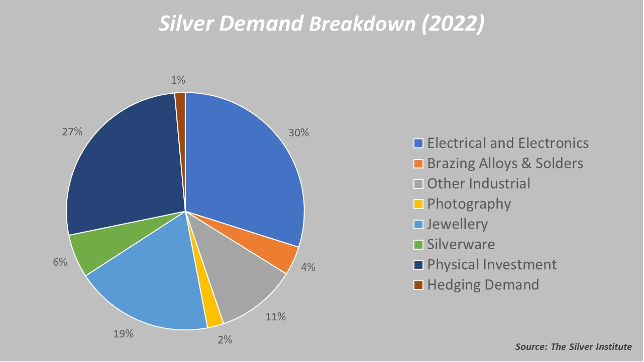
According to The Silver Institute, global silver demand struck a record high of 1.24 billion ounces in 2022, up 18% year on year. Off-take rose across most categories, with physical silver investment rising 22% from the prior year (to 332.9 million ounces).
Pros and Cons Of Trading Silver
Pros
- Volatility – Silver prices can be much choppier than gold, providing superior opportunities for short-term traders to make money from market fluctuations.
- Easy to trade – The silver market is highly liquid, making it easy for day traders to enter and exit positions. Traders also have a wide range of ways they can play the market, from buying physical metal to trading futures contracts, CFDs and company stocks.
- Diversification – Silver’s role as a hedge against inflation helps spread risk and can protect traders’ portfolios from sharp slumps when prices rise.
- Cheapness – The grey metal is much cheaper than other precious commodities like gold and platinum group metals (PGMs). This makes trading it available to a wider range of individuals.
- Dual purpose – Silver’s role as an industrial and investment metal means prices can rise during economic upturns and downturns.
Cons
- Price unpredictability – Silver’s role as an investment and industrial commodity means that prices can move in surprising directions following macroeconomic news. Failure to understand the complex suite of factors that affect values can result in poor decision-making.
- Leverage risks – Many of the securities used to trade silver allow investors to use large amounts of borrowed funds. Whilst this can potentially rev up profits, it may also lead to monster losses.
- Holding costs – Owning silver bars comes with the added cost of vaulting and insuring the precious metal. Short-term traders can avoid this by speculating on silver prices using derivatives.
What Drives Silver Prices?
Like all commodities, prices are subject to the laws of supply and demand and are highly sensitive to macroeconomic and geopolitical conditions.
Signs of excess or deficient mine production also influence silver values.
The malleable metal is extremely versatile and thus has a broad assortment of applications:
- Its conductivity makes it a key component in the manufacture of electronics and solar panels.
- High reflectivity means it is a core material in mirrors and photographic film.
- Its role as a catalyst for various chemical reactions means it is widely used in the chemical industry.
- Silver is a cherished material in jewellery production thanks to its aesthetic qualities (one-fifth of demand).
This all means that silver prices are extremely sensitive to broader economic conditions. As such, news on the following can impact demand and silver trading prices: Global growth, consumer spending, manufacturing output and employment levels.
Silver prices are also highly sensitive to the strength of the US dollar. When the currency rises in value it becomes more expensive to purchase the metal, and vice versa.
Like most commodities, silver is priced using the dollar on global markets.
 Royston WildAuthor
The Gold-Silver Ratio
Just like gold, silver is a safe-haven asset that investors flock to when market confidence sinks. It is used as a store of value during times of inflation, and as a wealth preserver during times of economic stress or uncertainty. For this reason, silver prices often closely track those of gold.
The gold-silver ratio is a historical metric used to appraise the relative value of these precious metals and is calculated by dividing the price of gold per ounce by the price of silver per ounce.
The gold-silver ratio has averaged around 15 to 1, meaning it would take 15 ounces of silver to buy one ounce of gold. Changes in the ratio can affect silver prices by influencing trader behaviour.
A high ratio, for example, can suggest that the grey metal is undervalued in comparison to gold, prompting a rush of buying interest and a surge in prices.
Different Ways To Trade Silver
Physical Silver
As with gold, or many of the other precious metals, physical silver is popular with investors seeking to benefit from appreciating prices.
Silver bars are the most cost-effective way for investors to purchase the metal in large quantities. This is because coins often feature intricate and detailed designs that require extra costs to manufacture.
Many mints and retailers also offer to store silver on behalf of their customers. This, along with taking out insurance to cover against loss and damage, means that investors in actual metal often endure additional expenses.
We recommend these firms if you want to invest in physical silver:
Best Silver Vaults
- BullionVault can be used to buy, sell and store precious metals like gold. Low fees, multiple security measures and a mobile app has made the firm popular with bullion investors.
Spot Contracts
A spot contract involves buying or selling a specified amount of the dual-role metal at the current market price for immediate settlement.
Spot silver agreements are traded by a wide range of individuals and institutions. Mining companies, manufacturers and jewellers, for instance, will buy these contracts to hedge against adverse price movements.
Traders meanwhile can trade them to diversify their portfolios and speculate on price movements.
Future Contracts
Silver is – like most commodities – mostly traded through the exchange of futures contracts.
These financial instruments state that a pre-agreed amount must be bought and sold for a set price and within a specified timescale. The prices of these contracts are based on spot silver values.
Futures are derivative vehicles, which means that they derive their value from the price of an underlying asset.
They are especially effective for commodities trading, as they allow traders to speculate on market movements without having to worry about taking physical delivery.
Silver futures are primarily traded on several major commodity exchanges:
- COMEX in the US
- Multi Commodity Exchange (MCX) in India
- Shanghai Futures Exchange (SHFE) in China
Options Contracts
Options are another common way for individuals to trade silver. As the name implies, they provide owners with the choice as to whether to buy or sell a quantity of the underlying asset later on and at a pre-set price (known as the strike price).
This gives traders much more flexibility, although this advantage over futures contracts attracts a higher price.
As with other types of derivatives, traders can choose to take either a long or a short position with silver options.
In other words, they have a chance to make money when the price of the precious commodity rises or falls in value.
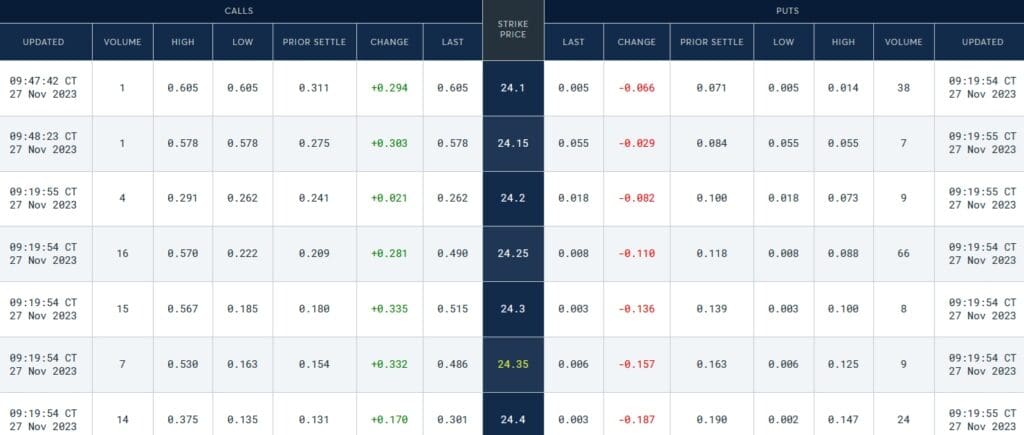
Here you can see a series of quotes on silver futures on COMEX. On the left are prices for call options, which give the contract owner the right to buy the metal. Prices for put options, which allow holders to sell silver on the expiration date, can be seen on the right.
Another reason why futures and options are so popular is because they allow individuals to use substantial levels of leverage, which is effectively a loan from a broker.
By using borrowed funds, you can open a much larger position than if you used just your own funds, which in turn provides the opportunity to make even greater profits.
Royston WildAuthorContracts for Difference (CFDs)
Derivatives known as contracts for difference (CFDs) are especially popular with short-term traders and day traders wishing to use leverage.
Gearing for these financial instruments is especially high, though the maximum leverage available varies according to the broker and the regulatory environment in the specific jurisdiction.
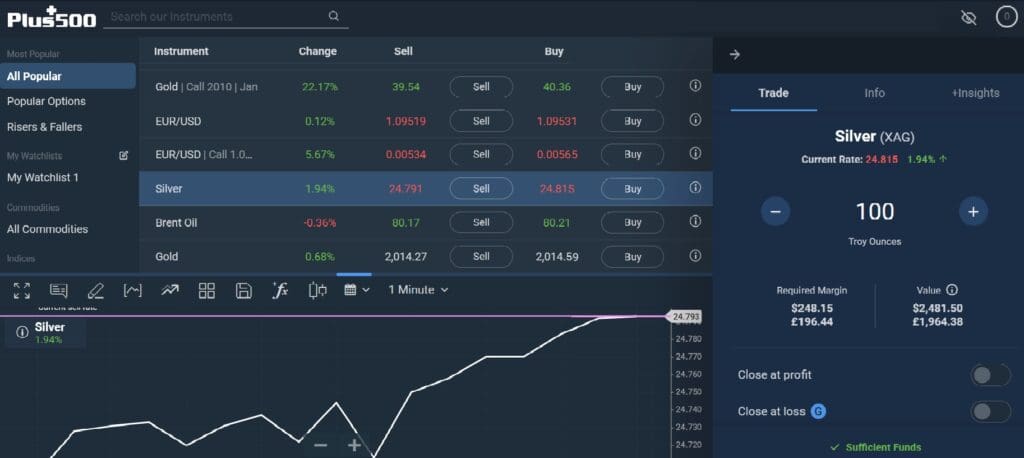
Here you can see an example of a CFD silver trade at Plus500. This broker allowed leverage of 1:10 (or 10%) for this particular trade, meaning that a trader would have to put down an initial deposit (or margin) of just $248.15 to control a position worth a total value of $2,481.50.
Using leverage can be a powerful weapon when you’ve invested correctly on how the silver market will move. However, when prices move in the ‘wrong’ direction traders can end up with thumping losses.
Even small price fluctuations can have a massive impact on the account balance, and traders may have to deposit extra funds to cover losses.
Silver Stocks
Traders can profit from rising metal prices by buying shares in silver-producing stocks.
Alternatively, they can make money when the metal value falls by taking a short position in one or more of these commodities companies.
Silver is rarely found in a pure metallic form. Instead, it is usually extracted alongside other elements including copper, lead, zinc and gold.
As a result, successful trading in silver shares also usually requires these other base and precious metals to rise in price.
The share prices of silver miners often track the value of the underlying metal. You can see this from the graph below which shows the market movement of FTSE 100-listed Fresnillo, the world’s biggest silver miner. When prices rise, shareholders usually see the value of their holdings increase, and vice versa.
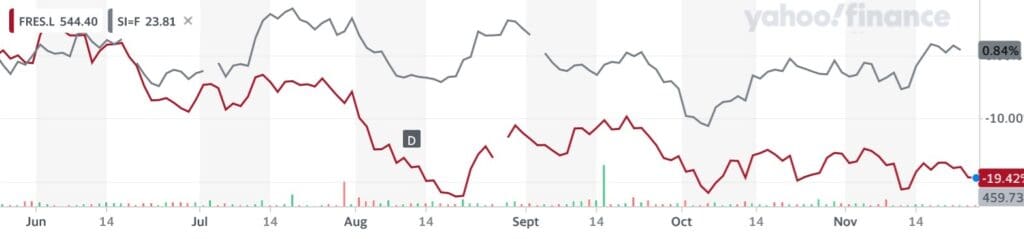
Yet as you can also see above, trading a silver stock doesn’t always pay off, even when prices of the commodity increase. This is because share prices are dependent on operational factors as well as movements in the silver market.
The graph above shows a near-20% decline in Fresnillo’s share price as soaring costs put a squeeze on profits.
Trading mining stocks has one big advantage over those other financial instruments I mentioned: equity investing can provide income as well as capital gains.
Not all silver producers pay dividends, but a large number do.
Royston WildAuthorExchange-Traded Funds (ETFs)
Also traded on stock markets, exchange-traded funds (ETFs) are financial instruments that are designed to track the precious metal price.
If a trader thinks the metal will become more valuable they can buy an ETF like the iShares Silver Trust. When silver prices set by the London Bullion Market Association (LBMA) appreciate, the value of the fund follows suit.
ETFs are highly liquid, cheap to trade, and allow individuals to diversify by getting exposure to a basket of different assets.
ETFs also allow individuals to execute a variety of different trading strategies. For example, someone who thinks silver metal values will fall can go short with the ProShares UltraShort Silver ETF.
Meanwhile, investors who want to get exposure to a selection of silver miners can buy the Global X Silver Miners ETF. At the time of writing, this fund held shares in 32 different silver producers.***
How To Start Trading Silver
- Learn about the silver market – BullionVault and Kitco are a couple of good sources of precious metals news and market information. Organizations like trade body The Silver Institute and metals refiner Johnson Matthey also provide valuable information on silver supply and demand.
- Choose a broker – The key things to consider are the fees and commissions for silver trading and the quality of the platform. Traders should also choose a firm regulated by a trusted body. Importantly, the best brokers offer educational materials and analysis of silver markets to help traders identify opportunities.
- Place a trade – Once you have opened an account, log in to your broker’s platform to make a trade. Day traders may opt for a vehicle like CFDs to profit from short-term changes in silver prices using leveraged funds. Also make use of risk management tools like stop-loss orders to cap your potential losses.
Bottom Line
Online traders have a wide selection of financial instruments they can use to profit from silver. Many of these make use of leverage, too, a tool that can significantly amplify short-term trading profits.
As with any asset class, traders should do plenty of homework before they begin trading silver. And particularly those who adopt the high-risk strategy of using borrowed funds.
* Total trading volumes on 22 November, 2023
** Prices stated as of 24 November, 2023
*** Holdings current as of 24 November, 2023
Article Sources
The writing and editorial team at DayTrading.com use credible sources to support their work. These include government agencies, white papers, research institutes, and engagement with industry professionals. Content is written free from bias and is fact-checked where appropriate. Learn more about why you can trust DayTrading.com