





In places such as the UK, the EU member states, and Australia, regulators have restricted retail CFD bonuses, and bonuses for certain other types of high-risk trading, because they concluded that incentives can encourage larger deposits, more frequent trading, bigger positions, and greater use of leverage. Regulators also found that bonuses and similar incentives distracted retail customers from the risk and cost of the underlying products. Typically, retail bonus prohibitions are introduced alongside other retail trader protection measures, such as leverage limits, margin close-out requirements, negative balance protection, and standardised loss warnings.
The restrictions discussed in this article mainly concern contracts for difference (CFD) and leveraged rolling spot forex offered to retail clients. That is considerably narrower than a blanket ban against trading bonuses. The restrictions we will discuss were put in place to protect retail clients, and even within the retail trading and investing space, they are fairly limited in their scope.
What Does “Tier-1 Regulator” Mean?
“Tier-1 regulator” is a shorthand industry term rather than any formal legal classification.
When we talk about trader protection, jurisdictions can broadly be divided into Tier 1, Tier 2, and Tier 3. Tier 1 are those jurisdictions with the strongest trader protection rules, especially for retail traders, but this also means that there are a lot of limitations in place that restrict traders, e.g. low retail leverage caps and no welcome bonus offers. Tier 2 jurisdictions are a more permissive and allow for greater flexibility, but there is still a substantial trader protection framework in place; brokerage companies are supervised, and rules are enforced. Tier 3 jurisdictions have either deliberately adopted a more laissez-faire approach to brokerage companies or simply don’t have dedicated regulations in place to manage them well. Vanuatu is an example of a jurisdiction that has deliberately decided to attract companies that look for a high degree of flexibility. There is a well-functioning framework in place to register and license online brokerage companies, but the law allows traders and brokers to decide most things through contracts. Vanuatu, for instance, does not impose any regulatory maximum leverage caps for retail forex and CFD traders, and retail bonus offers are not prohibited.
As mentioned above, the Tier 1/Tier 2/Tier 3 concept is shorthand industry lingo and not a formal legal classification with universally accepted criteria. Examples of factors that generally need to be in place for a jurisdiction to be considered Tier 1 are demanding capital, conduct, and disclosure rules, and very high enforcement standards.
- Examples of countries commonly referred to as Tier 1 are the UK, USA, Canada, Switzerland, many of the European Union member states, Australia, and Singapore.
- Examples of Tier 2 jurisdictions are South Africa, Kenya, and DIFC. (DIFC stands for the Dubai International Financial Centre, a financial free zone in Dubai that has its own legal and regulatory system separate from the rest of the United Arab Emirates.)
- Examples of Tier 3 jurisdictions where many online broker companies are registered and regulated are Vanuatu, the British Virgin Islands, Antigua and Barbuda, and Belize.
- There are also many jurisdictions around the world that lack a comprehensive trader protection framework, but also lack factors that would attract brokerage companies to register there. You are, for instance, not very likely to run into global brand retail forex brokerage companies that are registered in and regulated by countries such as Eritrea, Nepal, or Burma. They are generally seen as non-jurisdictions for international online forex brokerage companies rather than Tier 3 jurisdictions.
Finding out that your broker is based in and licensed by a jurisdiction considered Tier 1 or Tier 2 should not replace legal research. Even within these tiers, different regulators have widely different rules and resources, e.g. when it comes to capital requirements, compensation arrangements, and complaint systems. ASIC regulation does not provide the same compensation structure as UK FCA authorization; a Cyprus Investment Firm client has access to a different investor compensation arrangement than the client of a company based in one of the Canadian provinces, and so on.
CFDs Vs. Rolling Forex
Many jurisdictions that prohibit retail CFD bonuses also extend these restrictions to certain other forms of leveraged retail trading that are considered high-risk, including retail rolling spot forex.
For example, ESMA has clarified that certain rolling spot forex arrangements fall within the definition of CFDs for the purposes of its product intervention measures. This applies where the contracts are leveraged, cash-settled based on changes in the price of the underlying currency pair, and do not involve the actual delivery and exchange of currencies. This interpretation has been reflected in the national regulations adopted by EU member states, where retail protections such as leverage limits, risk warnings, and restrictions on incentives apply to qualifying rolling spot forex products in the same way as they apply to CFDs.
One example of this is found in the Policy Statement (PS-01-2019) issued by the Cyprus Securities and Exchange Commission (CySEC) on 4 February 2019.
2.5) According to the ESMA Decision, a “contract for differences” or “CFD” is defined as a derivative other than an option, future, swap or forward rate agreement, the purpose of which is to give the holder a long or short exposure to fluctuations in the price, level or value of an underlying, irrespective of whether it is traded on a trading venue, and that must be settled in cash or may be settled in cash at the option of one of the parties other than by reason of default or other termination event. The term includes Rolling Spot Forex and is further defined in the Questions and Answers on ESMA’s temporary product intervention measures on the marketing, distribution or sale of CFDs and Binary options to retail clients (the “ESMA Q&As”).
2.6) Specifically, the ESMA Q&As clarify that the ESMA CFD Decision applies to rolling spot forex that do not qualify as an option, future, swap or forward rate agreement. A forex derivative which a) uses the spot price as reference value; b)automatically rolls over at the end of the contract period; and c) allows a party to terminate the contract other than by reason of default or another termination event is a CFD for the purposes of Article 1(a) of the ESMA CFD Decision.
What Is A CFD?
A CFD (Contract for Difference) is a leveraged derivative contract that allows a trader to speculate on the price movement of an asset without owning the underlying asset. It is thus a type of derivative.
Instead of buying the asset itself, the trader enters into an agreement with the broker to exchange the difference in price between the opening and closing value of the contract.
Example:
1.) NASDAQ: APPL is at $200. The trader believes it will rise. The trader buys 100 CFDs, i.e. opens a position with a value of $20,000.
2.) APPL rises to $210. The price difference is $10. $10 x 100 CFDs = $1,000. The trader has made a profit of $1,000 before costs.
If APPL had instead dropped to $190, the trader would have been required to pay the broker $1,000. The price difference is the same, but in the wrong direction for the trader.
CFDs are available for a wide range of markets, including exchange-traded shares, forex currency pairs, commodities, cryptocurrencies, indices, and interest rates.
CFDs are offered with leverage, and the leverage allows the trader to control a large position with a small amount of money in their trading account. Example: With a 1:30 leverage, the required margin for a $100,000 position is around $3,333. This means that (if other applicable conditions are fulfilled), a trader with $3,333 of free cash in their account can open a $100,000 position.
When you use leverage, the broker effectively finances part of your position. If you keep the trade open past the broker’s daily cutoff time, overnight financing (also called a swap or rollover) is applied. Paying an overnight financing fee is common for leveraged long (buy) positions because you’re effectively borrowing money to maintain the position. There are, however, some cases where you will actually get money instead. Whether this happens depends on several factors, including if you’re long or short, the interest rates of the underlying asset or currencies, and the broker’s pricing and markup.
Regulators generally classify CFDs as complex, high-risk leveraged products because losses can be amplified by leverage, data shows that many retail traders lose money, and CFDs involve counterparty risk with the broker since your broker is also your counterparty in the trade.
This is why regulators such as the UK FCA, ASIC, and others impose rules for retail CFD accounts, e.g. leverage limits, risk warnings, negative balance protection, and restrictions on bonuses and incentives.
What Is A Rolling Spot Forex?
In the context of forex regulation aiming to protect retail traders, some retail forex products are treated just like CFDs when they are leveraged, cash-settled, and do not involve actual delivery of currencies. The most famous example is rolling spot forex, also known as rolling forex and spot FX rollover. This is a type of foreign exchange transaction where a spot forex position is automatically extended (“rolled”) from one trading day to the next instead of being settled.
A traditional spot forex transaction normally settles in two business days (T+2). Example: A hedge fund buys EUR today with the price fixed in USD, and the currencies are exchanged two business days later.
With rolling spot forex, no delivery happens because the position is automatically renewed each day, and the broker adjusts the position for the overnight financing cost or credit (the swap/rollover rate).
Example:
- Trader buys 1 standard lot of EUR/USD.
- The position remains open overnight.
- Instead of delivering euros and receiving dollars, the broker rolls the position forward.
- The trader pays or receives an overnight financing adjustment.
Rolling spot FX allows traders to hold leveraged FX positions indefinitely, as long as they fulfil the requirements.
Even if regulators do allow bonuses for spot forex trading, they can come with tough stipulations, as we’ve explained in our guide to the pitfalls of forex trading bonuses, plus our breakdown of common bonus clauses.
Rolling Spot Forex Vs. Forex CFDs
For a small-scale retail trader, rolling spot forex (RSF) and forex CFDs can look almost identical, and they do have many important similarities. It is no coincidence that many regulators apply identical or very similar rules to them when it comes to retail trader protection.
With both, you click buy or sell, use leverage, pay a spread, and your account balance changes depending on whether the currency pair moves in your favor. This similarity is especially strong when you trade with a pure market maker (MM) broker, because then the broker is your direct counterparty in both products.
However, they are still different financial instruments. The differences are mainly about the legal structure of the trade, the way the position is defined, and the regulatory framework around it rather than the basic trading experience.
With rolling spot forex, you are entering into a foreign exchange contract, but you are not exchanging physical currencies or receiving currency into a bank account while paying in another currency. Instead, you are holding a forex position that is continuously rolled forward. The position represents exposure to the movement of one currency relative to another. For example, if you buy EUR/USD, you are taking exposure to the euro strengthening against the US dollar.
With a forex CFD, you are not entering into a foreign exchange transaction. Instead, you are entering into a derivative contract with the broker. The CFD tracks the price of EUR/USD, and the profit or loss comes from the difference between your opening and closing prices. You do not have a currency position in the traditional FX sense. You have a derivative contract whose value is linked to the FX market.
For many retail traders, this distinction will not change the trading screen or the way a trade feels. A EUR/USD CFD and a EUR/USD rolling spot forex position can have the same chart, the same entry price, the same stop-loss level, and the same profit or loss. If EUR/USD rises by 50 pips, both positions may produce a similar gain.
The differences become more relevant in situations where the legal nature of the contract matters.
One difference is financing. A rolling spot forex position is normally associated with a rollover or swap adjustment. This reflects the cost or benefit of holding one currency against another overnight, based on interest-rate differences and broker adjustments. A forex CFD also has overnight financing, but this is typically structured as a CFD funding charge or credit. The calculation may use a different formula because it is not technically an FX rollover; it is the financing cost of maintaining a derivative position.
Another difference is regulatory treatment. In some countries, CFDs are regulated as derivative products, and regulators apply derivative or CFD-specific rules. Rolling spot forex may fall under a different regulation. The exact rules depend on applicable law and regulations, but the distinction can affect the protections and limitations that apply to the trader.
The difference can also matter during unusual market events. Suppose there is a sudden currency crisis, extreme volatility, and major market gaps. The legal basis for how the broker handles the situation can be different between the two products, since one product is a forex contract and the other is a derivative contract. Still, there are also other factors that will impact your outcome, such as your broker’s client agreement and execution practices.
It is also worth noting what is not a major difference. The fact that the broker is the counterparty is not unique to CFDs. Many retail forex traders use market maker brokers, meaning the broker is also the counterparty for rolling spot forex trades. Similarly, both products can usually be leveraged, held overnight, and traded without physical delivery of currencies.
For most small retail traders, the practical difference is often limited. The most important things to compare are usually the broker’s total costs, spreads, financing charges, execution quality, regulation, and account protections. The label “rolling spot forex” or “forex CFD” matters, but the quality and terms of the broker often matter just as much.
The Legal History of Retail Forex CFD Bonus Restrictions
Below, we will look at a few notable places where strong retail Forex CFD Bonus Restrictions are in place and how this has evolved.
The European Union And The Member States
ESMA’s 2018 Temporary Product Intervention
The European Securities and Markets Authority (ESMA) introduced temporary restrictions on retail CFDs in 2018 after examining retail losses, leverage, product complexity, and sales practices.
The measures limited leverage to 30:1 for major currency pairs, 20:1 for non-major pairs and gold, with lower limits for more volatile assets. They also introduced a 50% account-level margin close-out rule, statutory negative balance protection, standardised risk warnings, and a prohibition on certain monetary and non-monetary benefits, including what we normally call “CFD trading bonuses”. ESMA said monetary and non-monetary benefits could distract retail investors from the high-risk nature of CFDs, and noted that bonuses and similar benefits were often conditional on customers depositing money or completing a required trading volume.
The legal basis for the temporary intervention was ESMA’s product-intervention power under Article 40 of MiFIR (Regulation (EU) No 600/2014, the Markets in Financial Instruments Regulation). MiFIR and Directive 2014/65/EU (MiFID II) together form the EU legislative package governing markets in financial instruments.
Why did ESMA put this temporary measure in place?
ESMA explains its reasons in point 2.1. of the “Additional information on the agreed product intervention measures relating to contracts for differences and binary options”, published in March 2018.
“2.1 Why has ESMA agreed on this measure? CFDs that offer leveraged exposure to price, level or value changes in underlying asset classes have existed as a speculative short-term investment product provided to a niche client base in some jurisdictions for several years. However, in recent years, a large number of national competent authorities (NCAs) have raised concerns about the widening distribution of CFDs to a mass retail market, despite these products being complex and inappropriate for the large majority of retail investors, as further explained below.
These concerns have materialised across several jurisdictions, with a majority of retail investors in those jurisdictions typically losing money. NCAs’ analysis on CFD trading across different jurisdictions in the EU shows that 74-89% of retail investor accounts typically lose money on their investments, with average losses per investor ranging from €1,600 to €29,000. In an attempt to address these concerns, some NCAs took measures in this area. However, in the light of the persisting significant investor protection concerns across the EU and the crossborder nature of these activities, ESMA’s product intervention power is the most appropriate and efficient tool to address these concerns and to ensure that retail investors across the Union are provided with a common minimum level of protection.
Furthermore, before agreeing on product intervention measures, ESMA conducted a call for evidence on the possible use of its product intervention power2 (the call for evidence). ESMA duly considered all the responses to the call for evidence, including concerns expressed by individuals and CFD providers. After taking these concerns into account and considering the detriment caused by the offer of CFDs to retail investors, ESMA believe this measure to be a necessary and proportionate means to address such detriment.”
Note: NCA stands for National Competent Authority. In the context of EU financial regulation, an NCA is the regulator in each Member State responsible for supervising financial markets and firms and for enforcing legislation such as MiFID II and MiFIR. Examples include Autorité des marchés financiers (AMF) in France, Bundesanstalt für Finanzdienstleistungsaufsicht (BaFin) in Germany, and Comisión Nacional del Mercado de Valores (CNMV) in Spain.
The EU Member States
The process unfolded in two parallel tracks: ESMA’s temporary EU-wide intervention and the respective national permanent interventions established by national competent authorities (NCAs) throughout the EU.
A brief timeline looks like this:
- 18 January 2018 – ESMA published its Call for Evidence (ESMA35-43-904), proposing possible restrictions on CFDs and binary options for retail clients and inviting feedback from stakeholders.
- 22 May 2018 – ESMA adopted its first product intervention decision. The measure included leverage limits, margin close-out protection, negative balance protection, restrictions on incentives, and standardized risk warnings. Because MiFIR Article 40 only allows temporary interventions, the measures were limited to three months.
- 1 August 2018 – The first ESMA restrictions entered into force across the EU.
- 1 November 2018 – ESMA renewed the measures for another three months.
- 1 February 2019 – ESMA renewed them again. At this stage, ESMA noted that no NCA had yet adopted its own national product intervention measures under Article 42 of MiFIR.
During the first half of 2019, several national regulators began establishing permanent national measures under Article 42 of MiFIR. Under Article 43, ESMA reviewed these proposals and issued opinions on whether they were justified and proportionate. Among the earliest authorities to act were the UK’s FCA (the UK was still a Member State in 2019), Spain’s CNMV, and Latvia’s FKTK. Many other Member State CNAs followed with similar notifications.
On 1 May 2019, ESMA renewed its temporary measures for a third and final time, extending them until 31 July 2019, and acknowledging that an increasing number of NCAs were introducing equivalent permanent national measures. On 31 July 2019, ESMA announced that it would not renew the temporary CFD restrictions again. The reason was that most NCAs had already adopted permanent national product intervention measures that were at least as stringent as ESMA’s restrictions. Consequently, ESMA’s final temporary decision expired automatically at the end of that day.
ESMA’s intervention was always intended as a temporary, EU-wide response under Article 40 of MiFIR. As national regulators gradually implemented their own permanent restrictions under Article 42 of MiFIR, ESMA no longer needed to maintain its temporary measures. The regulatory protections therefore continued, but responsibility shifted from ESMA’s temporary EU intervention to permanent measures enforced by individual national competent authorities.
Cyprus Adopted Permanent National Measures On 27 September 2019
Cyprus was central to the European retail CFD industry because many international brokers used Cyprus Investment Firms licensed by the Cyprus Securities and Exchange Commission (CySEC) to serve customers across the European Economic Area (EEA). Yet, Cyprus’s permanent national measures did not come into force until after ESMA’s temporary measures had already expired for some time. ESMA’s measures expired on 31 July 2019, and CySEC’s permanent national CFD measures came into force on 2 October 2019. There was thus a gap in August and September.
The timeline was:
- 30 May 2019 – CySEC published a consultation paper proposing permanent national CFD measures under Article 42 of MiFIR.
- 29 August 2019 – CySEC formally notified ESMA of its proposed national measures, as required by Article 43(1) of MiFIR.
- 27 September 2019 – CySEC issued Policy Statement PS-04-2019, permanently imposing restrictions on the marketing, distribution, and sale of CFDs to retail clients. The measures largely mirrored ESMA’s temporary restrictions.
- 30 September 2019 – ESMA published its opinion concluding that CySEC’s measures were generally justified and proportionate.
- 2 October 2019 – The national measures came into force in Cyprus.
CySEC’s permanent national measures enacted in 2019 were largely similar to ESMA’s temporary measures for retail CFDs, including the 30:1 maximum leverage for major currency pairs, the 50% margin close-out rule, the statutory negative balance protection, and the restriction on cash and other incentives encouraging retail customers to trade (“trading bonuses”). In their Policy Statement (PS-04-2019, CySEC said that such incentives might result in distracting retail clients from the risk entailed and luring them into CFDs trading.
“3.4 RESTRICTION ON THE INCENTIVES OFFERED TO TRADE CFDs“
- In order to address the risks emanating from incentivising retail clients to trade in CFDs by means of monetary or certain types non-monetary benefits (including by 21 providing bonuses), CySEC proposed under CP-02-2019 to adopt the same restrictions as ESMA on the incentives offered to clients.
- Such incentives might result in distracting retail clients from the risk entailed and luring them into CFDs trading.
- To this end, CySEC believes that the CFD providers should not directly or indirectly provide the retail client with a payment, monetary or excluded non-monetary benefit in relation to the marketing, distribution or sale of a CFD, other than the realised profits on any CFD provided (the “Restrictions on the Incentives Offered to Trade CFDs”).
- CySEC reiterates that “excluded non-monetary benefit” means any non-monetary benefit other than, insofar as they relate to CFDs, information and research tools.
- Further information on the risks that such incentives entail are provided in the ESMA Decision on CFDs.”
The United Kingdom
In 2019, the UK was still an EU Member State, and when ESMA introduced its temporary CFD restrictions in 2018, they applied across the EU, including the UK. At that time, the UK’s financial regulator, the Financial Conduct Authority (FCA), was an EU National Competent Authority (NCA), operating within the MiFID II/MiFIR framework.
Timeline:
- 1 August 2018 – ESMA’s temporary CFD restrictions entered into force across the EU, including the UK.
- January 2019 – The FCA notified ESMA that it intended to introduce permanent national CFD product intervention measures under Article 42 of MiFIR.
- 1 July – Publication of PS19/18
- 1 August 2019 – The FCA’s permanent retail CFD restrictions came into force. They were broadly equivalent to ESMA’s measures, with leverage limits by asset class, margin close-out rules, negative balance protection, standardized risk warnings, and restrictions on monetary and non-monetary incentives.
On 31 January 2020, the UK left the EU, and the Brexit transition period ended on 31 December that same year. Since then, the FCA rules no longer operate under MiFID II and MiFIR. So far, the FCA has generally maintained the same core retail protections, while replacing EU references with UK-specific regulatory concepts. The FCA has not removed any of the major retail protections introduced in 2019, i.e. maximum leverage limits, 50% margin close-out, negative balance protection, standardized risk warnings, and the ban on incentives (“trading bonuses”).
These measures apply to retail clients of the FCA-regulated entity. A customer classified as a professional client loses retail protections. The FCA has continued to warn firms against inappropriate professional-client reclassification. In its 2024 CFD portfolio letter, the FCA told firms to make sure customers understand which protections they lose when they are moved into professional status.
Australia
ASIC’s CFD product intervention order took effect on 29 March 2021, imposing conditions on the issue and distribution of CFDs to retail clients, including leverage restrictions, standardised margin close-out arrangements, negative balance protection, and restrictions on inducements (“trading bonuses”).
The order capped retail leverage at 30:1 for major currency pairs and imposed lower limits on other assets. It introduced standardised margin close-out rules, negative balance protection, and prohibitions on certain inducements. The regulator had concluded that certain product features and sales practices could increase the harm produced by leveraged trading.
ASIC’s 2017 review found that 72% of clients trading CFDs lost money, while 63% of clients trading CFDs with a currency pair as the underlying asset lost money. Approximately 97% of the clients covered by the review were retail clients.
The 2021 order was eventually extended until 23 May 2027. Since then, ASIC has indicated that it will review the order during 2026 and consult on its proposed approach, with the order to be extended or allowed to expire in 2027. Given ASIC’s continued concerns regarding retail investor harm and its finding that the order has reduced significant detriment, further continuation appears plausible. ASIC’s 2026 regulatory timetable says it will begin its review in Q3 2026, consult on extending the order in Q4 2026, seek Ministerial approval in Q1 2027, and either extend the instrument or allow it to expire in Q2 2027. The regulatory case for continuation remains strong. ASIC’s January 2026 sector review found widespread compliance problems, including more than half of CFD issuers contravening aspects of the PIO. ASIC also secured nearly $40 million in refunds for more than 38,000 retail investors.
The USA
Compared with the EU, UK, and Australia, the United States adopts a different regulatory framework for retail leveraged foreign-exchange trading. Rather than regulating retail forex CFD trading and retail rolling spot forex trading primarily through the type of product-intervention regime used in the EU, UK, and Australia, the US regulates retail off-exchange forex under the Commodity Exchange Act (CEA) and CFTC framework, with registered Futures Commission Merchants (FCMs) and retail foreign exchange dealers (RFEDs) serving as counterparties to retail customers.
The Commodity Futures Trading Commission (CFTC) and National Futures Association (NFA) impose strict registration, capital, disclosure, leverage, and promotional-material requirements on firms serving US retail forex customers. Retail Foreign Exchange Dealers must register with the CFTC, become NFA members when applicable, and comply with the applicable Forex Dealer Member rules. The CFTC and NFA are both important US financial regulators, but they have different roles. The Commodity Futures Trading Commission (CFTC) is a US federal agency. It regulates derivatives markets, including futures, options, swaps, and retail foreign exchange. The Commodity Exchange Act (CEA) gives the CFTC authority over certain retail forex transactions. The National Futures Association (NFA) is a self-regulatory organization, not a government agency. It regulates and supervises firms and individuals involved in the US derivatives industry that are subject to NFA oversight. For example, FCMs and RFEDs generally must be registered with the CFTC and be NFA members. The NFA handles functions such as registration, compliance, examinations, and enforcement of its rules.
US security-deposit requirements effectively restrict leverage to 50:1 on major currency pairs and 20:1 on other pairs. The CFTC describes these as minimum deposits of 2% and 5%, respectively.
Promotions are not generally prohibited in the US retail forex market. However, CFTC regulations prohibit fraudulent or deceptive conduct in connection with retail forex transactions, including wilful deception, false statements and representations, and guarantees against loss. NFA rules impose additional and more specific requirements on the advertising and promotional activities of its members, and do, for instance, have rules against promotions that are misleading, deceptive, or high-pressure. Forex Dealer Members can be required to submit advertising to NFA for review, retain supporting records, and disclose relevant costs.
“NFA Compliance Rule 2-36 (g)- Communications with the Public and Promotional Material.
Forex Dealer Members and, as applicable, Associates of Forex Dealer Members must comply with sections (a) through (h) of NFA Compliance Rule 2-29 and the Interpretive Notices related to these provisions. The Member Oversight Department may require any Forex Dealer Member for any specified period to file copies of all promotional material with NFA for its review and approval at least 10 days prior to its first use or such shorter period as NFA may allow.”
Source: (NFA Compliance Rule 2-36(g) – Communications with the Public and Promotional Material.)
The U.S. framework does not impose the same broad prohibitions on monetary and non-monetary retail CFD benefits as the UK, EU, and Australia do, but US retail forex promotions operate inside a tightly restricted registered market, while unregistered foreign firms generally cannot lawfully solicit or accept US retail forex business requiring CFTC registration. Many non-US forex/CFD firms actively exclude US customers and block them from even registering an account, because serving them can trigger US registration and regulatory obligations. The CFTC explicitly says that foreign entities that solicit and/or accept funds from US residents for forex trading frequently operate in a capacity requiring CFTC registration.
Examples Of Why Some Regulators Consider Retail Forex Bonuses Harmful
Turnover Conditions Encourage Heavy Trading
Many bonuses are tied to a required number of lots or a notional-volume threshold, and the turnover requirement must be achieved within a certain time frame, e.g. 30 days, to release the bonus. This model can be especially harmful to inexperienced small-scale traders, since they should ideally start out slowly and carefully, and only gradually move onto more frequent trading and bigger positions, as they gain more knowledge and experience. With a turnover requirement to chase, inexperienced traders are encouraged to move into frequent trading and/or big positions too early and for the wrong reasons.
The customer may be unable to withdraw the bonus or associated profits until the target is completed. This creates a reason to trade even when the strategy has no valid setup. The trader starts opening positions that do not align with the strategy and is encouraged to disregard the risk-management routines. The direct cost of chasing a turnover requirement includes spreads, commissions, and financing. The less visible cost is the deterioration in trade quality that happens when a contractual deadline is allowed to influence trading decisions.
ESMA specifically noted that benefits were frequently conditional on depositing funds or completing a stated volume of trades. Its concern was that the benefit could distract the client from the product’s high risk and encourage activity that would not otherwise occur.
It is also important to remember that the bonus money is not free money when it comes with a high turnover requirement. You will pay back the broker through spreads / commissions / financing. If you can achieve the turnover requirement in time while sticking to your normal trading strategy and risk management routines, this is not really an issue since you would have paid those costs and taken those risks anyway. But many inexperienced small-scale traders can’t.

The “Risk-Free” / “Low-Risk” Entry and the Deposit Escalation Problem
No-deposit bonuses can create a particular behavioral risk because they may make leveraged trading appear to be “risk-free” or effectively risk-free at the point of entry. A prospective customer can be offered trading credit without first putting their own money at risk. For an inexperienced trader, this can substantially reduce the psychological barrier to opening an account and experimenting with a highly leveraged product whose ordinary risks may not yet be fully understood.
But a no-deposit bonus is pretty much always subject to conditions requiring a minimum trading volume or turnover before the customer can withdraw the bonus and any profits associated with it (if the bonus amount is withdrawable at all). In some programmes, making a deposit may also be a condition that must be met before making a withdrawal. A customer who initially entered without risking their own money may therefore face a strong incentive to deposit funds in order to satisfy the bonus conditions. A desire to complete the requirements may create pressure to deposit additional money and continue trading.
This is one reason regulators have treated aggressive trading incentives with concern. The problem is not simply that a bonus exists, but that an apparently low-risk or “risk-free” offer can bring inexperienced customers into a high-risk leveraged product and then expose them to incentives that encourage deposits. The initial promise and the eventual economic commitment can therefore look very different. What begins as an offer requiring little or no financial commitment can develop into a situation in which the customer is encouraged to commit substantially more of their own money.
A similar dynamic can arise with low-minimum-deposit advertising. An offer such as “start trading and get a welcome bonus – only €10 deposit needed” may make the financial commitment appear trivial and therefore reduce the perceived risk of entering the market. Once the customer has opened an account, however, bonus conditions encourage a larger deposit, particularly if the account reaches a point where it has insufficient funds to maintain margin and meet the trading-volume requirement. The customer’s initial decision to participate with a very small amount can consequently become the starting point for progressively larger financial commitments, and the threshold for an additional deposit is low since the trader has already completed a full live account sign-up and successfully made a deposit into the account.
This does not mean that every no-deposit or low-deposit offer inevitably produces harmful behavior or that retail traders are somehow strong-armed to make deposits. Nor does it establish that every customer who makes an additional deposit has been improperly pressured, is unable to understand the situation properly, or will have a negative outcome. The regulatory concern is instead the structure of the incentive and the possibility of escalation. An offer designed to make entry appear no-risk or low-risk may create incentives to trade more, deposit more, and continue trading after losses. In that sense, the concern is chiefly about the potential “slippery slope” from low perceived risk at entry to increasing financial exposure after the customer is committed to the product.
Bonuses Can Conceal The Effect Of Leverage For Inexperienced Traders
A 100% deposit match doubles the equity shown in the platform. A trader who deposits $1,000 may see $2,000 after the credit is added. That visual change can make a leveraged position appear safer without reducing its notional size. If the welcome bonus encourages the trader to double the lot size, the additional margin capacity has not created protection; it has encouraged more exposure. Regulators viewed this as particularly problematic for inexperienced traders who do not fully understand margin.
The fact that bonus money is conditional makes the situation even more precarious. The trader sees $2,000 in the account and makes leverage decisions based on this. But when the market takes a turn against the trader, bonus conditions can make it possible for the broker to remove all or part of the bonus, and this can trigger a margin call earlier than expected.
A bonus can add extra trading power, but bonus credits are not the same as real cash in your account.
Promotions Draw Attention Away From More Important Factors
Bonus adverts feel easy to compare. A customer can see that one broker advertises a 100% match bonus up to $1,000 while another offers nothing.
It takes considerably more work to understand and compare factors such as regulation, licensing, typical spreads, swap rates, execution model, slippage, rejection frequency, and withdrawal processing. But these are much more important factors, and we should not let the lure of a big bonus number decide which broker we pick.
Brokers are not handing out bonuses because they are so nice and generous and want to give away free money. They want to attract clients (and this part is pretty obvious), but there can also be other factors at play. A big welcome bonus and very high leverage can, for instance, be used to entice a trader to sign up with a Vanuatu-registered company instead of a UK FCA-registered company; both operating under the same brand but with vastly different retail trader rules.
Dealing Models, Conflicts-of-Interest, and Bonuses
Some brokers act as principals to the customer’s trade. This model means that your broker is also your counterpart.
With CFDs, that is the standard model: you are betting on price movements against your broker, rather than buying and selling financial instruments on an open market.
When your broker is your counterpart and retains the exposure rather than immediately hedging it externally, your loss can correspond with the firm’s trading gain, and this creates a conflict of interest. The broker makes money when you lose, and loses money when you profit.
This is not automatically an unsound model. Many reputable brokers work this way. It does, however, make proper regulation and supervision even more important. It also muddies the water a bit when bonus offers become involved.
ESMA has stated that when there is a direct relationship between the customer’s profit or loss and the provider’s result, it requires firms to manage the resulting conflict properly and act honestly, fairly and professionally. In their “Questions and Answers Relating to the provision of CFDs and other speculative products to retail investors under MiFID”, ESMA shows how a firm can demonstrate that it has met its MiFID obligations to act honestly, fairly and professionally in accordance with the best interests of its clients. (See “Question 1: In the case of some providers of CFDs or other speculative products dealing on own account”.)
Not every market-making or internally matched model is improper, but there is a conflict of interest present, and it must be handled correctly. This becomes very difficult with brokers where employees are rewarded for obtaining further deposits from losing clients, and this is an area where bonuses are sometimes used in various improper ways to apply additional pressure on the trader. Bonus credits can, for instance, be offered after a margin call in exchange for another deposit.
Regrettably, using high-pressure sales tactics to pressure retail traders into making more deposits is not unusual in the industry. ASIC has, for instance, documented cases involving account managers who pressured customers to deposit more and firms that benefited directly from customer losses. (See ASIC Federal Court findings on CFD issuers.)
With that said, we should not assume that any and all broker-trader conflicts-of-interest disappears when another model is used and the broker is not the customer’s direct counterparty. In an STP model, for example, the broker may pass the customer’s trades to external liquidity providers while earning revenue through commissions, mark-ups, or the spread. A broker can therefore have a commercial incentive to encourage greater trading activity even where it does not profit from the customer’s individual losses. Where remuneration or promotional structures encourage frequent trading, high turnover, or repeated deposits, the resulting conflict can arise from the broker’s dependence on transaction volume rather than from taking the opposite side of the customer’s position.
Accordingly, the fact that a provider operates a market-making or dealing-on-own-account model does not, by itself, establish that the model is inherently less fair to retail clients than an STP, ECN, or fully externally hedged model. Market makers may provide liquidity, manage exposure through hedging or portfolio-level risk management, and generate revenue from the spread in a fair and legitimate manner. The more relevant question is whether the firm’s remuneration, sales practices, risk-management arrangements, and client incentives create conflicts that are inadequately managed. Do they encourage behaviors contrary to the client’s interests? The same principle applies to non-market-making brokers. A broker that earns commissions or spreads can also have incentives to encourage excessive trading, even though it does not directly benefit from the client’s losses.
How Broker Groups Offer Bonuses Through Offshore (Tier 3) Entities
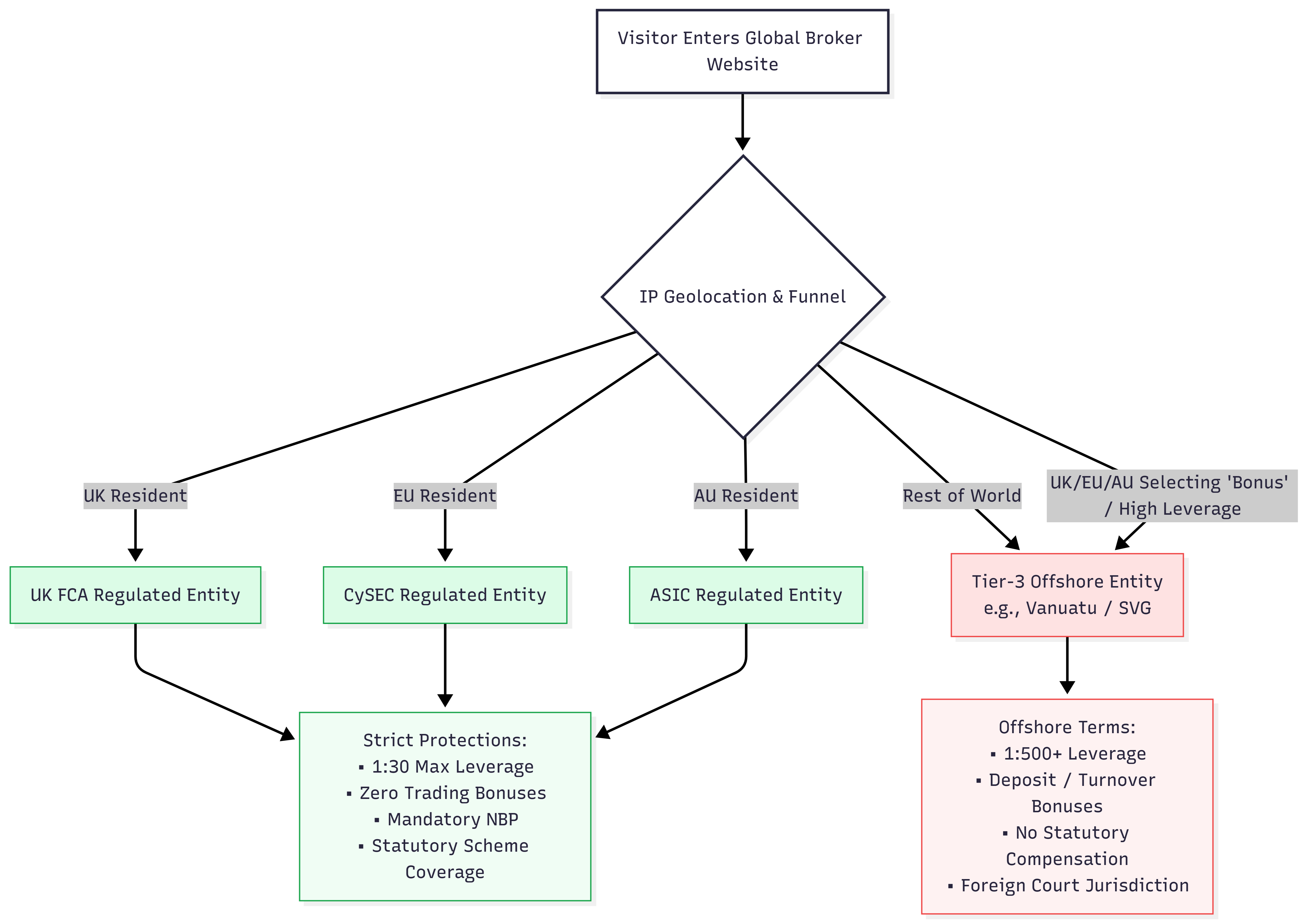
A trader visiting a retail forex CFD broker’s UK website will not find promotions such as welcome bonuses, deposit matches, or no-deposit bonuses. The leverage will be capped at 1:30, there will be risk disclosures, and the trader will probably also see some information about Negative Balance Protection (NBP). The same person opening the group’s international website may see something very different, e.g. offers for a 100% first deposit bonus, subsequent 50% match bonuses, and a small no-deposit bonus for new sign-ups. Leverage might be up to 1:500 or even higher, and you may be able to earn account credits for referring friends.
The branding is the same, and the trading platforms can be identical, but you are seeing offers from two different legal entities. One is a company that is registered in the UK and operates under a UK FCA license. The other is a company based in a so-called Tier 3 jurisdiction and regulated under that legal framework. They both belong to the same corporate group, but they are separate legal entities. In this context, Tier 3 jurisdictions are jurisdictions that have taken a more permissive stance towards brokers and give them a lot of flexibility, even when it decreases trader protection. Examples of well-known Tier 3 jurisdictions are the Seychelles, Vanuatu, and Saint Vincent & the Grenadines.
In addition to the UK company and the Tier 3 company, that same company group can include a variety of other companies, e.g. one based in Cyprus that welcomes European Union traders under its CySEC license, one in Kenya that onboards Kenyan traders under a CMA license, and one in Australia where Australian traders can trade protected by ASIC regulation and enforcement.
Different traders all signing up with the same global broker brand can therefore have their accounts regulated in very different ways. Different legal entities can use the same brand, the same trading platform, the same website design, and the same customer support office, while providing materially different contractual rights. The temptingly large retail CFD bonus you see is therefore not just a promotional feature; it can also indicate that the account sits outside the regulatory frameworks where this type of retail promotion is prohibited.
Company Group Example
A broker brand is often a group of companies rather than one regulated business. The group may use one trading platform and one marketing name, but each company is its own legal entity and has its own customer agreement.
A simplified structure may look like this:
| Company (legal entity) | Typical client group | Retail account conditions |
|---|---|---|
| UK company authorised by the FCA | UK retail clients | No trading bonus, leverage up to 30:1 on major forex pairs, statutory negative balance protection, risk disclosures |
| Cyprus company authorised by CySEC | EEA retail clients (under applicable EEA passporting rules) | No trading bonus, leverage up to 30:1 on major forex pairs, statutory negative balance protection, risk disclosures |
| Australian company authorised by ASIC | Australian retail clients | No trading bonus, leverage up to 30:1 on major forex pairs, statutory negative balance protection, risk disclosures |
| Vanuatu company authorised by VFSC | Clients from many different parts of the world, including clients from jurisdictions with stricter client protection rules | Large trading bonuses, vague bonus terms permitted, no statutory leverage caps (leverage often up to 1:500 or 1:1000 on major forex pairs), only contractual negative balance protection (if any) |
| St. Vincent & the Grenadines company, not an authorized financial service provider | Clients from many different parts of the world, including clients from jurisdictions with stricter client protection rules | St. Vincent & the Grenadines does not license and supervise online brokers, so the “SVG” badge simply denotes that the company is registered in that jurisdiction. No specific legislation exists here for online brokers, which means no restrictions for retail bonuses, bonus terms, leverage, and negative balance protection. |
Geolocation And Registration Redirection
A broker’s website can aim to identify the visitor’s location through data such as the IP you arrive from, or which advert you clicked, and potential clients can also select a country, enter their phone number, and provide residency information during the sign-up process.
The registration system then assigns the applicant to an available legal entity. If the brand company group has a UK company, a Cyprus company, and a Vanuatu company, residents of the UK will typically be directed to the UK company, residents of the EEA will be sent to the Cyprus-based company (assuming the required firm-passporting routines have been followed), and traders living in the rest of the world are likely to be sent to the Vanuatu company.
This means that a trader in a country such as Australia or Kenya might enter a site belonging to a broker brand that features a UK FCA license in their marketing material, but be sent on to be onboarded by the Vanuatu company. This routing can happen without a dramatic warning. The account-opening page may contain the new corporate name near the final confirmation button, while the main website continues to show off the group’s stronger licences.
Even a trader in the UK (or another Tier 1 or Tier 2 jurisdiction) can be nudged towards the Vanuatu company. You might, for instance, be required to answer a question about how much leverage you need, or if you want a welcome bonus, and if you indicate high leverage and/or that you want a welcome bonus, you are routed over to the Vanuatu company onboarding process, since the UK FCA-licensed company can not give these things to a retail client.
ESMA has warned about EU firms marketing the option for clients to move accounts to an intra-group company in a third country.
“ESMA observes that some CFD providers established in the EU are marketing the possibility for retail clients to move their accounts to an intra-group third-country entity. ESMA notes that firms should not incentivise retail clients to start trading with an intra-group firm established in a non-EU jurisdiction.
ESMA clarifies in its statement that in the absence of authorisation or registration in the EU in accordance with MiFIR or with the national third-country regimes in force in various Member States, third-country firms are only allowed to provide services to clients in the Union at the client’s own exclusive initiative. Furthermore, information in relation to the ‘benefits’ of trading CFDs with such an intra-group third-country entity could be seen as a circumvention of ESMA’s product intervention measures by the EU authorised firm.”
The Footer Disclaimer
If you look at the bottom of the broker’s site and make an effort to read the fine print, you may find that it says that bonuses are offered only by a named offshore company and are unavailable to UK, EU, or Australian residents (and so on).
That sentence is legally important. It identifies which company issues the promotion and confirms that the stricter group entity is not providing it.
User Agreement and Bonus Terms
A trader should search the bonus terms for words such as “contracting entity”, “governing law”, and “eligible jurisdiction”. Make sure you know the full legal name of the company offering the bonus, and where it is regulated and licensed, before you agree to anything. If that company is not the same as the one in your existing User Agreement, things can get complex. It might also be a part of a path that will lead you to being prompted to agree to a new User Agreement, where your new counterpart will be a company licensed in a Tier 3 jurisdiction.
Examples of What A Retail Trader May Change By Choosing A Tier 3 Bonus Entity
| Checkpoint | FCA-regulated UK entity | CySEC-regulated Cyprus entity | ASIC-regulated Australian entity | Entity regulated by a Tier 3 jurisdiction |
|---|---|---|---|---|
| Retail trading bonuses | Monetary and non-monetary CFD incentives prohibited | Monetary and non-monetary CFD incentives prohibited | Certain CFD inducements prohibited | Monetary and non-monetary CFD incentives are normally allowed. Bonus terms and conditions are agreed to between the parties, and can be legally binding even when they strongly favour the broker. |
| Leverage cap for major forex pairs | 30:1 for retail clients | 30:1 for retail clients | 30:1 for retail clients | No cap or a high cap, e.g. 1:500 |
| Negative balance protection | Mandatory for retail CFD accounts | Mandatory for retail CFD accounts | Mandatory for retail CFD accounts | Usually not mandatory for retail CFD accounts. You can still get contractual NBP. |
| Margin close-out | 50% account-level rule | 50% account-level rule | Standardised close-out rule | Regulated by the contract, not by law |
| Investor Protection Scheme (for broker firm failure) | FSCS may cover 100% of an eligible claim up to £85,000 per person per failed firm | ICF may cover 90% of an eligible claim, but not more than €20,000 per person, per failed firm | May cover up to A$150,000 of an eligible unpaid AFCA determination, subject to eligibility and scheme scope. Not as straightforward as FSCS and ICF. | Varies depending on the jurisdiction. Some have no investor compensation fund. Some funds are privately held and managed. |
| External complaints | An established, accessible complaints path exists for retail traders. | An established, accessible complaints path exists for retail traders. | An established, accessible complaints path exists for retail traders. | Depends on the jurisdiction. In some jurisdictions, the first step can be retaining legal representation in that country and launching a civil suit. |
| Local enforcement | FCA and UK legal system | CySEC and Cyprus or EU legal framework | ASIC and Australian legal system | Regulator and courts in the entity’s jurisdiction, unless otherwise specified in the User Agreement |
Knowing The Legal Entity Holding Your Account – A Practical Step-By-Step Guide
This audit was written with the User Agreement in mind, but it can also be useful for other contracts that may come your way, such as Bonus Terms & Conditions, Leverage Contracts, and more. Each time you are asked to agree to something, check if the contractual counterparty is still the one from your User Agreement, or if you are being nudged over to contract with another entity.
Important: Save dated copies of the user agreement, bonus terms and conditions, payment confirmation, and any other important documents. Do not rely on these documents being stable and always accessible on the broker’s platform. Anything that is under the broker’s control can be altered in the future, and you can also be locked out from the platform if there is a conflict.
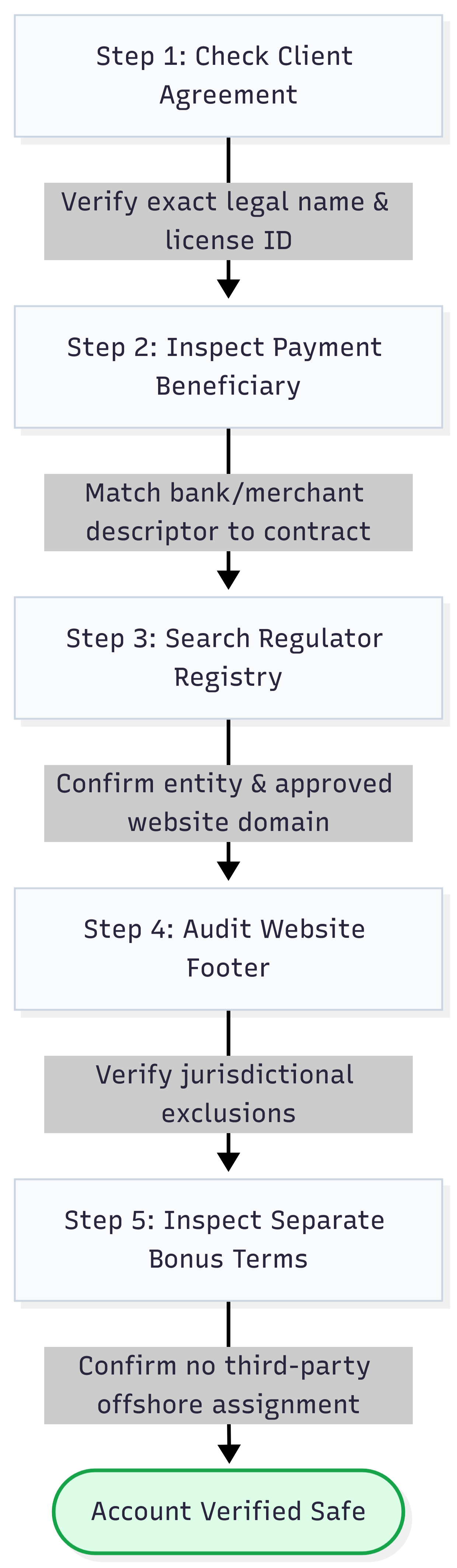
Step 1: Read The Account Agreement
Open the User Agreement before completing registration. This contract can also have some other name, e.g. Client Agreement or Account Agreement.
The contract should clearly name the company providing the account, the company registration number, the regulator, the licence number, and the company’s registered address. There may also be clauses defining governing law, jurisdiction, and forum. All this is important information.
Important: “Broker XYZ UK Limited” and “Broker XYZ International Limited” are two different companies even when they share directors, owners, branding, website, and trading platform. You need to look at the exact company name and company address, not the brand.
It is also important to know if the User Agreement permits the group to transfer the account to another company without new consent from you. A change of entity should not be treated as an insignificant administrative detail, because it is not.
Step 2: Inspect The Deposit Recipient
Deposit information can reveal which company or other entity receives the money. A discrepancy between your contractual counterpart and the entity that receives your payment can signal wider complications. It is not necessarily a deal-breaker, but it calls for further investigation. It can, for instance, indicate that you have entered a clone site and that you are dealing with a fraudster who has cloned the Broker XYZ site to capture your deposit and personal data.
A bank transfer should identify the beneficiary. A card statement or payment-provider confirmation may also show a company name. Compare this with the legal entity in the agreement. Differences can have legitimate explanations. A regulated payment processor may collect money for the broker, or the group may use a designated client-money account under another descriptor.
The broker should be able to explain the relationship in writing. A request to send money to an employee, introducing broker, unrelated company, or personal crypto wallet is a serious red flag.
The withdrawal terms should identify the entity responsible for returning funds. A situation where deposits are accepted by one company and withdrawals are handled by another can make a dispute harder to resolve.
Step 3: Cross-Reference The Official Register
Search for the exact company in the applicable regulator’s public database. Use the regulator named in the contract. A Seychelles company should appear in the FSA’s appropriate securities-dealer category, a Vanuatu company should appear on the VFSC financial-dealer list with active status, and so on.
Examples:
- UK firms should appear on the FCA Firm Checker or Financial Services Register.
- For a firm based in Cyprus, verify the broker’s legal entity against CySEC’s Investment Firms (Cypriot) Register and confirm that the broker’s website/domain appears on CySEC’s List of Approved Domains.
- Australian companies should be checked through ASIC’s professional registers.
- US retail forex dealers should be verified through CFTC registration records and NFA BASIC.
When you have found the exact company in the registry, use the official website to sign up for your account. That way, you avoid fraudsters who copy the company name and licence number of a genuine provider while using another domain, phone number, and bank account to steal your deposit. BrokerXYZ.com is not the same as TheBrokerXYZ.com or VIP-BrokerXYZ.com.
Also, do not treat a certificate of incorporation as a financial licence. A company can be registered in a jurisdiction without holding a financial services licence. Sometimes, it is not even possible for the company to obtain a financial services license there, because there is a no licensing regime or category for it. A notable example is Saint Vincent and the Grenadines, a small island nation that does not have any licensing regime for online retail brokers. A brokerage company can be based here, but it is not licensed and supervised by any financial authority.
Step 4: The Website Footnote
Serious broker groups typically put the name of every entity operating through that domain in the website footer. Look at the footer and compare the company associated with your jurisdiction against the name in your User Agreement or registration form. Look for any indication that services are provided by another company.
Step 5: The Bonus Terms And Conditions
If you are offered a bonus, open the bonus terms separately. Promotions may be issued under a different company from the one in your User Agreement. Any deviation needs an explanation.