
Understanding “Style” Brokers



- A Very Brief Explanation Of Important Execution Models
- The Marketing Myth Vs. The Legal Reality Of STP And ECN Labels
- The Infrastructure Matrix: How “Styles” Are Virtualized
- Many Brokers Marketed As STP/ECN-Style Are Also Internalizing At Least Some Orders And Are Therefore Actually Running A Dealing-Desk
- Practical Auditing And Operational Controls For Traders
When you are trying to make sense of all the different brokers, you will run into a lot of different labels and descriptions, such as MM broker, DD broker, STP broker, ECN broker, DMA broker, raw spread, no dealing desk, institutional execution, liquidity pool, agency model, zero conflict, and more. Any type of label or description can be hyped up to sound like the most amazing choice for you, so traders need to tread carefully and find out how brokers actually function, beyond the marketing buzz. Marketing wording can be deliberately vague and misleading, while still carefully staying just within the boundaries of what’s permissible in the applicable jurisdiction.
A notable example is how a broker can put Straight Through Processing (STP) style or Electronic Communications Network (ECN) style in big bold letters in their marketing material, while you have to read the very fine contract print to find out that this broker also serves as the legal counterparty to every rolling spot FX trade.
There are also brokers who call themselves “ECN style” to hide the fact that their model is actually not a true ECN. This matters because the “style” label shapes trader expectations. Traders hear ECN and assume a neutral marketplace. They hear raw spread and assume no manipulation. They hear no dealing desk and assume the broker has no discretion. In many cases, the fine print of the client agreement says something else. Execution technology and legal capacity are not the same thing. A broker may route risk externally, aggregate bank quotes, use a third-party bridge, display raw spreads, and charge a commission, but still chiefly function as a Market Maker broker. Especially when it comes to retail OTC derivatives, the client usually has the broker as their counterparty, and the broker may then choose to hedge, offset, warehouse, or internalize the risk.
The gap between the sales label and the contract can cause serious misunderstandings. Slippage, spread widening, requotes, rejected fills, bridge delays, last look, internalization, and post-trade corrections all become easier to understand once the trader stops looking at the shiny labels and starts asking who is legally on the other side of the trade and what the infrastructure actually looks like. Where is my order executed, what discretion does the broker retain, how is slippage distributed, and what evidence can I collect from live fills?
A broker labelling themselves STP or ECN is not proof of agency execution, bank access, neutral matching, or conflict-free trading. In retail CFDs and rolling spot FX, the broker is often the legal counterparty and may act as principal even while using sophisticated liquidity bridges, raw spreads, external hedges, and ECN-style aggregation.
It is also important to remember that an STP broker is not automatically a better choice than a Market Maker broker, and an ECN broker is not automatically a better choice than an STP broker. A broker can be principal and still provide good execution. A broker can provide ECN-style execution and still be a low-quality broker. Both statements can be true at the same time. There are also many situations where a market maker broker with a dealing desk is truly the best choice for this particular retail trader with this particular trading strategy.
A Very Brief Explanation Of Important Execution Models
Below, we will provide a brief explanation of some of the various execution models and terms discussed in this article. The information is short and not comprehensive. If you want to know more, we suggest you visit our longer articles about different types of brokers and execution models.
Here are a few examples of good articles to start with:
- This article starts with general information about trade slippage, but it will then also explain different broker execution models and how they relate to trade slippage and liquidity.
- Our Safety Hub includes a section headlined “Execution Quality, Slippage, and Conflicts of Interest”, which deals with how different execution models work and what that entails from a trader safety perspective.
Execution Models 101
Market Maker Execution Model
A Market Maker broker creates its own market and quotes its own buy (bid) and sell (ask) prices to clients. When you place a trade, the broker will typically become the direct counterparty to your position instead of immediately sending the order to the broader financial market. If you want to buy, the broker will sell. If you want to sell, the broker will buy.
The broker can then manage its own risk by offsetting some positions with banks or liquidity providers and by keeping some exposure internally.
For a trader, the main advantages of the market maker model are that it often provides stable pricing, fast execution, low minimum deposits, and a simple trading experience for retail traders.
The main concern is the built-in conflict of interest. Since the broker is not just an intermediary, the broker profits when clients lose and loses when clients profit. Serious and well-regulated brokers can typically manage this conflict well, and there are many examples of market maker brokers that operate fairly and have a good reputation among traders. Problems are statistically more likely to arise with brokerage companies that are loosely regulated and loosely supervised, in jurisdictions where a broker can manipulate the outcome of trades in subtle ways without facing regulatory repercussions.
Dealing Desk vs. No Dealing Desk
These terms describe how a broker handles client orders.
A Dealing Desk broker manages order flow internally. The broker may decide whether to keep trades in-house, match them against other clients, route them externally, or keep them in-house and hedge some or all of the resulting exposure externally. This model is commonly associated with market makers/hybrid models, where some trades are kept in-house, and some are routed externally. The dealing desk is essentially a layer between the trader and the external market. A typical dealing desk broker is more likely to offer fixed spreads and low minimum deposits. You should also be prepared for requotes during market turbulence. A requote happens when a broker has quoted a price that it is no longer willing to honor.
A No Dealing Desk (NDD) broker does not manually intervene in the execution process in the way a Dealing Desk broker does. Instead, orders are routed automatically to external liquidity providers such as banks, financial institutions, hedge funds, or electronic trading venues. The No Dealing Desk broker category is associated with direct order routing, market-based pricing, variable spreads, and reduced broker intervention. No Dealing Desk (NDD) is not a specific execution model. It is a broad category that generally includes STP, ECN, and DMA execution models.
Straight Through Processing (STP) Execution Model
STP stands for Straight Through Processing. When a trader places an order with an STP broker, the broker automatically sends that order to one or more external liquidity providers without letting the order pass through a traditional dealing desk.
The broker acts as a bridge between the trader and liquidity providers.
Imagine three banks are quoting EUR/USD:
- Bank A: 1.1000 / 1.1002
- Bank B: 1.1000 / 1.1001
- Bank C: 1.0999 / 1.1002
The STP broker aggregates these prices and may show the trader the best available combination. The broker usually earns revenue by adding a small markup to the spread and/or charging a commission. Since the broker is not profiting from trader losses, that conflict of interest is not present.
STP brokers are associated with fast automated execution and can offer more competitive pricing than many market makers. But spreads can widen considerably during volatility, and exact execution quality will depend a lot on your STP broker’s liquidity network. Compared to an ECN broker, the transparency is lower.
For some retail traders, STP represents a middle ground that can be a good choice when the MM model is no longer ideal, but the trader, account size, and strategy do not warrant an ECN setup.
Electronic Communication Network (ECN) Execution Model
In this context, an Electronic Communication Network (ECN) is a network that connects multiple liquidity providers and market participants into a shared order book where buy and sell limit orders are matched automatically. Participants such as banks, institutions, hedge funds, and trading firms submit orders at different price levels, and the ECN’s matching engine executes trades when compatible orders meet. Retail traders typically access this network indirectly through brokers that aggregate ECN liquidity.
In an ECN environment, prices come from multiple participants. Traders often receive very tight spreads, and execution occurs at market prices. During highly liquid periods, spreads can fall close to zero because buyers and sellers are competing directly.
The ECN model offers great transparency and access to deep liquidity. Many experienced traders prefer ECN accounts because they provide pricing that is often closer to what institutional participants see.
ECN brokers typically make the bulk of their money from commissions, so it is important that your trading strategy accounts for the cost of commissions. You should also be aware that while spreads are often tight, they are not always so, and spreads can fluctuate significantly in the ECN environment.
While many MM brokers, and some STP brokers, are very welcoming to inexperienced traders and cater to their needs in various ways, the target audience for ECN brokers is normally experienced traders. This can, for instance, manifest in higher minimum deposits and customer service staff who are less used to providing basic-level hand-holding for novices.
DMA Execution Model
DMA stands for Direct Market Access. DMA allows traders to place orders directly into the order book of an exchange, liquidity provider, or institutional trading venue. Unlike some execution models where the broker determines how and where orders are routed, DMA aims to give traders direct access to the underlying market.
With DMA, traders may be able to see available liquidity levels, multiple price tiers, order book depth, and market participation in real time.
Suppose a trader wants to buy a large amount of an asset. With DMA, they may see that 100 units are available at one price, 500 units are available at a slightly higher price, and 1,000 units are available above that. This visibility helps traders understand how much liquidity exist at different levels.
(In a retail ECN setup, a trader typically sees the best bid and ask, which represents the top of the order book. In some cases, the platform may also provide Level 2 data, meaning multiple price levels on both the buy and sell sides. This data is usually aggregated from several liquidity providers connected to the broker, so what the trader is viewing is a simplified version of the overall market depth rather than a single unified exchange book.)
Traders typically pick DMA when they have a strong need for direct market interaction, very high transparency and visibility of liquidity, and professional-grade execution. DMA often offers very tight spreads, sometimes close to the true interbank level.
DMA pricing is typically commission-based.
This is typically not an environment suitable for inexperienced traders and small or mid-sized trading accounts. The account requirements tend to be high, the trading environment is complex, and some of the guardrails that traders coming up through MM and STP systems are used to can be missing.
What Is A Raw Spread?
The spread is the difference between the bid price and the ask price.
Example: If Bid is 1.10000, and Ask is 1.10003, the spread is the difference between these two prices.
A raw spread is the spread received directly from liquidity providers before the broker adds any markup.
Some brokers offer two account types: Standard Spread Account and Raw Spread Account. With a Standard Account, the broker widens the spread and typically charges no separate commission. Example: The spread from the liquidity provider is 0.3 pips, but the spread you see in your Standard Account is 1.2 pips. The broker keeps the difference, and this is why the broker can offer trading with low or no commissions. If you instead opt for a Raw Spread Account, the broker shows you the original spread and charges a commission instead. The spread from the liquidity provider is 0.3 pips; the spread you see in your Raw Spread Account is also 0.3 pips.
Raw spread accounts are popular among traders who clearly want to see the spread cost and commission cost separately, and adjust their strategy accordingly. Scalpers, algorithmic traders, day traders, and high-frequency traders often use raw spread accounts.
What Is The Agency Model?
The agency model describes a broker that acts as an agent rather than a principal. In this structure, the broker’s role is to execute trades on behalf of the client without taking the opposite side of the position. Instead of acting as the counterparty, the broker routes the order to external liquidity providers or venues where another participant takes the other side of the trade.
The broker earns money through commissions, execution fees, or small markups on spreads. Because the broker’s revenue is not directly dependent on client losses, the conflict of interest is generally reduced compared to a principal (market maker) model.
This model is most clearly associated with ECN and DMA environments. In an Electronic Communication Network (ECN) setup, the broker provides access to a shared liquidity pool where orders are matched between multiple participants. In Direct Market Access (DMA), the broker provides direct access to an underlying liquidity venue or order book, with minimal or no intervention in order routing.
The Straight Through Processing (STP) model can also fall under the agency framework, but with important caveats. In a pure STP setup, client orders are automatically routed to external liquidity providers, and the broker does not take the opposite side of the trade, making it effectively agency-based. However, in practice, many retail STP brokers operate a hybrid model where some orders are routed externally (A-booked) while others may be internalized (B-booked), depending on risk management, client behavior, or market conditions. In those cases, the broker is not acting as a pure agent at all times.
So while ECN and DMA are more consistently agency-based by design, STP can be agency-based in its pure form but may deviate from that model in real-world implementations depending on how the broker structures its order flow.
What Is The Principal Model?
The opposite of the Agency Model is the Principal Model.
The principal model describes a broker that acts as the counterparty to the client’s trade rather than simply facilitating execution. In this structure, the broker enters into the trade directly with the client, meaning it buys when the client sells and sells when the client buys. This model is most commonly associated with Market Maker (MM) broker environments, where the broker internally prices instruments and manages client order flow. In a Market Maker setup, the broker may internalize trades (B-book them), match them against other clients, or hedge exposure externally, but the key defining feature is that the broker can act as principal to the trade.
The Straight Through Processing (STP) model is generally agency-based, but in practice, some STP brokers can incorporate principal-style elements through hybrid execution. This happens when part of the client flow is routed externally while other trades are internalized for risk management purposes. In those cases, the broker may temporarily or partially take on exposure similar to a principal model, even though the system is marketed as STP.
Overall, the principal model is structurally aligned with market makers, where the broker is the direct counterparty, while STP can sometimes overlap in practice depending on whether execution is fully externalized or partially internalized.
The Marketing Myth Vs. The Legal Reality Of STP And ECN Labels
The terms STP and ECN are not useless. They describe parts of an execution setup. As we have discussed above, STP means straight through processing, usually suggesting automated routing rather than manual dealing. ECN means electronic communication network, usually suggesting that multiple buyers and sellers, or multiple liquidity sources, interact electronically. The problem is that many brokers use these terms in vague ways rather than tie them to exact and narrow technical descriptions.
One of the situations where this becomes clear is when a broker labels itself as an STP or ECN broker, while also offering CFD trading that is handled in-house. A trader might catch a glimpse of the STP or ECN sign and assume it covers all types of trading offered through this broker, while reality is more complex.
A retail trader who is logging into the online trading platform and opens a CFD position is usually not entering into a contract with a Tier 1 bank, an exchange, or another retail trader. The trader is entering into a bilateral OTC derivative with the broker. The broker quotes the price. The broker accepts the order. The broker books the position. The broker is responsible for the client statement. Yes, the broker may elect to hedge that exposure elsewhere, but the hedge is a separate transaction between the broker and another entity (usually its liquidity provider, prime broker, or prime of prime).
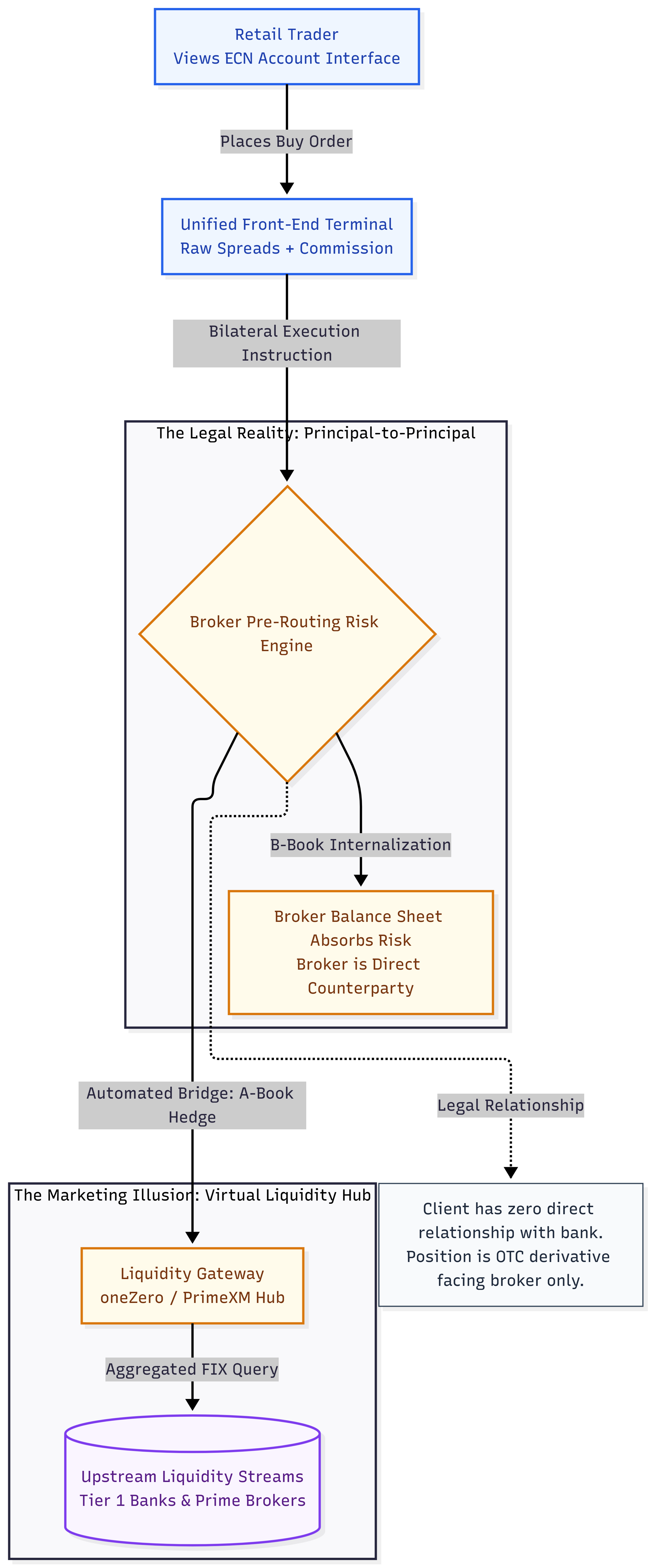
That distinction is visible in many broker execution policies. At the time of writing, Fortrade (DIFC) Limited’s order execution policy will, for instance, state: “When you trade with us you are entering into a contract for differences (CFD), which is a bilateral (or ‘principal to principal’) contract between you and Fortrade, and we are therefore your counterparty for each such transaction.” The wording is plain enough: the client is trading with Fortrade and not with other market participants. In this specific case, there should be no confusion because Fortrade does not present any offering under an STP or ECN execution framework, and its documentation consistently describes CFD trading as a bilateral arrangement with the broker as counterparty. In this article, we have included the line from the Fortrade policy purely as an illustrative example of standard industry language used in principal-model CFD contracts.
Things get a bit more complicated with IC Markets (now just “IC”). IC Markets is chiefly a CFD broker, and it is the counterparty for the CFDs. Still, the term ECN shows up in its marketing and information material. IC Markets is not claiming to be an ECN broker, but it does use phrases such as “ECN pricing model” in its marketing material, which can be confusing for traders. Here is one example from the IC Markets Global Help Center: “IC is the issuer of the products it provides. We consider ourselves to be a forex provider offering the ECN pricing model as we source our pricing from external unrelated liquidity providers, these prices are passed onto you with no dealing desk intervention. In order to provide you with better price certainty and to ensure fast execution speed we do not offset each and every position with our liquidity providers. We do this in order to provide you with a better overall trading experience.” Source: IC Markets Global Help Centre.
The IC Markets EU Ltd Best Order Execution Policy clearly states that IC acts as principal and not as agent on the client’s behalf, and that IC Markets is the sole execution venue for the execution of client orders in CFDs. That is not a small footnote. It is the legal framework of the entire account for traders who sign up with the EU-based IC Markets company. The website may discuss external, unrelated liquidity providers and an ECN pricing model, but the client’s trade is still executed against the broker as principal.
The UK FCA has also treated retail CFD firms as principal counterparties in its regulatory analysis. In CP16/40, the FCA stated that leverage limits would also reduce credit risks to retail CFD firms because those firms act as principal and counterparty to trades with their clients. That statement cuts through most marketing fog. The regulator looked at the product structure and saw principal dealing, not an agency model where the broker simply passes retail orders to banks.
The semantic illusion works because traders mix up vague marketing language with legal role. A broker can route the market risk of a trade externally and still be the client’s counterparty. A broker can use an “ECN-style” liquidity pool and still be the only contractual execution venue for the retail client. A broker can charge commission and still profit from internalized client losses. A broker can have no manual dealer pressing buttons and still run a dealing desk model through automated software.
The question is not whether the broker’s infrastructure and pricing models contain STP or ECN components. It often does. The question is whether the broker is acting as agent for the client or as principal against the client. In retail CFDs and rolling spot FX, the answer is commonly principal.
Best Execution Duties
Many legal systems have mandatory best execution policies in place to safeguard traders in the Agent Model environment. But what happens within the Principal Model environment? This will vary depending on the exact jurisdiction, but many financial authorities that demand best execution in Agent Models also demand it for Principal Models. When the broker is also properly supervised and audited, these rules can help mitigate a bit of a built-in conflict of interest that exist in the Principal Model.
Many financial regulatory regimes impose best execution obligations to help protect clients when investment firms execute orders on their behalf. While these duties are often associated with agency-style execution, they may also apply when a firm acts as principal, depending on the product, service, and jurisdiction. In the European Union, for example, MiFID II best execution requirements can apply even where a CFD broker is the client’s counterparty.
The precise rules vary by jurisdiction, but many regulators that require best execution in agency-based models also impose execution-quality obligations on firms operating under principal models. When a broker is properly supervised, audited, and subject to regulatory oversight, these requirements can help mitigate some of the inherent conflict of interest that exists when the broker is also the client’s counterparty. They do not eliminate that conflict, but they can constrain how the broker exercises its discretion over pricing and execution.
In the EU, MiFID II defines whether a broker is acting as an intermediary or as a principal counterparty, and “dealing on own account” is the regulatory term for the latter, which underpins market-maker-style CFD operations in the EU. In plain language, dealing on one’s own account means the firm trades against proprietary capital or as principal, rather than simply transmitting the client’s order to another venue as the client’s agent. A CFD broker can owe best execution duties and still act as principal. Those two ideas are not mutually exclusive. The broker still has to take all legally required steps to obtain the best possible result for the client, even when the client’s contract is still with the broker.
In the UK, FCA’s COBS 11.2A best execution rules require firms to have execution arrangements and an order execution policy, and to disclose information about execution venues and execution quality where relevant. The FCA Handbook says an order execution policy must include information on the different execution venues where the firm executes client orders, among other requirements.
Virtual ECN Instead Of True ECN
The retail “ECN” label often describes a virtualized or aggregated liquidity structure rather than direct participation in a single ECN order book. The broker connects to external liquidity providers through bridges, aggregators, or liquidity hubs. These liquidity providers may include banks, non-bank market makers, ECNs, prime brokers, and prime-of-prime firms. The broker’s technology then aggregates the available quotes, constructs a best bid and offer, applies any applicable commission or pricing logic, and streams the resulting prices to the trading platform.
As a result, many retail traders who use an “ECN account” are not interacting directly with a standalone ECN venue. Instead, they are accessing a broker-managed liquidity pool built from multiple external sources. This does not necessarily mean the execution quality is inferior, but it is different from the traditional institutional concept of a single ECN, where participants post and match orders within a shared order book.
To the trader, the virtual ECN environment looks like a marketplace. There are tight spreads and fast fills. There may be depth of market. The broker is charging commissions instead of making money from visible markups. But the client’s counterparty is still the broker unless the contract says otherwise, and the regulatory structure supports true agency execution. This is why it is necessary to read the user agreement and execution contract instead of simply assuming that you are getting true ECN from your broker.
Brokers who offer virtual ECN will often hedge client risk with a bank or other liquidity provider to not hold all risk internally. Example: The client buys EUR/USD from the broker, and the broker immediately buys EUR/USD from a bank to hedge. Economically, the broker has passed the risk upstream. Legally, the client’s trade and the broker’s hedge are separate. The client has no claim against the bank if the broker fails, cancels a fill, or reprices an order. The bank has no retail relationship with the client. The client trades with the broker, and the broker trades with the bank.
This virtual ECN setup is not automatically abusive. It can deliver good execution. It can reduce spreads. It can allow the broker to provide institutional-style pricing to retail clients. The problem is when the broker starts saying things such as “just connecting you to liquidity” in their marketing, because that it not true. The broker is transforming institutional liquidity into a retail OTC product, then deciding how much of the resulting risk to pass through. That is not true ECN, and “ECN style” and “true ECN” are not synonymous.
The Infrastructure Matrix: How “Styles” Are Virtualized
Brokers like to squeeze terms such as ECN-style, STP-style, and Raw Spread into their marketing material because they know traders want simple labels and a quick way to make decisions. Inexperienced traders often fall back on a simplified version of reality where MM brokers are bad, STP brokers are better, and ECN and DMA brokers are the goal. Reality is, of course, much more complex than this, and there are many situations where a well-regulated MM broker is a much better choice than an ECN or DMA broker, especially for small-scale hobby traders.
But it is easier for a trader to simply look for STP / ECN / DMA in the marketing material and make a snap decision. And that is also why brokers push these labels into their marketing, as a short-hand to explain what they are offering, while also muddying the waters a bit and not really explaining in a clear way the distinction between e.g. true ECN and “we consider ourselves to be a forex provider offering the ECN pricing model as we source our pricing from external unrelated liquidity providers”.
A market maker can offer fair, stable, transparent execution. An ECN-style broker can still have conflicts. Many brokers who are labeled STP-style will still internalize some of the risk. A raw spread account can still be B booked. A broker with principal execution can still owe best execution obligations under applicable law. A broker with external liquidity can still reject fills. The quality question is not the label. Quality is about how the broker actually manages execution, discloses its role, handles conflicts of interest, manages risk, treats profitable clients, processes withdrawals, and resolves disputes.
Both brokers and traders-in-a-hurry like style labels because they are easier to sell than legal architecture. “We act as principal in bilateral OTC derivative contracts and may hedge or internalize risk according to our execution policy” is accurate, but it does not fit nicely on a banner.
The STP Illusion And The Internalized Bridge
An STP-style bridge is a technical routing layer between the retail platform and the broker’s liquidity or risk system. In a simplified marketing diagram, the order moves from trader to platform to bridge to liquidity provider. That diagram is not wrong, but it is incomplete.
The real order path usually starts with platform validation. The trading server checks whether the symbol is tradable, whether the account has enough margin, whether the order size meets minimums, whether trading is enabled, whether the client has permission, and whether the quoted price is still valid. The order then reaches a pre routing layer. This is where the broker’s execution logic can decide whether the order should be internalized, hedged, partially hedged, delayed, rejected, routed to one liquidity provider, routed to several, or matched against other internal flow.
If the broker chooses to B book the trade, the order may never leave the broker’s own server environment. It can still be executed instantly on an “STP setup” because STP, in practice, may mean automated processing rather than external routing for every single ticket. No human dealer touched the order. The system did. The result can still be internalization.
This is where traders get fooled by speed. Fast execution does not prove external execution. Internal execution can actually be faster because the trade does not need to go to a bank, wait for last look, sweep multiple liquidity levels, or receive an external fill confirmation. A B book fill can be instantaneous because the broker simply accepts the other side.
The broker’s risk system can decide based on the account profile. A small losing trader using erratic position sizing may be internalized. A consistently profitable scalper may be A booked. A news trader may be routed selectively or subjected to stricter slippage controls. A correlated group of clients may be netted internally, with only the residual exposure hedged externally. And all these different movements can be automated. Modern bridge and liquidity systems are built for this, handling factors such as aggregation, pricing, and risk management on a granular level, helping the broker manage liquidity, pricing, and risk management variables. The infrastructure can support A book, B book, and hybrid routing.
The ECN-Style Mock-Up
The most common ECN-style retail account will show raw spreads and charge the trader commissions. The broker advertises spreads “from 0.0 pips” and charges, say, $3 to $7 per lot per side or round turn. Traders interpret this as proof that the broker is not profiting from their losses. That interpretation is too generous.
A market maker can charge commission. A B book broker can charge commission. A broker can show raw liquidity spreads and still internalize the trade. The commission model changes the visible revenue line, but it does not legally remove the broker’s capacity to warehouse risk. The raw spread model can be created in several ways. The broker may, for instance, stream best bid and offer from liquidity providers without adding much visible spread, then charge a commission separately. The broker may apply a smaller markup and a commission. The broker may offer raw pricing only on certain account types, minimum deposits, symbols, or volumes. The broker may internalize flow at those raw-looking prices if its risk model prefers that route.
A commission is not a conflict of interest cure. If a broker internalizes a losing client, it can collect both the commission and the trading loss. If the client wins, the broker pays the gain unless it hedged. This does not mean every commission broker is doing this or that this practice automatically hurts traders. It simply means commission alone is not an audit of execution model.
The ECN-style mock-up becomes especially convincing when combined with depth of market. Some retail platforms show multiple price levels. That can be useful, but traders need to ask what depth they are seeing. Is it direct exchange depth? Aggregated LP depth? Indicative depth? Internal synthetic depth? Depth available only for certain sizes? Depth subject to last look? The answer changes the value of the display.
In OTC FX, a displayed price is usually not the same as guaranteed exchange liquidity. The broker’s terms often allow slippage, rejection, repricing, or execution at a different level if the market moves. The client agreement, again, beats the platform aesthetic.
The Hybrid Book And The Real Internalization Engine
Most serious retail FX brokers operate hybrid books. Pure A book and pure B book are too blunt. A pure A book model can be expensive because every small trade must be routed or hedged, creating ticket costs, LP rejects, latency, and prime brokerage friction. A pure B book model can be dangerous because the broker can be run over by profitable flow or crowded client exposure. Hybrid risk management is the compromise.
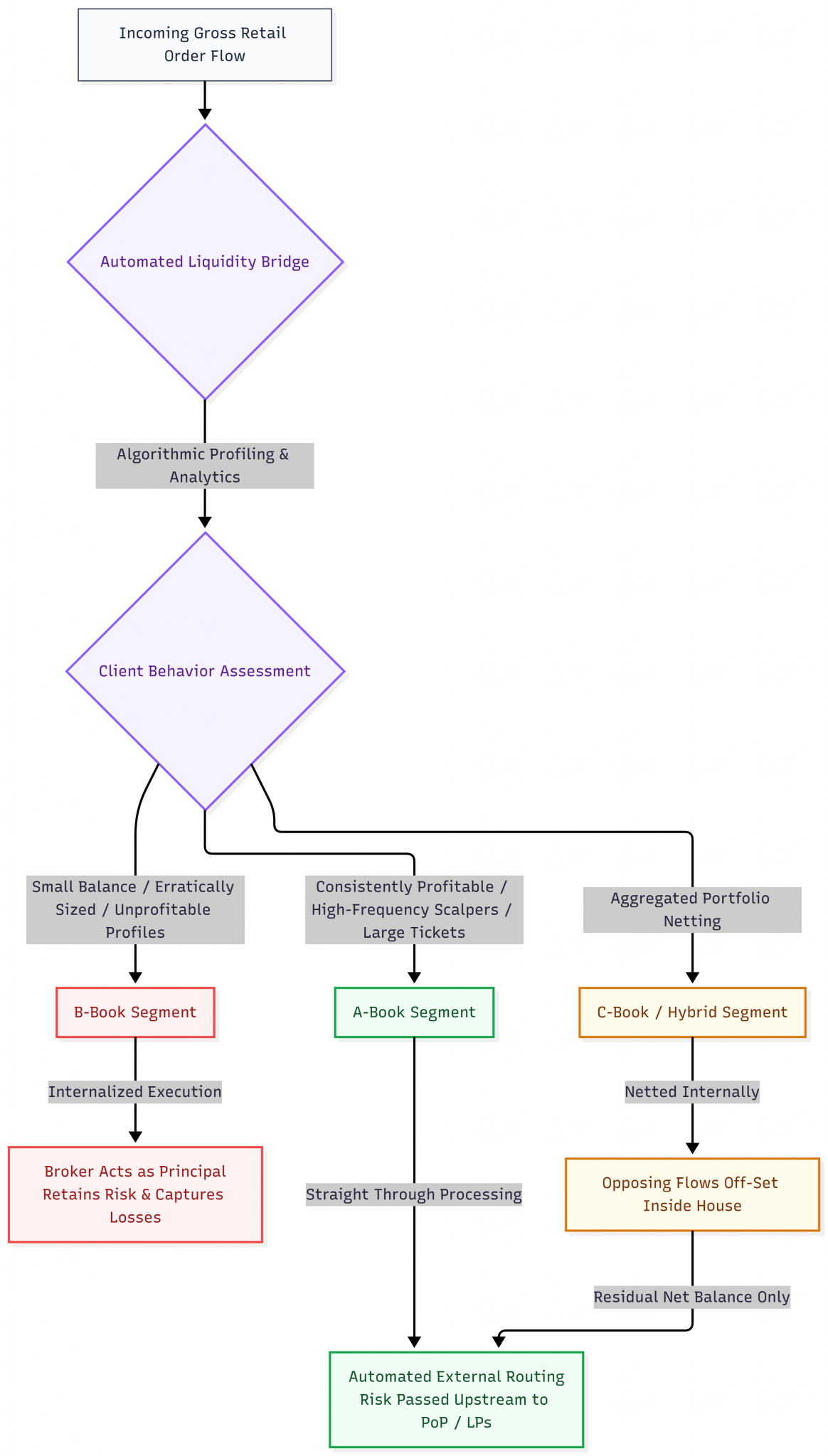
The A book segment is the flow the broker wants to send upstream. This can include consistently profitable traders, toxic scalpers, arbitrage systems, large tickets, flow correlated with known profitable groups, or positions that increase the broker’s existing market risk. The broker may hedge these trades immediately, route them to liquidity providers, or include them in net exposure hedging.
The B book segment is the flow the broker internalizes. This can include small unprofitable accounts, inconsistent retail trading, high churn accounts, or a flow that statistically loses after spread, commission, swaps, and poor timing. The broker becomes the counterparty and keeps the risk. When the client loses, the broker profits. When the client wins, the broker pays.
The C book, or hybrid split, is the more realistic middle. The broker aggregates client exposure and hedges only the net risk or only part of the risk. If clients are long 100 lots of EUR/USD and short 70 lots of EUR/USD, the broker may internalize the offsetting 70 lots and hedge the remaining 30. If a profitable trader buys 10 lots and a losing trader sells 10 lots, the broker might internalize both and carry no net market exposure. If a news event approaches, the broker may temporarily move more flow to the A book or raise margin.
Retail brokerage technology is designed to support dynamic routing, and industry technology providers offer solutions for things such as aggregation, routing, risk management, execution reporting, and liquidity provider analytics. But the retail trader does not normally see these routing decisions. The trade ticket looks the same. The fill confirmation looks the same. The account statement looks the same. The broker’s internal book, hedge blotter, and liquidity reports tell the real story.
Many Brokers Marketed As STP/ECN-Style Are Also Internalizing At Least Some Orders And Are Therefore Actually Running A Dealing-Desk
The Prime Of Prime Capital Constraint
True, uninternalized A book routing for every micro retail trade is commercially awkward. A Tier 1 bank does not want thousands of tiny retail tickets arriving as raw 0.01 lot orders. Institutional liquidity works through credit relationships, minimum ticket sizes, aggregation, prime brokerage, prime of prime access, and netting. The retail broker exists partly because the institutional market is not built to face small retail clients directly.
A 0.01 lot FX trade is 1,000 units. The revenue on that ticket is tiny. If every micro order were individually routed, cleared, confirmed, monitored, and reconciled through institutional channels, the operational cost would overwhelm the economics. Brokers therefore aggregate, internalize, batch, net, or warehouse flow.
The retail broker must also carefully manage its relationship with its prime-of-prime (PoP) broker. Retail brokers often access liquidity through a PoP, which provides credit, aggregation, and connectivity. The PoP faces institutional liquidity providers (LPs), while the retail broker faces the retail client. If the retail retail broker sends too many tiny or toxic orders upstream, the PoP or LP may widen prices, reject flow, impose higher costs, or terminate the relationship. This is another reason why the retail broker, even when marketed as STP or ECN, must act as a dealing desk in the structural sense, even if no human is sitting behind an actual wood panel dealing desk pushing buttons. The broker’s software slices flow, chunks micro liquidity, nets client positions, internalizes small tickets, and decides what residual risk deserves external hedging.
Instead of simply trusting a broker that advertises STP or ECN, a trader should ask the uncomfortable questions. STP (or ECN) to where, under what conditions, and for which flow? If the answer is “all client orders are automatically processed through our execution system”, that does not mean that all orders are filled externally; it simply means they are processed through the execution system.
The Discretionary Execution Gotcha
Client agreements and execution policies often give brokers wide rights to reject, cancel, correct, or reprice trades under certain conditions. These rights are usually framed around manifest errors, off-market prices, latency exploitation, platform abuse, stale quotes, or abnormal market conditions.
Some of those rights are necessary. If a pricing feed breaks and prints EUR/USD at 0.1000 for one second, a broker should not be forced to honor every trade at that obvious error. The issue is not whether error clauses should exist. The issue is how broad they are, who decides when they apply, and whether the client has a realistic appeal route when a broker is being abusive.
A broker with the contractual right to retroactively alter an execution price after a fill has asymmetric control over the order loop. The client cannot usually reprice a bad fill after the fact. The broker often can, at least where the contract says the price was erroneous, abusive, or outside market conditions. That is a dealing desk power, whether manual or software automated.
The retail implication is simple. Do not only read the spread table. Read the execution policy. A broker may advertise raw spreads and ECN-style fills while reserving strong discretion over orders executed during latency, news, platform errors, or illiquid periods. That does not automatically mean the broker will abuse those rights, but it does mean the broker has them.
Manifest Error Clauses And Latency Exploitation
Manifest error clauses usually allow the broker to correct or cancel transactions where the quoted or executed price was plainly wrong. Latency exploitation clauses usually target traders who use stale prices, slow feeds, or platform delays to trade at prices no longer available in the underlying market. These clauses exist because OTC brokers face real technology risk. A stale quote can be picked off in milliseconds by an automated system. If the broker cannot correct obvious errors, toxic strategies can turn infrastructure delay into broker loss. So, the fact that this type of clause exists is understandable. The issue (from the trader’s perspective) is boundary setting. Many clauses give the broker the exclusive right to decide when to apply the clause, and it can be very difficult for the broker to find recourse when a broker is using the clause unfairly. In addition to outright abuse, there are a lot of gray areas here. A profitable news trader may look like a skilled trader to themselves and like toxic latency flow to the broker. A trader using cross broker price comparison may see arbitrage, but the broker considers it stale quote abuse. A trader whose EA fires during CPI data may claim strategy execution, but the broker says it is latency exploitation. The facts matter, but the broker controls the first decision and leaves the trader holding the bag.
This is one of several reasons why “no dealing desk” claims should be treated with suspicion if the contract gives the broker a right to post-trade interventions. A desk does not need to intervene before the fill to control the outcome. It can intervene after the fill through cancellation, correction, or account closure.
The Spread Mark-Up Protocol
The fact that a broker is marketed as STP or ECN does not guarantee that there will be no spread markups. The broker’s quotation engine receives bid and ask prices from liquidity providers. It can pass those through, add a fixed markup, add a variable markup, widen spreads based on volatility, widen spreads based on time of day, or adjust pricing by account type.
The New York close and rollover window is the classic example. FX liquidity often thins around the daily rollover. Banks adjust swaps, spreads widen, and some liquidity providers reduce available depth. Brokers may widen spreads automatically during this period. A stop loss placed too close to the market can be triggered by a temporary spread blowout even if the mid price barely moves. This can behave exactly like old-fashioned dealing desk intervention, except it is rule-based. The broker did not manually hunt the stop. The pricing engine widened the spread according to settings. For the client, the result is the same, i.e. the position closes at a poor level during a thin window.
Low-volume periods, market opens, holidays, and pre news moments can produce similar effects. Index CFDs can widen before the cash market opens. Gold can widen during liquidity gaps. Crypto CFDs can widen on weekends. Exotic FX pairs can become absurd during rollover. If a broker’s price construction is opaque, the trader may not know whether the spread came from external liquidity, internal markup, risk controls, or all three.
This is where execution statistics matter. A broker that publishes clear average spread, slippage, and rejection data gives traders more to work with before they start their own small-scale testing. A broker that only advertises “from 0.0 pips” is selling the best possible moment, not the normal trading environment.
Why “Secret Dealing Desks” Can Be Lawful
The phrase “secret dealing desk” sounds criminal, but it is not automatically illegal for a broker to act as principal, internalize flow, or manage risk dynamically, even though they throw around things such as “STP-style” or “ECN-style” in their marketing material. Some brokers hide behind very vague terms, while others make sure to remain based in jurisdictions where consumer protection and marketing laws are weak.
In stricter jurisdictions, regulatory risk arises for the broker when its marketing communications and disclosures are inconsistent with its actual execution practices and conflict-of-interest arrangements. Where promotional language such as “ECN execution”, “no dealing desk”, or “direct bank access” creates a misleading overall impression relative to the firm’s contractual capacity as principal OTC counterparty and its actual order handling practices, regulators such as the FCA may intervene under fair, clear and not misleading communication standards and conflicts of interest rules. Modern supervisory approaches focus less on terminology in isolation and more on substance and conduct, assessing whether clients were misled, whether conflicts were properly disclosed and managed, whether execution aligned with disclosed policies, and whether retail clients received fair outcomes.
For traders, the practical position is to assume every retail broker has dealing desk capacity unless proven otherwise. That assumption does not mean avoid all brokers. It means do not build trust from marketing terms. Build it from legal documents, execution records, withdrawal performance, regulatory status, and live fill behavior.
The UK FCA 2014 enforcement action against FXCM’s operations in the UK: An example of how a broker’s marketing and overall presentation of execution arrangements can be deemed misleading by authorities
The FCA enforcement action against FXCM’s UK operations in 2014 is often cited in discussions about conflicts of interest, execution model disclosure, and the gap between marketing narratives and actual order handling practices in retail FX.
FXCM operated in the UK as an FCA-authorised retail FX and CFD broker. At the time, it promoted itself heavily as offering high-quality electronic execution and agency-style trading access. While terminology varied over time, the core commercial message presented to clients was that FXCM’s execution model reduced or removed the traditional broker-client conflict associated with market-making.
However, the FCA’s findings focused on a different dimension: not just the wording of marketing materials, but whether the overall representation of execution arrangements and conflict management accurately reflected how client orders were actually handled and routed in practice.
A central issue in the case was that FXCM’s UK business was exposed to conflicts of interest arising from its position as principal counterparty to client trades, while simultaneously presenting itself in a way that suggested a more neutral or agency-like execution environment. In practice, FXCM’s execution arrangements involved internal decision-making around order handling, including how client flow was routed and managed across liquidity providers and internal risk processes. This meant that the firm had economic exposure to client trading outcomes in certain circumstances, particularly where positions were not fully or immediately offset externally.
The FCA’s concern was not that FXCM used a hybrid or principal model per se (such models are permitted), but that the disclosure framework and client-facing narrative did not sufficiently align with the actual economic incentives and execution mechanics of the business. In regulatory terms, this created a risk that retail clients could reasonably believe they were trading in a more neutral execution environment than was actually the case.
The FCA assessed this under the core principles of UK conduct regulation, particularly the requirement that communications with clients must be fair, clear, and not misleading, and that firms must manage conflicts of interest so that they do not materially disadvantage clients. The issue was therefore not limited to contractual disclosures buried in legal documentation, but extended to the overall impression created across marketing materials, execution descriptions, and client communications.
From a supervisory perspective, the key concern was that there was a misalignment between the firm’s stated execution model and its internal handling of client flow, including how conflicts were mitigated and disclosed. If a firm implies that it operates as a neutral execution intermediary while simultaneously retaining discretionary control and economic exposure through its dealing model, the FCA views this as potentially distorting client understanding of execution quality, pricing neutrality, and conflict risk.
In FXCM’s case, the FCA ultimately concluded that aspects of its conduct did not meet the required standards of disclosure and conflict management expected of an FCA-authorised firm. The enforcement outcome included financial penalties and remedial obligations, reflecting the regulator’s view that retail clients had not been given a sufficiently accurate or balanced understanding of how their trades were executed and how the firm’s interests interacted with theirs.
The broader significance of the case is not limited to FXCM itself. It illustrates a recurring regulatory theme in retail trading: authorization does not depend on whether a firm is a market maker or agency broker, but on whether it accurately communicates that model and manages the resulting conflicts transparently. When execution narratives and actual flow handling diverge materially, Tier 1 regulators tend to treat this as a systemic conduct issue rather than a purely technical disclosure deficiency.
The FCA 2014 enforcement action against FXCM’s entities in the UK resulted in a total financial penalty of £4 million. The total penalty was reduced by 20% due to FXCM’s early settlement, which qualified it for the FCA’s executive settlement discount scheme. Without the settlement discount, the total financial penalty would have been £5 million.
In addition to the fines, FXCM agreed to pay up to approximately USD $9.94 million in customer redress. The FCA noted that while FXCM had previously compensated US clients for similar issues, UK clients were not initially treated in the same way, raising concerns about inconsistency in customer outcomes.
Practical Auditing And Operational Controls For Traders
Execution Policy Audit
Beyond the overall user agreement, traders also need to take a close look at the execution policy. This is often a separate document, and sometimes you get an individual one for each financial product. Execution policy can also be included in the user agreement, especially if the broker only offers one type of financial product.
The execution policy should answer whether the broker acts as principal, agent, or both. It should say whether orders are executed OTC, whether the broker is the sole execution venue, whether client consent is required for execution outside a trading venue, and how the broker determines best execution.
If the policy says the firm acts as principal, the trader should treat the broker as a dealing desk in legal terms. That remains true even if the broker uses STP bridges, ECN liquidity, shows raw spreads, and/or manages risk through external hedges.
The trader should also read the broker’s Pillar 3 or prudential disclosures where available. These may show the firm’s permissions, capital resources, risk categories, governance, and sometimes business model clues. They will not usually reveal A book versus B book percentages. Still, they can show whether the firm is dealing on its own account, the scale of its capital base, and the risks management says are material.
Access To Information
In stricter (Tier 1) jurisdictions, regulators often require investment firms to provide clients and prospective clients with information about how their orders are executed. One example is the United Kingdom, where COBS 11.2A.25R requires firms subject to its best-execution rules (including many retail FX/CFD brokers) to maintain and monitor order execution arrangements, establish an order execution policy, and disclose relevant execution information to clients and potential clients.
In the EU/EEA, the direct equivalent framework to FCA COBS 11.2A is found in MiFID II and its implementing regulation, especially Directive 2014/65/EU (MiFID II) and Commission Delegated Regulation (EU) 2017/565. Rules pertaining to best execution, execution policy, and disclosure are spread across several provisions. MiFID II Article 27 covers best execution. Commission Delegated Regulation (EU) 2017/565 – Article 66 requires firms to establish an order execution policy, include execution venues and factors affecting selection, provide clear information to clients about how orders are executed, and obtain client consent to the policy.
There is also MiFID II – Article 24 (“General principles and information to clients”), a high-level conduct rule that governs how investment firms must treat clients across all communications and services. Applicable firms must ensure all information is fair, clear, and not misleading, and that the information is understandable for the target client category (retail vs professional). This applies to all client communications and not just to execution info. Article 24 establishes general conduct and information standards requiring firms to communicate with clients in a fair, clear, and non-misleading way, including disclosures about services, risks, costs, and (where relevant under other MiFID provisions) order execution arrangements.
Slippage Symmetry Test
The second step of the audit is empirical. A trader should run a test using a small deposit and small positions. Keep historical fill logs, not just balance curves. The log should record order type, symbol, time, requested price, fill price, spread at entry, spread at exit, slippage, trade direction, market condition, and whether slippage was positive or negative.
The slippage symmetry test asks a simple question: Does slippage cut both ways? In a fair execution environment, market orders and stops can receive negative slippage, but limit orders and some marketable orders can sometimes receive price improvement. Over many trades, especially in normal conditions, the distribution should not look suspiciously one-sided. If an EA experiences negative slippage on winning trades but almost never receives positive slippage on losing trades, something that deserves scrutiny. If stops slip but take profits never improve, something deserves scrutiny.
In some situations, it makes sense to compare several brokers to each other. Use very small live accounts across two or three regulated brokers and compare fills under similar conditions. The results can be very revealing over time. Of course, the comparison should focus on your strategy’s actual trading hours and instruments, not generic spread screenshots. A trader using a certain scalping strategy may need to compare London and New York session fills, market order slippage, commission, stop distance rules, and reject rates. A swing trader using a completely different strategy needs to compare financing, weekend gaps, index adjustments, and stop execution. A news trader should probably focus on event spreads, order acceptance, and post-event dispute clauses.
If the slippage symmetry test turns out well and you decide to proceed with a bigger deposit and larger position sizes, don’t drop the ball. Keep evaluating your broker by maintaining a close eye on the fill logs. With some brokers, slippage worsens after the account becomes profitable, and this is something deserves scrutiny. If execution deteriorates only on one account but not on a small test account at the same broker, be vigilant.
Slippage is normal and to be expected, but it should be symmetrical, and persistent asymmetry is a warning sign. Compare fills with independent tick data, other brokers, VPS logs, and platform journal timestamps. You might not be able to actually prove to a third party that something is fishy, but you can find out enough to make your own decision to leave a broker where the broker’s execution is no longer compatible with your strategy. Remember, you have the right to leave your broker for any reason. Your “evidence” does not have to hold up in a court of law when it is simply you deciding not to use this financial service provider anymore.
Liquidity Bridge Verification
The third audit is infrastructure-based. Traders can check whether the broker discloses reputable third-party bridge or aggregation technology, such as oneZero, PrimeXM, Gold-i, Centroid Solutions, FXCubic, Tools for Brokers, or other established providers. This does not guarantee fair execution, but it raises the operational standard. A broker using recognized liquidity technology is more likely to also have better reporting, LP analytics, execution monitoring, reject analysis, and routing controls than a broker running a crude internal setup. Of course, there are no guarantees, only an elevated probability. The tool does not decide the broker’s ethics; it just expands the broker’s control set.
Deep API access can also help. FIX API, full execution reports, timestamps, reject codes, and depth data give serious traders more evidence. A broker that refuses meaningful execution data while claiming institutional access is asking for trust without records, and that is not a strong offer.
Reading Marketing Backwards And Asking The Uncomfortable Questions
One of the simplest methods is to read broker marketing backwards and start asking questions. When a broker says “STP-style”, ask whether every order is externally routed or merely automatically processed. When it says “ECN pricing”, ask whether you, as a trader, will have the ECN as your legal counterparty in each trade. When it says “raw spread”, ask whether the broker can still internalize the trade. When it says “no dealing desk”, ask whether the agreement allows repricing, rejection, cancellation, or internal execution. When it says “institutional liquidity”, ask whose credit line accesses that liquidity.