





How to Understand Forex Bonus Terms & Conditions
A trader deposits $1,000, receives a $500 bonus, and then earns $500 from several successful positions. The platform now displays $2,000 in equity. The trader submits a $300 withdrawal, expecting the remaining $1,700 to stay in the account. Instead, the broker removes the $500 bonus and cancels some or all of the profit. The account balance drops sharply, leaving open positions with insufficient margin.
What happened?
The trader put in a withdrawal request without first fulfilling the bonus turnover requirement.
To the trader, it can look like the broker suddenly stole a bunch of money and forced open positions to close. In reality, the broker simply acted in accordance with the bonus terms and conditions that the trader agreed to when he accepted the $500 bonus.
It is very common for bonus offers to come with some serious strings attached, including a turnover requirement. Many inexperienced traders don’t notice the trading requirement, or simply think the worst thing that can happen is losing the $500 bonus if the requirement is not fulfilled within the allotted time. It doesn’t feel like a bad deal because even if the bonus is removed 30 days from now, you still get to benefit from that extra $500 in your account for a 30-day period, right?
In reality, forex bonus terms and conditions can involve much more than simply removing the bonus if the turnover requirement is not fulfilled in time. Here are a few examples of clauses to look out for:
- Your account gets completely blocked from withdrawals during the bonus period, unless you have fulfilled the turnover requirement. You are not only prevented from withdrawing the bonus money; you also cannot withdraw your deposited money or any of your profits. Even in an emergency, your money is simply not accessible to you, because you approved those terms and conditions when you accepted the bonus. We see this restriction more infrequently.
- It is possible to make a withdrawal during the bonus period, even without fulfilling the turnover requirement first. But if you do, there will be consequences. Depending on the bonus terms, you may, for instance, lose all or part of the bonus, and all or part of any profits generated during the bonus period. We see this stipulation fairly regularly.
- The bonus money is never withdrawable. You are working the turnover requirement simply to be able to withdraw the profits generated during the bonus period. This rule is especially common for no-deposit bonuses. Check our guide on the common catches of using no-deposit trading bonuses.
- All or part of the bonus money will be removed if your account drops below a certain level. Imagine this: You have leveraged positions open when the market turns against you. The broker’s bonus rules state that the bonus will be removed if the account suffers a specified drawdown. When your account reaches this point, the bonus disappears. When the bonus disappears, the account’s equity falls, which can then trigger a margin call or stop-out. We see this stipulation often.
- Also remember to look for how you can fulfil the turnover requirement. Does this trading fit your strategy? Some bonus terms exclude certain strategies from counting against the turnover, e.g. very short-term trading (including scalping), automated systems (trading bots), arbitrage, and hedging. Certain instruments or products can also be excluded.
Forex bonus fine print does not normally convert a customer’s deposit into the broker’s property, but it can still (depending on applicable law) place severe restrictions on the account, including restrictions that impact whether a withdrawal can be made during the bonus period and what the consequences of a withdrawal will be.
Before accepting a bonus promotion, traders should ideally calculate account equity without the bonus, check every withdrawal and expiry clause, and confirm which trading strategies qualify against the turnover requirement.
A trading bonus that makes access to principal harder is not “free money”.
Can Bonus Terms Restrict My Real Money?
Yes, in many jurisdictions, bonus terms can apply to your own deposited money and profits as well. They will thus impact more than just your bonus money.
Legally speaking, a trader’s deposited money, bonus money, and trading profits are three separate things, even when the platform displays them combined into one equity figure or account balance.
The deposit is money deposited into the account by the customer. Bonus money is supplied under the bonus contract. Trading profit results from closed positions, but a User Agreement and Bonus Contract can state that profits generated while using bonus credit are not withdrawable until certain conditions are met.
Your exact rights will depend on applicable laws and contract terms. In many jurisdictions, you have a much stronger right to your deposited money and profits earned outside the bonus period than to bonus money and profits earned under the bonus contract. Still, the fact that you have a strong legal right to something does not mean that the path to actually getting it will be easy. Depending on the jurisdiction, you might, for instance, have to open a civil claim against the broker, and fighting your case through a legal pathway can require a lot of time, money, and effort. Brokers are aware that for many small-scale traders, this will simply not be feasible over a $500 or $1,000 claim.
The common assumption that a broker must, and will, process any withdrawal request immediately is wrong. A withdrawal may be delayed or blocked for various reasons, including bonus terms. Other examples are open positions in the account, insufficient free margin, incomplete identity checks, a name mismatch, or an unresolved source-of-funds review. Processing periods and payment-provider delays may also apply. It is therefore not a good idea to use your trading account as an emergency account. Before you even consider risking any money on forex trading, ideally save up an emergency buffer in a separate bank account. Trading accounts come with too many conditions and possible hurdles to be considered suitable for emergency cash, and it is also unwise to risk money on the forex market before you have an emergency fund in place.
So, the answer is yes, bonus terms can restrict you from withdrawing your deposited money and profits from your trading account.
Whether a bonus clause is lawful or enforceable depends on the governing law, regulatory status, and facts of the dispute. A term printed on a website is not automatically valid merely because the trader saw it. Equally, a trader cannot assume that describing money as “Free Bonus Money” defeats a condition that was clearly disclosed and lawfully incorporated into the contract.
True Freeze vs. Soft Freeze
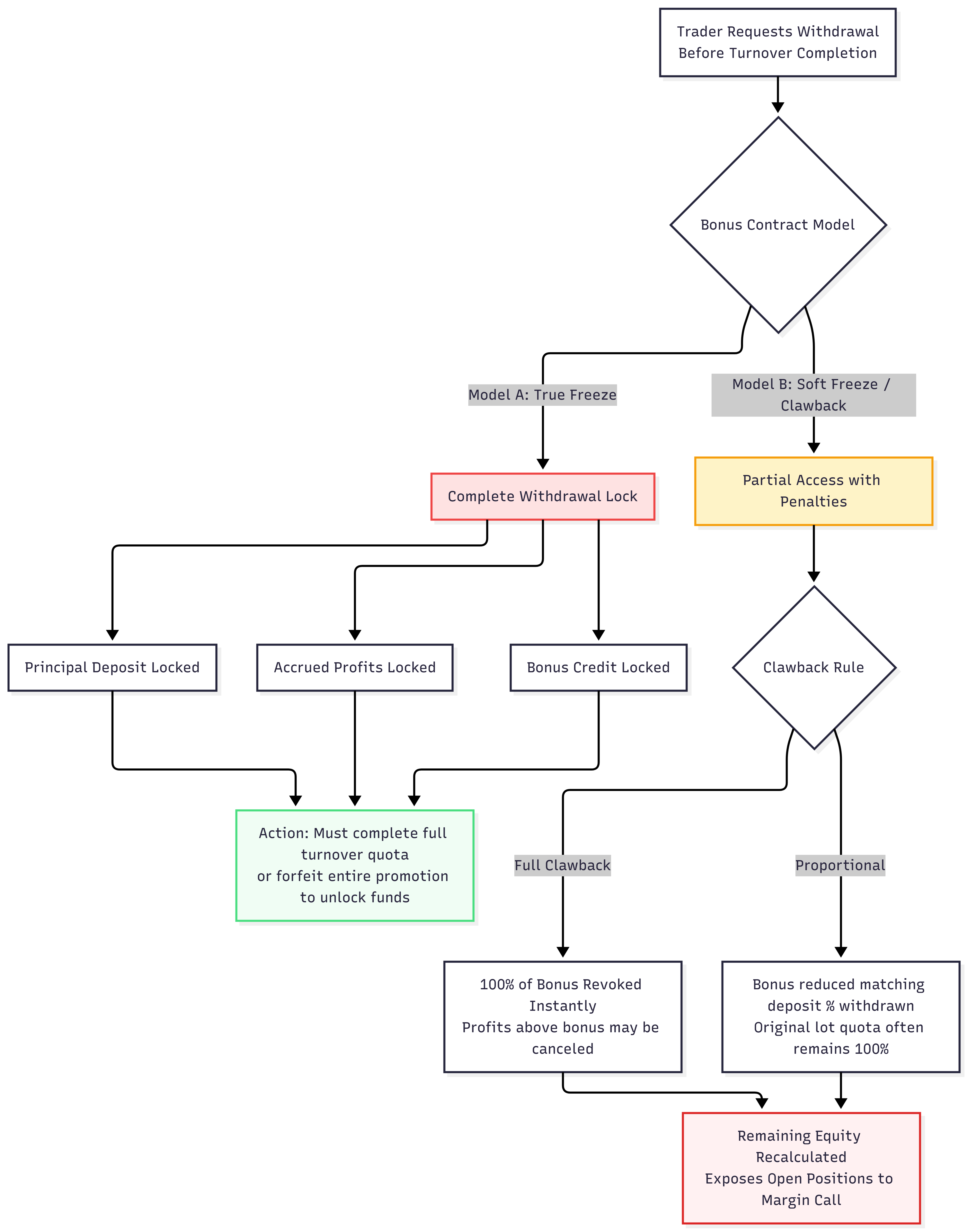
A bonus contract can state that no withdrawal can be made until you have fulfilled the turnover requirement or the bonus period is over, whichever happens first. This is considered a “true freeze”, since your account is frozen from withdrawals until one of these conditions is fulfilled.
A more common clause is the “soft freeze”, where you can make a withdrawal, but it will result in the removal of all or part of the bonus money. When you request the withdrawal, the applicable bonus amount will be removed from your account first. If the terms so stipulate, certain profits earned during the bonus period can also be removed. Finally, your withdrawal can be processed, but the available account equity is now lower.
Make a Withdrawal, But Lose the Bonus
As mentioned above, many brokers will let you make a withdrawal during the bonus period, but it will cause the bonus, or part of the bonus, to vanish.
- The strictest version of this removes the full bonus as soon as you make your first withdrawal request.
- A more moderate version reduces the bonus in proportion to the amount withdrawn.
- Another version allows profits to be withdrawn, but your bonus will be cancelled if you remove the deposit that gave you the bonus.
- Some brokers allow incremental bonus release. Example: You have fulfilled 20% of the bonus requirement, so 20% of the bonus is now released. This type of rule typically also impacts withdrawal conditions.
One real-world example of what bonus rules regarding withdrawals can look like is from FXPesa EGM Securities Ltd.
“4.4 The Welcome Bonus provides additional Margin to open new positions and maintain open positions in the Client’s Account. For the avoidance of doubt, the Welcome Bonus may not be withdrawn, transferred or dealt with in any way other than that set out in this clause 4.4.
Source: EGM Securities Ltd (FXPesa) Welcome Bonus terms and conditions
As you can see, this welcome bonus only provides additional margin. It can not cover losses, and it can not be withdrawn. If you withdraw any funds from the account while the bonus is still available, the bonus will be removed. In other words, you can make a withdrawal, but if you do, the bonus will vanish.
Consequences of Bonus Removal
In the example above, it is possible for the trader to make a withdrawal and only lose the bonus. The deposited money is not frozen.
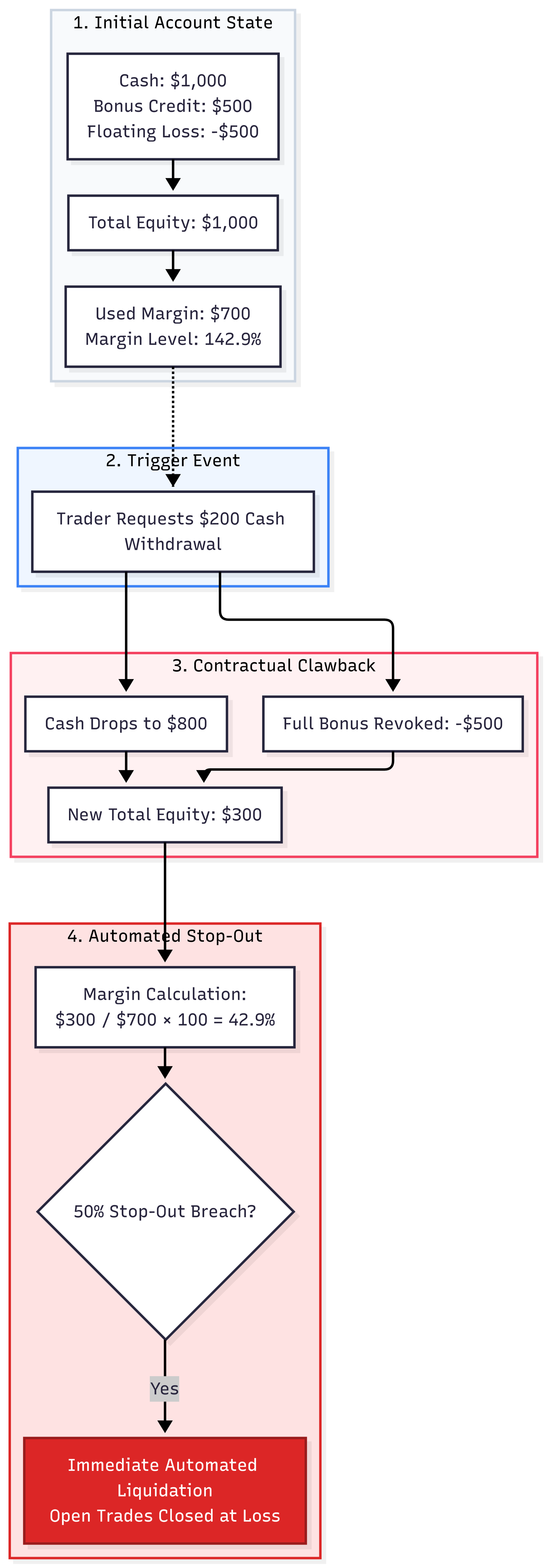
However, making a withdrawal can have wider consequences than simply losing the bonus money, because when the bonus money is removed, total account equity is reduced. If you have open leveraged positions when you make the withdrawal request, the consequences can be serious.
Consider an account with the following status after a $1,000 deposit and a $500 bonus credit.
| Account item | Before withdrawal |
|---|---|
| Cash balance | $1,000 |
| Promotional credit | $500 |
| Floating trading loss | $500 |
| Account equity | $1,000 |
| Used margin | $700 |
| Margin level | 142.9% |
The equity calculation is $1,000 cash + $500 credit − $500 floating loss = $1,000 equity.
The trader now requests a $200 withdrawal. The broker approves the withdrawal, but also removes the full $500 bonus at the same time, in accordance with the bonus terms. The new status for the account becomes:
| Account item | After $200 withdrawal and $500 bonus removal |
|---|---|
| Cash balance | $800 |
| Promotional credit | $0 |
| Floating trading loss | $500 |
| Account equity | $300 |
| Used margin | $700 |
| Margin level | 42.9% |
The withdrawal itself was only $200, but the combined reduction in equity was $700.
The new margin calculation is $300 equity ÷ $700 used margin × 100 = 42.9%.
If the account has a 50% stop-out threshold, positions may be closed automatically.
A trader looking only at the requested payment may conclude that the broker liquidated positions without reason. But the broker was simply following the account and bonus terms. The operational cause is the simultaneous withdrawal ($200) and bonus credit cancellation ($500), which caused the account equity to drop by $700.
Full Clawback vs. Proportional Bonus Removal
Under full clawback rules, withdrawing $10 will remove the same $500 bonus as withdrawing $1,000. The effect is not connected to the size of the withdrawal; it is the act of withdrawing anything that triggers the bonus removal.
If your bonus contract instead stipulates a proportional bonus removal, there will be a link between the bonus reduction and the withdrawn amount.
Example: The terms stipulate that a customer withdrawing 20% of the qualifying deposit will lose 20% of the bonus amount. A $500 bonus would then fall by $100 rather than disappear completely. The account would lose $200 in equity from a $100 withdrawal, but the result is less severe than a full bonus cancellation.
Make sure the contract explains which figure is used for the percentage calculation. It could, for instance, be the qualifying deposit, current balance, available cash, or cumulative withdrawals.
A proportional clause can retain the original turnover requirement after part of the bonus has been removed. The trader receives less credit but remains responsible for the volume attached to the initial amount.
Can The Broker Cancel Profits?
Yes. But how lawful it is will depend on applicable laws, regulations, contractual agreements, and the facts of the specific case.
Some user agreements and bonus contracts distinguish between ordinary profits and profits “derived from” promotional credit (bonus money). That phrase can give the broker scope to argue that all gains made while the bonus was active are conditional.
It is also important to distinguish between a profit being cancelled and a profit not being withdrawable. A clause cancelling profits is more severe than one simply keeping the profits in the account during the bonus period. Closed trading profit normally appears as cash balance in a trading account, but its contractual status can be conditional where the account is subject to bonus conditions.
Before accepting any bonus, it is important to determine exactly how the broker’s terms address the cancellation of profits. In particular, you should establish whether the broker may cancel only profits generated through the use of the bonus, all profits earned during the promotional period, or all profits in the account.
The legal enforceability of such provisions can vary significantly depending on the jurisdiction, the applicable laws and regulations, and the specific terms of the client agreement. In some jurisdictions, a provision allowing a broker to cancel legitimate profits may face legal or regulatory scrutiny, particularly if it is considered unfair, disproportionate, or insufficiently disclosed. However, in jurisdictions where contractual freedom is broader, the broker and client may have greater flexibility to define their rights and obligations through the client agreement and bonus contracts, provided that the relevant terms are legally valid and properly disclosed.
Therefore, before accepting a bonus, it is advisable to read the bonus terms carefully and identify exactly what circumstances may result in the forfeiture of profits and exactly which profits are at risk.
Example of What a Profit Rule Can Look Like
One example of a broker that restricts profit withdrawals during the bonus period is Angel Markets, a company registered in St. Vincent and the Grenadines under the name AMarkets Ltd. (Notably, the Financial Services Authority of St. Vincent and the Grenadines does not license and supervise retail online forex brokers, so this is simply a company registration.)
“VI. During the Bonus validity period, the Client may withdraw profits up to the value of the Bonus without affecting the Bonus itself. However, if the Client wishes to withdraw their initial deposit in full or in part, the Bonus will be removed from the account upon confirmation of the withdrawal.
VII. If the Client wishes to withdraw profits that exceed the Bonus amount, both the Bonus and the accumulated profits will be cancelled and removed from the account.”
Source: Angel Markets Bonus Terms and Conditions
In this case, it is possible for a client to withdraw profits during the bonus period and keep the bonus, as long as the profit withdrawal is no larger than the size of the bonus. Withdrawing profits above this limit during the bonus period is not possible, because a withdrawal request will cause a cancellation of both the bonus and the accumulated profits. In the first case, the withdrawal does not impact the bonus and the profits are not cancelled. In the second case, a withdrawal request causes both the bonus and the profits to vanish.
Meeting the Turnover Requirement
A forex bonus will usually come with a turnover requirement. This is a condition saying that you must execute a certain volume of trade before you can carry out a certain action, e.g. before you can withdraw the bonus, before you can withdraw your profits, or before you can make any withdrawal without forfeiting the bonus. Look for the exact terms and conditions of the turnover requirement in the bonus contract. If they are not there, that is cause for concern, unless they are covered in full within the user agreement.
Example of how a forex bonus turnover requirement can work:
- You are offered a 50% matching bonus.
- You are not allowed to withdraw the bonus money until you have fulfilled the turnover requirement, and the turnover requirement is 20x the bonus amount.
- You deposit $1,000 and receive a 50% bonus, i.e. a $500 bonus.
- The turnover requirement is $500 x 20 = $10,000.
- You would need to complete $10,000 of qualifying trading volume to satisfy the requirement.
Note: Forex CFD brokers typically put much higher turnover requirements on their bonus offers, since high leverage makes it possible to turnover very large volumes even with just a small amount of account equity.
Some brokers do not put a nominal value on the turnover requirement; instead, they denote it in lots. Example: You need to open and close 30 standard lots to fulfil the bonus requirement for this $100 welcome bonus.
What Is The Turnover Based On?
Make sure you know whether the turnover requirement is based on the bonus amount, the deposited amount, and the combined amount. Also check if there will be any turnover requirement placed on profits.
Example: You deposit $1,000 and receive a 50% bonus, i.e. a $500 bonus. The turnover requirement is 20x.
- If the turnover is based on the bonus, it is 20 x $500 = $10,000.
- If the turnover is based on the deposit, it is 20 x $1,000 = $20,000.
- If the turnover is based on the bonus and the deposit, it is 20 x $1,500 = $30,000.
We unpack turnover sizing and other volume requirements in our article on the real costs of forex bonuses.
Make Sure You Know How Turnover Is Calculated
Turnover generally refers to the notional trading volume of your transactions, rather than your profit or loss.
For example, if you open a forex position with a notional value of $10,000, the broker might count $10,000 toward turnover. But you need to check the terms because brokers can define turnover differently. Some count only the opening transaction, while others count both opening and closing transactions.
For example: You open a $10,000 EUR/USD position and then close a $10,000 EUR/USD position. Depending on the broker’s definition, that could count as either $10,000 or $20,000 of turnover.
How the turnover requirement is calculated can make a bonus much less attractive than it initially appears.
Example: You make a $1,000 deposit and get a $500 bonus. The terms say you must trade 30 times the bonus amount before withdrawal. That is $500 × 30 = $15,000 required turnover. If both opening and closing counts, opening a $7,500 position and closing a $7,500 position would fulfil the requirement. But if the broker only counts one side towards the requirement, reaching the turnover requirement becomes twice as difficult.
Make sure the contractual terms distinguish between a prohibited trading method and a method that simply does not count against the turnover. You need to know if a certain method is just excluded from the turnover, or if using this method will result in loss of the promotion, loss of linked profit, reversal of individual trades, or closure of the whole account.
Your Trading Strategy and The Turnover Requirement
Make sure you only accept a bonus where the turnover requirement suits your trading style. Do not change your trading strategy to fit a bonus requirement.
- Do not accept a bonus that will encourage you to deviate from your established trading strategy by opening bigger positions or trading more frequently.
- Do not accept a bonus where your trading strategy is excluded from the turnover or does not count fully against the turnover.
It is not unusual for a bonus turnover requirement to exclude certain types of trading, e.g. scalping, automated trading (trading bots), hedging, and news trading. The general user agreement can also ban certain types of trading altogether, e.g. arbitrage, coordinated hedging, multiple-account trading, and exploitation of delayed prices.
It is important to pick a bonus where your normal trading strategy will actually produce qualifying trades. A position can be valid for normal account purposes, incur the full spread and commission, yet contribute nothing to the turnover target.
Example
A minimum holding period is a common way to exclude certain trades from the turnover target. The threshold may, for instance, be two, three, five or more minutes, which excludes many scalping strategies and some types of news trading.
Let’s assume a trader completes 40 lots before the turnover deadline. 15 of these lots came from positions held for less than five minutes. If positions open for less than five minutes do not count, qualifying volume is only 25 lots. The trader has failed to reach the requirement, despite the platform history showing 40 completed lots.
The excluded trades still generated spreads and commissions. At an all-in cost of $8 per standard lot, the 15 disqualified lots cost 15 × $8 = $120. The trader has paid $120 in transaction charges without moving the bonus counter.
“Abusive Trading” Clauses
Most User Agreements and Bonus Contracts contain one or more clauses about abusive trading. The broker has a legitimate need to protect itself from abusive trading, including bonus abuse. But it becomes a problem for traders when the term “abusive trading” is defined broadly or not defined at all, giving the broker extremely wide flexibility to decide when the clause has been breached.
The existence of a discretionary clause does not prove the broker will actually use it unfairly, but it reduces trader certainty because the contractual test is controlled by the company rather than any objective rule or formula. A vague agreement uses phrases such as “trading inconsistent with normal behavior” without explaining what normal means.
It is generally better for the trader when the contract defines prohibited conduct clearly and narrowly. It might, for instance, identify latency arbitrage, multiple registrations, exploitation of incorrect prices, or matched trading between related accounts. A bonus contract might state that if more than 50% of trading volume during the bonus period are positions held open for less than 5 minutes, it will be considered bonus abuse.
Wide Discretionary Powers
Some brokers give themselves extreme discretionary powers in their user agreements and bonus contracts.
One example is RoboForex Ltd in Belize, where the Welcome Bonus 30 USD Program Conditions state that RoboForex reserves the right to, at any time and without any given reason, write off the previously issued Welcome Bonus 30 USD from the account, as well as revoke (cancel) all transactions that have been made with the use of the extra funds.
Further up, that same page states that both the client’s own funds and extra funds can be used in trading without any limitations and restrictions. It also states that the client can withdraw from the account his own funds and the profit without any limitations.
This shows how seemingly trader-friendly terms can sit within the same contract as clauses that give the broker far-reaching rights to cancel a bonus and profits at its own discretion and with no explanation. It is easy for a brokerage company to say “use the bonus without restrictions” when they also reserve the right to remove that bonus without even explaining why. Instead of being given clear rules to follow to keep the bonus, the RoboForex Ltd client is instructed to use the bonus “without restrictions” while simultaneously fearing that any type of action that draws the attention of the broker can cause the bonus to vanish.
How Turnover Pressure Can Impact Trader Behaviour
A trader who has completed 35 of a required 50 lots turnover requirement, with four days remaining, might be tempted to increase lot size or trade more frequently to finish the target. He will be tempted to stray from his trading strategy and risk management routines.
His trading decisions are no longer based solely on the trading setup. They are also based on the expiry clock. Suddenly, he is opening positions not because they fit the trading strategy correctly, but because they fit it “close enough” or he has a “good gut feeling”.
If the trader’s deposited money and/or profits are locked in the account until the turnover requirement is finished, the pressure can be even stronger, compared to a situation where a trader is “only” working to make the bonus amount itself withdrawable. This risk of behavior changes is something traders should take into account before they accept a bonus. It is not just about whether the forex bonus will lock your account, and how, it is also about how you will react to that lock. If life throws an unplanned expense into the works, a trader with a comfortable emergency bank account, or plenty of room left on a credit card with good terms, might react very differently from a trader who is using their trading account as the emergency account.
Your go-to response to an approaching deadline should not be to automatically change your behavior to complete the requirement. In many situations, the best course of action is actually to allow the bonus to expire.
Expiry Clauses And Margin
A forex bonus usually has a fixed lifespan, and at expiry, any bonus money that has not been released already will typically be removed automatically. The trader does not necessarily receive a warning immediately before the deletion, and the trading platform may recalculate margin within seconds.
This is important to remember, since this sudden change in the account can wreak havoc if you have open leveraged positions.
Let’s assume we have an account that looks like this before the bonus expiry.
Cash balance: $1,100
Bonus credit: $500
Floating loss: $350
Equity before expiry: $1,250
Used margin: $900
The margin level before removal is $1,250 ÷ $900 × 100 = 138.9%.
When the $500 bonus expires, the result is this:
Cash balance: $1,100
Bonus credit: $0
Floating loss: $350
Equity: $750
Used margin: $900
New equity = $1,100 − $350 = $750
The new margin level is $750 ÷ $900 × 100 = 83.3%
Assuming the broker removed the $500 bonus from equity while the open positions and their $900 used margin remain unchanged, the account would move from $1,250 equity and a 138.9% margin level to $750 equity and an 83.3% margin level. Whether this causes forced liquidation depends on the account’s margin-call and stop-out thresholds. Even where the stop-out level is below 83.3%, the account has lost much of its ability to absorb further market movement.
Brokers are well aware that traders often get upset when they suddenly face a margin call or auto-closed positions because of a bonus removal. To nip claims in the bud, they typically add clear clauses in their user agreements and bonus contracts specifically to deal with this, stating that the broker is not responsible for any trading losses resulting from the removal of a bonus for any reason (expiry or other).
One example is Angel Markets (AMarkets Ltd. in Belize), where the standard bonus lasts 90 days unless another period is published. The bonus terms add: “The Company is not responsible for any trading losses incurred due to the removal of the Bonus.”
The company DB Invest Limited in the Seychelles uses a 30-day period for the stated bonus and places responsibility for equity management on the trader. The published conditions say the company is not responsible for the resulting margin call or liquidation.
“5.2.4 The bonus will be removed in full after 30 days from the loading date. It is the client’s responsibility to manage their equity. The company is not responsible for any margin call or liquidation.”
Source: DB Investing Bonus Terms and Conditions
Equity-Supporting Versus Margin-Only Bonus Credit
An equity-supporting bonus functions like temporary account capital. Losses may reduce the customer’s cash first, then continue into the credit before stop-out occurs.
A non-equity credit, i.e. a margin-only bonus credit, inflates free margin but is never withdrawable, and will typically be removed when real funds fall below a defined limit.
The current welcome bonus from RoboForex Ltd in Belize is an example of an equity-supporting bonus. During a drawdown, it will remain until stop-out. The customer’s own funds are deducted first when losses occur. Once a stop-out takes place, the bonus money is removed from the account.
Switch Markets International PTE Ltd offers a Credit Bonus that belongs to the second category, i.e. it is a non-equity bonus, also known as a margin-only bonus credit.
“5. The Credit Bonus is granted as margin credit and serves only as additional free margin, increasing the available funds for trading (e.g., opening or maintaining positions). It is not part of the account balance, cannot be withdrawn, and cannot be used to cover trading losses (including floating losses or drawdown). The Credit Bonus is credited to the same trading account where the client’s deposit was made and approved by Switch Markets. The Credit Bonus is non-transferable between trading accounts and may only be used on the account to which it was originally credited.
6. The Credit Bonus funds remain the sole property of Switch Markets.”
Source: Switch Markets Credit Bonus Terms
How To Opt Out Of A Forex Bonus That You Have Already Accepted

Close Or Reduce Open Positions
A trader who has already accepted credit should not begin by submitting a withdrawal, because the bonus credit may disappear immediately when the request is granted, and this can cause problems for open positions.
Before proceeding, you need to calculate equity and margin without the bonus. If a bonus removal would put the account near stop-out, positions should be closed or reduced before you request a bonus cancellation.
Pending orders should also be reviewed. A position triggered after the bonus credit has been removed can cause issues if account equity is too low.
Note: Closing positions can create spreads, commissions, and taxable results. Those costs may still be lower than an uncontrolled liquidation after the bonus disappears.
Send A Written Opt-Out Request To Your Broker
The request should be made through email or a support ticket that produces a durable record.
Example of what a message can look like:
I request removal of all promotional credit from my account. Please confirm that my deposited funds and ordinary cash balance will remain available under the standard withdrawal terms once the promotional credit has been removed. Do not remove the credit until any open-position effect has been confirmed in writing.
The trader should include the account number, promotion name, and date of acceptance. Passwords, one-time codes, and payment PINs should never be included.
Some bonus programs impose a short period for correcting accidental bonus acceptance. DB Invest Limited, for example, currently allows a customer to report mistaken acceptance within five working days, subject to a limit on the number of trades already placed.
“5.8. The client is not required to accept any bonus offered by DB INVEST; all bonuses are optional. During the client’s initial deposit, the client may choose not to accept a bonus. In these circumstances, the client will not be bound to the terms relating to bonuses. Should the client mistakenly accept a bonus, they must notify a member of our Customer Support Team within 5 working days of mistakenly accepting the bonus. In such circumstances, DB INVEST will remove the bonus from the client’s account, and the client shall not be held to the bonus terms. However, all other terms and conditions shall continue to apply. The client must not have placed more than 2 trades since mistakenly accepting the bonus for the bonus to be removed from the client’s account.“
Source: DB Investing Terms and Conditions
Obtain Confirmation Before Trading Again
Support should confirm the amount of bonus credit being removed, the resulting balance, and whether remaining profit is withdrawable. A verbal response from a talk with a sales representative is weak evidence. The confirmation should be available by email, ticket, or downloadable account message.
Where support says profit will be cancelled, the customer should request the exact contract clause and the trades said to fall under it.
Audit The Account Ledger
After removal, the platform should normally show zero promotional credit. The cash balance and account equity should differ only because of open profit or loss.
The customer should download the full account statement and transaction ledger. Records should include deposits, bonus allocations, credit removals, closed trades, adjustments, and withdrawal requests.
An unexplained negative adjustment should be challenged promptly. The complaint should separate the deposited principal, closed trading profit, and promotional credit rather than referring to the combined equity as one sum.
How To Escalate An Unresolved Bonus Dispute
If the broker withholds deposited funds or cancels profit based on bonus terms, the customer should use the formal complaints procedure named in the account agreement. The complaint should identify the amount disputed, relevant contract clauses, transaction dates, and requested remedy. It should avoid unsupported allegations and focus on the ledger.
Forex Bonus Contract Audit
The table below can be used before accepting a bonus.
| Contract question | Lower-risk answer | Warning sign |
|---|---|---|
| Does a withdrawal cancel profit? | Only bonus credit is removed, profits remain. | Profit is voided by a withdrawal during the bonus period. |
| Will short trades count against the turnover requirement? | Yes, they will. No, but they are still allowed. | No, and short trades can be considered account abuse or bonus abuse, and the contract does not explain where the limits are. |
| Is abusive trading clearly defined? | Yes. Named practices and objective tests. | No. Broad and vague wording, and huge broker discretion. |
| What happens at bonus expiry? | Credit removal date and margin effect are stated in the contract. | Unclear |
| Can credit absorb trading losses? | Yes or no, as long as treatment is explained clearly. | Vague wording |
| Can the customer opt out? | Yes. Both before acceptance and after acceptance. | Acceptance is irrevocable. |
| Does partial withdrawal remove all credit? | Proportional reduction | Full clawback if a withdrawal is made. |
| Is deposited cash restricted? | Ordinary withdrawal rules apply to deposited money. | Deposited money becomes tied to turnover requirement. |
| Which entity issues the bonus? | Same entity as the one in the account agreement. | Different entity from the one in the account agreement. |
Some Regulators Have Banned Retail CFD Trading Bonuses
Retail trading bonuses have attracted significant regulatory scrutiny because they can encourage inexperienced traders to open accounts, deposit money, trade more frequently, open bigger positions, and use more leverage. They can also come with complex rules that are difficult for a standard consumer to understand and properly evaluate.
Problems surrounding retail trading bonuses have become especially noticeable in the retail CFD and retail rolling spot forex markets, where leverage magnifies risk and the complexity of the financial products can be difficult to understand for the inexperienced trader.
As a result, some of the world’s major financial regulators have gone beyond requiring brokers to clearly disclose bonus conditions and not offer unfair bonus terms. They have prohibited or heavily restricted this type of retail inducements altogether, both monetary and non-monetary.
In the European Union, ESMA’s temporary CFD intervention measures prohibited monetary and non-monetary benefits designed to incentivise retail investors to trade CFDs. ESMA specifically identified account-opening bonuses and volume-based rebates as examples falling within the prohibition. EU member states eventually enacted their own restrictions on the national level through each respective financial authority, and since these national rules were at least as strict as ESMA’s temporary measures, ESMA elected not to extend their temporary ban.
The UK FCA made the restrictions permanent for UK retail CFD accounts while the UK was still a part of the EU, and these rules were kept in place even after Brexit.
Australia has taken a similar approach. ASIC’s CFD product intervention order prohibits certain inducements to retail clients, including trading credits, rebates and gifts, alongside leverage limits, margin close-out requirements and negative-balance protection. ASIC’s intervention reflects its broader concern that CFD product features and sales practices can amplify retail clients’ losses.