





A forex broker’s deposit page shows a box marked “Accept 50% Welcome Bonus”. Leaving it checked adds promotional credit to the account. Unchecking it produces a conventional trading account that is not limited by any of the bonus terms and conditions.
Depending on the terms, a forex bonus can, for instance, increase free margin and absorb part of a drawdown. But it is not normal cash, and it comes with strings attached. A bonus can suddenly disappear after a withdrawal or drawdown; the bonus can prohibit certain profitable strategies, and a turnover requirement can prompt the trader to leave their normal strategy behind and complete more volume than the account can reasonably support.
When you are offered a forex bonus, your decision should not be based solely on the size of the bonus. Instead, look at factors such as the legal entity issuing the promotion, the transaction costs required to fulfil the turnover, the amount of bonus money and profits that can become withdrawable, whether your account will be locked from withdrawals during the bonus period, and the effect a sudden bonus removal would have on open positions.
Our matrix can help you convert important terms into a score between zero and 100, making it easier to evaluate a bonus offer from an objective point of view. First, however, the offer must pass our automatic rejection tests. A promotion that fails any of our red-card questions should be declined without wasting time on the rest of the calculation.
The idea is not that every bonus is unfair. Our matrix is simply there to help traders determine whether the offer improves the account sufficiently to be worth the restrictions. Generally speaking, a forex bonus is worth accepting only when it fits trading that would occur without it. The trader should retain access to deposited cash and ordinary profit, remain under the preferred regulated entity, and avoid increasing volume or position size to satisfy the turnover requirement. Where any of those conditions fail, unchecking the bonus box means declining a bonus contract that would entail significant downsides for the trader.
Our scoring system is deliberately conservative, reflecting regulatory and empirical evidence that inexperienced retail traders are particularly vulnerable to the risks associated with CFD trading and certain other short-term leveraged products. Research and regulatory analysis have also found that bonus schemes requiring clients to deposit funds and complete specified trading volumes can encourage more frequent trading and risky strategies, increasing potential losses.
In the UK, Australia, and most of Europe, regulators have restricted retail incentives for CFDs and certain leveraged forex products after finding that trading credits and volume-linked rewards could distract retail customers from product risk and encourage additional trading. The FCA’s current CFD rules put strong restrictions on the retail marketing, distribution, and sale of CFDs and similar speculative financial products, and the bonus ban is a part of this package. In Australia, ASIC’s intervention order restricts trading credits, rebates, and similar inducements until at least May 2027, and the order is very likely to be extended for several more years. In the European Union, the approach to retail CFDs and similar speculative financial products has evolved from a temporary EU-wide intervention by ESMA in 2018 into a permanent system of national regulation. In 2018, ESMA introduced temporary product-intervention measures restricting the marketing, distribution and sale of CFDs to retail clients across the EU. Among other things, the measures included a ban on monetary and non-monetary benefits designed to incentivise retail clients to trade CFDs and certain similar products. In July 2019, ESMA stopped renewing the measures because national regulators had adopted their own permanent product-intervention rules that were at least as restrictive as ESMA’s temporary rules. Consequently, the expiry of the ESMA measures did not mean that the restrictions disappeared. Instead, responsibility shifted to the national competent authorities under the EU’s MiFIR framework.
Red Card Questions: The Five-Minute Bonus Audit
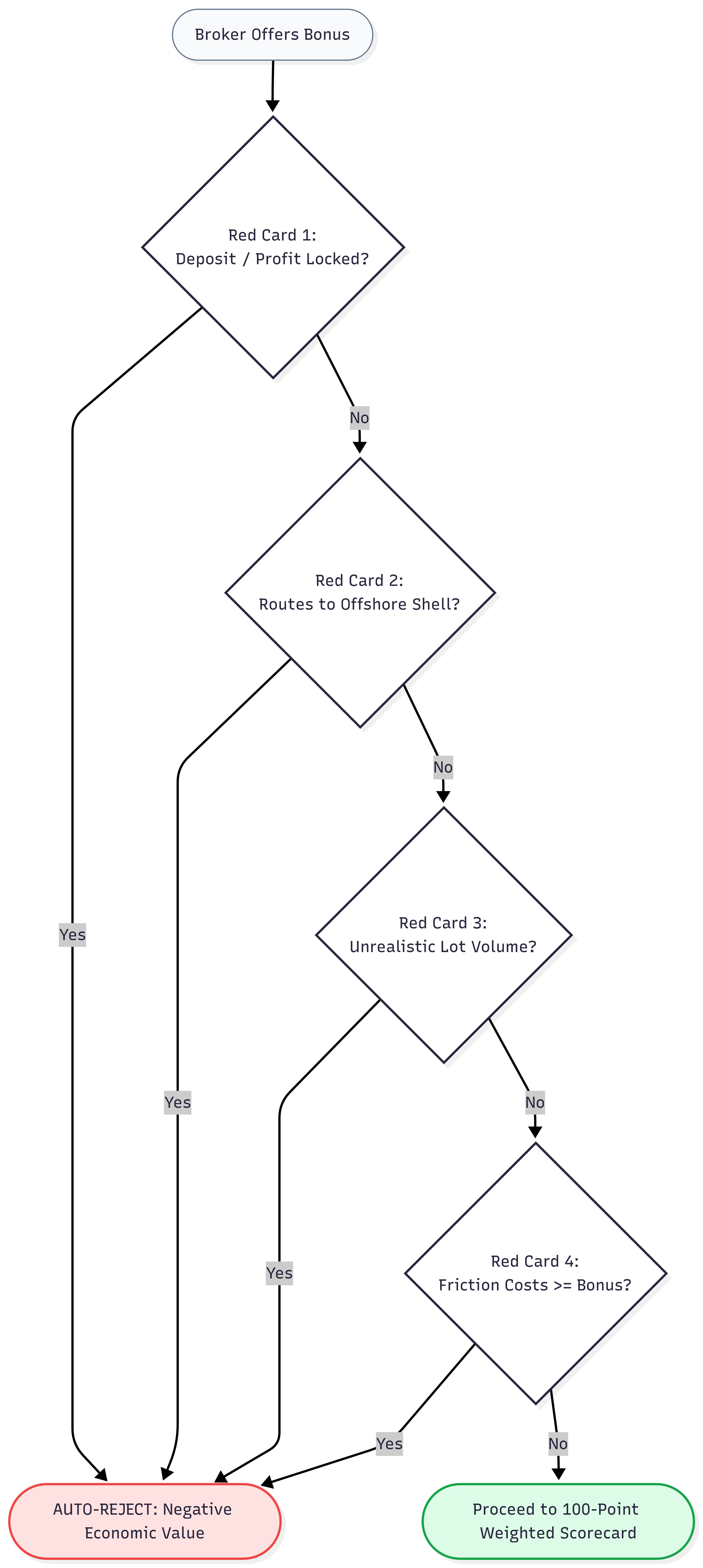
The first stage of our evaluation does not award points; it simply checks whether the offer contains a condition severe enough to make the remaining benefits irrelevant. If the bonus offer receives even one of our “Red Cards”, our recommendation is that you reject it immediately, without spending more time on evaluating it.
| Question | Decision |
|---|---|
| Deposit and profit access: Can the trader withdraw the original deposit after the bonus period, or by asking to have the bonus removed from the account before the bonus period is over? | Decline if the answer is no or unclear |
| Legal-entity switch: Does accepting the bonus move the trading account from a company in a jurisdiction with strong trader protection to a company in a jurisdiction with weaker trader protection? | Decline if the answer is yes or unclear |
| Economically unrealistic turnover: Does your normal trading volume fall far below the turnover requirement? | Decline if the answer is yes or unclear |
| Turnover costs: Are the estimated added trading costs close to (or above) the cash value of the bonus? | Decline if the answer is yes or unclear |
Deposit And Profit Access
Most forex credit bonuses are not directly withdrawable, but that alone does not make the promotion unusable. The more serious issue is if and how the promotion interferes with the customer’s deposited cash and/or trading profits.
A trader should be able to identify what happens to three separate figures during and after the bonus period: bonus money, deposited cash, and trading profits. A contract that prevents withdrawal of the original deposit solely because a promotion is active keeps money that you own locked in. So does a contract that classifies any profits generated during the bonus period as promotional profit rather than cash with no strings attached.
A reasonable contract may remove unused promotional credit when the customer withdraws money. A more restrictive contract can also cancel profits and impose a penalty. Some contracts completely freeze the original deposit from being removed until a volume target (turnover) or other conditions are completed.
Suppose a trader deposits $1,000, receives a $500 bonus credit, and earns $300 in profits. The account contains $1,300 in cash balance plus $500 in bonus credit. If a $200 withdrawal removes only the bonus, the account falls by $700. $200 withdrawal + $500 bonus removal = $700 equity reduction. (The result may still be damaging if leveraged positions were open when the equity dropped.)
If the contract also cancels the $300 profit when the withdrawal is approved, the same withdrawal request creates a $1,000 reduction. $200 withdrawal + $500 bonus + $300 profit cancellation = $1,000.
The Offshore Licensing Switch
A broker brand may operate through several companies based in different jurisdictions. Its UK entity is authorized by the UK FCA, its European entity by CySEC in Cyprus, its Australian business by ASIC, and its global/international account by a company in a laxer jurisdiction such as the Seychelles, Vanuatu, or Belize.
The group can use the same brand, logo, website, platform, and support centre across those entities. But your legal rights depend on the company named in the account agreement. If you are moved from a UK account to a Vanuatu account, your rights and protections as a retail trader drops dramatically.
In jurisdictions with strong trader protection rules (also known as Tier 1 jurisdictions), brokers are commonly prohibited from offering CFD and leverage forex bonuses to retail clients. Therefore, a bonus offer should be a warning sign that you might be about to sign a Tier 3 user agreement rather than simply accepting a bonus in a Tier 1 account.
A trader living in a Tier 1 jurisdiction may begin on the group’s main website, click a promotional banner for a big bonus, and be assigned to a Tier 3 company during registration. The shift might appear only in the customer agreement and footer, which is why it is so important to never agree to anything without knowing exactly who your legal counterpart is.
Accepting an account move to a new jurisdiction simply because you want a bonus is not a good idea. It is not automatically a bad move when an experienced and knowledgable trader deliberately seeks out a Tier 3 company after doing the necessary due diligence, but it is a big decision with massive legal implications for the account, and it should not be done simply to get $200 promotional credit.
This does not mean that every Tier 3-based company is unsafe. The question is narrower: Should a retail trader give up a materially stronger protective framework to receive temporary promotional credit? The answer is no. A $200 or $500 or even $1,000 bonus has a fixed maximum value, and it comes with many strings attached that limits the true value of the promotion. Factors such as local complaint access, negative balance protection (NBP), and enforceable client-money rights are always more important throughout the lifespan of the account.
Unrealistic Turnover Requirement
Do not accept the bonus where the forex turnover requirement can not be reached in time using your normal trading strategy. Accepting that bonus can nudge you toward abandoning your normal trading strategy and risk management routines to chase the turnover goal, and that typically spells disaster for a trading account.
A promotion fails the test where the turnover target can only be reached by changing the trader’s position size or frequency, or where you would need to sidestep your trading strategy in other ways. A swing trader who normally completes 10 lots in 90 days should decline a bonus requiring 100 lots in 30 days. The same requirement is, on the other hand, manageable for an established algorithmic strategy that normally completes 100 to 150 lots per month (provided that algorithmic trading is permitted with this broker and counts against the turnover requirement).
Turnover Costs
Do not accept a bonus where the turnover costs are close to (or even exceed) the promotional value of the bonus.
Example: You accept a $200 bonus, but to fulfil the turnover requirement you need to carry out trades that will cost you an estimated $180 in spreads, commissions, etc. And that is even before we factor in market losses.
When doing this evaluation, it is important to remember that turnover requirements are not standardised, so you need to find out exactly what the wording in your specific contract means. A simple “50 times turnover” requirement can mean different things with different brokers. A $500 forex bonus multiplied by 50 equals $25,000. If this refers to notional forex volume, it represents roughly 0.25 standard forex lots, using the simplified assumption that one standard lot equals $100,000.
If the broker instead requires 50 standard lots, the notional turnover is approximately $5 million. The difference is enormous.
The correct process is to convert every requirement into lots and then estimate its cash cost. Required lots = required notional turnover ÷ $100,000. Where the contract already states a lot requirement, no conversion is needed. The estimated cost is Estimated turnover cost = required lots × all-in cost per lot.
Suppose a $500 bonus requires 100 standard lots. At an all-in spread and commission cost of $8 per lot, the turnover costs approximately 100 lots × $8 = $800. The trader may pay $800 in transaction friction to release a promotion worth no more than $500. Slippage and overnight financing are not included.
This red card is triggered by the estimated added cost being equal to or greater than the realistically withdrawable bonus value. The relevant word is “added”. If a trader would naturally complete 100 lots anyway, the transaction costs are not caused by the bonus. Where normal volume is 20 lots, the other 80 represent bonus-driven activity.
Prepare The Contract Data Before Scoring
A score is only useful when every category is filled in using legally binding data found in contracts, not vague marketing buzz seen in a pop-up ad. The trader needs to confirm facts such as the legal entity, bonus amount, withdrawable value, lot requirement, expiry date, removal rules, and strategy exclusions.
The following values should be written down before a trader proceeds to the scorecard. In some situations, simply getting these numbers on paper will be enough for a trader to realize that the bonus offer is not suitable for their strategy and preferences.
A trader looking for these answers can also find out that the broker is being really vague in the bonus contract, which makes it difficult to put number values down. This is a warning signal in itself. Unclear terms receive the lowest score in the relevant category. Uncertainty should never be treated as a neutral result.
| Input | Figure required |
|---|---|
| Cash deposit | Personal money transferred to the broker to obtain the bonus. |
| Promotional credit | Bonus credit displayed in the trading account. |
| Maximum bonus cash value | Amount of bonus that can actually be withdrawn. |
| Maximum profit cash value | Amount of profit that can actually be withdrawn. |
| Required lots | Qualifying volume under the broker’s turnover formula. |
| Normal volume | Approximate number of lots your strategy would trade during the same period if you were not chasing a bonus turnover requirement. |
| Added volume | Required lots minus normal lots. |
| Cost per lot | Typical spread plus commission for the intended instruments. |
| Added transaction cost | Added volume multiplied by cost per lot. |
| Expiry | Final date for completing the requirement. |
| Removal rules | What happens after withdrawal, expiry, or drawdown. |
The Weighted Forex Bonus Scorecard
The scorecard awards up to 100 points across five categories. It should only be used after the offer passes all red-card tests.
If more than one answer is true for your bonus within a certain category, pick the answer that gives the largest number of points. You can never pick more than one answer per category.
Bonus Type And Equity Support: Maximum Is 25 Points
| Credit behavior | Score |
|---|---|
| Credit remains in equity through normal drawdown until the stated stop-out level. Removal rules are clear. | 25 |
| Credit is withdrawable gradually, as cash and removal cannot cancel deposited funds or ordinary profit. Removal rules are clear. | 25 |
| Credit only supports margin, and is removed at a clearly stated equity threshold. | 15 |
| Margin-only credit disappears when the cash balance approaches zero. | 5 |
| The contract does not explain how credit behaves during losses. | 0 |
Equity-supporting credit does not make a larger position safer, but the account can absorb more floating loss before stop-out.
RoboForex’s welcome-credit rules provide an example of credit described as remaining available during drawdown until stop-out. They also state that the customer can withdraw personal funds and profit, subject to the programme rules.
A credit that vanishes when the cash component reaches zero receives five points because it can still increase opening margin. Its protection is weaker than the displayed equity suggests. The trader should calculate Equity without bonus = cash balance + open profit or loss. Then Margin level without bonus = equity without bonus ÷ used margin × 100. If this percentage falls below the account’s stop-out level, the positions depend on temporary credit.
Volume Requirement And Economic Cost: Maximum Is 25 Points
This category replaces a raw multiplier score with a cost-based test.
This method recognises that the same bonus can be reasonable for one trader and poor for another. A high-frequency strategy may complete the requirement without changing behavior. A low-frequency strategy may need to abandon its trading plan.
| Added cost and volume | Score |
|---|---|
| Normal strategy volume completes the requirement, and added cost is below 10% of cash bonus value | 25 |
| Required volume is no more than 125% of normal volume, and added cost is below 30% of bonus value | 20 |
| Required volume is no more than 150% of normal volume, and added cost is below 50% of bonus value | 15 |
| Required volume is up to twice normal volume, and added cost remains below the bonus value | 5 |
| Required volume exceeds twice normal activity, added cost equals or exceeds bonus value, or the formula is unclear | 0 |
Assume a trader normally completes 80 lots during the promotional period. The bonus requires 100, creating 20 added lots.
At $8 per lot, the added cost is $160.
Added cost = 20 lots × $8 = $160
If the withdrawable bonus value is $500:
Cost ratio = $160 ÷ $500 × 100 = 32%
Required volume is 125% of normal activity:
100 ÷ 80 × 100 = 125%
The offer receives 15 points rather than 20 because the cost is above the 30% threshold.
Time Available: Maximum Is 20 Points
The time limit should be compared with the strategy’s normal trading.
| Completion period | Score |
|---|---|
| No expiry (but bonus can be removed upon request) | 20 |
| At least 90 calendar days | 15 |
| Between 60 and 89 days | 10 |
| Between 30 and 59 days | 5 |
| Less than 30 days | 0 |
A 90-day period does not automatically make the terms fair, but it reduces the pressure to manufacture trades to quickly meet the turnover requirement.
The score should be reduced to zero where the broker can end the promotion early without preserving already earned cash value. A nominally perpetual offer is not useful where the company can remove credit at any time without a defined reason.
The trader should also check whether the deadline applies to opening trades, closing trades, or requesting conversion. A position opened before expiry may contribute nothing if it closes after the final date.
Strategy Restrictions: Maximum Is 15 Points
If a strategy needs to change materially in order for the trading to be permitted and qualify for the turnover requirement, the bonus is not a good choice for the trader. A scalper receives zero points where trades under three or five minutes are excluded. An expert-adviser user receives zero points where automated systems are prohibited. A manual swing trader may still award points if those restrictions have no effect on the actual method.
| Restriction level | Score |
|---|---|
| Normal scalping, hedging, expert advisers and news trading are permitted, apart from clearly defined manipulation | 15 |
| One minor objective restriction, such as a 60-second minimum holding period | 10 |
| Several clear restrictions, but none conflict with the trader’s established method | 5 |
| Vague abuse language, broad sole discretion, or a restriction that conflicts with the strategy | 0 |
Rules against multiple-account bonus arbitrage, deliberate exploitation of incorrect prices, and coordinated opposite trades are not automatically unreasonable. They address conduct designed to extract promotional value without ordinary market exposure. The problem is vague language. A clause allowing the broker to cancel all profit for any activity it considers irregular provides no objective test.
Withdrawals And Clawbacks: Maximum Is 15 Points
This category assesses what happens when the customer takes money out during the bonus period.
| Withdrawal treatment | Score |
|---|---|
| Partial withdrawal causes only a proportional reduction in unused bonus credit | 15 |
| Withdrawal removes only the amount of credit connected with the withdrawn deposit | 10 |
| Any withdrawal removes the full bonus, but leaves deposited cash and ordinary profit intact | 5 |
| Withdrawal cancels profit, imposes a penalty on deposited funds, or is subject to unclear discretion | 0 |
Full bonus removal receives five points rather than an automatic rejection, only where the trader’s cash and profit remain available.
The account still needs to survive the equity reduction. A trader should close or reduce positions before making a withdrawal if the bonus is supporting margin.
Score Interpretation
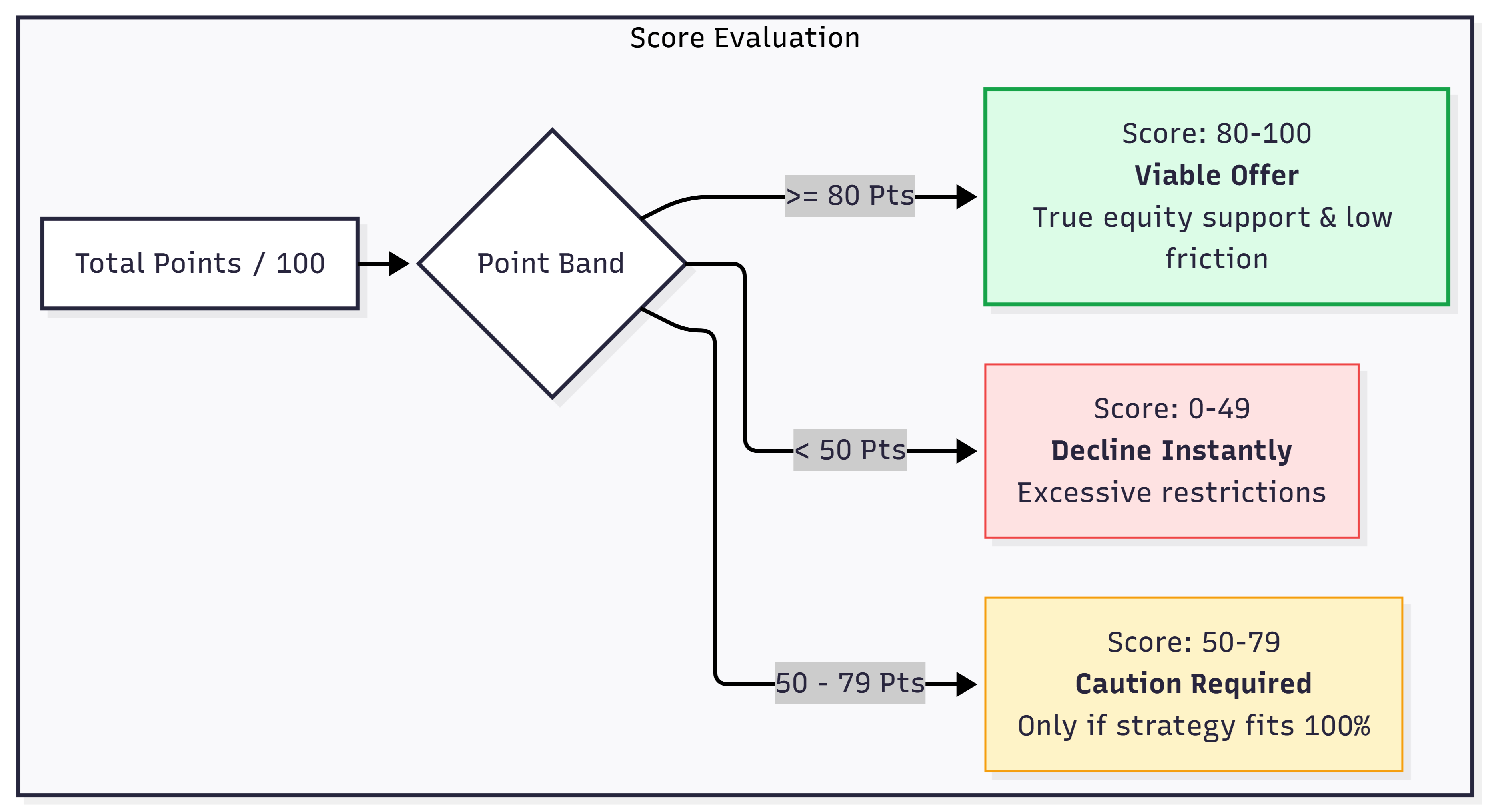
| Total score | Verdict | Action |
|---|---|---|
| 80–100 | Acceptable under the stated strategy | Accept only if no red-card condition exists, and the account entity is suitable. |
| 50–79 | Proceed with caution | Accept only if no red-card condition exists, the account entity is suitable, and normal trading will satisfy the terms without higher risk. |
| Below 50 | Decline | The promotion adds too much cost, risk, uncertainty, or withdrawal friction. |
“Acceptable” does not mean safe. It means the promotion’s mechanics do not appear to reduce the account’s value under the trader’s stated assumptions. A score above 80 cannot override a red card. A bonus offering excellent equity support and a long expiry still fails if claiming it transfers the account to a weaker legal entity or restricts access to deposited cash.
The score should be recalculated whenever the broker changes the terms, adds a deposit, or extends the promotion.
Trader Scenarios
The Scalper
A scalper opens frequent positions and may close them within seconds or minutes. This trading style can generate enough volume to satisfy many bonus targets naturally, provided that scalping is both permitted and counts towards the turnover requirement.
Assume a scalper receives a $500 bonus with equity support, needs 100 lots over 90 days, and normally trades 120 lots during that period. Added volume is zero, so the volume category earns 25 points. The offer expires after 90 days, earning 15 points. Partial withdrawals remove credit proportionately, earning 15.
The terms, however, exclude trades closed within three minutes. Around 70% of the trader’s positions normally close within that limit. The strategy category receives zero.
- Equity support: 25
- Volume: 25
- Time: 15
- Strategy: 0
- Withdrawal: 15
- Total: 80
The numerical result appears acceptable, but the offer should still be declined. Most of the trader’s normal activity will not qualify, making the original volume assumptions false. The recalculated qualifying volume would be much lower. The customer would need to hold positions longer than normally or create extra trades, which changes the strategy.
This scenario shows why the inputs must reflect qualifying trades rather than platform volume.
The Swing Trader
A swing trader may hold positions for several days or weeks and trade relatively few lots each month.
Assume the account receives $500 in margin-only credit. The bonus requires 60 lots within 45 days, while the trader normally completes eight lots during that period.
The terms do not restrict holding periods or overnight positions. Any withdrawal removes the entire bonus but leaves cash profit intact.
- Equity support: 5
- Volume: 0
- Time: 5
- Strategy: 15
- Withdrawal: 5
- Total: 30
The result is a decline.
The main problem is not the bonus-removal clause; it is the mismatch between the trader’s natural activity and the required volume. Completing 60 lots instead of eight means trading 7.5 times the normal volume. The trader must increase frequency, position size, or both.
Holding large positions for several days can also add overnight financing costs.
A swing trader should prefer a cash rebate without a forced minimum or a lower-cost account with no bonus promotion.
The Algorithmic Trader
This established algorithmic system completes 250 lots during a normal 90-day period. Risk is controlled through small individual positions and fixed portfolio limits.
The broker offers a $1,000 equity-supporting credit. Conversion requires 150 lots within 90 days. Expert Advisers are permitted, and only clearly defined latency-arbitrage methods are excluded. Partial withdrawals reduce the credit proportionately.
- Equity support: 25
- Volume: 25
- Time: 15
- Strategy: 15
- Withdrawal: 15
- Total: 95
The promotion may be reasonable because the system would complete the required activity without changing its orders. But the trader must still compare execution and costs with the broker’s non-bonus account. A wider spread of only $2 per lot across 250 lots costs $500. A $1,000 promotion remains valuable, but half of its benefit has already been absorbed.
How To Decline A Forex Bonus
Before Depositing
The cleanest option is to leave the promotion box unchecked during registration or deposit. The trader should take a screenshot showing that the promotion was declined. The client portal should then be checked after the deposit to confirm that no bonus credit has been added to the account. The account history should show the cash deposit without a separate credit allocation.
Some brokers give out a bonus automatically. In such cases, you need to contact customer support before you make your first deposit.
After Credit Has Been Added
If bonus credit has already been added to your account, you need to contact customer support to have it removed manually.
Open positions should be reviewed before requesting removal. If bonus credit is supporting margin, deleting the bonus credit can trigger stop-out. The trader should calculate equity without credit and close or reduce positions where the resulting margin level would be unsafe.
A written request should then be sent through email or the broker’s support-ticket system.
Example:
Please remove all promotional credit from account [account number] and opt the account of future bonus allocations. Please confirm that my deposited cash and ordinary closed trading profit will remain subject only to the standard withdrawal terms. Do not remove the credit while positions are open without confirming the resulting account equity.
The trader should request confirmation of the post-removal cash balance and retain the ticket.
After removal, the account ledger should show zero promotional credit. When no trades are open, balance and equity should be the same. Any difference should be matched to commission, financing, conversion, or another recorded adjustment. An unexplained deduction should be challenged before more trades are placed. The next withdrawal should be tested with a modest amount. A successful small payment confirms that the ordinary account and payment route are operating without the promotion.
Copyable Forex Bonus Decision Scorecard
| Test | Score |
|---|---|
| Deposit and ordinary profit remain withdrawable | Red card: Yes / No |
| Bonus does not require an offshore entity switch | Red card: Yes / No |
| Added turnover cost remains below bonus cash value | Red card: Yes / No |
| Equity support | __ / 25 |
| Volume feasibility and added cost | __ / 25 |
| Time available | __ / 20 |
| Strategy compatibility | __ / 15 |
| Withdrawal and clawback policy | __ / 15 |
| Total | __ / 100 |
The supporting calculations are:
- Added volume = required qualifying lots − normal qualifying lots
- Added cost = added volume × average all-in cost per lot
- Cost ratio = added cost ÷ maximum withdrawable bonus value × 100
- Required-volume ratio = required lots ÷ normal lots × 100
A promotion should be declined where any red card is triggered, regardless of the point total.
Where the score is below 50, the terms are too restrictive.
A score between 50 and 79 requires a clear reason for accepting the added conditions.
A result above 80 is acceptable only where the assumptions use realistic spreads, qualifying volume, and the correct legal entity.
Why Is A Legal Entity Switch Such A Big Deal? And How Are Bonus Offers Used To Nudge Retail Traders Towards Tier 3 Companies?
What Does “Tier 1” or “Tier 3” Actually Mean?
It is important to clarify that when we talk about brokers and regulators, Tier 1, Tier 2, and Tier 3 are simply industry shorthand terms for the perceived strength of a regulatory jurisdiction when it comes to trader protection. There is no globally agreed upon list of requirements that make a jurisdiction belong in a certain category. Though DayTrading.com has developed its own regulator bandings, from Green to Red, where Green generally corresponds with Tier 1.
Generally speaking, a Tier 1 jurisdiction has a highly developed financial regulatory framework, strong supervision, substantial capital requirements, strict reporting obligations, and relatively robust investor protections. There are usually special rules in place to safeguard retail traders, i.e. non-professional traders. These rules are not automatically loved by the retail traders themselves. While most retail traders are happy to get statutory negative balance protection and be covered by a generous investor compensation scheme, they are simultaneously less jubilant about retail trading bonus bans and very low leverage caps, and this can contribute to them seeking out brokers in more permissive jurisdictions.
Tier 2 jurisdictions typically have a robust financial regulatory framework in place, but have elected to be a bit more permissive. They might, for instance, allow retail bonuses and impose a 1:200 retail leverage cap instead of 1:30.
Tier 3 jurisdictions are regulatory environments that are known to be lax when it comes to online trader protection. This can either be deliberate, i.e. the country wants to attract brokerage companies and the political stance is that adults should be allowed to regulate their commercial dealings with a broker through contracts. Or it can simply be a consequence of not having a suitable framework in place to regulate and supervise online brokers.
That does not automatically mean every Tier 3-based broker is dishonest or unsafe, nor does Tier 1 regulation guarantee that a broker won’t fail or be sketchy. Rather, the distinction is about the regulatory environment and protections surrounding the broker-customer relationship. For a retail trader, these differences can become extremely important when something goes wrong, e.g. when your broker suddenly refuses all withdrawals from your account and claims you have violated some very vague rule found in the fine print of the bonus contract.
Switching from a Tier 1/Tier 2 brokerage entity to a Tier 3 entity affects a wide range of things, including regulatory protection, client-fund arrangements, leverage, execution, dispute resolution, and what happens to a trader’s money if the broker experiences financial difficulties and can’t honor its obligations.
Why Switching From A Tier 1/Tier 2 To A Tier 3 Broker Is A Big Deal
Which legal entity holds the trader’s account, and where this entity is regulated, is of imperative importance.
It is common for a brokerage group to operate through many different companies based in different jurisdictions. A trader may believe they are dealing with the same company because the brand, website, logo, trading platform, mobile application, and customer-support channels all look identical. Yet, behind the scenes, each company operates under different regulations.
Retail traders need to understand the difference between a brand and a legal entity. A global brokerage group may operate a single recognizable brand through several subsidiaries around the world. For example, the company might, for instance, have one subsidiary regulated in the United Kingdom, another in Australia, another in a European Union country, another in Kenya, and another in Vanuatu. From the customer’s perspective, everything can appear almost identical across the company group. Legally, however, these are different companies.
This means that knowing “I trade with Brand XYZ” doesn’t necessarily tell you which regulatory protections apply to your account. The much more important question is: Which legal entity is my account actually registered with?
Switching from a Tier 1 entity to a Tier 3 entity can be a much bigger decision than it initially appears. The consequences can include different requirements for client-money segregation, different investor protections, different compensation mechanisms, different leverage limits, different execution arrangements, different legal remedies if a dispute arises, and more.
None of this means that every Tier 3 entity is inherently bad or that every Tier 1 entity is guaranteed to be safe. Rather, it means that retail traders should understand exactly what they are giving up before they make a decision. Governing law impacts not only how the trading account operates on an ordinary day, but also how well the trader is protected on the day something goes seriously wrong.
Client Money And Asset Protection
One of the biggest issues is what happens to your money after you deposit it with the broker.
A Tier 1 regulatory framework typically imposes strict requirements concerning the segregation of client funds. In simple terms, the broker is required to keep customer money separate from the company’s own operating funds. This is designed to reduce the possibility that client money will become part of the company’s general assets if the broker experiences financial problems.
Suppose a trader has $50,000 in a brokerage account. If that trader moves from one subsidiary to another, the amount of money in the account may remain exactly the same. The trading platform may also look exactly the same. But the legal protections surrounding that $50,000 can be different.
This is why traders should never assume that the protections available from a brokerage group’s strongest regulated subsidiary automatically apply to every other subsidiary operating under the same brand.
Leverage Rules
One of the most attractive features of a lower-tier entity can be higher retail leverage. Tier 1 jurisdictions typically impose low caps on retail leverage, e.g. 1:30 for major forex pairs and even lower for other forex pairs. Tier 2 jurisdictions tend to be a bit more permissive, and Tier 3 jurisdictions typically have no statutory caps or very high caps.
Under the same brokerage brand, a retail trader can be offered the choice of maximum 1:30 leverage and maximum 1:500 leverage. To an inexperienced trader, the second option can look substantially better. But the reason a particular legal entity can offer higher retail leverage is that it operates outside restrictions imposed by stricter regulators.
Therefore, a trader should not automatically interpret higher leverage as a better brokerage arrangement, all things considered.
Execution
Another issue that is easy to overlook is trade execution. Two companies operating under the same brand can provide access to the same trading platform while using different operational arrangements behind the scenes. They may, for instance, have different liquidity providers, prime brokers, execution arrangements, risk-management systems, and internal dealing structures.
As a result, the trading experience can differ even if the platform looks identical. You may, for instance, experience differences when it comes to bid-ask spreads, slippage, execution speed, order rejections, re-quotes, stop-loss execution during major news events, and liquidity during volatility.
For a swing trader who holds positions for days, weeks, or months, small execution differences may not have a major impact, and other factors will be more important. For a day trader, execution quality can be a significant part of the trading strategy’s profitability, and shifting to another legal entity can turn a previously profitable strategy into a losing one. A difference of a fraction of a pip or a few milliseconds may sound insignificant on an individual trade. Across thousands of transactions, these costs can become meaningful.
Escalation Path And Dispute Resolution
Perhaps one of the most important differences between regulatory jurisdictions is what happens when the customer has a dispute with the broker.
Imagine a trader believes that the broker incorrectly liquidated a position during a period of extreme market volatility. The resulting loss is $5,000.
The trader wants to challenge the decision.
The available options can depend heavily on which legal entity holds the account.
A strongly regulated entity may be subject to formal complaint procedures, regulatory oversight, ombudsman mechanisms, or other avenues for dispute resolution.
An offshore entity may provide a substantially different process. The laws protecting trader rights can be weak, and the financial authority can be lacklustre or severely lacking in resources. The trader might need to retain legal counsel in the applicable jurisdiction and run their own civil case against the broker, as the financial authority is unable or unwilling to help.
A trader could therefore have a completely different level of recourse despite dealing with the same brand and using the same trading platform. The jurisdiction listed in the account agreement is not a minor administrative detail. It can determine what legal options are available when there is a serious disagreement.
Insolvency Is the Ultimate Test
The importance of regulatory structure becomes especially obvious if a brokerage firm encounters financial difficulties. During normal conditions, a trader may never notice whether the account is held by a Tier 1 or Tier 3 subsidiary. But if the broker becomes insolvent, the critical questions become:
- Who legally holds my assets?
- Where are client funds held?
- Are those funds segregated?
- Will my money and assets end up in the general bankruptcy estate?
- Which insolvency laws apply?
- Is there an investor compensation scheme, and how is it capped?
What Retail Traders Should Check
- Before accepting a move from one entity to another, a trader should identify several key details.
- First, determine the exact legal entity that will hold the account. Second, identify the regulator and license number associated with that entity.
- The license should now be independently verified with the financial authority rather than accepted solely on the basis of information from the broker.
- Examine the governing law and dispute-resolution procedures contained in the account agreement.
- Determine how client funds are held and segregated, and establish whether any compensation or investor-protection scheme applies.
- Understand the rules surrounding negative account balances and whether the trader can potentially end up owing the broker money. In other words, can you lose more money than what you have in your account?
- Examine the leverage and margin requirements.
- Understand the broker’s execution model and liquidity arrangements, particularly if execution quality is important to the trading strategy.
How Bonus Offers Are Used To Nudge Retail Traders Toward Tier 3 Brokerage Entities
For retail traders, a bonus offer can look like a simple marketing incentive. Deposit money, receive additional trading credit, and gain access to more attractive trading conditions. But when a brokerage group operates multiple legal entities under the same brand, bonuses can play a more subtle role. They can help make a Tier 3 entity appear more attractive than a Tier 1 entity, and encourage a trader to give up protections in exchange for a bonus.
The key issue here is not that every bonus is inherently problematic. Rather, it is the way incentives can influence a trader’s decision about which legal entity to use. A brokerage group may operate a UK FCA-licensed entity alongside a Vanuatu VFSC-licensed entity, using the same brand and website. The retail trader sees marketing materials that heavily feature the UK FCA badge and feels that this must be a reputable broker. But during the sign-up process, the trader is presented with an attractive package: higher leverage, fewer product restrictions, and one or more welcome deposit bonuses. If the trader picks the “attractive package” with the bonus, the sign-up process is diverted from the UK FCA company to the Vanuatu VFSC company. This change will be visible in the User Agreement, but many traders do not read them before confirming.
$$$ bonus in your trading account right now, or trader protection three years from now when something goes wrong?
Even when the trader is fully aware of the switch to another jurisdiction, the lure of a big bonus and higher leverage can be difficult to fight. The bonus is immediate and visible, while the value of stronger regulatory protection is usually invisible during normal trading. If anything, strong regulatory protection feels like a bad thing for many retail traders, since it typically comes with things such as lower leverage caps, more product restrictions, and a bonus ban.
The power of the global brand
The use of the same corporate brand can make this effect even stronger. A trader may already trust the brokerage because of its reputation, advertising, trading platform, or experience with another company within the same group. When the trader is offered an account through a different entity, the familiar branding can create the impression that nothing fundamental has changed. The trader may think: “I’m still trading with the same brokerage company.” But legally, that is not true. The bonus can reinforce the perception that the move is an upgrade rather than a negative change for the trader’s regulatory position.
Framing the move as an upgrade
Language matters here. A trader may not be told explicitly in large and bold print that they are moving from a strongly regulated entity to a less-protected one. Instead, the transition may be described using positive terms such as:
- “Upgrade”
- “Enhanced trading conditions”
- “Professional trading environment”
- “Exclusive benefits”
- “VIP account”
- “Higher leverage”
- “Special rewards”
None of these descriptions necessarily means that the offer is improper. But they can influence how the trader frames the decision. The word “upgrade” implies that the customer is receiving something better. Yet, the move results in reduced trader protection.
Manufactured Urgency
To increase the chance of the trader accepting a move, bonus promotions often come with a manufactured sense of urgency. The broker could, of course, make the bonus offer a 12-month-long campaign if they wanted, but that would give the trader more time to think and investigate. If the bonus offer is presented as a super-scarce, act-right-now, time-limited bonus offer with a countdown clock, the trader is pressured to act without giving the issues much thought. You snooze, you lose! Fortune favors the bold!
Messages such as “claim your bonus today,” “exclusive offer,” or “offer ends soon” can encourage customers to make decisions quickly. This matters because careful due diligence takes time. Urgency can discourage that process by turning the decision into a simple question: “Do I want to grab the bonus before it disappears?”