
Fund Segregation: The Client Money Safety Test Every Serious Trader Should Understand



- Understanding Fund Segregation
- The Two Main Issues Segregation Is Designed To Prevent
- Examples Of Client Fund Segregation Rules (And Related Investor Compensation Schemes) Around The World
- Where Is Your Legal Counterpart Regulated? The Importance Of Jurisdiction
- Statutory Trusts Vs. Ordinary Operational Pools
- Client Classification Can Matter
- True Segregation Vs. The Hedging Loophole
- Extended Due Diligence Before You Pick A Broker
- A Simple Client Money Risk Checklist
- Questions To Send Your Broker
- How To Read Broker Client Money Disclosures
- How Much Money Should I Keep With A Broker?
- Red Flags In Client Fund Protection Claims
- The Safest Broker Is Not Always The Biggest Brand
- What “Segregated Client Funds” Does Not Protect Against
When broker safety is addressed in marketing materials, you often get short, catchy lines designed to sound reassuring without actually revealing much about how things really work and where the risks are located. Many brokers put terms such as “regulated broker”, “segregated funds”, “tier one banking partners”, and “client money protection” into their spiel, but trusting vague buzzwords is not a good way to pick a broker.
In this article, we will take a closer look at client fund segregation, why it is important, and what the label “client fund segregation” can hide. We explain how fund segregation works, where it usually breaks when it does break, how jurisdiction changes the risk, and why even traders protected by strong UK regulation can get caught by the “double banking” problem.
Important: This is educational content, not legal, tax, or personal financial advice. Personal advice must be tailored to the specific situation, taking factors such as jurisdiction, account type, client classification, broker entity, and banking chain into account.
For a serious trader, the question is not only whether a broker’s branded marketing material says client money is segregated. The real question is what segregation actually means, and this answer will include details about things such as your client agreement, account type, your specific contract partner, the partner’s jurisdiction, the partner’s license, the exact banking setup, and the applicable failure procedure.
The idea behind client fund segregation is to keep client capital (the trader’s money) separate from the broker’s own operating money. When you make a deposit, the money should not just go into the broker’s general account and be kept there together with the brokerage company’s own money.
The two main reasons behind client fund segregation are to prevent two ugly outcomes:
- The first is misappropriation, where a broker uses client deposits to pay company expenses, such as rent, salaries, ad campaigns, technology bills, etc. This can be especially tempting if the company is going through a rough patch and those in charge believe everything will turn out well if they can just “borrow” a little bit of money from the clients to cover acute expenses right now.
- The second is to prevent client funds from being included in the broker’s bankruptcy estate if the brokerage becomes insolvent. When client funds are kept segregated, they can usually be paid back to their rightful owners. When client funds have been mingled with company funds, they usually go into the bankruptcy estate, and each trader will only have an unsecured claim against the estate. In the second case, getting the full amount back is unusual.
Done properly, fund segregation puts client money behind a legal wall that clarifies that this money does not belong to the brokerage company. But each jurisdiction has its own rules about what that wall must look like, and some brokers claim “client money segregation” without actually doing what it takes for the client money to be fully protected. This is especially common in jurisdictions where client fund segregation is not required by law and where applicable regulation do not outline exactly how client fund segregation must be done. Therefore, it is important to know exactly who your legal counterpart is, where they are regulated, and what your account classification is.
The claim “client money is segregated” can hide many different conditions when you begin to scratch the surface. The custodian bank or banks matters, the broker’s rights concerning margin matter, applicable rules for banks matter, investor compensation schemes matter, applicable company insolvency procedures matter, and so on.
Treat the “segregated funds” market claim as a suggestion that needs verification. On its own, it is not proof that your money will be safe. For small balances, a simple check of the basics may be enough. If you are planning to keep serious capital in your brokerage account or accounts, you need to go further.
The goal is to avoid being the trader who did everything right in the market, then lost money because they never bothered to check where their cash was sitting.
Understanding Fund Segregation
Fund segregation means the brokerage company must keep client money apart from its own money.
A broker normally has at least two broad money buckets. One bucket contains the broker’s own funds. This is the firm’s operating capital. It pays staff, office costs, software providers, liquidity relationships, marketing spend, tax bills, and corporate debt. The other bucket contains client money. This belongs to customers and should not be treated as the broker’s working capital.
That split sounds simple, but it is not, and exactly how well the money is separated, both legally and practically, varies a lot between different brokerage firms. This is also where jurisdiction becomes important because some jurisdictions have detailed rules about client money segregation, while others leave more discretion up to the brokerage company.
Examples of questions that carry value are whether your funds are held in a strictly regulated client money account, whether the account is subject to a statutory trust, whether records are reconciled daily, whether independent auditors review the process, and whether the broker can move the money to third parties for margin, hedging, and/or settlement.
The Two Main Issues Segregation Is Designed To Prevent
A jurisdiction with strong client money protection rules is typically trying to prevent two main issues:
- Misuse or misappropriation of client money.
- Client money being treated as part of the broker’s assets during insolvency, with the client only having an unsecured claim alongside all the other creditors.
The first point covers a lot of different situations where a broker is using customer deposits for its own purposes against the rules. This can be blatant embezzling, but it can also involve things such as plugging a liquidity gap, paying invoices, funding aggressive growth, covering hedging losses, or using idle balances as cheap internal financing. It does not have to involve a dramatic fraud scene where the CFO siphons millions of client money into their own offshore account and runs away to the Maldives. It can just as well involve the managers of a struggling brokerage company desperately deciding that plugging a hopefully temporary money problem with client money is better than filing for bankruptcy and letting all the employees go.
The second point is about keeping the trader’s money away from the brokerage company’s creditors if the brokerage company becomes insolvent. Without proper segregation, client money is likely to be treated as part of the insolvent estate. That means traders line up with every other creditor, waiting for the liquidator to work out who gets what. When a company fails, there are often many claimants, e.g. banks, landlords, technology vendors, tax authorities, liquidity providers, and prime brokers. That queue is never where a trader wants to be, especially considering they will only have an unsecured claim, and all the creditors with secured or otherwise legally prioritized claims will get their money first. If there is even anything left for unsecured claims, claimants can expect to only receive a fraction of what they are owed. After all, a company that has enough assets to cover all its dues in full will typically not file for bankruptcy. The bankruptcy process can also be much slower than the process for paying back properly segregated client funds.
Examples Of Client Fund Segregation Rules (And Related Investor Compensation Schemes) Around The World
The United Kingdom
The UK Financial Conduct Authority (FCA) regime is widely treated as one of the stronger client money regimes for investment firms.
The Client Assets Sourcebook (CASS), a set of rules within the FCA Handbook, is one of the most important regulatory frameworks governing how FCA-licensed financial firms must handle client money and custody assets, and CASS sets out strict requirements for firms that hold money or investments on behalf of clients, including brokers, investment firms, and some custodians.
Under CASS, firms must keep client money separate from their own operational funds, typically in designated client bank accounts. Firms must regularly reconcile internal records with external banks and custodians to ensure accuracy, and firms must also carefully select and monitor banks where client money is held. If a firm fails, CASS defines how client money is handled and returned to clients.
The CASS 7 Client Money Rules are detailed and cover things such as how firms must identify client money, segregate it, keep records, run reconciliations, and handle shortfalls in a prescribed way. More specifically, CASS 7.15 contains detailed rules for records, accounts, and reconciliations, and stipulates that any shortfalls identified during the internal oversight process are corrected by injecting the broker’s own corporate capital into the client pool by the close of the same business day.
For traders, CASS and the broader FCA framework give meaningful protection. It reduces the chance that client money disappears into the broker’s normal accounts. It also creates a clear legal process for dealing with client money if the broker’s insolvency happens.
But CASS protection does not remove all risk. It does not stop a bank failure from creating a shortfall, it does not automatically make poor broker records possible to unwind, and it does not remove all legal and administrative costs from insolvency. If a broker fails and client money records are accurate, distribution can be cleaner. If the records are poor, the process becomes slower. Administrators may need to reconstruct entitlements. Open positions may need to be closed or valued. Cash may be trapped across banks, counterparties, and currencies.
The UK Financial Services Compensation Scheme (FSCS)
Segregation is meant to ensure that customer deposits are kept separate from a firm’s own funds so that, in the event of insolvency, there is a clear pool of money that belongs to customers and can be returned to them. In practice, however, how efficient the segregation will be depends on factors such as accurate records, proper reconciliation, and correct handling of client money throughout the firm’s operations.
When a firm or bank fails, this system can break down. There may be errors in record-keeping, shortfalls in the segregated client money pool, or situations where customer funds were incorrectly mixed with the firm’s own assets. The remaining pool of assets may not be sufficient to repay all customers in full.
This is where the Financial Services Compensation Scheme (FSCS) steps in as a statutory backstop. If a UK-authorized firm becomes insolvent and the segregated funds are missing or insufficient, the FSCS compensates eligible depositors up to £85,000 per person, per authorized institution. It effectively guarantees that covered depositors will receive their protected amount.
Segregation is the first line of protection designed to ensure customer money is properly identified and set aside, while the FSCS is the second line that ensures depositors are still reimbursed up to the legal limit when that first line does not fully work as intended.
The FSCS And The UK Banking Overlap Risk
A less obvious risk in the UK financial protection framework is not how your money is held, but where it ultimately sits in the banking system.
Under the Financial Services Compensation Scheme (FSCS), eligible deposits are protected up to £85,000 per person, per authorized banking institution. Importantly, this limit applies at the banking licence level, not per account or per brand. Several well-known retail banking brands can operate under the same banking licence, meaning balances held across them are aggregated for compensation purposes.
The issue becomes more complex when you add broker-held client money. UK-regulated brokers must follow FCA CASS rules, which require client funds to be segregated from the firm’s own money and typically held in pooled (omnibus) accounts at one or more commercial banks. While this structure is designed to protect client assets if the broker fails, it does not eliminate exposure to the underlying bank(s) where the cash is held.
This creates a potential overlap: an individual may hold personal savings directly with a bank, while also having trading funds held by a broker that uses the same banking institution for its client money accounts. In that situation, both exposures sit within the same FSCS-protected banking group. If that bank were to fail, compensation limits apply across the combined exposure, not separately by account type or source.
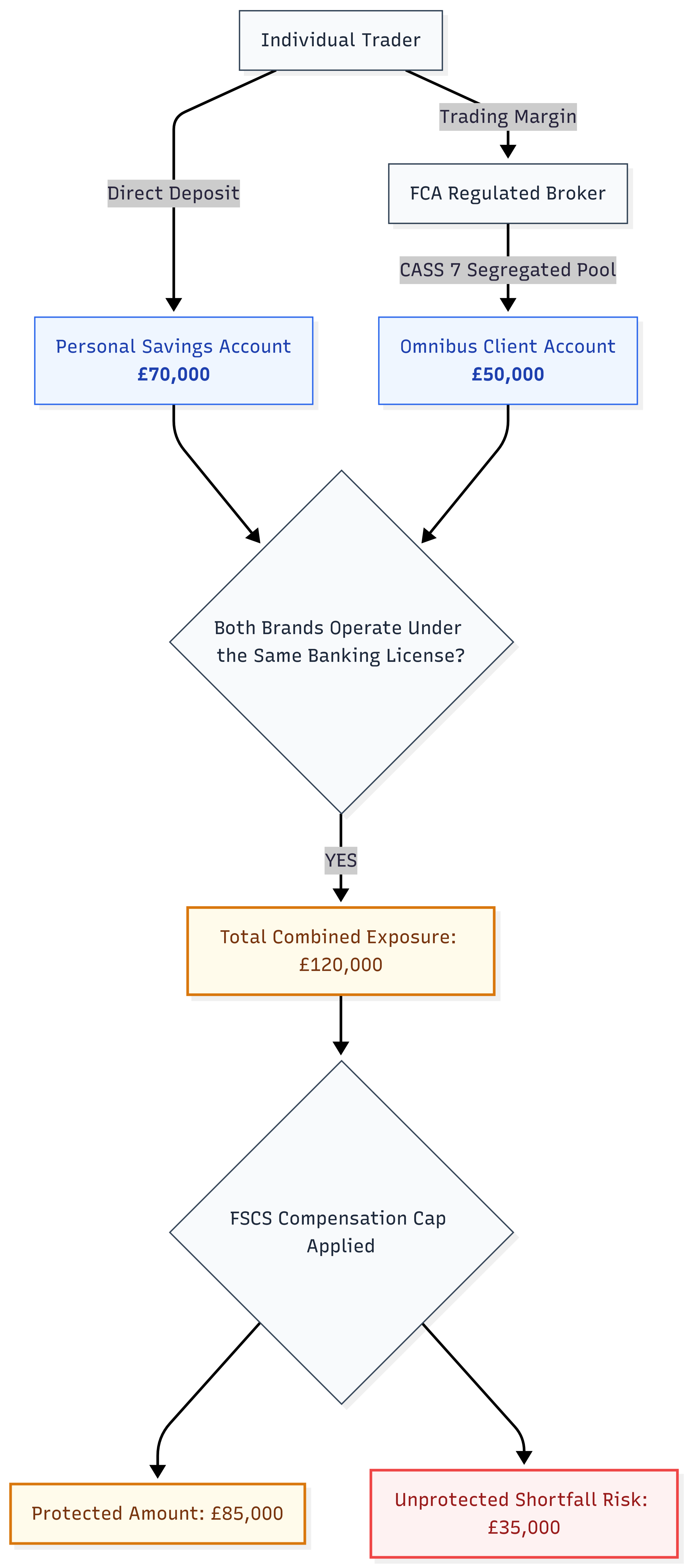
For example, £70,000 in a personal savings account and £50,000 in broker client money held at the same banking institution could, in a failure scenario, be treated as a single £120,000 exposure. Only £85,000 would be protected under FSCS deposit rules.
There is also an additional layer of operational risk. In rare cases where a third-party bank holding client money fails, FCA “client money distribution” rules can require pooling and allocation of shortfalls across affected clients. While this is uncommon and heavily regulated, it highlights that UK broker segregation reduces a certain aspect of counterparty risk, but does nothing to address concentration risk in the banking system.
The key takeaway is that protection depends not just on how many accounts you hold, but on which banking licenses ultimately sit behind them, and that both your trading account money and personal bank account money are relevant in this evaluation.
A trader might think they are safe if they limit the money kept in each broker account to below £85,000 and transfer everything else to their personal bank account. In reality, this diversification might turn out to be just an illusion. If the brokers and the client are using the same bank or are using different bank brands that ultimately operate under the same bank license, the risk is concentrated.
You can read more about this in our FSCS double banking trap article.
See also CASS 7 – Diversification of client money, especially CASS 7.13.22R and CASS 7.13.23G.
EU/EEA
Within the European Union (EU) and European Economic Area (EEA), brokers are governed through national regulators acting within the EU framework. One example of an important act is the Markets in Financial Instruments Directive II (MiFID II), a major European Union regulatory framework governing investment firms, trading venues, and financial markets. It came into force on 3 January 2018, replacing the original MiFID framework. In addition to MiFID II, there are also other directives and regulations to consider, such as the Financial Collateral Directive (2002/47/EC) and Markets in Financial Instruments Regulation (MiFIR).
This means that a Cyprus broker licensed by CySEC, a German broker licensed by BaFin, and a Swedish broker licensed by FI do not all sit under identical national processes, but they operate under the same broad European investment services structure.
MiFID II regulates client money segregation and safeguarding of assets mainly through its organizational requirements for investment firms, set out in the MiFID II Level 1 Directive and the MiFID II Level 2 Delegated Directive (EU) 2017/593.
Under Article 16(8) and 16 (9) of MiFID II (Directive 2014/65/EU), investment firms must take adequate arrangements to safeguard clients’ ownership rights, prevent use of client assets for the firm’s own account, and prevent loss or misuse of client money and instruments. This is the legal foundation for the segregation rules. The segregation rules stipulate that client funds must be held in segregated accounts that are identified separately from firm accounts and held with credit institutions, central banks, or qualifying money market funds. Firms must keep accurate books and records showing ownership at all times, perform frequent reconciliations between internal records and third-party accounts, and ensure client money is not used for proprietary trading or firm liquidity.
Firms must also exercise care and skill when selecting banks or custodians, and periodically review those institutions’ risk and stability.
To find the nitty-gritty operational details, we must look into the Delegated Directive (EU) 2017/593. This is where we find rules for the practical segregation mechanics, e.g. the rules that stipulate that client money must be held in trust or equivalent arrangements under national law, and the rules that specify things such as reconciliation frequency, escalation procedures for discrepancies, and safeguards when using third-country custodians.
MiFID II sets a harmonised EU minimum standard, but is largely principles-based at Level 1, and the exact implementation details can vary by member state. Delegated Directive (EU) 2017/593 is materially less principles-based and significantly more detailed than MiFID II Level 1. It reduces Member State discretion, but it does not eliminate it entirely.
Investor Compensation Schemes (ICS)
Compared to the UK FSCS ceiling of £85,000, most EU/EEA members have considerably lower ceilings for their investor compensation schemes (ICS).
Under the Investor Compensation Scheme Directive (Directive 97/9/EC), every member state is required to operate an ICS that provides a minimum level of protection for retail investors in the event that an investment firm is unable to return client money or financial instruments. The minimum threshold is €20,000 per eligible investor per firm. This is the regulatory floor, and some members have elected to have a more generous ICS, but a majority of the members have placed the compensation ceiling at or just above €20,000 or the equivalent in national currency.
You can find more information about investor compensation schemes in the EU/EEA in our article: The EU Broker Passporting Paradox: Mapping Structural Shortfalls in Cross Border Investor Guarantees.
Kenya
In Kenya, client money segregation is regulated primarily through the Capital Markets Authority (CMA) under the Capital Markets Act (Cap. 485A) and the Capital Markets (Conduct of Business) (Market Intermediaries) Regulations, 2011, as well as related CMA guidelines for licensed intermediaries such as brokers and fund managers.
The Capital Markets Act itself does not set detailed client money segregation mechanics, but it gives the CMA the legal power to regulate intermediaries and issue binding regulations. One of these binding regulations is the Capital Markets (Conduct of Business) (Market Intermediaries) Regulations, 2011.
In Kenya, client money segregation is enforced through CMA regulations requiring licensed intermediaries to hold client funds in separate, identifiable accounts, maintain accurate client-level records, and avoid any commingling or misuse of funds. Client money must be maintained by approved financial institutions, and clearly recorded so each client’s entitlement can be identified at all times.
For more information, see Regulations 28–30 of Capital Markets (Conduct of Business) (Market Intermediaries) Regulations, 2011. Regulation 28 (Client’s funds) establishes the legal trust status of client money and ring-fences it from the insolvency risk of the firm. Regulation 29 ( Segregation of clients’ funds) creates a strict framework for operational segregation, reconciliation, and bank acknowledgment. Regulation 30 (Accounting for and use of clients’ funds) restricts the use of client money to client-related settlement purposes only, preventing proprietary use. There is also Regulation 31, which extends the mandatory segregation beyond cash into full asset custody protection.
ICF – The Investor Compensation Scheme In Kenya
Kenya does have an investor compensation scheme, but it is much more limited in scope and scale than the ones in the EU/EEA. Kenya operates the Investor Compensation Fund (ICF) under the Capital Markets Act (Cap. 485A), administered by the Capital Markets Authority (CMA).
The statutory limit is KSh 50,000 per investor per defaulting intermediary. It is thus a useful backstop chiefly for Kenya’s emerging nano and micro traders. It is also important to note that compensation is not sovereignly guaranteed by the Kenyan government. The scheme operates as a pooled industry-funded mechanism, and its ability to meet claims depends on the resources available within the fund. As a result, there is no absolute assurance that sufficient funds will be available to satisfy all eligible claims. This makes proper segregation of client money (and other assets) even more important for trader safety.
Vanuatu
In Vanuatu, client money segregation exists as a general regulatory expectation enforced through licence conditions, requiring the separation of client and firm funds and proper record-keeping. However, the framework is comparatively vague and does not prescribe the same detailed operational custody and reconciliation architecture as the ones we find in Tier 1 trader protection jurisdictions, such as the UK, or Tier 2 jurisdictions, such as Kenya.
Vanuatu is generally considered a Tier 3 jurisdiction when it comes to trader protection (it’s ‘red tier’ in our regulator bandings), and is typically a place that brokerage companies register in when they want a high degree of flexibility, e.g. when it comes to offering very high leverage to retail clients. But clients who agree to sign up with a broker regulated in a Tier 3 jurisdiction will lose many of the stringent client fund protection rules and mechanisms that exist in Tier 1 and Tier 2 jurisdictions.
This does not mean that Vanuatu does not have any client money segregation rules. But the framework is materially different, since client money segregation is handled chiefly through licensing rules and requirements, and not through precise and detailed legislation. The Vanuatu Financial Services Commission (VFSC) has broad discretionary powers in how it regulates and supervises licensed brokers, especially compared with more prescriptive regulators such as the FCA in the United Kingdom or ASIC in Australia.
Under the Financial Dealers Licensing Act (CAP 70), the VFSC is empowered to grant licences, impose conditions on those licences, vary or revoke conditions, and supervise ongoing compliance. A key feature of this framework is that licensing conditions are not always uniform across all brokers. Instead, the VFSC can tailor requirements depending on factors such as the broker’s business model, risk profile, ownership structure, client base, jurisdiction of operation, and compliance history.
In practice, this means that two VFSC-licensed brokers may operate under meaningfully different regulatory expectations. One broker may be subject to more detailed reporting obligations, enhanced oversight, or stricter operational conditions, while another may face fewer or less detailed requirements. This regulatory approach is therefore largely “firm-specific” and supervision is implemented through individual licence conditions rather than a single, highly detailed, universally applied rulebook.
However, this discretion is not unlimited. The VFSC must still operate within the boundaries of its enabling legislation and broader financial integrity requirements. It cannot simply waive core obligations or act outside its statutory authority, but it does have significant flexibility in how those obligations are expressed and enforced at the firm level.
From a client money segregation perspective, this structure has important implications for traders using VFSC-licensed brokers. Unlike regimes such as the UK or Australia, where client money rules are highly codified and uniform (for example, detailed custody, reconciliation, and bank eligibility rules), Vanuatu requirements are generally more vague and implemented through licensing conditions set by the VFSC rather than by a single, granular regulatory framework. This means that the exact strength and operational detail of client money protection can vary between brokers depending on their specific licence conditions and compliance arrangements.
As a result, the robustness of client money segregation in Vanuatu is more dependent on the individual broker’s implementation practices, banking arrangements, and compliance culture than on a consistently applied regulatory template. Some brokers may adopt strong internal safeguards and use reputable banking institutions, while others may operate under less stringent arrangements permitted within their licence conditions.
For traders, this variability is important because it means that “VFSC regulation” does not necessarily equate to a uniform level of client money protection across all firms. The absence of highly prescriptive, standardized custody rules increases reliance on broker-level practices rather than regulator-defined operational controls. In other words, client money safety in this environment is more heterogeneous and depends more heavily on the specific broker chosen, rather than on a tightly standardized regulatory framework that applies identically across the jurisdiction.
ICS
Vanuatu does not have a statutory Investor Compensation Scheme (ICS). Therefore, investor protection relies even more heavily on segregation of client funds, licensing requirements, and regulatory supervision. If a VFSC-licensed broker fails, clients may have claims against the broker or its estate, but there is no government-backed or industry-funded compensation scheme that covers eligible losses up to a specified limit.
Where Is Your Legal Counterpart Regulated? The Importance Of Jurisdiction
As we have touched on several times, applicable legislation is extremely important when we try to evaluate exactly how well our trading account money is protected. Because of this, it is also extremely important to know where your broker is regulated and which law will regulate your contract.
In this context, it is important to keep in mind that global broker brands tend to operate through a network of different companies registered in different jurisdictions. Under the marketing umbrella of a specific brand, we can, for instance, find an FCA-regulated UK company, a CySEC-regulated Cypriot company, an ASIC-regulated Australian company, and various companies in jurisdictions that offer more lax broker legislation, such as the Seychelles, Vanuatu, and the Bahamas. There can also be companies within the company group that are not even licensed as brokers and that exist to fulfil other tasks, e.g. technical solutions and asset holding.
You might enter through a global website, download a global trading platform, and deal with a unified customer service. But exactly which client money rules are in place will depend on which one of all these companies you sign up with. You being a resident of Australia does not guarantee that you will be funneled to an ASIC-licensed company, so it is important to pay attention and never approve a user agreement or other contract without knowing who the legal counterpart is.
Global brands tend to be very happy to plaster their Tier 1 licenses prominently over their main site and in their marketing material. So, you will see clearly that there is a UK FCA license, an Australian ASIC license, and a CySEC license (probably called an EU license). But you are not protected by the financial authorities showcased on the site. You are protected by the authority that regulates your contractual counterpart. And if that authority offers weak trader protection, that’s what you get, even if you happen to live in the UK, Australia, or the European Union. When it comes to client fund segregation, a trader in London onboarded to the FCA-licensed entity is in a different position from a trader in London onboarded to a Vanuatu entity of the same brand.
It is important to remember that a global brokerage brand operating through multiple legal entities in different jurisdictions is normal and is not by itself a red flag. It is a structural requirement driven by licensing law, regulatory perimeter rules, and client protection frameworks that differ across jurisdictions. Typically, each jurisdiction requires firms that solicit clients or provide regulated services within its territory to be legally present in the country, obtain a local license, and comply with local rules.
As a result, firms must create local companies or branches to legally serve clients in different jurisdictions. It is often the regulators who demand separation, rather than broker brands actively trying to weasel out of their obligations by running multiple companies. For instance, rules on client asset segregation, capital adequacy, and insolvency protection often assume that client money is held within a locally regulated entity, not pooled globally across a multinational group. Keeping entities separate helps ensure that client protections apply cleanly within each legal system and that insolvency can be handled locally under the relevant national law.
A Few Words About “Offshore” Jurisdictions
Vanuatu, the Seychelles, British Virgin Islands (BVI) are just a few examples of so-called “offshore locations” where it is comparatively easy to form a company and both obtain and maintain a broker license. Typically, the financial authorities in such locations also have greater discretionary powers to tailor each license to the applicable firm. This increases flexibility, but also becomes a structural weakness when it comes to trader protection.
In many offshore regimes, also known as Tier 3 regimes when it comes to trader protection, the combination of tailor-made license agreements, lighter supervision, and weaker enforcement creates an environment in which brokers have great powers to privately interpret exactly what they mean when they claim “client money segregation” in their marketing. Combined with non-existing or very limited investor compensation schemes, this establishes a risky situation for traders who keep more than insignificant amounts of cash in their trading accounts.
Common reasons why traders choose offshore entities are higher leverage, looser onboarding, and access to products not allowed in their home country. That trade may be deliberate, but it is important to understand both the pros and the cons before you put your money on the line.
Statutory Trusts Vs. Ordinary Operational Pools
Jurisdictions with strong client money protection rules typically require brokers to hold client funds in designated client money accounts that are segregated from the firm’s own funds.
One example is the United Kingdom, where client money is generally governed by the Financial Conduct Authority (FCA) Client Assets Sourcebook (CASS). CASS 7 is the section that sets out the rules for the handling, segregation, and protection of client money by investment firms.
A simplified structure is as follows:
![[ Client Deposit ] │ ▼ [ Segregated Omnibus Client Money Account ] │ ▼ [ Approved Bank or Credit Institution ]](https://www.daytrading.com/wp-content/uploads/2026/07/Broker-Client-Money.png)
The term ‘omnibus account’ matters. An omnibus account is a single account that holds assets or money belonging to multiple clients, while the broker keeps internal records showing how much belongs to each individual client. Each client does not have a separate bank account in their own name. Instead, the broker holds one or more pooled client money accounts, with internal records showing how much belongs to each customer. The broker must maintain accurate records showing each client’s entitlement to the funds held in that account.
Under the UK client money regime, client money received by a firm is generally held on a statutory trust created by the CASS rules. The firm has legal control over the account and administers the money, but it does so subject to trust obligations for the benefit of clients.
In jurisdictions where brokers are permitted to hold client funds as part of their own operating cash rather than in segregated client money accounts, the legal position is materially different. In such arrangements, the broker may have legal ownership of the funds and can use them in the ordinary course of business, subject to any applicable regulatory restrictions. The client typically does not retain a proprietary interest in a segregated pool of funds. Instead, the client generally has a contractual claim against the broker for repayment of the amount owed. If the broker becomes insolvent, client funds may form part of the broker’s insolvency estate, and clients may rank as unsecured creditors alongside other creditors, unless specific legal protections apply.
As always, having rules on the books is not enough. The existence of regulatory rules alone is not sufficient to ensure effective protection of client funds. Where brokers are subject to limited supervision or weak enforcement, deficiencies in the handling of client money may persist undetected for extended periods. Such issues often only come to light during periods of financial distress or upon the insolvency of the firm, when reconciliation processes and external audits expose shortfalls or improper fund management.
Client Classification Can Matter
In some jurisdictions, client classification is relevant to the level of investor protection and, in some cases, the application of client money safeguarding rules and investor compensation schemes. When protections differ, it is usually retail clients who receive the highest level of regulatory protection. Professional clients and eligible counterparties may have reduced protections, depending on the regulatory framework and contractual arrangements, including in relation to disclosures, risk warnings, and access to investor compensation schemes.
In many jurisdictions that are considered Tier 1 when it comes to trader protection (i.e. very strong trader protection rules), client money segregation is broadly status-neutral, and firms must segregate client money regardless of trader classification. This is, for instance, the case in the UK under FCA CASS, in Australia under ASIC rules, and in the EU under MiFID II. (Note: There can be differences when it comes to Title Transfer Collateral Arrangements. You can read more about TTCAs further down in this article.)
The United States is an example of a country where client classification is more important in this context because it determines the level of regulatory protection and the types of financial arrangements a client is permitted to enter into, particularly in derivatives and OTC markets. But it is less about whether client funds are segregated in basic securities accounts and more about whether a person is treated as a “protected customer” under specific regulatory regimes. Unlike the EU framework under MiFID II, where client classification mainly affects conduct of business rules rather than core asset segregation requirements, the US system uses classification more fundamentally to determine whether a client is within the protected retail framework or can be treated as a sophisticated counterparty capable of opting into reduced regulatory protections.
In the securities context, broker-dealers are subject to the SEC’s customer protection framework, including Rule 15c3-3, which requires customer cash and securities to be held in segregated customer reserve accounts. Rule 15c3-3 applies customer protection and segregation requirements based primarily on regulatory customer status and account structure, rather than sophistication alone. While retail vs. institutional classification is generally not determinative, certain institutional or dealer relationships may fall outside the customer protection framework, meaning classification can matter indirectly in edge cases.
Classification becomes much more important in derivatives markets regulated by the Commodity Futures Trading Commission. Here, classification into categories such as retail customers versus eligible contract participants determines the level of regulatory protection that applies. Eligible contract participants, typically large institutions or high-net-worth entities meeting specific thresholds, are permitted to access more lightly regulated OTC derivatives markets and may waive certain protections that would otherwise apply to retail clients. Retail clients, by contrast, are subject to stricter safeguards, including full segregation of customer funds in futures accounts and more prescriptive regulatory oversight. For more information, see the CFTC customer funds segregation regime for futures commission merchants (FCMs) under the Commodity Exchange Act and implementing regulations.
Key provisions are in 17 CFR Part 1, Subpart B (Segregation of Customer Funds), especially §1.20.
17 CFR § 1.20 (Customer Funds Segregation – Futures Accounts) is the core rule reflecting that customer funds in futures accounts must be held in segregation and protected from commingling or use for the firm’s own purposes, subject to the CFTC’s customer protection framework for retail futures customers.
True Segregation Vs. The Hedging Loophole
Not all segregated money stays cleanly segregated. In both examples below, the broker will happily claim “client fund segregation” in their marketing. But when we look at the details, we see two very different scenarios.
Example 1:
The broker maintains the full value of client money in the client money pool, subject to permitted withdrawals, settlement movements, fees, losses, and client instructions. The broker may hedge its exposure, but it does that with its own capital and does not involve client money.
Example 2:
The broker passes client margin capital to a liquidity provider, prime broker, or wholesale counterparty. The broker describes this as part of its hedging, liquidity, or settlement process. From the trader’s perspective, the danger is that money that looked like protected client cash is becoming exposed to another institution in the chain.
Example 2 is known as the “hedging loophole”. In practical terms, it is often executed via Title Transfer Collateral Arrangements (TTCAs). When a trader signs an agreement containing a TTCA clause, legal ownership of the capital transfers entirely to the broker. The funds cease to be “Client Money” and become an asset on the broker’s balance sheet.
TTCA structures can change the nature of client protection and introduce counterparty risk. Under a TTCA, legal ownership of posted collateral transfers to the broker or receiving counterparty, and the client typically becomes an unsecured creditor rather than retaining a proprietary claim to segregated assets. As a result, if the broker remains solvent but a downstream counterparty (such as a liquidity provider or prime broker) fails, or if an intermediary in the collateral chain becomes insolvent, the client may still be exposed to loss depending on how the arrangement is structured and how exposures are booked and managed.
You still see your balance in your trading account, but that balance may now reflect contractual entitlements rather than directly segregated assets. In insolvency, the amount you can recover will depend on the legal positions of the relevant counterparties and the applicable insolvency and priority rules.
Can My Broker, Who Is Licensed By An EU-Country, Do A TTCA With The Money In My Retail Account?
Within the European Union, TTCA arrangements are not permitted as a way to take ownership of retail client money under MiFID II investment services in the same way they are used in wholesale OTC markets.
MiFID II Article 16(10) specifically states that an investment firm shall not conclude title transfer financial collateral arrangements with retail clients for the purpose of securing or covering present or future, actual or contingent or prospective obligations of clients.
Under EU law, the key distinction is which legal regime applies to the relationship. For retail clients receiving investment services under MiFID II, firms are subject to MiFID II client asset protection rules. Those rules require that client funds and financial instruments be safeguarded and effectively treated in a way that preserves the client’s proprietary protection and segregation from the firm’s own assets. In that context, firms cannot freely recharacterise retail client money as their own balance sheet funding in a way that undermines those protections. So, while contractual arrangements exist in finance generally, MiFID II compliance eliminates the use of TTCA structures for retail client money.
By contrast, TTCA is explicitly recognized and permitted under the Financial Collateral Directive (2002/47/EC), but that regime is primarily designed for wholesale financial markets, such as OTC derivatives between professional counterparties, repo transactions, and interbank collateral arrangements. In those contexts, title transfer is a normal and legally enforceable mechanism, and the client (or counterparty) accepts that legal ownership of collateral passes to the receiving party.
Extended Due Diligence Before You Pick A Broker
If you plan on keeping more than an insignificant amount of money in your trading account, putting some time and effort into an extended due diligence before you pick a broker is strongly recommended. Simply reading a Trustpilot review and noticing that the broker has a regulation badge on its site is not enough for larger balances.
A proper due diligence should cover three areas:
- The broker entity
- The client money treatment
- The banking chain
The Legal Entity, Where It Is Regulated, And Its License
Start with the legal entity. Find the exact company name in your client agreement. Then search that entity on the official regulator register. Do not rely on the homepage footer alone. Broker groups often list several license holders, and the prestigious one written in bold print may not be the one serving your account.
For a broker licensed by FCA, check the FCA register, for a broker licensed in Australia, check the ASIC register, and so on. Then, follow the exact link provided in the register to get to the official broker website, to make sure you end up on the correct official page and do not sign up with a clone or other type of scam.
Client Money Disclosure
Next, read the client money disclosure. Does the broker explain whether money is held in segregated client accounts, which banks may be used, whether interest is retained, what happens on default, and whether money can be transferred to third parties? If the disclosure is vague, that is a finding in itself.
Generally speaking, the weaker the regime, the more important the client money disclosure document becomes. In a strict regime such as the United Kingdom or Australia, all licensed brokers must adhere to a very granular legal framework when it comes to client money segregation. In more flexible jurisdictions, more discretionary powers tend to be given to the financial authority and the individual brokerage companies.
As a part of your due diligence, you can write and ask the broker directly: “Which banks hold client money for my account entity?”
A serious broker should be able to answer, or point you to a public client asset disclosure. Some may not name every bank for security or operational reasons, but they should explain the policy, including the tier of banks, diversification, reconciliation, treatment of client money, and whether retail margin can be passed to counterparties.
Banking
Finally, map your own banking footprint. List every bank where you hold meaningful cash. Then group them by banking licence, not brand. Use official compensation scheme checkers and regulator registers. That one exercise can reveal a risk you did not know you had.
In the UK, the FSCS provides a bank and savings protection checker that uses FCA register data and allows consumers to check whether deposits may share protection under the same firm.
A Simple Client Money Risk Checklist
Use this checklist if you consider keeping more than an insignificant amount of money in a trading account.
| Question | Good answer | Example of risky answer |
|---|---|---|
| Which legal entity holds my account? | A named company regulated in a strong jurisdiction. | “We are globally regulated” with no clear account entity. |
| Are funds held under client money rules? | Yes, under a named regulatory framework such as FCA CASS, MiFID II national rules, or ASIC client money rules. | “Segregated for your safety” with no reference to a specific rule. |
| Can retail client money be used for hedging or working capital? | No, or only in circumstances tightly restricted by law and company policy. | Vague wording that allows transfers to counterparties or the use of client money as collateral. |
| Which banks hold the client money? | Named banks or a clear policy covering approved credit institutions and diversification across institutions. | No disclosure, no documented policy, or no useful answer. |
| Is compensation available if the broker fails? | A clearly identified compensation scheme and coverage limit, such as FSCS investment protection of up to £85,000 for eligible UK investment claims. | No compensation scheme, reliance only on private investor insurance, or an offshore claims process. |
| Could my personal bank be part of the same banking group that holds the broker’s client money? | The overlap is checked and managed across banking licences and legal entities. | The broker does not know or cannot provide an answer. |
| Are client money records independently audited? | Yes, under regulatory audit requirements or through published audited financial statements. | No clear audit requirement or independently verifiable audit trail. |
Questions To Send Your Broker
Here is an example of questions that can be included in an email to a broker you are considering using. Be suspicious if the reply you get is filled with vague sales language rather than precise legal answers. Serious compliance teams are not marketers. You want answers that are comprehensive, clear, and consistent with the legal documents.
“To Broker XYZ
Before I make my first deposit into my account, please answer the following for the legal entity that will hold my account:
- What is the full legal name of the legal entity that will hold my account? Where is this entity registered and regulated? What is the regulatory license number of the entity, and what is the name of the licensing body? Which country’s laws govern the account agreement, and where would any disputes be resolved (courts, arbitration, or other dispute resolution mechanisms)?
- Which client money rules apply to my account?
- Will my funds be held in segregated client money accounts?
- Can retail client money be used for hedging, working capital, margin with liquidity providers, or collateral?
- Which banks or types of banks are used for client money accounts?
- Is client money is diversified across more than one banking institution?
- How will client money be treated if the broker fails?
- How will client money be treated if a client money bank fails?
- Is client money covered by any investor compensation scheme (ICS)? Is so, which one, and what are the compensation limits? Will I, who lives in country XYZ, be covered by the scheme?
- Does the account agreement grant the broker any title transfer rights, liens, rights of set-off, security interests, rehypothecation rights, or other claims over assets held in my account? If so, under what circumstances?”
How To Read Broker Client Money Disclosures
Look for the section titled “client money”, “client assets”, “custody”, “safeguarding”, “risk disclosure”, or “terms of business”.
You want to know five main things.
- Does the broker state that client money is held separately from firm money?
- Does it name the governing rules, such as FCA CASS, MiFID-derived local rules, or ASIC client money requirements?
- Does it say where money may be held? This can include banks, qualifying money market funds, intermediate brokers, clearing houses or settlement agents.
- Does the broker retain interest on client money? This is not necessarily dangerous, but it shows how cash is being handled.
- Does the document allow title transfer, set off, lien, security interest, or transfer of client money to a third party? For retail accounts in strong regimes, these powers are typically narrow. For professional clients, and for all clients in laxer regimes, they tend to be wider. The words to watch are not always dramatic. Phrases like “we may transfer”, “you agree that”, “as collateral”, “title passes”, “security interest”, “set off”, “third party”, “margin provider”, and “intermediate broker” deserve attention.
How Much Money Should I Keep With A Broker?
There is no universal number. It depends on your personal financial situation, trading strategy, margin needs, withdrawal speed, bank limits, tax setup, and account protection.
Traders often leave idle cash at brokers because it is convenient or because there is a withdrawal fee, but it does increase risk. The safer habit is to keep only the capital needed for trading and risk buffer at the broker, while holding surplus cash at banks or government-backed savings products under separate banking licences.
For a larger trading bankroll, consider splitting the money across more than one well-regulated broker and more than one banking licence. Some sophisticated traders also split their capital over more than one jurisdiction, but only do so if you understand the pros and cons, and how to avoid creating an operational mess.
Red Flags In Client Fund Protection Claims
- When the broker offers very high leverage through an offshore entity while claiming “segregated funds”, especially if the broker gives little detail on the actual client money rules.
- When the broker is vague about which legal entity you are contracting with.
- When the broker says it is “regulated by the FCA” but your user agreement names a company outside the UK, and so on.
- When the broker gives generic assurance but will not explain where and how client money is held.
- When private insurance is presented as equal to a statutory compensation scheme. Private insurance may help, but it has exclusions, claim limits, policy terms, and insurer risk.
- When the broker’s client money terms allow broad transfer of funds to counterparties.
- When withdrawal delays are brushed off as “banking issues” for weeks. Banking issues happen. Persistent withdrawal friction is different.
The Safest Broker Is Not Always The Biggest Brand
Large broker brands can be safer if they have more capital, better systems, and stronger audit functions. But a broker being large and well-known is not the same as actual legal protection.
A large broker group may still route some clients to offshore entities, it may still hold client money at banks that overlap with your own deposits, it may still use broad contractual rights for professional clients, it may still have complex intra-group arrangements, and so on.
The safest setup is usually a combination of:
- A legal entity that is authorized to be active in your home jurisdiction if you live in a Tier 1 or Tier 2 jurisdiction.
- A strict regulator.
- Clear client money treatment.
- Transparent banking arrangements.
- No avoidable banking licence overlap.
- A compensation scheme that fits your account size.
- Clean terms that do not transfer ownership of retail money to the broker or its counterparties.
What “Segregated Client Funds” Does Not Protect Against
Sometimes, brokers promote the amazing safety provided through “account segregation” and “investor protection schemes” so heavily that very inexperienced traders become confused and think their money is somehow safeguarded from market risk as well. That is very much not the case. None of these things will protect an account from things such as bad trades, slippage, overnight gaps, spread widening, liquidation, stop out, platform downtime, market closures, or currency conversion.
There is also no guarantee that a broker is high quality in other ways, just because the client money segregation is done well and your account is covered by an investor protection scheme. There can still be conflicts of interest, weak execution, excessive fees, and so on.
Account segregation and investor protection schemes will also not ensure that your money comes back instantly as soon as the brokerage company begins experiencing financial difficulties. Even after insolvency has been formally declared, there are several steps left before client funds are sent back to their rightful owners. And if your balance includes things such as unrealized profits, bonus credits, open position value, or non-cash adjustments, the insolvency treatment may not be as simple as you want it to be.