





The EU passporting system allows certain financial firms, including trading brokers, that are authorized in one EU/EEA country to provide services throughout the EU/EEA without obtaining a separate full license in each member state.
While this gives traders access to a wider range of brokers, it does not provide uniform protection in the event of a broker’s insolvency or failure to return client assets. Investor Compensation Schemes (ICS) continue to operate primarily at the national level, and they are not uniform.
Although these schemes must satisfy certain minimum requirements under Directive 97/9/EC, they are not fully harmonized. Member states retain considerable discretion regarding matters such as coverage limits, eligibility criteria, exclusions, claims procedures, and scheme administration. As a result, an investor’s access to compensation may depend significantly on the national scheme applicable to the account.
This is a point many retail investors overlook. They often treat “EU-regulated” as a single badge and assume that investor protections are identical regardless of which EU/EEA regulator authorized the broker. In reality, important differences remain between national compensation schemes despite the common EU/EEA framework.
Below, we examine how and why using a broker authorized in another EU/EEA country can affect your investor compensation protection, both positively and negatively.
Understanding The EU Passporting System For Financial Firms
The EU passporting system allows certain financial firms that are authorized in one EU/EEA country to provide services across the rest of the EU/EEA without needing a full separate license in each country.
For applicable brokers and investment firms, passporting is primarily based on the rules in MiFID II.
Example: A broker licensed in Sweden and authorized by Finansinspektionen can often offer services to clients in Germany without first obtaining a complete German license from BaFIN. But the broker still has to go through the passporting process, which includes notifying Finansinspektionen (home regulator), which then coordinates the passporting with BaFIN (host regulator).
The two main paths for passporting are cross-border service and branch passport:
- Cross-border service. The broker serves customers in another EU/EEA country directly from its home country. In the example above, the Swedish brokerage company would serve clients in Germany from Sweden. No office in Germany is required.
- Branch passport. The broker establishes a branch in the host country. In the example above, the Swedish brokerage company would set up a branch and a branch office in Germany. ‘
Who Supervises A Passported Broker?
The basic principle is home-state supervision. The regulator where the broker is licensed remains the primary supervisor, but the host-country regulators have certain powers regarding local conduct, consumer protection, and anti-money-laundering requirements. For example, if a broker is licensed in Sweden, the main prudential supervisor would be Finansinspektionen, even when serving customers in Germany. This also means that only activities covered by the firm’s home-state authorization can be passported.
The Difference Between The Banking Deposit Guarantee Scheme (DGS) And The Investor Compensation Scheme (ICS)
Before we proceed, we need to get this step out of the way, because it is one that often causes confusion and a false sense of security for traders.
The mandatory national deposit guarantee scheme (DGS) within the EU/EEA is not the same thing as the mandatory national investor compensation scheme (ICS).
A national Deposit Guarantee Scheme (DGS) protects cash deposits held by an eligible client at an eligible bank if the bank itself fails. The protection is up to €100,000 per depositor, per bank, across the EU/EEA under harmonized rules. Some countries even guarantee more than €100,000 under certain circumstances.

Unfortunately, many traders mix up the DGS with the ICS, and believe the assets they keep in their trading account within the EU/EEA are also protected up to €100,000. So a trader in France, Germany, Ireland, Sweden, or Spain opens an account with a broker licensed in any of the EU/EEA countries and thinks: “Great. It is an EU/EEA entity. I’m automatically covered up to €100,000.”
The truth is that the ICS cap is considerably lower, and the rules for how large a percentage of your loss that can be compensated by the ICS also differs between different countries. If your broker fails after having broken the client money segregation rules, and there is not enough money left to pay back the account holders in full, it will suddenly become very important to know exactly which national ICS covers your account, if any.
Article 4(1) of Directive 97/9/EC stipulates that the national ICS coverage must be at least 90% of the eligible claim, with a minimum of €20,000 per investor. That is very far from covering 100% of an eligible claim up to €100,000, which is the requirement for the national DGS under Directive 2014/49/EU on deposit guarantee schemes (DGS Directive). More precisely, the European Banking Authority states that deposit protection in the EU is harmonized at €100,000, or the equivalent in local currency.
These two protections are often confused because both are mandatory safety nets in EU/EEA financial systems, but they protect different assets against different risks, and they have very different floors when it comes down to actually getting paid.
The National Deposit Guarantee Schemes (DGS) In The EU/EEA
These national banking guarantee schemes protect cash deposits held at a bank if the bank itself fails. They cover money in current accounts, savings accounts, and many term deposits. The protection required by Directive 2014/49/EU on deposit guarantee schemes (DGS Directive) is generally up to €100,000 (or the equivalent in local currency) per depositor per bank.
The DGS becomes relevant when an eligible bank becomes insolvent and cannot return customer deposits. The compensation is paid by the national deposit guarantee scheme, which is ultimately backed by the applicable state.
Example:
- You hold €40,000 in a savings account at a bank. The bank collapses. The deposit guarantee scheme reimburses you in full because your money was a bank deposit, and €40,000 is below €100,000.
- You hold €120,000 in a savings account at a bank. The bank collapses. The deposit guarantee scheme reimburses you with €100,000 because that is where the harmonized cap is.
The National Investor Compensation Schemes (ICS) In The EU/EEA
These national investor protection schemes protect financial assets held through a covered firm or broker when the firm fails to return assets or money that belong to clients.
Under the EU Investor Compensation Scheme framework (Directive 97/9/EC), the key trigger is not “firm failure” in the strict corporate-bankruptcy sense, but “inability to return client assets or money” due to a protected failure event.
ICS can pay out even if the firm is still legally alive, as long as it is unable to return client funds or financial instruments. The legal trigger is the inability of an investment firm to meet its obligations to investors. For more information, see Directive 97/9/EC, Article 2(2).
- You keep €40,000 in a brokerage account covered by a national ICS. The broker collapses and cannot return your money because client assets are missing. The ICS kicks in, but the relevant national ICS only covers 90% of your claim, up to a maximum of €20,000. Your claim is €40,000. 90% of €40,000 is €36,000. You get only get €20,000 since that is where the cap is.
- You keep €20,000 in a brokerage account covered by a national ICS. The broker collapses and cannot return your money because client assets are missing. The ICS kicks in, but the relevant national ICS only covers 90% of your claim, up to a maximum of €20,000. Your claim is €20,000. 90% of €20,000 is €18,000. You get only get €18,000 since you can not get more than 90% of your eligible claim.
This means that when you move money from your bank account and use it to buy CFDs in your brokerage account, the scheme covering that money will change dramatically, even when both accounts are within the EU/EEA. Not only does the protection change from DGS to ICS, but it also changes from the much more harmonized DGS environment to the ICS environment, where protection can vary more significantly from one country to the next.
Understanding The ICS Background: The Minimum Of Directive 97/9/EC
The foundation for the EU/EEA National Investor Compensation Schemes (ICS) is the Directive 97/9/EC. This directive was adopted by the European Parliament and Council on 3 March 1997 and entered into force on 20 March 1997. Member States were required to transpose it into national law by 26 September 1998.
Directive 97/9/EC Did Not Establish Uniformity
The legal frameworks for the DGS are very different from those for the ICS. The purpose of Directive 2014/49/EU was specifically to harmonize DGS levels across the EU/EEA after the financial crisis of 2008, and all national DGSs in the EU/EEA are currently at the harmonized €100,000 level under normal circumstances. (Under certain temporary circumstances, the maximum payout is higher than €100,000 in certain countries).
The Directive 97/9/EC, on the other hand, did not create a uniform investor compensation level across the EU/EEA. Instead, it established minimum harmonization requirements. Member States must maintain an investor compensation scheme meeting the directive’s minimum standards, but they retain considerable discretion regarding the scheme’s institutional structure, funding arrangements, administration, eligibility rules, compensation mechanics, and the provision of protection above the EU minimum.
Article 4(1) of Directive 97/9/EC requires that compensation be at least 90% of the investor’s claim, subject to a minimum coverage level of €20,000 per investor. It is just a minimum requirement, and states may provide higher compensation percentages, higher compensation limits, and more generous protection generally.
The minimum-harmonisation approach of Directive 97/9/EC explains why investor compensation protection remains fragmented across the EU/EEA. While every state must maintain a scheme that satisfies the directive’s minimum requirements, the states retain significant discretion regarding coverage levels above the minimum, compensation methodology, institutional design, funding arrangements, and administrative procedures. As a result, investors may experience materially different outcomes depending on which national investor compensation scheme applies to their account.
Why Is The ICS Floor At €20,000? Why Is It Lower Than The DGS floor?
What we are dealing with here is Directive 97/9/EC, a directive that was developed and adopted in the late 1900s, when the European markets looked very different from today, especially when it comes to retail trading and investing through online platforms. Online retail trading was still in its infancy and cross-border digital onboarding was not really something that ordinary consumers would deal with. The directive set a minimum investor compensation floor of €20,000, which made sense at the time.
Using Eurozone inflation estimates (HICP/ECB-based), cumulative inflation from 1997 to 2026 is roughly 84% total price increase, meaning prices are about 1.84× higher today than in 1997. In real terms, the EU minimum ICS threshold has therefore lost significant real purchasing power. Despite this, a 2010 proposal to raise the floor from €20,000 to €50,000 was not approved. It was the European Commission who, in 2010, proposed to update the rules in response to complaints about how the directive was being applied. Under the new rules proposed by the Commission, investors would be compensated within nine months after the investment firm’s failure, and the level of compensation would increase from €20,000 to €50,000. As the proposal was not endorsed at the EU level, the Commission decided to withdraw it in March 2015.
Compare this to the Deposit Guarantee Scheme (DGS) rules, which have been updated several times, and now sit at €100,000. Under the old Directive 94/19/EC, the EU minimum guarantee was only €20,000 per depositor. Following the 2008 banking crisis, the EU adopted Directive 2009/14/EC, which required member states to raise protection to at least €50,000 immediately, and then raise it to a uniform €100,000 level by the end of 2010. By 31 December 2010, Member States had to ensure coverage of €100,000 per depositor per bank.
The ICS floor, on the other hand, has not been updated, and still remains at the €20,000 floor level set in 1997. It is easy to understand why traders who were used to both floors being at €20,000 assumed that the ICS was bumped up to €100,000 at the same time as the DGS.
So, why did the 2010 proposal to raise the floor for the ICS not go through? The proposal came from the European Commission, the executive branch of the European Union. In simple terms, the European Commission is a part of the EU that proposes laws, enforces rules, and manages day-to-day policies for the union. If the EU were like a country, the European Commission would be its executive branch / government administration, while the European Parliament would be its elected lawmakers.
When the European Commission made its proposal in 2010, the global financial crisis of 2008 had revealed weakness in financial safety nets, investor trust had been damaged, and the €20,000 baseline looked low. The Commission proposed changes that included faster compensation and a higher ceiling of €50,000. Under the proposed new rules, investors would have been compensated no later than nine months after the investment firm’s failure, and the floor level would have increased from €20,000 to €50,000.
There were several reasons the proposal failed to gain sufficient support. Member states had different domestic schemes, different financial sectors, different funding models, and different views on who should bear the cost of higher investor protection. A country with a conservative, bank-dominated investment sector may not see the same risk profile as a country hosting many cross-border brokers. A state with a large investment firm sector may worry about levy burdens. Raising a compensation floor sounds good, but somebody must fund it. Firms pay levies. Higher levies affect business models. Weak firms may resent paying for failures caused by other firms. Regulators may fear moral hazard if investors stop caring where they place assets. For a variety of reasons, the proposed reform stalled, and in 2015, the proposal was withdrawn.
This is why the EU/EEA has the split architecture that we see today. Banking deposits get a more harmonized 100% up to €100,000 protection. Investor compensation remains stuck around an older minimum and with much more national discretion.
The marketing phrase “EU-regulated broker” therefore hides three separate questions:
- Which legal entity (brokerage company) holds the account?
- Which member state is that entity licensed by?
- Which investor compensation scheme (ICS) applies to my account if I open an account with this entity?
ICS Throughout The EU/EEA
Here’s an alphabetical list of EU/EEA countries and their statutory investor compensation schemes based on Directive 97/9/EC. These limits apply only to eligible clients and eligible firms.
Important: This is just an overview to illustrate how ICSs can differ throughout the EU/EEA. Before you make any financial decision, research the relevant broker entity more thoroughly to confirm exactly which ICS would cover your account, which protections your account would have under current national regulation, and which exceptions might apply.
Also, remember that countries have the right to exclude certain clients from compensation, e.g. professional and institutional traders.
| Country | Main compensation rule |
|---|---|
| Austria | Compensation up to €20,000 per investor per institution. |
| Belgium | Compensation up to €20,000 per investor per institution. |
| Bulgaria | Pays up to 90% of the eligible claim, but not more than BGN 40,000 per investor per institution. |
| Croatia | Compensation up to €20,000 per investor per institution. |
| Cyprus | Compensation up to €20,000 per investor per institution. |
| Czechia | Pays up to 90% of the eligible claim, but not more than the CZK equivalent of €20,000 per investor per institution. |
| Denmark | Compensation up to €20,000 per investor per institution. |
| Estonia | Compensation up to €20,000 per investor per institution. |
| Finland | Pays up to 90% of the eligible claim, but not more than €20,000 per investor per institution. |
| France | Compensation up to €70,000 per investor per institution. |
| Germany | Pays up to 90% of the eligible claim, but not more than €20,000 per investor per institution. |
| Greece | Compensation up to €30,000 per investor per institution. |
| Hungary | Pays 100% of eligible loss up to HUF 1 million and 90% above that amount, subject to a statutory maximum compensation limit which is approximately €100,000 when converted. |
| Iceland | Compensation up to ISK 1.7 million per investor per institution. The ISK amount is fixed by reference to the EUR exchange rate of 5 January 1999. |
| Ireland | Pays up to 90% of the eligible claim, but not more than €20,000 per investor per institution. |
| Italy | Compensation up to €20,000 per investor per institution. |
| Latvia | Compensation up to €20,000 per investor per institution. |
| Liechtenstein | Compensation up to CHF 30,000 per investor per institution. |
| Lithuania | Compensation up to €22,000 per investor per institution. |
| Luxembourg | Compensation up to €20,000 per investor per institution. |
| Malta | Pays up to 90% of the eligible claim, but not more than €20,000 per investor per institution. |
| Netherlands | Compensation up to €20,000 per investor per investment firm. |
| Norway | Compensation up to NOK 200,000 per investor per institution. |
| Poland | Pays 100% of eligible loss up to €3,000 equivalent in PLN, and 90% above that amount, subject to a maximum total compensation equal to a statutory PLN-based cap which is approximately €20,100 when converted. |
| Portugal | Compensation up to €25,000 per investor per institution. |
| Romania | Compensation up to €20,000 per investor per institution. Payouts are converted to RON. |
| Slovakia | Compensation up to €50,000 per investor per institution. |
| Slovenia | Compensation up to €22,000 per investor per institution. |
| Spain | Pays up to 90% of the eligible claim, but not more than €100,000 per investor per institution. |
| Sweden | Compensation up to SEK 250,000 per investor per institution. |
The Co-Insurance Mechanics Of Certain ICS
As you can see in our list above, not every ICS in the EU/EEA repays 100% of an eligible claim, even if it is below the cap. Instead, many countries have opted to only repay 90%. This is known as co-insurance, and it is permitted under Directive 97/9/EC.
It’s called co-insurance because the risk is being shared, or “co-insured,” between two parties. With co-insurance, the insurer only covers part of the loss, and the insured person (or investor, depositor, etc.) covers the rest.
Example:
In Ireland, it is the Irish The Investor Compensation Company DAC (formerly known as the Investor Compensation Company Limited or ICCL) who is the compensation fund of last resort for customers of authorized financial services firms.
The Investor Compensation Company DAC operates under The Investor Compensation Act 1998, which stipulates that the standard ICS repays 90% of net loss, up to a maximum of €20,000. This means that the scheme covers 90% of the loss (but not beyond the cap) and the trader covers 10%. So both parties are effectively sharing the loss, albeit not equally. The prefix “co-” signifies “together” or “jointly.”
Let’s say the trader has an eligible claim of €10,000. ICS pays €9,000 (90%), and the trader absorbs €1,000 (10%).
This is where many people get the scheme wrong. They see “up to €20,000” and assume a €20,000 loss will be compensated in full, since it is below the cap. But under a 90% co-insurance structure, you would only get €18,000 back from the ICS.
This can be especially surprising for traders who live in an EU/EEA country that repays 100% of an eligible claim up to the cap. Example: An Irish broker’s passport to Croatia, and the Croatian trader feels safe since the broker is licensed in one of the EU countries. They see that the Irish cap is €20,000 and assume that it must mean 100% up to a maximum of €20,000.
Why Use The Co-Insurance Model?
One reason regulators sometimes opt for co-insurance is to reduce moral hazard. The idea is that people (in this case traders) may take less care if they know they are fully protected. By leaving some portion of the loss with the trader, policymakers encourage investors to pay attention to the risks of the firms they use.
In Ireland’s case, the 90% compensation level was set in legislation enacted by the Oireachtas (Parliament) in 1998. The Investor Compensation Act 1998 defines a compensatable loss as 90 per cent of the amount of an investor’s net loss, or 20,000 ECUs, whichever is the lesser.
In Ireland’s case, we have not found any evidence of there being much debate around the 90% model back in 1998. It looks like the Oireachtas simply followed the floor in the Directive 97/9/EC, i.e. 90% repayment and a €20,000 cap, without much discussion around the possibility of repaying 100% and/or setting the cap higher than €20,000.
The rationale underpinning the investor compensation scheme (ICS) co-insurance is generally to ensure that investors retain a degree of residual financial exposure, often described as maintaining “skin in the game.” The concern is that if investors assume that all losses arising from the failure of a broker or investment firm will be fully indemnified by the state-backed compensation scheme, they may become less attentive to the underlying quality and risk profile of the firms with which they choose to transact.
Under a full compensation model, investors may place emphasis on factors such as leverage offerings, trading costs, and user experience, while paying insufficient attention to fundamental considerations such as custody arrangements, capital adequacy, and the financial resilience of the firm. Co-insurance is intended to mitigate this behavioral risk by ensuring that, while investors are protected against catastrophic loss up to defined limits, they continue to bear a limited residual exposure that incentivizes basic due diligence when selecting intermediaries.
However, this rationale raises an important policy tension. Within the EU/EEA regulatory framework, investors are generally encouraged to place reliance on the fact that a broker is authorized and supervised by the competent national authority, or that it operates under a passporting regime approved by that authority. This creates a legitimate expectation of regulatory oversight, institutional credibility, and baseline safety.
Against this backdrop, it is open to question whether it is reasonable to expect retail investors to conduct meaningful independent assessments of a brokerage firm’s financial soundness beyond the due diligence already performed by the relevant supervisory authority. This highlights a structural tension in policy design. On the one hand, regulators certify and supervise firms as fit to operate within the market. On the other hand, co-insurance frameworks implicitly assume that investors must independently account for the residual risk of firm or supervisory failure.
Advocates of full compensation models typically argue that it is not appropriate to place this burden on retail investors. It is debatable whether a retail trader can reasonably be expected to identify elevated risk in a firm and decline to engage with it, notwithstanding its authorization and supervision by competent authorities such as the Central Bank of Ireland or BaFin in Germany. Detractors of the co-insurance model put forward that the existence of regulatory authorization and passporting arrangements should shift the primary responsibility for risk assessment onto the supervisory system itself, rather than onto individual investors, especially when the account amounts involved are so small that they fall below statutory compensation limits such as the €20,000 required by Directive 97/9/EC.
Different ICS Caps In Different Countries
In addition to checking if the applicable ICS uses the co-insurance model or not, you should also check the cap before you make any decision. Many of the EU/EEA countries have placed their ICS cap at or near the €20,000 floor, or have their cap set in their own currency at a level that is at or near €20,000, but not all of them. A few countries have significantly higher caps.
Let’s take a look at the math to see how different a trader loss can be treated depending on which ICS that apply.
The Ireland ICS Applies And The Trader’s Eligible Loss Is €50,000
€50,000 loss × 90% = €45,000
The scheme cap is €20,000.
So the investor receives €20,000.
A €30,000 loss remains for the trader. That is a 60% economic loss after compensation.
The France ICS Applies, And The Trader’s Eligible Loss Is €50,000
France is a country where the ICS covers a 100% of the eligible loss, and the cap is at €70,000 per person, per institution. The money is paid out by the Fonds de Garantie des Dépôts et de Résolution (FGDR), the same fund that handles the normal bank guarantee in France.
If a trader has a €50,000 loss where the French ICS applies, the math looks like this:
€50,000 loss × 100% = €50,000
The scheme cap is €70,000.
So the investor receives €50,000.
Zero loss remains for the trader after compensation.
If your account had been covered by the Irish ICS, you would have lost €30,000. But your account is covered by the French ICS instead, so you get compensated in full. Both Ireland and France are EU countries, and both follow the Directive 97/9/EC, but the outcomes for the two different scenarios are very different.
This difference can appear especially flabbergasting to a trader based in a third country within the EU/EEA. Example: Two retail traders in Belgium each decide to use a foreign broker that has passported into Belgium.
- Trader A picks an Irish broker. When the broker fails, Trader A loses €50,000 and receives €20,000 in compensation from the Irish ICS.
- Trader B picks a French broker. When the broker fails, Trader B loses €50,000 and receives €50,000 in compensation from the French ICS.
Both traders live in Belgium, both are retail traders, both have picked brokers that passported into Belgium under the EU/EEA framework, and both have lost €50,000 from broker failure. One got compensated in full, the other had to shoulder 60% of the loss.
So, why did France decide to go with a 100% compensation scheme and pay up to €70,000, instead of just sticking to the Directive 97/9/EC floor? France’s decision reflects a deliberate policy choice to go beyond the minimum requirements of Directive 97/9/EC in order to prioritize investor confidence and protection. When Directive 97/9/EC had been adopted in 1997, France transposed it into national law through reforms to the Monetary and Financial Code that were enacted in 1999. The French investor compensation system (via what is now the Fonds de Garantie des Dépôts et de Résolution) was operationalised around 1999–2000, with the €70,000 coverage level and 100% reimbursement structure becoming part of the French framework at that time.
France’s decision is not that surprising when we consider France’s history of taking a more state-backed protection approach in financial markets. In France, retail investors are seen as structurally less able to assess firm risk, and authorization by regulators is intended to be a strong signal of safety.
A key policy objective is to prevent panic or contagion after broker failures, strengthen confidence in regulated intermediaries, and reduce fear-driven exits from investment markets. Full compensation up to €70,000 is viewed as a stability tool, not just a consumer protection tool. Refusing the co-compensation model and putting the cap at €70,000 aligns with broader French regulatory philosophy. France tends to favor strong central supervision and higher baseline protection for retail clients.
It should also be noted that, in the late 1990s, France was one of the larger, higher-income EU economies, with a comparatively high minimum wage and relatively strong GDP per capita. At the time, it was among the world’s largest economies, alongside the United States, Japan, and Germany. Average annual salaries in France were approximately €23,000–€25,000, and the median annual salary for the private sector was almost €16,000. From this perspective, it is plausible, but ultimately speculative, that French lawmakers could have considered a higher compensation cap than the minimum required under Directive 97/9/EC. However, there is no clear evidence that this reasoning directly informed the legislative choice, and any such interpretation should therefore be treated as informed conjecture rather than established fact.
Spain, by contrast, was a lower-income EU member state relative to the EU average in the late 1990s, but nonetheless implemented a higher compensation than required by the directive, providing 90% coverage up to a cap of €100,000 per investor per institution.
The Cross-Border Downgrade Or Upgrade: Home Vs. Host Difference
The EU single market makes financial services portable. A properly authorized investment firm in one member state can, under the relevant passporting rules, provide services into another member state through cross-border services or branches, subject to notification procedures and regulatory requirements. The Central Bank of Ireland explains that an Irish MiFID investment firm wishing to provide cross-border services in another member state must notify the Central Bank, and the home competent authority communicates the notification to the host state authority.
This system is efficient, as it reduces regulatory duplication and facilitates the scalability of firms across the single market. It enhances consumer choice and competition, while also supporting the broader objective of the EU single market by removing unnecessary barriers to the cross-border provision of financial services. But since the Investor Compensation Schemes (ICS) are still determined nationally, with each country having significant discretionary powers, we also end up with a protection mismatch.
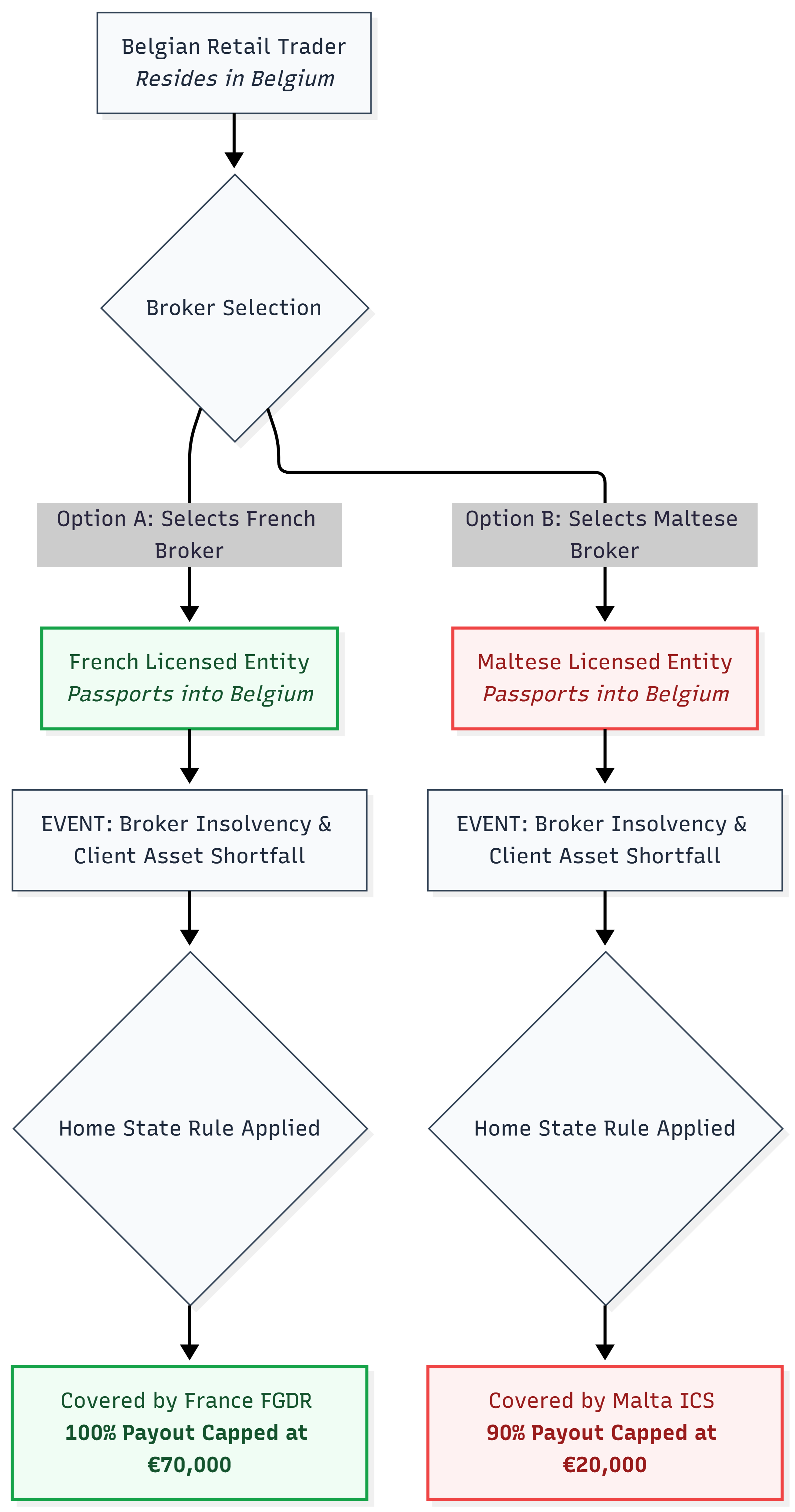
The investor may, for instance, live in Slovakia, where the ICS compensates 100% of an eligible claim up to €50,000 per investor per institution. But the broker who passported in the investor’s home country is licensed by Malta, where the ICS only pays 90% of an eligible claim and never more than €20,000. Under EU Directive 97/9/EC, investor compensation is linked to the member state where the investment firm is authorized (home state). So if a broker is authorized in Country A and passported into Country B, the applicable compensation scheme is Country A’s ICS, and not the client’s residence. By picking a broker based in Malta instead of Slovakia, the trader in Slovakia reduced their coverage significantly, even though the Maltese broker followed all the passporting requirements.
Similarly, a French resident may think in French protection terms. They have grown up within a strong banking and investment guarantee architecture. The FGDR framework includes both deposit protection and investor compensation mechanisms, and the French ICS gives 100% protection up to €70,000 per investor per firm. But if that French resident opens an account with a Danish investment firm, passporting services into France, the French investor does not bring the French ICS with them into their account with the Danish brokerage company. The account is with the Danish entity, and the Danish scheme is the relevant one if that firm fails and the conditions are met. The Danish ICS pays a 100% of the eligible loss, but only up to a maximum of €20,000. (Source in Danish. See § 11 of Bekendtgørelse af lov om en indskyder- og investorgarantiordning)
Of course, a trader can also take advantage of the fact that ICS is linked to the member state where the investment firm is authorized (home state). A trader living in Denmark can obtain better ICS coverage by picking a properly passported broker licensed by a country such as France, Slovakia, or Spain.
Regardless of how you move (upgrade, downgrade, or no material difference), the broker will probably not work very hard to make you aware of this. There might be some relevant information about ICS hidden in the fine print on a long Q&A page, but don’t expect an attention grabbing pop-up or blaring siren being there to warn you about how signing up with a foreign broker can impact your ICS.
This is why every cross-border brokerage review should include finding out exactly who your legal contract party will be, where that entity is based and licensed, confirmation that it has actually passported into your country, and information about which ICS that will apply to your account and exactly how much coverage that ICS gives.
Is Your Trader Class Eligible Under ICS In Your Foreign Broker’s Home Country?
Directive 97/9/EC did not establish a uniform investor compensation scheme (ICS) across the EU/EEA. Instead, it introduced a minimum harmonization framework, allowing member states considerable discretion in designing their national schemes, including the definition of eligibility criteria.
As a result, member states may exclude certain categories of investors from ICS protection or limit the scope of their coverage. This may apply, for example, to clients classified as professional clients or otherwise deemed sophisticated investors.
Not only do the rules governing exclusions and coverage vary between jurisdictions, but the criteria used to determine investor classification may also differ. A trader may, for instance, be considered a professional client in one jurisdiction based on factors such as trading activity or employment status, while being treated as a retail client in another.
It should also be noted that ICS classification does not necessarily align with other regulatory frameworks within the EEA, such as rules on CFD leverage restrictions, binary options bans, or broader retail investor protection measures.
My Foreign Broker Has Failed
Many investors think of ICS as automatic. The broker files for bankruptcy, a claim is filed, and money arrives in a timely fashion. This is not how it works, and reality tends to be both messier and slower.
Under Directive 97/9/EC, an ICS does not become obliged to pay compensation just because a broker files for bankruptcy. Instead, it becomes operational once the competent authority determines that an investment firm is unable to meet its obligations to investors. This determination, rather than the formal bankruptcy filing itself, is generally the key trigger for activating compensation procedures. In practice, this assessment may depend on information from insolvency practitioners, regulators, or court proceedings.
From that point, the ICS must establish which clients are eligible, what losses are covered, and the extent of any shortfall. This may involve reliance on records provided by insolvency administrators, reconciliation of client asset accounts, verification of entitlements, and, in some cases, recovery of assets from the estate before final calculations can be made. The process can therefore take considerable time, particularly where records are incomplete, disputed, or difficult to reconstruct.
This is relevant for the cross-border discussion because the investor who is seeking ICS compensation can find it considerably more difficult to deal with the administration associated with getting money out of a foreign ICS compared to the ICS at home. It is understandable if a Norwegian trader might start to resent picking a Bulgarian broker four years ago, and vice versa.
Before we proceed, let’s pause and remember that broker failure is, fortunately, a rather unusual thing in the EEA. And when it happens, the statutory rules about client asset segregation and record keeping usually make it pretty straightforward for the administrators to separate client assets from the rest of the assets and repay the clients their money. That is the normal route, and it does not involve ICS.
ICS typically becomes relevant only when important rules have been broken, particularly rules pertaining to client asset segregation, asset safekeeping, record keeping, and custody chains. A broker failing after a serious failure to uphold such rules is, fortunately, unusual in the EEA. But if you do find yourself in a situation where this happens, do not expect to see the neat folding of a well-managed company that just happened to run into economic difficulties. Instead, prepare yourself to watch a dumpster fire that will involve civil claims, criminal investigations, and the unraveling of chaotic and deliberately deceitful bookkeeping.
There might be prolonged bankruptcy hearings, financial authority involvement, aggressive news coverage, missing client ledgers, the need to pinpoint custody chains, faulty reconciliations, missing records, frozen portals, and unanswered emails, all while you try to stay on top of legal notices and claim deadlines in French or Spanish.
When your broker is based in a foreign country, it fails in that foreign country. In other words, when your broker is authorized by Country A and only passporting into your country, its insolvency and compensation proceedings will be generally handled by Country A and fall under the Country A law. This means you may need to interact with foreign insolvency administrators, regulators, and compensation schemes, often under unfamiliar legal frameworks and procedural requirements.
Claims may require submission of account statements, identity verification, proof of ownership, and transaction records, all of which must be assessed under the rules of the firm’s home jurisdiction. Language barriers, differing documentation standards, and unfamiliar legal deadlines may further complicate the process. Although some authorities provide English-language guidance, legally binding documents and determinations are typically governed by the official language of the relevant jurisdiction.
Suppose a German trader uses an Irish passported broker. The firm fails. The trader now deals with an Irish process, not a German route. The relevant authorities and administrators follow Irish law, Irish scheme procedure, and Irish documentation requirements. The investor may need to file a claim, submit proof, wait for certification of eligible loss, respond to queries, and track communications from a foreign liquidation process. The same issues apply to a Swedish investor using a Cypriot firm, a French investor using a German firm, a Spanish investor using a Slovakian firm, and so on.
The investor can be required to deal with things such as:
- Foreign insolvency administrators
- Scheme claim forms
- Proof of identity requests
- Proof of account ownership
- Statements and transaction records
- Position valuations at the failure date
- Currency conversion issues
- Language barriers
- Deadlines under unfamiliar law
- Disputes over eligibility
- Partial asset recoveries
- Scheme subrogation rules
- Tax reporting uncertainty
- Frozen assets during reconciliation
Investors may need local legal advice to understand deadlines or challenge calculations. And language is not a cosmetic issue, not even with the advent of automatic translation software. Scheme websites may offer English summaries, but formal legal documents, court filings, or administrator updates may be in the local language. Even when translations exist, the controlling version is usually the domestic one.
In short, investor compensation schemes may operate alongside complex and often lengthy insolvency proceedings, and this can be especially difficult to cope with when it is happening in a foreign jurisdiction. While the scheme is intended to protect eligible investors, the process of establishing entitlement, verifying losses, and distributing compensation can be procedurally intensive.
In this context, it can be worth mentioning that Directive 97/9/EC does not impose a fixed deadline for ICS counting from the moment of insolvency. It only requires, in its Article 9, that compensation be paid no later than three months after the eligibility and the amount of the claim have been determined, with a possible extension of up to three additional months in exceptional circumstances. The important caveat here is “after the eligibility and the amount of the claim have been determined”. Directive 97/9/EC does not establish any specific maximum period for determining eligibility and calculating the amount of the claim. As a result, complex insolvencies can spend a considerable amount of time in the preparatory stages before the payment deadline begins to run.
Record Keeping
Saving important documents, screenshots, and broker communication is always a good idea, but having access to all documentation can be even more important for a trader who is trying to handle a cross-border broker failure and might require assistance from a foreign ICS.
Always save your record stash away from the trading platform. Do not trust that the platform or any other portals will remain accessible to you and that no tampering will take place. You need to be able to access this information independently, even if everything the broker used to provide is now offline.
Examples of important records:
- Client agreement
- Entity disclosure
- Regulatory status page
- Investor compensation disclosure
- Account statements
- Trade confirmations
- Deposit and withdrawal records
- Custody or nominee disclosures
- Annual tax reports
- Platform screenshots at key dates
- Support correspondence
- Migration or entity change notices
Side Note: Understanding The Concept Of Reverse Solicitation
In this article, we have mentioned numerous times how an investment firm licensed by one EEA country must go through a passporting process to be able to legally solicit clients in another EEA country without obtaining a separate license.
There is some nuance to this, due to the concept “reversed solicitation”, i.e., when a client is actively seeking out an investment firm rather than being solicited by that investment firm.
If a broker licensed in Country A within the EEA accepts a client who independently approaches it from another EU/EEA country (so-called reverse solicitation), the broker may not need a passport for that particular client relationship. The exact boundaries of reverse solicitation are interpreted quite narrowly by regulators.
Under the regulatory framework applicable to investment firms within the EEA, including Directive 2014/65/EU on markets in financial instruments (“MiFID II”), an EEA-authorized investment firm is generally required to obtain the appropriate passport in order to provide investment services on a cross-border basis into another EEA member state. Where a firm actively markets, promotes, or otherwise solicits clients in another EEA member state, such activity will fall under the cross-border provision of investment services at the firm’s initiative and will therefore require the firm to rely on its MiFID II passport rights.
By contrast, where a client located in another EEA member state approaches the firm entirely on its own exclusive initiative, without any prior solicitation, marketing, or inducement by the firm (commonly referred to as “reverse solicitation” or “client-initiated business”), the provision of investment services to that client may, in principle, fall outside the scope of cross-border service provision requiring passporting in respect of that specific relationship.
However, reverse solicitation is construed narrowly by both the European Securities and Markets Authority (“ESMA”) and national competent authorities. In particular, firms are expected to demonstrate that the client relationship was genuinely unsolicited, and reverse solicitation will not be available where any form of direct or indirect marketing, targeting, or promotional activity has been undertaken in the relevant member state.
Furthermore, reverse solicitation is assessed on a strict, case-by-case basis and does not constitute a general exemption permitting systematic provision of services into another EEA jurisdiction. Firms remain responsible for ensuring that their conduct does not, in substance, amount to circumvention of applicable passporting requirements.
It should also be noted that reverse solicitation does not determine the client’s investor compensation scheme (ICS) coverage under Directive 97/9/EC. Compensation eligibility is determined by the firm’s regulatory authorization (“home state”) and not by whether the client came via passporting or reverse solicitation.
For more information about reverse solicitation:
- ESMA reminds firms of the MiFID II rules on reverse solicitation
- Directive 2014/65/EU (MiFID II) – Article 42 (Provision of services at the exclusive initiative of the client)