





Getting a big bonus from your broker can feel great, but unfortunately, the strings attached to the bonus can make a seemingly wonderful $500 bonus cost far more than its nominal value. In this article, we will look at common pitfalls and how to properly evaluate a bonus offer. Learn more about how you can stay clear of bad terms and conditions and turn down bonus offers that are unsuitable for your trading strategy.
Forex bonuses are commonly marketed as extra capital. Example: Deposit $1,000, receive another $500, and trade with $1,500 in account equity. On the surface, the offer appears to improve purchasing power without requiring the trader to put more personal money at risk.
The fine print of the contract usually tells a different story.
Instead of being more cash in your account, a trading bonus is commonly highly conditional credit with a turnover requirement, expiry date, and withdrawal restrictions. The trader may have to generate millions of dollars in notional turnover before the bonus becomes cash, or before profits made while using it can be withdrawn. Every trade used to reach that requirement can potentially produce a spread, commission, and financing charge, depending on trading style and account terms and conditions. A $500 bonus credit can easily result in $1,000 or $2,000 of transaction costs. That does not mean the trader pays those costs in one invoice. They are deducted trade by trade, which makes them less visible and easier to underestimate.
The relevant question is not whether a broker gives extra credit. It is whether the financial value of that credit exceeds the cost and risk created by its conditions. A $500 forex bonus is not a gift. It is conditional trading credit whose value depends on factors such as turnover requirement, transaction costs, withdrawal rules, and the applicable and enforceable trader protection framework.
A 200-lot requirement can create $2,000 of spread and commission costs at one pip per lot. If 200 lots is less than what the trader normally trades in the stated period of time, this type of turnover requirement can encourage more frequent trading and larger trades, adding significant market risk.
For many retail traders, declining the bonus produces cleaner withdrawals, simpler margin calculations, and fewer reasons to overtrade. The promotion is worth considering only where normal trading volume satisfies the conditions without any change to position size or strategy.
Around the world, many regulators have prohibited or highly restricted brokers from giving retail traders CFD bonus offers. They have done so for a variety of reasons. Incentives can, for instance, push retail clients to deposit more, trade more frequently, open bigger positions, and focus on promotional value rather than product risk. One example of a well-known financial authority with a restrictive approach to retail CFD bonus offers is the European Securities and Markets Authority (ESMA). In the EUROPEAN SECURITIES AND MARKETS AUTHORITY DECISION (EU) 2018/796, ESMA stated that promotions often distract retail investors from the high-risk nature of CFD products.
“(137) A final measure to address risks relating to the distribution of CFDs to retail clients is a ban on monetary (for example so called ‘trading bonuses’) and certain types of non-monetary benefits. Financial promotions offering bonuses or other incentives to trade CFDs often distract retail clients from the high-risk nature of CFD products. They draw in retail clients who may not otherwise choose to invest in these products. Such benefits are often contingent on clients depositing money on the account or on executing a certain volume of trades.”
Commission Decision (EU) 2018/796 was always intended to be temporary, and has not been in effect since 31 July 2019. At that point, most of the EU national regulators had already adopted permanent national measures that were at least as strict as ESMA’s temporary rules, and ESMA therefore elected not to renew the temporary measure.
Forex Bonus Terminology
Deposit Match / Matching Bonus
A deposit match adds promotional credit according to the size of a qualifying payment.
Examples:
- With a 50% match up to a maximum of $500 in bonus money, a $100 deposit produces $50 of bonus credit.
- With a 100% match up to a maximum of $500 in bonus money, a $100 deposit produces $100 of bonus credit.
- With a 100% match up to a maximum of $500 in bonus money, a $1,000 deposit produces $500 of bonus credit.
Fixed-Sized Deposit Bonus / Flat Deposit Bonus
A bonus that requires a deposit, but where the bonus amount is not proportional to the deposited amount (i.e. it is not a matching bonus).
Example: Deposit at least $100 and get a $50 bonus.
No-Deposit Bonus
A bonus that comes without a deposit requirement. It is usually a sign-up bonus.
Example: Sign up and complete the registration and verification process, and you’ll get a $30 no deposit bonus.
Depending on the bonus terms, you might still have to make a deposit to be able to withdraw any profits generated by the bonus money. The no-deposit bonus itself is usually non-withdrawable, but that also depends on the exact no-deposit bonus terms.
Standard Lot
One standard forex lot represents 100,000 units of the base currency.
Examples:
- One lot of EUR/USD represents €100,000.
- One lot of GBP/USD represents £100,000.
- One lot of USD/JPY represents $100,000.
The USD value of a non-dollar base currency changes with the exchange rate, so the phrase “one lot equals $100,000” is just an approximation.
Leverage
With leverage, a trader does not need to have the full notional value of a position in their account to open the position.
Examples:
- With leverage of 1:100, a $100,000 position requires around $1,000 of margin, depending on terms and conditions.
- With leverage of 1:500, a $100,000 position requires around $200 of margin, depending on terms and conditions.
The smaller margin requirement does not reduce the position’s notional exposure. Spread, commission, and profit/loss are still calculated using the full trade size.
Turnover Requirement
Bonus money typically comes with a turnover requirement, which must be completed before a withdrawal can be made. Turnover is the cumulative amount traded during the promotion.
Some contracts express the turnover requirement as notional currency value (e.g. 40x the bonus amount), while others specify a number of standard lots.
With some offers, it is not all-or-nothing, because a fixed amount of bonus cash will become available for withdrawal after each completed lot or completed notional currency value.
It is important to understand exactly how the turnover requirement works before you accept a bonus, because many different designs exist, and they can produce very different results.
If the terms say the trader must complete turnover equal to 40 times a $500 bonus, the required notional turnover is $500 × 40 = $20,000. Using a simplified $100,000 standard-lot assumption, this equals 0.2 lots.
If the turnover requirement is instead based on the combined deposit and bonus, a 40x turnover requirement becomes more difficult to achieve. Example: You are offered a 50% matching bonus. You deposit $1,000 and get a $500 bonus. A 40x turnover requirement based on $1,500 is $60,000. Using a simplified $100,000 standard-lot assumption, this equals 0.6 lots.
Bonus contracts sometimes use loose wording. That might not seem like a big deal at first glance, but a seemingly small difference in the bonus term can be enough to turn a manageable requirement into something that is really difficult to fulfil within the allotted time period without taking huge risks. Do not accept a bonus when the formal terms do not clearly state exactly how the turnover requirement is calculated and whether bonus release is all-or-nothing or incremental.
Your Own Money Vs. Bonus Money
Bonus money will usually increase the amount shown as account equity and free margin, but that does not mean the bonus money is legally yours in the way your deposited money is.
Example: The platform might display a $1,000 cash balance and a $500 bonus credit. The account equity before open trades is $1,500. But only the $1,000 deposit is the trader’s cash. The $500 bonus credit is conditional and governed by the promotion. It may be cancelled by the broker according to the bonus terms, e.g. following a withdrawal, account inactivity, prohibited trading, or a failure to complete the required turnover.
Equity-Supporting Credit vs. Margin-Only Credit
Equity-supporting credit remains part of account equity while positions move against the trader. It can absorb floating losses until the promotion’s removal conditions are triggered.
Margin-only credit may increase the amount available for opening trades but offer little protection once real cash has been lost. Some contracts remove the credit when the cash balance or equity reaches a stated threshold.
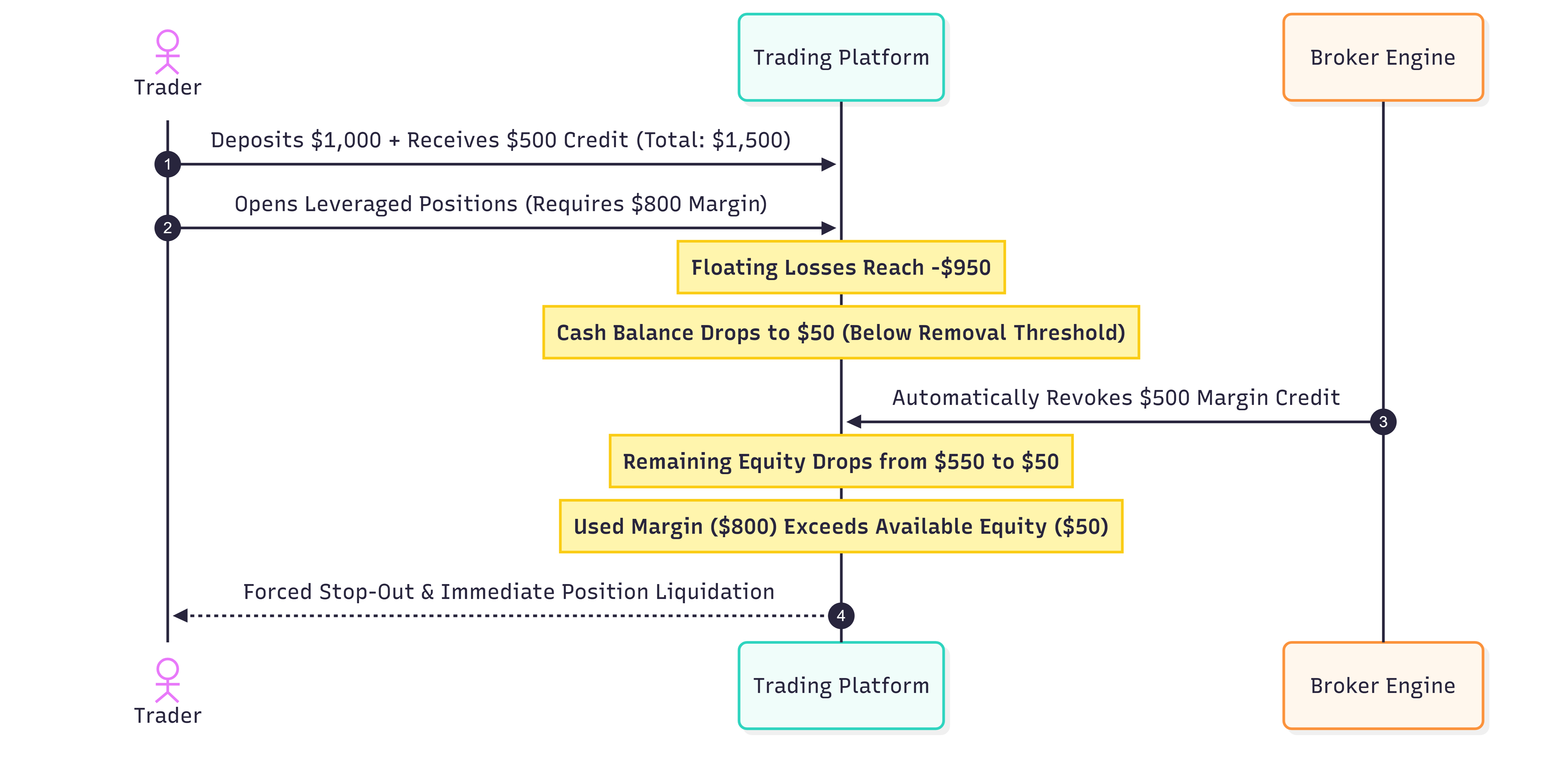
Example: The account contains $1,000 of cash and a $500 bonus. After $950 of trading losses, the platform still shows $550 of total equity because the credit remains active. If the broker then removes the $500 bonus when cash equity drops below the $50 threshold (as stated in the bonus terms), the account suddenly falls to just under $50 and positions may be automatically closed because there is not enough margin left in the account anymore.
The trader thought it was a $500 cushion. The contract stipulated that it was conditional margin.
Note: The labels themselves are not standardised. Traders need to read and understand the account equity formula, bonus-removal rules, and stop-out treatment rather than trust a marketing description stating that the promotion “boosts trading power”.
How To Calculate A Forex Bonus Volume Requirement
The calculation begins by identifying how the contract defines turnover.
A bonus that comes with a turnover requirement is difficult to assess when the terms state that the customer must meet a “40x trading requirement” without identifying what constitutes the base for the multiplication. Forty times the deposit, forty times the bonus amount, forty times the deposit + bonus, or forty times something else? Will any profits earned during the bonus period also be included in the 40x turnover requirement before a withdrawal can be made?
A trader should not accept an offer until the broker confirms the calculation in writing. Screenshots of the bonus terms, including the date, should be saved on your own device. Anything that is on the platform can be changed by the broker.
For a bonus that can be used for more than just forex trading, bonus terms should state whether the requirement is measured in base-currency notional, account-currency notional, or platform lots. Compared to forex, this matters more for metals, indices, and cryptocurrencies, where one platform “lot” does not equal 100,000 currency units.
Here are two examples of common volume requirements for forex CFD bonuses.
First Model
The first model multiplies the bonus by a notional turnover figure. Required notional turnover = bonus × turnover multiplier. In this example, a $500 bonus with a 5,000-times condition requires $500 × 5,000 = $2,500,000. Using a $100,000 standard-lot approximation, that is $2,500,000 ÷ $100,000 = 25 standard lots.
This sounds enormous, but in leveraged products like forex CFDs, notional trading volume accumulates faster because each trade’s full contract value counts toward the requirement. A trader using leverage can generate millions of dollars in cumulative notional turnover without depositing or risking millions of dollars. Many forex CFD brokers use very high notional-volume requirements (often in the thousands of times the bonus) before bonus funds or profits derived from them can be withdrawn.
Second Model
The second model specifies the lots directly. If the contract requires 25 standard lots, no multiplier conversion is needed. The trader must complete 25 standard lots according to the broker’s definition of a qualifying trade.
The second model is not inherently more or less onerous than the first model. They are just different ways of expressing the same underlying volume requirement, provided the broker’s definition of a standard lot is known.
A requirement expressed in standard lots refers to the cumulative trading volume, not the size of any individual trade. The trader can satisfy the requirement through many small trades, a few large trades, or any combination whose total equals the required number of lots. For example, a requirement of 25 standard lots could be met by executing 25 trades of 1 standard lot, 250 trades of 0.1 lots, or 2,500 trades of 0.01 lots. Assuming all trades qualify under the broker’s terms, each contributes to the cumulative total.
Incremental Turnover Fulfilment
With some bonus contracts, bonus credit will be converted into cash in your account at a fixed rate. Instead of an all-or-nothing situation, you can get some cash even if you only achieve a part of the turnover requirement.
For example, suppose a trader receives a $100 bonus that is released at a rate of $2 for every standard lot traded. If the trader completes 1 standard lot, $2 is released. After the next standard lot, another $2 is released. After 25 standard lots, a combined $50 has been released, in $2 increments. And so on.
This approach differs from an all-or-nothing bonus release, under which the trader would receive nothing unless the full trading volume requirement was completed. With incremental fulfilment, every pre-defined step (in this case, every standard lot) contributes toward releasing a corresponding portion of the bonus, allowing the trader to retain at least part of the promotional value even if the full requirement is never reached.
For many small-scale retail traders, incremental fulfilment is more advantageous than all-or-nothing because they may not trade enough volume to satisfy a large turnover requirement before the bonus expires or they decide to stop trading. Under a gradual release model, traders who generate only modest trading volume can still realize a proportional share of the bonus instead of forfeiting it entirely. As a result, the benefit received more closely reflects the trading activity actually undertaken, reducing the risk that substantial effort and risk produce no bonus at all.
Opening Volume Vs. Round-Turn Volume
The next question is whether opening and closing a position count separately against the turnover requirement. This is also something you need to consult the bonus terms and conditions to find out.
A trader opening one standard lot and later closing it has generated one lot of opening volume and one lot of closing volume. Some bonus systems count this as one completed lot. Others describe the combined activity as two lot sides. This difference can halve or double the apparent requirement.
The contract may also count only closed trades, meaning an open position contributes nothing until it is exited. Partially closed positions can be calculated proportionately or ignored until the entire position is closed.
The 200-Lot Example
Assume a trader deposits $1,000, receives a $500 bonus, and must open and close 200 standard lots of qualifying forex trading volume within 30 calendar days to release the bonus. When the standard lot is 100,000 units, the required notional turnover is approximately 200 × $100,000 = $20 million.
Because the forex market operates 24 hours a day, 5 days a week, a 30-calendar-day period generally provides around 20–22 trading days rather than 30 trading sessions. With 21 trading days, the trader would need to complete an average of 9.5 standard lots per trading day. (Because 200 lots ÷ 21 days is approximately 9.5.)
This does not necessarily mean holding a 9.5-lot position at one time. The requirement is based on cumulative trading volume, so the trader can satisfy it through repeated smaller trades. Using 0.10-lot positions, the trader would need approximately 2,000 completed trades (200 ÷ 0.10), assuming each trade qualifies under the broker’s volume rules. The trader could use any combination of trade sizes, provided the total qualifying volume reaches 200 standard lots before the deadline.
Under a completed-lot (round-turn) system, the trader would need to open and close 200 standard lots. The trader would therefore generate 200 lots of opening volume and 200 lots of closing volume, or 400 lot sides in total, but the broker would recognize this as 200 completed lots.
Under a side-based volume system, the same 200-lot requirement could be satisfied with only 100 completed 1-lot positions, because each position generates two lots of counted volume: one lot when opened and one lot when closed. In that case, 100 openings plus 100 closings would equal the required 200 lots.
Therefore, a stated requirement of “200 lots” is unclear. If the broker counts completed positions, the trader will need twice as much executed volume as they would under a system that counts both opening and closing sides separately.
Margin Pressure On A $1,000 Deposit
At 1:100 leverage, one standard lot with roughly $100,000 notional exposure will require around $1,000 of margin. A $1,500 account including bonus credit would have little room for adverse movement after opening one lot.
At 1:500, the margin requirement could be closer to $200, but the pip value remains around $10 for a standard lot of EUR/USD. A 20-pip adverse move represents about $200 before spread and slippage.
Forex brokers with high leverage help the trader satisfy the platform’s margin requirement faster. It does not make the position smaller. Completing (on average) 9.5 lots each trading day on a $1,000 cash deposit is possible as a matter of platform mechanics, but it will require some serious risk-taking.
Spread And Commission Costs Can Exceed The Nominal Bonus Value
Each qualifying trade has a cost. The visible components are the bid and ask spread, any separate commission, and any overnight financing. Slippage is an example of a less visible and highly unpredictable cost.
The basic transaction-cost formula is estimated trading cost = qualifying lots × average all-in cost per lot.
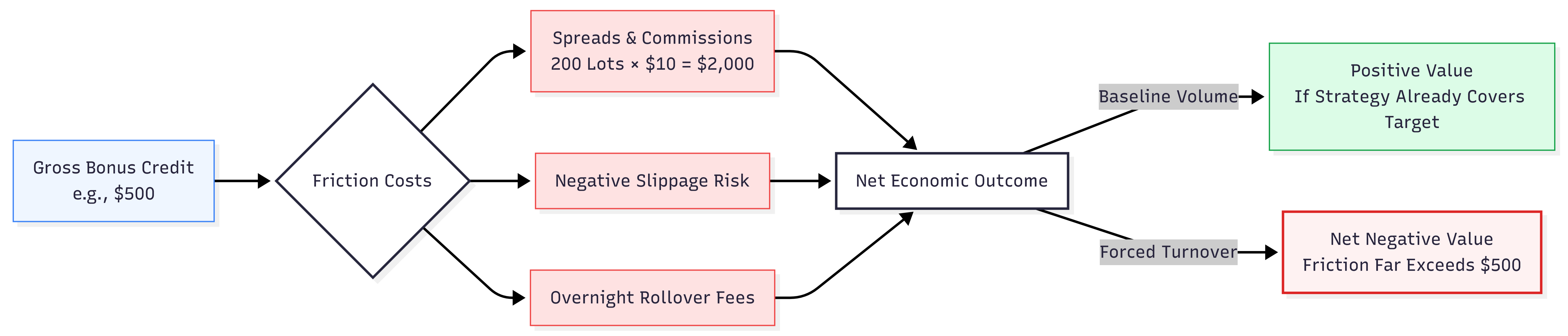
If we assume the bonus is $500, the turnover requirement is 200 standard lots, and the average all-in cost is 1 pip per lot, the trader incurs approximately $2,000 in costs while trying to release a $500 bonus.
For bonus-turnover calculations, using a 1-pip cost is a simplifying assumption. The real cost could be lower or higher depending on the broker. For a USD-quoted major pair, a standard lot is typically worth about $10 per pip. The actual round-trip trading cost depends on factors such as the broker’s spread, commission structure, and account type. If the all-in cost is assumed to be 1 pip, the approximate cost is $10 per standard lot.
Cost Of Completing 200 Lots
Assume the trader must complete 200 standard lots.
| Average all-in cost | Cost per standard lot | Cost over 200 lots |
|---|---|---|
| 0.6 pips | $6 | $1,200 |
| 0.8 pips | $8 | $1,600 |
| 1.0 pip | $10 | $2,000 |
| 1.5 pips | $15 | $3,000 |
Calling the entire amount net profit for the broker would be inaccurate. The $2,000 is a customer trading cost, not automatically $2,000 of net profit for the broker. The broker has costs to cover, e.g. for liquidity access, technology, introducing-broker, and hedging. But the commercial point remains. The trader has generated gross transaction charges worth four times the promotion’s stated value.
Cost Of A 25-Lot Example
Using the 5,000-times example on a $500 bonus gives approximately 25 standard lots.
At an $8 all-in cost per lot: 25 × $8 = $200
At $10 per lot: 25 × $10 = $250
At $15 per lot: 25 × $15 = $375
This version may still leave a positive gross bonus value, assuming the full $500 becomes withdrawable and the trader would have completed the 25 lots anyway. That last condition matters. The transaction cost is not created solely by the bonus if the trader’s established strategy naturally produces the required volume. If the promotion causes 20 extra lots that would not otherwise have been traded, those 20 lots are the relevant added cost.
The correct comparison is not always total trading cost versus bonus value. It is the additional cost caused by accepting the promotion. Suppose an active trading strategy normally completes 80 lots during the offer period. The bonus requires 100 lots. Only 20 lots are additional. At $8 per lot, the additional cost is 20 × $8 = $160. A fully withdrawable $500 bonus may then have an estimated pre-risk value of $340.
The answer changes when the trader normally completes ten lots but must reach 100. Ninety additional lots at $8 cost around $720, already exceeding the bonus.
The end result will also be impacted by losses arising from lower-quality trades placed to reach the target. Those losses are notoriously difficult to predict.
Slippage
Negative slippage adds another cost. Slippage is when market orders execute away from the expected price. A tenth of a pip across 200 standard lots is approximately $200 on EUR/USD. Half a pip would represent about $1,000.
Negative slippage is when the price moves in a way that is negative for the trader. The opposite is positive slippage, i.e. when the market order executes at a better price than expected.
Overnight Financing
Turnover pressure can cause traders to venture outside their normal strategy, and someone who is normally a day trader can, for instance, be tempted to start holding positions open longer. Positions carried beyond the broker’s rollover time typically attract swap charges, which can catch this type of trader unaware.
How The Turnover Requirement Can Change Trader Behavior
Bonus contracts do more than alter account arithmetic. They introduce a second objective that can conflict with the trading strategy. The trader is no longer deciding only whether a trade has positive expected value. The trader is also trying to complete a volume target before the bonus expires.
In the European Union, the European Securities and Markets Authority (ESMA), which is the European Union’s securities markets regulator, came to the conclusion that this type of bonus encourages retail clients to trade CFDs and distracts them from adequately considering the products’ risks. Consequently, European CFD product intervention measures now prohibit brokers from offering monetary and non-monetary benefits to retail clients.
Expiration Pressure
A 30-day deadline gives every inactive day an apparent cost. The trader can begin to treat missed volume as a lost opportunity, even when market conditions offer no suitable setup that aligns with the trading strategy.
A strategy designed to place eight trades per month may suddenly produce 30, because the trader gets focused on releasing the bonus in time. The additional positions are not generated by better market opportunities. They are generated by the contract calendar.
Position Size Creep
When normal trade frequency cannot meet the target, increasing lot size appears to be the quickest answer. A trader who normally uses 0.10 lots may move to 0.50 lots or 1 lot, so each position contributes more volume. The stop-loss distance may remain unchanged, which multiplies the cash risk by five or ten, respectively. The advertised bonus may be $500, but one oversized losing trade can cost more than the entire promotion.
The Sunk Cost Fallacy
The sunk cost fallacy is the tendency to continue investing time, money, or effort into something just because you’ve already invested a lot, even when stopping would lead to a better outcome.
After completing most of the bonus turnover requirement, abandoning the promotion feels wasteful. A trader who has reached 160 of 200 lots may continue trading poor setups because “only 40 lots remain”.
Revenge Trading
Revenge trading is when a trader makes impulsive trades to try to recover losses quickly or “get back at the market” after a bad trade. It is driven more by emotions, such as anger, frustration, and fear, instead of being a part of a well-thought-out strategy.
After receiving a bonus with a turnover requirement, a trader may take bigger risks and suffer larger losses. This can nudge the trader towards revenge trading, where the trader trades increasingly more aggressively to recover the cash loss and finish the turnover before expiry.
Learn How To Spot The Fine-Print Clauses That Change The Bonus Value
Minimum Holding Periods
When it comes to fulfilling the turnover requirement, some bonus offers exclude trades held for less than a certain period of time, e.g. two, three, or five minutes. The trades still incur spreads and commissions, but contribute nothing to the release target. A trader completing 100 lots may later discover that only 60 qualified, because the remaining positions were closed too quickly.
The rule can be particularly damaging to scalpers and certain automated strategies. Make sure you know before you accept any bonus offer if the turnover rules fit your trading strategy.
Instrument Weighting
Not every instrument necessarily receives equal turnover credit. Example: Major currency pairs may count at 50%, metals at 25%, and less liquid instruments at 100%. Another bonus offer may exclude low-spread pairs entirely.
If EUR/USD receives half weighting, completing ten standard lots contributes only five qualifying lots. The effective transaction requirement doubles.
The weighting table should be incorporated into the cost calculation. Using the cheapest instrument is not helpful when it receives little or no credit.
Do not adjust your trading strategy to fit a bonus turnover requirement. Pick a broker and a bonus offer that suits your strategy.
Withdrawal Consequences
A partial withdrawal made before the bonus has been released may cancel the full bonus, or cancel any remaining bonus that has not yet been released.
Assume a trader deposits $1,000, receives $500 credit, and later earns $300. The account has $1,800 before open profit or loss. Withdrawing $100 could remove $100 in cash, and then the entire $500 bonus vanishes, reducing equity by a total of $600. Open positions based on the prior margin figure may then be stopped out.
A proportionate rule is less severe. Withdrawing 10% of the qualifying cash might remove 10% of the active credit. The calculation still needs to be completed before the request is submitted.
Ideally, do not accept bonus offers with withdrawal penalties if you know that you sometimes have to dip into your trading account for cash and might not be able to refrain from this during the entire bonus period.
Profit Restrictions
Some bonus contracts prevent the withdrawal of profits until the entire turnover condition is met. A trader may see real cash profit in the balance while having no contractual right to take it out.
Other bonus offers permit profit withdrawals, but will still punish you by cancelling the remaining bonus if make a withdrawal of profits before the bonus period is over or the turnover requirement has been fulfilled.
There may also be a maximum profit withdrawal for profits made during the bonus period. Example: A trader who earns $2,000 using a promotion could be restricted to a $500 profit withdrawal, with the remainder of the profit removed after the first payout. This condition is especially common with no-deposit bonuses.
Strategy Disqualification
The bonus terms may prohibit you from using certain strategies during the bonus period, or prevent this type of trading from counting towards the turnover requirement. Examples of strategies that can be restricted are hedging, news trading, robo trading (e.g. MT Expert Advisers), and latency strategies.
Clearly defined restrictions against a certain strategy or stale quote exploitation can be reasonable, while broad clauses allowing the broker to cancel bonus money and profits for any trading it considers “undesirable” create a lot of uncertainty for the trader.
The contract terms should define the prohibited conduct. A contract that grants the broker sole discretion to void transactions has weak withdrawal certainty, however attractive the bonus percentage looks.
Remember that strategy prohibitions and limitations can be found in both the bonus terms and in the general user agreement for the account.
Expiry And Automatic Credit Removal
The terms should state the exact expiry date and what happens to any unreleased bonus money on that date. A bonus with incremental releases is typically more beneficial than the all-or-nothing model, since you might be able to release at least a few portions of the bonus before the expiry date.
When bonus credit is removed, what will happen to open positions? A trader should not hold positions near the expiry point unless the account can support them without promotional credit. Example: If an account has $700 of cash equity, $500 of bonus credit, and $800 of used margin, removing the bonus reduces total equity from $1,200 to $700. Free margin changes from $400 to negative $100. The platform may immediately close positions even though the underlying market has barely moved.
A Practical Forex Bonus Evaluation Framework
A reasonable rule is to decline the promotion where two or more of the following are true: the credit is not equity-supporting, the estimated added cost is close to, equal to, or larger than the bonus value, the deadline forces more trading, the normal strategy is partly excluded.
| Test | Calculation or question | Acceptable result |
|---|---|---|
| Legal status | Which entity issues the bonus and who regulates it? | Verified company regulated by a reputable financial authority. Preferably use brokerage entities that are regulated in jurisdictions that are considered Tier 1 or Tier 2 when it comes to trader protection. |
| Bonus ownership | Is the credit withdrawable (with conditions) or non-withdrawable temporary margin? | Clearly stated |
| Volume requirement | What exact number of qualifying lots is required, and within which timeframe? | Suitable for your normal strategy volume, within the time limit. |
| Added cost | Extra lots × realistic cost per lot | Lower than expected cash benefit |
| Expiry | Can your normal trading meet the target in time? | Yes, without increasing frequency or position size. |
| Drawdown | Does credit remain during losses? | Removal rule is known and manageable |
| Withdrawal | What happens after a cash withdrawal during the bonus period? | No disproportionate clawback |
| Restrictions | Do my normal strategies qualify for the turnover requirement? | No conflict with the trading plan |
| Profit access | Are profits capped or locked? | Cash value remains worthwhile |
You can also use our more detailed bonus decision guide to decide whether the offer is right for you.
Expected Bonus Value
Expected bonus value = probable withdrawable bonus minus added transaction costs
A $500 bonus with $160 of added transaction costs has an estimated value of $340 before trading losses, financing, tax, etcetera.
Post-Removal Free Margin
This calculation tests the effect of credit removal.
Post-removal free margin = cash equity after withdrawal minus used margin
If this figure is negative, the account may face immediate position closure.
Strategy Alignment
The third test is behavioral. Would the trader place the same positions, at the same size, and at the same time without the promotion? If the answer is no, the bonus is influencing the strategy. That influence needs to be included as a cost, even though it cannot be reduced to a neat dollar figure in advance. Leaving your trading strategy behind to chase a bonus turnover requirement introduces a new element of risk.
When A Forex Bonus Might Be Worth The Headache
A bonus can make financial sense for an active trader whose ordinary strategy already generates the required volume. Suppose your trading system consistently trades 120 lots during a 90-day period, while the bonus requires 100, and your 120 lots are qualifying lots. No extra turnover is needed. A bonus should fit the strategy. The strategy should not be rebuilt to serve the bonus.
The trader still needs to assess spreads and commissions against another account without the promotion. A broker can finance a generous deposit match through higher trading costs. The trader must also check if the bonus will remain active during drawdowns.
A trader who knows for certain that they can refrain from withdrawals during the bonus period can accept a bonus that locks the account from withdrawals or where a withdrawal will cancel the bonus.
Why Have Many Regulators Banned Or Restricted Retail Trading Bonuses For CFD Trading?
Around the world, many financial authorities have prohibited or heavily restricted retail CFD trading bonuses.
Financial authorities have been more eager to prohibit or restrict promotional bonuses for retail CFDs and retail leveraged forex trading, compared to bonuses offered in connection with traditional investment products such as stocks and exchange-traded funds (ETFs). Retail bonuses are considered extra dangerous when combined with high leverage, complex pricing, and rapid turnover.
With heavily leveraged products, investors can control a large market exposure with only a small initial margin. While leverage magnifies potential gains, it also magnifies losses, meaning that even relatively small price movements can result in substantial financial losses. Because the underlying product is already inherently risky, regulators are particularly concerned about marketing practices that encourage retail traders to trade more frequently, open larger positions, and deposit larger amounts of money.
For leveraged trading, bonus turnover requirements can be extremely high, encouraging clients to continue trading even when doing so may not be in their financial interests. Since leveraged products allow traders to generate large notional trading volumes with relatively little capital, such conditions may incentivize excessive risk-taking.
Many financial authorities have expressed concerns about the behavioral effects of bonuses, especially for inexperienced retail clients. A promotional bonus does not reduce the underlying market risk associated with a leveraged position. But it can distract traders from carefully evaluating the probability of loss, and it can encourage decisions driven by the desire to unlock promotional rewards rather than by sound investment judgment. The European Securities and Markets Authority (ESMA), for example, concluded that financial promotions offering bonuses or other incentives often distract retail investors from the high-risk nature of CFD products.
With some regulators, the empirical evidence regarding retail CFD outcomes has also been taken into account. As early as 2016, the UK Financial Conduct Authority (FCA) proposed stricter rules for firms selling CFD products to retail customers, and one of the suggestions was to prohibit firms from using any form of trading or account opening bonuses or benefits to promote CFD products to retail traders. In their proposal, the FCA noted the high loss rate for CFD traders.
“Contracts for differences, such as spread bets and rolling spot foreign exchange products, are complex financial instruments offered by investment firms, often through online platforms. Following an increase in the number of firms in the CFD market, the FCA has concerns that more retail customers are opening and trading CFD products that they do not adequately understand. The FCA’s analysis of a representative sample of client accounts for CFD firms found that 82% of clients lost money on these products.”
Depending on the exact study, regulators commonly report that between roughly 70% and 90% of retail clients incur losses when trading CFDs. Against this backdrop, incentives that encourage additional trading are viewed as likely to increase aggregate investor losses rather than improve retail trader welfare.
By contrast, traditional retail investment products generally do not present the same combination of risks, even though they are far from risk-free. Buying shares in a company or investing in an ETF typically does not involve embedded leverage, margin calls, or rapid liquidation resulting from small market movements. Promotional incentives for these products, such as account-opening bonuses, transfer incentives, or fee discounts, have therefore attracted less criticism from regulators, especially since a bonus targeting potential long-term investors is not likely to be combined with a huge 30-day turnover requirement. While these promotions remain subject to consumer protection, anti-fraud, and disclosure requirements, they usually do not create the same direct incentive for excessive speculative trading.
So far, regulators have therefore commonly adopted product-specific measures rather than a blanket approach. Instead of prohibiting all financial promotions or all customer acquisition incentives, many regulators focus on situations where promotional practices interact with products that already present unusually high risks for retail investors. CFDs and leveraged retail forex trading are widely regarded as fitting this description.
As a result, many financial authorities have concluded that banning or restricting retail bonuses for certain financial products is a proportionate retail trader protection measure. Rather than preventing firms from competing for customers altogether, these restrictions are designed to ensure that competition is based on pricing, execution quality, platform features, and customer service, rather than on incentives that may encourage retail investors to take greater risks than they otherwise would.
The current FCA Handbook deals with restrictions on the retail marketing, distribution and sale of contracts for differences (CFDs) and similar speculative investments in a section labelled COBS 22.5. It is in COBS 22.5 that we find the rule that prohibits firms from offering retail clients monetary or non-monetary incentives (for the applicable financial products).
“A firm must not offer to a retail client, or provide a retail client with, any of the following when marketing, distributing or selling a restricted speculative investment: (1) a monetary incentive; or (2) a non-monetary incentive.” Source: COBS 22.5.2001/08/2019R
FCA guidance identifies account-opening bonuses and volume-based fee rebates as monetary incentives, while lower fees offered to the whole retail client base are treated differently.
“For the purposes of COBS 22.5.20R: (1) monetary incentives include, but are not limited to, the offering of bonuses in relation to the opening of a new account or the offering of rebates on fees (including volume-based rebates); (2) lower fees offered to all retail clients do not constitute a monetary incentive; and (3) information and research tools do not constitute non-monetary incentives.” Source: COBS 22.5.21G
These restrictions, and the ones imposed by several other major regulators, do not prove that every CFD bonus is fraudulent. It only shows that several major regulators regard incentives as capable of distorting retail trading decisions, and this is something that retail clients (i.e. consumers) should be protected from.