





Advertisements for a free $30, $50, or even $100 no-deposit forex bonus are common, and the offer looks simple on the surface. Register for a trading account, receive the bonus money, start trading, and keep the profit. It feels easy and risk-free, since you are not making any deposit.
But when we start looking at the fine print in the user agreement and bonus contract, we typically find quite a lot of strings attached. Accepting a bonus, making a profit, and withdrawing the money will usually not be as easy as predicted.
Bonus money is not the same as deposited money, and it usually comes with special conditions, as outlined in the bonus contract. For a no-deposit bonus, a common design is to make it non-withdrawable. This means you can use it to open positions, but the bonus money cannot be withdrawn. Also, any profits made can be subject to limitations, such as a cap, an expiry date, and/or a requirement to make a real deposit before a withdrawal can be processed.
No-deposit bonus campaigns are popular among brokers because they provide brokerage companies with verified prospective customers. In return for temporary account credit, applicants will go through the registration and verification process. Typically, this involves supplying the broker with personal information such as name, phone number, date of birth, home address, email address, identity documents, and proof of residence. The client can go through the entire registration and know-your-customer process, which means that the threshold is now lowered significantly and a very small nudge can be enough to convince the client to take the next step and make a first deposit. Especially when the client finds out that a deposit is required to withdraw the profits earned from trading with the bonus money.
Many campaigns also expressly permit the company to use the registration details for continued marketing. So even if the client does not convert into a depositing client this time, the brokerage company still has a good lead and can continue to send promotions and offers to the person.
Before accepting a no-deposit bonus, it is important to do your due diligence.
- Do not skip due diligence just because you’re not planning to do a deposit. You are still sending private information to the broker. Anything you use to identify yourself and prove your identity and residency can be used for identity theft, so you do not want it to end up in the wrong hands. Only give this type of information to a reputable and properly regulated brokerage company.
- Do not accept a no-deposit bonus without knowing exactly what is required to make a withdrawal. If a deposit is required to make a withdrawal, will that deposit be subject to conditions, e.g. a turnover requirement that must be fulfilled before you can take your deposited money back?
No-deposit bonus contracts differ considerably. One may impose a heavy turnover target, while another requires no minimum volume but demands you make a deposit before any profit can be withdrawn. The term “no deposit” describes how the promotional account is opened; it does not guarantee that a withdrawal can be made without a deposit. A no-deposit forex bonus is temporary trading credit with contractual conditions. It is not unrestricted capital.
Examples of common bonus conditions are profit caps, mandatory “verification” deposits, turnover requirements, trade-duration rules, and strategy rules. The original credit remains non-withdrawable in almost every structure. Before accepting a bonus, always ask yourself if the bonus offer is good enough to justify the conditions, the data supplied, and the client-broker relationship created.
Examples of common terms and their practical result:
| No-Deposit Bonus Term | Practical Result |
|---|---|
| The bonus itself is non-withdrawable | Only profits can become cash |
| Profit is capped | A large profit may produce a small withdrawal |
| Profit withdrawal requires a real-money deposit | This is no longer a no-deposit situation. You are being asked to trust the broker with your own money. |
| Trading conditions restricting strategy, time-duration, or other factors | You might not be able to try your trading strategy. Profitable trades may fail to qualify, i.e. they will not result in withdrawable cash. |
| The account expires at the end of the bonus period if you have not yet made any deposit. | Profits and open positions disappear. You feel stressed to make a deposit to prevent the account from expiring. |
| Personal data is required during the account registration and verification process. | Risk of identity theft. Risk of your information being sold or shared for marketing purposes. Some brokers use high-pressure sales tactics. |
This does not mean that every no-deposit bonus is a bad idea or that brokers are handing them out to hurt people. It only means that as traders, we need to be sceptical, look at the fine print, and do our due diligence before accepting any offer. There are situations where a no-deposit bonus can be useful, but it should not be considered “free money with no strings attached” because it is not.
Rather than looking at a no-deposit bonus as a way to quickly earn money and withdraw a profit, we can look at it as a useful way to check live platform behavior without making a deposit first. If you have already located and investigated a reputable broker that suits your trading strategy, the next step can be to accept a no-deposit bonus to get a taste of what live trading would be like with this broker. If red flags start popping up, you can leave quickly, since you have not made any deposit.
A free demo trading account filled with plenty of play money is generally better for getting familiar with the platform interface, but only live trading can show you how the platform and broker handle live markets, and this is where a no-deposit bonus can be handy, provided that its terms and conditions do not prohibit the trading style you want to try on the platform. Instead of chasing some type of turnover requirement or other condition, you will be using the no-deposit bonus to evaluate performance, deciding if this broker is offering a bonus that is worth accepting or not.
How A No-Deposit Forex Bonus Works
Exactly how a no-deposit bonus will work depends largely on applicable laws, the user agreement, and the bonus contract. Instead of relying on general guidelines about how a no-deposit bonus “is supposed” to work, it is therefore important to investigate the exact mechanics of the specific no-deposit bonus offer you are interested in.
Generally speaking, a no-deposit forex bonus is a type of promotional credit allocated to a trading account without requiring a deposit upfront. It is often, but not always, a type of welcome bonus, with no-deposit bonus offers typically being used to bring in new clients rather than rewarding existing ones.
The new customer registers, verifies their identity and residency, meets the campaign’s eligibility requirements, and receives the bonus amount as credit in the trading account. Depending on the platform, the credit may appear in the balance field, a separate credit field, or a dedicated promotional account.
Trading Using A No-Deposit Bonus
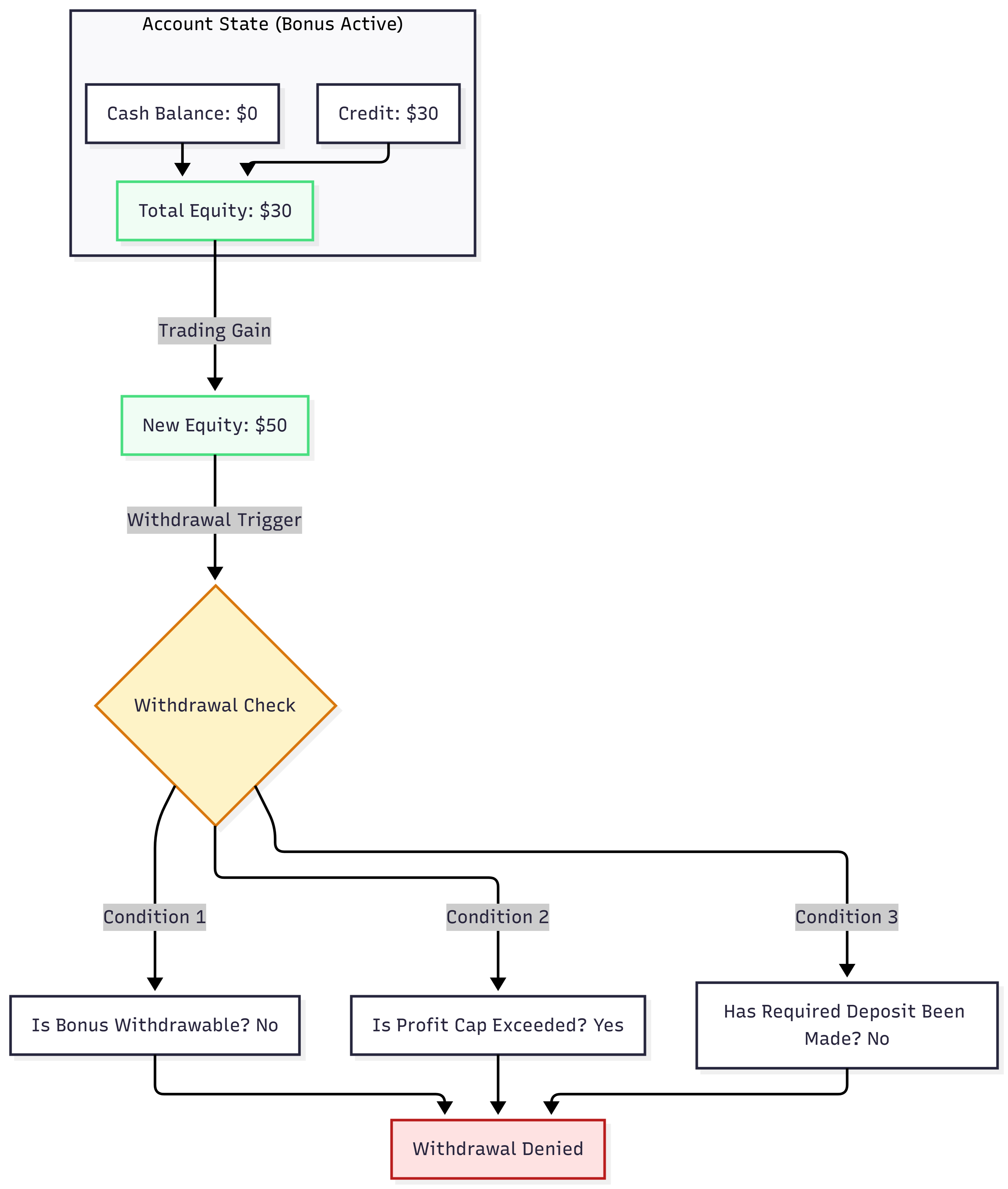
For this example, let’s say you sign up and get $30 of non-withdrawable credit. Your account looks like this:
Cash balance: $0
Promotional credit: $30
Account equity: $30
Once trading begins, equity changes according to open profit and loss.
Equity = cash balance + promotional credit + unrealised profit or loss
The trade goes your way, and you close the position with a $20 profit. The platform now displays $20 in balance and $30 in credit. Total equity is $50, but that does not mean you can withdraw $50.
The $30 remains promotional property and can never be withdrawn. The $20 may also remain conditional, depending on the bonus terms. You might, for instance, be required to meet a deposit and/or turnover requirement before you can withdraw any profit.
A Bonus Credit Is Not The Same As Cash In Your Account
Most no-deposit bonus (NDB) contracts stipulate that the bonus credit is not withdrawable under any circumstances.
One example is Tickmill’s Welcome Account Campaign, where the $30 initial credit cannot be withdrawn or transferred under any circumstances. There is also a limit on how little and how much profit can be transferred, and only one transfer request is permitted.
- The Initial deposit cannot be withdrawn or transferred from the Welcome Account.
- A minimum of 30 USD and a maximum of 100 USD of profit can be transferred from the Welcome Account to the Client’s Wallet held with Tickmill Ltd.
- Each Client can make only one request to transfer profit from the Welcome Account to the Client’s Wallet.
- In order to make a transfer of profit from the Welcome Account to the Wallet, the Client must:
- Register a Client Area account, using the same information provided during the Welcome Account registration (name, surname, email, date of birth, phone number, etc.);
- Provide the necessary identification documents required to validate the Client Area account;
- Deposit a minimum of $100 (or equivalent in other currency) to the Wallet.
- New live MT4 trading account should not be connected to any other Promotions (e.g. Rebate Campaign). “
Note: Tickmill calls the no-deposit bonus “a 30 USD initial complimentary deposit” that is added automatically to the Welcome Account. It is important to understand that even though the word deposit is used, this is not a $30 deposit made by the trader; it is a bonus credit given by the broker to the newly formed account.
The Tickmill Welcome Account arrangement separates promotional value from cash value.
A trader who turns $30 into $200 has produced $170 in platform profit. Under the $100 maximum transfer, no more than $100 of this can be withdrawn. The original $30 is also removed when the promotional account is closed.
The visible account value of $200 can therefore produce no more than $100 in withdrawable profit.
Do All No-Deposit Bonus Accounts Use B-Book Execution?
B-Book is a term used in the forex and CFD brokerage industry to describe a model where the broker takes the other side of a client’s trade rather than immediately hedging it in the external market.
We should not assume that every no-deposit bonus account uses B-book execution. Some do, and some don’t, and there are also hybrid solutions.
Retail forex brokers use several risk and execution structures. A company may internalise positions, hedge some exposure externally, route orders to liquidity providers, or apply a combination of two or more methods. You can find more information in the account agreement, execution policy, etcetera.
The existence of a no-deposit bonus in the account does not show or prove which method will be used. A no-deposit bonus account creates no customer deposit exposure initially, and this may affect the broker’s risk treatment.
A no-deposit account can often provide the trader with useful information about quoted spreads, platform stability, and order handling for this specific account type with this broker and platform.
The No-Deposit Bonus As A Tool For Customer Acquisition
For a broker, a no-deposit welcome bonus can be a great way to acquire new clients.
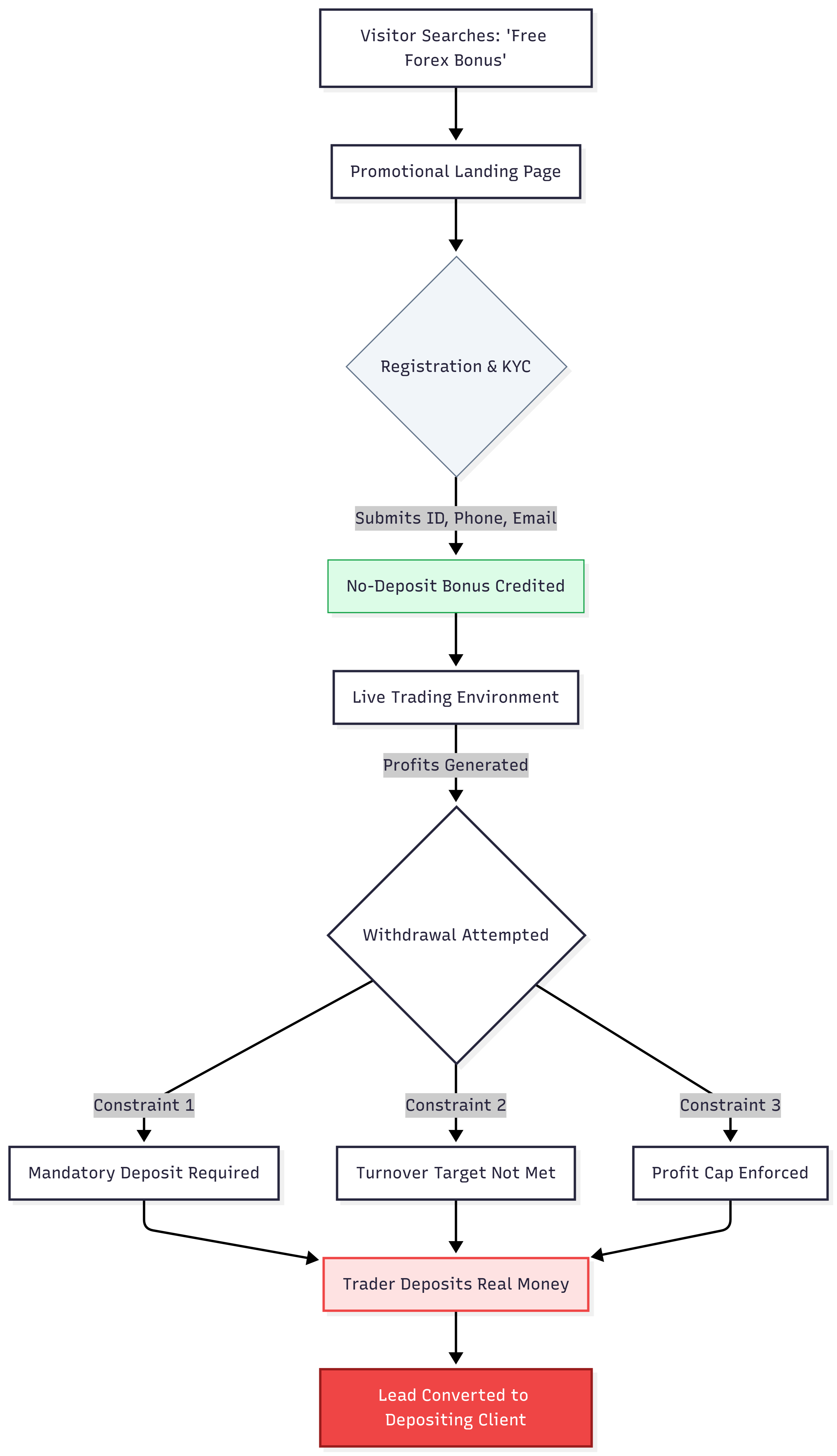
A broker does not need every promotional no-deposit account to generate an immediate deposit. Even if you don’t deposit in conjunction with the bonus period, the campaign may still have created a large database of people who have shown an interest in forex trading, and the broker knows how to reach them with new offers.
No-deposit bonus applicants will normally provide personal information, including contact information, before any bonuses are given out. They also go through the process of verifying their identity and residency, and open a live account that is ready to receive a real-money deposit at any time. The brokerage company can invite them to make a deposit to get a deposit match, enter a contest, or continue trading after the promotional account expires. With many no-deposit bonus offers, it is not possible to withdraw any profits without making a deposit first.
The Tickmill Welcome Account terms provide a clear example. The campaign gives qualifying new customers $30 in introductory credit and states that registration information may be used for the campaign and other marketing purposes.
Calling this “data harvesting” can be misleading if it implies that information is collected secretly or unlawfully. A more accurate description is that the promotion exchanges a no-deposit bonus credit for information, and that this is clearly stated in the contract terms. As a trader, you need to decide if supplying information and identity documents to a broker based in the Seychelles is proportionate to the potential benefit of a $30 no-deposit bonus with a $100 maximum profit withdrawal.
Why Brokers Require Verification For No-Deposit Bonus Accounts
Identity verification serves several purposes, and we will look at some of the major ones below.
A request for full verification of identity and residency is, by itself, not evidence of wrongdoing. But it shifts the scenario from “risk-free bonus money” to a scenario where you are actually taking a risk. You might not be making a deposit, but you are sending personal information to a broker who could potentially abuse it. In the wrong hands, any information you use to verify your identity and residency can be used by someone committing identity theft. It is therefore necessary to vet the broker closely before parting with this information.
Example: In the United States, the US Commodity Futures Trading Commission advises the public to thoroughly research over-the-counter foreign exchange (“forex”) dealers before handing over sensitive personal information.
It is also important to understand how reputable brokers handle the verification process and what they typically ask for. Examples of normal account verification requests are a photocopy of your passport or national photo ID, proof of address, phone verification, and a selfie. It is a strong red flag if you are asked to hand over an online-banking password, any type of PIN (e.g. M-Pesa PIN), your credit card number and security code, or similar.
Preventing Bonus Abuse
One of the reasons why brokers want to verify your identity before you get the no-deposit bonus is because they want to prevent the same person from claiming the promotion repeatedly, using several devices or registering through different email addresses. Therefore, they require identity verification.
Applicable Laws
In some jurisdictions, a broker can be required to verify customer identity even for a no-deposit bonus account. This can, for instance, be linked to rules regarding sanctioned countries.
A broker can also have strong internal reasons to prohibit customers from certain countries. Many retail forex and CFD brokers do, for instance, prohibit clients from the United States, since they are not in compliance with U.S. broker laws and do not want to run into trouble with U.S. authorities.
Typically, anti-money-laundering (AML) laws do not become an issue until it is time to process a withdrawal request, although many brokers still prefer to get the AML requirements out of the way upfront.
Lowering The Threshold
The no-deposit bonus is typically marketed as an easy and risk-free way to start trading without making a deposit. But of course, the broker is hoping that the new client will eventually make a deposit. To encourage this, they want to lower the threshold for making a deposit as much as possible. Therefore, they can, for instance, require the new client to go through the complete verification process before obtaining the bonus. When you already hold a trading account that is verified and ready for deposits and withdrawals, the threshold for making a deposit feels considerably lower. This makes it easier to convert a non-depositing client into a depositing trader.
For Marketing Purposes
If the trader goes through the full process of verifying their identity and residency, that information is worth more from a marketing perspective than simply having an email address on file. The broker, and the wider brokerage company group, can now use this information for tailor-made offers, e.g. deposit match bonus offers.
Depending on jurisdiction and the contract terms, the broker may also be able to sell and/or share the information with other entities that are interested in reaching an individual who has a known interest in financial trading/investing, and who has proven that that they are an adult, live in a certain country, and have access to the internet.
Examples Of Common Terms And Conditions For No-Deposit Forex Bonuses
No-Deposit Bonus With A Profit Cap
A profit cap limits how much money you withdraw, regardless of the displayed trading result.
Suppose a trader receives a $30 no-deposit bonus, trades successfully, and increases total account value to $800 during the bonus period. But the no-deposit bonus terms state that the maximum profit transfer is $50.
Displayed account value: $800
Original non-withdrawable credit (the no-deposit bonus): $30
Trading gain: $770
Maximum withdrawal: $50
When the bonus period ends, the broker removes the $30 bonus credit and the trader elects to withdraw $50. The account value decreases from $800 to $720. What happens to the remaining balance depends on the account and bonus terms and conditions. In some cases, the money is removed. In others, they remain available in the account, but can not be withdrawn. Make sure you know in advance what will happen.
If the contract stipulates that the profits will stay, it is important to know if the money will be tradable cash, meaning it can be used to absorb trading losses, or whether it is non-cash credit that only increases available margin or leverage. Traders should review these conditions in advance so they understand exactly how withdrawals, losses, margin, and bonus adjustments will affect their account balance.
Profit caps protect the broker from paying large returns generated from a small promotional amount. A cap does not make the offer worthless, but it does reduce the usefulness of the bonus, especially if all additional profit will vanish once the bonus period is over.
Instead of believing trading your small no-deposit bonus will make you rich, it is better to treat the no-deposit bonus as a chance to evaluate how the broker and platform work. A setup that grows a $30 promotional account to $300 has not generated a withdrawable $270 return if there is a $50 profit cap, but it has still demonstrated trading performance within these specific conditions.
No-Deposit Bonus With A Minimum Profit Condition
Some no-deposit bonus campaigns set a minimum withdrawal requirement, and if your account does not have enough withdrawable cash to fulfill it, you can’t make any withdrawal.
If we go back and look at Tickmill’s Welcome Account terms, we see that there is both a minimum and maximum threshold for the transfer into the Client’s Wallet, and only one transfer is permitted. This is not even a withdrawal; it is simply the transfer from the welcome account to the Client’s Wallet held with the broker.
- “The initial deposit cannot be withdrawn or transferred from the Welcome Account.
- A minimum of 30 USD and a maximum of 100 USD of profit can be transferred from the Welcome Account to the Client’s Wallet held with Tickmill Ltd.
- Each Client can make only one request to transfer profit from the Welcome Account to the Client’s Wallet.”
When a no-deposit bonus has both minimum and maximum transfer limits, it creates a payment range, and this range can be uncomfortably narrow. The trader must earn enough to cross the minimum, but gains no added cash value after reaching the cap.
Meeting A Turnover Requirement Before Profits Can Be Withdrawn
No-deposit promotions can require that you trade a certain amount of money or a certain number of lots before profits become withdrawable. This can encourage overtrading and is one of the reasons some regulators have banned online trading bonuses.
Turnover conditions are often a source of confusion for traders, since there is no global standard for how the different terms must be used or how different types of trading must count towards the turnover requirement.
Since turnover requirements are both very common and frequently cause problems for traders, we have given them their own section further down in this article, where we will look at the nitty-gritty of no-deposit bonus turnover requirements.
The Deposit Condition
This is a condition that many traders miss until they try to make a withdrawal. A verification deposit requirement means that you have to make a first deposit into your trading account before you can make your first withdrawal.
You got a no-deposit bonus, but removing any of the profits earned during the bonus period requires a deposit. This is part of the plan to convert no-deposit clients into depositing clients. Even if you do the minimum possible deposit, you now have a funded account.
A real-world example of this is Tickmill’s Welcome Account terms, which stipulate that a trader must create and verify a full client account and deposit at least $100 into the wallet before requesting a profit transfer. The promotion is no-deposit at the trading stage, but it is not deposit-free at the payment stage.
Let’s assume you accepted a $30 no-deposit bonus and made a $75 profit. The $30 bonus is removed at the end of the bonus period. You now see $45 in the account. To make a withdrawal request, you must first make a $100 deposit. After the deposit, you have $145 in your account. The economics are not automatically poor, but it is important to check the fine print to find out what happens next.
Examples of questions to ask:
- Will my $100 deposit be immediately withdrawable?
- What are the deposit and withdrawal fees?
- Can all the money be withdrawn using my deposit method, or are special rules in place for the $45 that comes from the bonus period?
Disclosure Makes The Difference
A clearly disclosed deposit condition is different from an unexpected demand made after a withdrawal request. The CFTC warns that fraudulent entities commonly refuse withdrawals until customers pay expensive, undisclosed commissions, pay made-up taxes, or invest more to reach a higher account-level status.
The distinction rests on timing and documentation. A deposit requirement shown in the official promotion terms before registration is a contractual condition that can be assessed. A new payment demand invented after the customer meets the published rules is a serious red flag, and it is best to cut your losses right away and not deposit a cent.
Beware Of The New Bonus Trap
When a broker requires you to make a deposit in order to make a withdrawal request, don’t be surprised if you get a deposit bonus offer.
This deposit bonus will come with its own terms and conditions, and if you accept the bonus, you can find your account temporarily locked again, with no withdrawals being permitted until you have met the new requirements.
Meeting A Turnover Requirement Before Profits Can Be Withdrawn
Many bonus offers, including no-deposit bonus offers, come with a turnover requirement, as we unpack in our warning about the costs of forex bonuses. This general idea is to prevent a person from accepting a bonus, doing a little bit of trading, and then quickly vanishing with any profits.
A turnover requirement is typically expressed in money or number of lots, and it must be fulfilled before profits become withdrawable. (Other conditions can also apply.)
Fully understanding what the turnover requirement entails can be complicated, since there is no agreed-upon terminology that all brokers use.
Example Of A 100-Time Turnover Requirement
One standard forex lot represents 100,000 units of the base currency. Using a simplified $100,000 notional value, the conversion is Standard lots = required notional volume ÷ $100,000.
A $30 bonus with a turnover requirement equal to 100 times the bonus will have $30 × 100 = $3,000 in notional turnover requirement.
The lot equivalent is $3,000 ÷ $100,000 = 0.03 standard lots.
The Vantage No-Deposit Bonus Of 2024
A real-world example of a no-deposit bonus that came with a 3-lot turnover requirement is the no-deposit bonus offered by Vantage Global Limited in 2024.
A client who received the $100 no-deposit bonus was required to complete three standard lots before withdrawing profit. The bonus contract also capped profit withdrawals at $100 and required each qualifying trade to remain open for at least ten minutes. The offer was issued by Vantage Global Limited under Vanuatu jurisdiction.
This is a useful mathematical case.
At an estimated all-in spread and commission cost of $8 per standard lot, the client pays $24 in transaction costs to complete 3 lots. (3 lots × $8 = $24 in transaction costs).
A trader attempting to unlock a maximum $100 payment would therefore consume 24% of that value through ordinary transaction costs. And that is even before considering slippage and market losses.
How A Trade Counts Against The Turnover Requirement
It is important to know how the contract counts opening and closing volume.
We must also know if both sides of the transaction count, or just one. Does opening 1 lot and closing 1 lot count as 1 lot or 2 lots against the turnover requirement? Do both sides of the transaction need to be completed to register any trade against the turnover requirement? (This question can become especially hot as the bonus deadline approaches.)
The volume contribution can vary by market. One lot of gold does not have the same contract size or pip value as one standard lot of forex. The bonus contract should clearly define how each instrument counts against the turnover. If you are given a vague contract, it will be difficult for you to properly evaluate the no-deposit bonus before you decide to accept or reject it.
Position Size And Total Turnover
Fortunately, completing three standard lots will normally not require the trader to open and close one 3-lot position, or even three 1-lot positions. Under most contracts, a trader can just as well complete the turnover requirement through 300 trades of 0.01 lots, or 30 trades of 0.10 lots, or any other combination.
Using smaller positions reduces the amount lost per pip, but increases the number of separate decisions and opportunities for execution error. Splitting the turnover into many tiny positions changes the pattern of risk, but it does not remove transaction friction.
At 0.01 lots, one pip on EUR/USD is normally worth about $0.10. A one-pip all-in cost across 300 completed 0.01-lot trades still produces approximately $30 in aggregate cost.
Minimum Holding Periods
A trade may need to remain open for a certain amount of time, e.g. 5 minutes, before it contributes to the target. Shorter trades can still be permitted in the account, but will not help you reach the turnover goal.
In the old Vantage example, each trade had to remain open for at least ten minutes to count against the requirement. A position closed after nine minutes could still generate profit or loss, and result in transaction costs, but would not count towards the withdrawal requirement.
This restriction is particularly important for scalpers and certain other very short-term traders. The account can permit the position while disqualifying it from the turnover countdown.
Why Tight Time Limits Matter
A volume requirement becomes more dangerous when paired with a short expiry period.
Suppose you must complete three lots in 14 days. Your strategy is based on 0.01-lot positions. Therefore, you need 300 completed trades, equal to more than 21 trades per day if activity is spread evenly. Of course, a 14-day period running from Monday 1 to Sunday 14 will actually only contain 10 standard trading days, since it includes 2 Saturdays and 2 Sundays, and the global forex market runs 24/5, not 24/7. Therefore, if the requirement can only be satisfied during normal forex trading hours, you would need an average of 30 trades per trading day (300 ÷ 10).
If your normal trading strategy only generates two or three suitable trades per trading day, on average, you might feel tempted to diverge from it, since you have a turnover requirement to fulfil. When a small-scale trader who is used to making no more than a few trades per trading day suddenly tries to cram in 30 trades per trading day, the result is rarely a positive one. The strategy is not suited for it, and the trader is not used to trading so frequently. He will pick setups that are less than ideal for the strategy and can start making emotional decisions based on “gut feeling”.
This is also where many traders begin to open larger positions than normal, and use more leverage (if available), and this is also, typically, a recipe for account disaster.
With a turnover requirement to fulfil, the trading objective changes from finding a favourable risk and reward relationship to generating eligible volume.
Incremental Release
With a no-deposit bonus, profits are typically released as a lump sum. This means you have to fulfil the entire turnover requirement, within the allotted time, to be able to withdraw any profits. It is all-or-nothing.
With deposit bonuses, which are often larger than no-deposit bonuses, some brokers offer incremental release of bonus money and/or profits. This means that money can become available for withdrawal at certain intervals, as you gradually work your way through the turnover requirement.
Operational Restrictions On No-Deposit Trading Accounts
When you sign up for a new trading account and receive a no-deposit bonus, the bonus terms can place significant limitations on your account. Bonus terms can, for instance, restrict position size, available instruments, hedging, and the number of open orders. They can also prohibit certain trading strategies and styles, e.g. news trading, scalping, and the use of trading robots. These conditions manage the broker’s exposure.
You should also make sure you know the general prohibitions and limitations with this broker and account type; the rules that will remain even as you move out of the no-deposit bonus period and into normal trading. Don’t sign up with a broker to get a no-deposit bonus if the broker is ultimately unsuitable for your trading strategy and preferences.
Last but not least, the turnover requirement itself can also come with limitations. A certain financial product might, for instance, be available and permitted during the no-deposit bonus period, but will not count against the turnover requirement. For more information about turnover requirements, go to that section further up in this article.
Position And Account Limits During The No-Deposit Bonus Period
A no-deposit bonus contract may impose a maximum lot size per trade or cap total open volume during the bonus period. The purpose is normally to stop a customer from placing one highly leveraged transaction that either destroys the account or produces a large profit and turnover.
A low position limit can make a turnover target time-consuming. A generous maximum can encourage the customer to take more risk than the account can absorb. The trader should calculate the margin requirement and pip value for the permitted size. The fact that an order fits within the promotion’s maximum does not mean it is sensible on a $30 account.
Instrument Restrictions During The No-Deposit Bonus Period
When you start digging into the bonus terms, you might find all sorts of instrument restrictions. Some no-deposit bonus terms will, for instance, only permit major and minor currency pairs during the bonus period, while others include all forex pairs and metals but exclude indices, shares, and digital assets.
Instrument restrictions alter the educational value of the account. A customer interested in gold trading learns little from a campaign that permits only EUR/USD and GBP/USD.
Automated Trading
Some bonus contracts prohibit the use of trading robots, such as Expert Advisors. A trader testing an automated strategy can therefore not use the bonus for the evaluation.
Hedging
Many bonus contracts prohibit internal or external hedging designed to avoid market risk. Hedging restrictions can be broader than placing opposite positions inside one account, and they may, for instance, cover related accounts at the same broker or positions held with another company.
Abuse
The bonus terms should define abuse precisely. A general right to cancel profit at the broker’s own discretion based on vague criteria gives the broker more power than an objective rule that is clearly stated in the contract.
No-Deposit Bonus Trading vs. Demo Account Trading
A free demo account filled with play-money is a great way to learn how the platform works without risking any real money and without being stressed by a turnover requirement. It allows the trader to focus on order mechanics, strategy testing, and risk control without an expiry-driven withdrawal target. A downside is the fact that some demo environments are too perfect and may, for instance, be devoid of slippage.
A no-deposit bonus can serve as a bridge between a demo account and a funded account, since it uses a live trading platform and creates a possible cash reward. But we need to take into account that the bonus conditions can distort trading, both through firm limitations and through the urge to complete the turnover requirement.
| Checkpoint | No-deposit Bonus Trading | Free Demo Account With Play-money |
|---|---|---|
| Personal cash required initially | Usually none | None |
| Original account funds withdrawable | No, the bonus is usually never withdrawable | No, it’s just play-money |
| Profit withdrawal | Possible under contract conditions | Not possible, it’s just play-money |
| Identity and address verification | Often required | Less likely to be required |
| Know-your-customer (KYC) | More likely to require KYC, not by law, but because the broker wants you to have a fully functional account | Will usually not require KYC |
| Trading pressure | Turnover requirement can create pressure | No financial reason to force turnover |
| Account lifespan | Often fixed, e.g. 30 days | Varies. Some expire after 30 days, or close after a period of inactivity. Some are more limited. |
| Execution | Live or live-style conditions, depending on the programme | Simulated execution, even if based on true price data |
| Best use | Testing limited live conditions and withdrawal mechanics | Learning the platform and testing a strategy repeatedly (albeit in too perfect conditions) |
Educational Value
A demo account is better for learning platform controls because mistakes have no financial or contractual consequence. The trader can practise things such as placing stops, changing order size, and closing partial positions. You can learn features by experimenting. Many brokers will give you at least 30 days and $10,000 in play-money. Typically, you can prolong this and get more money by contacting customer support. This way, you can practise at your own pace.
A no-deposit account introduces real spreads, slippage risk, and a potential payment. Bonus money can create more emotional involvement than play-money, but the emotion is not identical to trading your own deposited capital. The turnover requirement can distort trading decision-making.
Execution Comparison
The demo environment might not reproduce live slippage, liquidity, and order rejection correctly. The server does not need to manage the same financial exposure as for a live account.
No-deposit bonus trading can provide a more realistic display of the broker’s live platform, though its execution arrangement may still differ from ordinary funded accounts.
Neither account is a complete test of how a large live order will perform. A $30 promotional account using 0.01 lots cannot establish how the broker handles a ten-lot position during an economic announcement.
Privacy Difference
A demo account is not free from privacy considerations. The provider may, for instance, collect an email address, phone number, device data, cookies, and platform activity.
The difference is degree. A no-deposit profit claim commonly requires formal identification and proof of address. A basic demo account often does not require that level of documentation.
How To Evaluate A No-Deposit Bonus
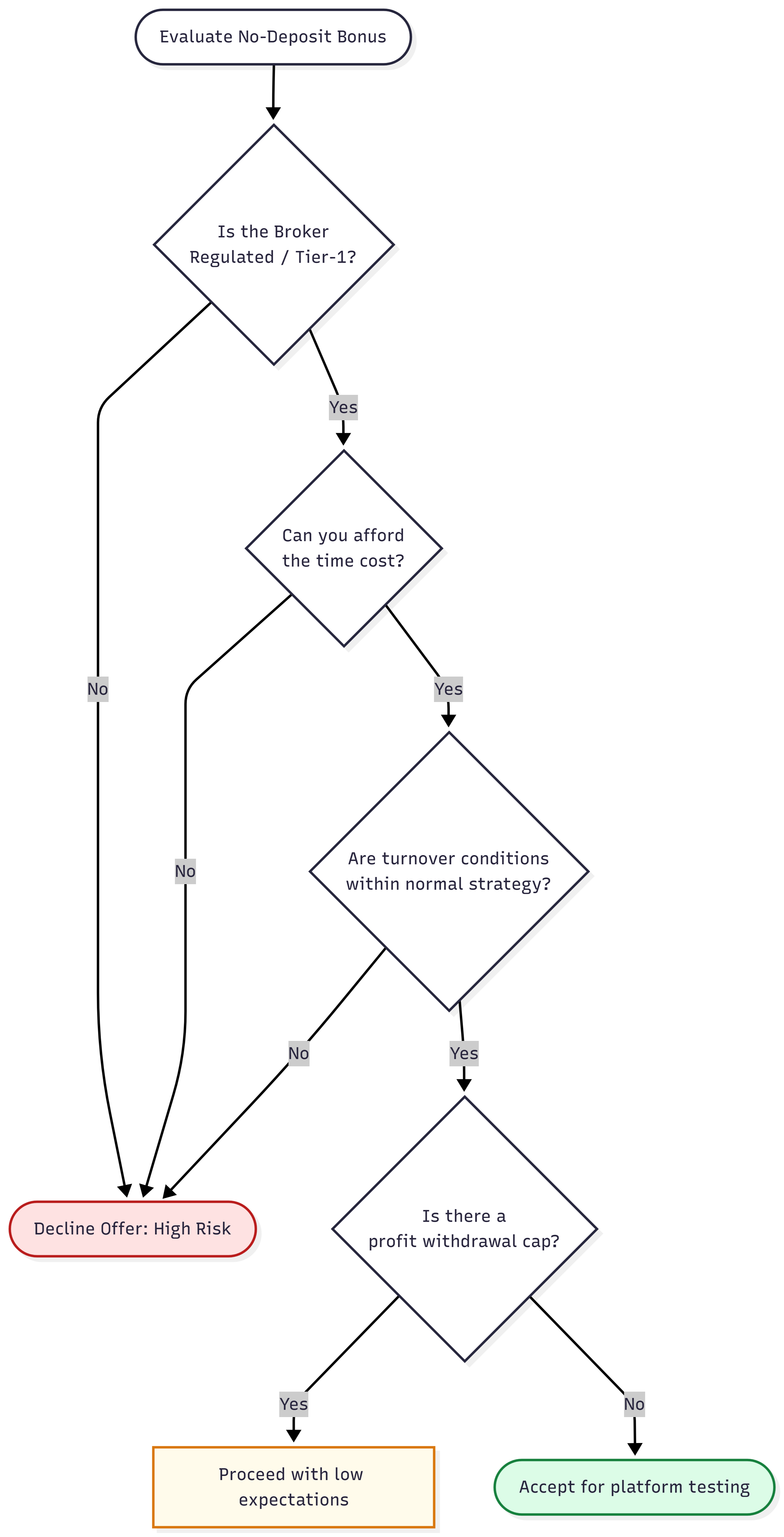
Consider it a warning sign if the user agreement and bonus contract can not provide you with this information in a clear manner.
| Checkpoint | What to check |
|---|---|
| Legal company | The entity issuing the bonus, its regulator, and governing law |
| Bonus withdrawal | Is the bonus non-withdrawable promotional credit, or can it be withdrawn if conditions are fulfilled? |
| Maximum profit | The precise cash amount that can leave the account |
| Minimum profit | The threshold below which no withdrawal can be made |
| Deposit requirement | Whether funding is required before a withdrawal can be made |
| Turnover requirement | The exact lots or notional value required |
| Turnover requirement limitations | Which positions are eligible against the turnover requirement? |
| Time period | The bonus period expiry |
| Final withdrawal-request date | How soon after bonus expiry must the withdrawal request be made? |
| Position rules during bonus period | Maximum lot size, open-position cap, and eligible instruments |
| Strategy rules | Treatment of scalping, EAs, hedging, news trading, etc. |
| Data use | Whether registration details can be used for wider marketing, shared, and sold. |
| Payment route | Approved deposit and withdrawal methods; Deposit and withdrawal fees |
| Cancellation power | The circumstances in which the broker can void credit and/or profits |
The trader should calculate the cash ceiling first. There is little reason to jump through the hoops and analyse and adapt a complex strategy for an account that can pay out no more than $50. You can still use the no-deposit bonus for educational purposes, but without chasing the turnover requirement.
The next calculation is the expected transaction cost. Estimated cost = required lots × average spread and commission per lot. This figure should be compared with the maximum profit payment, not the promotional credit.
The customer should then remove the flowery marketing language and describe the offer in one sentence. A current Tickmill-style structure could, for instance, be summarised as “You can trade with $30 for up to 60 days, but earn no more than $100 in transferable profit, and you must verify a full account and deposit $100 before requesting the transfer.” That description is less exciting than “free risk-free trading funds”, but it is much easier to evaluate.
A Welcome Bonus Is Not Necessarily A No-Deposit Bonus
Do not assume that a bonus is a no-deposit bonus just because it is labelled a welcome bonus. The term welcome bonus is used for a variety of bonus types, e.g.
- No-deposit bonus for new sign-ups
- First deposit bonus (often a matching bonus)
- A welcome bonus package that can include various welcome bonuses, e.g. a no-deposit sign-up bonus followed by matching bonuses on your first three deposits.
One example of a welcome bonus that requires a deposit even though it is a small bonus is the RoboForex Welcome Bonus 30 USD. In addition to requiring full identity and address verification and phone number verification, this $30 bonus also requires a qualifying deposit of at least $10 or €10 before you get the bonus credit. You must make the deposit using a bank card, and only deposits made via China UnionPay, Maestro, MasterCard, or VISA cards are eligible. (For Tanzania, Uganda, and Namibia, deposits via Binance Pay are also eligible.) Deposits made using virtual cards issued by payment systems, as well as prepaid cards, are not eligible. So, not only is there a deposit requirement, but the deposit requirement also comes with very specific rules for how the deposit can be made.