




A number of high-profile trading brokers and exchanges have gone bankrupt in recent years without suitable liquidity and client fund protection measures. As a result, investors are becoming increasingly aware of the importance of trading with a broker that holds customer funds in segregated bank accounts.
This article explains the pros of brokers with segregated accounts and how to compare providers. We also list the dangers of signing up with trading platforms that do not separate operating capital from traders’ funds.
Brokers With Segregated Accounts
-
- Demo account
- Min. deposit: $100
- Min. trade: 0.01 Lots
-
- Demo account
- Platforms: MT4, MT5, TradeLocker
- Min. deposit: $50
-
- Demo account
- Regulator: CySEC, FSCA, FSA, ADGM/FRSA
- Min. deposit: $10-$250 (location and tier dependent)
-
- Demo account
- Platforms: MT4, MT5, TradingCentral
- Min. deposit: $5
-
- Demo account
- Regulator: FCA, ASIC, CMVM , FSCA, SCB, FSA
- Platforms: TN Trader, MT4, TradingView
-
- Demo account
- Regulator: FSC
- Min. deposit: $200






Learn how we test brokers and why you can trust our ratings.
This is why we think these brokers are the best in this category in 2026:
- AvaTrade 4.9/5 Established in 2006, AvaTrade is a leading forex and CFD broker trusted by over 400,000 traders. Operating under regulation in 9 jurisdictions, AvaTrade processes an impressive 2+ million trades each month. Through like MT4, MT5, and its proprietary WebTrader, the broker provides a growing selection of 1,250+ instruments. Whether it’s CFDs, AvaOptions, or the more recent AvaFutures, short-term traders at all levels will find opportunities. With terrific education and 24/5 multilingual customer support, AvaTrade delivers the complete trading experience.
- Plexytrade 3.9/5 Established in 2024 and headquartered in Saint Lucia, Plexytrade is an ECN/STP broker. Geared towards active traders, it supports four account options, crypto deposits and withdrawals, plus very high leverage up to 1:2000 made possible by its unregulated status.
- NAGA 4.1/5 NAGA is a German-headquartered social investing platform offering copy trading on thousands of financial markets including CFDs and real stocks. Founded in 2015, the company is publicly listed on the Frankfurt Stock Exchange and regulated in the EU, Middle East and globally. The firm offers an all-in-one web platform and mobile app, but traders can also synchronize their NAGA accounts with popular third-party software, including MT4 and MT5.
- XM 4.8/5 XM is a globally recognized forex and CFD broker with 20+ million clients in 190+ countries. Since 2009, this trusted broker has been delivering low trading fees across its growing roster of 1000+ instruments. It also offers a comprehensive MetaTrader experience that we've observed firsthand placing test trades.
- Trade Nation 4.4/5 Trade Nation is a top FX and CFD broker regulated in multiple jurisdictions including the UK and Australia. The firm offers low-cost fixed and variable spreads on 1000+ assets with robust trading platforms and training materials. The Signal Centre can also be used for trade ideas.
- IC Trading 4.2/5 IC Trading is part of the established IC group (including what used to be 'IC Markets'). Built for serious traders, it boasts some of the most competitive spreads, reliable order execution, and advanced trading tools. The catch is that it’s registered in the offshore financial centre of Mauritius, enabling it to offer high leverage but in a weakly regulated trading setting.
Community Sentiment
See how users rate these brokers based on the average customer ratings submitted on DayTrading.com, plus ratings from Trustpilot, the Apple App Store and Google Play.
| Broker | Our Users' Rating | Trustpilot Score | Trustpilot Reviews | iOS App Rating | Android App Rating |
|---|---|---|---|---|---|
| AvaTrade | 13545 | ||||
| Plexytrade | 95 | ||||
| NAGA | - | 4113 | |||
| XM | 3130 | ||||
| Trade Nation | 2142 | ||||
| IC Trading | 606 |
AvaTrade
AvaTrade offers active traders everything they need: an intuitive WebTrader, powerful AvaProtect risk management, a smooth 5-minute sign-up process, and dependable support you can rely on in fast-moving markets.
 Jemma Grist, Reviewer
AvaTrade quick facts
- Demo Account
- ✔Yes
- Instruments
- CFDs, Forex, Stocks, Indices, Commodities, ETFs, Bonds, Crypto, Spread Betting, Futures
- Regulator
- ASIC, CySEC, FSCA, ISA, CBI, JFSA, BVI, FSRA/ADGM, AFM, CMA-Kenya, CIRO (via Friedberg Direct)
- Platforms
- WebTrader, AvaTradeGO, AvaOptions, AvaFutures, MT4, MT5, AlgoTrader, TradingView, TradingCentral, DupliTrade
- Minimum Deposit
- $100
- Minimum Trade
- 0.01 Lots
- Account Currencies
- USD, EUR, GBP, CAD, AUD, ZAR
Pros
- Support at AvaTrade performed excellently during testing, with response times of 3 minutes and localized support in major trading jurisdictions, including the UK, Europe and the Middle East.
- The WebTrader excelled in our hands-on tests, sporting a user-friendly interface for beginners, complete with robust charting tools like 6 chart layouts and 60+ technical indicators.
- AvaTrade launched AvaFutures to offer low-margin access to global markets, then expanded in 2025 as one of the first brokers to add CME’s Micro Grain Futures, and then later in the year went further by integrating with TradingView.
Cons
- The AvaSocial app is good but not great – the look and feel, plus the navigation between finding strategy providers and account management needs upgrading to rival category leaders like eToro.
- While signing up is a breeze, AvaTrade lacks an ECN account like Pepperstone or IC Markets, which provides the raw spreads and ultra-fast execution many day traders are looking for.
- AvaTrade’s WebTrader has improved, but work is still needed in terms of customizability – frustratingly widgets like market watch and watchlists can’t be hidden, moved, or resized.
Plexytrade
Plexytrade is a newcomer in the brokerage scene with attention-grabbing features like 1:2000 leverage, zero spreads on select instruments and fast execution speeds of less than 46 milliseconds. However, the absence of regulation is a significant concern, while the non-existent research and educational tools place it far behind industry frontrunners.
 Christian Harris, Reviewer
Plexytrade quick facts
- Demo Account
- ✔Yes
- Instruments
- CFDs, Forex, Indices, Stocks, Commodities, Crypto
- Platforms
- MT4, MT5, TradeLocker
- Minimum Deposit
- $50
- Minimum Trade
- 0.01
- Account Currencies
- USD, EUR
Pros
- Plexytrade accommodates a range of trading methods and short-term strategies, including scalping, hedging, and automated trading.
- Sub 50ms execution speeds are fast enough for intraday trading setups.
- There are various VPS packages starting from $50 per month, but they become complimentary once specific deposit thresholds are reached.
Cons
- There are no social or copy trading features for inexperienced traders to replicate the trades of more experienced investors, trailing category leaders like eToro.
- Deposits and withdrawals are exclusively facilitated through cryptocurrencies, as Plexytrade does not support bank cards, bank wire transfers, or e-wallets.
- Plexytrade lacks regulation in major jurisdictions, significantly increasing the risks of opening an account and depositing funds.
NAGA
NAGA is a snug fit for beginners who like to learn by watching others, delivering a more advanced social trading network than the majority of CFD brokers, featuring a leaderboard with top traders by profit and win rate, and a one-tap autocopy function in the platform and app that’s a standout.
Christian Harris, Reviewer
NAGA quick facts
- Demo Account
- ✔Yes
- Instruments
- CFDs on Forex, Indices, Shares, Commodities, Crypto, Real Stocks and Futures
- Regulator
- CySEC, FSCA, FSA, ADGM/FRSA
- Platforms
- NAGA Platform, NAGA App, MT4, MT5, TradingView, TradingCentral
- Minimum Deposit
- $10-$250 (location and tier dependent)
- Minimum Trade
- 0.01 Lots
- Account Currencies
- USD, EUR, GBP, PLN
Pros
- NAGA stands out among social brokers for its wide range of assets, offering over 4,000 tradable options. These include forex pairs, stock, ETF, and index CFDs, commodity CFDs, crypto, and even exchange-traded futures, which are rare for retail clients.
- During testing, we were approved to begin trading very quickly; after we provided our ID and proof of address, approval was granted the next business day, and the onboarding process included a suitability questionnaire — a responsible step that some brokers fail to include.
- The copy-trading feature is the main reason to open a NAGA account, and it’s more advanced than what most CFD brokers offer. You can check a leaderboard of top traders by profit and win rate, then automatically copy their trades in the same app - only eToro offers something similar.
Cons
- The 1:30 leverage limit only applies to clients in the EU (under CySEC) and the GCC (through Abu Dhabi’s ADGM). Clients from LATAM, Asia, and Africa use the Seychelles or FSCA entities, where leverage can go up to 1:1000 and there’s no compensation scheme. This mix of high leverage and little protection is a risk, along with concerns about its suspended Trustpilot score in 2026.
- The $50 monthly inactivity fee is on the high end of the scale. It kicks in after two months of no activity, not every quarter like some brokers. If your balance falls below $50 while your account is inactive, NAGA takes whatever is left and closes your account.
- NAGA’s pricing structure is tough on smaller accounts. There’s only one account type, but it has six tiers based on your deposit. The EUR/USD spread is about 1.7 pips at the Iron tier and drops to a competitive 0.9 pips at Diamond ($50,000 deposit) or 0.7 pips at Crystal ($100,000 deposit).
XM
With a low $5 minimum deposit, advanced charting platforms in MT4 and MT5, expanding range of markets, and a Zero account offering spreads from 0.0, XM provides all the essentials for active traders, even earning our ‘Best MT4/MT5 Broker’ award in recent years.
Christian Harris, Reviewer
XM quick facts
- Demo Account
- ✔Yes
- Instruments
- CFDs, Forex, Stocks, Commodities, Indices, Thematic Indices, Precious Metals, Energies
- Regulator
- CySEC, DFSA, FSCA, SCA, FSA, FSC-Belize, FSC-Mauritius, CMA-Kenya, CMA-UAE
- Platforms
- MT4, MT5, TradingCentral
- Minimum Deposit
- $5
- Minimum Trade
- 0.01 Lots
- Account Currencies
- USD, EUR, GBP, JPY, ZAR
Pros
- XM’s customer support has delivered over years of testing, with 24/7 assistance in 30 languages, response times of under 2 minutes and a growing Telegram channel.
- XM’s growing roster of 1,400+ instruments provides diverse short-term trading opportunities, with unique turbo stocks, fractional shares, and more recently thematic indices.
- XM stands out for its commitment to trader education, with a wealth of well-presented resources, including webinars, tutorials, and even real-time trading sessions through XM Live.
Cons
- XM is falling behind the curve by not offering cTrader, which is favored over MetaTrader by some serious traders for its smoother user experience and superior charting package.
- While the XM app stands out for its usability and exclusive copy trading products, the selection of technical analysis tools needs to be improved to meet the needs of advanced traders.
- Although trusted and generally well-regulated in some regions, XM also has global entities registered with the weak regulators like FSC (Belize) and FSA (Seychelles), whilst UK clients are no longer accepted, reducing its market reach.
Trade Nation
Trade Nation suits discretionary traders who want to speculate on major indices like the US 500 or liquid FX pairs, and want the predictable all-in costs of fixed spreads. In tests, we found the fixed-spread TN Trader environment particularly useful for trading around scheduled economic releases owing to its reliable charting environment and because published spreads stayed capped.
Christian Harris, Reviewer
Trade Nation quick facts
- Demo Account
- ✔Yes
- Instruments
- CFDs, Forex, Indices, Shares, Commodities, Futures, Bonds, Spread Betting (UK and Ireland only), Cryptos (Bahamas entity only)
- Regulator
- FCA, ASIC, CMVM , FSCA, SCB, FSA
- Platforms
- TN Trader, MT4, TradingView
- Minimum Deposit
- $0
- Minimum Trade
- 0.1 Lots
- Account Currencies
- USD, EUR, GBP, AUD, ZAR, SEK, NOK, DKK
Pros
- Trade Nation's 2026 partnership with Volt has sped up payments for Australian traders, who can now make instant deposits and withdrawals using PayID, with the faster payout capabilities planned for clients in the UK and EU.
- Trade Nation accounts can now be linked with TradingView, providing advanced multi-charts and the ability to execute trades directly.
- The demo comes with a $5,000 practice account and you can request a one-on-one platform walkthrough by callback - this level of personal help is rare.
Cons
- There is no raw or ECN pricing tier, which are often prefered by day traders. No matter how much you deposit or trade, you use the same fixed (or variable on MT4) pricing as beginners, making it unsuitable for scalpers especially.
- Withdrawals can take up to five business days, which is around the industry average but slower than the 1-3 days we’re increasingly seeing brokers offer in an attempt to quash withdrawal complaints from retail investors.
- Offshore SCB and FSA entities allow retail clients up to 1:200 and 1:500 leverage compared to 1:30 in regions like the UK, Europe and Australia, so an FSA client can have 16 times the exposure of a UK retail client on the same trade, but with less oversight and no compensation scheme.
IC Trading
With superior execution speeds averaging 40 milliseconds, deep liquidity, and powerful charting software, IC Trading delivers an optimal trading environment tailored for scalpers, day traders, and algorithmic traders.
Christian Harris, Reviewer
IC Trading quick facts
- Demo Account
- ✔Yes
- Instruments
- CFDs, Forex, Stocks, Indices, Commodities, Bonds, Cryptos, Futures
- Regulator
- FSC
- Platforms
- MT4, MT5, cTrader, AutoChartist, TradingCentral
- Minimum Deposit
- $200
- Minimum Trade
- 0.01 Lots
- Account Currencies
- USD, EUR, GBP, CAD, AUD, NZD, JPY, CHF, HKD, SGD
Pros
- Trading Central and Autochartist are valuable tools for in-depth technical summaries and actionable trading ideas and are accessible from within the account area or the cTrader platform.
- IC Trading provides industry-leading spreads, including 0.0-pip spreads on major currency pairs such as EUR/USD, making it ideal for day traders.
- IC Trading offers unusual flexibility in its accounts, enabling traders to open up to 10 live and 20 demo accounts, meaning you can run separate profiles for different activities, such as manual trading and algo trading.
Cons
- Despite being part of the trusted IC group, IC Trading is authorized by a weak regulator - the FSC of Mauritius, with limited financial transparency and regulatory safeguards.
- Customer support performed poorly during testing with multiple attempts to connect via live chat and no one available to assist, plus unanswered emails, raising concerns about its ability to address urgent trading concerns.
- The educational resources are greatly in need of improvement, unless you navigate to the IC.com website, posing a limitation for beginners in search of a comprehensive learning journey, especially compared to category leaders like eToro.
Segregated Accounts Explained
In trading, a broker that uses a segregated bank account holds client funds separately from company capital. This means the broker does not use its customers’ funds for trading, lending, or other purposes.
The top trading brokers conduct regular audits of their segregated asset accounts to give investors peace of mind regarding their funds. The most secure brokers also store client funds in reliable, Tier-1 bank accounts to offer maximum protection.
But the claim of ‘segregated client money accounts’ that you see in a broker’s marketing materials isn’t always as clear cut as it seems. The entity used, local regulations and more can impact how secure and separate the client money really is. We’ve build a dedicated guide to unpack the importance of client fund segregation and the steps every active trader should take.
Why Are Brokers With Segregated Accounts Important?
Many traders assume their funds are safe with a trading broker or online exchange. However the collapse of several big names, such as FTX, has brought the importance of using a brokerage with segregated accounts into sharp focus.
When a broker keeps client funds segregated from company capital, the firm can theoretically pay out all of its clients should they wish to withdraw their net balance. However, firms that do not use segregated accounts can be exposed when many traders want to take out funds, leaving users empty-handed.
Mass withdrawals often have a knock-on effect when more and more investors scramble to get their capital, spiralling the broker into financial difficulties.
This was illustrated when, despite being a CFTC-regulated crypto exchange, FTX used client funds as capital to invest through their sister company – Alameda Research. A wave of client withdrawal requests exposed that FTX did not have the means to cover all of its clients’ withdrawals.
However, FTX is not the only trading provider that has used client funds for its own purposes. MF Holdings also used client funds from supposedly segregated bank accounts to cover their margin obligations. The CFTC fined the brokerage $100 million, and after a year, investors received their funds back.
How To Check If A Broker Uses Segregated Accounts
While many of the largest brokerage firms use segregated bank accounts to protect client funds, investors should never assume that their capital is safe.
With forex brokers, general investment brokers, crypto exchanges or any other online finance company, information about segregated accounts is usually found on their website.
When you’re on a broker’s website, navigate to the “About” section of the site. Many forex brokers will advertise their fund protection measures here, but if not, there will usually be a separate section for “Regulation” or “Safety of Funds”.
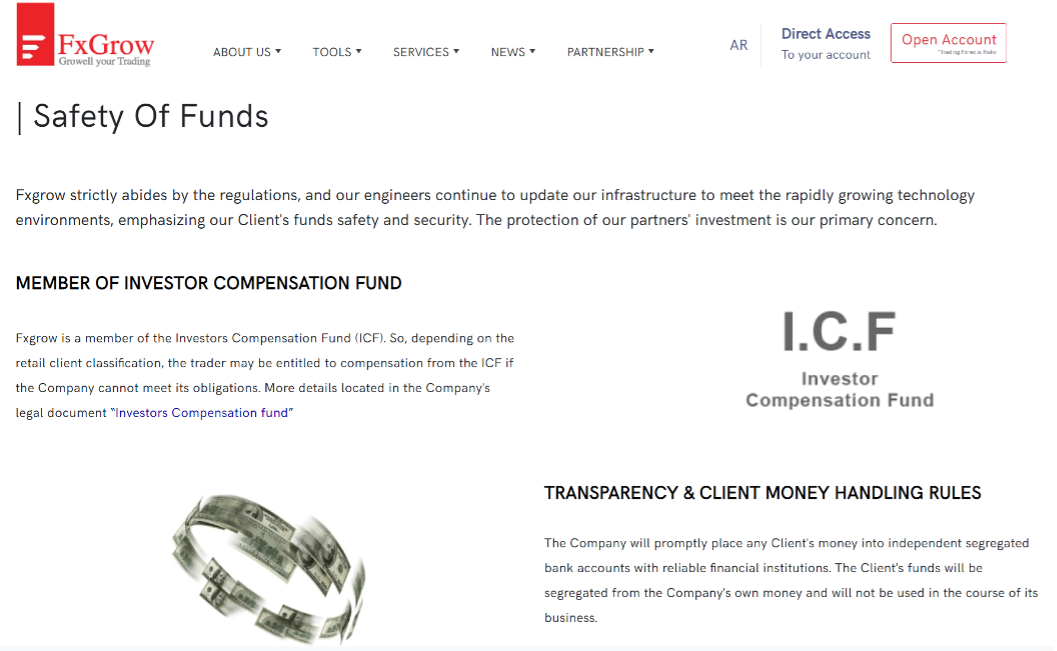
Another port of call is checking on a trusted broker review site like ours to see if our experts have confirmed whether the broker uses segregated bank accounts to store traders’ funds.
In addition, traders should consider any stipulations to these segregated holdings. For example, as the CFTC allows brokers to invest client funds in approved global government securities, some firms may hold substantial amounts of client capital in this form.
This may make funds illiquid or, in the event of a significant regional economic downturn, even not have investors’ supposedly safe segregated capital.
For example, Interactive Brokers‘ segregated accounts have exposure to US Treasury securities. Even the largest brokerage firms, if holding client funds this way, may be affected by a significant economic incident.
Regulation & Segregated Accounts
The most reputable financial regulators will require securities and forex brokers to hold client funds in segregated accounts. These bodies include the UK Financial Conduct Authority (FCA), the Australian Securities and Investments Commission (ASIC), the Cyprus Securities & Exchange Commission (CySEC), and the US Commodity Futures Trading Commission (CFTC).
However, as demonstrated by the collapse of FTX, this does not apply to crypto exchanges – very few of which are regulated regardless.
Other forex broker regulators include the Belize-based International Financial Services Commission (IFSC) and the Vanuatu Financial Services Commission (VFSC).
These regulators also require brokers to hold client funds in segregated accounts. However, their checks may not be as routine or stringent as more trusted licensing bodies.
How To Approach Non-Segregated Account Brokers
Some brokers and online financial providers may not have any such assurances or may not have the regulation to underscore their claims. In this case, it is an investor’s responsibility to conduct their due diligence.
Some brokers or exchanges, such as the Kraken crypto exchange, may conduct independent audits of their holdings to reassure investors that their cash is safe.
However, some unregistered brokers do not segregate client funds from their own. This is especially common with less regulated sections of the finance industry, such as binary options brokers and crypto exchanges.
Traders should only hold what they can afford to lose with such brokers at any time.
Advantages Of Brokers With Segregated Accounts
- Safety – When trading with brokers with segregated accounts, investors’ funds are protected from misuse by a company.
- Indicates trustworthiness – While not a full indicator of a brand’s credentials, brokers with segregated accounts are more likely to be trustworthy and highly regarded.
- Access to funds – Brokers that have segregated asset accounts can pay out on withdrawal requests from a high volume of clients without having to restrict access.
Disadvantages Of Brokers With Segregated Accounts
- Less choice – If only trading with brokers that use segregated bank accounts, investors may be limited in choice for markets like cryptos or binary options.
- Not 100% reliable – Without regular audits by an independent company or a stringent regulator, brokers can break the rules and use client funds for their own trading or to cover liabilities. So it is not a full-proof security measure.
How To Compare Brokers With Segregated Accounts
When it comes to choosing a broker that uses segregated accounts, look for the following qualities:
- Regulation – A broker regulated by a reputable licencing body is more likely to offer solid protection to investors from fraud. Among the top agencies are the FCA, ASIC, and CySEC.
- Low fees – Brokers with zero commission and low spreads are often favored by traders. These can help protect profit margins, especially if you are actively day trading.
- Wide range of trading assets – Ensuring that a broker supports your favored trading markets is important, whether that’s major forex pairs, stocks and shares, or precious metals like gold.
- Trading platforms – Traders will have different requirements. Some investors may prefer simple and accessible web-based software, while more experienced speculators may require advanced, capable platforms like MetaTrader 4 or MetaTrader 5.
- Customer support – A dependable and knowledgeable customer support team can be critical when investors find themselves with urgent trading issues. The top brokers with segregated accounts offer 24/5 or 24/7 support through live chat, phone and email.
Segregated Accounts VS Separate Accounts
While separate and segregated fund accounts sound similar, they are different. Separate accounts are bespoke investment accounts, usually co-managed with a professional wealth manager or firm.
Segregated accounts refer to client funds being held in segregated bank accounts, meaning brokers cannot use client funds to trade, loan or invest.
Other Useful Security Measures
In addition to brokers with segregated accounts, here are a few more security measures to look out for when trading online:
Fund Protection & Insurance
Choosing a broker that offers insurance for trading funds is another way to help protect your capital. Some brokers are signed up to fund protection schemes such as the Financial Services Compensation Scheme (FSCS) as part of their regulatory obligations. The FSCS protects client funds up to £85,000 per account.
Some trading brokers offer additional insurance, sometimes exceeding $1 million, to provide clients further peace of mind. These programs are underwritten by prominent insurance companies that regularly ensure firms hold a significant amount of free capital.
Negative Balance Protection
Losses can quickly build up when trading using leverage or margin on volatile markets such as forex or CFDs. While you can always set a stop-loss level to prevent significant losses, using a broker that employs negative balance protection (NBP) is also recommended.
Negative balance protection ensures that a trader’s funds never dip below zero. Brokers do this by liquidating any positions that would cause this and restoring negative balances to zero if positions cannot be automatically closed in time.
Audits
As outlined above, the best way to ensure that a broker is using segregated accounts is to pick a company that conducts regular independent audits of its finances. These checks can be done by regulators or, in the case of some brokers such as the Kraken crypto exchange, by third parties.
Two-Factor Authentication
Many brokers offer two-factor authentication (2FA) to secure their client’s trading accounts. This measure requires a one-time passcode when they log in.
Often tied to a trader’s registered phone, this can prevent fraudulent login attempts even when an account’s primary password is exposed in a data breach.
Final Word On Brokers With Segregated Accounts
Using a broker or exchange with segregated bank accounts for client funds is a no-brainer when trading online. While investors may be restricted to a select few crypto exchanges and binary options providers, the safety benefits of a broker that does not use client funds for its own means are too important to miss out on.
However, using a broker with segregated accounts still does not guarantee that firms will not use traders’ funds when in a financial pinch. This was illustrated by the collapse of MF Holdings, which defied CTFC regulations to cover its own losses using client funds.
Head to our list of the best brokers with segregated accounts to get started.
FAQs
Are Online Trading Accounts Safe?
Most trading brokers will never collapse, but choosing a brokerage that keeps client funds separate from its own capital gives investors better protection from the effects of significant market events and mass withdrawals.
How Can I Spot A Segregated Trading Account?
Most brokers will let investors know that they hold client funds in segregated bank accounts in the “About” section, “Regulation” page or “Safety of Funds” section on their websites. Alternatively, we have reviewed and ranked the top trading brokers with segregated accounts.
Can Unregistered Brokers Still Use Segregated Accounts?
Some unregulated brokers will still claim to segregate client funds from their own. However, this can be difficult to verify without regular audits or oversight from a reputable regulator.
Are Online Trading Accounts Insured?
Some brokers with segregated accounts also insure their clients’ funds as part of a fund protection scheme or a separate insurance policy. These firms offer greater protection than trading brokers with segregated accounts only.
Can I Open A Segregated Trust Account?
Many brokers offer strong protection measures to protect client funds, whether in the form of a segregated trust, asset or individual account. Many will use segregated accounts and some will provide additional insurance.