




If you’re day trading in the US, consider a broker regulated by the National Futures Association (NFA), a ‘green tier’ body in DayTrading.com’s Regulation & Trust Rating that provides excellent investor safeguards.
Established in 1981, the NFA plays a pivotal role in maintaining market integrity, enforcing strict regulatory standards, ensuring investor protection, resolving disputes, and promoting financial education.
Brokers regulated by the NFA are held to these high standards, offering traders enhanced transparency. If their actions threaten customers or the integrity of the markets, the NFA promptly takes appropriate action.
Immerse yourself in our choice of the top NFA-regulated brokers operating within the US. We’ve thoroughly confirmed that each recommended platform is officially registered with the NFA.
Best NFA Brokers
Sorry, there are no brokers that accept traders from your location (Canada). If this location is incorrect, please change it.
Methodology
To discover the top brokers authorized by the NFA, we:
- Reviewed our list of 143 brokers to identify those asserting NFA authorization.
- Checked their details against the NFA’s online registry to confirm their authorization.
- Integrated the findings of our hands-on tests and 200+ data points to develop a ranking of the best NFA-authorized brokers.
How Can I Check If A Broker Is Regulated By NFA?
Verifying that the NFA regulates a brokerage is a simple process we employ to assess the legitimacy of trading platforms operating in the US.
You can easily confirm this by following these three steps:
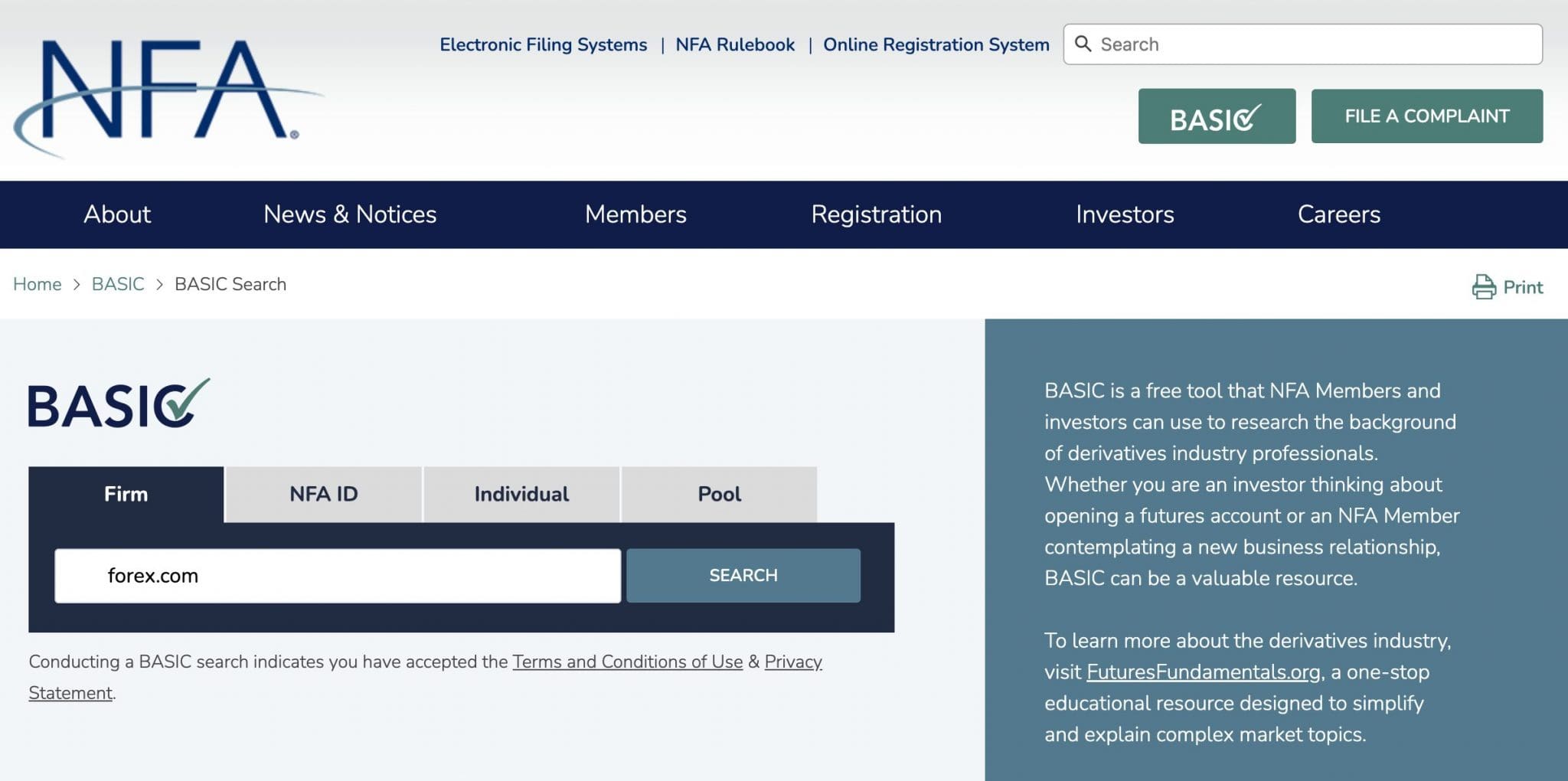
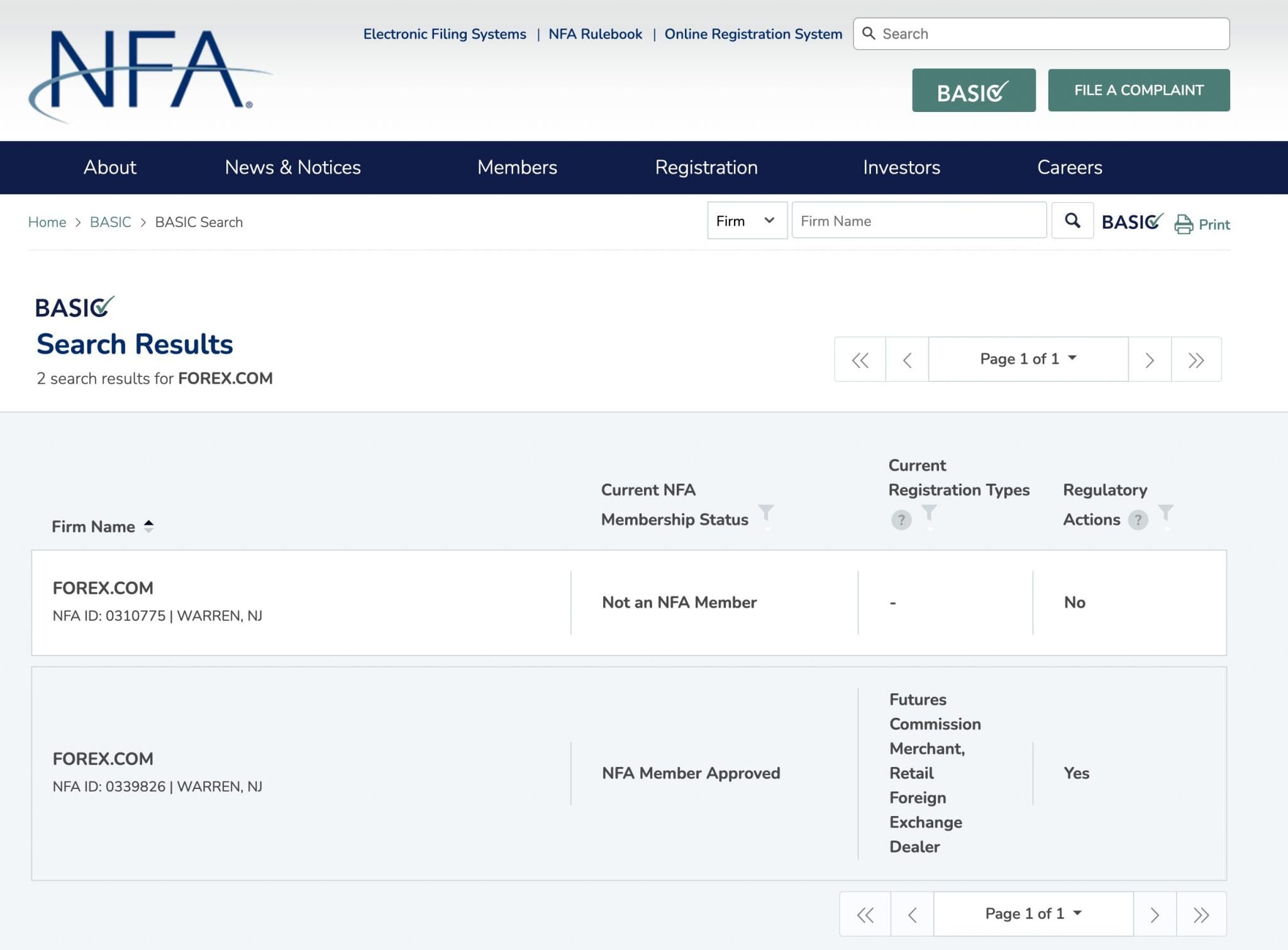
- Access the NFA’s ‘Background Affiliation Status Information Center (BASIC)‘ search on its website.
- Input the provider’s name into the search field.
- If needed, refine the search by ‘NFA ID’, ‘Individual’ or ‘Pool.’
To illustrate, I verified that FOREX.com, a popular US brokerage, is authorized by the NFA, as seen in the following screenshots.
 Christian HarrisAuthor
What Rules Must NFA-Regulated Brokers Follow?
NFA-regulated brokers must adhere to strict rules to ensure transparency, fair practices, and the protection of clients in the financial markets.
Here are some of the main rules that brokers regulated by the NFA must follow:
- Risk Disclosure: Providers must clearly warn customers about the risks involved in trading, which are high, especially if you employ fast-paced strategies like day trading.
- Fair Conduct: Brokers must act ethically, avoiding false claims about profits or downplaying risks. Advertising must be truthful and not misleading.
- Capital Requirements: NFA-regulated US brokers have varying minimum adjusted net capital requirements. Forex Dealer Members (FDMs) must maintain $20 million, Futures Commission Merchants (FCMs) $1 million (or $20 million if also a swap dealer), and independent Introducing Brokers (IBs) $45,000. Guaranteed IBs are exempt from these requirements.
- Client Fund Segregation: Brokers must keep customer funds separate from company assets to safeguard them from misuse or loss.
- Anti-Fraud Measures: Providers are prohibited from engaging in fraudulent practices, including misleading promotions or unfair trade executions.
- Record-Keeping & Reporting: Firms must maintain detailed records of transactions and report regularly to regulators to ensure compliance and transparency.
- Know Your Customer (KYC) & Anti-Money Laundering (AML): Brokers must verify customer identities and monitor for suspicious activity, reporting potential money laundering.
- Supervision & Risk Management: Trading platforms must implement robust employee oversight systems and risk management policies to minimize market and operational risks.
- Leverage Limits: Restrictions on leverage to 1:50 (or a 2% margin) ensure that retail investors do not take on excessive risk that could lead to significant losses.
- Dispute Resolution: Brokers must participate in structured processes like arbitration or mediation to resolve client disputes fairly.
Online brokerages that do not adhere to these regulations may face enforcement action from the NFA, which could result in fines, penalties, or the loss of their license.
For example, StoneX was fined $100,000 for several violations, including improper handling of initial margin calculations and failing to maintain adequate risk management systems.
In a separate case, the NFA imposed penalties on Trinity Trading Group due to violations involving improper record-keeping and promotional practices that misrepresented profit potential without highlighting risks. The firm and its principal were barred from reapplying for NFA membership as part of the settlement.
Bottom Line
Choosing a firm authorized by the NFA is a no-brainer if you’re an active trader in the US.
The NFA’s role is to ensure that market participants – brokers and traders – operate within a fair, transparent, and regulated environment.
You can verify if the NFA regulates a broker in just a few minutes on the NFA’s website. Or, explore our list of the best day trading platforms regulated by the NFA.
While regulation provides a degree of protection, it’s essential to understand that online trading involves risks and a chance of losing all your invested US dollars.
Article Sources
- National Futures Association (NFA)
- Commodity Futures Trading Commission (CFTC)
- NFA's Background Affiliation Status Information Center (BASIC)
- NFA Enforcement And Registration Actions
- NFA Fines StoneX $100K For Multiple Violations
- NFA's Action Against Trinity Trading Group - TTP
- NFA's Rulebook Table Of Contents
The writing and editorial team at DayTrading.com use credible sources to support their work. These include government agencies, white papers, research institutes, and engagement with industry professionals. Content is written free from bias and is fact-checked where appropriate. Learn more about why you can trust DayTrading.com