




Based in South Africa? Use a broker regulated by the Financial Sector Conduct Authority (FSCA) for safety.
After stepping up its oversight of brokers in recent years with tougher penalties for non-compliance resulting in stronger trader protections, FSCA has earned ‘yellow tier’ status in DayTrading.com’s Regulation & Trust Rating.
Check out our pick of the top FSCA-regulated platforms to find the perfect provider for your trading needs.
Best FSCA Brokers
Based on our latest hand-on tests in October 2026, these are the 6 best FSCA-regulated trading platforms:
-
- Demo account
- Regulator: FCA, ASIC, CMVM , FSCA, SCB, FSA
- Platforms: TN Trader, MT4, TradingView
-
- Demo account
- Instruments: CFDs, Forex, Indices, Shares, Commodities
- Regulator: ASIC, CySEC, FSCA, FSC
-
- Demo account
- Regulator: FCA, ASIC, FSCA, VFSC, CIMA
- Min. deposit: $50
-
- Demo account
- Platforms: WebTrader, App
- Min. deposit: $100
81% of retail CFD accounts lose money. -
- Demo account
- Regulator: FCA, CySEC, FSCA, FSC
- Platforms: WebTrader, UM Social, UM App, MT4, MT5
-
- Demo account
- Regulator: FSCA, FSC, FSA, CNAD
- Platforms: PXTrader 2.0, MT5, TradingCentral






Learn how we test brokers and why you can trust our ratings.
This is why we think these brokers are the best in this category in 2026:
- Trade Nation 4.4/5 Trade Nation is a top FX and CFD broker regulated in multiple jurisdictions including the UK and Australia. The firm offers low-cost fixed and variable spreads on 1000+ assets with robust trading platforms and training materials. The Signal Centre can also be used for trade ideas.
- FBS 4.3/5 Founded in 2009, FBS is an award-winning CFD broker operating in over 150 countries with a client base exceeding 27 million traders. Traders are supported at every stage of their journey with 24/7 assistance, market analytics, trading calculators, and competitive pricing with zero commissions.
- Vantage 4.7/5 Founded in 2009, Vantage offers trading on 1000+ short-term CFD products to millions of clients. You can trade Forex CFDs from 0.0 pips on the RAW account through TradingView, MT4 or MT5. Vantage is ASIC-regulated and client funds are segregated. Copy traders will also appreciate the range of social trading tools.
- Plus500 4.1/5 Established in 2008 and headquartered in Israel, Plus500 is a prominent brokerage that boasts over 25 million registered traders in over 50 countries. Specializing in CFD trading, the company offers an intuitive, proprietary platform and mobile app. It maintains competitive spreads and does not charge commissions or deposit or withdrawal fees. Plus500 also continues to shine as one of the most trusted brokers with licenses from reputable regulators, including the FCA, ASIC and CySEC.
- Ultima Markets 3.9/5 Ultima Markets is a forex and CFD broker, established in 2016. The firm is regulated by several financial bodies, including the CySEC. Users can trade 250+ CFDs spanning major asset classes, from currencies to stocks and commodities. As well as the industry-leading MetaTrader 4 platform, clients can use the Ultima Markets app and social trading service.
- PrimeXBT 4.2/5 PrimeXBT is a multi-asset platform offering highly leveraged trading in forex, indices, commodities and cryptocurrencies. The company launched in 2018 and now has over 1 million users from more than 150 countries. With no minimum deposit, copy trading features and low commissions, the broker remains a popular option among crypto trading novices.
FSCA Brokers Comparison
| Broker | FSCA Regulated | ZAR Account | Minimum Deposit | Markets | Platforms | Leverage |
|---|---|---|---|---|---|---|
| Trade Nation | 1 | ✔Yes | $0 | CFDs, Forex, Indices, Shares, Commodities, Futures, Bonds, Spread Betting (UK and Ireland only), Cryptos (Bahamas entity only) | TN Trader, MT4, TradingView | 1:30 |
| FBS | 1 | - | $5 | CFDs, Forex, Indices, Shares, Commodities | FBS App, MT4, MT5 | 1:30 |
| Vantage | 1 | - | $50 | CFDs, Forex, Stocks, Indices, Commodities, ETFs, Bonds | ProTrader, MT4, MT5, TradingView, TradingCentral, DupliTrade | 1:500 |
| Plus500 | 1 | ✔Yes | $100 | CFDs on Forex, Stocks, Indices, Commodities, ETFs, Options, Crypto | WebTrader, App | ✔Yes |
| Ultima Markets | 1 | - | $50 | CFDs, Forex, Stocks, Indices, Commodities, Crypto, ETFs, Pre-IPO | WebTrader, UM Social, UM App, MT4, MT5 | 1:30 (EU), 1:2000 (RoW) |
| PrimeXBT | 1 | - | $0 | CFDs, Cryptos, Forex, Indices, Commodities, Futures | PXTrader 2.0, MT5, TradingCentral | 1:1000 |
Community Sentiment
See how users rate these brokers based on the average customer ratings submitted on DayTrading.com, plus ratings from Trustpilot, the Apple App Store and Google Play.
| Broker | Our Users' Rating | Trustpilot Score | Trustpilot Reviews | iOS App Rating | Android App Rating |
|---|---|---|---|---|---|
| Trade Nation | 2142 | ||||
| FBS | 10166 | ||||
| Vantage | 15581 | ||||
| Plus500 | 20078 | ||||
| Ultima Markets | 971 | ||||
| PrimeXBT | 422 |
Trade Nation
Trade Nation suits discretionary traders who want to speculate on major indices like the US 500 or liquid FX pairs, and want the predictable all-in costs of fixed spreads. In tests, we found the fixed-spread TN Trader environment particularly useful for trading around scheduled economic releases owing to its reliable charting environment and because published spreads stayed capped.
 Christian Harris, Reviewer
Trade Nation quick facts
- Demo Account
- ✔Yes
- Instruments
- CFDs, Forex, Indices, Shares, Commodities, Futures, Bonds, Spread Betting (UK and Ireland only), Cryptos (Bahamas entity only)
- Regulator
- FCA, ASIC, CMVM , FSCA, SCB, FSA
- Platforms
- TN Trader, MT4, TradingView
- Minimum Deposit
- $0
- Minimum Trade
- 0.1 Lots
- Account Currencies
- USD, EUR, GBP, AUD, ZAR, SEK, NOK, DKK
Pros
- The demo comes with a $5,000 practice account and you can request a one-on-one platform walkthrough by callback - this level of personal help is rare.
- Trade Nation accounts can now be linked with TradingView, providing advanced multi-charts and the ability to execute trades directly.
- Trade Nation's 2026 partnership with Volt has sped up payments for Australian traders, who can now make instant deposits and withdrawals using PayID, with the faster payout capabilities planned for clients in the UK and EU.
Cons
- Offshore SCB and FSA entities allow retail clients up to 1:200 and 1:500 leverage compared to 1:30 in regions like the UK, Europe and Australia, so an FSA client can have 16 times the exposure of a UK retail client on the same trade, but with less oversight and no compensation scheme.
- The 2–20% rebate scheme is closed to FCA, CMVM, and ASIC clients, meaning active day traders in these regions who would benefit from transaction rebates cannot claim them.
- Withdrawals can take up to five business days, which is around the industry average but slower than the 1-3 days we’re increasingly seeing brokers offer in an attempt to quash withdrawal complaints from retail investors.
FBS
FBS is an excellent choice for day traders at every level and budget, with just a $5 minimum deposit and intensive academy for aspiring traders alongside access to MT4 and MT5.
Christian Harris, Reviewer
FBS quick facts
- Demo Account
- ✔Yes
- Instruments
- CFDs, Forex, Indices, Shares, Commodities
- Regulator
- ASIC, CySEC, FSCA, FSC
- Platforms
- FBS App, MT4, MT5
- Minimum Deposit
- $5
- Minimum Trade
- 0.01 Lots
- Account Currencies
- USD, EUR, AUD, JPY
Pros
- The trading firm has picked up over 90 awards and amassed more than 27 million clients, making it one of the largest and most established brokers globally.
- FBS strikes the balance between robust features and ease of use, with a sign-up process taking <10 minutes, an intuitive app, advanced research through Market Analytics & more recently VIP Analytics, plus immersive education through the FBS Academy and Trader’s Blog.
- 24/7 customer support that performed excellently during testing is available, alongside a $5 minimum deposit, and a huge variety of 200+ funding options, making it ideal for traders with small accounts.
Cons
- Although the FBS app offers a terrific mobile trading experience for aspiring traders and MT4/MT5 cater to advanced traders, the absence of cTrader and TradingView, which are increasingly offered by alternatives like Pepperstone, will deter day traders familiar with these platforms.
- Despite enhancing the selection of currency pairs, now providing over 70, FBS still trails industry leaders like BlackBull Markets in its market offering with a particularly narrow selection of commodities and indices.
- There are only four base currencies available - EUR, USD, AUD and JPY (region dependant) - which isn't practical for minimizing currency conversion fees for many global traders, and is especially striking given the broker’s user base spans over 150 nations.
Vantage
Vantage remains an excellent option for CFD traders seeking a tightly-regulated broker with access to the reliable MetaTrader platforms. The fast sign-up process and $50 minimum deposit make it very straightforward to start day trading quickly.
 Jemma Grist, Reviewer
Vantage quick facts
- Demo Account
- ✔Yes
- Instruments
- CFDs, Forex, Stocks, Indices, Commodities, ETFs, Bonds
- Regulator
- FCA, ASIC, FSCA, VFSC, CIMA
- Platforms
- ProTrader, MT4, MT5, TradingView, TradingCentral, DupliTrade
- Minimum Deposit
- $50
- Minimum Trade
- 0.01 Lots
- Account Currencies
- USD, EUR, GBP, CAD, AUD, NZD, JPY, HKD, SGD, PLN
Pros
- The app was upgraded in 2026 with wider asset visibility bringing together balances across Contract, Copy, and Funding accounts on one screen
- The ECN accounts are very competitive with spreads from 0.0 pips and a $1.50 commission per side (Pro ECN account)
- Vantage maintains its high trust score thanks to its strong reputation and top-tier regulation from the FCA and ASIC
Cons
- The average execution speeds of 100ms to 250ms are slower than alternatives based on tests
- A steep $10,000 deposit is needed for the best trading conditions, which include the $1.50 commission per side
- It's a shame that some clients will need to register with the offshore entity, which offers less regulatory protection
Plus500
Plus500 offers a super-clean experience for traders with a CFD trading platform that sports a modern design and dynamic charting. That said, the broker’s research tools are limited, fees trail the cheapest brokers, and there’s room for enhancement in its educational resources.
Christian Harris, Reviewer
Plus500 quick facts
- Demo Account
- ✔Yes
- Instruments
- CFDs on Forex, Stocks, Indices, Commodities, ETFs, Options, Crypto
- Regulator
- FCA, CySEC, EFSA, ASIC, FMA, FSCA, MAS, ISA, FSA, DFSA, SCA, JFSA, SCB, CIRO, BAPPEBTI, OJK, BI
- Platforms
- WebTrader, App
- Minimum Deposit
- $100
- Minimum Trade
- Variable
- Account Currencies
- USD, EUR, GBP, AUD, ZAR, CZK
Pros
- Plus500 provides a specialized WebTrader platform designed explicitly for CFD trading, offering a clean and uncluttered interface
- The customer support team continue to provide reliable 24/7 support via email, live chat and WhatsApp
- The broker offers low commission trading on a diverse range of markets, minimizing additional fees while appealing to established traders
Cons
- Educational resources are limited compared to best-in-class brokers like eToro, impacting the learning curve for beginners
- The absence of social trading means users can’t follow and replicate the trades of experienced traders
- Compared to some competitors, especially IG, Plus500’s research and analysis tools are limited
Ultima Markets
Ultima Markets is best for beginners looking to speculate on popular financial markets on the reliable MetaTrader 4 or more recently the MetaTrader 5 platform. The minimum deposit is accessible at $50, there are no fees when you open and fund your account, and the addition of the Academy makes for a supportive learning environment.
Jemma Grist, Reviewer
Ultima Markets quick facts
- Demo Account
- ✔Yes
- Instruments
- CFDs, Forex, Stocks, Indices, Commodities, Crypto, ETFs, Pre-IPO
- Regulator
- FCA, CySEC, FSCA, FSC
- Platforms
- WebTrader, UM Social, UM App, MT4, MT5
- Minimum Deposit
- $50
- Minimum Trade
- 0.01 Lots
- Account Currencies
- USD, EUR, GBP, CAD, AUD, JPY, HKD, SGD
Pros
- $50 minimum deposit with the Standard account
- Regulated by the CySEC and more recently the FCA, boosting its trust score
- Fast execution speeds averaging <20ms
Cons
- $20,000 minimum deposit required for the very best trading conditions
- Slow sign-up process compared to rivals
- Weak regulatory oversight through the offshore branch
PrimeXBT
PrimeXBT is suited to aspiring traders looking for crypto derivatives alongside traditional markets like forex and indices, all tradable on an intuitive, web-based platform. The copy trading solution is also ideal for hands-off traders with 5-star ratings and performance graphs to help you find traders that align with your preferences and risk appetite.
 William Berg, Reviewer
PrimeXBT quick facts
- Demo Account
- ✔Yes
- Instruments
- CFDs, Cryptos, Forex, Indices, Commodities, Futures
- Regulator
- FSCA, FSC, FSA, CNAD
- Platforms
- PXTrader 2.0, MT5, TradingCentral
- Minimum Deposit
- $0
- Minimum Trade
- 0.01 Lots
- Account Currencies
- USD, EUR, GBP
Pros
- PrimeXBT seriously bolstered its suite of Crypto Futures in 2025, now offering over 200 tokens spanning AI, NFTs, Metaverse, Layer 1 &2, and more.
- Traders can now use crypto balances (BTC, ETH, USDT, USDC) as margin to trade traditional financial markets, without needing to convert funds into fiat currency first.
- Maker and taker fees of at 0.01% and 0.02%, respectively, for crypto futures contracts are highly competitive within the industry.
Cons
- Although there's a wide selection of educational articles, including covering charting analysis for short-term strategies, there lacks more engaging and interactive resources like videos and quizzes.
- Despite improvements like 7 metal additions, the around 350+ instruments still trails competitors, notably OKX with its 400+ assets.
- Despite licenses from agencies like the FSCA, FSC, CNAD, and FSA, PrimeXBT lacks authorization from a top-tier body, making it higher risk than some other top-rated crypto exchanges and brokers.
Methodology
To list the best brokers authorized by the FSCA, we:
- Took our evolving directory of 143 trading providers to identify those claiming FSCA authorization.
- Ran their details through the FSCA’s List of Regulated Persons and Entities for verification, which has had a design upgrade.
- Combined the results of our personal tests with 200+ data points to rank the very best FSCA-regulated firms.
How Can I Check If A Broker Is Regulated By The FSCA?
Here’s a step-by-step guide to verifying a broker’s FSCA status, with a practical example using IG, a well-known CFD and forex broker operating in South Africa.
If you’ve traded in our industry, you’ll know of IG. They’re a quoted firm on the UK FTSE and have a solid reputation as a fair, honest, and competitive brokerage that prides itself on compliance and efficacy.
I expect IG to get a clean bill of financial health from any financial authority’s database I search.
However, I’m using IG to highlight the diligence you should engage in before depositing your hard-earned funds into any broker’s account, even if they have a solid reputation for integrity.
 Paul HolmesAuthor
You should absolutely conduct such diligence if you’re considering trading with a smaller, less-known broker. A search only takes a few minutes of research.
Step 1. Visit The FSCA’s Official Website
Go to the official FSCA website.
The FSCA maintains an online database of licensed Financial Services Providers (FSPs).
Step 2. Access The “Search For An FSP” Section
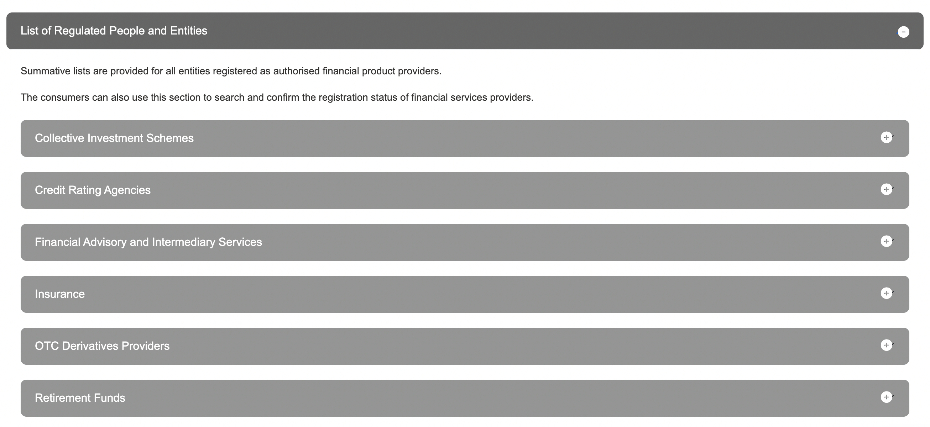
You’ll discover the page you need after you click the “Regulated Entities” tab and scroll to the “List of Regulated Entities and Persons”, then depending on the type of provider, e.g. “OTC Derivatives Provider”.
This facility allows you to search for registered brokers by name. The look and feel has been revamped but it’s still easy to use.
Step 3. Enter The Broker’s Details
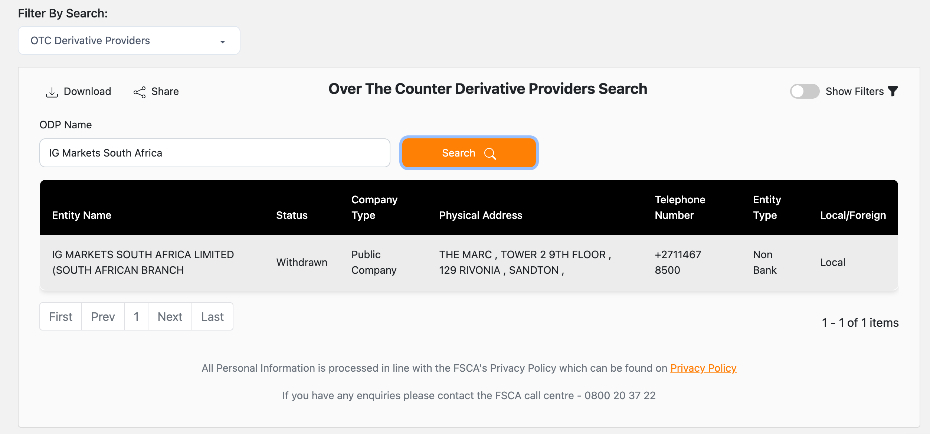
Input the broker’s named entity. This is often found on their website or promotional materials. I typed “IG Markets South Africa“. The IG website also lists its FSCA licence number – FSP No 41393.
Step 4. Review The Search Results
Once you’ve entered the details:
- Confirm that the broker appears in the search results.
- Check the broker’s FSP status to ensure it is active and valid.
- Review the services they are licensed to offer (eg CFDs and forex are common at day trading brokers in South Africa).
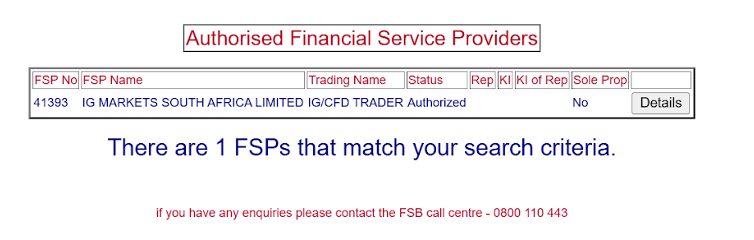
For IG, our latest search result confirmed that the licence has been withdrawn. This has changed since we previously ran the check, where it was still listed as authorized – screenshots below for reference.
Step 5. Verify Contact Details
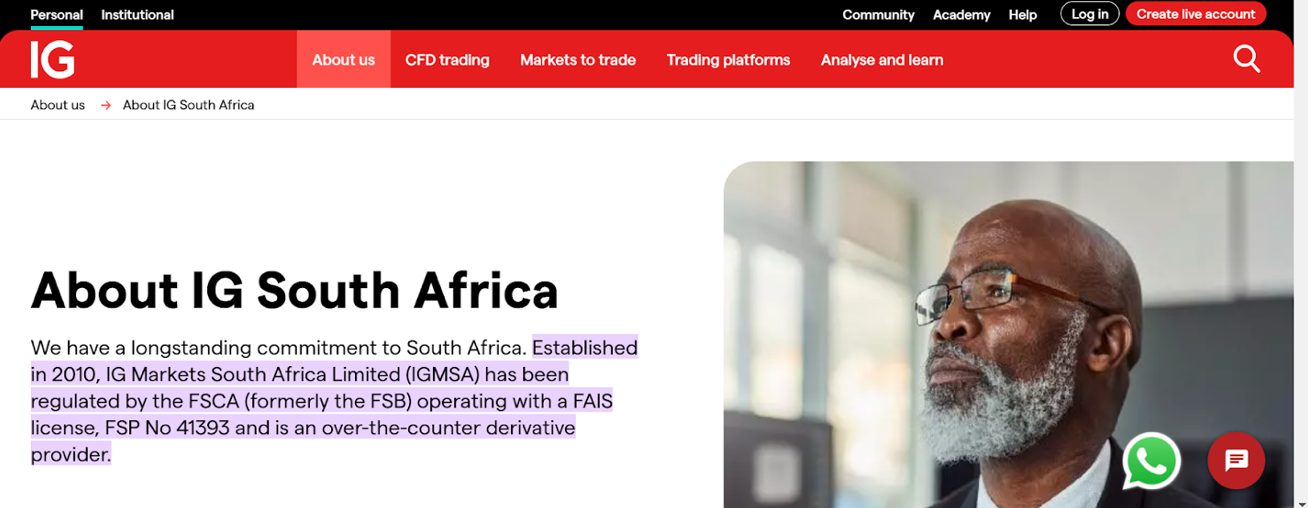
If you’re using a lesser-known trading provider, compare the contact details listed on the FSCA website with those on the company’s official site.
Discrepancies could indicate a fraudulent entity impersonating a regulated brokerage.
Step 6. Look For Public Warnings
The FSCA occasionally issues warnings about unregulated or suspicious brokers. In fact, we’ve seen the volume of these increase in recent years as it’s improved its oversight of online brokers.
Step 7. Contact The FSCA (If Needed)
If you’re unsure about the search results or need further assistance, you can:
- Call: +27 (0)12 428 8000
- Email: info@fsca.co.za
Red Flags To Watch For
- The broker claims to be FSCA-regulated but isn’t listed in the database.
- The broker’s FSP licence is inactive, suspended, or does not cover the services they are offering.
- They avoid sharing their FSP number or providing proof of regulation.
By verifying a broker’s FSCA registration, you can ensure you’re dealing with a legitimate provider and help protect yourself from potential fraud or scams targeting South African traders.
Paul HolmesAuthorWhat Is The FSCA?
The Financial Sector Conduct Authority (FSCA) exists to oversee and regulate South Africa’s financial services sector to ensure it operates fairly, transparently, and in the best interest of consumers like us active traders.
Before the Financial Sector Conduct Authority was formed in 2018, South Africa’s primary regulator was the Financial Services Board (FSB).
Unfortunately, the FSB was unable to prevent a number of scandals, especially in the pension funds industry. These issues led to investigations and the subsequent signing of the FSR Act, which among several changes, dissolved the FSB and led to the creation of the FSCA.
The FSCA’s core focus is on market conduct – how financial institutions and service providers interact with their customers and the integrity of the financial markets overall.
Key Objectives:
- Protect Consumers: The FSCA ensures that financial services providers treat customers like day traders fairly, provide transparent information, and adhere to ethical practices.
- Promote Market Integrity: It works to maintain trust and confidence in South Africa’s financial markets by enforcing compliance with laws and addressing misconduct.
- Ensure Financial Stability: By regulating the conduct of financial institutions, the FSCA helps maintain stability in the financial system, reducing the risk of systemic crises caused by misconduct or mismanagement.
- Educate And Empower Consumers: The FSCA actively promotes financial literacy to help consumers, such as the growing class of online traders in South Africa, make informed decisions, understand their rights, and recognize potential risks.
- Monitor And Regulate Service Providers: The FSCA oversees entities such as banks, insurance companies, retirement funds, trading firms, and financial advisors, ensuring they meet required standards.
In short, the FSCA exists to foster a healthy financial ecosystem where businesses can thrive, consumers and traders like us are protected, and trust in the system remains strong.
Paul HolmesAuthorWho Does The FSCA Answer To?
The FSCA is answerable to the South African government, specifically through its alignment with the National Treasury.
It operates under the oversight of the Minister of Finance, who is responsible for ensuring that the FSCA fulfils its mandate following national financial legislation and policy objectives.
Governance Structure:
- The FSCA Commissioner And Deputy Commissioners: The FSCA is led by a Commissioner and a team of Deputy Commissioners, who oversee its operations and ensure compliance with its regulatory duties.
- The Financial Stability Oversight Committee (FSOC): The FSCA collaborates with this committee, which includes representatives from the South African Reserve Bank (SARB) and other regulators, to ensure systemic stability across the financial sector.
- Parliamentary Accountability: The FSCA is ultimately accountable to South Africa’s Parliament. It must submit annual reports and provide updates on its performance and activities to relevant parliamentary committees.
What Powers Does The FSCA Have?
The Financial Sector Conduct Authority has extensive powers to regulate and oversee South Africa’s financial markets and online trading providers.
Key Powers:
- Regulatory And Supervisory Authority – The FSCA regulates a wide range of financial institutions, including investment firms. It sets and enforces rules on market conduct, ensuring compliance with South Africa’s financial laws and standards.
- Licensing And Registration – The FSCA has the power to issue, renew, suspend, or revoke licences for financial services providers (FSPs), including brokers. It ensures that only qualified and compliant entities operate within the financial sector.
- Investigation And Enforcement – The FSCA can investigate misconduct, fraud, or breaches of financial laws and regulations. It has the authority to impose penalties, fines, or administrative sanctions on entities and individuals who violate the rules and can initiate legal proceedings against offenders when necessary.
- Market Surveillance And Oversight – The FSCA monitors market activity to identify and address unfair practices, insider trading, or market manipulation. It oversees the conduct of trading platforms and other financial infrastructure.
- Consumer Protection And Education – The FSCA develops and enforces policies to ensure that consumers are treated fairly by financial service providers. It conducts awareness campaigns and financial literacy programs.
- Rule-Making Authority – The FSCA can issue directives, guidelines, and regulations to clarify financial legislation and promote best practices across the sector.
- Collaboration With Other Regulators – It works with bodies like the South African Reserve Bank (SARB) and Prudential Authority to ensure financial stability and address cross-sector issues.
Enforcement tools:
The FSCA can take decisive actions, such as:
- Freezing bank accounts or assets linked to misconduct
- Issuing public warnings about unregistered or fraudulent trading providers
- Suspending trading activities in cases of severe breaches
What Rules Must An FSCA Broker Follow?
Brokers regulated by the Financial Sector Conduct Authority (FSCA) must adhere to a comprehensive set of rules designed to ensure transparency, fairness, and consumer protection.
These rules cover how brokers operate, interact with clients like you and me, and manage risk.
Key rules:
- Licensing And Registration – Before offering services, brokers must obtain a valid Financial Services Provider (FSP) licence. They must display their FSP licence number prominently on their website, communications, and marketing materials.
- Suitability Assessments – Brokers are required to assess whether their financial products and services are suitable for their clients’ needs, experience, and risk tolerance. This is especially important as a day trader, where the risk of incurring losses is high.
- Risk Disclosure – Brokers must disclose all risks associated with financial instruments, such as CFDs or forex trading, to ensure clients fully understand potential losses. Notably for short-term traders, brokers must inform retail investors about potential losses due to leverage trading.
- Segregation Of Client Funds – Client funds must be held in segregated accounts, separate from the broker’s operational funds. This protects your money in case the brokerage faces financial difficulties.
- Anti-Money Laundering (AML) Compliance – Brokers must implement strict Anti Money Laundering (AML) policies, including verifying the identity of clients (Know Your Customer/KYC checks) and reporting suspicious transactions to authorities.
- Transparent Pricing And Fees – All fees, commissions, spreads, and other charges must be disclosed clearly to clients. Traders are protected from undisclosed charges or deceptive pricing practices.
- Advertising And Marketing Standards – Marketing materials must be accurate, not misleading, and comply with FSCA guidelines. Claims of guaranteed profits or minimized risks are strictly prohibited.
- Regular Reporting And Audits – Brokers must submit regular compliance reports to the FSCA. They are subject to periodic audits to ensure adherence to regulatory requirements.
- Complaint Handling – Brokers must have an accessible and effective complaints resolution process to address client grievances. They must inform clients of their right to escalate unresolved complaints to the Ombud for Financial Services Providers (FAIS Ombud).
- Risk Management Practices – Brokers must maintain sufficient capital reserves to meet their financial obligations and safeguard clients’ funds. They must implement risk management systems to protect the business and their clients.
- Anti-Market Manipulation Oversight: Brokers must not artificially influence asset prices to disadvantage traders. They also oversee conflicts of interest, ensuring brokers do not trade against their clients unfairly.
- Capital and Operational Requirements – Brokerages must maintain adequate capital reserves to cover their financial obligations and protect traders. This reduces the risk of broker default, ensuring the safety of traders’ funds.
- Continuous Supervision and Updates – The FSCA monitors global trends and updates its regulations to protect active traders in South Africa in a fast-evolving market.
By regulating brokers, enforcing transparency, and monitoring market conduct, the FSCA provides us traders with a safer trading environment, reducing risks and empowering us to trade confidently.
Paul HolmesAuthorDoes The FSCA Have Teeth?
While it may not have the direct enforcement powers of a law enforcement agency, the FSCA is equipped with significant authority to maintain order, impose penalties, and take legal action against entities that break the rules.
And although it’s relatively young with limited enforcement actions under its belt compared to many leading regulators in our industry (the SEC in the US dates back to 1934), the FSCA’s “teeth” are increasingly coming into play.
Here are some notable examples:
- Kabelo Emanuel Mogale (2024): The FSCA imposed a significant penalty of R1,015,315.87 on Mogale, a forex trading signals provider, and debarred him for 10 years. This action was taken because Mogale provided forex trading signals via Telegram without a financial services provider license, which the FSCA considers a financial service requiring proper authorization.
- JP Markets SA (Pty) Ltd (2023): The FSCA fined this forex broker R100,000 for contravening regulations governing over-the-counter (OTC) derivatives trading. JP Markets enabled clients to trade CFDs on forex pairs, shares, and indices without being suitably authorized.
Bottom Line
Verifying that the FSCA regulates a CFD or forex broker is crucial for South African traders to ensure they are dealing with a legitimate and compliant financial services provider.
By utilizing the FSCA’s FSP search function, you can confirm whether a broker, such as IG Markets South Africa, is authorized to operate and provide specific financial services.
For us traders, staying informed about a broker’s regulatory status is not just about compliance – it’s about safeguarding your investments.
To get started, see our pick of the best FSCA-regulated brokers for day traders.