




If you’re an active trader in the US looking to deal in derivatives like futures and options then choose a broker regulated by the Commodity Futures Trading Commission (CFTC) to safeguard your dollars.
With a rigorous process to gain and maintain authorization, alongside increasing scrutiny and penalties in recent years, the CFTC has comfortably earned its ‘green tier’ status in DayTrading.com’s Regulation & Trust Rating.
Best CFTC Brokers
Since evaluating our first CFTC-regulated broker in 2017 (IG), hundreds of trading platforms have gone under our microscope. However, these 1 brokers that are licensed by the CFTC are the frontrunners in October 2026:
-
- Demo account
- Min. deposit: $0
- Min. trade: 0.01 Lots

Learn how we test brokers and why you can trust our ratings.
Here is a short overview of each broker's pros and cons
- IG 4.8/5 Founded in 1974, IG is part of IG Group Holdings Plc, a publicly traded (LSE: IGG) brokerage. The brand offers a top-tier selection of 17,000+ markets, with a range of user-friendly platforms and investing apps. For 50 years, IG has maintained its position as an industry leader, excelling in all key areas for traders.
Commodity Futures Trading Commission (CFTC) Comparison
| Broker | USD Account | Minimum Deposit | Markets | Platforms | Leverage |
|---|---|---|---|---|---|
| IG | ✔Yes | $0 | CFDs (not in US), Forex, Stocks, Indices, Commodities, ETFs, Futures, Options, Crypto, Spread Betting (UK only) | Web, L2 Dealer, MT4, TradingView, AutoChartist, TradingCentral, ProRealTime | 1:30 (Retail), 1:250 (Pro) |
Community Sentiment
See how users rate these brokers based on the average customer ratings submitted on DayTrading.com, plus ratings from Trustpilot, the Apple App Store and Google Play.
| Broker | Our Users' Rating | Trustpilot Score | Trustpilot Reviews | iOS App Rating | Android App Rating |
|---|---|---|---|---|---|
| IG | 10204 |
IG
IG continues to provide a comprehensive package with an intuitive web platform, best-in-class education for beginners, advanced charting tools bolstered by its recent TradingView integration, real-time data, and robust trade execution for experienced day traders.
 Christian Harris, Reviewer
IG quick facts
- Demo Account
- ✔Yes
- Instruments
- CFDs (not in US), Forex, Stocks, Indices, Commodities, ETFs, Futures, Options, Crypto, Spread Betting (UK only)
- Regulator
- CFTC, NFA, FCA, BaFin, ASIC, FINMA, MAS, JFSA, FMA, DFSA, BMA, CONSOB
- Platforms
- Web, L2 Dealer, MT4, TradingView, AutoChartist, TradingCentral, ProRealTime
- Minimum Deposit
- $0
- Minimum Trade
- 0.01 Lots
- Account Currencies
- USD, EUR, GBP, CAD, AUD, JPY, ZAR, SEK, DKK, CHF, HKD, SGD
Pros
- IG is amongst the best in terms of its range of instruments, which includes stocks, forex, indices, commodities, and cryptocurrencies, plus added US-listed futures and options as well as an AI Index, providing diversification opportunities.
- IG offers an extensive collection of professional and engaging educational resources, including webinars, articles, and analysis.
- The ProRealTime advanced charting platform is free as long as certain modest monthly trading activity requirements are met.
Cons
- IG applies an inactivity fee of $12-$18 per month after 2 years, deterring casual investors.
- Beginners might find IG’s fee structure complex, with various fees for different types of trades or services, potentially leading to confusion or unexpected charges.
- IG has discontinued its swap-free account, reducing its appeal to Islamic traders.
Methodology
To list the top brokers authorized by the CFTC, we:
- Took our directory of 143 brokers to find those claiming CFTC registration.
- Punched their details into the CFTC’s register (NFA Basic) to verify their authorization.
- Blended the findings from our hands-on tests and 200+ data entries to rank the top CFTC-authorized brokers.
How Can I Check If My Broker Is Regulated By CFTC?
Verifying if a broker is CFTC-regulated is essential; below is a six-step mechanism to ensure you deal with a legitimate and compliant provider.
I’ll bring these steps to life by taking you through the check I personally conducted on OANDA US.
Founded in 1996, OANDA is regulated in multiple jurisdictions, including by the CFTC in the US, and impresses with its transparency, robust trading platforms, and financial analytics.
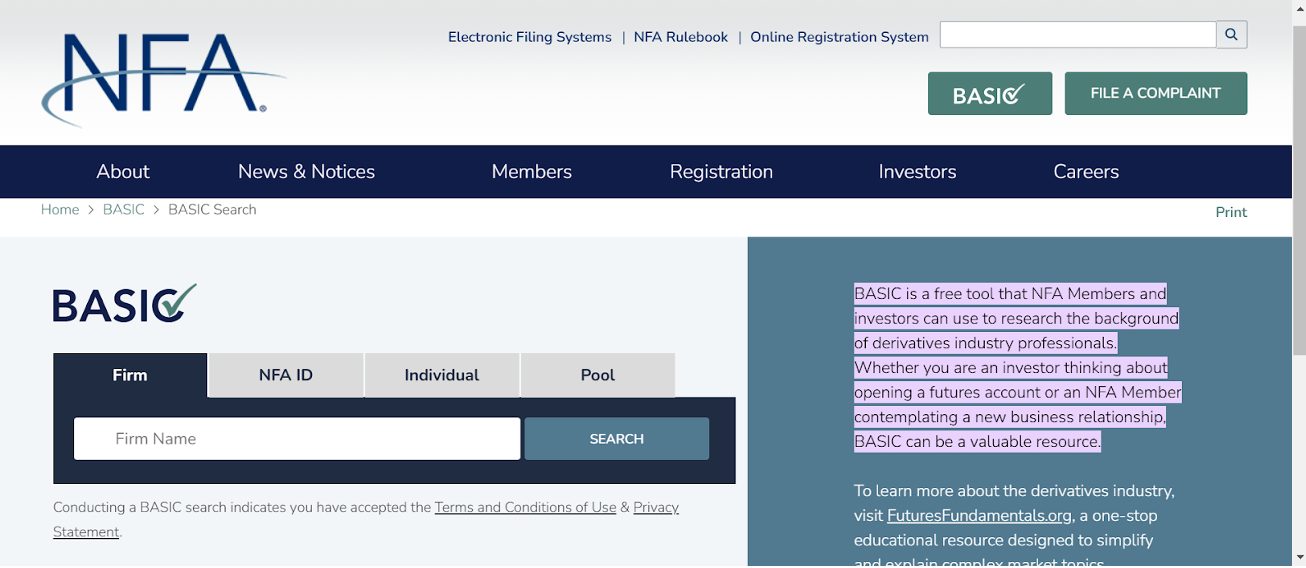
Step 1 – Visit The NFA Website
The NFA BASIC (Background Affiliation Status Information Center) is the official database for registered entities overseen by the CFTC.
Step 2 – Search For The Broker
In the box, type in the name of the broker you wish to search for, in this instance, OANDA Corporation.
For the most accurate results, use the exact name as listed in the broker’s materials or website.
You could also enter the NFA ID number (if provided).
Step 3 – Verify Registration Details
Once you locate the broker, check their registration status with the CFTC and the NFA.
The profile should state whether they are registered as a:
- Futures Commission Merchant (FCM)
- Introducing Broker (IB)
- Swap Dealer (SD) or other categories
The results will be displayed like the below. Four columns will be displayed: broker name, current NFA membership status, registration types, and regulatory actions.
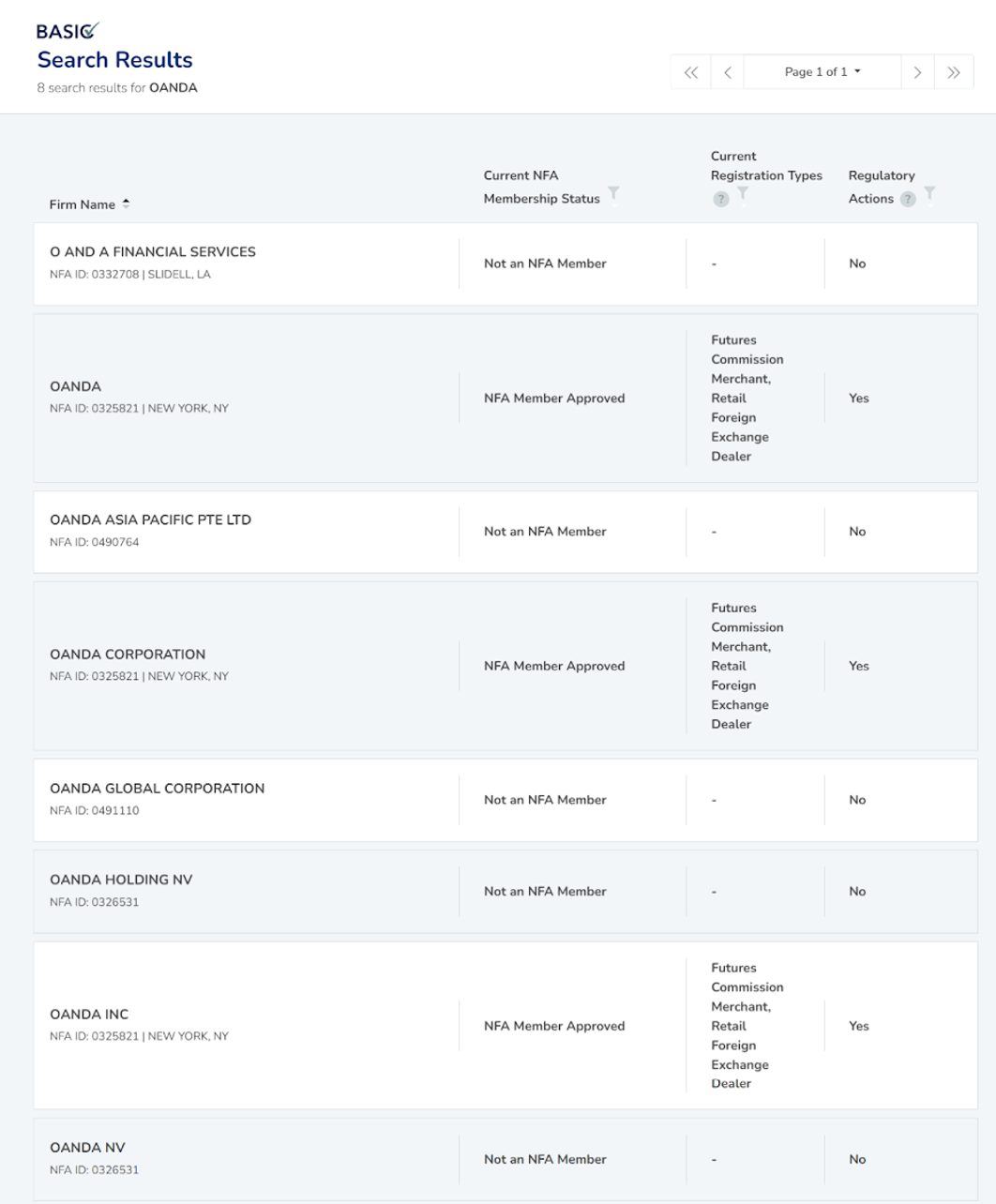
We can see that OANDA Corporation is a CFTC-regulated broker and a registered NFA member with NFA ID 0325821.
This registration ensures that OANDA operates under the oversight of the CFTC, adhering to strict standards for transparency and accountability in the US derivatives market.
Step 4 – Active Registration
Confirm their registration is active and hasn’t been suspended or revoked.
Step 5 – Review Disciplinary History
The NFA BASIC tool also displays any disciplinary actions, complaints, or regulatory violations involving the broker.
We can see that the NFA has taken regulatory action against OANDA US. Clicking on the actions will take you to this page, which will produce the results.
Clicking the “view all actions” button takes you to this results page:
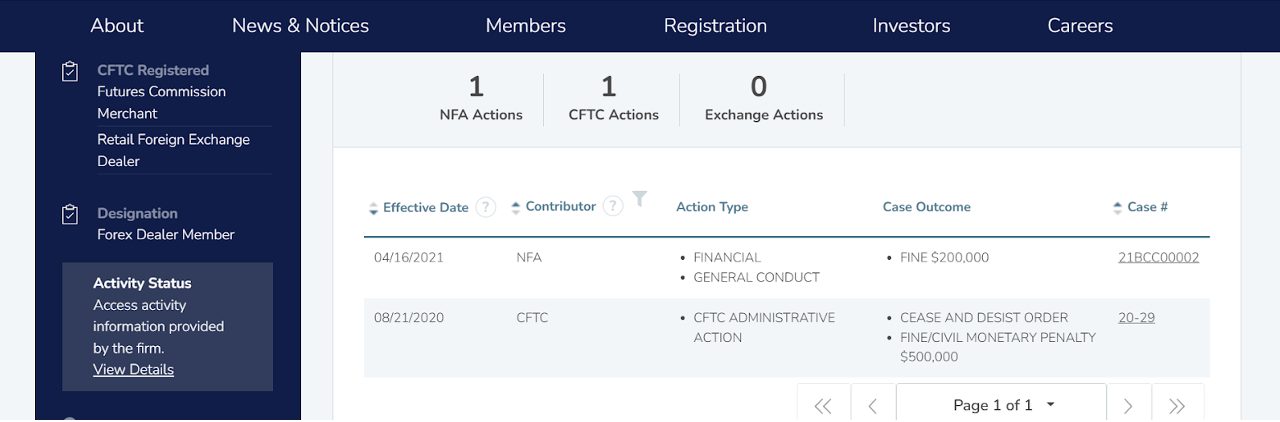
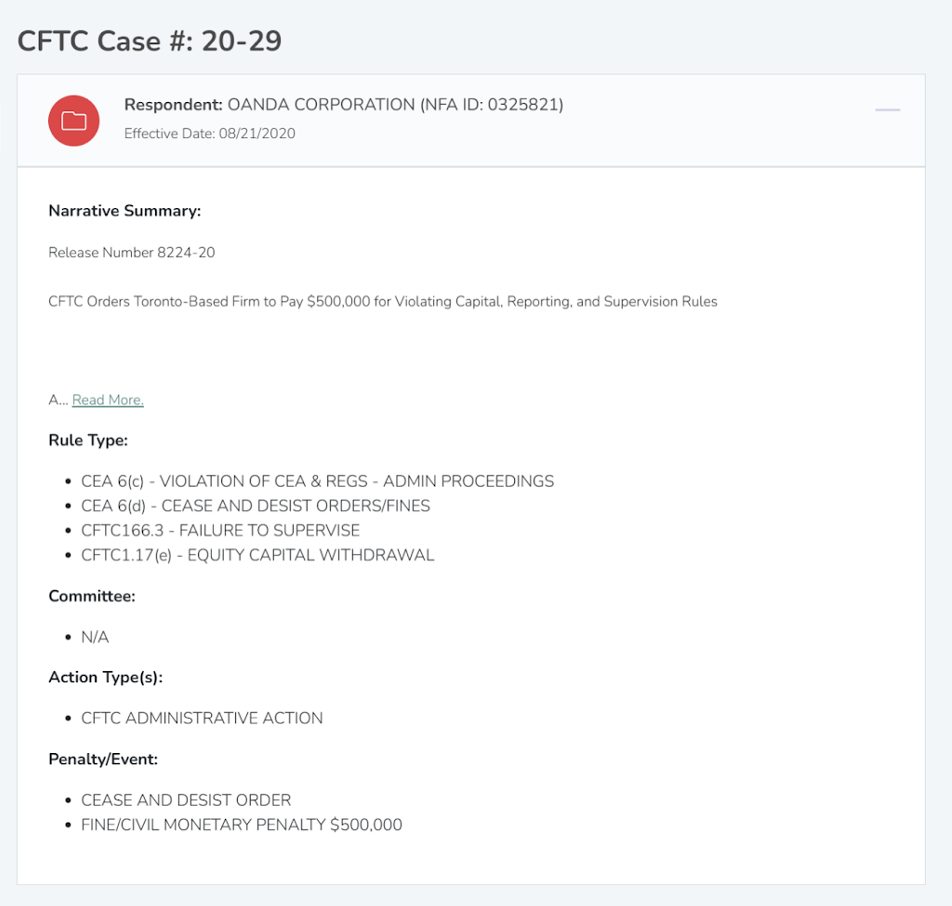
If you hover over the details of a specific case number, you can click through to the details surrounding the claim.
Step 6 – Check The Broker’s Website Claims
Many CFTC-regulated brokers will prominently display their NFA ID and registration details on their website. However, don’t rely solely on the broker’s claims; always verify independently via the NFA website.
If you’re uncertain about a broker’s status or the information you find, you can directly contact the CFTC or the NFA for assistance:
- CFTC: www.cftc.gov
- NFA: www.nfa.futures.org
As the example highlighted above shows, the CFTC is highly active in protecting traders’ interests and has a deserved reputation as the strictest financial authority worldwide.
 Paul HolmesAuthor
Red Flags To Watch For
Here are some things to be vigilant about drawing on my own years in the industry:
- Unregistered Brokers: Any broker offering services in futures, options, or swaps in the US must be registered with the CFTC. Unregistered brokers are operating illegally.
- No NFA ID: Legitimate brokers should be able to provide their NFA ID. Be wary if this information is missing.
- Misleading Claims: Avoid brokers that claim to be “regulated by the CFTC” but don’t appear in the official database or have unverifiable credentials.
What Is The CFTC?
The Commodity Futures Trading Commission (CFTC) is a US government agency that’s responsible for regulating the derivatives markets, notably futures, options, and swaps.
These markets play a critical role in risk management and price discovery for industries ranging from agriculture to energy and finance.
They are also popular instruments with day traders in the US.
Here are the CFTC’s primary objectives:
- Ensuring Market Integrity: The CFTC works to maintain fair and efficient markets where participants can confidently engage in trading without fear of fraud or manipulation. It enforces laws against deceptive trading practices, insider trading, and price manipulation to promote trust in the system.
- Protecting Market Participants and the Public: One of the CFTC’s top priorities is safeguarding participants, especially smaller retail traders, from fraud, misrepresentation, and abusive practices. The CFTC actively investigates and takes action against entities that violate rules, ensuring those who break the law are held accountable. Educational initiatives help market participants better understand the risks and opportunities in derivatives trading.
- Promoting Financial Stability: Derivatives markets are deeply interconnected with the global financial system, so the CFTC monitors them to prevent risks from spiraling into broader economic crises. The CFTC aims to prevent excessive speculation and manage systemic risks that could destabilize the economy through regulations like margin requirements and position limits.
- Fostering Innovation and Competition: As markets evolve, the CFTC adapts its oversight to incorporate new technologies and products. For example, in recent years it has turned its crosshairs to cryptocurrencies and blockchain-based derivatives. The CFTC supports healthy competition among exchanges and market participants, ensuring innovation doesn’t come at the expense of regulatory safeguards.
- Promoting Transparency and Accountability: The CFTC requires detailed reporting of trades and positions, which allows it to monitor market activity in real-time and identify potential risks. Publicly available data on derivatives activity ensures transparency, enabling participants to make informed decisions.
- Enforcing Compliance: The CFTC oversees and audits registered entities such as exchanges, clearinghouses, and intermediaries like brokers to ensure compliance with federal regulations. It collaborates with domestic and international regulators to maintain consistent enforcement across global markets.
Ultimately, the CFTC supports economic growth and financial stability while protecting public confidence in these vital markets, helping ensure traders like us have the utmost protection.
Paul HolmesAuthorWho Is The CFTC Answerable To?
The Commodity Futures Trading Commission is an independent agency within the US federal government, meaning it operates autonomously in its day-to-day regulatory activities.
However, it is ultimately answerable to Congress and the President:
- Congress
- Legislative Oversight: Congress has the authority to create, amend, or repeal laws that govern the CFTC. It also oversees the agency’s activities to ensure they align with the law and serve the public interest.
- Budgetary Control: Congress decides the CFTC’s funding, giving lawmakers a degree of control over the scope of its operations.
- Reporting Requirements: The CFTC regularly reports to Congress on its activities, enforcement actions, and the state of the derivatives markets. For instance, it submits an annual report outlining its achievements, challenges, and priorities.
- The President
- Appointments: The President appoints the five CFTC Commissioners, including the Chairperson, with the advice and consent of the Senate. These appointments allow the President to influence the agency’s leadership and direction.
- Policy Alignment: While independent, the CFTC’s policies may reflect the administration’s broader economic and regulatory priorities, such as promoting financial stability or addressing emerging risks like cryptocurrencies.
- Judicial Oversight: Though not directly answerable to the judiciary, the CFTC’s actions are subject to legal review. If the CFTC enforces a rule or takes an action deemed unlawful or exceeding its authority, it can be challenged in federal courts.
Key Points On Independence
While the CFTC is answerable to Congress and the President, its independent status ensures it can make decisions based on market needs and regulatory principles, free from undue political influence.
This independence is crucial for maintaining impartiality, especially in enforcing rules against powerful market participants.
The powerful bodies the CFTC is answerable to: Congress, The President, and Judicial oversight mean the CFTC is probably the tightest-run financial authority worldwide.
Paul HolmesAuthorWhat Rules Must CFTC-Regulated Brokers Follow?
CFTC-regulated brokers, also known as Futures Commission Merchants (FCMs) or Introducing Brokers (IBs), must adhere to strict rules designed to maintain market integrity and protect traders.
These rules are rooted in the Commodity Exchange Act (CEA) and further defined by CFTC regulations.
Here’s an overview of the critical rules brokers must follow and how they ensure trader protection:
- Registration and Licensing: All brokers must register with the CFTC and the National Futures Association (NFA), a self-regulatory body overseen by the CFTC. Registration ensures brokers meet specific qualifications, including financial standards and background checks.
- Segregation of Funds: Brokers must segregate client funds from their operational accounts. This rule ensures that a trader’s deposits cannot be misused or lost due to the broker’s business activities or financial troubles.
- Capital Requirements: Brokers must maintain minimum net capital levels to prove financial stability and meet client obligations, even during periods of market stress.
- Disclosure Obligations: Brokers must provide clear and detailed disclosures about risks associated with trading derivatives, as well as any fees or costs clients may incur. They must also inform clients about the possibility of losing more money than initially invested (in cases of leverage – a popular tool with short-term traders).
- Fair Dealing and Best Execution: Brokers must execute trades fairly and on time, ensuring they act in the best interests of their clients. They must avoid conflicts of interest or practices that could unfairly disadvantage clients. This is vital for active traders executing frequent transactions where profit margins may be slim.
- Recordkeeping and Reporting: Detailed records of client transactions must be maintained and made available for audits or regulatory review. Brokers also report trading activities to the CFTC and NFA for monitoring purposes.
- Prohibition of Fraud and Manipulation: Brokers are strictly prohibited from engaging in fraudulent activities, market manipulation, or deceptive practices.
- Monitoring and Surveillance: The CFTC actively monitors derivatives markets and trading activity to detect fraud, manipulation, or other irregularities. Advanced systems, like the CFTC Market Surveillance Program, help identify suspicious behavior.
- Enforcement Actions: The CFTC investigates complaints against brokers and takes enforcement actions, such as imposing fines, suspending licenses, or pursuing legal action against violators.
- Whistleblower Program: The CFTC offers financial rewards to individuals who report misconduct or violations, encouraging transparency and accountability.
- Regulatory Audits: The CFTC regularly audits registered brokers to ensure compliance with rules. Non-compliance leads to sanctions or expulsion.
- Trader Education: The CFTC provides resources to educate traders about risks, fraud prevention, and how to choose reputable brokers. Programs like SmartCheck help traders verify a broker’s registration and disciplinary history.
- Complaint Resolution: Traders can file complaints with the CFTC if they encounter misconduct. The agency investigates these complaints and may provide restitution to affected clients in cases of proven violations.
- Market Safeguards: Through regulations like position limits and margin requirements, the CFTC ensures excessive speculation doesn’t lead to market disruptions that could harm traders.
Does The CFTC Have Teeth?
Yes, the Commodity Futures Trading Commission (CFTC) has substantial regulatory “teeth,” meaning it wields strong enforcement authority to uphold the integrity of US derivatives markets.
Here’s why:
- Significant Penalties: The CFTC imposes hefty fines for violations such as fraud, manipulation, spoofing, and inadequate supervision. For example, it has levied multi-million-dollar penalties on major institutions like JPMorgan Chase and HSBC.
- Broad Investigative Power: The CFTC can investigate individuals and firms across the derivatives market, subpoena records, and compel testimony to uncover wrongdoing.
- Civil and Criminal Referrals: While the CFTC cannot prosecute criminal cases, it refers evidence of criminal conduct to the Department of Justice (DOJ) and often collaborates with them on enforcement actions.
- Whistleblower Program: The agency incentivizes whistleblowers by offering financial rewards for information leading to successful enforcement actions. In some cases, whistleblower rewards have exceeded $200 million.
- Spoofing and Market Manipulation: The CFTC has aggressively targeted spoofing practices, fining firms, and banning individuals from trading. High-profile cases include fines on Tower Research and others for distorting market prices.
- Recordkeeping Enforcement: In 2023, banks like BNP Paribas and Société Générale faced penalties totaling over $260 million for failure to maintain proper records, showcasing the CFTC’s focus on transparency.
While the CFTC is powerful, it faces resource limitations and jurisdictional constraints, especially as new markets like cryptocurrency grow.
However, its collaboration with other agencies like the DOJ, SEC, and international regulators amplifies its reach.
The NFA has fined several trading brokers in recent years for various compliance failures. Notable cases include:
- Trading.com Markets Inc.: In 2024, the firm was fined $50,000 for failing to file timely financial and trade reports, not adhering to internal financial controls, and insufficient supervision. FX News Group.
- GMG Brokers: In 2023, the NFA fined GMG Brokers and two employees $350,000. Violations included deceptive trading practices, prioritizing certain clients over others, and inadequate supervision. FX News Group.
- OANDA: In 2021, the NFA fined OANDA $200,000 for deficiencies in anti-money laundering (AML) procedures, failure to handle customer complaints per regulations, and inaccuracies in financial reporting. These issues were repeat offenses identified in prior NFA examinations. FX News Group
These fines underscore the NFA’s focus on ensuring brokers meet extremely high compliance standards, transparency, and customer protection.
Bottom Line
The CFTC has adapted to new challenges, such as the rise of cryptocurrencies and decentralized finance, balancing innovation with oversight.
It enforces strict rules to protect active traders from fraud, manipulation, and abusive practices. Its actions promote confidence in markets like futures, options, and swaps.
However, it’s not perfect. As markets evolve rapidly, the CFTC’s funding and staffing levels sometimes struggle to keep pace with growing oversight demands, particularly in emerging sectors like crypto.
Modern financial instruments can also outstrip existing regulatory frameworks, requiring constant adaptation to ensure comprehensive oversight.
But overall, while challenges remain, the agency’s commitment to protecting traders and ensuring market stability continues to enhance its importance.
To get started, see DayTrading.com’s choice of the best CFTC-regulated brokers.
Although regulatory oversight provides a level of protection, it’s key to understand that trading derivatives represent significant risks to your US dollars.
Article Sources
- Commodity Futures Trading Commission (CFTC)
- Chairman & Commissioners - CFTC
- Commodity Exchange Act (CEA)
- Market Surveillance Program - CFTC
- Smart Check - CFTC
- Division of Swap Dealer and Intermediary Oversight (DSIO)
- BASIC (Background Affiliation Status Information Center)
- Futures Commission Merchant (FCM) - CFTC
- Introducing Broker (IB) - NFA
- Swap Dealer (SD) - NFA
- Department of Justice (DOJ)
- Whistleblower rewards - CFTC
- Deceptive schemes and spoofing - CFTC
- Record keeping and supervision failures - CFTC
- JP Morgan fine - CFTC
- HSBC fine - CFTC
- Trading.com CFTC fine - FX News Group
- GMG Brokers CFTC fine - FX News Group
- OANDA CFTC fine - FX News Group
The writing and editorial team at DayTrading.com use credible sources to support their work. These include government agencies, white papers, research institutes, and engagement with industry professionals. Content is written free from bias and is fact-checked where appropriate. Learn more about why you can trust DayTrading.com