





The Corporate Illusion Of The Global Broker Brand
A retail trading platform is built to feel simple and provide quick access to financial markets. One login. One brand name. One interface. But this simple and uniform surface can make us believe every trader on the platform has the same client contract, the same rights, and the same legal protections. In reality, many global brands are owned by a company group that operates through a multitude of different companies based in different jurisdictions. This is not a problem in itself. Setting up a separate, local company is often required to obtain a local broker license and adhere to the exact requirements of a specific jurisdiction and its financial authority. So far, so good.
The problems arise when traders do not fully understand exactly who their contract partner is or wrongly believe that signing up with a well-known brand will give them access to the best of all worlds as far as trader rights and trader protection go.
A trader in Kenya, Canada, or Argentina sees an advert for the global brand “Awesome Broker” and notices that Awesome Broker has a German BaFin license. That sounds very trustworthy. The problem is that only one of the companies within the wide Awesome Broker Company Group holds a BaFin license. And the company “Awesome Broker Deutschland AG” is only used as a contract partner for traders living in Germany, or possibly also within the rest of the EU/EEA.
Traders might believe that “Awesome Broker” is the name of a single brokerage company. In reality, they get a contract with one of several legally separate companies that share a brand name, logotype, technology stack, website design, payment interface, affiliate network, and customer support tone. The legal party you contract with might, for instance, depending on the circumstances, be a UK company authorized by the UK Financial Conduct Authority, a Cyprus firm authorized by CySEC and operating under the EU MiFID II rulebook, an Australian financial services licensee supervised by ASIC, or a loosely regulated postbox company registered in St. Vincent, Seychelles, Vanuatu, Mauritius, the British Virgin Islands, or some other light touch “offshore paradise” jurisdiction. The platform and the broker’s marketing and communication feel unified, but that feeling should not be enough to make you sign a contract without checking who your contract partner is, where they are based, and how they are regulated.
It is important to point out that not every trader is going into this unaware. Many traders, including retail traders, actively seek out brokers in other jurisdictions to gain access to something that brokers in their home jurisdiction are not allowed to offer them. For retail traders in a Tier 1 jurisdiction, this can, for instance, be higher leverage and access to certain financial products. Traders in a Tier 3 jurisdiction can, conversely, feel safer signing up with a Tier 1 licensed company, provided that company accepts traders from Tier 3 jurisdictions. The Tier 3 trader might not enjoy the total legal protection of a trader actually living in the applicable Tier 1 jurisdiction, but it can still be better than what’s on offer locally.
In this article, we will take a closer look at how jurisdiction impacts a trader’s rights and limitations, and go through several different aspects of account jurisdiction that a trader should consider before making a decision that could ultimately have large financial consequences.
Traders who sign up with a brokerage group for the first time should make sure they know exactly who their legal counterpart is and what that entails. Traders who already have an account with one company within a brokerage group should make sure they do not fall into the trap of thinking that moving from one brokerage company to another brokerage company in another jurisdiction, while remaining with the same brand, is of very little consequence. In reality, it typically entails terminating one legal relationship, starting another, changing which law governs the account, changing the court or arbitration forum that hears disputes, changing the rules for client money protection, changing access to investor compensation (when applicable), and changing how much protection exists if the broker fails and can not honor its obligations to its clients. A trader who clicks “accept updated terms” may think they have accepted increased leverage only, when they have actually accepted being signed to a new entity, which in turn means new governing law, new paths for recourse, a new leverage model, an account that can drop below zero, and new broker insolvency risk.
The Legal Entity Matrix: One Brand, Many Companies
The foundation of this issue is corporate personality. Each company in a broker group is a separate legal person. It may have its own registration number, regulator, directors, bank accounts, client agreements, complaint process, insolvency treatment, regulatory obligations, etc.
A typical global brand CFD broker group might, for instance, look like this:
| Brand-facing name | Legal entity | Regulator & Jurisdiction | Typical client type | Legal trader protection level |
|---|---|---|---|---|
| XYZMarkets UK | XYZMarkets UK Ltd | UK FCA, United Kingdom | UK clients | High (Tier 1) |
| XYZMarkets Europe | XYZMarkets Europe Ltd | CySEC, Cyprus (EU) | EU/EEA clients | High to medium (Tier 1 or Tier 2) |
| XYZMarkets Australia | XYZMarkets Pty Ltd | ASIC, Australia | Australian clients | High (Tier 1) |
| XYZMarkets Global | XYZMarkets International Ltd | FSA, Seychelles | Clients living outside strict jurisdictions | Low (Tier 3) |
| XYZMarkets Markets | XYZMarkets Markets LLC | VFSC, Vanuatu | Global clients opting in for high leverage | Low (Tier 3) |
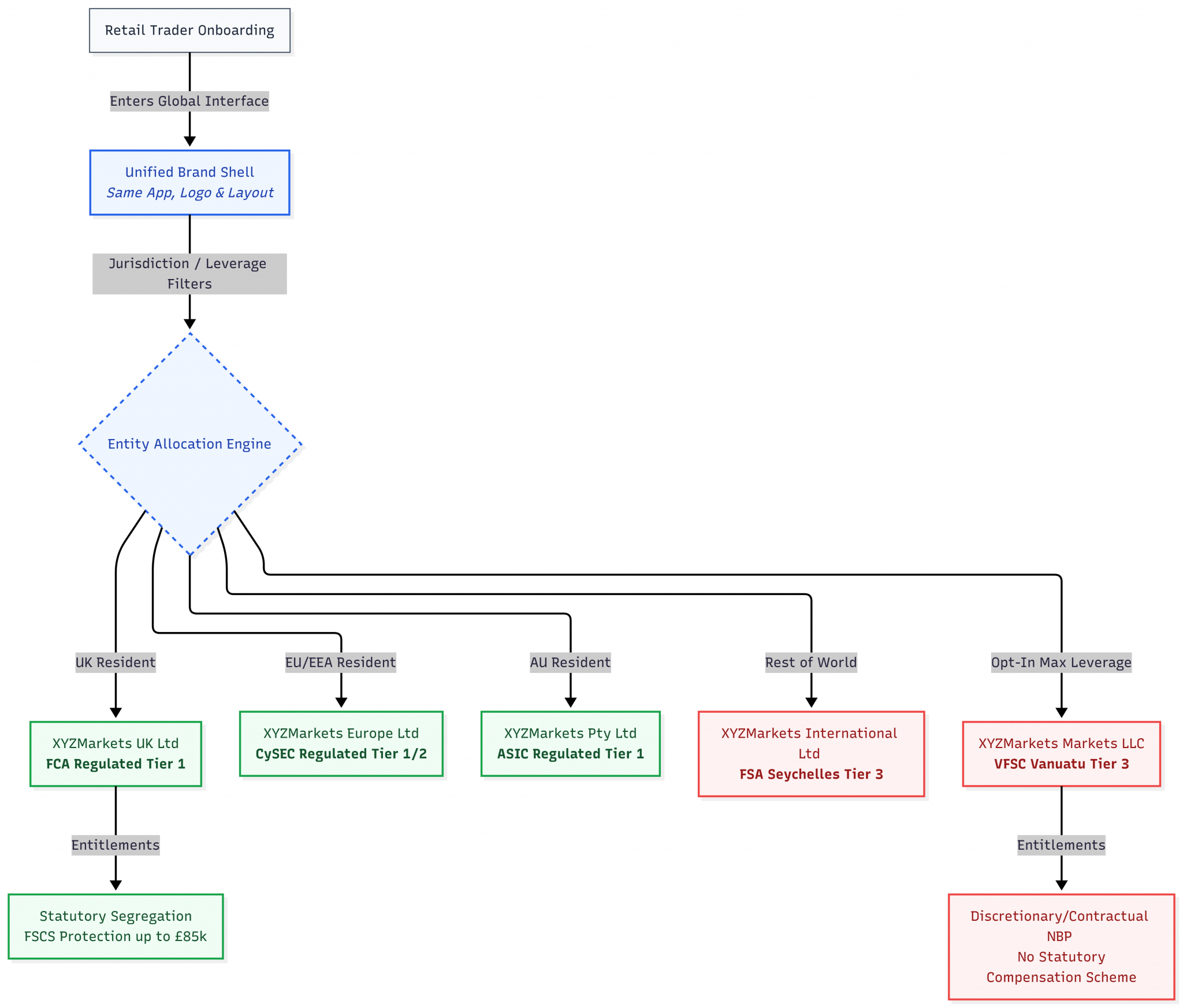
In this specific example, the company group holds licenses from the FCA, CySEC (EU), and ASIC, and uses them to onboard clients from these respective places. Clients who sign up from other parts of the world are given the FSA-licensed company as their contract partner. Retail clients who actively (albeit sometimes without understanding the consequences) opt in for high leverage are offered a contract with the VFSC-licensed company.
Typically, a company group will also block prospective traders from a list of countries that they do not want to run into trouble with (e.g. the USA), countries that are sanctioned (e.g. Iran), and countries that are considered high fraud risk (e.g. Sudan).
Your Contractual Counterparty Matters
A company group operating individual companies in several jurisdictions is not a problem in itself. As discussed above, it can even be a requirement to obtain national licenses and adhere to the requirements of each jurisdiction.
The issue is that the trader’s rights sit with the contracting entity, not the brand, and that is true even in situations where companies share directors, liquidity relationships, back office systems, and marketing material.
If XYZMarkets UK Ltd fails, your claim is against XYZMarkets UK Ltd. If XYZMarkets International Ltd refuses a withdrawal, your claim is against XYZMarkets International Ltd, and you will need to file a complaint with the FSA in the Seychelles. The fact that both use the same logo does not make them the same legal entity.
To build good habits, it is advisable to replace the brand name with the legal entity name in your own thinking and stop being vague. Do not think or say: “I trade with XYZMarkets” when the truth is that “I hold a retail CFD account with XYZMarkets UK Ltd, a company authorized by the FCA” or “I hold a retail CFD account with XYZMarkets International Ltd, a company incorporated in Vanuatu, under a VFSC license, governed by Vanuatu law, but with disputes heard in Singapore International Arbitration Centre (SIAC), as specified in the client agreement.”
Yes, that is very clunky, but precision in thinking and speaking is how traders avoid believing in protections that they do not have.
Since group structure can be confusing, it is best to stick to company groups that communicate clearly about how they are structured and where each company is registered and regulated. When in doubt, ask one direct question: “Please confirm the full legal name, registration number, regulator, governing law, and dispute forum of the entity that will be my contractual counterparty.” A serious broker can answer that without making it complicated or acting like you are being difficult.
Understanding The Concept Of Tier 1, Tier 2, And Tier 3 Jurisdictions/Regulation
In brokerage and trading circles, “Tier 1 / Tier 2 / Tier 3 jurisdictions/regulation” is a shorthand, not an official classification system. There is no global regulator, treaty, or standard body that defines these tiers. Instead, firms, compliance teams, and fintech companies use the terms informally to describe perceived regulatory strength, trader/investor protection, and enforcement rigor. Because it’s subjective, the same jurisdiction can appear in different tiers depending on context and who made the list.
In simple terms, a Tier 1 jurisdiction has the strongest trader protection, especially when it comes to retail trader (consumer) protection. From a retail trader perspective, the downside is that you will also be limited “for your own good”, e.g. when it comes to how much leverage a broker can give you and which financial products you can access.
Tier 1 Jurisdictions
A list of Tier 1 jurisdictions will typically be comprised of jurisdictions that combine several different factors. It is not enough to simply have strict trader protection rules in theory. The jurisdiction must also have a solid history of actually enforcing these rules, and the legal system must be both willing and able to investigate brokers and take effective actions against rule-breakers. This, in turn, requires both sufficient legal mandate and sufficient actual, practical resources.
Tier 1 jurisdictions typically combine:
- Strong investor protection frameworks
- Tight licensing for brokers
- Actual supervision and auditing of licensed firms
- Mature enforcement history
- Useful and accessible dispute resolution paths for retail traders
- A wider legal system that works well
- Investor/trader protection schemes that can step in after broker bankruptcy
Examples of common Tier 1 jurisdiction characteristics:
- High broker capital requirements
- Mandatory client money segregation
- Low leverage caps for retail traders
- Mandatory negative balance protection on retail accounts
- No deposit bonuses for retail traders
- Retail binary options are banned or heavily restricted
- For the broker, the costs associated with constantly staying on top of the many compliance requirements can be heavy
Examples of jurisdictions that are often included in Tier 1 lists:
- United Kingdom
- Ireland
- Germany
- France
- Netherlands
- Belgium
- Luxembourg
- Austria
- Switzerland
- Singapore
- Hong Kong
- Japan
- United States
- Australia
- Canada
Tier 2 Jurisdictions
A list of Tier 2 jurisdictions will typically contain three different main groups.
A.) Jurisdictions that have strong trader protection rules in theory, but where enforcement needs to become more solid. This includes several countries within the European Union that operate under the MiFID II framework but do not have the long history of strong enforcement that Tier 1 EU/EEA countries can show.
Examples of countries commonly considered Tier 2 because of this are Bulgaria and Romania.
B.) Jurisdictions that possess credible regulators, functioning courts, and meaningful investor protections, but that have adopted a more permissive regulatory philosophy toward retail trading. Rather than imposing highly restrictive measures such as low leverage caps or broad prohibitions on trading incentives, regulators have chosen to allow retail traders greater freedom while emphasizing disclosure, risk warnings, and personal responsibility.
A well-known example is the United Arab Emirates (UAE). Notably, the special financial zones DIFC and ADGM are a bit closer to Tier 1 than the rest of the UAE.
C.) Evolving frameworks and enforcement. These countries are not marketing themselves as lightly regulated offshore paradise locations (Tier 3), and they are not attracting foreign brokers looking for a laissez-faire regulator. But they have a long way to go before their total trader protection is on par with even Group A and Group B within Tier 2. One example would be Kenya, which has made great strides in increased broker regulation and trader protection in recent years, but where the legal institutions are still struggling with a lack of resources. In case of broker failure, the Kenyan Investor Compensation Fund (ICF) will not cover more than KES 200,000 per investor per failed firm. This is a meaningful sum for many of Kenya’s nano retail traders and reflects the current trader landscape in the country, but the cap is low compared to the norm in Tier 1 jurisdictions. Also, the ICF is not an uncapped sovereign guarantee, so payouts are limited by the available resources of the compensation fund.
When brokers obtain a license from a Tier 2 jurisdiction, it is often because they are interested in entering or expanding in that specific market or within that region. Tier 2 jurisdictions are not commonly sought out by brokers who are looking for especially light regulation to onboard global clients, since Tier 3 jurisdictions are more suitable for that.
Notes:
- You can encounter lists where small markets are never listed as Tier 1, no matter how strong the trader protection is in theory and practice. This means that a country such as Iceland can show up as Tier 2, simply because it is a small market and rarely mentioned in global broker discussions.
- You can encounter lists where outdated perceptions keep certain countries listed as Tier 2 despite recent changes in framework and enforcement. Cyprus and Malta are two examples, since they became famous as comparatively “easy” jurisdictions to deal with for brokerage companies that wanted to be licensed within the EU. Both Cyprus and Malta have firmed up considerably since then, and they have both been required to adhere to MiFID II since January 2018. Still, some lists keep them as Tier 2, either because of their past reputation, or because they are considered too small to have the same enforcement muscles as a jurisdiction such as the UK, France, or Germany.
Tier 3 Jurisdictions
This group contains two major groups:
- Jurisdictions with very limited relevance to global brokerage operations, where financial markets are small and regulatory frameworks are not developed around complex online retail trading products such as leveraged FX or CFDs. One example would be Mauritania, which has only a basic financial regulatory system, a very small capital market, and low levels of domestic trading activity. Mauritania has no meaningful role in international broker licensing or structuring.
- Jurisdictions that actively attract businesses by offering very light regulation of online brokers. The pathways to company formation and licensing are clear, and the barriers are low. Many of these places fit the trope of the classic tropical offshore paradise island jurisdiction, where businesses can also enjoy preferential tax treatment and a high degree of privacy. Trader protection is typically weak both in theory and practical reality. Even when certain trader protection rules do exist on paper, recourse can be difficult and expensive to obtain for the trader. For many retail traders with a small account, trying to navigate a legal system that is ineffective or heavily favors the broker would not be worth it.
Examples of Tier 3 jurisdictions that are also commonly referred to as lightly regulated offshore locations for brokerage companies:
- Belize
- Saint Vincent and the Grenadines (SVG)
- Seychelles
- Vanuatu
- Bahamas (a bit closer to Tier 2)
- Barbados (a bit closer to Tier 2)
- Antigua and Barbuda (a bit closer to Tier 2)
Note: Certain other “offshore paradise” jurisdictions, such as the Cayman Islands and the British Virgin Islands, frequently appear in the corporate structures of global brokerage groups, but not as direct retail broker licensing jurisdictions. Instead, they are commonly used for holding companies, special purpose vehicles (SPVs), or intermediary entities due to tax considerations, flexible corporate law, and well-established and dependable offshore financial services frameworks.
The Two Directions: Traders Seeking Tier 1 Benefits & Traders Seeking Tier 3 Benefits
There are two main directions to take into account when we discuss jurisdictional arbitrage for retail traders.
- Retail traders in Tier 1 jurisdictions sign up with brokers in Tier 3 countries to get access to higher leverage, additional financial products, easier onboarding, etc. They lose many of the trader protection rules that are in place in the Tier 1 jurisdiction they are accustomed to.
- Retail traders in Tier 1 and Tier 2 jurisdictions that have previously used a Tier 3 licensed broker but now want to sign up with a broker that is authorized in a Tier 1 jurisdiction (often their home country) instead, to get stronger trader protection and (when applicable) eligibility for the national investors protection scheme. When signing up with a Tier 1 licensed broker, they typically lose access to high leverage, certain financial products, etcetera, and might need to reconfigure their entire trading strategy to account for this.
When a trader lives in a Tier 1 jurisdiction but signs up with a Tier 3 licensed broker, leverage is often a strong factor behind the decision. Retail trading accounts in Tier 1 jurisdictions are typically restricted by low leverage caps, cautious margin close-out rules, mandatory negative balance protection (NBP), and bans or restrictions on certain products. One example is the United Kingdom, where the Financial Conduct Authority’s permanent retail CFD rules limit leverage between 30:1 and 2:1 depending on the asset class, require 50% margin close-out, and impose mandatory NBP. In Australia, ASIC’s retail CFD product intervention order applies similar controls, including leverage limits from 30:1 to 2:1, margin close-out rules, and mandatory NBP.
When a trader lives in a Tier 1 jurisdiction and wants to move from their Tier 3-licensed broker to a Tier 1-licensed broker, it is typically because they have decided that benefits such as high leverage and deposit bonuses are worth giving up in exchange for the better trader protections offered by Tier 1 jurisdictions. This type of move is less glamorous, and we don’t see it discussed much by finfluencers and similar social media entities. It is not as easy to do viral trading content about lower leverage, no welcome bonus, client money segregation, and more boring paperwork. Many traders find statutory NBP protection for tail events less exciting than a $500 sign-up bonus, at least until they have experienced the horrors of a tail event with their own eyes and with their own money on the line.
Signing Up With A Tier 3-Licensed Brokerage Company
As discussed above, traders living in Tier 1 and Tier 2 jurisdictions can usually sign up with brokerage companies in Tier 3 jurisdictions. Sometimes this is a well-informed decision, and sometimes it happens without the trader fully understanding the true significance of the change, especially when that change takes place under the umbrella of a global broker brand.
The motives for signing up with a Tier 3 broker from a Tier 1 or Tier 2 jurisdiction vary. Here are a few common examples:
- Higher leverage (to be able to open larger positions)
- Higher leverage (to be able to open the same size positions as before, but with less money sitting in the account). Also known as lower margin requirements.
- Access to financial products that are banned or restricted in the Tier 1 jurisdiction
- Fewer appropriateness checks during onboarding
- Less intrusive wealth or funds verification
- More flexible funding options, e.g. cryptocurrency transfers
“Silent Migration” To Tier 3, And Why Traders Need To Be Vigilant
In some cases, the trader agrees to move their account from a Tier 1-licensed entity to a Tier 3-licensed entity under the same brand without really understanding what’s happening. Customer service and marketing material will typically not say “Hey, would you like to lose a bunch of your trader protection rights?” or “Do you want your account balance to be able to drop far below zero so you end up owing us money after a horrifying tail event?”
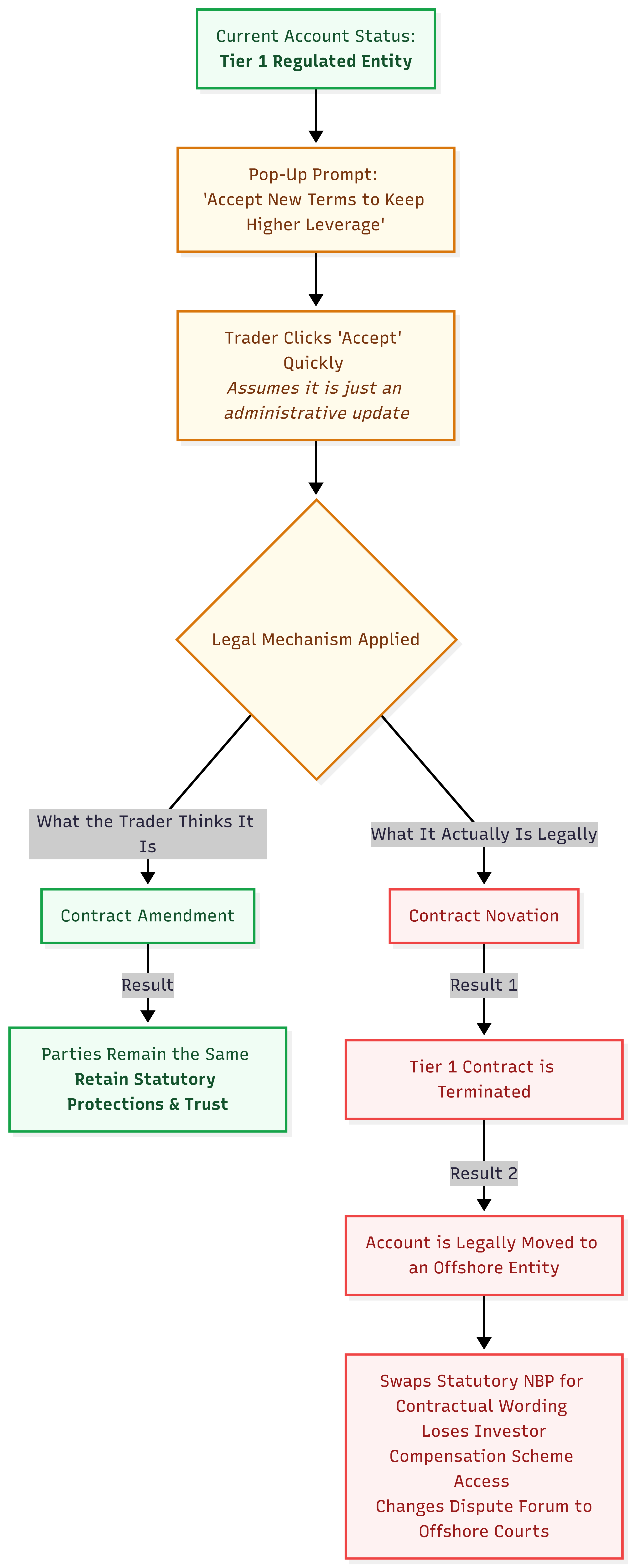
Instead, a trader can be gently nudged into approving a move into Tier 3. Be careful with phrases such as:
- “Continue trading with higher leverage.”
- “Transfer to our global entity.”
- “Get access to additional products.”
- “Move your account.”
- “Upgrade your trading conditions.”
- “Accept new terms.”
- “Due to regional changes, please accept the updated terms to continue accessing your current leverage”
- “Due to regional changes, your account will be transferred to our international entity.”
- “To keep your trading experience uninterrupted, we are updating your contracting entity.”
The wording can make the action sound administrative, and the trader can be tempted to quickly agree to everything just to get it out of the way. In legal terms, however, the action may be a novation. A novation is the replacement of one contractual relationship with another. In the context of online trading, it can mean that the trader’s agreement with the Tier 1 entity is terminated, and a new agreement is formed with a Tier 3 company within the same sphere.
The difference between amendment and novation matters a lot here. An amendment changes the existing contract. The same parties remain. The legal identity of the broker remains the same. A novation replaces the contract or substitutes a party, and your new counterparty might not be covered by the same regulator, compensation scheme, complaint body, or client asset regime.
Many traders do not even understand that something major has happened when they have gone through novation. The platform is still the same, and the trader logs in using the same credentials. Watchlists remain. The account balance is unchanged. Yet the legal foundation is not the same as before.
When you are asked to approve something regarding your contract, it is important to slow down and find out what´s going on. The correct question is not “will my login still work?” but “will my legal rights change if I click accept?”
Always make sure you check for things such as:
- Old entity vs. new entity
- Whether the regulator changes
- Whether open positions transfer
- Whether account balances transfer
- Whether client money status changes
- Whether compensation rights change
- Whether complaint rights and escalation paths change
- Whether negative balance protection changes from mandatory to contractual
- Whether the dispute resolution forum changes
- Whether you can refuse the transfer and what happens if you do
If the notice does not answer those questions, ask support in writing. Keep the response, including any screenshots, emails, downloaded PDFs, and chat transcripts. Store your evidence away from the platform, to make sure they don’t suddenly disappear or change if there is a conflict. Do not rely on a phone call with an account manager who says “everything is the same”. Everything is almost never the same. If it were the same, the broker would not be so eager for you to legally approve the change.
The appeal to skip the research and simply agree when a pop-up shows up or a message from customer service lands in your inbox is understandable. Especially when the change is presented as something very positive. Your leverage is currently capped at 30:1 for major FX pairs and even lower for minors. If you approve this upgrade, you will instead get access to up to 500:1 leverage. But the trade-off is not just “more trading freedom, more trading risk.” You are also adding legal risk and counterparty risk. You might, for instance, be swapping mandatory regulatory negative balance protection (NBP) for much more vague and limited private contract promises. That distinction might go unnoticed for months or years, until it suddenly becomes extremely apparent. When the market gaps through a stop during a tail event and the broker invokes a force majeure or “abnormal trading conditions” clause to nullify the contractual NBP, you find yourself owing the broker $50,000 on leveraged positions that could not be closed fast enough because liquidity disappeared.
The exact rules vary from one jurisdiction to the next, but the patterns are clear. Tier 1 regimes reduce trader flexibility and add legal trader protection. Tier 3 regimes add flexibility but shift more risk onto the trader. A trader is not automatically stupid or reckless because they want to use a Tier 3 broker for their strategy. But the decision to move your account to Tier 3 should be an informed one and not something that happened because you were stressed one night and quickly agreed to a novation when a pop-up showed up on your screen. An experienced and knowledgeable trader who wants to scalp high leverage during volatile sessions can make the deliberate decision to open an account with a Tier 3 broker. But a trader holding serious capital in their account should be careful and not accidentally move all that money to a Tier 3 brokerage company in the Seychelles.
A broker company change is usually sold as a trading conditions decision rather than a change of contract partner. You are promised higher leverage, better spreads, more products, cryptocurrency payment rails, and generally more flexibility. But focusing on these things is not enough. The real question is this: Which legal system do you want your account to be located in when something goes wrong? Because the risk of something going wrong is far from zero. Maybe not today. Maybe not in several years. But it is a well-known fact that markets can gap, servers can freeze, liquidity can thin, payment processors can fail, regulators can intervene when AML protocols have been broken, brokers can become insolvent, and new company owners can turn out to be sketchy.
A trader moving to Tier 3 should be aware that they are swapping statutory protection for flexibility. A trader moving to Tier 1 should understand that they are giving up flexibility for a stronger legal perimeter. Neither choice is automatically wrong, but both choices have a cost. The mistake is pretending the cost does not exist.
Account Managers And Conflicts Of Interest
Account managers are not neutral advisers. If they are hired by your broker and paid by your broker, they work for your broker. Not for you. That does not make them villains. Some are actually helpful. But incentives matter, and their job description and Christmas bonus requirements can include goals that make them eager to convince you to make bigger deposits, trade more frequently, engage in more risky trading, use more leverage, and approve account migration from Tier 1 to Tier 3.
If your account manager encourages any type of “account upgrade”, it is time to start asking some uncomfortable questions, such as:
- Is this a migration from one contractual counterparty to another?
- Are you acting on behalf of my current Tier 1 regulated entity or the Tier 3 entity you are suggesting I sign up with?
- How would my regulatory protections change?
- How would my negative balance protection change?
- Would my complaint escalation path change?
- Would my client money treatment change?
- Would I retain eligibility for any applicable compensation scheme?
- Can you provide all of the above responses in writing?
Note that sometimes these salespeople are not called account managers. They come under many different labels, such as account executive, client relationship manager, client success manager, customer success manager, trading specialist, investment consultant, financial consultant, senior account representative, retention agent, client services manager, portfolio adviser, wealth adviser, onboarding specialist, VIP account manager, or business development manager. Titles can sound advisory or administrative in nature even when the role is primarily sales-oriented.
Signing Up With A Tier 1-Licensed Brokerage Company
Sometimes, a trader using a Tier 3 regulated broker decides to move to a Tier 1 regulated broker. This can, for instance, be motivated by a bad experience, the fact that the account size is now larger, increased tax reporting issues, bank pressure, estate planning, corporate treasury control, or simply having learned more about counterparty risk and legal risk. A trader can also decide to diversify by keeping their Tier 3 brokerage account and creating a Tier 1 brokerage account with another broker.
Can I Pick Any Tier 1 Jurisdiction?
The answer to this question depends on your specific situation.
Generally speaking, traders living in Tier 1 jurisdictions get the best legal coverage and access to recourse if they pick a broker licensed to operate in that jurisdiction. Using a broker that is licensed in your own country reduces jurisdictional complexity, and you are less likely to “fall between the cracks” from a legal perspective. Many traders also prefer not having to deal with a foreign financial authority, a court case that is taking place on the other side of the world, possible language barriers, and so on.
By sticking to a broker that is authorized within your own jurisdiction, you are also more likely to be covered by a national investor compensation scheme that kicks in if your broker becomes insolvent (after commingling funds) and can not pay back your money.
Example: A trader lives in Tier 1 Country X but signs up with a foreign broker licensed by Country Y, which is also a Tier 1 jurisdiction. The broker fails, and there is not enough money left to compensate the trader in full. The trader finds out that they are not covered by the Country X investor compensation scheme since the broker was not licensed by Country X. And they are also not covered by the Country Y investor compensation scheme, because they are not a resident of Country Y.
This is not always the case, because some national compensation schemes will cover even foreign traders. But don’t count on it; always do your own due diligence.
In the context of picking a suitable jurisdiction, it is also worth mentioning that many Tier 1 licensed brokerage companies are particular about accepting new traders. Before you get too deep into your research of a specific brokerage company, make sure you are eligible. It is not fun to spend a lot of time researching Awesome Broker UK Ltd, only to find out late in the process that you are only eligible for a contract with Awesome Broker Seychelles Ltd.
Expect Friction
Traders moving from Tier 3 to Tier 1 often feel they are making the correct and responsible choice, and then get annoyed when the change turns out to be slower and more complex than expected. If I am doing the right thing, why do I have to clear so many hurdles? Shouldn’t this Tier 1 jurisdiction and all their brokers roll out the red carpet and welcome me with open arms and a smooth path to onboarding?
Due to a variety of reasons, moving over to a Tier 1 jurisdiction is often harder than traders expect. Even if you move within the same brand and company group, the Tier 1 regulated entity can not automatically copy your Tier 3 account and let you continue seamlessly. In order to comply with Tier 1 regulation, the Tier 1 entity must run its own onboarding. It must go through steps such as verifying identity, getting proof of address and tax residency, assessing appropriateness and trading experience, verifying source of funds, verifying source of wealth, verifying bank account ownership, and so on. Even if you, as a trader, are accepted, the Tier 1 broker can still reject financial products the Tier 3 entity allowed, refuse to accept funds from certain payment paths, and so on.
Open Positions And Liabilities
Open positions make novation harder. If you, for instance, have positions open under a Vanuatu or SVG entity, a UK, Australian, or French entity can usually not keep them open and copy them into your new Tier 1 account. Instead, the normal route is for the positions to be closed with the Tier 3 broker and for new positions to be opened with the Tier 1 broker. And this may not be a smooth ride. Pricing may differ, margin requirements may differ, product permissions may differ, and so on.
A multinational broker may create an internal process that appears seamless on the surface, but legally the old exposure and new exposure need careful treatment. If the trader later disputes something, e.g. slippage, liquidation, swap charges, or stop execution, the first question will involve determining who was the legal counterparty at that exact moment. Secondly, you might have granted blanket permissions for opening and closing and associated costs when you agreed to the novation. As always, the fine print matters.
Leverage Limits, Margin Requirements, And How Much Money Needs To Be Kept In Your Tier 1 Account To Continue With Your Current Trading Strategy
Leverage Limits
Traders engaging in leveraged trades should run the numbers themselves before making decisions about jurisdictions. If you don’t, you set yourself up for unwelcome surprises.
Examples:
Suppose a retail trader holds a $500,000 notional EUR/USD position in a Tier 3 jurisdiction where 500:1 retail leverage is permitted. At 500:1 leverage, the margin required is $500,000 ÷ 500 = $1,000.
In a Tier 1 jurisdiction where retail leverage is capped at 30:1 for major FX pairs, the margin required is $500,000 ÷ 30 = $16,666.67. That is a huge difference.
If the trader’s account equity is $5,000, the Tier 3 account can hold the position, but the Tier 1 account cannot.
As we have already discussed, leverage mismatch can be a problem, especially when a retail trader wants to move from a high leverage jurisdiction to a jurisdiction where retail leverage is capped low by regulators.
Margin Close-Out Rules Mismatch
Margin close-out rules can also differ.
Tier 1 regimes often standardize close-out protection. One example is the UK, where FCA rules require retail CFD providers to apply margin close-out protection, meaning that one or more of a retail trader’s positions must be closed if the equity in the account falls to 50% of the total margin required to maintain all open CFD positions. It is important to understand that these FCA rules set a minimum margin close-out threshold of 50%, but brokers are permitted to implement stricter internal risk controls and may initiate liquidation earlier (e.g. at 70%) provided the rules are clearly disclosed.
Tier 2 and Tier 3 jurisdictions often give brokers more leeway. This is why you can find brokers who set their margin close-out level far below 50%, e.g. when the account falls to 30% or 20% of the total margin required to maintain all open CFD positions. They will also have more room for how the close-out can be applied. Some apply close-out per position. Some apply it by account. Some may liquidate largest losing trades first. Some may liquidate in whatever order their policy allows. Some may widen spreads during volatile pricing or change margin requirements before major events.
If you are used to a Tier 3 broker who does not close out your positions until 20% and applies that close-out in a very specific way, you might have to adjust your entire strategy as you move to a Tier 1 broker bound by strong margin close-out rules. A trader’s strategy may be calibrated to the routines of a certain broker in a Tier 3 environment, and transitioning into a Tier 1 jurisdiction can materially disrupt the strategy’s performance or even render it unworkable. This is not inherently negative. Some strategies only function because they operate close to the edge of regulatory, liquidity, or risk constraints, and in such cases, moving away from that environment before conditions deteriorate can be a prudent and protective adjustment.
Banned Financial Products
Some products cannot cross the border because the Tier 1 entity cannot offer them at all or can not offer them to retail clients. This is one of several reasons why a move from Tier 3 to Tier 1 often starts with flattening the book, especially for retail traders. A trader should never assume that the same brand and same platform mean the same product permissions.
Suppose a retail trader holds a $100,000 cryptocurrency CFD position with a Tier 3 broker. At 100:1 leverage, the margin required is $1,000. The trader starts calculating how much margin would be required after an account move to the UK, but this calculation is a waste of time. If the trader were to move their account to the UK, any talks about margin requirements would be pointless for this position, because since January 2021, firms acting in or from the UK are prohibited from selling, marketing, or distributing crypto derivatives (including CFDs, futures, and options on cryptoassets) to retail consumers. So, the UK-regulated company cannot offer any crypto CFDs to that retail client at all. As of 2026, when this article was originally written, the FCA continues to prohibit retail access to most crypto derivatives, while separately allowing certain crypto Exchange-Traded Notes (ETNs) to be made available under specific regulatory conditions. The two product categories are treated differently in FCA policy, with non-ETN derivatives remaining subject to a permanent retail ban due to their higher leverage and OTC risk profile.
Another example of a financial product that is common in Tier 3 jurisdictions but banned or heavily restricted in many Tier 1 jurisdictions is the retail binary option (under its various names). These products are prohibited or tightly restricted in jurisdictions such as the EU/EEA countries, the UK, Australia, and Canada, while in the United States they are generally limited to exchange-traded venues rather than being widely available as OTC retail products. Generally speaking, however, binary options are less of a consideration in account migration, as retail products in this category are typically very short-dated and expire within minutes or hours. This reduces the need for position management during transfers. Compared with margin-based products such as CFDs, they present less ongoing exposure that requires reconciliation at the point of migration. In addition, many international brokerage groups have discontinued retail binary options entirely, even within their Tier 3 entities, due to regulatory pressure and reputational risk.
CFD Suitability And Appropriateness
Many Tier 1 jurisdictions require brokers to conduct formal appropriateness and/or suitability assessments before granting retail clients access to certain types of CFD trading, or before reclassifying a client from retail to professional status.
A trader who is used to a more lax Tier 3 jurisdiction can find this process annoying, a waste of time, or outright insulting. These reactions are understandable but misplaced. The questionnaire is not a personal attack from the broker; it is a regulatory requirement. Your broker is legally required to assess if the product is appropriate for you given your knowledge and experience.
The objective is not to determine whether a client will be profitable. Rather, it is to evaluate whether the client has sufficient knowledge and understanding of key concepts, including leverage, margining, liquidation mechanics, and the risk of rapid and total loss of capital.
Importantly, firms subject to Tier 1 regulatory regimes are generally not permitted to rely uncritically on information provided by another entity, even within the same corporate group. Differences in regulatory frameworks, questionnaire design, and client classification standards mean that information obtained in one jurisdiction may be incomplete, inconsistent, or no longer valid for the purposes of another regulated entity.
As a result, when opening or transitioning to a Tier 1 CFD account, clients should expect to complete a structured questionnaire and, in some cases, provide supporting evidence of relevant trading experience.
Typical assessment questions may include:
- How long have you been trading CFDs or other leveraged products?
- How many trades have you executed in the past?
- Do you understand what happens when margin falls below the close-out threshold?
- Do you understand that losses can exceed your initial deposit in certain conditions (where applicable)?
- What is leverage and how does it amplify both gains and losses?
- What is slippage and under what conditions can it occur?
Anti-Money Laundering (AML) checks
Anti-money laundering (AML) rules, controls, and routines can be very different between Tier 3 and Tier 1 brokers.
Compared to a Tier 3 broker, the Tier 1 broker might, for instance, refuse a greater number of third-party payment processors. The Tier 1 broker can also require stronger explanations and evidence of the source of funds, source of wealth, and whether the funds route makes sense.
In this context, source of funds means the origin of the particular money used for a deposit. Examples include salary, business revenue, property sale proceeds, and investment liquidation or savings. Source of wealth means the broader origin of a client’s total wealth. Examples include employment history, company ownership, inheritance, property portfolio, long-term investing, professional earnings, or sale of a business.
A trader moving $200,000 from an account in the British Virgin Islands (BVI) to a broker regulated by BaFin in Germany may be asked for bank statements, tax returns, salary information, company accounts, sale contracts, wallet transaction histories, exchange statements, etcetera, depending on the circumstances. Simply declaring that the transfer comes from a trading account based in the BVI might not be enough, since the broker can be required to make a contextual assessment rather than simply check from whence the $200,000 is transferred.
This is not because the broker thinks every client who has used a Tier 3 broker is a Tony Montana or Yuri Orlov character with TradingView alerts. It is because Tier 1 regulators require firms to follow certain procedures to combat money laundering. These regulators are, in turn, typically basing their rules on standards established by the Financial Action Task Force (FATF), the global standard-setter for anti–money laundering (AML) and counter-terrorist financing (CFT) frameworks. FATF was created by the G7 countries at the G7 Summit in Paris in the late 1980s in response to growing concerns about money laundering linked to international drug trafficking and organized crime. Originally, FATF had a narrow focus on working against money laundering in the financial system, but its mandate has since expanded significantly to also include things such as working against terrorist financing (especially after 2001) and working against proliferation financing (weapons of mass destruction).
Operational And Risk Engine Asymmetries
Even where the legal path is clear, the trading system may not support the type of smooth migration from Tier 3 to Tier 1 that the trader was hoping for. Even within the same company group, two different entities can use different risk engines, liquidity streams, margin tables, close-out settings, product lists, mark-up schedules, and booking models. The trader sees the same platform for the entire brand, but backends may be very different for different entities within the group.
Special Considerations Concerning Jurisdictional Arbitrage
Governing Law And Dispute Resolution
In the retail trading industry, contracts for difference (CFDs), rolling spot foreign exchange (FX), margin products, and similar over-the-counter (OTC) derivatives are typically structured as bilateral agreements between the client and the broker, or between the client and another entity within the broker’s corporate group. As a result, the trader’s rights and obligations arise primarily from the contractual relationship with that counterparty.
Unlike exchange-traded derivatives, these products are generally not traded on a regulated exchange and are typically not centrally cleared. Consequently, there is no exchange rulebook or clearing-house framework providing an additional layer of contractual rights, obligations, and protections. The terms of the client agreement therefore become critically important.
The extent to which contractual terms can disadvantage a retail trader depends largely on the applicable legal and regulatory framework. In jurisdictions with strong regulatory oversight, certain retail trader protection rules are mandatory and cannot be waived by contract. For example, where regulators require negative balance protection (NBP) for retail clients, firms cannot contract out of that obligation. In less protective jurisdictions, however, some safeguards may be subject to contractual modification or exclusion, resulting in significantly different risk profiles for retail traders.
Before entering into any agreement, traders should obtain clear answers to the following questions:
- Which country’s laws govern the contract?
- Which court, arbitration panel, or other tribunal has jurisdiction to resolve disputes?
- Are there statutory investor-protection, consumer-protection, or general contract-law provisions that override conflicting contractual terms?
- If I incur a debt to the company, can that debt be enforced in my home jurisdiction, and if so, how?
Understanding these issues is an essential part of assessing counterparty risk and the practical level of protection available to a retail trader.
Governing Law Vs. Forum Selection
A client agreement may distinguish between the law governing the contract and the forum in which disputes must be resolved, provided that such an arrangement is permitted under the applicable legal framework.
As a result, it is possible for a contract to be governed by the laws of one jurisdiction while requiring disputes to be litigated or arbitrated in another. For example, a contract might state:
“This Agreement is governed by the laws of Mexico.”
and later provide:
“Any dispute arising out of or in connection with this Agreement shall be submitted exclusively to the courts of Vanuatu.”
In this scenario, Mexican law would generally govern the interpretation of the agreement, while disputes would ordinarily need to be brought before the courts of Vanuatu.
Such arrangements can introduce significant practical and legal complexity. A trader may need to obtain legal advice in multiple jurisdictions, navigate unfamiliar procedural rules, and incur substantial costs in order to pursue a claim. For this reason, the location of the dispute-resolution forum can be just as important as the governing law itself.
It is also worth considering why a particular forum has been selected. Businesses often choose jurisdictions that are operationally convenient, legally predictable, or commercially advantageous. They can also seek to increase the cost and difficulty of dispute resolution for clients located elsewhere.
That said, the enforceability of forum-selection clauses varies by jurisdiction. In some countries, consumer-protection laws, financial-services regulations, or mandatory statutory rights may limit or override contractual provisions that require retail clients to pursue disputes in a foreign forum. In addition, a regulatory complaint is generally distinct from a civil claim. Even where a contract specifies a foreign court or arbitration venue, a client may still be able to submit complaints to the relevant financial regulator or ombudsman scheme if one is available under applicable law.
Why Party Autonomy Matters
Party autonomy is the principle that contracting parties can choose the law and forum that govern their relationship. In commercial life, this is useful. Two sophisticated companies trading across borders can choose a specific law and court system where any future disputes will be resolved. This can, for instance, be necessary to prevent the jurisdictional complexity that arises when an international cargo ship has passed through three national waters, engaged with two different port authorities, and experienced an issue while in international waters.
In retail brokerage, party autonomy can create a very lopsided situation, with a well-established brokerage group and their legal team on one side and a hobby trader with a $5,000 account on the other. In practical reality, this is not two equal partners negotiating a contract. The broker drafts a standard contract, and the trader accepts or rejects it.
As we have already touched on above, Tier 1 regimes often restrict what retail brokers can do despite contract wording. Product intervention rules, conduct rules, negative balance protection, client money rules, and marketing restrictions can override the broker’s preferred contract clauses. Tier 3 jurisdictions usually give much wider effect to the contract as written. Brokers are well aware of this, and Tier 3 contracts are much more likely to contain broad discretion clauses, extensive force majeure provisions, rights of set-off, withdrawal review powers, deliberately vague bonus conditions, and a negative balance protection that is limited to “normal market conditions”.
A broker brand that behaved exceptionally well when your contractual counterparty was one of its Tier 1 entities may suddenly show a very different side once you have agreed to a novation that makes one of its Tier 3 entities your new contract partner.
A Change Of Broker Entity Can Change Execution
Changing from one broker entity to another, even within the same brokerage group, is not merely a matter of governing law, dispute resolution, or investor protection. It can also have material implications for execution quality and market access.
Different entities within the same group may operate under different regulatory frameworks, maintain relationships with different liquidity providers, apply different risk-management policies, and utilize different execution architectures. Consequently, execution outcomes may vary between entities despite a common brand name and trading platform.
Examples of possible execution arrangements:
- Agency-style execution, where client orders are transmitted to external counterparties.
- Matched-principal execution, where the broker intermediates between the client and an external liquidity provider while remaining the client’s contractual counterparty.
- Principal market-making, where the broker assumes market risk and acts as the client’s counterparty.
- Hybrid models that combine multiple execution methodologies based on product type, client classification, order characteristics, or prevailing market conditions.
- Internalisation frameworks, under which client flow is offset within the broker or across affiliated entities before exposure is transferred externally.
The practical consequences may extend beyond simple differences in quoted spreads. Liquidity sourcing, fill quality, slippage characteristics, order-routing logic, last-look practices, rejection rates, and the treatment of market gaps can all differ between entities. Transparency can also change, because some jurisdictions require a much higher degree of disclosure when it comes to things such as execution venues.
Accordingly, traders should not assume that a transfer from one group entity to another is merely an administrative or jurisdictional change. In some cases, the underlying execution environment may differ substantially, even where the trading platform, product offering, and branding appear unchanged.
A trader may change contract entity to obtain higher leverage, and then discover that the new entity has wider spreads, increased requote frequency, or less predictable execution under volatile market conditions compared to the previous entity.
Cross-Border Tax And Reporting Considerations
Changing from using a broker based in Country A to using a broker based in Country B can create practical issues around tax reporting. The broker in Country B may be different when it comes to things such as statement format, base currency, realized profit records, withholding tax treatment, corporate actions reporting, availability of annual tax reports, classification of products, and audit trail quality. On a related note, your country of payment origin can change, and bank reporting tripwires can be triggered.
If you are planning to close your old trading account, make sure you download full records and take screenshots before you close the account. Do not assume reports will remain available. If you plan to keep your account alive but not use it for trading, be aware that this might trigger account dormancy.
Examples of records that are good to keep:
- Monthly and annual statements
- Closed trade reports
- Deposit and withdrawal history
- Currency conversion records
- Dividend and financing adjustments
- Bonus credits and removals
- Migration notices
- Entity agreements
The Bank’s Role In Migration
Banks are often the hidden gatekeepers. Your broker may approve a withdrawal, but your bank blocks, reviews, or returns the funds.
Banks Are Especially Likely To Question:
- Funds from offshore financial firms
- Large incoming transfers
- Crypto-related proceeds
- Payments from high-risk jurisdictions
- Mismatch between sender name and broker name
- Unusual currency flows
- Corporate funds into personal accounts
- Personal funds into corporate accounts
A trader planning migration should speak with their bank before moving large sums. A simple explanation and documentation can prevent problems. The bank needs to know things such as the origin of funds, the sender, and why you want to do the transfer.
Reverse Solicitation And Marketing Restrictions
There are jurisdictions where brokers are not permitted to solicit clients unless the firm has national authorization, typically in the form of a license from the local financial authority. Restrictions are especially common when it comes to reaching out to retail clients (as opposed to professional clients) and for the promotion of certain financial products (such as retail binary options).
Because of this, you might encounter the term “reverse solicitation”. Reverse solicitation means the client approaches the firm independently, rather than the firm marketing into a jurisdiction where it lacks permission. There are situations where a foreign broker would be legally able to accept a client from jurisdiction X, but not solicit that client in jurisdiction X.
In order to stay on the right side of “reverse solicitation”, brokers must be careful not to unlawfully solicit clients. And brokerage groups can be especially vigilant when they hold licenses in Tier 1 countries and are very eager not to ruffle any feathers. They must tow the line not to “push” clients in a way that could make a Tier 1 regulator lose its patience.
Because of this, a trader will sometimes receive vague replies when they contact customer support about a potential move from one entity to another.
A trader asks, “Can you move me to your entity in country Y?”, and the support replies with a canned “Please visit the relevant website and apply directly if available in your region.”
The trader thinks support is being useless. And yes, sometimes support is being useless. But sometimes support is simply trying very hard not to create evidence of illegal solicitation, and they have been told to err on the side of caution.
This is one of the reasons why you might feel that your request to move to another entity is being treated as a brand new independent application rather than an account transfer request. For the brokerage group, the safest route might be to make sure you flatten your existing account and, by your own volition, sign up with the other entity.
Of course, this experience is very different from the one had by the trader in another brokerage group who was so heavily nudged to move to a Tier 3 entity he did not even understand what was happening when he agreed to that “account upgrade” to get access to higher leverage. Depending on which broker you are dealing with and exactly which jurisdictions are involved, experiences can vary widely.
Examples Of How Client Asset Safeguards Can Differ In Different Jurisdictions
For many traders, one of the strongest reasons to move from a Tier 3 broker entity to a Tier 1 broker entity is to get better client asset protection.
What happens to the money (and possibly other assets) in your account if your broker becomes insolvent and files for bankruptcy? That question is easy to ignore until it is too late.
Client Money Segregation In Tier 1 Vs. Tier 3
The first step of trader asset protection is typically to make it mandatory for the broker to never mix client money with company money.
- Mandatory segregation of client money makes it more difficult (not impossible) for a broker to dip into client money in an effort to keep the company afloat during difficult times.
- When client money is held in properly segregated accounts, it is typically treated as belonging to clients rather than the insolvent firm. In insolvency, an insolvency practitioner can usually return these segregated funds to clients after reconciliation. If client money has instead been mixed with the firm’s own funds, it will typically form part of the general insolvency estate. In that case, clients generally rank as unsecured creditors and must claim through the general insolvency process, with recovery depending on the available assets after higher-priority claims are satisfied. In practical reality, traders are unlikely to get their money back, at least not in full. If the company had enough money to cover all its creditors, it would probably not have filed for bankruptcy in the first place.
This is why Tier 1, and many Tier 2, regulatory regimes impose mandatory client money segregation requirements. These rules are generally regulatory obligations rather than contractual terms, and cannot be waived or altered through client agreements. As a result, firms are typically not permitted to contract out of core client money segregation.
Example: The UK FCA states that firms holding or controlling client money or safe custody assets must follow CASS, and that these rules help keep client money and assets safe if firms fail and exit the market. CASS stands for the Client Assets Sourcebook, a set of rules issued by the UK Financial Conduct Authority (FCA). CASS provisions on segregation state that one purpose is to ensure client money is kept separate from the firm’s own money unless otherwise allowed.
In Tier 1 regimes, a broker simply saying “yes, yes, it’s segregated” is not enough. There are routines in place that must be followed for how client money is stored, reconciled, identified, and protected according to the applicable rules. In the UK, the above-mentioned CASS requires the broker to:
- Segregate client money from the firm’s own funds
- Hold client money in designated client bank accounts
- Keep accurate records and reconciliations of client balances
- Safeguard client assets according to custody rules
- Conduct regular internal and external audits of client asset protection
- Apply procedures in case of insolvency to help ensure orderly return of client assets
No system is perfect. Reconciliations can be wrong. Records can be deliberately tampered with. But a strict and detailed statutory client money regime is still a very different beast than a vague Tier 3 promise that “funds are stored safely” that comes without clear routines, independent oversight, and strong enforcement.
Tier 3 brokers can use reassuring phrases such as:
- “Client funds are held separately.”
- “Funds are kept in segregated accounts.”
- “We maintain separate client ledgers.”
- “Client money is not used for operational purposes.”
Some of these statements may be true. Some may be partly true. Some may mean less than the trader thinks. In a light-touch Tier 3 jurisdiction, “segregated” may mean the broker tracks client balances internally but still holds funds through accounts controlled by the company, and this may not give clients priority over other creditors if the broker fails. There is also the problem of these brokers not being strictly supervised and audited by the local financial authority. Even when statutory or contractual segregation rules do exist, brokers know they can get away with breaking them for a long time without anyone noticing, and if they get caught, a proverbial slap on the wrist might be the only consequence.
The question is therefore not whether the marketing page says “segregated”. You need answers to questions such as:
- Is client money segregation required by statute, contract, or both?
- Where are client funds held, and which banks or institutions hold them?
- In whose name are client money accounts maintained?
- Are the accounts formally designated as client (or segregated) accounts?
- Is there a trust, statutory trust, or equivalent legal structure protecting client funds?
- Are client funds excluded from the broker’s insolvency estate in the event of bankruptcy?
- Which court or legal mechanism enforces client money protections?
- Which financial regulator or supervisory authority oversees compliance?
- Are client funds reconciled regularly (e.g., daily), and is this required by regulation?
- What happens if a shortfall is identified in client money accounts?
- Are client funds pooled with those of other clients or individually segregated?
- Are client funds permitted to be held with affiliated entities?
- Can the broker earn or retain interest generated on client money?
- Can the broker use client money as collateral or margin with liquidity providers or other counterparties?
Examples of common phrases used by brokers:
| Phrase used by broker | Possible meaning | Strength |
|---|---|---|
| Client money held under statutory trust | Statutory separation between firm money and client money | Strong |
| Client funds held in designated client accounts | Separate bank accounts; the exact degree of separation depends on applicable law | Medium to strong |
| Client balances tracked in internal ledgers | Accounting separation, but not necessarily legal separation | Weak to medium |
| Funds not used for hedging or operations | A policy promise that may be difficult to verify and does not create legal separation | Weak |
In some regimes, firms are allowed to pass client money to third parties, banks, exchanges, clearing houses, or intermediate brokers under rules. That may be normal. But the trader should understand the chain and what it means from a legal perspective.
Are You Covered By Any Investor/Trader Compensation Scheme?
Even in countries where client money segregation is statutory, a broker can break the rules. Funds can be commingled, trader money can be used to pay company expenses, and there is also the risk of embezzlement and similar criminal activities. And when something like that has happened before a bankruptcy, traders can find themselves in a situation where there is not enough money left in the company to pay them back.
Because of this, many countries around the world have instituted some type of investor/trader compensation scheme that can step in and repay the traders/investors.
Examples:
- In the UK, eligible investment claims may be covered by the Financial Services Compensation Scheme (FSCS) up to £85,000 per person, per authorized firm, where the failed firm falls within scope, and the claim is valid. The FSCS acts as a safety net of last resort if a licensed firm becomes insolvent and cannot return client money. It only applies to firms authorized by the UK Financial Conduct Authority (FCA) or Prudential Regulation Authority (PRA). The FSCS is a statutory compensation scheme backed by the UK financial services industry and ultimately supported by the UK state framework.
- In Saint Vincent and the Grenadines (SVG), a popular Tier 3 jurisdiction for brokers, there is no compensation scheme comparable to the UK’s FSCS. There is no statutory, government-backed investor compensation fund here that protects clients of failed investment or brokerage firms. Recovery of funds depends on standard insolvency processes and on whether client money was properly segregated and identifiable. If segregation has not been maintained or records are incomplete, clients typically have to participate in insolvency proceedings as unsecured creditors. As a result, client protection is primarily dependent on the broker’s internal practices. (In this context, it is also good to remember that brokers in SVG are not legally required to segregate client funds, so the risk of your funds not being segregated is high. There can be a contractual or internal policy commitment, but that is not the same as a strongly enforced statutory requirement.)
Mandatory Vs. Contractual Negative Balance Protection (NBP)
Negative balance protection, often shortened to NBP, means the trader is not responsible for losses that exceed the amount of money held in the account. In other words, the account can drop down to zero, but not below. If losses are greater than that, which is possible on leveraged positions, the broker has to eat that loss if the account has NBP.
In many Tier 1 retail CFD regimes, NBP is mandatory for retail accounts. When NBP is required by law, the broker can not contract out of it.
When NBP is not required by law, any NBP that does exist is contractual NBP, and it can come with many caveats. It is not uncommon for brokers to advertise negative balance protection but narrow the scope of that NBP significantly in the contract. The wording may say protection applies only in “normal market conditions” or that the broker may waive negative balances at its discretion, or that the broker may recover deficits in cases of abuse, market disruption, system error, latency, arbitrage, force majeure, or abnormal volatility. Some of these clauses are understandable, but they still put the trader in a precarious position. Also, the situation becomes very lopsided when a contract gives the broker the right to unilaterally decide if market conditions were “normal”, if trading was “abusive”, and so on. A trader can use a specific strategy for months with a particular broker, run into a tail event, see their account drop to negative $35,000, and be told that there is no NBP because the trading strategy has been deemed abusive.
Typically, exclusions embedded in contractual Negative Balance Protection (NBP) provisions create a significant paradox. Traders are most likely to need NBP during abnormal or highly volatile market conditions. And these are precisely the circumstances under which many contracts reserve the right to suspend or exclude the NBP. Under normal market conditions, a trader’s stop-loss orders, together with the broker’s margin close-out mechanisms, will generally liquidate positions well before the account balance falls below zero. Negative balances most commonly arise during extraordinary market events, when prices gap sharply, and positions cannot be closed at the intended levels. Ironically, it is during these abnormal conditions, when NBP is most valuable, that contractual exclusions will limit or eliminate its application.
Examples of things that a broker can consider abnormal events:
- A weekend market gap
- An exchange trading halt
- The breakdown of a currency peg
- A flash crash
- A negative oil price event
- The withdrawal of liquidity providers
- A pricing or market data feed failure
- A major geopolitical shock
- An index reopening following limit-down conditions
During routine trading, NBP is rarely tested. It becomes valuable when normal pricing fails. If the contract excludes those moments, you will probably not have NBP when you actually need it.
Force Majeure & Manifest Error
In Tier 3 jurisdictions, the user agreement often gives the broker very broad powers during exceptional events. These powers can include the right to:
- Void trades
- Amend execution prices
- Cancel profits
- Reconstruct account balances
- Suspend trading
- Widen spreads
- Change margin requirements
- Delay or freeze withdrawals
- Aggregate or net accounts
- Suspend NBP
- Correct “manifest errors”
Some of these powers are commercially reasonable. Brokers require mechanisms to address erroneous price feeds, exchange disruptions, operational failures, and abusive trading practices. The concern is not the existence of these powers, but rather their breadth and the absence of meaningful oversight.
Within a Tier 1 regulatory framework, broad contractual discretion is typically constrained by conduct rules, regulatory expectations, formal complaint procedures, and access to independent dispute resolution mechanisms. By contrast, in many Tier 3 jurisdictions, a trader may find themselves in a position where the broker unilaterally determines that an “exceptional event” has occurred, decides which contractual powers to exercise, and faces little meaningful external scrutiny.
The practical importance of regulatory oversight becomes apparent when disputes arise. If a broker misapplies or abuses its contractual powers, traders benefit from having access to a credible financial regulator with the authority to investigate complaints, review conduct, and require corrective action where appropriate.
In a weakly regulated environment, however, these safeguards may be largely absent. A trader may submit repeated complaints to a regulator that lacks either the willingness or the capacity to intervene, while their account remains frozen, withdrawals are delayed, or profits are cancelled with limited explanation and no effective avenue for redress.
Cross-Account Contamination And Set-Off
Cross-account contamination and set-off are factors to consider if you have more than one account with the same broker or brokerage group. Set-off rights allow a broker to use money or other assets held in one of your accounts to cover debts in another one of your accounts.
A trader may believe their Tier 1 or Tier 2 account is insulated from their heavily leveraged Tier 3 account. But some brokerage group agreements attempt to create broad rights across accounts, wallets, sub-accounts, brands, and affiliated entities. The broker may claim it can net balances, freeze withdrawals, or use positive balances to cover deficits elsewhere. Whether such a clause is enforceable depends on the law, the wording, the entities involved, consumer protection rules, and insolvency facts. But traders should identify the risk before signing. If you one day find that your Tier 1 account has been cleaned out to cover a debt in your Tier 3 account, it can require a lot of time and effort to obtain recourse. Remember, the broker is in control of your accounts. The brokerage company can decide to net your accounts today, knowing they have plenty of time and resources to fight you over the action through a slow-moving legal system.
The cleanest structure is therefore separation. Do not keep funds across multiple group entities, unless you are okay with the risks associated with this. Make sure you know of any affiliations between the different entities you use. You will need to do some digging here, since such connections might not be apparent from brand names and marketing material.
Large brokerage groups frequently operate multiple brands and regulated entities across different jurisdictions. As a result, clients may hold accounts with what appear to be separate brokers, even though those accounts ultimately belong to companies within the same corporate group. This can become relevant where client agreements contain set-off, lien, or cross-default provisions that purport to apply across multiple accounts, brands, or affiliated entities.
The Psychology Of Changing Tiers
The Psychology Of Moving From Tier 1 To Tier 3
When a little nudge is enough to make a trader quickly jump ship from a Tier 1 account to a Tier 3 account, it is often because the move is presented in a way that flatters the trader’s ego. Indirectly, the nudge says: You are not like the other retail clients. You know what you are doing. You deserve more leverage because you have what it takes to handle it in a smart way. The Tier 1 regulator and the nanny state are holding you back. Come over to the grown-up table.
There is some truth in that. Regulators do restrict traders. Some retail traders do understand leverage very well, but without being able to classify as professional traders. Some retail traders can and do manage offshore risk rationally. But the sales psychology is still powerful. The trader starts thinking in terms of opportunity. More leverage means more buying power. More buying power means more profit. More product access means more setups.
In this situation, it feels very dull to think about the downsides or acknowledge that they might impact you. Higher leverage does not merely increase potential returns, it also accelerates the speed at which losses compound, and it can amplify emotional reactions to volatility. Increased product access expands optionality, but also exposes traders to instruments that may exhibit discontinuous pricing and abrupt gap risk.
Greater funding flexibility may reduce friction at onboarding, but it often shifts scrutiny to a later stage, where enhanced AML and source-of-wealth checks can introduce uncertainty.
Reduced regulatory oversight can feel permissive in calm conditions, yet it also reduces the availability of structured recourse mechanisms when disputes arise.
Finally, greater contractual freedom translates into wider discretion for the broker when it comes to things such as execution, pricing adjustments, and account-level interventions. Psychologically, this creates an asymmetry. The trader experiences increased autonmy and flexibility on entry, while the broker actually increases its control.
In combination, these factors shape not only the financial outcome distribution, but also the trader’s perception of control, fairness, and predictability under stress.
The Psychology Of Moving From Tier 3 To Tier 1
For some traders, moving from a Tier 3 regulated broker to a Tier 1 regulated broker feels dull, because they know that more restrictions will be in place, especially if you are a retail trader. Lower leverage. More questions. Fewer products. Slower onboarding. More documents. No deposit bonuses.
That is why many traders only make the move to Tier 1 after a bad experience in Tier 3, such as a prolonged withdrawal delay, a stop fill dispute, an unexpected negative balance, or a sudden change of bonus terms. Often, the bad experience also sheds light on how the local financial authority was less than eager to properly investigate the issue.
For others, the move to Tier 1 is a happy one, since it is associated with “having made it”. After cutting your teeth in the wild west of brokers based in places such as the Bahamas and Vanuatu, your trading has reached a level where you no longer feel safe trusting Tier 3 brokers with your money.
Practical Protocol For Account Migration From Tier 1 To Tier 3
Moving your trading from a Tier 1 or Tier 2 environment to a Tier 3 environment is not automatically irrational. Some experienced traders understand the risks and prefer fewer restrictions. Professional clients, high net worth traders, proprietary style traders, and international clients may choose offshore entities for reasons that are not silly. For risk-management reasons, a trader can prefer to use high leverage rather than park more cash in a broker account.
The problem is not that knowledgeable and well-informed traders decide to sign up with a Tier 3 entity after carefully assessing the situation. The problem is that so many retail traders with little to no experience get giddy when they are offered 500:1 leverage and agree to everything that is put in front of them, without fully understanding what it means and how it can hurt their entire financial situation for years to come.
For a knowledgeable trader who is accustomed to a Tier 1 environment but is seriously considering setting up an account with a Tier 3 broker, we have compiled a practical workflow that can help bring structure to the assessment. It is not a comprehensive or exhaustive guide.
Step 1: Identify The Exact Legal Entity
Start at the website footer, account opening page, client agreement, and deposit page. Find:
- Legal company name
- Registration number
- Registered office
- Regulator or registry
- Licence number, if any
- Client agreement entity
- Payment receiving entity
- Complaint address
- Governing law
- Dispute forum
Do not stop at the brand name. The brand name is marketing. The legal entity is the counterparty for your contract.
Check whether the regulator is an actual financial authority or just a company registry. “Registered in” is not the same as “regulated and supervised by”. A company can be registered in a jurisdiction without being supervised as an investment firm or financial service provider in any meaningful way.
Step 2: Read The Dispute Clauses
In step 1, you found the governing law and forum clauses. Now you need to start looking for the nitty-gritty details about things such as:
- Exclusive jurisdiction
- Mandatory arbitration
- Foreign court venue
- Class action waiver
- Complaint time limits
- Language requirements
- Service of process rules
- Costs clauses
- Limits on damages
Ask the ugly question: If this broker withholds $25,000, can you realistically bring a claim in the chosen forum and actually attain justice? If the answer is no, size the account as if legal recovery is unavailable. That does not mean the broker will behave badly. It means your risk model should not rely on the broker’s good conscience.
Step 3: Audit Negative Balance Protection
Do not rely on the website banner. Find the exact contract wording. Look for phrases such as:
- At our discretion
- Normal market conditions
- Subject to market disruption
- Force majeure
- Manifest error
- Abusive trading
- Exceptional volatility
- We may recover negative balances
- We reserve the right
When NBP is discretionary, trade as if the NBP will fail during the event where you need it most.
Step 4: Reduce Position Size For Slippage Reality
Will your intended strategy still be feasible if you size positions correctly for a Tier 3 environment? High leverage makes small price moves financially large. It also makes slippage fatal. Under a Tier 1 account, statutory NBP and margin close-out rules may limit the damage. Calculate position size assuming stops can slip badly.
In Tier 3, you can lose more than you have in your account. Remember that stop-loss orders are not guaranteed unless the broker offers a guaranteed stop product and the contract supports it. Standard stops become market orders when triggered. In a gap, they fill where liquidity exists, and that can be far away from the stop-loss point.
Step 5: Keep Capital Lean
Assume that you will lose the money in your account if the Tier 3 broker becomes insolvent. Keep only the amount needed for margin and strategy operation in the account. Set up a routine for withdrawals. Offshore accounts should be treated as trading venues, not storage vaults.
Practical Protocol For Account Migration From Tier 3 to Tier 1
A trader moving from a Tier 3 broker entity to a Tier 1 broker entity is typically seeking to reduce risk and/or simplify certain aspects of the administrative work. We have compiled a practical workflow that can help bring structure to the assessment. It is not a comprehensive or exhaustive guide.
Step 1: Flatten The Book
Typically, a move from a Tier 3 account to a Tier 1 account will require that you flatten the book in the old account, transfer the money to your own bank account, and then make a deposit into the new broker account. This is not always the routine, but it is a common one.
In some cases, certain positions can be migrated. But you still need to close any positions that can not be migrated, including financial products that are banned for your trader classification in the new jurisdiction and positions where leverage is mismatched.
Make sure you know how the Tier 1 jurisdiction regulates products that are currently in your Tier 3 account, such as:
- Retail crypto derivatives
- Binary options
- CFDs
- Positions requiring leverage above the applicable regulated cap
- Bonus-linked trades
- Copy trading structures
- Positions with unresolved disputes or negative balance risk
Step 2: Preserve Records
Download everything before closing or reducing the Tier 3 account. Examples of documents that can prove important:
- Client agreement
- Entity disclosure
- Account statements
- Trade history
- Deposit and withdrawal receipts
- Wallet addresses used
- Emails and chat transcripts
- Margin notices
- Corporate action notices
- Bonus terms
- Any migration consent screen or PDF
Step 3: Withdraw To A Bank Account In Your Own Name
The cleanest inbound funding path is: Tier 3 broker → your personal bank account → Tier 1 broker
Avoid routes that are more complex, such as:
- Tier 3 broker → crypto wallet → crypto exchange → Tier 1 broker
- Tier 3 broker → third party account → Tier 1 broker
- Tier 3 broker → payment processor → unrelated wallet → Tier 1 broker
- Tier 3 broker → internal transfer to another group entity
The bank account in our name creates a clearer audit trail.
Step 4: Apply Through The Tier 1 Domain
Do not ask the Tier 3 account manager to do the move for you. Apply independently through the Tier 1 entity’s official website for your region.
Make sure you use accurate information and spell everything exactly the way it is spelled in your documentation, e.g. spell your name the way it is spelled on your national ID card.
Do not exaggerate experience and incorrectly claim professional status just to bypass retail restrictions.
Step 5: Complete The Appropriateness And AML Process From Scratch
Expect friction. Provide clear documents. Use matching names and addresses. Explain large transfers in plain language. If funds came from trading profits, provide statements. If funds came from employment, provide salary information and tax evidence. If funds came from property, provide completion statements. If funds came from crypto, prepare exchange records, wallet ownership evidence, and transaction histories. Make sure your records are consistent and complete.
Cost and Friction In Cross Border Capital Movement
Currency Strategy During Migration
Currency mistakes can be expensive, so you need to do your research and make a plan in advance.
Suppose a trader has USD offshore but wants a GBP regulated account. Options include:
- Convert inside offshore broker
- Withdraw USD to a bank and let the bank convert
- Withdraw USD to a multi-currency account
- Use a regulated FX provider
- Open a GBP account after conversion
- Open a USD sub-account if allowed
The best route depends on factors such as regulation, fees, spreads, documentation, and tax treatment. The cheapest visible fee may not be the cheapest after conversion spread. For larger sums, even a 1% difference is big. On $250,000, 1% is $2,500.
Before conversion, investigate costs such as:
- Broker internal rate
- Bank rate
- Specialist FX provider rate
- Transfer fees
- Intermediary fees
- Receiving fees
- Tax reporting consequences
- Statement clarity
Intermediary Banking Fees
International wire transfers may pass through correspondent banks before reaching the final bank. Each bank can charge a fee. The sending broker may say it charged nothing. The receiving bank may say it charged little. The missing money may have been taken by one or more intermediaries in the chain. This is common when funds move from offshore banks, payment processors, or multi-currency accounts into mainstream banks.
Before withdrawing, ask:
- What bank sends the wire?
- What country is it sent from?
- Is it sent via SWIFT?
- Are intermediary fees deducted?
- Can fees be prepaid?
- What currency is being sent?
- Will the receiving bank convert it?
Internal FX Conversion Spreads
Broker groups can profit from internal conversion rates when funds move between entities or wallets. The platform may show a convenient transfer button from USD to GBP, EUR to USD, or AUD to USD, but the rate may include a markup. Always compare the quoted rate against a live interbank reference. The transfer may be far more expensive than withdrawing to a bank or specialist FX provider, depending on available options and tax reporting needs.
Stablecoin Settlement
Stablecoins appeal to traders because settlement is fast. Offshore brokers often support USDT or USDC deposits and withdrawals. The problem begins when those funds later need to enter a regulated account.
A Tier 1 broker or bank may ask questions such as:
- Which exchange did you use?
- Who owns the wallet?
- Can you prove wallet control?
- Did funds pass through mixers?
- Did funds touch sanctioned addresses?
- Were funds sourced from gambling, DeFi, P2P trades, or third parties?
- Can you explain every transaction hop?
The Financial Action Task Force (FATF) highlights money laundering and terrorist financing risks in the virtual asset sector and places risk-based obligations on relevant service providers. A cryptocurrency route that feels clean to a trader may look messy to a compliance department. To avoid hiccups, it is best to only use crypto rails when records are complete, and the Tier 1 broker has confirmed it can accept the funding route.
Expanded Migration Playbook: The Fine Print That Decides Who Gets Paid
The earlier sections covered the main architecture. One brand can hide several separate legal entities, and migration is rarely a simple transfer. The trader may be changing counterparty, jurisdiction, dispute forum, product permissions, insolvency treatment, and account protection in one click.
Now we need to get more practical and look even closer at the details. As we have already discussed, the serious part of jurisdictional arbitrage is not the marketing page, it is the contract stack. That means things such as client agreement, risk disclosure, order execution policy, conflicts policy, client money statement, product schedule, complaints procedure, bonus terms, privacy policy, payment terms, and any pop-up consent used during migration. In this part of the article, we will look at the operational and legal workflow in more depth. Regrettably, many retail traders do not even skim the documents they accept. Brokers know this. Regulators know this. Lawyers know this. Everybody knows this, including the trader who is busy checking whether gold has broken structure on the 15-minute chart.
The Broker Contract Stack
A broker contract stack usually includes several documents, not one. The client agreement is the centerpiece, but important details may sit in supporting documents too.
Examples of common documents:
| Document | What it usually controls | Examples of how it can matter during migration |
|---|---|---|
| Client agreement | Main legal relationship, rights, duties, termination, set-off, and disputes | Determines the contracting entity and dispute forum |
| Product schedule | Terms for CFDs, FX, crypto, indices, commodities, options, or other products | May prevent certain products or positions from being transferred |
| Order execution policy | How orders are routed, filled, and priced | Explains slippage and execution discretion and shows what to expect from the new entity |
| Risk disclosure | Required warnings about leverage, losses, and volatility | Shows which risks the broker requires you to acknowledge and accept |
| Client money disclosure | Treatment of funds, segregation, banking arrangements, and insolvency risks | Core document for analysing what happens if the broker fails |
| Conflicts policy | Broker conflicts, market-making activities, and group arrangements | Reveals whether the broker may act as the counterparty to your trades |
| Bonus or promotion terms | Withdrawal restrictions, clawbacks, and trading-volume requirements | May restrict or prevent withdrawals |
| Complaints procedure | Internal complaint process and access to an external body, if any | Determines the available escalation path |
| Migration consent | Click-through terms governing an account transfer or entity change | May provide evidence that the client agreed to a novation |
The most dangerous clauses are not labelled “dangerous clause”. They often sit under boring headings such as “General,” “Miscellaneous,” “Events Outside Our Control,” “Transfer of Rights,” or “Account Administration.”
Clause Audit: What To Read Before Moving Your Account Abroad
Migration should begin with a clause audit where the goal is to identify the clauses that change your recovery options if something goes wrong.
1. Contracting Entity Clause
Find the sentence that says who the agreement is between. It usually looks like:
“This Client Agreement is entered into between you and [Legal Entity Name].”
Check that legal entity against the footer, regulator register, payment page, and account portal. If the client agreement names one entity, but deposits are sent to another, ask why. Sometimes payment processing is outsourced. Sometimes group companies collect funds. Sometimes the structure is messy or deliberately deceptive. Messy does not always mean fraudulent, but messy means less clarity and more work for you.
2. Regulatory Status Clause
Look for wording such as:
- “Authorized and regulated by…”
- “Registered with…”
- “Licensed by…”
- “Operating under company number…”
- “Not regulated by…”
- “Services provided on an execution only basis…”
A company registration is not a financial services license. A financial services license is not always difficult to obtain and keep.
3. Client Categorization Clause
Some entities classify clients as retail, professional, elective professional, wholesale, sophisticated investor, or eligible counterparty. Your classification can impact your rights and protections, both statutory and contractual ones.
Examples of features that can be impacted by your classification are negative balance protection, compensation scheme eligibility, standard warnings, and certain complaint paths.
Before accepting any change in classification from basic retail to something else, ask:
- Do I lose negative balance protection, or change statutory NBP for contractual NBP?
- Do I lose eligibility for any investor compensation scheme?
- Do I lose access to an ombudsman or dispute body?
- Does this impact the margin close-out rules?
- Can I return to retail status later?
4. Governing Law Clause, Forum, Arbitration, etc
This clause tells you which law interprets the contract. The legal system selected will also affect things such as consumer protection, limitation periods, damages, contract interpretation, and enforceability of broad discretion clauses.
You also need to know the forum, since it might not be the same as governing law. Country X law might be great, but having to settle conflicts in a faraway court in Country Y may be expensive and impractical for the trader.
Look for clauses that involve things such as:
- Governing law
- Forum selection
- Exclusive court jurisdiction
- Mandatory arbitration
- Seat of arbitration
- Language of proceedings
- Costs rules
- Waiver of class or collective claims
- Requirement to first complain internally
- Complaint deadlines
Arbitration is not automatically bad. In commercial contracts between equally powerful partners, it can be efficient and private, and make a lot of sense from a business perspective. But with retail brokerage disputes, where a small hobby trader is up against a big brokerage group, it is often prohibitively expensive, remote, intimidating, and secretly biased.
6. Force Majeure Clause
A force majeure clause lets the broker suspend or alter obligations when events outside its control occur. This can cover wars, government actions, exchange closures, system failures, market disruptions, liquidity failures, bank problems, natural disasters, cyber incidents, etcetera.
The danger is breadth and the power of interpretation. The trader is in a weak position when the contract allows the broker to unilaterally declare that an event constituted force majeure and decide which broker actions were justified under the circumstances. With no powerful financial authority to complain to, the trader will be in a tough spot when the broker decides it was correct in canceling trades, delaying withdrawals, widening spreads, changing margin requirements, suspending negative balance protection, and amending prices during a volatile event.
Force majeure clauses are supposed to deal with extraordinary disruption. But in some Tier 3 contracts, it has become a permission slip for the broker to act whichever way it feels like during any kind of market hiccup that threatens the company’s bottom line.
7. Manifest Error Clause
A manifest error clause lets the broker correct obvious pricing errors. Fair enough. If a platform suddenly and accidentally quotes EUR/USD at 30.0000, nobody should pretend that is a real market. But broad manifest error wording can become a dispute weapon if it allows the broker to reprice trades after the fact without clear evidence.
A good clause should explain:
- What counts as an error
- How corrections are calculated
- Whether both profitable and losing trades can be corrected
- Whether the client receives notice
- How the client can dispute the correction
- Which independent source is used
8. Right Of Set-Off Clause
This clause allows the broker to apply money it owes you (typically money in your account) against money you owe it (e.g. when another of your accounts within the same broker has dropped below zero after a tail event).
Set-off can be narrow or broad. Narrow set-off may apply only within the same account and same legal entity. Broad set-off may apply across multiple accounts, products, brands, and affiliated companies.
For migration, broad set-off creates contamination risk. If one account suffers a deficit, the broker may try to freeze or apply funds from another account. Whether that works legally is a separate question. The practical problem is that your funds will be frozen first and argued over later.
9. Withdrawal Discretion Clause
Withdrawal clauses deserve more attention than they get. Look for wording allowing the broker to delay, reject, or condition withdrawals due to things such as:
- Compliance review
- AML checks
- Open positions
- Margin requirements
- Bonus conditions
- Unverified payment method
- Suspicion of abuse
- Dispute investigation
- Chargeback risk
- Third-party funding
- Technical issues
- Banking provider restrictions
Many of these reasons make sense, but you need to be aware of them and size your account balance accordingly. And broad withdrawal discretion becomes risky when combined with Tier 3 jurisdiction and weak complaint routes.
A practical test: does the clause give clear timeframes and reasons, or does it let the broker hold funds indefinitely while using vague language?
10. Termination Clause
This clause explains how the account can be closed and what happens to open positions.
Check whether the broker can terminate immediately, close positions without notice, cancel orders, convert currencies, deduct charges, or keep accounts frozen during investigation.
Migration Checklists
Advanced Checklist For Migration To Tier 1
We have already gone over migration to a Tier 1 broker in the first part of this article, and included practical checklists. The lists below are a bit more extensive.
Account Clean Up
- Close banned or restricted products.
- Reduce leverage to levels the Tier 1 entity can support.
- Resolve open disputes.
- Remove bonus obligations.
- Cancel pending withdrawal restrictions.
- Download account history.
- Download contract documents.
- Export trade reports in CSV and PDF if available.
Funding Clean Up
- Withdraw to a bank account in your own name.
- Use the same currency where possible.
- Avoid multiple unnecessary conversion hops.
- Keep SWIFT confirmations.
- Keep exchange records if crypto was involved.
- Prepare a short written explanation of fund origin.
- Do not send funds from friends, relatives, or corporate accounts unless the new broker has approved that structure.
Documentation
- Prepare passport or national ID.
- Prepare proof of address.
- Prepare bank statement showing name and address.
- Prepare tax identification details.
- Prepare employment or business evidence.
- Prepare source of funds documents.
- Prepare source of wealth documents for larger deposits.
- Prepare offshore broker statements showing profits or withdrawals.
Application
- Apply directly through the regulated entity’s website.
- Answer appropriateness questions accurately.
- Select retail status unless genuinely eligible and willing to be treated as professional.
- Do not use a VPN to appear in a different jurisdiction.
- Do not conceal tax residence.
- Do not claim experience you cannot evidence.
- Wait for approval before moving large sums.
Post Approval
- Start with a small deposit.
- Confirm withdrawal works.
- Confirm statements are issued by the correct entity.
- Confirm client agreement entity.
- Confirm product availability.
- Confirm margin settings.
- Confirm negative balance protection status.
- Confirm complaints route.
Advanced Checklist For Migration To Tier 3
We have already gone over migration to a Tier 3 broker in the first part of this article, and included practical checklists. The lists below are a bit more extensive.
Corporate Checks
- Confirm the offshore entity’s legal name.
- Confirm the country of incorporation.
- Confirm licence status, not just registration status.
- Check whether the regulator handles retail complaints.
- Check whether the entity is named on any regulator warning list.
- Check whether deposits go to the same entity or a payment agent.
- Check whether the broker uses third party processors.
Contract Checks
- Read the client agreement.
- Save the agreement version and date.
- Check governing law.
- Check dispute forum.
- Check set-off rights.
- Check negative balance protection wording.
- Check force majeure wording.
- Check manifest error wording.
- Check withdrawal discretion.
- Check account termination rights.
- Check bonus terms, even if no bonus is currently used.
Trading Checks
- Compare margin requirements under both entities.
- Check margin close out level.
- Check whether stops are guaranteed or standard.
- Check weekend margin policies.
- Check news trading restrictions.
- Check scalping or latency rules.
- Check swap and financing charges.
- Check whether product specifications differ from the Tier 1 account.
- Check whether spreads widen outside core market hours.
- Check whether the broker can change leverage without notice.
Funding Checks
- Use an account in your own name.
- Avoid third-party deposits.
- Avoid unnecessary crypto funding if you may later return to a Tier 1 entity.
- Check withdrawal method restrictions.
- Check withdrawal fees.
- Check currency conversion spreads.
- Keep deposit receipts.
- Keep bank records.
- Download monthly statements.
Risk Checks
- Assume negative balance protection may not apply in extreme events.
- Assume stops can slip.
- Assume withdrawals can be delayed during compliance review.
- Assume legal recovery may be expensive.
- Assume the broker may change margin terms during volatility.
- Keep surplus funds outside the offshore entity.
Sample Migration Scenarios
Scenario 1: The Leverage Chaser
A UK retail trader has £8,000 and trades major FX pairs. Under the UK FCA-licensed entity, leverage is capped at 30:1. The trader wants 500:1 leverage and accepts migration to a Vanuatu company.
The account dashboard is the same, and the brand is the same, but available leverage is much higher. The trader decides to open positions far larger than before. Then, a weekend political event gaps the market. Stops fill worse than expected, and the account goes negative. The trader now owes the broker a very large amount of money.
The trader assumed negative balance protection (NBP) applied because the broker’s website mentioned it. But retail NBP is not statutory in Vanuatu, so the trader only has contractual NBP. And the contract says NBP is discretionary and may not apply during abnormal market conditions. The broker declares that the account fell below zero during abnormal market conditions, and now demands payment.
Examples of legal questions that become relevant:
- Which entity was the counterparty? The company based in Vanuatu.
- Was the negative balance protection statutory or discretionary? Discretionary, as outlined in the user agreement.
- Did the trader accept Tier 3 terms? Yes, when the trader accepted migration to the Vanuatu-based company.
- Did the market event fall under force majeure? Debatable
- Can the broker enforce the deficit in the trader’s country? Unknown
- Where can the trader dispute the broker’s decision? That depends on the contract terms.
Scenario 2: Build It In Tier 3, Move It To Tier 1
A retail trader living in Germany built a CFD account from $20,000 to $180,000 in the Seychelles. The trader now wants to move to a BaFin-licensed entity in Germany.
The offshore account includes crypto CFDs and high-leverage index positions. The BaFin-licensed entity cannot accept those positions. The trader closes them, withdraws USD to a personal bank account, converts the currency through the bank, and then applies to the BaFin-licensed broker.
The broker asks for source of funds and source of wealth. The trader provides broker statements, bank records, and tax documents. Approval takes longer, but the application is eventually approved, and money can be transferred from the bank account to the Tier 1 trading account.
The trader loses product access and leverage, but gains a clearer client money framework, stronger complaint rights, and a better insolvency position. In Germany, the statutory investor compensation scheme for investment firms and brokers is generally 90% of the investor’s claim, capped at €20,000 per investor, per firm. This protection is provided through the German investor compensation scheme, primarily the Entschädigungseinrichtung der Wertpapierhandelsunternehmen (EdW).
Examples Of Red Flags Relevant To Migration
Here are a few examples of broker behaviors that should be taken as warning signals.
Red Flag 1: The Entity Is Hard To Identify
If the broker does not clearly state the legal entity, registration number, and jurisdiction, that is a big red flag. A serious financial services firm should not make you launch a complex investigation to find out who your contractual counterparty would be.
Red Flag 2: Support Avoids Written Answers
If support will explain migration by phone but not in writing, stop. Phone reassurance is weak evidence.
Red Flag 3: The Broker Says Regulation Does Not Matter
A broker dismissing the importance of regulation is highly suspicious. The person you are communicating with is either ill-informed and seriously lacking in knowledge, or deliberately deceiving you, or a little bit of both.
Red Flag 4: Bonuses Are Used To Push Migration
A deposit bonus tied to offshore migration should be treated carefully. Bonus terms can restrict withdrawals, create volume obligations, or allow clawbacks. It is not necessarily a deal breaker, but you need to proceed with caution if you decide to continue.
Red Flag 5: The Broker Urges You To Be Economical With The Truth
If anyone suggests you enter a different address, an alternate country selection, or false residency information, do not proceed.
Red Flag 6: Internal Transfers Are Pushed Strongly Over Bank Withdrawals
An internal transfer is convenient and can work well, but if the broker is overly eager to prevent you from withdrawing money to your bank account instead, ask yourself why.
Red Flag 7: NBP Is Advertised, But Is Neither Statutory Nor Contractual
If negative balance protection (NBP) appears in marketing but not in the client agreement, assume you won’t have it unless the broker is based in a jurisdiction where you would get it by law instead. Also ask yourself why the broker is being contradictory and if you really want to trust your money with a broker who acts like this.
Red Flag 8: The Dispute Forum Is Impractical
If the forum is too remote or expensive for your account size, treat the account as practically unenforceable, and size your account balance accordingly.
Making Rational Decisions
When Tier 3 Can Make Sense
Having an account in a Tier 3 jurisdiction can make sense for traders who:
- Understand the prevailing margin and liquidation mechanics well
- Use small account balances relative to net worth
- Do not rely on statutory negative balance protection
- Can tolerate withdrawal delays
- Maintain clean records to avoid future problems
- Do not need a governmental investor compensation scheme
- Accept that legal recovery may be hard
- Use Tier 3 accounts only for high-risk tactical trading
- Keep the Tier 3 account completely insulated from all other accounts, to avoid netting if the Tier 3 account drops below zero
The most important phrase is probably “small account balances relative to net worth”. A trader with $500,000 liquid net worth placing $10,000 in an insulated offshore high leverage account is taking one type of risk. A trader with $25,000 total savings placing $10,000 offshore is taking another.
When Using Tier 1 Can Be Especially Important
- For all inexperienced retail traders
- When your account balance is not an insignificant part of your total liquid assets
- When an account freeze or delayed withdrawals would cause major issues for you
- When you need to keep a large amount of money in the account
- When you live in a Tier 1 jurisdiction and can use domestic brokers for easier tax administration
- When you live in a Tier 1 jurisdiction and can use domestic brokers to be covered by the national investor compensation scheme
- When you need statutory NBP
- When you want a clear path for escalation
- When your trading strategy does not require high leverage
How To Decide: A Migration Decision Framework
This list of questions will not tell you what to do, but it can help you assess your particular situation with more clarity, and hopefully also make you see more clearly exactly which questions your broker needs to answer before you consider taking the next step. The list is for both migration to Tier 1 and migration to Tier 3.
Question 1: What Is The Main Reason For Migration?
- Higher leverage
- Product access
- Protection
- Tax reporting
- Withdrawal reliability
- Banking compatibility
- Professional status
- Regulatory comfort
- Something else, concrete
- Something else, vague
Question 2: What Do I Lose?
- Statutory negative balance protection
- Investor compensation scheme
- Ombudsman access
- Statutory client money segregation
- Client money trust
- Mandatory close-out rules
- Marketing protections
- Local court access
- Something else
Question 3: What Do I Gain?
- Higher leverage
- Lower margin
- More products
- Crypto funding rails
- Bonus
- Lower stated spreads
- Faster onboarding
- Easier upgrade to professional client status
- Specific perks
- Other
Question 4: What Happens If The Broker Fails (Bankruptcy)?
Write the answer in plain English. If the answer is “I have no idea” or “Everyone says they are too well-established to fail”, you should treat that as a warning sign.
Question 5: What Happens If I Owe The Broker Money?
Can your account drop below zero? Can the broker pursue a negative balance? Can the broker set off other accounts? Can it send debt collectors? Can it sue you in your home country? Can it report to relevant credit agencies?
Question 6: What Happens If The Broker Refuses Withdrawal?
What is the complaint route? What is the forum? What is the likely cost? Is recovery practical for the account size?
Question 7: Can I Reverse The Move Cleanly?
If returning to Tier1 would trigger AML issues, product closures, tax complications, or bank scrutiny, factor that in before leaving.
Dispute Preparation: Build the File Before You Need It
Most traders start gathering evidence after a dispute has already started. At that point, it can be too late, because the broker is in control of the platform, and a sketchy broker can deliberately limit your access in subtle ways.
For Both Outbound And Inbound Migration, Create A Simple Folder
- 01 Entity documents
- 02 Client agreements
- 03 Migration notices
- 04 Account statements
- 05 Deposits and withdrawals
- 06 Trade history
- 07 Support communications
- 08 Compliance documents
- 09 Relevant screenshots
- 10 Tax reports
Use dates in file names. Save PDFs. Export CSVs. Screenshot pop-ups. Save chat transcripts.
If A Dispute Happens, Your Evidence Helps You Show:
- Which entity was involved
- Which terms applied
- What support told you
- What you accepted
- What trades were open
- What prices were shown
- What funds moved
- When withdrawals were requested
- How the broker responded
Model Complaint Path After A Migration Dispute
If a dispute occurs after migration, use a structured approach.
Step 1: Identify The Entity
Do not complain to “the broker” in general. Name the legal entity.
Step 2: Identify The Account And Time Period
Include account number, dates, products, and relevant trades.
Step 3: Identify The Contract Version
Attach or cite the agreement version accepted at the time.
Step 4: State The Issue Clearly
Examples:
- Wrongful liquidation
- Delayed withdrawal
- Unlawful negative balance claim
- Improper migration consent
- Misleading regulatory disclosure
- Improper set-off
- Manifest error abuse
- Failure to apply NBP
- Blocked funds after compliance review
Step 5: State The Remedy
Ask for a precise outcome:
- Release withdrawal
- Correct balance
- Reverse deficit
- Reinstate funds
- Provide execution report
- Provide legal basis for set-off
- Provide complaint final response
- Confirm regulator and escalation body
Step 6: Keep The Tone Dry
Do not write a 4,000-word emotional letter calling the broker thieves. The complaint should be factual, chronological, and evidence-based.
Step 7: Escalate According To The Correct Route
Start with the firm’s formal complaint process where available. If necessary, follow up with a complaint to the applicable next step. The complaint route depends on entity and jurisdiction. In Tier 1 jurisdictions, the local financial authority will typically have clear information about the escalation path on their site.
Examples Of Issues That Can Make Migration More Difficult
Product-Specific Migration Issues
Different products create different migration problems. Here are a few examples:
Forex CFDs
Usually easiest to migrate conceptually, but the possibility of leverage mismatch remains. Major pairs may be available in both entities, but margin requirements and close-out rules probably differ.
Index CFDs
Often available across entities, but leverage caps, trading hours, dividend adjustments, and financing may differ.
Commodity CFDs
Gold and crude oil may be available across entities, but margin can vary sharply. Oil has a history of extreme pricing events, including the 2020 WTI negative price episode, so contracts often contain special disruption language.
Single Stock CFDs
Migration can be blocked by regional share restrictions, short selling rules, corporate action treatment, or local product permissions.
Crypto CFDs
Retail crypto CFDs can not be imported to brokers that are UK FCA-licensed. Other countries can have other limits, including very low leverage caps. Even where retail crypto exposure is permitted, AML review can become more intense when crypto exposure is involved.
Binary Options
Retail binary options are banned or heavily restricted in most Tier 1 jurisdictions. These products are a hard stop in many scenarios.
Options And Structured Products
May require separate permissions, knowledge assessments, professional status, or different platforms.
Copy Trading And PAMM/MAM Structures
Copy Trading and PAMM/MAM Structures add another layer. The strategy provider, money manager, or copy relationship may not be authorized under the destination entity. Even if the underlying products are allowed, the management arrangement may not be.
Copy trading and PAMM/MAM make migration messy because there are three layers: the client, the broker, and master trader or strategy provider.
If the Tier 3 entity allows copy trading with high leverage, the Tier 1 entity may not allow the same strategy. It may need disclosures, suitability checks, portfolio management permissions, or social trading controls.
Questions To Ask
- Who is making trading decisions?
- Is the copied trader authorized?
- Does the broker treat this as execution only?
- Can the strategy run under lower leverage caps?
- Are fees or performance shares involved?
- Can positions be closed before migration?
- Who is liable for open losses during transfer?
Corporate And Trust Accounts
Migration becomes more complex when the client is not an individual. Moving a corporate or trust account offshore may be easy at onboarding and painful at withdrawal. Moving inbound usually requires full beneficial ownership transparency. The Tier 1 broker will not care that the Tier 3 broker accepted a blurry company certificate and a Gmail address; it will ask for the full file.
Corporate Accounts May Require:
- Company registration documents
- Directors register
- Shareholder register
- Ultimate beneficial owner details
- Board resolution
- Operating address
- Source of funds
- Source of wealth
- Tax classification
- Authorised trader mandate
- Legal Entity Identifier (LEI) where required
- Corporate bank account proof
Trust Accounts May Require:
- Trust deed
- Trustee identification
- Beneficiary details
- Protector details, if any
- Source of trust assets
- Tax residency
- Legal capacity confirmation
Side Note: The Professional Client Temptation
In this article, we have focused on the differences between different jurisdictions. But another change that can make a huge difference for your legal situation as a trader is changing from the retail classification that most of us start out with to a professional trader classification.
Some traders try to avoid account migration to a Tier 3 jurisdiction by becoming classified as professional clients inside a Tier 1 jurisdiction. Typically, this means access to higher leverage, and sometimes also additional products. But the cost can be high, because professional clients typically lose the specific retail protections. You still benefit from staying within a firmly regulated environment, but you should not assume that all the protections that pertain specifically to consumers (retail traders) still pertain to you and your account.
Depending on the jurisdiction and product, being classified as a professional trader can affect negative balance protection, margin close-out rules, risk warnings, compensation eligibility, complaint rights, and more.
Before choosing professional status, a trader should compare four options:
- Retail trader with a Tier 1 account
- Professional trader with a Tier 1 account
- Retail trader with a Tier 3 account
- Professional trader with a Tier 3 account
Example Scenario
A retail trader wants more leverage and applies to be classified as professional. The application is approved. The trader later suffers a loss that drops the account down to far below zero. The trader complains that NBP should have applied. The broker points to the professional classification documents. The trader had accepted reduced protections and must now repay their broker.