



Orange juice trading has grown significantly across the planet since the first orange juice futures contracts were traded in the 1960s. Today, the refreshing drink is also an attractive commodity due to its short-term volatility and long-term trends, and thousands of retail and institutional investors trade orange juice every day using a range of financial products, such as futures and options.
This guide will cover the basics of trading orange juice, why day traders should consider this soft commodity, how they can get involved, the major influences on its price economics and more. Use our list of the best orange juice brokers in 2026 to get started.
Top Orange Juice Brokers
These are the 6 best brokers for trading Orange Juice in Spain:
-
- Demo account
- Regulator: ASIC, CySEC, VFSC, FSA
- Platforms: MT4, MT5, cTrader, TradingView, DupliTrade
-
- Demo account
- Regulator: FCA, ASIC, CySEC, SCA, SCB, CMA-Kenya
- Platforms: Web Platform, MT4, TradingView
-
- Demo account
- Min. deposit: $0
- Min. trade: 0.01 Lots
-
- Demo account
- Regulator: CySEC, FSCA, FSA, ADGM/FRSA
- Min. deposit: $10-$250 (location and tier dependent)
-
- Demo account
- Regulator: ASIC, FSCA, FSA, FSC, CMA-UAE
- Min. deposit: $20
-
- Demo account
- Platforms: MT4, MT5
- Min. deposit: $10






Learn how we test brokers and why you can trust our ratings.
Here is a short summary of why we think each broker belongs in this top list:
- Fusion Markets 4.6/5 Fusion Markets is an online broker established in 2017 and regulated by the ASIC, VFSC and FSA. It is best known for its low-cost forex and CFD trading, although its multiple account types and copy trading solutions cater to a range of traders. New clients can sign up and start trading in 3 easy steps.
- Capital.com 4.3/5 Established in 2016, Capital.com initially focused on CFDs across forex, indices, stocks, commodities, and crypto, aimed squarely at active traders. Over the years it has added more instruments, obtained multiple regulatory licenses, improved its charting tools, and introduced an 1X account that lets you trade without using margin (borrowed funds), now catering to a diverse mix of traders worldwide.
- IG 4.5/5 Founded in 1974, IG is part of IG Group Holdings Plc, a publicly traded (LSE: IGG) brokerage. The brand offers a top-tier selection of 17,000+ markets, with a range of user-friendly platforms and investing apps. For 50 years, IG has maintained its position as an industry leader, excelling in all key areas for traders.
- NAGA 4.1/5 NAGA is a German-headquartered social investing platform offering copy trading on thousands of financial markets including CFDs and real stocks. Founded in 2015, the company is publicly listed on the Frankfurt Stock Exchange and regulated in the EU, Middle East and globally. The firm offers an all-in-one web platform and mobile app, but traders can also synchronize their NAGA accounts with popular third-party software, including MT4 and MT5.
- PU Prime 4.5/5 PU Prime is a forex and CFD broker offering direct market access on forex, commodities, stocks, bonds, indices, and ETFs. With four account types (Cent, Standard, Prime, ECN) and multiple platforms, from MetaTrader to its own PU Prime app, it’s built for active traders at every level.
- Grand Capital 3.9/5 Grand Capital is a MetaTrader broker with welcome bonuses, trading competitions and an intuitive copy trading service. Several account types and 400+ assets provide trading opportunities for various types of investors and strategies. New users can also open an account and start trading in a matter of minutes.
Community Sentiment
See how users rate these brokers based on the average customer ratings submitted on DayTrading.com, plus ratings from Trustpilot, the Apple App Store and Google Play.
| Broker | Our Users' Rating | Trustpilot Score | Trustpilot Reviews | iOS App Rating | Android App Rating |
|---|---|---|---|---|---|
| Fusion Markets | 10495 | ||||
| Capital.com | 15247 | ||||
| IG | 10291 | ||||
| NAGA | - | 4110 | |||
| PU Prime | 1880 | ||||
| Grand Capital | 104 |
Fusion Markets
Fusion Markets is a standout option for forex traders looking for excellent pricing with spreads near zero, industry-low commissions and recently TradingView integration. It’s a particularly good broker for Australian traders where the company is headquartered and regulated by the ASIC.
 Jemma Grist, Reviewer
Fusion Markets quick facts
- Demo Account
- ✔Yes
- Instruments
- CFDs, Forex, Stocks, Indices, Commodities, Crypto
- Regulator
- ASIC, CySEC, VFSC, FSA
- Platforms
- MT4, MT5, cTrader, TradingView, DupliTrade
- Minimum Deposit
- $0
- Minimum Trade
- 0.01 Lots
- Account Currencies
- USD, EUR, GBP, CAD, AUD, NZD, JPY, CHF, HKD, SGD
Commodities
Fusion Markets offers trading of 19 commodities:
- Aluminium
- Cocoa
- Coffee
- Copper
- Corn
- Cotton
- Gold
- Lead
- Natural Gas
- Nickel
- Oil
- Orange Juice
- Palladium
- Platinum
- Silver
- Soybeans
- Sugar
- Wheat
- Zinc
Pros
- The market analysis features, Market Buzz and Analyst Views, are great tools for discovering opportunities and conveniently integrated into the client dashboard.
- Withdrawal processing times have been slashed to under an hour and can be processed 24/7, making it faster and easier for active traders to withdraw any gains.
- Fusion Markets continues to impress with its pricing that provides tight spreads with below-average commissions that will appeal to active day traders.
Cons
- While the selection of currency pairs trumps most rivals, the broker's alternative investment offering is average with no stock CFDs beyond the US.
- Fusion Market trails alternatives, notably IG, in the education department with limited guides and live video sessions to upskill new traders.
- There is no proprietary trading platform or app built with beginners in mind, a notable drawback compared to AvaTrade.
Capital.com
Capital.com is a great match for day traders with its thousands of CFDs, SmartFeed providing tailored market updates, and TradingView charts for advanced technical indicators paired with Capital.com’s fast and reliable order execution.
 Christian Harris, Reviewer
Capital.com quick facts
- Demo Account
- ✔Yes
- Instruments
- CFDs on Forex, Stocks, Indices, Commodities, ETFs, Crypto
- Regulator
- FCA, ASIC, CySEC, SCA, SCB, CMA-Kenya
- Platforms
- Web Platform, MT4, TradingView
- Minimum Deposit
- $20
- Minimum Trade
- 0.01 Lots
- Account Currencies
- USD, EUR, GBP, AUD, SEK, NOK, DKK, CHF, HKD, PLN, CZK, AED, HUF, MXN
Commodities
Capital.com offers trading of 25 commodities:
- Aluminium
- Cattle
- Cocoa
- Coffee
- Copper
- Corn
- Cotton
- Gasoline
- Gold
- Iron
- Lead
- Lean Hogs
- Livestock
- Natural Gas
- Nickel
- Oil
- Orange Juice
- Palladium
- Platinum
- Precious Metals
- Silver
- Soybeans
- Sugar
- Wheat
- Zinc
Pros
- Capital.com enhanced the mobile trading experience in 2026 with an AI assistant, live trading analytics, and a more customizable home screen with cleaner watchlists.
- Capital.com’s SmartFeed curates news and market updates tailored to your watchlist and trading style. This proactive feature helps day traders stay on top of relevant events without feeling overwhelmed by generic market noise.
- The Capital.com app performed excellently during testing, with smooth orders, trade management and alerts, while it sits among the highest rated trading apps on the App Store for iOS users.
Cons
- The broker’s research resources focus on educational content and in-house analysis but do not currently include third-party tools such as Trading Central, Autochartist, sentiment indicators, and professional-level screeners that some top competitors offer.
- Capital.com offers primarily a standard CFD account and a professional account (subject eligibility) with higher leverage, but it lacks ECN/raw spread accounts or tiered pricing, which can limit trading flexibility for high-volume scalpers.
- While Capital.com supports MT4, it lacks MT5 integration, limiting access to advanced trading features, including additional timeframes, indicators, and order types.
IG
IG continues to provide a comprehensive package with an intuitive web platform, best-in-class education for beginners, advanced charting tools bolstered by its recent TradingView integration, real-time data, and robust trade execution for experienced day traders.
Christian Harris, Reviewer
IG quick facts
- Demo Account
- ✔Yes
- Instruments
- CFDs (not in US), Forex, Stocks, Indices, Commodities, ETFs, Futures, Options, Crypto, Spread Betting (UK only)
- Regulator
- CFTC, NFA, FCA, BaFin, ASIC, FINMA, MAS, JFSA, FMA, DFSA, BMA, CONSOB
- Platforms
- Web, L2 Dealer, MT4, TradingView, AutoChartist, TradingCentral, ProRealTime
- Minimum Deposit
- $0
- Minimum Trade
- 0.01 Lots
- Account Currencies
- USD, EUR, GBP, CAD, AUD, JPY, ZAR, SEK, DKK, CHF, HKD, SGD
Commodities
IG offers trading of 20 commodities:
- Aluminium
- Cannabis
- Cattle
- Coffee
- Copper
- Gold
- Iron
- Lean Hogs
- Lithium
- Natural Gas
- Nickel
- Oil
- Orange Juice
- Palladium
- Precious Metals
- Silver
- Soybeans
- Steel
- Sugar
- Wheat
Pros
- IG offers an extensive collection of professional and engaging educational resources, including webinars, articles, and analysis.
- As a well-established broker, IG operates under strict regulatory guidelines in multiple jurisdictions, maintaining a high level of trust.
- The IG app offers a superb mobile trading experience with a clean design that helped it secure Runner Up at our 'Best Trading App' award.
Cons
- IG has discontinued its swap-free account, reducing its appeal to Islamic traders.
- Beginners might find IG’s fee structure complex, with various fees for different types of trades or services, potentially leading to confusion or unexpected charges.
- IG applies an inactivity fee of $12-$18 per month after 2 years, deterring casual investors.
NAGA
NAGA is a snug fit for beginners who like to learn by watching others, delivering a more advanced social trading network than the majority of CFD brokers, featuring a leaderboard with top traders by profit and win rate, and a one-tap autocopy function in the platform and app that’s a standout.
Christian Harris, Reviewer
NAGA quick facts
- Demo Account
- ✔Yes
- Instruments
- CFDs on Forex, Indices, Shares, Commodities, Crypto, Real Stocks and Futures
- Regulator
- CySEC, FSCA, FSA, ADGM/FRSA
- Platforms
- NAGA Platform, NAGA App, MT4, MT5, TradingView, TradingCentral
- Minimum Deposit
- $10-$250 (location and tier dependent)
- Minimum Trade
- 0.01 Lots
- Account Currencies
- USD, EUR, GBP, PLN
Commodities
NAGA offers trading of 12 commodities:
- Coffee
- Copper
- Gold
- Natural Gas
- Oil
- Orange Juice
- Palladium
- Platinum
- Precious Metals
- Silver
- Soybeans
- Wheat
Pros
- During testing, we were approved to begin trading very quickly; after we provided our ID and proof of address, approval was granted the next business day, and the onboarding process included a suitability questionnaire — a responsible step that some brokers fail to include.
- NAGA Group AG, the parent company, is listed on the Frankfurt Stock Exchange and publishes audited financial statements. This level of transparency is not available with privately held offshore brokers.
- The copy-trading feature is the main reason to open a NAGA account, and it’s more advanced than what most CFD brokers offer. You can check a leaderboard of top traders by profit and win rate, then automatically copy their trades in the same app - only eToro offers something similar.
Cons
- The $50 monthly inactivity fee is on the high end of the scale. It kicks in after two months of no activity, not every quarter like some brokers. If your balance falls below $50 while your account is inactive, NAGA takes whatever is left and closes your account.
- The 1:30 leverage limit only applies to clients in the EU (under CySEC) and the GCC (through Abu Dhabi’s ADGM). Clients from LATAM, Asia, and Africa use the Seychelles or FSCA entities, where leverage can go up to 1:1000 and there’s no compensation scheme. This mix of high leverage and little protection is a risk, along with concerns about its suspended Trustpilot score in 2026.
- NAGA’s pricing structure is tough on smaller accounts. There’s only one account type, but it has six tiers based on your deposit. The EUR/USD spread is about 1.7 pips at the Iron tier and drops to a competitive 0.9 pips at Diamond ($50,000 deposit) or 0.7 pips at Crystal ($100,000 deposit).
PU Prime
PU Prime is a great fit for experienced, high-volume traders with its ECN account offering tight spreads from 0.0 pips and low commissions from $1/side. The addition of an easy-to-use copy trading app, alongside the stacked Trading Academy with progression levels, also makes PU Prime a strong option for aspiring traders.
 Tobias Robinson, Reviewer
PU Prime quick facts
- Demo Account
- ✔Yes
- Instruments
- CFDs, Forex, Stocks, Indices, Commodities, Metals, Crypto, Bonds, ETFs, Pre-IPOs, Synthetic Indices (region-dependent)
- Regulator
- ASIC, FSCA, FSA, FSC, CMA-UAE
- Platforms
- PU Prime App, PU Web Trader, PU Social, MT4, MT5, AutoChartist
- Minimum Deposit
- $20
- Minimum Trade
- 0.01 Lots
- Account Currencies
- USD, EUR, GBP, CAD, AUD, NZD, JPY, HKD, SGD
Commodities
PU Prime offers trading of 16 commodities:
- Cocoa
- Coffee
- Copper
- Corn
- Cotton
- Gold
- Natural Gas
- Oil
- Orange Juice
- Palladium
- Platinum
- Precious Metals
- Silver
- Soybeans
- Sugar
- Wheat
Pros
- There’s a great suite of tools for short-term traders, from practical margin and position sizing calculators to economic calendars and strong technical insights via Autochartist.
- The platform lineup is strong, with the PU Prime Web Trader and app especially smooth to use with a modern design, easy-to-configure order tickets and responsive charts for fast entries and exits.
- PU Prime has added a dynamic leverage system for high-impact economic news releases and weekend gaps, helping to protect accounts from extreme market volatility.
Cons
- The in-house market updates are useful for a quick read, but they’re generally high-level and don’t go deep enough for serious strategy building or advanced analysis.
- The ECN account’s $10,000 minimum deposit puts the best pricing out of reach for some active retail traders who may end up paying more for spreads and commissions on Prime, Standard or Cent accounts.
- Getting through to customer support can be fiddly and slow to reach a human – in our latest checks we had to navigate multiple chatbot menus and questions then enter contact details before getting to an agent.
Grand Capital
Grand Capital may appeal to traders familiar with MetaTrader, plus passive investors interested in copy trading and LAMM solutions. However, this comes at the expense of regulatory oversight and a checkered history of regulatory warnings.
 William Berg, Reviewer
Grand Capital quick facts
- Demo Account
- ✔Yes
- Instruments
- CFDs, Forex, Indices, Shares, Energies, Metals, Cryptocurrencies
- Platforms
- MT4, MT5
- Minimum Deposit
- $10
- Minimum Trade
- 0.01 Lots
- Account Currencies
- USD, EUR, GBP, JPY, CHF, RUB
Commodities
Grand Capital offers trading of 15 commodities:
- Cocoa
- Coffee
- Copper
- Corn
- Cotton
- Gold
- Natural Gas
- Oil
- Orange Juice
- Palladium
- Platinum
- Silver
- Soybeans
- Sugar
- Wheat
Pros
- Wide selection of payment methods and account currencies
- Fast and easy account opening
- Demo competitions with cash prizes
Cons
- Limited regulatory oversight
- High spreads on some assets
- Withdrew from Financial Commission compensation scheme in April 2026
Orange Juice Trading Basics
Orange juice is a popular commodity across the globe, with trading volumes continuing to increase – orange juice futures have climbed drastically in price over the last few years, reaching levels significantly above 200 USD/Lbs in 2023.
Orange juice is one of a list of soft commodities, such as cocoa, wheat, and coffee, that regularly take a place in investment and trading portfolios. They are commonly traded with financial derivatives, notably futures and forward contracts, as well as options and CFDs.
Essentially, this means that traders can speculate on the price of orange juice without taking ownership or possession of the commodity.
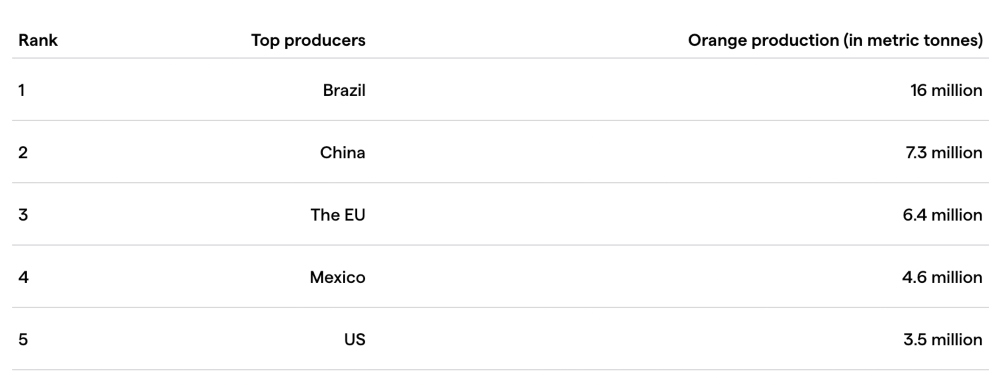
While orange juice is consumed the world over, the major consumers are the USA, Germany, Canada, France and Australia. Key producing locations include Brazil, the USA, the European Union, China, and Mexico. Of these, 85% of the world market is split between Florida and Sao Paulo.
History
People have been making juices from oranges in various places throughout history, but large-scale production only became practical over the last century. Freezable orange juice from concentrate was first developed in the 1940s by Cedric Donald Atkins. This, coupled with the rise of household refrigeration, led to a massive spike in the popularity of frozen concentrated orange juice (FCOJ).
Widespread speculative orange juice trading began in the 1960s, when the first futures contracts for orange juice were established on the New York Coffee and Sugar Exchange. Since then, trading orange juice has become an integral part of the agricultural commodity markets.
Orange juice futures contracts are used today by traders, investors, and agricultural companies to profit through speculative trading or to hedge their orange juice exposure.
Reasons To Trade Orange Juice
There are many social and economic factors that can be used to predict the price action of orange juice, making it a prime trading commodity.
Common factors include betting on emerging market demand, war, global warming, and natural disasters.
Live Price Chart
What Influences The Price Of Orange Juice?
Those looking to trade orange juice need to understand both the supply-side and demand-side factors that affect orange juice consumption. Here, we will look at some of the most influential factors.
Weather
Orange juice is predominantly produced in Brazil and the USA. Orange trees need to be kept in very specific climates to maximize their yield, and both countries have excellent conditions for this type of agriculture.
As such, traders can gain an edge by carefully following the weather forecasts in these regions. Extreme weather could seriously impact the production of oranges, thus reducing the supply of orange juice and causing price inflation. Alternatively, perfect weather could lead to increased orange yields, increasing supply and lowering the price.
Global Warming
Global warming’s effects on the climate of orange-growing areas could have a heavy impact on the production of orange juice over decades. Hedging against the effects of global warming could be a viable long-term investment strategy for those interested in trading orange juice.
Market Demand
Recent demand for orange juice has been declining in the West, particularly in the USA and Germany. This could be down to several cultural factors, such as the declining emphasis on breakfast meals or health trends moving away from high-sugar products.
However, many emerging markets, including Brazil and China, are seeing a rise in demand for orange juice. This could be because higher disposable incomes allow for increased food and drink consumption or cultural influence from developed countries.
Investors will have to decide which they think is the more prominent effect to predict how orange juice prices will move over the long term.
Brazilian Real Value
Brazil is the largest producer of orange juice in the world. As such, fluctuation in the Brazilian Real (BRL) can have an impact on the price of orange juice.
For example, if the currency weakens, countries with strong currencies will be able to take advantage of their increased purchasing power and import larger quantities of the juice drink. This will impact your orange juice trading strategy.
Food Safety & Health
The more developed countries of the world have seen an increase in the importance of health. This has led to a greater focus on ensuring dangerous chemicals are not used in food and drink production.
Orange growers that have used certain pesticides and chemicals have received bans from being able to export to certain countries, thus reducing supply and increasing the price of orange juice.
Diseases
There have been several notable occasions when a rise in orange tree diseases heavily affected the supply of orange juice, pushing the price up. The severity of the disease and whether a cure can be quickly found and applied will determine the disease’s effect on the price.
War & Geopolitics
Wars or other geopolitical issues can lead to embargos, reduced agricultural capacity, reduced consumption, and other factors affecting both demand and/or supply of orange juice. Again, this can all impact an orange juice trading strategy.
Paying attention to the geopolitical climate, particularly between heavy producers and consumers of orange juice, can have a large impact on predicting the price of orange juice.
How To Trade Orange Juice
There are several financial instruments that can be used to trade orange juice. These include futures, options, CFDs, ETFs and stocks.
CFDs
Contracts for difference (CFDs) are derivative instruments that allow traders to speculate on the price of FCOJ. This enables traders to trade orange juice without having to purchase the commodity – you are simply speculating on the price.
One feature of CFDs that is popular among day traders is the ability to make leveraged trades on orange price movements. This allows traders to greatly increase their trading positions using borrowed funds, meaning they can make larger profits from even small price movements. However, leverage also multiplies losses, making strict risk management a necessity.
ETFs
Exchange-Traded-Funds (ETFs) are baskets of commodities that are tradable just like shares on exchanges. ETFs compile the prices of multiple commodities, meaning that the overall price of the ETF is affected by all those assets.
There are no ETFs that specifically focus on orange juice, but investors in agriculture-focussed funds may have some exposure to the market. As such, since most ETFs are not dominated by orange juice, the value cannot be predicted purely by orange juice price predictions.
Futures
Futures contracts are derivative instruments in which traders enter into an agreement to buy or sell a fixed amount of orange juice on a set date at a pre-determined price. Investors do not need to pay upfront or own any of the underlying asset to be able to open a futures contract.
FCOJ-A futures contracts can be traded on the ICE (Intercontinental) exchange. The settlement of one contract equals 15,000 lbs of orange juice solids (delivered in drums or tanks). The contract series is through January, March, May, July, September and November.
Options
Options for orange juice have the FCOJ-A futures contracts as the underlying asset. Successful options contracts give the buyer of the option the right to enter into a buy (long) or sell (short) FCOJ-A futures contract.
The main advantage of trading options is that if the price moves against you, your losses are limited to the premium paid for the options contract, protecting you from large, unexpected price swings. Of course, traders pay a fee for this privilege.
Shares
You could also trade the shares of orange juice-producing companies to capitalize on predicted prices. However, this is quite difficult as most orange groves are privately owned.
Orange Juice Trading Strategies
Much like other financial assets, you can employ several different trading strategies depending on the time frame, the familiarity you have with the commodity and your risk appetite. Orange juice is not only volatile in the short term but can hold trends in the long term, giving traders more freedom in how they want to trade the commodity.
Fundamental Trading
News and forecasts can have a huge impact on the price action of orange juice. Keeping yourself up to date on related news stories and articles, as well as knowing when key forecasts and prediction reports are due to be released, will help you predict the price action of orange juice before the market has time to fully react.
An example of something worth looking out for is extreme weather forecasts. Florida is prone to adverse weather conditions, like hurricanes or sudden cold snaps, that can affect the orange juice supply.
Support & Resistance
By analyzing price charts, traders can identify support and resistance levels in an asset’s price action. Using these levels, you can predict when price trends will stop and reverse.
Typically, if the price approaches a resistance level, you should sell. If the price approaches a support level, you should buy.
Breakout Strategy
Breakout strategies use support and resistance levels to help determine when the price action will reverse. Traders will look for levels that the commodity is unable to move beyond. The trader will then wait for the level to be broken through, placing a trade expecting the price to now continue beyond the breakthrough. You are essentially trying to predict the start of a new trend and open a position accordingly.
Orange juice traders will typically try making a prediction about global supply for the next year using this strategy.
How To Start Orange Juice Trading
Choose A Financial Product
First, you need to choose which financial instrument you want to trade. The most common in the orange juice market are futures, options, or CFDs.
- CFDs allow traders to open considerable trading positions with a smaller amount of capital, and you don’t need to physically own the underlying commodity.
- Futures allow you to directly trade the underlying asset. Traders should take care as some exchanges require the buyer to take physical possession of the orange juice stock at the end of the contract. Many traders prefer to choose cash-settled futures for this reason.
- Options give you more choices when it comes to the exercise date, allowing you to settle in the future, trade it or carry it over. Options are also useful for limiting traders’ risk as a trade that does not pay out cannot cost more than the contract premium.
Choose A Broker
One of the most important factors in successfully trading orange juice is choosing the right broker. Luckily, there are multiple brokerages online that allow investors to trade orange juice assets. For example, IG offers the trading of CFDs and spread bets with orange juice as the underlying asset. Other top-rated brokers providing access to orange juice markets include CMC Markets and VT Markets.
Most traders prefer brokers that:
- Support powerful third-party or proprietary trading platforms, such as MetaTrader 4
- Are licensed and overseen by a reputable regulator such as the CySEC or FCA
- Support a good range of deposit methods including e-wallets and bank cards
- Have a fair pricing structure with tight spreads and low to zero commissions
- Execute trades quickly with no re-quotes or slippage
- Support a mobile trading app
Finding an orange juice trading broker that ticks most of these boxes will ensure you have the best investing experience.
Open A Trading Account
Once you have chosen a suitable broker, you will need to open an account. Different orange juice brokers require different things when opening a live profile. Many require ID verification through government-issued documentation. Some will allow you to begin trading right away.
We recommend opening demo accounts (if available) first to get yourself accustomed to the trading platform and the broker’s fee structure before risking capital.
Build A Risk Management & Trading Strategy
Having an effective and consistent strategy is one of the most important factors in becoming a successful trader, especially when dealing with volatile assets like orange juice.
Make sure you calculate the risks, know how much you can afford to lose, and stick to your plan to ensure you trade without letting emotions interfere. Also employ stop losses and alerts to limit your losses.
Open A Position
Follow your orange juice trading strategy and open a position based on your analysis.
Monitor your position using the trading charts or graphs provided and be sure to keep up to date with news that could influence the price.
Close Your Position
While some assets automatically exercise at the exercise time (such as options), others will need to be manually closed (like CFDs).
Follow your plan and close the position in accordance with it.
Pros Of Trading Orange Juice
- High volatility, meaning high profit potential
- Range of tradable instruments, including CFDs, ETFs, futures and options
- Portfolio diversification and low associations with other financial assets
- Leverage trading available in derivatives (amplifying profit and loss)
Cons Of Trading Orange Juice
- The complexity of commodities, lots of different terms and variations of contracts can be daunting for new traders
- Unpredictable factors, the effects of weather can have major impacts on the price and are arguably less predictable
Trading Hours
Many commodities can be traded 24/5, with the markets closed only on Saturday and Sunday. This is also the case for most soft commodities, including orange juice.
The Intercontinental Exchange does have specified times for its FCOJ-A futures and options contracts. Trading hours are 13:00 – 19:00 UTC.
Final Word On Orange Juice Trading
The short-term volatility and long-term trends present in the orange juice commodity offer traders the opportunity to make large profits. As a popular commodity, orange juice is regularly traded using a range of financial products, from short-term options and CFDs to long-term futures contracts. The increase in the orange juice commodity price over the last 3 years demonstrates that more than just a fruit drink, orange juice is an interesting opportunity for investors with the right skills and knowledge.
Head to our ranking of the top orange juice brokers to start day trading.
FAQs
Why Is The Orange Juice Commodity Price So Volatile?
Orange juice prices are incredibly sensitive because of how easily demand and supply for the commodity change. Bad weather, changing health trends and trade embargos all affect the price of orange juice, making it a volatile asset to trade.
How Can I Trade Orange Juice?
There are several financial instruments that can be traded to profit from orange juice price action predictions. The most traded are the FCOJ-A futures contracts, options on these futures, and CFDs.
What Are The Best Brokers For Orange Juice Trading?
The best orange juice broker differs from trader to trader. Some investors like to trade based on their technical analysis and so will look for brokers with trading platforms that allow for detailed analysis. Others trade based on fundamentals, and so will be looking for brokers that provide stronger news data streams. Finding the broker best suited to your needs will require research. Alternatively, use our list of the best orange juice trading brokers.
What Affects The Orange Juice Commodity Price?
There are many factors that affect the price of orange juice. Some important factors to consider are the weather conditions in regions where oranges are predominantly grown, geopolitical tension between orange juice-producing and consuming countries, health trends, and emerging market demands. See our full guide to trading orange juice for more details.
What Are The Orange Juice Futures Trading Hours?
Orange juice futures (FCOJ-A) are traded on the Intercontinental Exchange (ICE). The listed trading hours for FCOJ-A are 13:00 – 19:00 UTC with pre-open at 01:00 UTC. See our full guide for other places that trade orange juice.