




Every day, investors from all over the world fire up their computers to start day trading the GBP/JPY, otherwise known as the ‘Beast,’ ‘Dragon’ or ‘Geppy.’ This page will look at the history of the GBP/JPY currency pair, as well as its benefits and risks, including notable volatility and liquidity. We then break down strategy, charts, technical analysis, trading hours, plus investing tips for 2026.
Best GBP/JPY Brokers
Our in-depth assessments have revealed the following 6 brokers as the best for trading GBP/JPY:
-
- Demo account
- Platforms: xStation
- Min. deposit: $0
75% of accounts lose money when trading CFDs with this provider. -
- Demo account
- Regulator: ASIC, VFSC, FSA
- Platforms: MT4, MT5, cTrader, TradingView, DupliTrade
-
- Demo account
- Regulator: FMA, FSA
- Min. deposit: $0
-
- Demo account
- Regulator: CySEC, MISA
- Platforms: MT4, MT5
-
- Demo account
- Regulator: FCA, ASIC, FSCA, VFSC, CIMA
- Min. deposit: $50
-
- Demo account
- Platforms: WebTrader, App
- Min. deposit: $100
81% of retail CFD accounts lose money.






Learn how we test brokers and why you can trust our ratings.
Here is a short summary of why we think each broker belongs in this top list:
- XTB 4.8/5 Founded in 2002 in Poland, XTB now serves more than 1 million clients. The forex and CFD broker combines a heavily regulated trading environment with an extensive selection of assets and a commitment to trader satisfaction, featuring an intuitive in-house platform with superb tools to support aspiring day traders.
- Fusion Markets 4.6/5 Fusion Markets is an online broker established in 2017 and regulated by the ASIC, VFSC and FSA. It is best known for its low-cost forex and CFD trading, although its multiple account types and copy trading solutions cater to a range of traders. New clients can sign up and start trading in 3 easy steps.
- BlackBull 4.5/5 BlackBull is a New Zealand-based CFD broker providing diverse trading opportunities on over 2,180 instruments. After undergoing a rebrand in 2023, it now sports a modern look and feel complete with professional-grade trading tools and ultra-fast execution speeds averaging 20ms.
- FXCC 4.6/5 FXCC is an established broker that’s been offering low-cost online trading since 2010. Registered in Comoros Union and regulated by the CySEC, it stands out for its ECN trading conditions, no minimum deposit and smooth account opening that takes less than 5 minutes.
- Vantage 4.7/5 Founded in 2009, Vantage offers trading on 1000+ short-term CFD products to millions of clients. You can trade Forex CFDs from 0.0 pips on the RAW account through TradingView, MT4 or MT5. Vantage is ASIC-regulated and client funds are segregated. Copy traders will also appreciate the range of social trading tools.
- Plus500 4.1/5 Established in 2008 and headquartered in Israel, Plus500 is a prominent brokerage that boasts over 25 million registered traders in over 50 countries. Specializing in CFD trading, the company offers an intuitive, proprietary platform and mobile app. It maintains competitive spreads and does not charge commissions or deposit or withdrawal fees. Plus500 also continues to shine as one of the most trusted brokers with licenses from reputable regulators, including the FCA, ASIC and CySEC.
Community Sentiment
See how users rate these brokers based on the average customer ratings submitted on DayTrading.com, plus ratings from Trustpilot, the Apple App Store and Google Play.
| Broker | Our Users' Rating | Trustpilot Score | Trustpilot Reviews | iOS App Rating | Android App Rating |
|---|---|---|---|---|---|
| XTB | 3022 | ||||
| Fusion Markets | 10215 | ||||
| BlackBull | 3519 | ||||
| FXCC | 223 | ||||
| Vantage | 15759 | ||||
| Plus500 | 20136 |
XTB
XTB stands out as a top choice for new day traders with the terrific xStation platform, low trading costs, no minimum deposit, and excellent educational tools, many of which are seamlessly integrated into the platform.
 Christian Harris, Reviewer
XTB quick facts
- Demo Account
- ✔Yes
- Instruments
- CFDs on shares, Indices, ETFs, Raw Materials, Forex currencies, cryptocurrencies, Real shares, Real ETFs
- Regulator
- FCA, CySEC, KNF, DFSA, FSC, SCA, CMF, Bappebti
- Platforms
- xStation
- Minimum Deposit
- $0
- Minimum Trade
- 0.01 Lots
- Account Currencies
- USD, EUR, GBP
- Currency Pairs
- USD/CHF, USD/JPY, EUR/AUD, EUR/JPY, EUR/TRY, EUR/CAD, EUR/GBP, GBP/AUD, GBP/CAD, GBP/JPY, GBP/ZAR, NZD/SGD, USD/INR, USD/SGD, USD/THB
Pros
- With an excellent range of educational materials, including training videos and articles integrated into the platform, XTB supports traders at all levels.
- XTB offers fast withdrawals with payment within 3 business days, depending on the method and amount.
- XTB has improved its assets and markets offering further in 2026 with options trading in Spain and Germany, spot cryptos in some regions, and Investment Plans 2.0 with more pre-built plans covering sectors like Defence, a more intuitive interface, and greater flexibility to combine single stocks and ETFs into individual plans.
Cons
- Trading fees are competitive with average spreads of around 1 pip on the EUR/USD but still trail the cheapest brokers like IC Markets, plus there's an inactivity fee after 12 months.
- XTB does not offer a raw spread account, which is becoming increasingly common among competitors like Pepperstone, and may disappoint day traders looking for the tightest spreads.
- Not being able to adjust the default leverage level of XTB products is frustrating, as manual adjustment can significantly mitigate trade risk, especially in forex and CFD trading.
Fusion Markets
Fusion Markets is a standout option for forex traders looking for excellent pricing with spreads near zero, industry-low commissions and recently TradingView integration. It’s a particularly good broker for Australian traders where the company is headquartered and regulated by the ASIC.
 Jemma Grist, Reviewer
Fusion Markets quick facts
- Demo Account
- ✔Yes
- Instruments
- CFDs, Forex, Stocks, Indices, Commodities, Crypto
- Regulator
- ASIC, VFSC, FSA
- Platforms
- MT4, MT5, cTrader, TradingView, DupliTrade
- Minimum Deposit
- $0
- Minimum Trade
- 0.01 Lots
- Account Currencies
- USD, EUR, GBP, CAD, AUD, NZD, JPY, CHF, HKD, SGD
- Currency Pairs
- USD/CHF, USD/CNH, EUR/AUD, EUR/JPY, EUR/SGD, EUR/CAD, EUR/GBP, GBP/AUD, GBP/CAD, GBP/HUF, GBP/JPY, GBP/ZAR, NZD/SGD, USD/HKD, USD/INR, USD/SGD, USD/THB
Pros
- Fusion Markets continues to impress with its pricing that provides tight spreads with below-average commissions that will appeal to active day traders.
- Fusion Markets is set up to support algo traders with a sponsored VPS solution and a 25% discount if you opt for the NYC Servers VPS for MT4 or cTrader.
- Withdrawal processing times have been slashed to under an hour and can be processed 24/7, making it faster and easier for active traders to withdraw any gains.
Cons
- Fusion Market trails alternatives, notably IG, in the education department with limited guides and live video sessions to upskill new traders.
- The demo account expires after 30 days, limiting its potential as a useful trading tool alongside a real-money account.
- There is no proprietary trading platform or app built with beginners in mind, a notable drawback compared to AvaTrade.
BlackBull
After improving its trading infrastructure with Equinix servers in London, reducing latency for traders, BlackBull is an obvious choice if you want to day trade stock CFDs with ECN pricing. With competitive spreads and no commission on a growing roster of digital tokens paired with USD, BlackBull also works for active crypto traders.
Christian Harris, Reviewer
BlackBull quick facts
- Demo Account
- ✔Yes
- Instruments
- CFDs, Stocks, Indices, Commodities, Futures, Crypto
- Regulator
- FMA, FSA
- Platforms
- BlackBull Invest, BlackBull CopyTrader, MT4, MT5, cTrader, TradingView, AutoChartist
- Minimum Deposit
- $0
- Minimum Trade
- 0.01 Lots
- Account Currencies
- USD, EUR, GBP, CAD, AUD, NZD, JPY, ZAR, SGD
- Currency Pairs
- EUR/AUD, EUR/JPY, EUR/SGD, EUR/CAD, EUR/GBP, GBP/AUD, GBP/CAD, GBP/JPY, GBP/ZAR, NZD/SGD, USD/SGD
Pros
- After partnering with ZuluTrade and Myfxbook, alongside improvements to its own CopyTrader, and finally enabling cTrader Copy, BlackBull offers one of the most comprehensive copy trading experiences we've seen.
- With two ECN-powered accounts (Standard and Prime), plus Prime+ - an active trader rewards program offering trading rebates - BlackBull accommodates beginners through to high-volume active traders.
- BlackBull is a much greater fit for aspiring traders following the overhaul of its ECN Prime account, now featuring improved spreads averaging 0.16 on EUR/USD and a more accessible minimum deposit of $0 compared to the old $2,000.
Cons
- Despite a growing selection of 2,180+ assets, including additions to its Asia Pacific indices, they are mainly stocks with an average selection of currency pairs and indices.
- Although the Education Hub now features improvements like webinars and tutorials, the courses we’ve explored need more focus on explaining the wider economic factors influencing prices.
- Unlike most top brokers, BlackBull charges an irritating $5 withdrawal fee, which can detract from the overall cost-effectiveness, especially for active traders who frequently move funds.
FXCC
FXCC continues to prove itself an excellent option for day traders with a particularly strong selection of 70+ currency pairs, ultra-tight spreads from 0.0 pips during testing, and a free VPS for qualifying traders.
Jemma Grist, Reviewer
FXCC quick facts
- Demo Account
- ✔Yes
- Instruments
- CFDs, Forex, Stocks, Indices, Metals, Energies, Crypto
- Regulator
- CySEC, MISA
- Platforms
- MT4, MT5
- Minimum Deposit
- $0
- Minimum Trade
- 0.01 Lots
- Account Currencies
- USD, EUR, GBP, CAD
- Currency Pairs
- AUD/CAD, AUD/CHF, AUD/JPY, AUD/NOK, AUD/NZD, AUD/SEK, AUD/SGD, AUD/USD, CAD/CHF, CAD/JPY, CHF/DKK, CHF/JPY, CHF/NOK, CHF/PLN, CHF/SGD, EUR/AUD, EUR/CAD, EUR/CHF, EUR/GBP, EUR/HKD, EUR/HUF, EUR/JPY, EUR/MXN, EUR/NOK, EUR/NZD, EUR/PLN, EUR/SEK, EUR/SGD, EUR/TRY, EUR/USD, GBP/AUD, GBP/CAD, GBP/CHF, GBP/DKK, GBP/JPY, GBP/NOK, GBP/NZD, GBP/PLN, GBP/SEK, GBP/SGD, GBP/USD, GBP/ZAR, HKD/JPY, MXN/JPY, NOK/JPY, NOK/SEK, NZD/CAD, NZD/CHF, NZD/JPY, NZD/SGD, NZD/USD, SEK/JPY, SGD/JPY, TRY/JPY, USD/CAD, USD/CHF, USD/CNH, USD/CZK, USD/DKK, USD/HKD, USD/HUF, USD/JPY, USD/MXN, USD/NOK, USD/PLN, USD/RUB, USD/SEK, USD/SGD, USD/TRY, USD/ZAR, ZAR/JPY
Pros
- The free VPS for qualifying traders and the ability to build or buy EAs on MetaTrader make FXCC a strong option for algo traders.
- FXCC has stepped up its offering over the years, adding MT5 to its suite of platforms, hundreds of stocks and more cryptos to its product line-up, plus a copy trading feature and greater margin trading opportunities.
- Customer support still relies on human agents with response times of under three minutes on live chat during our tests and knowledgeable reps - a welcome break from the frustrating AI chatbots increasingly offered by brokers.
Cons
- Although the economic calendar has benefited from a facelift, FXCC still offers very little in terms of market research beyond basic daily technical analysis and aggregated market news, with no tools like Autochartist or social sentiment data.
- Although FXCC has bolstered its range of markets with US, European and Asian stocks, the choice of metals and energies is light, and there are no soft commodities.
- FXCC charges steep withdrawal fees on many of its payment methods, including $45 for bank transfers and 2% crypto transfers, which may cut into the returns of traders making regular withdrawals.
Vantage
Vantage remains an excellent option for CFD traders seeking a tightly-regulated broker with access to the reliable MetaTrader platforms. The fast sign-up process and $50 minimum deposit make it very straightforward to start day trading quickly.
Jemma Grist, Reviewer
Vantage quick facts
- Demo Account
- ✔Yes
- Instruments
- CFDs, Forex, Stocks, Indices, Commodities, ETFs, Bonds
- Regulator
- FCA, ASIC, FSCA, VFSC, CIMA
- Platforms
- ProTrader, MT4, MT5, TradingView, TradingCentral, DupliTrade
- Minimum Deposit
- $50
- Minimum Trade
- 0.01 Lots
- Account Currencies
- USD, EUR, GBP, CAD, AUD, NZD, JPY, HKD, SGD, PLN
- Currency Pairs
- USD/JPY, EUR/AUD, EUR/JPY, EUR/SGD, EUR/TRY, EUR/CAD, EUR/GBP, GBP/AUD, GBP/CAD, GBP/JPY, NZD/SGD, USD/INR, USD/SGD, USD/THB
Pros
- The ECN accounts are very competitive with spreads from 0.0 pips and a $1.50 commission per side (Pro ECN account)
- There are no short-term strategy restrictions with hedging and scalping permitted
- It’s quick and easy to open a live account – taking less than 5 minutes
Cons
- The average execution speeds of 100ms to 250ms are slower than alternatives based on tests
- It's a shame that some clients will need to register with the offshore entity, which offers less regulatory protection
- A steep $10,000 deposit is needed for the best trading conditions, which include the $1.50 commission per side
Plus500
Plus500 offers a super-clean experience for traders with a CFD trading platform that sports a modern design and dynamic charting. That said, the broker’s research tools are limited, fees trail the cheapest brokers, and there’s room for enhancement in its educational resources.
Christian Harris, Reviewer
Plus500 quick facts
- Demo Account
- ✔Yes
- Instruments
- CFDs on Forex, Stocks, Indices, Commodities, ETFs, Options, Crypto
- Regulator
- FCA, CySEC, EFSA, ASIC, FMA, FSCA, MAS, ISA, FSA, DFSA, SCA, JFSA, SCB, CIRO, BAPPEBTI, OJK, BI
- Platforms
- WebTrader, App
- Minimum Deposit
- $100
- Minimum Trade
- Variable
- Account Currencies
- USD, EUR, GBP, AUD, ZAR, CZK
- Currency Pairs
- EUR/AUD, EUR/JPY, EUR/SGD, EUR/CAD, EUR/GBP, GBP/AUD, GBP/CAD, GBP/JPY, GBP/ZAR, USD/HKD, USD/SGD
Pros
- Plus500 provides a specialized WebTrader platform designed explicitly for CFD trading, offering a clean and uncluttered interface
- AI Bites has been added, giving active traders real-time, AI-generated market summaries, technical analysis, and social sentiment next to charts, aiding in short-term trading decisions
- Plus500 has bolstered its suite of short-term trading products, including introducing VIX options with enhanced volatility and extended 24/5 hours trading on select stock and ETF CFDs, including SpaceX
Cons
- Compared to some competitors, especially IG, Plus500’s research and analysis tools are limited
- Plus500’s lack of support for MetaTrader or cTrader charting tools might be a deal breaker for advanced day traders looking for familiarity
- Algo trading and scalping are not supported, which may deter some day traders
Chart
GBP/JPY Trading Explained
What does GBP/JPY mean? It is the relative value of the British pound against the value of the Japanese yen. Both are traded enough to qualify them amongst the top six global currencies. In the BIS 2022 Triennial Survey, the yen was on one side of about 17% of global FX trades and the pound about 13%, putting both among the six most traded currencies. The pair is considered a ‘cross.’ This means the US dollar is not used when calculating the exchange rate.
Why Day Trade GBP/JPY?
With so many currency pairs and trading vehicles available, including ETFs, futures, and options, why does the GBP/JPY warrant your attention?
- Volatility – It ensures plenty of opportunities for generating profit. The pair is highly volatile, typically moving around 150–180 pips per day on average, though this can vary a lot between market regimes.
- Carry trades – Historically, UK interest rates have generally been higher than Japan’s, so GBP has often yielded more than JPY and GBP/JPY has been a popular carry-trade pair (borrowing yen to buy pounds).
- Risk tracking – When world economies look good, stocks and commodities rise while bonds fall. When things go the other way, the situation reverses. Those with an appetite and aversion to risk can utilize macro-economic sentiment to profit from market dynamics. GBP/JPY often tracks global risk sentiment, tending to move in the same direction as major stock indices and some commodities, though these correlations can change over time.
- Availability of resources – Real-time trading today is more accessible than ever before. You have direct access to graphs, candlestick charts, and amazing indicators. For example, conducting Elliott wave analysis is more straightforward. In addition, you can access knowledge-rich trading communities like forums and trading analysis blogs.
Drawbacks & Risks
Downsides to day trading GBP/JPY include:
- Amplified losses – Daily trends can be strong; you often need to set wider stop losses. Otherwise, you could experience significant losses. The UK’s Financial Conduct Authority classifies CFDs and rolling-spot forex as high-risk investments because leverage can magnify losses as well as gains.
- Volatility – As one of the most volatile currency pairs, false signals are frequent. Traders can lose money and learn painful lessons. It isn’t nicknamed the ‘widow maker’ for no reason.
- Experience required – Although the promise of pips attracts beginners, many traders suggest that novice investors stay clear. Volatile moves in a consolidation phase are just one straightforward way you can be taken out.
- Automated competition – You must compete against sophisticated trading algorithms and expert advisors. As a result, how to trade successfully is no longer clear. You need more than historical charts, average daily ranges, and forecast analysis. The best indicator for the GBP/JPY pair may no longer be enough.
Influences on Movement
Energy Commodities
The relationship between the Japanese yen and energy pricing can have a significant impact on investing. Japan buys crude oil and natural gas to satisfy domestic energy requirements. Japan is one of the world’s largest energy importers – for example, in 2019 it was the fourth-largest crude oil importer and the largest importer of liquefied natural gas.
There is an important link between energy prices and the Japanese yen: as a major energy importer, Japan often sees its currency weaken when oil and gas prices rise and strengthen when they fall, though this relationship is not perfectly stable.
Other Factors
- News – Favourable or negative events about the GBP, JPY, or their respective countries
- Indices – The UK’s FTSE 100 and Japan’s Nikkei 225 stock market index can also lead to strengthening and weakening
- Market sentiment – The market’s overall emotions and thoughts about each currency are reflected in the price of the GBP/JPY
- Currencies – The US dollar and euro, in particular, will impact the GBP/JPY. Currency pairs do not move independently of each other
- Governments – Major political elections and decisions impact the strength of respective currencies
- Bonds – Gilt (debt securities issued by the BoE) and GJGB10 (Japan Generic Govt 10Y Yield) will influence the relationship of the highly volatile pair
- Bank of England (BoE) – This central bank and lender of last resort oversees monetary policy and interest rates. Its actions significantly affect the pound and the British economy as a whole
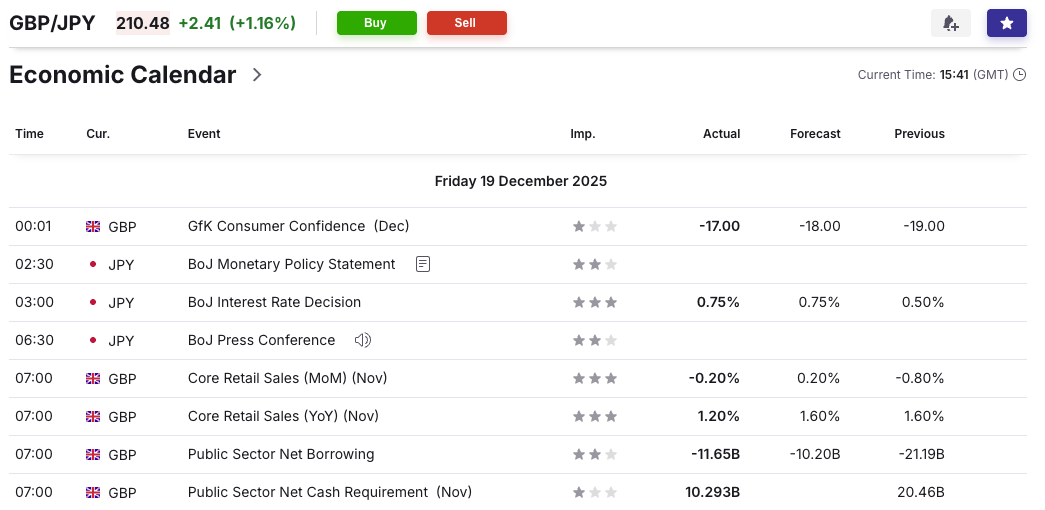
- Bank of Japan (BoJ) – The BoJ has been applying extremely low-interest rates for years, as reflected in its monetary policy statements, impacting the strength of the Japanese yen vs. the British pound. Day traders should monitor the Consumer Price Index (CPI), a key indicator of JPY-related currency crosses
Investors can feel wars and natural disasters in the GBP/JPY relationship. The savvy day trader won’t just focus on charts from Yahoo and historical data. They will keep track of multiple global factors using various sources.
Currency Correlations
Foreign exchange currencies do not move independently of each other. Because they are traded in pairs, their movements are tied to the movements of other pairs.
For example, if you are trading the GBP/JPY, you are handling a derivative of the GBP/USD and USD/JPY pairs. This means that GBP/JPY is related to either or both of the other pairs. The problem is that they can move with each other and in opposite directions. Plus, their correlation can change.
- Positive correlation – Occurs when pairs react in line with each other. GBP/USD, AUD/USD, and EUR/USD, the three most commonly traded pairs, are all positively correlated. That is because USD is the counter currency, and any change will impact all pairs
- Negative correlation – Takes place when currency pairs move in the opposite direction. USD/CHF, USD/JPY, and USD/CAD are excellent examples. This happens because the US dollar is the base currency
Correlation is a statistical measure ranging from -1 to +1. The former is when currency pairs move in opposite directions, and the latter is when they move together.
Calculation
The best way to understand how this knowledge can assist you in day trading the GBP/JPY is to be the correlation calculator yourself. All you need is an Excel spreadsheet:
- Input price data from your currency pairs, GBP/JPY, for example
- Create two columns, one for each pair
- Fill the columns with the past daily prices over the period you are interested in
- Type =CORREL in an empty box at the bottom
- Highlight all the data in a column, and you will get a range of cells in the formula box. Type in a comma
- Now repeat steps 3 to 5 for the other currency
- Close the formula. It will then look like =CORREL (A1: A25, B1: B25)
The final figure is the correlation between the two currency pairs.
GBP/JPY Day Trading Strategy
Timing
Whether you opt for a breakout or scalping strategy, timing is essential. So, when is the best time to trade GBP/JPY? You want to focus your trading around key economic releases at 01:30, 02:00, 08:30, and 10:00 EST. Also, consider the Asian European overlap, which runs from 00:00 to 03:00 EST. This is when you will see the most liquidity for the Japanese yen, plus the European yen crosses.
Breakout Strategies
The volatility of the GBP/JPY means the pair can trade wide swings in either direction, making trading breakouts an appealing technique. You can capitalize on profits when big swings are correct and minimize losses when they move against you. A top tip is to regularly monitor your support and/or resistance lines and levels because the volatility can cause severe fluctuations in a short time frame.
20 Pips GBP/JPY Scalping Strategy
This method is straightforward. You use 5-minute time frames and free GBP/JPY signals. You will also need 25 exponential moving averages (EMAs) on the indicator front.
When the price is above 25 EMA, you are seeing an uptrend. When the price is below 25 EMA, it is considered a downtrend. The angle of the trend is essential. A relatively horizontal angle means the market is ranging. There is a solid trend if the angle is around 30 degrees or higher.
Buy Setup
- Moving average angle is 30 degrees or more
- The price has to move above the 25 EMA line
- Your buy signal is a bullish pin bar. So, buy at market price once the bullish pin bar closes
- Place your stop loss at least 10 pips under the low of the pin bar
- Your profit target will be 20 pips
Sell Setup
- Look for a moving average angle of 30 degrees or above
- Price should be moving below the 25 EMA line
- This time it is a bearish pin bar that is your sell signal. You should sell at the market price once the bearish pin bar closes
- Again, opt for a stop loss of 10 pips above the high of the pin bar
- The profit target is also 20 pips
Because the range of the GBP/JPY can be anywhere from 150-200 pips a day, there is ample scalping opportunity. However, be warned, this system may underperform in ranging, non-trending markets.
Trade Size
Whatever your strategy, the GBP/JPY can turn bullish or bearish quickly. You must set stop losses wide, with small lot sizes. You may even want to consider cutting your trade size to around a third. This allows you to aim for higher targets and reduce potential losses in a volatile currency pair.
Summing Up Strategy
One person’s best GBP/JPY strategy may not generate consistent profits for another investor. The trick is finding a strategy that complements your trading style. Some focus on bar charts and daily pivot points, while others prefer economic calendars and news events.
For more guidance, see our strategy page.
History
Early History
The British pound is thought to be the oldest currency in the world still in use, and the Bank of England’s history highlights its role over more than 300 years. A turning point came in 1940 when the British government pegged sterling to the US dollar at £1 = $4.03. A few years later, the 1944 Bretton Woods agreement formalised a wider fixed-exchange-rate system that governed post-war currency relations until the early 1970s.
The Japanese yen, which means ‘circle’ or ’round object,’ is much younger than its British pound counterpart. The Meiji government introduced it in 1871 to replace the unstable Edo period, where no standard currency exchange existed. However, the yen lost its value during World War II. From 1949 to 1971, the yen was pegged at ¥360 per US dollar under the Bretton Woods system.
Global Credit Crunch
A critical period in the currency pair’s relationship was the global financial crisis of 2008. Between 2007 and 2009, the pound was clearly under pressure. In response to this, it weakened against the yen. GBP/JPY traded from a high of 250.13 to a low of 121.21, a staggering decline of over 50%.
Brexit
The Brexit decision of 2016 also had far-reaching implications. Although the repercussions were felt for less time than the crunch of 2008, volatility was still substantial. In June 2016, the GBP/JPY traded from a high of 160.66 to a low of 133.31.
However, the all-time records for this currency pair weren’t during these periods. Instead, they were:
- All-time high – This was 1014.000 on 1st of January, 1963
- All-time low – 116.853 was recorded on the 19th of September 2011
Role of the Great British Pound
Before you start focussing on your GBP/JPY trading signals and system, it helps to have some context about the role these two currencies play.
Although the UK is relatively small in size, its economy is one of the largest in the world. It plays a leading role in international financial markets. London is thought of as the forex trading capital of the world.
The UK was at one time the global superpower, with the largest economy on the planet for over one hundred years. The British pound was considered the world’s unofficial reserve currency. However, the world wars sparked a decline. Stringent government regulations and restricted labor markets further impacted the economy.
The economy has since stabilized partially due to the UK’s role as a key global player in financial services.
Role of the Japanese Yen
Japan is one of the biggest economies in the world, boasting one of the highest GDPs, plus it is a huge exporter. However, it has had a challenging few decades. Low fertility rates and an ageing workforce have also made taxation and consumption a constant battle.
Despite troubles, their workforce is well-educated, and while industries such as shipbuilding have moved to China and South Korea, Japan remains a leading manufacturer of electronics and technological components. Japan is now heavily reliant on China as a trade partner.
The main driving forces are interest rates and price action. However, there are other economic data releases that traders should keep an eye out for:
- GDP data
- Retail sales
- Inflation data
- Trade balances
- Industrial production
- Employment rates
- Central bank policies
For the UK, official economic releases from the Office for National Statistics provide GDP, inflation, employment and other key indicators referenced above. For Japan, traders can refer to the Cabinet Office’s economic statistics and business surveys for indicators such as GDP, business conditions and consumer confidence.
Google Finance, Yahoo Finance, Bloomberg, and Reuters are also good GBP/JPY news resources. For truly yen-specific information, the Tankan survey is particularly useful. This is published quarterly online by the BoJ.
Final Word on GBP/JPY Day Trading
The GBP/JPY is thought of as a gauge for global economic health, as it reflects issues affecting both Western Europe’s monetary policies and those in the Asia-Pacific region. Phenomenal volatility and wide trading ranges attract vast numbers of day traders.
Success will be no easy challenge when you open up your live forex chart. You will need an understanding of how and what influences each currency and economy, fundamental analysis, charts, patterns, and the news to spot potential opportunities. Only then can you begin your journey to join the likes of famous forex traders, Ed Seykota and Richard Dennis.
For more guidance, see our forex day trading page.
FAQ
What Does GBP/JPY Mean?
GBP stands for the Great British pound and JPY for Japanese yen. GBP/JPY is the forex exchange pair that these two currencies generate. With it, you can speculate on the price movement between GBP and JPY.
Is GBP/JPY A Good Pair To Trade?
The pair is highly volatile and suitable for investors who can manage such conditions. Volatility is great for day or short-term trading as it offers plenty of opportunities to take advantage of the price fluctuations.
What Is The Best Time To Trade GBP/JPY?
GBP/JPY moves the most when the London and the Japanese markets are open at the same time, between 03:00 and 04:00 EST. This creates liquidity and substantial price movements.
Why Is The GBP/JPY Highly Volatile?
Both GBP and JPY are highly volatile currencies; when combined, this results in an exciting pairing. GBP/JPY is also tied to distinct types of economies, which creates big up and down swings in price. The pair also has ample liquidity due to its popularity.
What Affects GBP/JPY?
Japan is a big importer of crude oil and natural gas, with the IEA noting its heavy reliance on imported fossil fuels, so JPY is highly dependent on the cost of energy. The UK is one of the most influential economies in the world. Its policies often have a knock-on effect on regional and international markets.