
Carry Trading Forex Strategy



Carry trading with forex represents an interesting strategy for day traders. This article will provide a definition of carry trading, explain trading costs, momentum and timing, and highlight some of the pitfalls and issues that might impact performance.
Key Points:
- Carry trading, as it relates to forex, involves going long a high-yield currency against a low-yield currency.
- Currency-related carry trading execution primarily relies on correctly timing interest rate cycles and having the backdrop of a low volatility, “risk-on” environment
- Common pitfalls include indiscriminately chasing spread, failing to keep up on central bank monetary policies, using too much leverage, and a lack of broader-level portfolio diversification
The Basics of Carry Trading
The entire basis of capitalist economic systems comes in the fundamental form of the borrower/lender relationship. It is the spread between borrowing and lending activity that forms the basis by which economic activity is transmitted and how financial markets are priced.
When you invest your money, you are fundamentally chasing a spread. If there was no future return on your money – that is, no spread – then there would be no point to trading or investing in the first place.
Definition
In financial markets parlance, this is typically referred to as “carry.” Carry is the return you earn from holding an asset, net of financing costs, assuming its price stays unchanged. In currencies, this is closely related to the interest rate differential between two countries, and is the basis of what the Bank for International Settlements (BIS) describes as a leveraged cross-currency carry trade. It can come in various forms:
- Credit – e.g., a bond or loan yielding X% over cash
- Duration – compensation for financial assets of longer maturities
- Volatility – markets tend to take high volatility or uncertainty into account by pricing financial assets lower
- Equity (stocks) – assets subordinate to other claims in a company’s financial structure and effectively of infinite duration
- Currency-related – borrowing in one currency and using it to buy another currency or financial assets of higher yield
Forex Carry Trading
Carry is one of the most foundational concepts in trading and investing, and forex is no exception. Below, I will provide examples of how the carry trade is structured with respect to trading currencies:
Forex carry trading broadly means borrowing in a cheap currency, such as the Japanese yen (JPY) or Swiss franc (CHF) and investing in either a higher-yielding currency – e.g., Mexican peso (MXN), Turkish lira (TRY) – or another financial asset.
What currencies are “high yield” and which are “low yield” is relative and dependent on interest rates. Central banks of certain countries or jurisdictions raise or lower short-term interest rates to ensure price stability and/or employment levels, depending on their statutory mandate.
Among major currency pairs, AUD/JPY and AUD/CHF have been the more popular carry trade options, with AUD being the “high yield” currency and JPY and CHF being “low yield” currencies.
If one were to be long the AUD/JPY, for example, interest would be earned daily. If one were short the pair, interest would be paid daily.
Forex day trading broker OANDA provides a free tool to calculate financing charges on various currencies, where interest earned is a function of the currency pair traded, the number of units purchased, and the amount of time it’s held.
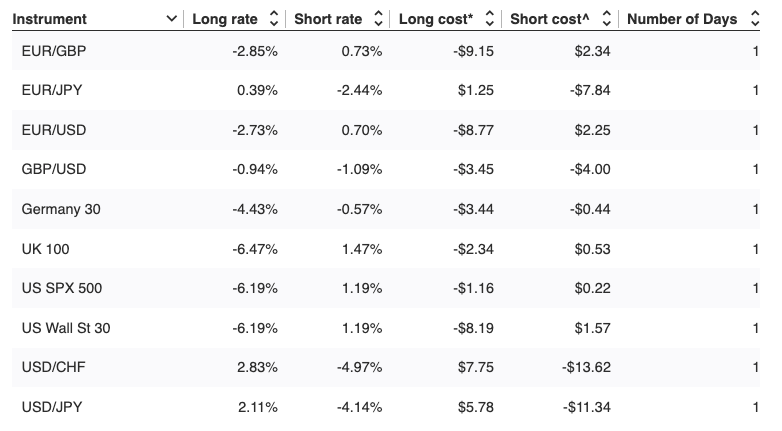
Policy rates on major currencies change frequently as central banks move through tightening and easing cycles. For example, after 2022, many major central banks, including the Federal Reserve, European Central Bank and Bank of England, raised their policy rates sharply from near-zero levels to combat high inflation, and several have only recently started to cut them again.
What matters for a carry trade is the difference between two currencies’ short-term interest rates, not the exact level at any one point in time. Traders should always check a current, trusted source (for example, the relevant central bank or their broker) for up-to-date policy and swap rates before sizing a trade.
In theory, the annual “carry” between two currencies is roughly the difference between their short-term interest rates. In practice, brokers usually pass on only part of that differential in the form of overnight swap credits or debits, so the effective carry you earn (or pay) can be notably lower than the raw policy-rate gap.
Example (as of December 2025): if a high-yield currency has a policy rate around 4% and a funding currency is near 0.5%, the theoretical spread is 3.5% per year. Your broker might only credit you something like 2–3% after adjustments and fees, so always check the swap schedule rather than assuming you get the full 3.5%.
In the long period before 2022, very low policy rates in most developed economies meant that carry trades among the major currencies offered limited yield. After the global rate-hiking cycle of 2022–2023, nominal interest rates are higher almost everywhere, but the most attractive carry opportunities often still lie in borrowing in lower-yielding developed-market currencies and buying higher-yielding emerging-market currencies, accepting the additional volatility and credit risk that come with them.
On carry trades, if you are long the higher-yielding currency relative to the lower-yielding currency, interest is accumulated daily. In spot forex, positions held over Wednesday’s New York close usually incur three days’ swap to cover the weekend, due to the T+2 settlement. Some brokers may have different rules for CFDs on indices or commodities, so check your broker’s schedule.
Suppose the effective interest-rate differential on AUD/CHF that your broker passes through is 2.75% per year. On a 100,000-unit position, the indicative daily carry would be about USD 7.53 (100,000 × 0.0275 / 365), credited or debited depending on your direction
For those short the AUD/CHF, interest is paid daily, just as someone shorting a stock would pay the dividend, if applicable.
Keys to Carry Trading
Follow the actions of central banks
Carry trades develop based on central banks adjusting interest rates, normally the front-end, “overnight” lending rate. The rest of the curve is generally set by the market.
When one country tightens its monetary policy (i.e., raises interest rates and/or contracts its money supply) while another is easing (i.e., lowering interest rate and/or expands its money supply) or holding steady, this provides the opportunity not only for carry – assuming the country tightening its monetary policy has a higher-yielding currency to begin with – but for capital appreciation as well.
The idea of going long currencies before they tighten monetary policy and short those that are easing is, of course, a strategy that exists outside of the carry trade concept.
Identify the right environment
Carry trades became heavily unwound during the 2008 financial crisis as liquidity dried up and investors shunned risk-taking. Carry trades are ideal when markets are relatively placid, and investors display a risk appetite.
The Japanese yen and Swiss franc often behave like safe-haven currencies during periods of market stress, a bit like gold: they tend to strengthen when investors are de-risking. However, their correlation with gold is unstable over time and can vary a lot across market regimes, so it’s better to think of them as assets that sometimes move together in stress rather than assuming a fixed long-run correlation.
Carry trades are attractive to investors for much of the same reasons dividend stocks and coupon-paying bonds are. Namely, the market doesn’t have to move for you to make money. Thus, calm, low-volatility environments are generally prime for carry trade opportunities.
Pitfalls in Carry Trades
Carry trades have to be approached carefully and correlate with risk assets such as stocks and high-yield bonds more broadly.
There have been multi-year periods where classic carry pairs such as AUD/CHF or AUD/JPY delivered negative total returns despite offering positive carry, because the high-yield currency depreciated more than the interest earned.
For example, during the mid-2010s commodity downturn, weakness in the Australian dollar more than offset the yield pick-up in some AUD-funded carry trades. This illustrates that carry alone is not enough: you also need a supportive macro backdrop for the high-yielding currency.
This has trickled into the AUD’s valuation as the Reserve Bank of Australia has cut interest rates to counteract the downswing in growth and inflation:
When central banks cut interest rates and yields decline, investors are likely to move their capital elsewhere to seek out more profitable trading opportunities. When this selling is exacerbated through the unwinding of leveraged positions, years’ worth of gains can be reversed quickly.
Indiscriminately going long a higher-yielding currency against a lower-yielding currency can land oneself in trouble. The more important focus is to determine how rates are likely to change in the future, which is a function of future growth and inflation prospects. Higher growth and inflation are associated with a greater likelihood of rate hikes.
Even if you’re in a carry trade with a large spread to it – e.g., long TRY/JPY – if it’s believed that the central bank of Turkey is likely to ease relative to the Bank of Japan, both diminished carry (from a closing spread) and capital depreciation could impair the profitability of this trade.
On top of that, given that currency traders often use leverage, even a relatively modest 10% dip in a currency pair, combined with 10:1 leverage on a trade, will wipe out one’s entire amount of capital committed to that trade. Properly managing risk is vital.
Conclusion
Like any strategy, carry trades must be employed prudently. While technicals, such as support and resistance levels, can be useful in finding entry points, carry trades should not be committed to without an understanding of where central banks are in their monetary regimes and what their next policy moves are likely to be.
Carry trades also tend to be long and directional. Interest rate policies mirror credit cycles. And business cycles typically last 5-10 years. Therefore, this is not a strategy that one would execute as part of a short-term trading orientation, as interest rate adjustments typically occur only once every few months (or years).
Limiting risk should also be accomplished via two main conduits: (1) using only small amounts of leverage (or possibly none at all) and (2) portfolio diversification.
For US-based traders, the Commodity Futures Trading Commission (CFTC) imposes various rules on brokers that facilitate forex trading, including limiting leverage available to retail forex traders to 50:1 on major currency pairs and 20:1 for non-major currency pairs.
However, most traders should not use anywhere near these amounts. At 50:1 leverage, a 2% move in the wrong direction will wipe out your entire capital base allocated to a particular trade. If you’re doing carry trading, an intrinsically long-term strategy, you need to allow at least 2% wiggle room for the trade to develop.
Most traders shouldn’t use above 5:1 leverage. Novices should start by using paper accounts and then by avoiding leverage once they begin trading live with real money and determine that they can prove to themselves that they can be profitable over a statistically meaningful period of time (usually one or more years). Carry trading or trading in general is not a get-rich-quick scheme.
Regarding diversification, this isn’t strictly limited to being in various currency-related carry trades, but through diversification into other asset classes as well, including stocks, bonds, and real assets, such as gold or commodities.