




With a boom in cryptocurrency, margin trading on this volatile asset provides new and potentially lucrative opportunities. In this tutorial, we explain how to trade crypto on margin plus offer tips for choosing the best exchanges and platforms. We also cover the pros and cons of crypto margin trading and a guide to getting started.
Note that traders based in the United Kingdom can no longer trade cryptocurrency via CFDs. Regulatory changes took effect in January 2021 to prohibit speculation on crypto prices via leveraged products such as CFDs.
Traders can still buy cryptocurrency directly on exchanges as this is provided without leverage.
Crypto Margin Trading Platforms
-
- Crypto Spread: Variable
- Min. deposit: $0
- Leverage: 1:30 (Retail), 1:222 (Pro)
70% of retail investor accounts lose money when trading CFDs with this provider. You should consider whether you can afford to take the high risk of losing your money. -
- Crypto Spread: 0.05% BTC, 0.05% ETH
- Platforms: PXTrader 2.0, MT5, TradingCentral
- Min. deposit: $0
-
- Coins: BCH, BTC, ETH, LTC, XRP
- Crypto Spread: 1 - 140 pips
- Platforms: Spreadex Platform, TradingView, AutoChartist
-
- Crypto Spread: 0.22%
- Platforms: xStation
- Min. deposit: $0
74% of accounts lose money when trading CFDs with this provider. -
- Crypto Spread: Variable
- Platforms: MT4, MT5
- Min. deposit: $0
-
- Crypto Spread: 12 average (Bitcoin)
- Min. deposit: $0
- Regulator: FMA, FSA





Learn how we test brokers and why you can trust our ratings.
Here is a short summary of why we think each broker belongs in this top list:
- IG 4.8/5 IG offers a growing selection of over 100 crypto CFDs and digital assets for buying, selling and storing. It also stands out with its crypto index, which tracks the value of the top 10 digital currencies by market cap and provides a holistic way to speculate on the value of the crypto market. Its crypto offering was also bolstered in the UK after it secured a digital asset license from the FCA, providing trading and investing on popular crypto coins in a regulated setting. It has also expanded its spot crypto offering to Australia, France, and Singapore.
- PrimeXBT 4.2/5 Traders can speculate on popular cryptos with commissions as low as 0.05% and high leverage up to 1:200. Additionally, the broker continues to improve its offering by introducing Crypto Futures, with 101 new tokens added in 2025, as well as trading contests with real prizes.
- Spreadex 4.5/5 Spreadex offers spread betting on Bitcoin, Bitcoin Cash, Ether, Litecoin and Ripple in pairs with USD, allowing traders to make leveraged bets on crypto price movements through a derivative contract without owning the digital assets.
- XTB 4.8/5 XTB offers an excellent selection of cryptos with more than 50 digital currencies. Spreads are tight starting from 0.22% on BTC and leverage reaches 1:5. The xStation platform also provides intra-crypto pairs like ETH/BTC and DSH/BTC. With the capability to trade cryptos 24/7, XTB ensures a secure environment with transparent accounts for cryptocurrency day trading.
- FXCC 4.6/5 FXCC has ramped up its range of cryptocurrencies for trading, going from under 10 to more than 30. There are no restrictions on crypto day trading strategies with Expert Advisors (EAs) permitted. Digital currencies can be traded 24/7 with no commission and leverage up to 1:20.
- BlackBull 4.5/5 BlackBull excels for active traders interested in trading crypto. It has grown its selection of cryptocurrencies, now providing 27+ digital tokens, including Bitcoin, Ethereum, and Trump, with all cryptos paired with USD. But pricing is where it excels, with testing revealing average spreads of around 12 on BTC/USD - less than half that of competitors like Eightcap, plus there’s no commission, making it considerably cheaper than most crypto CFD brokers. BlackBull also offers separate well-presented crypto guides for beginner, intermediate and advanced traders. Up to 1:100 leverage is available on cryptos.
Community Sentiment
See how users rate these brokers based on the average customer ratings submitted on DayTrading.com, plus ratings from Trustpilot, the Apple App Store and Google Play.
| Broker | Our Users' Rating | Trustpilot Score | Trustpilot Reviews | iOS App Rating | Android App Rating |
|---|---|---|---|---|---|
| IG | 10153 | ||||
| PrimeXBT | 418 | ||||
| Spreadex | 2286 | ||||
| XTB | 2946 | ||||
| FXCC | 221 | ||||
| BlackBull | 3517 |
IG
IG continues to provide a comprehensive package with an intuitive web platform, best-in-class education for beginners, advanced charting tools bolstered by its recent TradingView integration, real-time data, and robust trade execution for experienced day traders.
 Christian Harris, Reviewer
IG quick facts
- Coins
- BTC, ETH, SOL, XRP, BCH, ADA, TIA, LINK, EOS, HBAR, ICP, LTC, NEAR, NEO, ONDO, PEPE, DOT, POL, SHIB, XLM, SUI, TRX, TON, UNI, DOGE, AAVE, APT, ARB, AVAX, CRYPTO10
- Crypto Mining
- ✘No
- Auto Market Maker
- ✘No
- Crypto Spread
- Variable
- Crypto Lending
- ✘No
- Crypto Staking
- ✘No
- Platforms
- Web, L2 Dealer, MT4, TradingView, AutoChartist, TradingCentral, ProRealTime
- Minimum Deposit
- $0
- Regulator
- CFTC, NFA, FCA, BaFin, ASIC, FINMA, MAS, JFSA, FMA, DFSA, BMA
- Account Currencies
- USD, EUR, GBP, CAD, AUD, JPY, ZAR, SEK, DKK, CHF, HKD, SGD
- Leverage
- 1:30 (Retail), 1:222 (Pro)
IG Leverage Trading
Pros
- IG is amongst the best in terms of its range of instruments, which includes stocks, forex, indices, commodities, and cryptocurrencies, plus added US-listed futures and options as well as an AI Index, providing diversification opportunities.
- The IG app offers a superb mobile trading experience with a clean design that helped it secure Runner Up at our 'Best Trading App' award.
- IG obtained a crypto asset license from the FCA, allowing it to re-enter the UK market to provide buying, selling and storing opportunities on 55+ digital tokens with fees from 1.49%, and all within an FCA-licensed environment.
Cons
- IG has discontinued its swap-free account, reducing its appeal to Islamic traders.
- Beginners might find IG’s fee structure complex, with various fees for different types of trades or services, potentially leading to confusion or unexpected charges.
- IG applies an inactivity fee of $12-$18 per month after 2 years, deterring casual investors.
PrimeXBT
PrimeXBT is suited to aspiring traders looking for crypto derivatives alongside traditional markets like forex and indices, all tradable on an intuitive, web-based platform. The copy trading solution is also ideal for hands-off traders with 5-star ratings and performance graphs to help you find traders that align with your preferences and risk appetite.
 William Berg, Reviewer
PrimeXBT quick facts
- Coins
- BTC, LTC, ETH, XRP, EOS, ADA, DOT, SOL, UNI, LINK, DOGE, BNB, ICP, SAND, PAXG, andmore
- Crypto Mining
- ✘No
- Auto Market Maker
- ✘No
- Crypto Spread
- 0.05% BTC, 0.05% ETH
- Crypto Lending
- ✘No
- Crypto Staking
- ✘No
- Platforms
- PXTrader 2.0, MT5, TradingCentral
- Minimum Deposit
- $0
- Regulator
- FSCA, FSC, FSA, CNAD
- Account Currencies
- USD, EUR, GBP
- Leverage
- 1:1000
PrimeXBT Leverage Trading
Pros
- 24/7 customer support, available via live chat, proved excellent during testing, while the extensive help centre is perfect for self-help.
- The web platform and app were built for technical traders with advanced charting features, a customizable layout and multiple order types including one-cancels-the-other (OCO).
- PrimeXBT has added opportunities with new tokens for exchanging and funding, including 1Inch, Aave, and Injective.
Cons
- Support response times and the choice of channels could be improved to provide active traders with quicker, more comprehensive assistance.
- Despite improvements like 7 metal additions, the around 350+ instruments still trails competitors, notably OKX with its 400+ assets.
- Although there's a wide selection of educational articles, including covering charting analysis for short-term strategies, there lacks more engaging and interactive resources like videos and quizzes.
Spreadex
Spreadex will appeal to UK day traders who are interested in both spread betting on financial markets and placing traditional bets on sports events. Fees are low on short trades and profits are tax-free on spread bets. There's also a powerful proprietary charting platform, plus £0 minimum deposit required to get started.
Christian Harris, Reviewer
Spreadex quick facts
- Coins
- BCH, BTC, ETH, LTC, XRP
- Crypto Mining
- ✘No
- Auto Market Maker
- ✘No
- Crypto Spread
- 1 - 140 pips
- Crypto Lending
- ✘No
- Crypto Staking
- ✘No
- Platforms
- Spreadex Platform, TradingView, AutoChartist
- Minimum Deposit
- £0 (but £5 minimum for standard payment methods)
- Regulator
- FCA
- Account Currencies
- USD, EUR, GBP, CAD, CHF
- Leverage
- 1:30
Spreadex Leverage Trading
Pros
- There's 10,000+ instruments and better-than-average access to AIM small-caps, including names many larger brokers do not offer. That gives UK-focused traders more opportunity in niche small-cap setups.
- In our live tests near London, Spreadex returned 120–200ms round-trip latency across 50+ FTSE and EUR/USD trades, with no requotes and mostly controlled slippage in normal market conditions.
- Our fee analysis came through with the EUR/USD at 0.6 pips in quieter hours, while FTSE and S&P 500 spreads stayed in the normal competitive range for spread-betting brokers. For day traders, costs are fair.
Cons
- CFDs, financial spread bets, sports, and casino activity all sit in one pooled balance. For serious active traders, that means losses outside trading can directly reduce margin available for trading positions.
- There is no MT4, MT5, cTrader, API, VPS, or algo support - leaving Spreadex much better suited to hands-on traders than anyone running automated or custom trading infrastructure.
- Execution is decent but not elite from our tests - we recorded 0.2–0.4 pip slippage on liquid markets in calmer periods, but news spikes pushed some fills toward 1 pip, and thinner AIM stocks regularly slipped by 2–4 points.
XTB
XTB stands out as a top choice for new day traders with the terrific xStation platform, low trading costs, no minimum deposit, and excellent educational tools, many of which are seamlessly integrated into the platform.
Christian Harris, Reviewer
XTB quick facts
- Coins
- ADA, BTC, BCH, DSH, EOS, ETH, IOTA, LTC, NEO, XRP, XLM, TRX, XEM, XLM, XMR, DOGE, BNB, LINK, UNI, DOT, XTZ
- Crypto Mining
- ✘No
- Auto Market Maker
- ✘No
- Crypto Spread
- 0.22%
- Crypto Lending
- ✘No
- Crypto Staking
- ✘No
- Platforms
- xStation
- Minimum Deposit
- $0
- Regulator
- FCA, CySEC, KNF, DFSA, FSC, SCA, CMF, Bappebti
- Account Currencies
- USD, EUR, GBP
- Leverage
- 1:30
XTB Leverage Trading
Pros
- With an excellent range of educational materials, including training videos and articles integrated into the platform, XTB supports traders at all levels.
- First-class 24/5 customer support is available, including a friendly live chat with response times of under two minutes during testing.
- Opening an XTB account is a hassle-free, entirely online process that takes just a few minutes, making the entry into day trading smooth for new traders.
Cons
- XTB discontinued support for MT4, limiting traders to its proprietary platform, xStation, potentially deterring advanced day traders familiar with the MetaTrader suite.
- XTB does not offer a raw spread account, which is becoming increasingly common among competitors like Pepperstone, and may disappoint day traders looking for the tightest spreads.
- Trading fees are competitive with average spreads of around 1 pip on the EUR/USD but still trail the cheapest brokers like IC Markets, plus there's an inactivity fee after 12 months.
FXCC
FXCC continues to prove itself an excellent option for day traders with a particularly strong selection of 70+ currency pairs, ultra-tight spreads from 0.0 pips during testing, and a free VPS for qualifying traders.
 Jemma Grist, Reviewer
FXCC quick facts
- Coins
- BTC, BCH, ETH, LTC, XMR, DASH, XRP, ALG, ATO, AVE, AVX, AXS, BNB, BSV, CKE, DOT, ENJ, FTM, LNK, MEL, MNA, MTC, SHB, SND, SNX, SOL, TRP, UNI, WAV, XTZ, YFI
- Crypto Mining
- ✘No
- Auto Market Maker
- ✘No
- Crypto Spread
- Variable
- Crypto Lending
- ✘No
- Crypto Staking
- ✘No
- Platforms
- MT4, MT5
- Minimum Deposit
- $0
- Regulator
- CySEC, MISA
- Account Currencies
- USD, EUR, GBP, CAD
- Leverage
- 1:1000 (Exceeds FCA limits; high risk)
FXCC Leverage Trading
Pros
- Customer support still relies on human agents with response times of under three minutes on live chat during our tests and knowledgeable reps - a welcome break from the frustrating AI chatbots increasingly offered by brokers.
- FXCC’s ECN XL account has been built with active traders in mind, featuring spreads from 0.0 with no commission, while also passing our execution speed benchmark for day traders.
- The free VPS for qualifying traders and the ability to build or buy EAs on MetaTrader make FXCC a strong option for algo traders.
Cons
- FXCC charges steep withdrawal fees on many of its payment methods, including $45 for bank transfers and 2% crypto transfers, which may cut into the returns of traders making regular withdrawals.
- Although regulated by the CySEC, FXCC’s offshore entity operates with weak regulatory oversight from MISA and may not provide safeguards like investor compensation in the event of broker insolvency.
- Although FXCC has bolstered its range of markets with US, European and Asian stocks, the choice of metals and energies is light, and there are no soft commodities.
BlackBull
After improving its trading infrastructure with Equinix servers in London, reducing latency for traders, BlackBull is an obvious choice if you want to day trade stock CFDs with ECN pricing. With competitive spreads and no commission on a growing roster of digital tokens paired with USD, BlackBull also works for active crypto traders.
Christian Harris, Reviewer
BlackBull quick facts
- Coins
- BTC, ETH, SOL, XLM, XRP, BCH, ADA, SUI, TRUMP, LNK, DOT, DOGE, AAVE, AXS, HED, LTC, TRX, UNI, PYTH, ARB, BNB, AVAX, NEAR, ILV, ATM, INJ, POLY
- Crypto Mining
- ✘No
- Auto Market Maker
- ✘No
- Crypto Spread
- 12 average (Bitcoin)
- Crypto Lending
- ✘No
- Crypto Staking
- ✘No
- Platforms
- BlackBull Invest, BlackBull CopyTrader, MT4, MT5, cTrader, TradingView, AutoChartist
- Minimum Deposit
- $0
- Regulator
- FMA, FSA
- Account Currencies
- USD, EUR, GBP, CAD, AUD, NZD, JPY, ZAR, SGD
- Leverage
- 1:500
BlackBull Leverage Trading
Pros
- After partnering with ZuluTrade and Myfxbook, alongside improvements to its own CopyTrader, and finally enabling cTrader Copy, BlackBull offers one of the most comprehensive copy trading experiences we've seen.
- BlackBull offers every ingredient for day traders; fast execution speeds of <100ms and tight spreads from 0.0 pips.
- BlackBull is a much greater fit for aspiring traders following the overhaul of its ECN Prime account, now featuring improved spreads averaging 0.16 on EUR/USD and a more accessible minimum deposit of $0 compared to the old $2,000.
Cons
- Although the Education Hub now features improvements like webinars and tutorials, the courses we’ve explored need more focus on explaining the wider economic factors influencing prices.
- Despite a growing selection of 2,180+ assets, including additions to its Asia Pacific indices, they are mainly stocks with an average selection of currency pairs and indices.
- Unlike most top brokers, BlackBull charges an irritating $5 withdrawal fee, which can detract from the overall cost-effectiveness, especially for active traders who frequently move funds.
What Is Crypto Margin Trading?
Crypto margin trading is the practice of using leverage to multiply the results of a trade. The amount a trader has deposited in their account is known as the margin.
A broker offering margin trading will provide traders with a leverage quote, this is usually displayed as either a ratio (e.g 1:2) or a multiple (e.g 2x), meaning that for every 1 base crypto coin, the results of a trade are multiplied by 2.
To enable traders to open larger positions, the broker allows them to borrow capital. This will need to be paid back in full, but the profits can be retained by the trader.
For example, if your leverage is 1:2 and you deposit $1,000, you can open positions with a total value of $2000.
If you use this to purchase Ethereum and the price moves 5%, you’ll have $2,100 worth of ETH.
If you close your trade there and return the $1,000 borrowed, you’re left with $1,100, having made a $100 profit.
If you’d placed the same trade in your spot account, you’d have made a $50 profit.
It’s important to note that profits are amplified, but equally, so are losses. Plus, your borrowed amount will still need to be returned. Therefore, margin trading on cryptos should only be utilised by knowledgeable investors.
Some of the top crypto exchanges offer crypto margin trading, including Kraken and Crypto.com.
What Is A Margin Call?
If the price of the asset held on margin drops in value significantly, a broker will issue a margin call. This means that traders will have to prove that they can return the amount borrowed, by depositing more funds.
The account will usually be suspended from opening new trades until this has been completed, or the asset rises in value again.
A margin call is designed to protect traders from losing more than they can afford.
For example, if you’re trading $1,000 on margin with 5x leverage and the value of ETH drops 17.5%, the value of the asset you hold is now worth $4,125.
Your operating loss is -$875. Since you’ve only deposited $1,000, you’re in danger of losing more than your initial deposit amount if the value slips further. At this point, a margin call may be issued.
Pros Of Crypto Margin Trading
- Lower capital requirements – Some Bitcoin trading strategies that require large amounts of capital. For example, scalping is the practice of executing short and sharp trades to collect small profits regularly. Crypto margin trading allows traders to maximise the results of each trade and means profits can accumulate quickly.
- 24/7 margin trading – Unlike the forex and commodities markets, crypto can be traded 24/7. If you’re a weekend trader, this means you can take advantage of margin trading outside of usual operating hours.
Cons Of Crypto Margin Trading
- Losses are amplified – While crypto trading on margin can mean increased profits, it also means that any losses are multiplied. Losses can exceed the deposit amount, so the risk involved is significantly larger when compared with trading on a cash account. Traders should consider whether they can afford the risk.
- Interest on borrowed crypto – While traders keep all the profits from their trades, some exchanges charge interest on the borrowed amount. The rate varies based on the cryptocurrency and the length of time capital is borrowed.
- Negative balance protection – In the world of forex, margin trading has been around a while. Therefore, most brokers are subject to regulation that aims to protect retail investors. In the EU, regulated forex brokers must provide negative balance protection, for example. This means that traders are prevented from losing more than their deposit amount when trading on margin. This level of protection is not generally available in the crypto industry, leaving altcoin margin traders exposed to significant risk.
- Regulatory challenges – Leveraged crypto trading has been barred outright or severely restricted in some jurisdictions due to its volatility and high risk. For example, measures introduced by the European Securities and Markets Authority (ESMA) in 2018 limited leverage to 1:2, while the UK’s Financial Conduct Authority barred leveraged crypto derivatives for retail traders in 2020.
- Limited trading pairs – Not all crypto margin trading platforms offer leverage on all pairs, sometimes it’s only available on one or two. This limits traders’ scope for utilising an arbitrage strategy.
How To Start Crypto Margin Trading
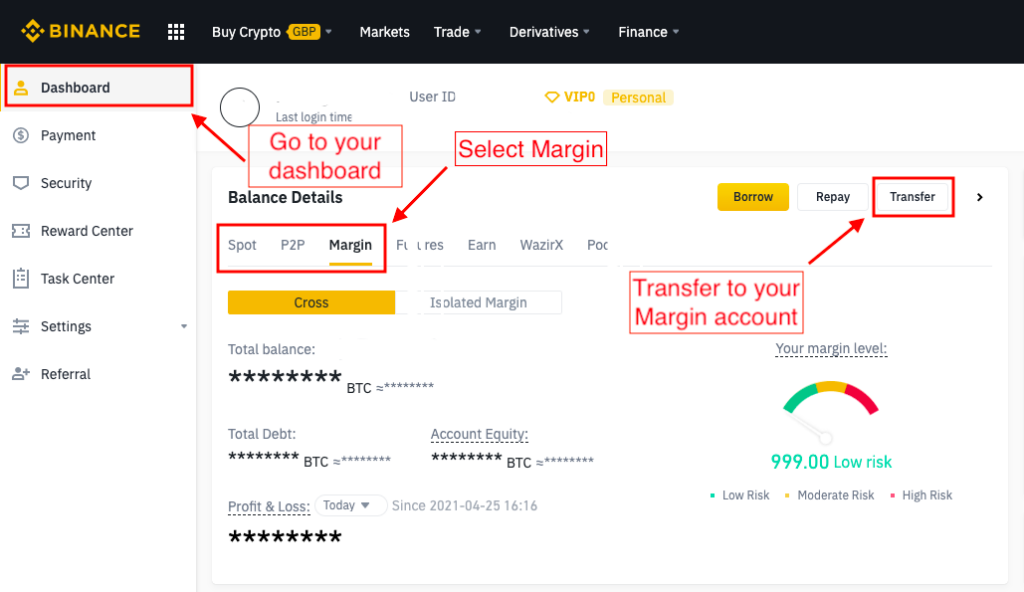
To start crypto margin trading, you’ll first need to select a broker or an exchange that provides the service. Some of the best crypto exchanges that offer margin trading include Kraken. Then sign up to an account and complete any KYC checks – this usually involves inputting proof of identity and some personal information. Next, visit your settings. There will usually be an option to switch your account from spot to margin trading. In some cases, you’ll then need to transfer tokens to your margin account.
Choosing A Crypto Margin Trading Broker
- Leverage offered – Take a look a what leverage a broker is offering to understand how much you can trade. Note that higher leverage isn’t necessarily better – crypto assets tend to be highly volatile, meaning that even leverage of 1:2 can bring tidy profits, while high leverage will expose you to very serious risk if a trade goes the wrong way.
- Fees – The fee structure for margin trading varies per broker. Some operate by allowing traders to borrow tokens as leverage. In this instance, interest is usually charged on the borrowed amount. Kraken, on the other hand, charges an opening and closing fee on the spot value of the trade. A rollover fee is applied based on how long the position is held. Look for a broker whose fee structure you’re comfortable with. Also, taxes will usually need to be paid on any gains, in line with rules in your jurisdiction.
- Demo accounts – Since Bitcoin margin trading involves an increased level of risk, traders must have the opportunity to practice their strategies using signals beforehand. A trading simulator and online courses allow clients to trial strategies before using real money. Profit calculators are also useful to help predict the outcome of a trade and can replace the manual spreadsheet you’ve previously worked with.
Final Word On Crypto Margin Trading
Now we’ve explained the ins and outs of crypto margin trading, you’ve hopefully got the understanding to get started. Bitcoin and other cryptos are highly volatile markets and while trading on margin can mean huge upside, retail investors should also be aware of the risks involved. It’s possible this asset could suffer from increased regulation in the future, but for now, it represents an exciting opportunity for traders.
FAQ
How Does Bitcoin Margin Trading Work?
Crypto margin trading means investors can multiply the results of their Bitcoin trade by utilising leverage. Leverage is the number of times you can multiply the results, it is either written as a ratio (e.g 1:3) or a multiple (e.g 3x). Leverage allows traders to borrow funds from their broker. In this way, a trader can execute much larger positions than their deposit amount and can amplify profits.
Are There Many Crypto Exchanges That Allow Margin Trading?
The top crypto margin trading exchanges that allow margin trading include Kraken, but there are more to choose from. However, availability does vary by location. Some popular exchanges, including eToro and Coinbase, have suspended crypto margin trading at times due to volatility in the market.
Is Crypto Margin Trading Legal In The USA?
The US has taken steps towards crypto margin trading on CFTC‑registered exchanges following 2025 regulatory changes that lifted prior restrictions on spot margin.
Will A Crypto Margin Call Go Away?
A margin call will cease once your account has been deposited with sufficient funds or the asset has increased in value. A margin call is designed to protect a trader from losses that exceed their deposit amount.
Can I Trade Crypto On Margin?
Yes, some of the top Bitcoin exchanges now offer trading on margin, with the opportunity to multiply the results of any trade. Whilst the practice is restricted in some jurisdictions, it is available in Australia, India, and Canada, to name just a few.