




Crypto CFDs are derivatives where the buyer and seller pay the difference between the opening and closing price of a token when the trade is closed. Day traders can go long and short with these crypto-backed instruments, meaning you can make profits whether digital asset prices rise or fall. They are usually traded using leverage (borrowed capital). This can supercharge profits, but it can also amplify losses when the crypto market moves quickly.
The guide will explain how crypto CFDs work, discuss their advantages and disadvantages, and list the steps to trade these short-term financial products. We’ve also vetted and listed the best brokers for trading crypto CFDs.
Top 6 Crypto CFD Brokers
We've evaluated the range of crypto CFDs and trading conditions at each of these top-rated brokers:
-
- FTSE Spread: 1.4
- GBPUSD Spread: 0.8
- Stocks Spread: 1.79 (Apple)
-
- FTSE Spread: 0.5
- GBPUSD Spread: 1.5
- Stocks Spread: 0.13
-
- FTSE Spread: From 0.4
- GBPUSD Spread: From 0.6
- Stocks Spread: Variable
-
- FTSE Spread: 17.5
- GBPUSD Spread: 0.4
- Stocks Spread: 0.01
-
- FTSE Spread: 1.0
- GBPUSD Spread: 0.23
- Stocks Spread: 0.02
-
- FTSE Spread: 1.0
- GBPUSD Spread: 0.4
- Stocks Spread: 0.02
73-89% of retail investor accounts lose money when trading CFDs






Learn how we test brokers and why you can trust our ratings.
Here is a summary of why we recommend these brokers in October 2026:
- XM 4.8/5 XM offers a handful of cryptocurrencies against the USD via the South African entity only. These are tradable via CFDs with very high leverage up to 1:500, amplifying potential returns but also losses. You can day trade major tokens like Bitcoin, Ethereum and Ripple, though the suite of tokens trails the 100+ crypto derivatives at some category leaders.
- AvaTrade 4.9/5 Regulated in five continents, AvaTrade offers a secure way to access crypto markets. There's a growing range of digital currencies including Bitcoin, Ethereum and Ripple, plus more unusually, a crypto index for diversified exposure. You can also access competitive crypto spreads in the broker's three platforms as well as 1:2 leverage.
- Trade Nation 4.4/5 Cryptocurrencies are available through the broker's Bahamas entity. Traders can access thousands of indicators to tailor their crypto trading strategies and there are no hidden charges.
- RoboForex 4.5/5 RoboForex has launched 24/7 CFD crypto trading for popular tokens, including Bitcoin, Ethereum, and Cardano. Transparent fees, margin trading opportunities, and the reliable RoboForex execution make it suited to active crypto traders. Crypto trading is on select accounts like Pro, ProCent, and ECN accounts, alongside leverage up to 1:500 for BTC/ETH.
- IC 4.8/5 IC offers 20+ cryptocurrencies which are tradable via CFDs, including lesser-known tokens such as Avalanche, Kusama and Uniswap. Commission-free trading is available, and experienced crypto traders can access leverage in the MetaTrader platforms.
- Pepperstone 4.8/5 Pepperstone continues to prove itself as one of the most trusted crypto CFD brokers. Although its selection of digital tokens is average, you can trade popular cryptos like Bitcoin and altcoins like Ripple with up to 1:10 leverage, while its crypto indices provide a holistic view of the digital currency markets not found on most day trading platforms. It has also launched a dedicated crypto exchange in Australia - Pepperstone Crypto.
Compare Crypto CFD Trading Conditions
| Broker | Coins | Crypto Spread |
|---|---|---|
| XM | 5 | Variable |
| AvaTrade | 8 | BTC <1%, ETH 2% |
| Trade Nation | 3 | Fixed |
| RoboForex | 6 | Variable |
| IC | 18 | BTC 42.036 |
| Pepperstone | 15 | 30 (BTC) |
Community Sentiment
See how users rate these brokers based on the average customer ratings submitted on DayTrading.com, plus ratings from Trustpilot, the Apple App Store and Google Play.
| Broker | Our Users' Rating | Trustpilot Score | Trustpilot Reviews | iOS App Rating | Android App Rating |
|---|---|---|---|---|---|
| XM | 3133 | ||||
| AvaTrade | 13567 | ||||
| Trade Nation | 2147 | ||||
| RoboForex | 773 | ||||
| IC | 2 | ||||
| Pepperstone | 3678 |
XM
With a low $5 minimum deposit, advanced charting platforms in MT4 and MT5, expanding range of markets, and a Zero account offering spreads from 0.0, XM provides all the essentials for active traders, even earning our ‘Best MT4/MT5 Broker’ award in recent years.
 Christian Harris, Reviewer
XM quick facts
- FTSE Spread
- 1.4
- GBPUSD Spread
- 0.8
- Stocks Spread
- 1.79 (Apple)
- Leverage
- 1:1000
- Regulator
- CySEC, DFSA, FSCA, SCA, FSA, FSC-Belize, FSC-Mauritius, CMA-Kenya, CMA-UAE
- Platforms
- MT4, MT5, TradingCentral
- Coins
- BTC, ETH, LTC, XRP, BCH
- Crypto Mining
- ✘No
- Auto Market Maker
- ✘No
- Crypto Spread
- Variable
- Crypto Lending
- ✘No
- Crypto Staking
- ✘No
- Minimum Deposit
- $5
- Account Currencies
- USD, EUR, GBP, JPY, ZAR
Pros
- XM’s growing roster of 1,400+ instruments provides diverse short-term trading opportunities, with unique turbo stocks, fractional shares, and more recently thematic indices.
- XM stands out for its commitment to trader education, with a wealth of well-presented resources, including webinars, tutorials, and even real-time trading sessions through XM Live.
- XM has rolled out platform upgrades with integrated TradingView charts and an XM AI assistant, delivering faster execution, smarter analysis, and a sleeker, more intuitive trading experience.
Cons
- XM relies solely on the MetaTrader platforms for desktop trading, so there’s no in-house downloadable solution for a more beginner-friendly user experience with unique features.
- XM is falling behind the curve by not offering cTrader, which is favored over MetaTrader by some serious traders for its smoother user experience and superior charting package.
- Although trusted and generally well-regulated in some regions, XM also has global entities registered with the weak regulators like FSC (Belize) and FSA (Seychelles), whilst UK clients are no longer accepted, reducing its market reach.
AvaTrade
AvaTrade offers active traders everything they need: an intuitive WebTrader, powerful AvaProtect risk management, a smooth 5-minute sign-up process, and dependable support you can rely on in fast-moving markets.
 Jemma Grist, Reviewer
AvaTrade quick facts
- FTSE Spread
- 0.5
- GBPUSD Spread
- 1.5
- Stocks Spread
- 0.13
- Leverage
- 1:30 (Retail) 1:400 (Pro)
- Regulator
- ASIC, CySEC, FSCA, ISA, CBI, JFSA, BVI, FSRA/ADGM, AFM, CMA-Kenya, CIRO (via Friedberg Direct)
- Platforms
- WebTrader, AvaTradeGO, AvaOptions, AvaFutures, MT4, MT5, AlgoTrader, TradingView, TradingCentral, DupliTrade
- Coins
- BCH, BTC, BTG, ETH, LTC, XRP, EOS, DASH
- Crypto Mining
- ✘No
- Auto Market Maker
- ✘No
- Crypto Spread
- BTC <1%, ETH 2%
- Crypto Lending
- ✘No
- Crypto Staking
- ✘No
- Minimum Deposit
- $100
- Account Currencies
- USD, EUR, GBP, CAD, AUD, ZAR
Pros
- Years on, AvaTrade remains one of the few brokers offering a bespoke risk management tool, AvaProtect, that insures losses up to $1M for a fee and is easy to activate on the platform.
- Support at AvaTrade performed excellently during testing, with response times of 3 minutes and localized support in major trading jurisdictions, including the UK, Europe and the Middle East.
- AvaTrade launched AvaFutures to offer low-margin access to global markets, then expanded in 2025 as one of the first brokers to add CME’s Micro Grain Futures, and then later in the year went further by integrating with TradingView.
Cons
- The AvaSocial app is good but not great – the look and feel, plus the navigation between finding strategy providers and account management needs upgrading to rival category leaders like eToro.
- AvaTrade’s WebTrader has improved, but work is still needed in terms of customizability – frustratingly widgets like market watch and watchlists can’t be hidden, moved, or resized.
- While signing up is a breeze, AvaTrade lacks an ECN account like Pepperstone or IC Markets, which provides the raw spreads and ultra-fast execution many day traders are looking for.
Trade Nation
Trade Nation suits discretionary traders who want to speculate on major indices like the US 500 or liquid FX pairs, and want the predictable all-in costs of fixed spreads. In tests, we found the fixed-spread TN Trader environment particularly useful for trading around scheduled economic releases owing to its reliable charting environment and because published spreads stayed capped.
Christian Harris, Reviewer
Trade Nation quick facts
- FTSE Spread
- From 0.4
- GBPUSD Spread
- From 0.6
- Stocks Spread
- Variable
- Leverage
- 1:30 (FCA, CMVM, ASIC), 1:200 (FSCA, SCB), 1:500 (FSA)
- Regulator
- FCA, ASIC, CMVM , FSCA, SCB, FSA
- Platforms
- TN Trader, MT4, TradingView
- Coins
- BTC, ETH, LTC
- Crypto Mining
- ✘No
- Auto Market Maker
- ✘No
- Crypto Spread
- Fixed
- Crypto Lending
- ✘No
- Crypto Staking
- ✘No
- Minimum Deposit
- $0
- Account Currencies
- USD, EUR, GBP, AUD, ZAR, SEK, NOK, DKK
Pros
- Trade Nation accounts can now be linked with TradingView, providing advanced multi-charts and the ability to execute trades directly.
- Trade Nation's 2026 partnership with Volt has sped up payments for Australian traders, who can now make instant deposits and withdrawals using PayID, with the faster payout capabilities planned for clients in the UK and EU.
- The demo comes with a $5,000 practice account and you can request a one-on-one platform walkthrough by callback - this level of personal help is rare.
Cons
- Offshore SCB and FSA entities allow retail clients up to 1:200 and 1:500 leverage compared to 1:30 in regions like the UK, Europe and Australia, so an FSA client can have 16 times the exposure of a UK retail client on the same trade, but with less oversight and no compensation scheme.
- The 2–20% rebate scheme is closed to FCA, CMVM, and ASIC clients, meaning active day traders in these regions who would benefit from transaction rebates cannot claim them.
- There is no raw or ECN pricing tier, which are often prefered by day traders. No matter how much you deposit or trade, you use the same fixed (or variable on MT4) pricing as beginners, making it unsuitable for scalpers especially.
RoboForex
RoboForex is great if you want a vast range of 12,000+ day trading markets with ECN accounts, powerful charting and loyalty promotions. It also stands out for stock traders with its user-friendly R StocksTrader platform, featuring 3,000+ shares, fees from $0.01 and sophisticated watchlists.
Christian Harris, Reviewer
RoboForex quick facts
- FTSE Spread
- 17.5
- GBPUSD Spread
- 0.4
- Stocks Spread
- 0.01
- Leverage
- 1:2000
- Regulator
- FSC
- Platforms
- R StocksTrader, MT4, MT5, TradingView
- Coins
- BTC, ETH, XRP, SOL, DOGE, ADA
- Crypto Mining
- ✘No
- Auto Market Maker
- ✘No
- Crypto Spread
- Variable
- Crypto Lending
- ✘No
- Crypto Staking
- ✘No
- Minimum Deposit
- $10
- Account Currencies
- USD, EUR
Pros
- RoboForex is known for its tight spreads starting from 0 pips and low minimum deposits from $10, making it accessible to those on a budget. The ability to trade with micro lots further lowers the barrier to entry for new traders.
- The R Stocks Trader platform rivals leading solutions like MT4, with netting and hedging capabilities, comprehensive backtesting, Level II pricing, and a flexible workspace.
- RoboForex offers over 12,000 instruments, providing more short-term trading opportunities than the vast majority of online brokers, with forex, stocks, indices, ETFs, commodities, and futures.
Cons
- RoboForex provides a variety of account types, which, while offering flexibility, can be overwhelming for newer traders trying to choose the most suitable option for their trading style. Alternatives, notably eToro, provide a smoother entry into online trading with one retail account.
- Despite offering a range of platforms, RoboForex still doesn't support the increasingly popular cTrader. This might deter traders who prefer this specific platform for their day trading activities and is available at firms like Fusion Markets.
- RoboForex now restricts base currency options to USD and EUR. This limitation may inconvenience day traders preferring to manage their accounts in other currencies, while potentially leading to conversion fees.
IC
IC (formerly IC Markets) offers superior pricing, exceptionally fast execution and seamless deposits. The introduction of advanced charting platforms, notably TradingView, and the Raw Trader Plus account, ensures it remains a top choice for intermediate to advanced day traders.
Christian Harris, Reviewer
IC quick facts
- FTSE Spread
- 1.0
- GBPUSD Spread
- 0.23
- Stocks Spread
- 0.02
- Leverage
- 1:5000
- Regulator
- ASIC, CySEC, FSA, SCB, CMA-Kenya
- Platforms
- MT4, MT5, cTrader, TradingView, TradingCentral, DupliTrade, Quantower
- Coins
- BTC, BCH, DOT, DSH, EMC, EOS, ETH, LNK, LTC, NMC, PPC, XLM, XRP, ADA, BNB, DOG, UNI, XTZ
- Crypto Mining
- ✘No
- Auto Market Maker
- ✘No
- Crypto Spread
- BTC 42.036
- Crypto Lending
- ✘No
- Crypto Staking
- ✘No
- Minimum Deposit
- $200
- Account Currencies
- USD, EUR, GBP, CAD, AUD, NZD, JPY, CHF, HKD, SGD
Pros
- You have access to over 2,250 CFDs across various markets, including forex, commodities, indices, stocks, bonds, and cryptocurrencies, allowing for diversified trading strategies.
- IC offers among the tightest spreads in the industry, with 0.0-pip spreads on major currency pairs, making it especially cost-effective for day traders.
- As a tightly regulated and widely respected broker, IC prioritizes client security and transparency, helping to ensure a reliable trading experience globally.
Cons
- The breadth and depth of tutorials, webinars and educational resources still need work, trailing alternatives like CMC Markets and reducing its suitability for beginners.
- Despite four industry-leading third-party platforms, there is no proprietary software or trading app built with new traders in mind.
- Interest isn't paid on unused cash, an increasingly popular feature found at alternatives like Interactive Brokers.
Pepperstone
Pepperstone stands out as a top choice for day trading, offering razor-sharp spreads, ultra-fast execution, and advanced charting platforms for experienced traders. New traders are also welcomed with no minimum deposit, extensive educational resources, and exceptional 24/5 support (18h a day on weekends).
Christian Harris, Reviewer
Pepperstone quick facts
- FTSE Spread
- 1.0
- GBPUSD Spread
- 0.4
- Stocks Spread
- 0.02
- Leverage
- 1:30 (Retail - UK, EU, Australia), 1:500 (Pro), 1:200 (Offshore), 1:400 (Kenya)
- Regulator
- FCA, ASIC, CySEC, BaFin, DFSA, SCA, SCB, CMA-Kenya
- Platforms
- Pepperstone Trading Platform, MT4, MT5, cTrader, TradingView
- Coins
- BCH, BTC, ETH, LTC, DASH, ADA, LINK, DOGE, EOS, DOT, XRP, XLM, XTZ, UNI, BNB
- Crypto Mining
- ✘No
- Auto Market Maker
- ✘No
- Crypto Spread
- 30 (BTC)
- Crypto Lending
- ✘No
- Crypto Staking
- ✘No
- Minimum Deposit
- $0
- Account Currencies
- USD, EUR, GBP, CAD, AUD, NZD, JPY, CHF, HKD, SGD
Pros
- Award-winning customer support is available via telephone, email or live chat with response times of <5 minutes during testing and friendly agents knowledgeable about its products and trading tools.
- Offers a dedicated CopyTrading app for traders who want a less active approach to trading, available in some countries.
- Pepperstone has started providing trading in pre-IPO perpetual futures like SpaceX (SPCX.US-PERP) in select regions, such as the UAE.
Cons
- Pepperstone has removed support for several tools that elevated the trading experience for active retail traders, notably Autochartist, Capitalise.ai and a free VPS for qualifying traders (now only pro traders in some countries).
- Overnight holding fees are higher than that found with some Market Maker brokers (usually Benchmark + 2.5%). This makes pepperstone an ideal broker for day traders and forex scalpers but less suitable for swing traders who often keep position open overnight.
- Execution may not feel as reliable in fast markets as headline speeds suggest. In our own testing, execution was fast at desired prices, but some community complaints focus on slippage, stop-loss fills and spread-sensitive order triggers during volatile conditions.
What Are Crypto CFDs?
Crypto CFDs are financial instruments that track price movements in cryptocurrencies, such as Bitcoin, Ethereum and Litecoin.
They enable speculators to bet on whether crypto prices will rise or fall without having to own the underlying asset itself, a characteristic of all CFDs.
You can bet on crypto prices rising by taking a ‘long’ position, or speculate that values will drop by going ‘short’.
Like many derivatives, crypto-backed CFDs are popular with short-term traders who wish to use leverage. These are funds that you can borrow from a brokerage to control a larger position.
You will put down a deposit (known as margin) that allows you to open and hold a position in a cryptocurrency. Your broker will specify the minimum balance you must maintain in your account relative to the total value of the leveraged position.
Based on our many years in the industry, the level of leverage available on crypto CFDs typically ranges from 1:2 to over 1:20. A $100 outlay with 1:2 leverage would give you $200 (2 x $100) in buying power, while 1:20 leverage would give you $2,000 (20 x $100).
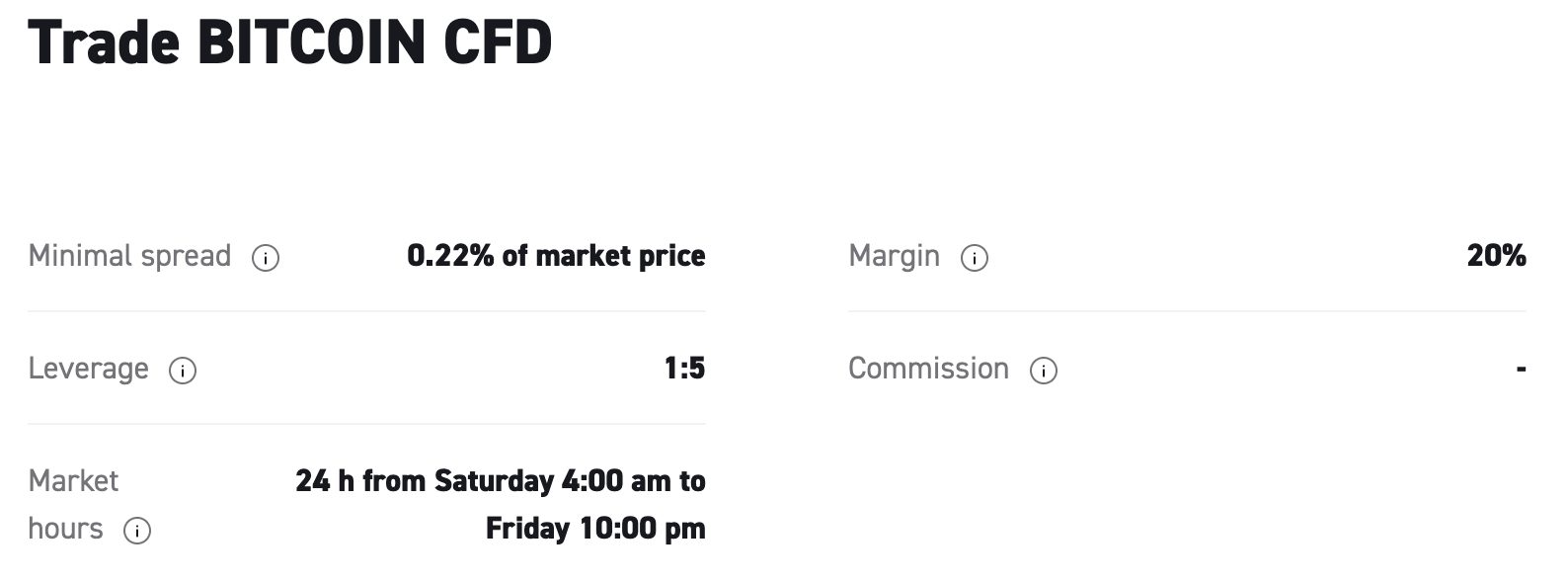
Due to their volatile nature, crypto CFDs are normally available with less leverage than other financial instruments, such as fiat currencies, protecting against significant losses in fast-moving markets.
Importantly, if you fall short of the margin requirements, the brokerage will demand that you deposit more cash. This is known as a margin call. If you fail to do this you may find your cryptocurrency CFD position liquidated by your broker – an extremely frustrating situation.
Crypto CFDs are controversial financial securities. While they can significantly enhance your returns, they can result in whopping losses when things go wrong.
 Royston WildAuthor
A Crypto CFD Trade In Action
To help you understand how a crypto CFD trade works in reality, let’s look at an example…
Initial Scenario
- Current Bitcoin Price: $60,000
- My Deposit (Margin): $1,000
Objective
I anticipate that the price of Bitcoin will increase following an announcement from an established public company that it’s bought a large amount of the digital currency, so I decide to enter a long position (buy) using a Bitcoin CFD with 10x leverage.
The 10x leverage means that my $1,000 deposit allows me to control a position worth 10 times my deposit, so $1000 x 10 = $10,000.
Trade Execution
- Price Movement: The price of Bitcoin rises over the next 6 hours
- New Bitcoin Price: $62,500
Importantly, Bitcoin CFDs are only settled when I choose (or the broker closes it because I have failed to meet margin requirements).
Calculating My Profit
- Determine the price movement: The price moved from $60,000 to $62,500, which is a $2,500 increase.
- Calculate the percentage increase: The increase is $2,500 on the original $60,000, which is a 4.17% increase.
- Apply the percentage to my controlled amount: Since I control $10,000 worth of Bitcoin, a 4.17% increase on my position is $10,000 x 4.17% = $417. My profit excludes trading fees.
If I had not used leverage and simply invested my $1,000 directly into Bitcoin, my profit from the price increase from $60,000 to $62,500 would have been approximately $41.67 ($1,000 x 4.17%), excluding any fees, demonstrating the huge impact of leverage.
If The Price Had Fallen
If, instead, the price of Bitcoin had fallen to $58,000, I would calculate my loss in a similar manner. The price movement would be a $2,000 decrease, equating to a 3.33% decrease. On my $10,000 position, a 3.33% decrease would result in a $330 loss.
While this won’t impact day traders, if you keep a Bitcoin CFD trade open overnight, you may incur interest charges, potentially increasing the cost of trading.
Royston WildAuthorShould I Trade Crypto CFDs Instead Of Crypto Directly?
You can trade cryptocurrency directly on a specialist crypto exchange like Coinbase. However, trading a crypto-based CFD can have advantages over buying and selling digital currencies themselves. These include:
- Eliminating wallet management: If I buy cryptocurrency on an exchange, I also need to set up a digital wallet in which to store the asset. These can only be accessed via a private ‘key’, a code that can easily be lost or stolen. Trading cryptocurrency CFDs eliminates this threat and also makes day trading much simpler.
- Better liquidity: Crypto CFDs tend to have higher trading volumes than digital tokens and, as a consequence, much deeper liquidity. This can result in reduced costs through tighter bid and ask spreads, while short-term traders can also be able to enter and exit positions more quickly.
- Tighter regulation: Regulatory oversight of CFDs tends to be much tighter than the cryptocurrency market more broadly. This provides traders with an enhanced level of protection. However, day traders who use overseas brokers should carefully check their regulatory status.
- Leverage: I may be able to obtain higher leverage by trading a crypto-based derivative than by dealing in the digital currency itself, potentially increasing profits (and losses).
Trading crypto CFDs instead of the underlying cryptocurrency also has drawbacks. These can include the potential for higher trading fees and increased counterparty risk (the danger that the broker may fail to meet its contractual obligations).
Also, despite improvements in recent years, there is still often a limited choice of digital tokens beyond the biggest and most well-known, such as Bitcoin, Ethereum and Litecoin.
Royston WildAuthorHow To Trade Cryptocurrency CFDs
If allowed in your jurisdiction, day trading crypto CFDs requires 3 steps:
- Choose a CFD crypto broker
- Develop a strategy
- Place a trade
Choose A Crypto Broker
The first step is to choose a broker with cryptocurrency CFDs. I always start by checking that the company is trusted; there are vast numbers of unregulated crypto CFD brokers doing business across the globe with scams prevalent.
Next, consider the levels of leverage that you’re able to take advantage of. After all, the ability to use borrowed funds from a broker is one of the major selling points of day trading crypto CFDs.
Also look for brokers with negative balance protection. This will ensure that you cannot lose more than the funds that are already in your account when trading with leverage.
Once you’re happy with these points, check the pricing – low spreads will help maximize profits, especially for active day traders.
Finally, make sure the trading platform is easy to use with the charting tools you need to analyze and forecast cryptocurrency price movements. This is really important – an intuitive platform can really enhance the trading environment in my experience.
Develop A Strategy
Successful CFD crypto trading requires a well-thought-out strategy, typically entailing technical analysis if you’re short-term trading, though it could also include fundamental analysis.
Determine in advance your entry and exit points, stop-loss orders, and take-profit levels. Backtest your strategy where possible, making use of a demo account if needed, and remain adaptable to changing market conditions – crypto prices are notoriously volatile.
Two popular strategies for short-term crypto CFD trading include:
Breakout Trading – This strategy involves identifying a channel of resistance and support levels that the asset is consistently oscillating between. A breakout trader would wait until the price breaks through either level and then open a position for the breakout to be consolidated and become a new trend.
Contrarian Trading – This strategy is similar to swing trading, entailing betting against a consolidated trend as you are anticipating its reversal. This can be indicated in several ways, for example, a declining trading volume.
Place A Trade
You should be able to execute a cryptocurrency CFD trade directly in the broker’s platform or mobile trading app in a few clicks, inputting long/short, position size and any risk management parameters.
Importantly, begin day trading crypto CFDs with an amount of capital you can afford to lose. Start small to test your strategy under real market conditions.
Always stay informed about market news and events that could affect crypto prices, and be prepared to adjust your strategy as needed.
A Restricted Asset Class
Their high-risk nature means that trading crypto CFDs is closely regulated in many countries and even outlawed in others.
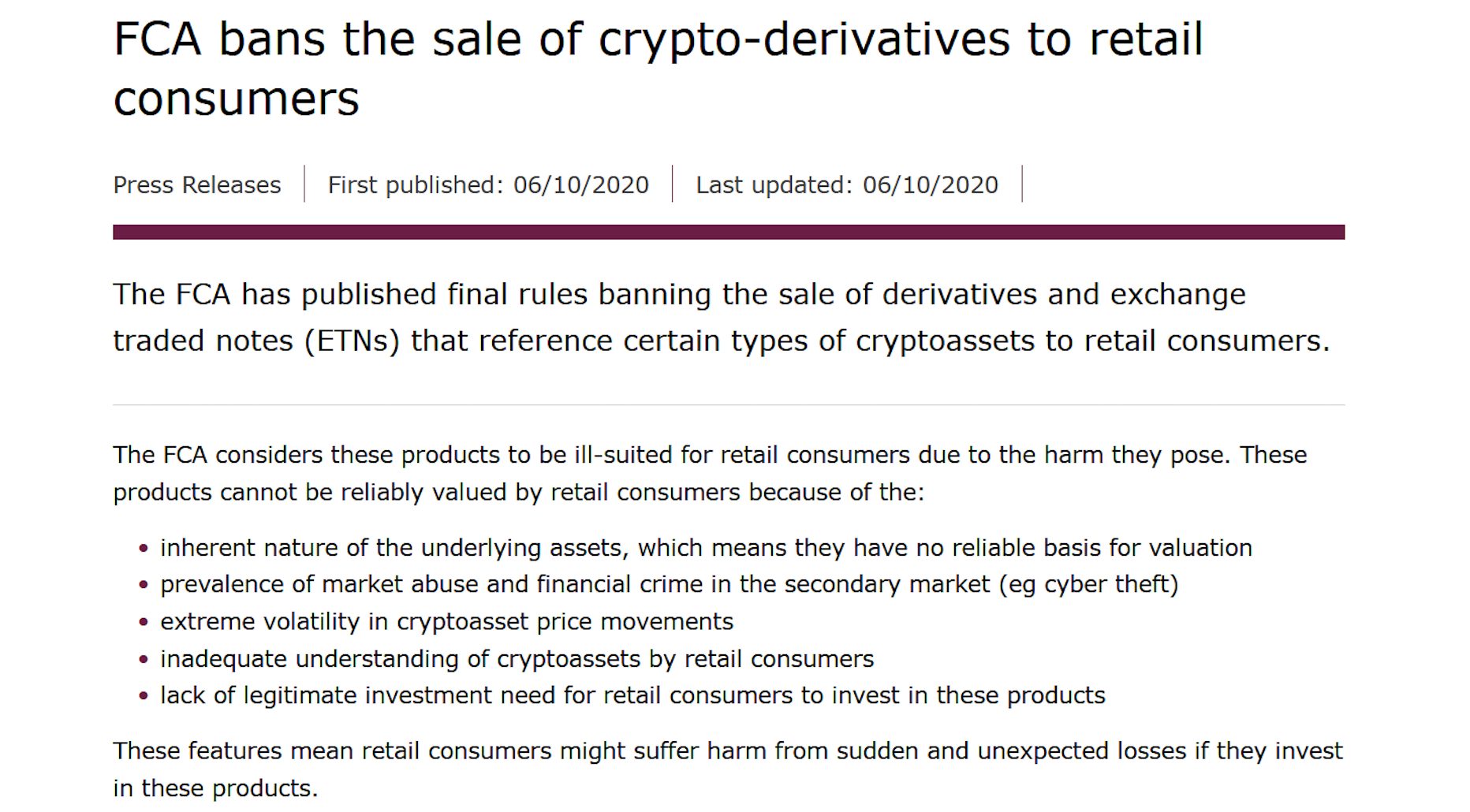
For example, in January 2021, the Financial Conduct Authority (FCA) in the UK banned retail traders from speculating on cryptocurrencies through derivatives like CFDs. Retail clients in the UK can only trade crypto CFDs with offshore, weakly regulated brokers with limited legal protections.
That said, the FCA has left the door open for professional traders to continue dealing in crypto derivatives.
The high-risk nature of CFDs means many territories have prohibited them regardless of which underlying asset they are linked to. The Securities and Exchange Commission (SEC), for instance, has prohibited any US citizens from dealing in these contracts.
Certain regions like the European Union and Australia have strict rules on the trading of CFDs, including crypto CFDs, while some like Hong Kong prevent their citizens from trading them unless they use an overseas broker.
Bottom Line
Since the creation of Bitcoin in 2009, hundreds of other cryptocurrencies have been created and now form a massive part of the day trading landscape. CFDs are extremely popular ways to capitalize on these new-age assets, although the wide-scale availability of leverage adds extra danger to these trades.
Investors who decide to deal in these financial instruments should be fully aware of these risks, and must have a detailed understanding of cryptocurrency markets before taking the plunge.
To get started, see our ranking of the best brokers with crypto CFDs. Alternatively, trading cryptocurrency-backed CFDs via a demo account is a lowe-risk first step for newer traders.
FAQ
How Does CFD Crypto Trading Work?
Two parties will enter a contract that states that the difference between the opening and closing values of the digital asset will be paid by either the broker or trader (depending on the type taken out and the direction of price movement).
Importantly, CFDs are derivatives, so you do not take ownership of the underlying digital asset, you simply make or lose money based on the change in its value.
Do I Need A Digital Wallet For CFD Crypto Trading?
No, you do not need a digital wallet. Digital wallets are used when you own digital currencies, which is not the case for CFD crypto trading, and is part of their appeal to short-term speculators.
What Cryptocurrencies Can I Trade CFDs With?
It is primarily the cryptos with the biggest market capitalization that brokers will offer CFDs for. These include Bitcoin, Ripple, Ethereum and Litecoin.
Having said that, we’re seeing brokers expand their suite of cryptocurrency CFDs, with Eightcap standing out for its around 100 crypto derivatives.
How Much Money Do I Need To Trade Crypto CFDs?
CFD crypto trading is much akin to betting in that you can put as much or as little money as you wish (to a point) on the trade.
The use of leverage can also increase market exposure by allowing you to front only a portion of a trade’s stake, for example, less than $100.
Importantly, given the derivative nature of CFDs, you do not need to be able to purchase one whole Bitcoin, for example, to begin trading.
What Time Does Crypto CFD Trading Cease?
As cryptocurrencies are not traded on one specific regulated exchange, they are open for CFD trading 24/7, all year round.
That said, there are times of higher and lower market activity that will often follow the peak trading hours of popular physical exchanges, which can affect profits through slippage and volatility.
Article Sources
The writing and editorial team at DayTrading.com use credible sources to support their work. These include government agencies, white papers, research institutes, and engagement with industry professionals. Content is written free from bias and is fact-checked where appropriate. Learn more about why you can trust DayTrading.com