





Want to trade market volatility? Dig into the best brokers with the CBOE Volatility Index (VIX) and related instruments, based on the tests of our experts who’ve traded volatility indexes across multiple platforms.
Top 1 Brokers For Trading Volatility Index
We've exhaustively evaluated 143 brokers and these 1 jump out as the best brokers for trading volatility indices:
-
- Demo account
- Instruments: Stocks, Options, ETFs, Crypto
- Regulator: SEC, FINRA
eToro USA LLC and eToro USA Securities Inc.; Investing involves risk, including loss of principal; Not a recommendation
Learn how we test brokers and why you can trust our ratings.
Why Are These Brokers The Best For VIX Trading?
Here’s a rundown of why these brokers stand out for trading the VIX and volatility-based instruments:
- eToro USA is the best broker for trading the volatility index in 2026 3.4/5 When we tested eToro USA, we accessed VIX futures and ETF options (like VXX) via the proprietary platform, with execution smooth and charts real-time. Spreads hovered near 2 points on VIX futures, and integrated sentiment tools helped refine entry timing.
Compare The Best VIX Brokers By Key Features
Find the right VIX broker for you based on our comparison of core features that matter to volatility traders:
| Broker | Minimum Deposit To Trade The VIX | Minimum Trade On The VIX | Fast Execution | Platforms | Regulator |
|---|---|---|---|---|---|
| eToro USA | $50 | $10 | ✔Yes | eToro Trading Platform & CopyTrader | SEC, FINRA |
How Safe Are The Best VIX Brokers?
Compare how well the top brokerages protect client funds when day trading volatility indices:
| Broker | Trust Rating | Guaranteed Stop Loss | Negative Balance Protection | Segregated Accounts |
|---|---|---|---|---|
| eToro USA | ✘No | ✘No | ✔Yes |
Compare Mobile Platforms For Trading VIX
If you’re trading on the go, see which of our top brokers offer strong mobile tools for volatility index trading:
| Broker | Mobile Apps | iOS Rating | Android Rating | Smart Watch App |
|---|---|---|---|---|
| eToro USA | iOS & Android | ✘No |
Are The Top VIX Brokers Good For Beginners?
See which of our leading providers offer demo accounts, support, and education for getting started VIX trading:
| Broker | Demo Account | Minimum Deposit | Minimum Trade | Education Rating | Support Rating |
|---|---|---|---|---|---|
| eToro USA | ✔Yes | $50 | $10 |
Are The Top VIX Brokers Good For Advanced Traders?
Experienced traders will value our top platforms with low latency and tools to maximize VIX strategies:
| Broker | Automated Trading | VPS | AI | Pro Account | Leverage | Low Latency | Extended Hours |
|---|---|---|---|---|---|---|---|
| eToro USA | ✘No | ✘No | ✔Yes | ✘No | - | ✔Yes | ✔Yes |
Compare Detailed Ratings Of The Top VIX Brokers
See how the leading brokers for trading volatility stack up across our nine core scoring categories:
| Broker | Trust | Platforms | Assets | Mobile | Fees | Accounts | Research | Education | Support |
|---|---|---|---|---|---|---|---|---|---|
| eToro USA |
Compare Trading Fees
Costs can add up, so here’s how the best VIX trading platforms compare on spreads and other charges:
| Broker | Cost Rating | Fixed Spreads | Inactivity Fee |
|---|---|---|---|
| eToro USA | ✔Yes | $10 |
Community Sentiment
See how users rate these brokers based on the average customer ratings submitted on DayTrading.com, plus ratings from Trustpilot, the Apple App Store and Google Play.
| Broker | Our Users' Rating | Trustpilot Score | Trustpilot Reviews | iOS App Rating | Android App Rating |
|---|---|---|---|---|---|
| eToro USA | 32200 |
How Popular Are The Top VIX Brokers?
See which of the best brokers for VIX trading have the most client sign-ups:
Why Trade The VIX With eToro USA?
eToro remains a top pick for traders looking for leading social investing and copy trading services. With a low deposit, zero commissions and an intuitive platform, the broker will meet the needs of newer day traders.
 Jemma Grist, Reviewer
eToro USA quick facts
- Demo Account
- ✔Yes
- Instruments
- Stocks, Options, ETFs, Crypto
- Regulator
- SEC, FINRA
- Platforms
- eToro Trading Platform & CopyTrader
- Minimum Deposit
- $50
- Minimum Trade
- $10
- Account Currencies
- USD
Pros
- The online broker offers an intuitive social investment network with straightforward copy trading on cryptos
- The low minimum deposit and straightforward account opening process means beginners can get started quickly
- Investors can access Smart Portfolios for a more hands-off approach, covering a range of sectors and markets such as renewable energy and artificial intelligence
Cons
- Average fees may cut into the profit margins of active traders
- There's a narrower range of day trading instruments available compared to competitors, with only stocks, ETFs, options, and cryptos
- eToro USA was fined $1.5 million by the SEC in 2024 related to unregistered crypto offerings
How DayTrading.com Chose The Best Brokers For Trading The VIX
We followed a three-step process to find the top brokers for trading the VIX and related volatility products:
- VIX Access Verified – We manually logged into each platform in our database of 143 brokerages to confirm whether volatility indexes were available, such as CBOE Volatility Index (VIX) derivatives, VIX-linked ETFs/ETNs, or VIX CFDs. This ensured we only included brokers that genuinely support volatility trading.
- Product Testing – For each shortlisted broker, we personally tested the VIX trading experience. This involved checking the type and quality of the VIX product, trading conditions (spreads, execution, margin), platform tools and usability for volatility-focused strategies, and reliability during market hours.
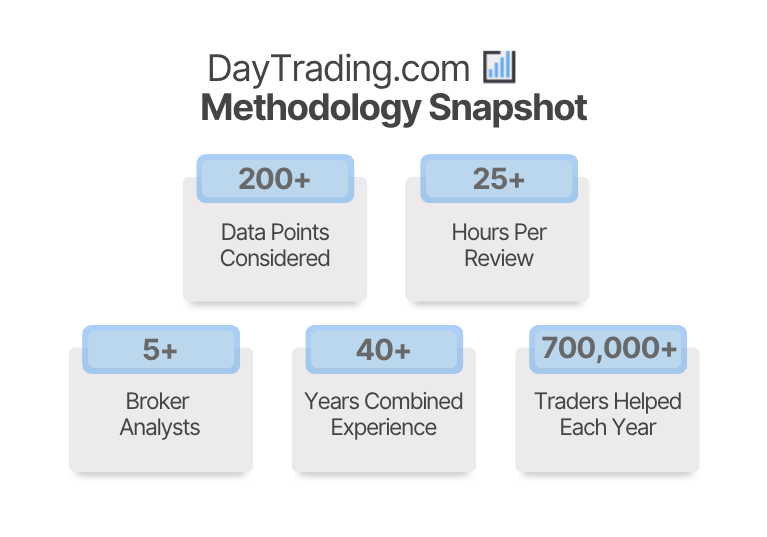
- Broker Ranking by Overall Score – We then ranked these brokers based on overall ratings, using our in-house scoring system that pulls from 200+ data points across nine key categories. Only brokers that passed product-level volatility index testing and scored the highest overall scores made it into our final list.
What Is a Volatility Index?
A volatility index is a real-time gauge of expected market turbulence. For active traders, it’s essentially a barometer of fear, momentum, and uncertainty. This makes it a powerful tool for spotting short-term trading opportunities.
The most well-known volatility index is the VIX, often called the “fear index”. Created by the CBOE (Chicago Board Options Exchange), the VIX measures expected 30-day volatility in the S&P 500, based on options pricing.
When the VIX rises, it typically reflects increased nervousness in the market, often during sell-offs or major news events. When it drops, markets are seen as calmer or more complacent.
What Types of Volatility Indices Do Brokers Offer?
We’ve spent hours combing through volatility indexes on trading platforms, and not all providers offer the same volatility products.
While there are technically more volatility indexes, here’s a breakdown of the four types that are primarily available to retail traders from our research:
1. VIX (CBOE Volatility Index)
- The gold standard in volatility trading.
- Measures expected volatility in the S&P 500.
- Typically available via futures, options, ETFs and CFDs.
- Common on regulated brokers and trading platforms with US index exposure. eToro a stand-out option.
2. VSTOXX (EU Volatility Index)
- Europe’s equivalent of the VIX, based on the EURO STOXX 50 index.
- Useful for active traders focused on EU equity markets.
- Offered by select brokers with European derivatives access. XTB excelled in our analysis.
3. GVZ (Gold Volatility Index)
- Tracks expected volatility in the gold market, derived from gold option prices.
- Great for traders looking to hedge or speculate on gold price swings.
- Not commonly available at retail brokers, but there are exceptions. Interactive Brokers is the most trusted.
4. Volatility 75 Index (Synthetic VIX)
- A simulated volatility index offered by some brokers. Deriv pioneered this product.
- Not tied to real-world markets, but mimics high-volatility conditions 24/7.
- Popular with day traders for its constant movement and leveraged exposure.
- Comes in versions like Volatility 25/50/100, depending on desired intensity.
What Should I Look For When Choosing A Broker To Trade A Volatility Index?
Some brokers specialize in regulated market instruments (like VIX futures or VSTOXX CFDs), while others offer synthetic indices that trade 24/7 with tight spreads and algorithmic volatility.
Before you choose a platform, ask the same questions I did during testing:
- What type of volatility index can I trade, for example, real or synthetic?
- Is it available via CFDs, options, ETFs, futures, or another instrument?
- What are the trading hours, spreads, and margin requirements?
- Is the platform stable during high-volatility spikes?
What Is The Typical Spread Charged By Brokers On The VIX?
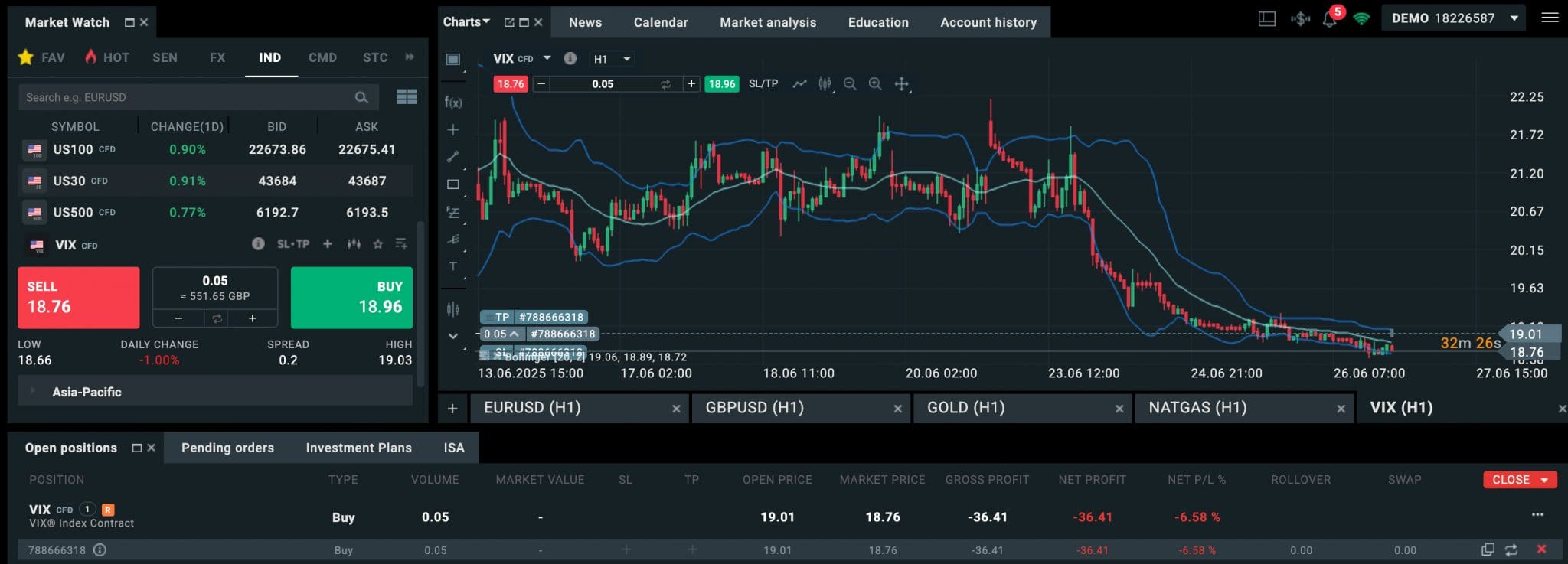
We analyzed VIX spreads from five leading brokers (Pepperstone, XTB, CMC Markets, IG, and XM) to come up with an average.
While the average spread came out at around 2.0, that’s that’s skewed by CMC Markets’ unusually wide spread of 8.0 during our latest tests.
A more realistic figure based on the median and trimmed average puts the typical VIX spread at around 0.6 to 0.7. This better reflects what day traders can expect on most top platforms during normal trading conditions.
What Leverage Do Brokers Offer On The VIX?
We investigated the maximum leverage available to trade the VIX at various brokers during our tests. For most regulated platforms, the maximum leverage is 1:5, meaning a 20% margin is required.
Some offshore brokers may offer higher leverage, but this may increase the risk of large losses. Unregulated brokers do not offer the same fund safeguards in our experience.
Bottom Line
We’ve watched the number of brokers offering a volatility index increase over the years, with many day traders drawn to these products where significant price fluctuations open up opportunities to generate profits.
However, our analysis shows the quality of providers can vary dramatically, from spreads and commission on volatility indices to the speed of execution and the quality of the trading software.
To find the right provider for your needs, turn to our rankings of the top VIX brokers.
FAQ
How Is The Volatility Index Calculated?
The VIX, or Volatility Index, is calculated by the CBOE using SPX options, specifically those with expiries between 23 and 37 days out. These include both monthly SPX options (expiring the third Friday of each month) and weekly SPX options (expiring every other Friday).
The VIX blends these options to create a 30-day forward-looking estimate of market volatility, not based on historical movement, but on real-time options pricing. It reflects how much traders are willing to pay for protection (or speculation) around the S&P 500.
For day and short-term traders, VIX spikes often signal market fear, higher intraday volatility, and wider price swings – making it a key sentiment indicator for short-term setups.
Why Is The Volatility Index Referred To As The “Fear Gauge”?
The VIX is often called the “fear gauge” because it rises when traders expect higher risk or turbulence, usually due to economic shocks, geopolitical events, or sudden sell-offs.
It doesn’t measure fear directly – it measures expected volatility, but since traders often buy SPX options as protection during uncertainty, rising VIX levels correlate closely with increased market anxiety.
For short-term traders, a rising VIX often means bigger moves, faster reversals, and higher risk-reward potential, but also more risk. It’s a warning light and an opportunity signal in one.
Article Sources
- VIX (CBOE Volatility Index)
- VSTOXX (EU Volatility Index)
- GVZ (Gold Volatility Index)
- VFTSE (FTSE 100 Volatility Index)
The writing and editorial team at DayTrading.com use credible sources to support their work. These include government agencies, white papers, research institutes, and engagement with industry professionals. Content is written free from bias and is fact-checked where appropriate. Learn more about why you can trust DayTrading.com