
Best Brokers With Low Spreads 2026



If you’re a day trader, every fraction of a pip counts. That’s why brokers with low spreads can be a game-changer, helping you pocket more of what you earn and keeping you competitive in fast-moving markets.
Let’s dig into our lowest spread brokers, tested and rated by industry experts and active traders.
Best Low Spread Brokers
We've been recording and analyzing spreads for 7+ years, and these 2 brokers offer the tightest spreads:


This is why we think these brokers are the best in this category in 2026:
- FOREX.com - In our ECN-style testing with FOREX.com’s account, execution averaged 40ms with moderate slippage during fast market moves. Spreads on EUR/USD started near 0.1 pips, plus a $6 commission per lot. Liquidity was deep but slightly fragmented during off-hours. Best suited for experienced traders using limit-order dependent strategies.
- Plexytrade - When we spent time using PlexyTrade’s ECN account, execution speeds averaged 45–50ms with moderate slippage during volatile periods. Spreads on EUR/USD were around 0.3 pips, plus a $7 commission per lot. Liquidity was fair for smaller trade sizes but showed limitations during peak volatility - more suited to swing traders.
Fee Comparison At Low Spread Brokers
| Broker | EUR/USD Spread | FTSE Spread | Oil Spread | Stock Spread | Crypto Spread |
|---|---|---|---|---|---|
| FOREX.com | 1.2 | 1.0 | 2.5 | 0.14 | BTC 1.4%, ETH 2% |
| Plexytrade | 0.7 | 0.8 | 5 | 5 | 1.1 |
Community Sentiment
See how users rate these brokers based on the average customer ratings submitted on DayTrading.com, plus ratings from Trustpilot, the Apple App Store and Google Play.
| Broker | Our Users' Rating | Trustpilot Score | Trustpilot Reviews | iOS App Rating | Android App Rating |
|---|---|---|---|---|---|
| FOREX.com | 2516 | ||||
| Plexytrade | 95 |
FOREX.com
"FOREX.com remains a best-in-class brokerage for active forex traders of all experience levels, with over 80 currency pairs, tight spreads from 0.0 pips and low commissions. The powerful charting platforms collectively offer over 100 technical indicators, as well as extensive research tools."
Christian Harris, Reviewer
FOREX.com Quick Facts
| Demo Account | Yes |
|---|---|
| Instruments | Forex, Futures and Options on Metals, Energies, Commodities, Indices, Bonds |
| Regulator | NFA, CFTC |
| Platforms | WebTrader, Mobile, MT4, MT5, TradingView |
| Minimum Deposit | $100 |
| Minimum Trade | 0.01 Lots |
| Account Currencies | USD, EUR, GBP, CAD, AUD, JPY, CHF, PLN |
Pros
- There’s a wealth of educational resources including tutorials, webinars, and a stacked YouTube channel to help you get educated in the financial markets.
- With over 20 years of experience, excellent regulatory oversight, and multiple accolades including runner-up in our 'Best Forex Broker' awards, FOREX.com boasts a global reputation as a trusted brokerage.
- The in-house Web Trader continues to stand out as one of the best-designed platforms for aspiring day traders with a slick design and over 80 technical indicators for market analysis.
Cons
- FOREX.com's MT4 platform offers approximately 600 instruments, significantly fewer than the over 5,500 available on its non-MetaTrader platforms.
- Demo accounts are frustratingly time-limited to 90 days, which doesn’t give you enough time to test day trading strategies effectively.
- The group being FOREX.com, GAIN Capital Group LLC, had to pay a $700k fine to NFA for improperly handling some client accounts.
Plexytrade
"Plexytrade is a newcomer in the brokerage scene with attention-grabbing features like 1:2000 leverage, zero spreads on select instruments and fast execution speeds of less than 46 milliseconds. However, the absence of regulation is a significant concern, while the non-existent research and educational tools place it far behind industry frontrunners."
Plexytrade Quick Facts
| Demo Account | Yes |
|---|---|
| Instruments | CFDs, Forex, Indices, Stocks, Commodities, Crypto |
| Platforms | MT4, MT5, TradeLocker |
| Minimum Deposit | $50 |
| Minimum Trade | 0.01 |
| Account Currencies | USD, EUR |
Pros
- There are various VPS packages starting from $50 per month, but they become complimentary once specific deposit thresholds are reached.
- Sub 50ms execution speeds are fast enough for intraday trading setups.
- Plexytrade accommodates a range of trading methods and short-term strategies, including scalping, hedging, and automated trading.
Cons
- Deposits and withdrawals are exclusively facilitated through cryptocurrencies, as Plexytrade does not support bank cards, bank wire transfers, or e-wallets.
- There are no research and educational materials, falling short of alternatives like IG, while access to the economic calendar is restricted to clients with balances of $500.
- Plexytrade lacks regulation in major jurisdictions, significantly increasing the risks of opening an account and depositing funds.
Methodology
To rank the brokers with the best spreads, we
- Evaluated spreads on forex, stocks, indices, crypto, and commodities for 143 brokers as of October 2026;
- Combined these with the overall ratings we assigned brokers because you need more than just low spreads;
- Ranked these providers to reveal the brokers with the lowest spreads AND the best trading experience.
What Is A Spread?
A spread is the difference between the bid (selling) price and the ask (buying) price of a financial instrument – essentially, the cost your broker charges for executing a trade. Think of it as a toll booth on your trading highway.
Let’s break it down with an example:
Imagine you’re trading EUR/USD (the Euro against the US Dollar), and your broker quotes:
- Bid price (Sell): 1.1000
- Ask price (Buy): 1.1002
The spread here is 2 pips (1.1002 – 1.1000 = 0.0002).
Here’s how it works in action:
- You decide to buy one standard lot (100,000 units) of EUR/USD at the ask price of 1.1002.
- As soon as your trade is executed, if you were to sell it immediately, you’d sell at the bid price of 1.1000.
- That means you’d start with a -2 pip loss, which is the spread.
To break even on this trade, the price must move in your favor by at least 2 pips. If the price goes beyond that, you’re in profit.
For those with a short-term trading strategy, like day trading or scalping, this cost directly impacts your bottom line.Low spreads mean you can hit profitability faster, especially when making multiple trades a day.
What Influences Spreads?
Not all spreads are created equal, and understanding what makes them widen or shrink can give you an edge in choosing the right broker.
Here are the key factors that come into play:
Broker Markups
Your broker has to make money. That’s where markups come in. Some brokers like IC Markets offer raw spreads (essentially the market spread) and charge a commission, while others roll their fees into wider spreads.
Example: A raw spread on EUR/USD might be 0.2 pips, but a broker could add 1 pip as their markup, making your spread 1.2 pips.
Market Volatility
Spreads tend to widen in fast-moving markets. This is because prices are jumping around, and brokers increase spreads to manage their risk.
Example: During a significant news release like Non-Farm Payrolls, spreads can skyrocket as liquidity providers struggle to quote stable prices.
Asset Liquidity
High-liquidity assets like EUR/USD or major indices like the S&P 500 generally have lower spreads because there’s a lot of buying and selling.
On the other hand, exotic currency pairs or niche stocks often have wider spreads due to lower trading activity.
Example: EUR/USD might have a spread as low as 0.1 pip, while USD/TRY could have a spread of 10+ pips.
Time Of Day
Markets aren’t equally active 24/7. Spreads are usually tight during peak trading hours (like the London-New York overlap) and wider during quieter periods, like the Asian session for non-Asian markets.
Type Of Broker
- Market Maker: These brokers set their own spreads and can widen them based on market conditions or internal policies.
- ECN broker/STP broker: These brokers pass on market spreads directly, which can be tighter but may charge a commission.
Knowing these factors can help you spot when and why spreads change – and, more importantly, which brokers and trading times are better for minimizing your costs.
What To Look For In A Low-Spread Broker
Low spreads are great, but they’re not the only thing that matters when choosing a broker. A flashy claim of “spreads as low as 0.0 pips” might sound tempting, but there’s more to the story.
Here’s what you should be looking for:
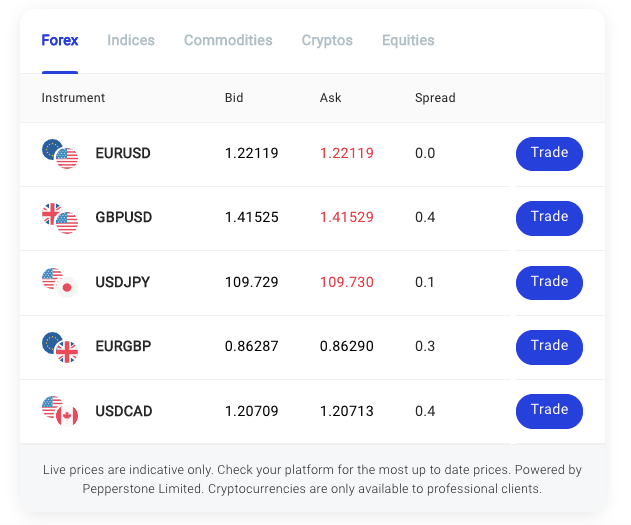
Transparent Average Spreads
Ignore the marketing hype about minimum spreads. Those ultra-low numbers often apply under perfect conditions that rarely happen.
Instead, focus on brokers like Pepperstone that provide their average spreads across key trading hours and assets.
Reliable Execution
Low spreads mean nothing if you can’t enter or exit trades at the prices you see. A good broker should offer fast and reliable trade execution, especially during high-volatility periods when the market is moving quickly.
Why it matters: Slippage (getting a worse price than expected) can cancel out the benefits of low spreads.
BlackBull impresses with speeds of less than 75 milliseconds.
Powerful Platforms And Tools
A low-spread broker should also equip you with the tools to trade effectively.
Look for platforms like MetaTrader 4, MetaTrader 5, or TradingView available at providers like FOREX.com with features like:
- Advanced charting and analysis tools.
- Automated trading support.
- Risk management tools like stop-loss and take-profit orders.
Market Data And Insights
A broker that provides real-time market data, economic calendars, and regular insights can help you make smarter trading decisions.
It’s a massive plus if these come free of charge, which you can find at firms like Fusion Markets.
No Hidden Costs
A broker with low spreads might offset them with other fees like:
- Commissions on trades (especially with raw spread accounts).
- High withdrawal fees or inactivity charges.
- Wide spreads during off-peak hours.
Strong Regulation
Choose a broker like Vantage which is regulated by reputable authorities, including the FCA and ASIC. Low spreads are only worth it if your funds are secure and the broker operates transparently.
DayTrading.com’s Regulation & Trust Rating can help here. We’ve classified a growing list of over 65 regulators depending on their reliability and safeguards, from ‘green tier’ bodies like the UK’s Financial Conduct Authority (FCA) through to ‘red tier’ bodies like the Vanuatu Financial Services Commission (VFSC).
Liquidity And Asset Variety
The more liquid the broker’s offering, the tighter the spreads you’ll see. Make sure they offer a good range of assets, especially the ones you trade most, whether that’s major currency pairs, indices, or commodities.
By focusing on these factors, you’ll enjoy low trading costs and a smooth and reliable trading experience. Remember, a low-spread broker is about the complete package, not just a single number.
What Type Of Broker Offers The Best Spreads?
Raw spreads are the tightest possible spreads – straight from the interbank market, with no markup.
Electronic Communication Network (ECN) brokers like IC Markets and Pepperstone typically provide access to these raw spreads by directly connecting you to liquidity providers.
While raw spreads often come with a commission fee per trade, they can still be cost-effective for active traders like us. Here’s why:
Ultra-Low Spreads
ECN brokers provide raw spreads as low as 0.0 pips on major pairs like GBP/USD or EUR/USD. This significantly lowers your trading costs, especially for high-frequency traders who make multiple trades daily.
Imagine:
- You trade GBP/USD with an ECN provider offering a raw spread of 0.1 pip.
- The commission is $7 per round trip (buy and sell) on a standard lot.
- The total cost is $7 + the 0.1 pip spread, much lower than a broker with a fixed spread of say 2 pips.
Direct Market Access
ECN firms connect you directly to the market, meaning you’re trading against other participants (banks, hedge funds, etc) rather than the broker.
This eliminates potential conflicts of interest, as the broker doesn’t profit from your losses.
Better Execution Speed
ECN brokers generally offer faster trade execution, which is crucial for day traders who rely on quick entries and exits.
Fewer requotes during volatile conditions means more reliable trading.
Transparency
You see actual market prices without hidden markups, giving you confidence that you’re getting a fair deal.
However, there are things to keep in mind:
- Commissions Add Up: While spreads are minimal, commission fees per trade can add up for smaller-volume traders. Ensure your strategy can cover these costs.
- Volatility Risks: Raw spreads can widen during high-volatility events. Even with an ECN account, be prepared for occasional spread spikes.
- Minimum Deposit Requirements: ECN accounts often have higher minimum deposits than standard accounts.
Bottom Line
Choosing the right broker with low spreads can make a big difference in your trading profitability, especially for active traders like day traders.
However, look beyond flashy “minimum spread” claims and focus on brokers offering transparent average spreads.
For high-frequency traders, ECN brokers with raw spreads may be worth considering. Lower costs and direct market access can outweigh commission fees.
Ultimately, the best broker for you isn’t just about spreads – it’s about the whole package: reliable execution, helpful trading tools, and a trustworthy, regulated platform.
Find the right low-spread trading platform for your needs.