





In our accompanying research, we found that 88% of the UK brokers with publicly disclosed client money banks keep customer cash at Barclays. Now, we’ll answer the next question, which most people don’t know.
Barclays isn’t just one bank. It’s actually two separate banks.
This might seem like a small detail, but it decides whether the money in your trading account shares a compensation limit with your current account. If you have a good amount in both, this could be the difference between being protected or not.
What Happened In 2018?
After the 2008 crash, the UK Parliament decided that regular people’s savings should not be kept in the same company as a bank’s trading business. The new law made every large UK bank split into two by 2019. Everyday banking moved to one legally separate company, while corporate and investment banking went to another.
This process is called ring-fencing. Now, Barclays has two separate parts:
- Barclays Bank UK PLC handles current accounts, savings, and credit cards. It also includes Tesco Bank, since Barclays bought it.
- Barclays Bank PLC is the corporate and investment bank.
They share the same brand, but they are two different companies.
Lloyds, HSBC, and NatWest also split in the same way. That’s why you might see their names twice on some broker lists.
Why Two Companies Means Two Limits
The Financial Services Compensation Scheme (FSCS) will pay up to £120,000 if a bank fails. This limit is tied to a banking license, not to a brand or logo.
Barclays Bank UK PLC and Barclays Bank PLC each have their own license. This means they each have a separate £120,000 limit.
You can check any bank using the FSCS licence checker or the Bank of England’s list of banking brands.
There are two important points to consider, and they work against each other.
Your Barclays current account is with Barclays Bank UK PLC. So, for any trading account, the key question is: which side does it belong to?
Most brokers use the corporate side. Spreadex, Hargreaves Lansdown, and AJ Bell all use Barclays Bank plc. This is a different license from your current account, so your balances are kept separate.
But not all brokers do this. Which side a broker uses is important, and the two sides are not the same. Interactive Investor says that it spreads client cash across several institutions, including Barclays Bank UK PLC, which is the retail bank, not the corporate one. This is the same license as your current account, your Barclays savings, and Tesco Bank.
Interactive Investor is the only platform we found on the retail side. This shows why the difference matters. Two brokers can both say ‘Barclays’ but mean different banks, which can have different results for the same customer.
Cash held at different brokers can add up together. Hargreaves Lansdown and AJ Bell both confirm they use Barclays Bank plc, so cash at both is under one license and one limit. XTB, IG, CMC Markets, Trading 212, Freetrade, and Pepperstone just say ‘Barclays’ without naming the company, so you can’t be sure if your money is combined or not. That’s the issue.
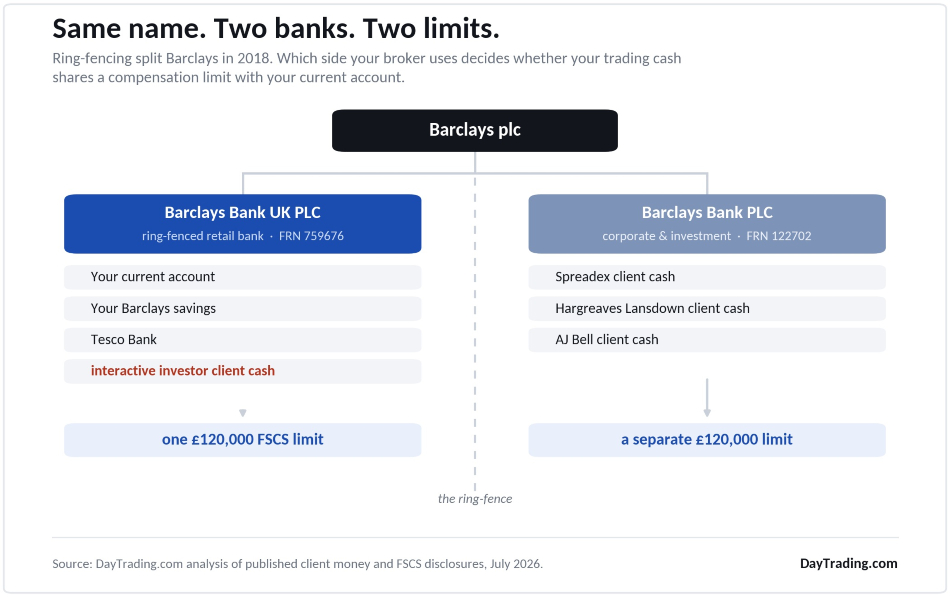
This information only helps if your broker tells you which company it uses. Most brokers do not.
It’s the same with other banks.
‘Lloyds’ could mean Lloyds Bank plc or Lloyds Bank Corporate Markets plc. ‘HSBC’ could mean HSBC Bank plc or HSBC UK Bank plc. Each pair has two licenses and two limits.
What It Costs To Be On The Wrong Side
Let’s run through an example with two people, with identical money, using different platforms.
Amara holds £70,000 in cash on AJ Bell, £60,000 in a Barclays savings account, and £40,000 with Tesco Bank.
Ben holds £70,000 in cash on Interactive Investor, and the same £60,000 Barclays and £40,000 Tesco balances.
| Scenario | Amara (AJ Bell) | Ben (Interactive Investor) |
|---|---|---|
| Broker cash at Barclays | £24,500 (35% cap) | up to £70,000 |
| Which licence | Barclays Bank plc | Barclays Bank UK PLC |
| Barclays savings | £60,000 | £60,000 |
| Tesco Bank | £40,000 | £40,000 |
| Retail licence total | £100,000 | £170,000 |
| Covered | all of it | £120,000 |
| Uncovered | £0 | £50,000 |
Amara’s broker cash is on the corporate license, so it stays separate from her savings. Her retail total is £100,000, which is under the limit. Ben’s broker cash is on the same license as his other accounts, so £50,000 is not covered by compensation.
Neither of them made a mistake. Neither could have figured this out from their platform’s website.
The Two Panels In Full
Hargreaves Lansdown and AJ Bell publish complete lists using proper legal names, plus a cap on how much can sit at each. They’re the only two firms in our sample that do.
Our other article on Barclays role serving the majority of Britain’s investment brokers explains why this difference can be confusing.
Hargreaves Lansdown
Eleven institutions, three tiers.
| Institution | Tier | Most it can hold | Owner |
|---|---|---|---|
| Barclays Bank plc | Core | 35% | Barclays |
| Bank of Scotland plc | Core | 35% | Lloyds Banking Group |
| Lloyds Bank plc | Core | 35% | Lloyds Banking Group |
| Lloyds Bank Corporate Markets plc | Core | 35% | Lloyds Banking Group |
| HSBC Bank plc | Core | 35% | HSBC |
| Santander UK plc | Secondary | 15% | Santander |
| Goldman Sachs International Bank plc | Secondary | 15% | Goldman Sachs |
| Bank of Montreal | Secondary | 15% | BMO |
| Investec Bank plc | Tertiary | 8% | Investec |
| Qatar National Bank SAQ (UK branch) | Tertiary | 8% | QNB |
| Emirates NBD PJSC (UK branch) | Tertiary | 8% | Emirates NBD |
HL says it holds client money with at least 10 of these at any one time.
AJ Bell
Fourteen institutions, two tiers.
| Institution | Tier | Most it can hold | Owner |
|---|---|---|---|
| Barclays Bank plc | Tier 1 | 35% | Barclays |
| Lloyds Bank plc | Tier 1 | 35% | Lloyds Banking Group |
| Bank of Scotland plc | Tier 1 | 35% | Lloyds Banking Group |
| Lloyds Bank Corporate Markets plc | Tier 1 | 35% | Lloyds Banking Group |
| HSBC Bank plc | Tier 1 | 35% | HSBC |
| HSBC UK Bank plc | Tier 1 | 35% | HSBC |
| Royal Bank of Scotland plc | Tier 1 | 35% | NatWest Group |
| NatWest Markets plc | Tier 1 | 35% | NatWest Group |
| Santander UK plc | Tier 1 | 35% | Santander |
| Cater Allen Limited | Tier 1 | 35% | Santander |
| Nationwide Building Society | Tier 1 | 35% | Nationwide |
| Qatar National Bank | Tier 1 | 35% | QNB |
| Bank of Montreal | Tier 1 | 35% | BMO |
| Investec Bank plc | Tier 2 | 15% | Investec |
AJ Bell says cash sits across up to 14 of these, that the split changes daily, and that all are investment grade.
Eleven Banks, Fourteen Banks, Nine Owners Each
Count the names, and you get 11 and 14. Count the companies that own them, and both come out at nine.
Hargreaves Lansdown’s list includes three separate Lloyds businesses. AJ Bell’s list has three Lloyds, two HSBC, two NatWest, and two Santander. Cater Allen has its own license, but it is a Santander subsidiary. These genuinely are separate banks. Each license gets its own £120,000, so spreading across three Lloyds companies really does triple your cover. Both firms are doing that deliberately, and customers benefit.
But protection and risk are not the same. If Lloyds Banking Group ever faced serious trouble, three licenses under one parent would not act like three separate banks. You would have three compensation claims, but still one big problem.
Hargreaves Lansdown’s top tier makes this clear. Five institutions can each hold 35% of client cash, but there are only three owners: Barclays, Lloyds, and HSBC. AJ Bell’s top tier has 13 institutions across eight owners.
Neither firm publishes a cap at the owner level, only at the license level. That’s not a criticism of either company. They are the only two open enough for anyone to notice this. It’s the next question worth asking.
The One Case Where The Rules Actually Bite
There’s a rule we left out of part one because it applies to almost nobody. It applies here.
According to the client money rules, a broker owned by a bank cannot put more than 20% of client money with its own parent or a sister company. In simple terms, a firm is not allowed to keep most of its customers’ cash inside its own banking group. This rule is there to stop a broker and its bank from failing together.
For a regular third-party bank, there is no similar cap. A broker can put all client money at Barclays and still follow the rules. That’s why Spreadex can use just one bank and still comply.
But Barclays has its own investment platform called Direct Investing, which was renamed from Smart Investor in May 2026. Its terms say client money may be held with banks, including those in the Barclays group.
This is the only case in the market where the 20% cap really matters. Barclays cannot keep most of Direct Investing’s client money inside Barclays. At least 80% must go elsewhere, so Barclays’ own customers get a diversification guarantee that others do not.
It’s a strange outcome. The rule was made to prevent conflicts of interest, but the result is that the one platform with a clear conflict is the only one with a strict limit. Everyone else can put all the money in one bank.
We did not include Direct Investing in part one, because a Barclays platform using Barclays does not show how the wider market works. Still, it’s worth mentioning because it shows that rules can set a limit when someone thinks the risk is high enough.
How To Check Where You Actually Stand
You can do this in a few minutes with these five steps:
- Make a list of every place you hold cash. This includes investing apps, online trading platforms, spread betting, and CFD accounts. For CFDs and spread bets, count your whole account balance, not just the uninvested part.
- Find the disclosure. Search for your broker’s name along with ‘client money bank FSCS.’ Start with the FSCS or safety page, then check the terms and conditions.
- Ask for the legal name, not the brand. Email support: “Which credit institutions hold my client money, giving the full legal entity name, and what is the maximum you place with any single banking license?” The wording matters. Ask for “the bank” and you’ll get “Barclays.” Ask for the legal entity, and you’ll either get an answer or a revealing silence.
- Look it up. Enter the name into the FSCS license checker to see which brands share the license. For more details, search the FCA Register and check the “trading names” section.
- Add up your balances by license. Multiply each cash balance by the published cap. If there’s no cap, use the full balance. Group the totals by license, not by broker or brand, and compare each to the £120,000 limit.
Include your own bank accounts in that sum. If your broker turns out to use Barclays Bank UK PLC rather than Barclays Bank plc, your current account joins the same pot.
What This Can’t Tell You
- Some firms publish the legal entity and others confirmed it on request. For the others, this exercise stops at step three until they answer.
- A cap is just a maximum, not an exact amount. Both HL and AJ Bell say the actual split changes every day and is usually well below the limits.
- Panels can change at any time without notice. AJ Bell’s disclosure has a date, but HL’s does not. Ring-fencing structures can change. Always check instead of assuming.
- No major UK bank has failed since the scheme started. This is a rare risk, not a prediction.
There are two banks with the same name, and most brokers won’t say which one they use. This small gap in the paperwork can hide a big risk.
Read more on the topic: