





If you ask most people where their trading app keeps their money, they’ll probably say, “in the app.” That’s not the case. Trading apps aren’t banks, so the rules don’t let them hold your cash directly. Instead, they must keep it in a real bank account, separate from the company’s own funds.
So which bank?
We did some digging. We looked at 36 major trading apps, brokers, and investment platforms that people in the UK really use. Of the 16 that publish the names of their client money banks, 14 of them keep customer money at Barclays. This is more important than it might seem, and we’ll explain why.
First, The Context
When you put £5,000 into a trading account, it doesn’t sit in a vault with your name on it. Your broker combines your money with other customers’ cash and deposits it all into a bank account called a client money account. This account is separate from the broker’s own money, so if the broker goes out of business, your cash isn’t taken by its creditors.
That’s the protection everyone talks about, and it works well.
But this leads to another question that most people don’t consider. Now that your money is in a bank, what happens if that bank fails?
If that happens, the Financial Services Compensation Scheme (FSCS) covers you up to £120,000 if a bank fails. But here’s the catch: the £120,000 limit applies to each bank, not each broker. All the money you have with the same bank counts toward that single limit.
That sounds fine, until you realize how many brokers use the same bank.
What We Found
We checked which banks 36 prominent UK brokers use for their client money accounts. 20 weren’t upfront about those banks, but of the 16 that were, here’s what we found:
| Broker or platform | Banks it uses | Barclays? |
|---|---|---|
| ActivTrades | Barclays, Lloyds, RBS, Citibank | Yes |
| CMC Markets | Barclays, NatWest, Lloyds | Yes |
| eToro | J.P. Morgan, Deutsche Bank, Coutts | No |
| Fortrade | Barclays | Yes |
| FXOpen | Barclays | Yes |
| FxPro | Barclays, RBS, Emirates NDB | Yes |
| IG | Barclays, Lloyds | Yes |
| Saxo | Citibank | No |
| Spreadex | Barclays | Yes |
| Vantage | Barclays, NatWest | Yes |
| XTB | Barclays, J.P. Morgan | Yes |
| Trading 212 | Barclays, NatWest, J.P. Morgan | Yes |
| Admirals | Barclays | Yes |
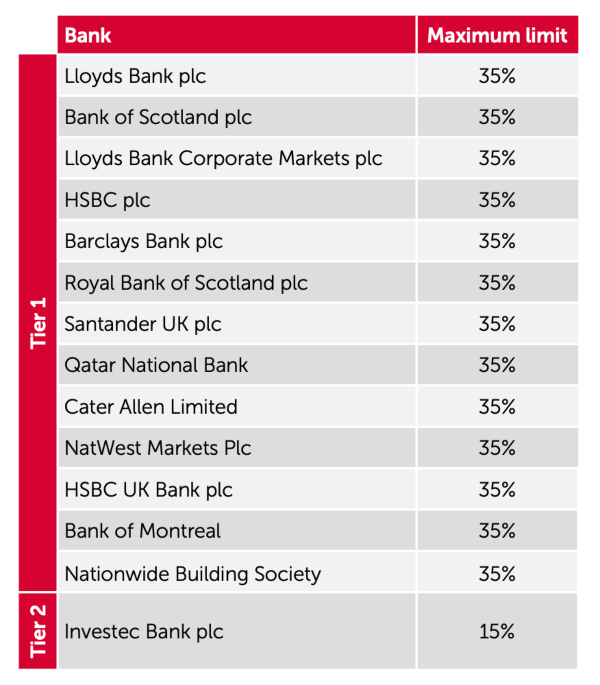
| Hargreaves Lansdown | Barclays, Bank of Scotland, Lloyds, Lloyds Corporate Markets, HSBC, Santander, Goldman Sachs, Bank of Montreal, Investec, Qatar National Bank, Emirates NBD | Yes |
| AJ Bell | Barclays, Lloyds, Bank of Scotland, Lloyds Corporate Markets, HSBC, HSBC UK, Royal Bank of Scotland, NatWest Markets, Santander, Cater Allen, Nationwide, Qatar National Bank, Bank of Montreal, Investec | Yes |
| Freetrade | Barclays, Lloyds, NatWest, J.P. Morgan | Yes |
Every bank mentioned here holds client money, meaning real customer cash. None of these are liquidity providers, which brokers sometimes call “banks” but which never actually hold your balance. We’ll explain the difference below.
How We Chose These Brokers
We started with the platforms most popular with UK retail traders and investors, then included only those where we could find out which banks hold client money — using the company’s own disclosures, terms of business, or information they gave us. If a firm didn’t clearly name any banks and we had no other information, we left it out.
So, this list covers the more transparent part of the market, not the whole market. The real share of Barclays across all UK brokers could be higher or lower.
14 out of 16 use Barclays, or a staggering 88%.
Why They All Pick The Same Bank
There’s nothing suspicious happening here. The market is simply small.
Managing a pooled client money account is a specialist task. The bank must sign specific legal documents, check the account daily, and be willing to hold hundreds of millions of pounds for thousands of people. In the UK, about five banks do this on a large scale: Barclays, Lloyds, HSBC, NatWest, and Santander.
If you look at the table above, you’ll see those five banks appear frequently. The others — Investec, Goldman Sachs, Bank of Montreal, Qatar National Bank, Emirates NBD — only show up as minor names.
Careful: ‘Tier-1 Banks’ Usually Means Something Else
Broker websites use this phrase a lot, but it rarely means where your cash is kept. Most of the time, it refers to liquidity providers — the institutions that give brokers their pricing and handle trade execution. That money never goes into your account balance.
Vantage is a clean example. Its institutional page names seven tier-1 banks it has partnered with for liquidity: J.P. Morgan, HSBC, RBS, Credit Suisse, Citibank, Nomura and Goldman Sachs. None of them holds client money. The bank that does is named in the footer of the same page — NatWest. (The list is also dated: Credit Suisse stopped existing as an independent bank in 2023.)
When you’re checking, ignore terms like ‘tier 1,’ ‘liquidity,’ and ‘partners.’ Instead, look for words like client money, segregated, or CASS. Those are the terms that show where your cash is held.
Even the regulator admits there aren’t many choices. Its rulebook says the system “necessarily involves the use of a limited number of eligible credit institutions.” In other words, there are only a few options, and that’s understood.
How Much Can Sit At Any One Bank
A list of banks only tells part of the story. What really matters is how much of your money can be kept at each bank — and only Hargreaves Lansdown and AJ Bell provide that information.
Both cap Barclays at 35% of client cash.
So, if you have £100,000 in cash at Hargreaves Lansdown, up to £35,000 of it could be at Barclays. To hit the £120,000 FSCS limit with just one platform, you’d need about £343,000 in cash, which is more than most people have.
But if you split that £343,000 between both platforms, you still reach the limit — even if you chose two different companies on purpose.
| Where your money sits | Amount | How much lands at Barclays |
|---|---|---|
| Hargreaves Lansdown cash | £150,000 | £52,500 |
| AJ Bell cash | £150,000 | £52,500 |
| Spreadex account | £40,000 | £40,000 |
| Total | £340,000 | £145,000 |
| Covered by FSCS | £120,000 |
|
| Not covered | £25,000 |
Let’s say you use three different brokers. Each one is safely within its own £85,000 protection limit. But if Barclays failed, £25,000 of your money wouldn’t be covered.
Take Spreadex as an example. It puts all client money at Barclays, since it only uses one bank. The broker states this clearly, which is more than most companies do.
None of the other companies in the table publish any cap. If your broker isn’t HL or AJ Bell, you can’t work out this calculation. You have to assume the worst.
The Uncomfortable Truth About ‘Fully Regulated’
This is something brokers won’t mention in their marketing. The rules do set one hard limit on concentration. If a bank owns a broker, it can’t put more than 20% of client money with its own parent or sister company. That rule exists to stop a broker and its own bank collapsing together.
For all other cases — like a regular third-party bank such as Barclays — there’s no set limit. A broker can put all client money in one bank and still follow the rules, as long as it reviews the decision from time to time and can show it considered the risks.
This means Spreadex, which keeps all its money at Barclays, is fully compliant. AJ Bell, which uses 14 banks, is also compliant. The rules don’t distinguish between them.
That’s the trade-off nobody talks about: being ‘regulated by the FCA’ says a lot about honesty and process, but almost nothing about how your money is spread out. If you want to know if your cash is divided between banks, only clear disclosure will tell you—not compliance.
For scale: around 3,500 UK firms hold roughly £195bn of client money between them. No public data shows how that splits across banks. Nobody outside the regulator knows.
Barclays’ Own Record
It’s worth looking at, considering how much of the market relies on one bank.
In 2014 the FCA fined Barclays £37.7m for failing to properly protect £16.5bn of client assets — at the time the biggest penalty it had ever issued for that kind of failure. It followed a smaller fine in 2011 for something similar.
In July 2025, the FCA fined Barclays again, £42m this time, over a client money account it opened for a wealth firm called WealthTek. A quick check of the public register would have shown WealthTek wasn’t allowed to hold client money. £34m went in. Barclays voluntarily paid £6.3m to WealthTek’s customers.
None of this means Barclays is a bad place to keep client money. Its balance sheet is among the strongest in Britain, and no major UK bank has failed in recent memory. Still, when one bank holds so much of the market’s money, it’s fair to look at its track record with client accounts. This is a fair thing to know.
What Would Fix This
- Publish the limits. Only two out of the firms above say how much of your money can be kept with any one bank. A list of banks without these limits doesn’t tell you much.
- State which bank is used, in writing, on a public page. 20 out of the 36 firms we looked at don’t do this. That’s a choice, not a mistake.
- Show this information in the app. Trading 212 customers say they can see their live bank split on screen. If one broker can do it, others can too.
There’s one more step that most people miss: knowing the brand name isn’t the same as knowing the actual bank.
“Barclays” refers to two different companies, each with its own compensation limit. Which one your broker uses makes a big difference.
What This Research Can’t Tell You
- This covers 36 firms, not the whole market, and the sample leans toward companies that disclose information. Barclays’ own platform, Direct Investing (renamed from Smart Investor in May 2026), is excluded, since a Barclays product using Barclays doesn’t show how other firms act.
- A maximum is not the same as the actual amount. HL and AJ Bell both point out that the real split changes every day and is usually well below the caps. We’ve shown the worst-case scenario.
- Naming a bank doesn’t tell you how much money is actually there. For example, IG and CMC Markets mention Barclays but don’t publish any percentages.
- Bank lists can change without notice. AJ Bell’s list is dated April 2026, while Hargreaves Lansdown’s list has no date.
- Some entries rely on information we haven’t confirmed directly with the company. We stuck to public information as that’s the test and position many retail investors will be in – what they can easily find researching online.
- This article only covers cash. Your shares are kept under a different arrangement, with different risks.
- The FSCS limit exists because even small risks are real. But it doesn’t match up with how brokers actually hold your money.
Read more on the topic: