





From 1 December 2025, the Financial Services Compensation Scheme (FSCS) increased its protection for money in failed banks from £85,000 to £120,000. This change got a lot of attention. The FSCS promoted it publicly, and banks updated the protection badges in their apps. Since then, I keep hearing the same thing, even from regular traders: “Good news, my trading pot is covered up to £120k now.”
That’s probably not the case.
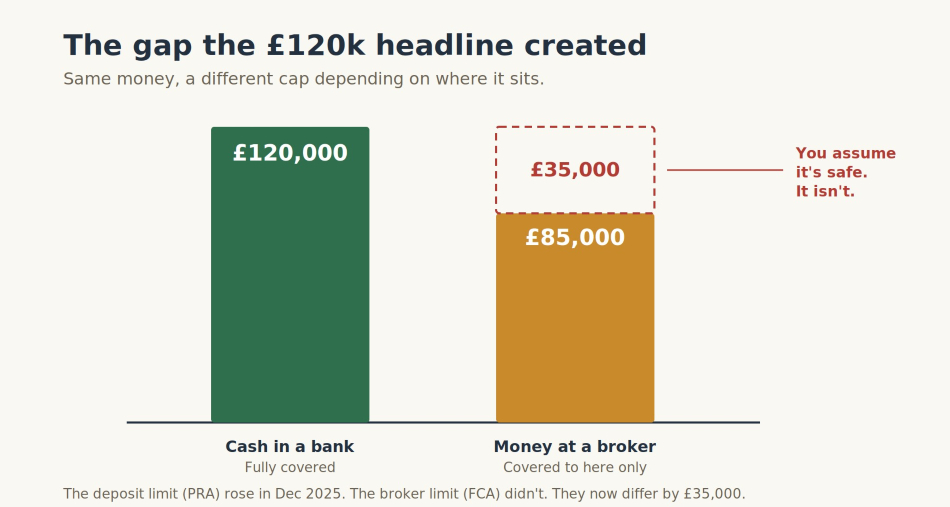
The extra £35,000 only applies to one area, and it’s not your trading account. The FSCS makes it clear: only the savings and deposits limit increased. Investments, pensions, insurance, and everything else stayed the same.
If you keep cash or investments with a UK broker, the limit is still £85,000. That hasn’t changed since April 2019.
Our Double Banking Trap article explained what happens when your savings and your broker’s client money are held at the same bank. This article looks at the other side: what it means now that the two limits are different, and what the £120,000 headline doesn’t actually cover.
What Actually Changed
Two separate regulators set these limits. The Prudential Regulation Authority (PRA), part of the Bank of England, decides the rules for money in banks. The Financial Conduct Authority (FCA) sets the rules for money with brokers and investment firms.
The PRA must review its limit at least every five years. In March 2025, it suggested raising it to £110,000, but by November, the final rules set it at £120,000. The FCA did not make a similar change.
| Money | Before | Now |
|---|---|---|
| in a bank, building society or credit union | £85,000 | £120,000 |
| A short-term windfall, such as a house sale (six months only) | £1m | £1.4m |
| Money and investments with a broker or platform | £85,000 | £85,000 |
| Pensions | £85,000 | £85,000 |
The new limit only applies if a firm fails on or after 1 December 2025. If a failure happened before that, the old limit still applies.
There’s one more thing to keep in mind. Firms had until 31 May 2026 to update their leaflets, websites, and branch signs. That deadline has passed. If you see a bank document still showing £85,000 for savings, it’s just out of date — the £120,000 limit now applies.
Trap 1: Your Broker Account Never Got The Rise
The £85,000 broker limit was set in April 2019, when the FCA raised it from £50,000. It hasn’t changed since then. In July 2026, the FCA said it has no plans to raise the limit. If the limit had kept up with inflation, it would be about £112,000 today.
The savings limit went up because of inflation. The PRA said £85,000 doesn’t have the same value it did in 2017. The broker investment limit was set in 2019 and has also been affected by rising prices. Since different groups review the limits at different times, the two amounts have drifted apart.
Here’s why this difference matters for retail investors:
- If you split £240,000 across two banks with separate licenses, all of it is covered — £120,000 at each.
- If you split £170,000 across two brokers as invested funds, all of it is covered — £85,000 at each.
It’s the same idea, but the numbers are very different. Many people assume the £120,000 limit applies everywhere, but this can leave a £35,000 gap. This is the most common mistake I see.
Trap 2: The £85,000 Cap Has Already Let UK Clients Down
Most reports about the December increase missed this point, but it’s the one you should remember.
WealthTek was a UK wealth manager. It also traded as Vertem Asset Management and Malloch Melville. In April 2023, the FCA shut it down after finding it had been holding client money and investments without permission. Administrators from BDO were appointed.
When the High Court approved the plan for returning what was left, the judgment set out the scale of it. The figures below come from that hearing (full judgment here).
| WealthTek | Figure |
|---|---|
| Clients affected | About 1,320 |
| Ordinary private clients | 98% of them |
| Average age | 68 |
| Investments held | About £148m |
| Missing from those investments | About £70.6m |
| Cash held | About £2.7m |
| Missing from that cash | About £10m |
Then the important bit. The FSCS worked out that around one client in six was short by more than £85,000. Another one in twenty-five was short by somewhere between £62,000 and £85,000.
Altogether, about one in five clients went over the cap and lost money permanently. The judge said some would be out of pocket “significantly so”.
Why The Cap Runs Out Faster Than You’d Expect
Another detail often trips people up, and it’s important to explain it clearly. When a broker fails, someone has to review the records, figure out who owns what, and return the assets. This process costs money, and the fees are taken from the client money and investments.
The FSCS does help cover these costs, but it pays for both the fees and your missing money together, up to a total of £85,000.
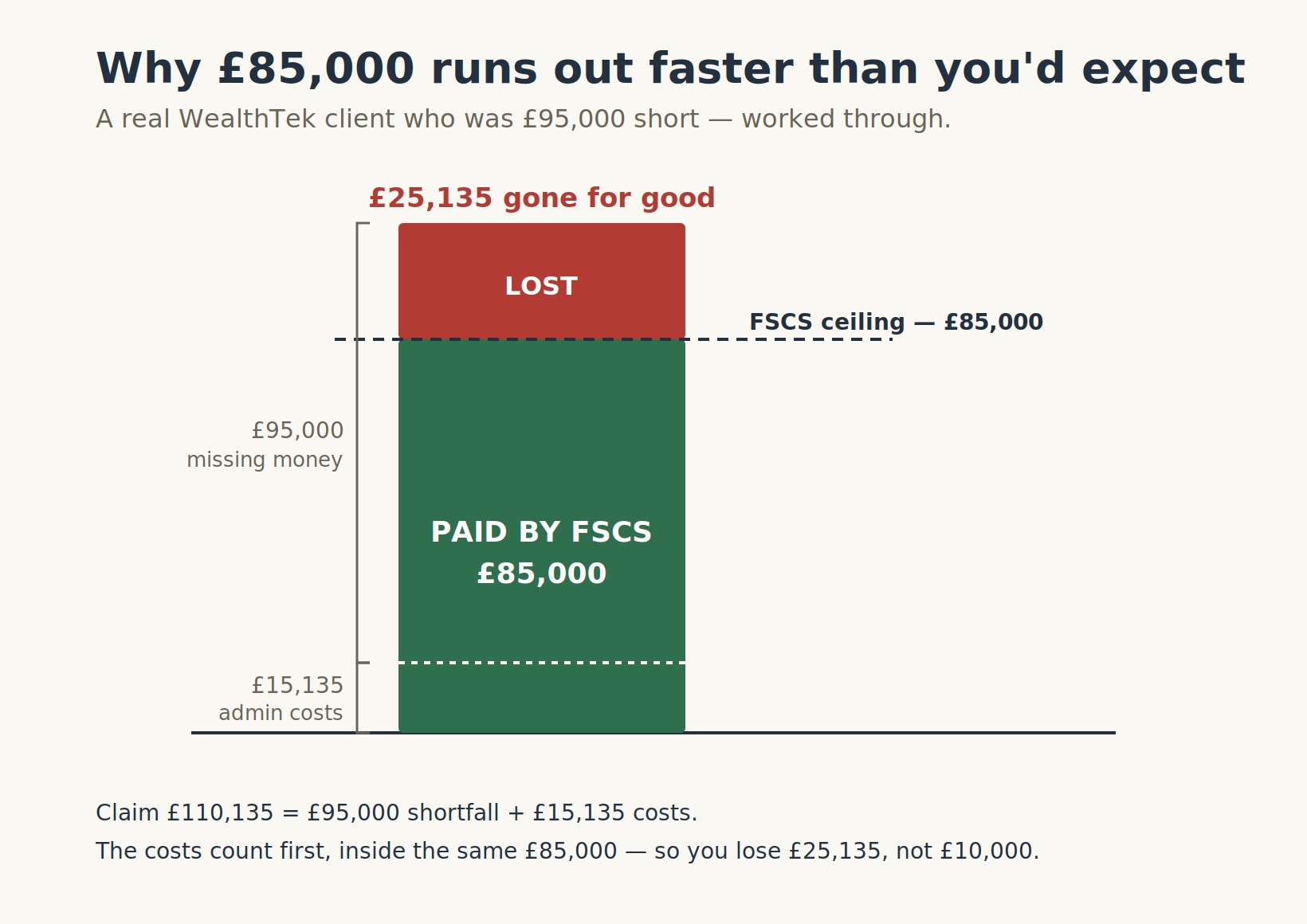
At WealthTek, the court set each client’s share of the costs at £15,135. So imagine you were a WealthTek client who was £95,000 short:
- Your share of the costs: £15,135
- Your missing money: £95,000
- Total claim: £110,135
- FSCS pays: £85,000
- You are left short by: £25,135
You weren’t just £10,000 over the limit. You were £25,000 over, because the costs were included in the same £85,000 cap.
The same thing happened at Beaufort Securities in 2018. Costs were capped at £10,000 per account for investments, and at a tenth of the balance for cash, with the FSCS absorbing them for eligible private clients.
None of this changed on 1 December 2025. The limit that came under strain in the WealthTek case is the one that stayed where it was.
Trap 3: “FSCS Protected” Doesn’t Tell You Which Scheme
Here’s something we often check when reviewing a broker’s safety, and it’s the step traders most often miss. Which company is actually named on your statements, and where does it keep your money?
A UK brand name doesn’t always mean it’s a UK company. And even if it is, the company might not hold your assets directly.
- Interactive Brokers — UK clients sign up with Interactive Brokers (U.K.) Limited, which is FCA-authorised. But IBKR’s own guide says your main trading account is “carried” by Interactive Brokers LLC in the US, which looks after the assets. Its standard wording is that products are covered by the UK scheme “in limited circumstances”. Most UK clients are largely covered by the American scheme instead, which protects up to $500,000, with a $250,000 sub-limit on cash. On the headline numbers, that is more cover than the UK scheme offers, not less. It just isn’t the scheme on the badge you thought you were relying on.
- Trading 212 — UK clients get the FSCS. Clients signed up to the group’s Cyprus company get the Cypriot scheme, which pays a maximum of €20,000. Clients on the German company get a German scheme, also capped at €20,000.
Interactive Brokers Ireland has served EU customers since August 2024. The Irish scheme covers 90% of your loss, up to €20,000. That’s less than £20,000 at recent exchange rates. If you’re a British trader who moved abroad, or you were signed up to the wrong company, your cover didn’t just drop from £120,000 to £85,000 — it dropped much further.
| Who your account is really with | Maximum you’d get back |
|---|---|
| A UK broker regulated by the FCA | £85,000 |
| Interactive Brokers in the US | $500,000 ($250,000 of it cash) |
| Interactive Brokers Ireland | 90% of the loss, capped at €20,000 |
| A Cyprus or Germany-based firm | €20,000 |
| An offshore firm (Seychelles, St Vincent and similar) | Nothing |
You can check this in a few minutes. Open your latest statement, find the full company name, and enter its firm reference number into the FCA Register to make sure it’s authorized for what you need.
Trap 4: Switching On Interest Can Switch Off The Protection
This issue most safety guides haven’t covered yet, and it’s directly linked to the December change. Trading 212 is the clearest published example, because the company spells the arrangement out in its own help pages.
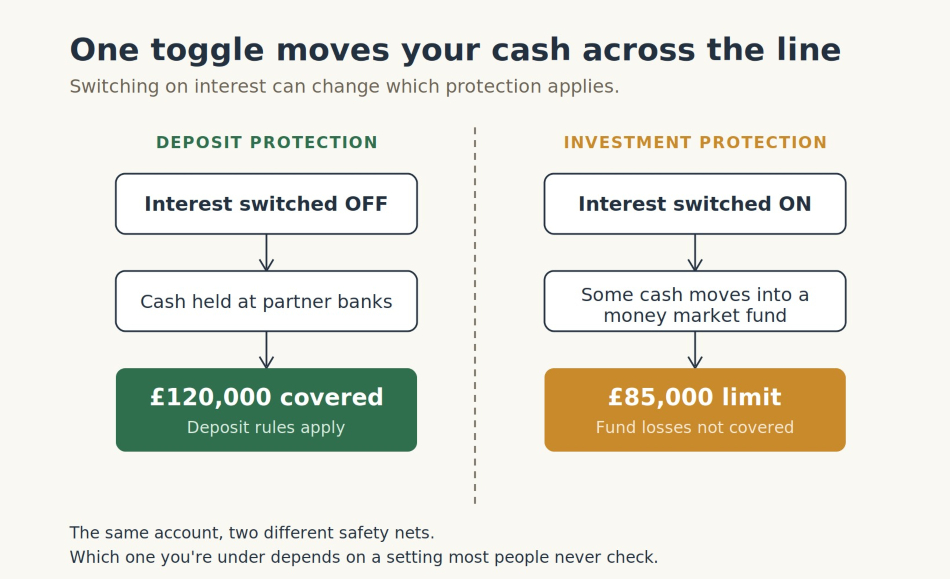
Leave interest on your spare cash switched off, and that cash sits in bank accounts. It gets the £120,000 bank protection. Switch interest on, and some of your cash gets moved into a money market fund. These are very low-risk funds that lend money short-term to banks and governments. Trading 212’s own words are that money placed in one of these funds is treated as an investment, not as money held with a bank.
That single detail shifts your cash from one side of the protection line to the other, which is the main point of this article. Once it’s an investment, it falls under the £85,000 broker limit rather than the £120,000 bank limit. And the FSCS never pays out for an investment simply losing value. So if the fund ever dipped below par, that’s a loss you’d carry yourself.
In reality, when these funds have lost value, the drop has only been a few percent, not a total loss. There’s no need to panic, but you should know which type of protection your money has before making a choice.
There’s another important detail in their disclosure, which connects to our earlier article about whether UK brokerages are transparent about the client banks they use. Trading 212 lists Barclays, NatWest, and J.P. Morgan Chase as banks it uses, and states that the £120,000 limit covers everything you hold at that bank — whether it’s through itself, another provider, or your own account. If you bank with Barclays and your broker also keeps cash there, you only get one lot of protection, not two.
Trap 5: Deposit Protection Only Covers Deposits
Three main gaps especially affect traders.
- Crypto isn’t covered at all. Not by the FSCS, not by the Financial Ombudsman Service, at any limit. When Revolut got its full UK banking license, its crypto arm was deliberately kept in a separate company outside the protected perimeter. That’s a normal structure, not a red flag. It just means the £120,000 figure in the app has nothing to do with your coins.
- E-money accounts are not the same as bank accounts. Revolut got full UK banking authorization on 11 March 2026 and created Revolut Bank UK Ltd, which offers up to £120,000 in protection. Its millions of UK customers are being moved over in stages, a process expected to take a few months. Revolut also said that people signing up after 11 March 2026 might still start with the old e-money company and be moved later. The protection applies to the bank company, not just the Revolut brand. Until your account is moved, your money is kept separate at a bank but isn’t FSCS-protected. The same rule applies to any e-money provider, so check in your app which company holds your account instead of assuming.
- Losing money on a trade is never covered under either limit. The FSCS steps in when a firm fails, and money or assets are missing. A position that goes against you isn’t a claim and never will be.
Trap 6: The Two Limits Pay Out At Very Different Speeds
The £120,000 protection has an extra benefit that the £85,000 limit doesn’t: it’s automatic. If a UK bank fails, the FSCS pays most people back without a claim form, usually within seven working days, and is required to do it within 20. More awkward cases, such as a recent house sale, can take up to three months.
If a broker fails, the process is very different. Nothing happens automatically. You have to wait while an administrator reviews the records, figures out who owns what, creates a plan to return assets, and sometimes gets that plan approved by the High Court.
WealthTek failed in April 2023. Administrators were still returning assets and arguing over costs in court into 2026. Beaufort’s clients were moved to new brokers in batches from September 2018 into 2019.
If you trade with leverage, these delays can cause their own problems. You can’t manage open positions, adjust hedges, or deal with margin calls elsewhere while your client money account is being sorted out.
How To Stay Safe
- Make sure you use the correct limit for each situation: £120,000 per banking license for cash in a bank, and £85,000 per firm for anything with a broker. The most common mistake I see is using the higher number for brokers.
- Check who you’re actually dealing with. Look at your latest statement, find the full company name, and check its firm reference number on the FCA Register. The FSCS also has a checker for bank and savings protection. Do this for every account, even ones you opened years ago and might have forgotten.
- Ask your broker where they keep client money. Some brokers publish this in their client agreement or annual report. If yours doesn’t, email support and ask. In my experience, brokers who answer quickly and clearly usually run a tighter operation overall.
- Decide about earning interest on purpose. Choosing a better rate for idle cash in exchange for less protection can be reasonable, but you shouldn’t make that trade by accident.
- Keep your trading float small. Cash left with a broker doesn’t earn anything and is only protected up to the lower limit. Money you’re not using should be somewhere with £120,000 of protection.
- Learn the windfall rules before you need them. The limit is £1.4m for six months, but only for certain events like a house sale, inheritance, or redundancy. The FSCS won’t confirm if you qualify until after a firm has failed.
- Use joint accounts and NS&I for extra savings. Each person on a joint account gets the full £120,000, so a couple can have £240,000 protected at one bank. The Treasury backs NS&I and has no cap.
The Bottom Line
The £120,000 limit gives savers more protection than before, but it was never meant for traders.
If you take one thing away, make this your takeaway: In the last three financial years, at the time of this article’s initial publication, total savings compensation was £10.1m, mostly from small credit union failures. In the same period, the £85,000 broker limit left about one in five WealthTek clients permanently out of pocket.
Read more on the topic: