





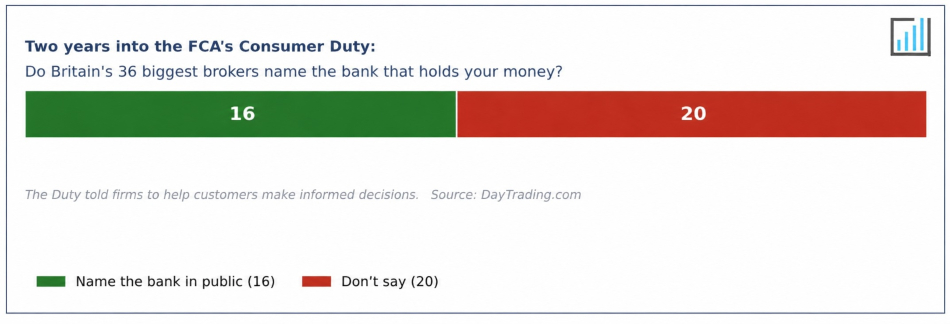
In July 2023, the Financial Conduct Authority (FCA) told firms it oversees that provide retail services to give customers the information they need to make good decisions. Three years later, we checked if 36 of the UK’s most prominent brokerages make clear the one thing that decides if your cash is safe: the bank that holds it. 56% don’t.
The Consumer Duty was described as the biggest change in UK financial regulation in a generation. Its promise was simple: firms must help customers make good decisions, not just hide the facts in a PDF and call it disclosure. One of the four outcomes, consumer understanding, says a firm has to give you what you need, when you need it, so you can decide for yourself.
So we made a fair test of whether that promise means anything: Before you deposit money with an online broker, can you find out which bank actually holds it?
Why This Matters
As a retail investor buying stocks, funds, precious metals or investing in crypto, your cash doesn’t stay with your trading broker. Brokers are not banks. The rules require them to place client money in a separate account at a real bank, kept apart from the firm’s own funds. This is to help prevent the company from misusing client funds and to make it easier to return those funds to the respective retail clients in an insolvency situation.
Which underlying bank your brokerage uses ultimately helps to decide whether your money is truly protected or quietly added to savings you already have there.
This is because in case of a bank failing, the Financial Services Compensation Scheme (FSCS) protection up to £120,000 applies at the banking license level, meaning exposure across personal accounts and pooled brokerage accounts can be aggregated. Let’s say:
- A retail investor has £100,000 in their savings account at Barclays, £50,000 in a trading account with Trading 212, and £50,000 in a trading account with Freetrade.
- Barclays has a UK banking license, and both brokers are licensed by the FCA. The individual feels safe because the bank balance is below the £120,000 banking limit, and each trading account balance is kept well below the £85,000 broker account limit, which covers broker insolvency and misappropriation.
- However, both of these brokers use Barclays for the segregated client money accounts. If Barclays fails, and there is a significant shortfall, the individual has a total claim of £200,000. Although they think their £200,000 in total would come back to them, it might not.
So we ran a test. We checked the public disclosures of 36 prominent FCA-authorised brokers – their websites, terms of business, and pages explaining their client-money procedures. 16 name the bank. 20 don’t. That’s over half of brokers still keeping retail investors in the dark about important information concerning their money.
What The Duty Asks For – And What Top Brokers Actually Give
The consumer-understanding outcome isn’t about publishing more words. The FCA made that plain in its March 2026 review: a ticked disclosure box isn’t the test – whether the customer can actually act on the information is.
Brokers That Do Clearly Disclose
On the question of where your money sits, 16 of the FCA-regulated brokers we looked at are upfront about which banks they use for client money accounts:
| Broker | FCA Entity | Bank(s) Holding Client Money | Verify Information |
|---|---|---|---|
| ActivTrades | ActivTrades Plc | Barclays, Lloyds, RBS, Citibank | Protection of Funds |
| CMC Markets | CMC Markets UK Plc | Barclays, NatWest, Lloyds | Regulations: your money |
| eToro | eToro (UK) Ltd | J.P. Morgan, Deutsche Bank, Coutts | Investor Protection |
| Fortrade | Fortrade Ltd | Barclays | Wire Transfers |
| FXOpen | FXOpen UK Ltd | Barclays | ECN Trading in the UK |
| FxPro | FxPro UK Ltd | Barclays, RBS, Emirates NDB | About |
| IG | IG Markets Ltd / IG Index Ltd | Barclays, Lloyds | What we do with your money |
| Saxo | Saxo Capital Markets UK Ltd | Citibank | Where are my funds held? |
| Spreadex | Spreadex Ltd | Barclays | Who is Spreadex Regulated By? |
| Vantage | Vantage Global Prime LLP | Barclays, NatWest | Corporate Governance |
| XTB | XTB Ltd | Barclays, J.P. Morgan | XTB Limited Terms of Business |
| Trading 212 | Trading 212 UK Ltd | Barclays, NatWest, J.P. Morgan | Protecting your assets |
| Admirals | Admiral Markets UK Ltd | Barclays | Our Partners |
| Hargreaves Lansdown | Hargreaves Lansdown Asset Mgmt Ltd | Barclays, Bank of Scotland, Lloyds, Lloyds Corporate Markets, HSBC, Santander, Goldman Sachs, Bank of Montreal, Investec, Qatar National Bank, Emirates NBD | How safe is your investment? |
| AJ Bell | AJ Bell Securities Ltd | Barclays, Lloyds, Bank of Scotland, Lloyds Corporate Markets, HSBC, HSBC UK, Royal Bank of Scotland, NatWest Markets, Santander, Cater Allen, Nationwide, Qatar National Bank, Bank of Montreal, Investec | FSCS FAQs |
| Freetrade | Freetrade Ltd | Barclays, Lloyds, NatWest, J.P. Morgan | How Freetrade complies with FCA rules to protect your money |
Brokers That Do Not Clearly Disclose
However, 20 of the FCA-regulated brokers we looked at give you nothing to act on. They fall back on phrases built to reassure without really informing:
| Broker | FCA Entity | What You Get Instead |
|---|---|---|
| Axi | Axi Financial Services (UK) Limited | No banks clearly named |
| City Index | StoneX Financial Ltd | ”Approved top-tier banks” |
| Eightcap | Eightcap Group Ltd | No banks clearly named |
| FOREX.com | GAIN Capital UK Ltd | ”Approved top-tier banks” |
| FXCM | Stratos Markets Ltd | No banks clearly named |
| FXTM | Exinity UK Ltd | No banks clearly named |
| HYCM | HYCM Capital Markets (UK) Ltd | ”Tier-1 bank accounts” |
| Interactive Brokers | Interactive Brokers (U.K.) Ltd | No banks clearly named |
| Pepperstone | Pepperstone Ltd | ”Top-tier banks” |
| Plus500 | Plus500UK Ltd | No banks clearly named |
| Swissquote | Swissquote Ltd (UK) | ”Omnibus accounts” |
| Trade Nation | Trade Nation Financial UK Ltd | No banks clearly named |
| IronFX | Notesco UK Ltd | ”Highly rated institutions” |
| Capital.com | Capital Com (UK) Ltd | ”Top-tier UK banks” |
| OANDA | OANDA Europe Ltd | Bank identities “kept confidential” |
| Tickmill | Tickmill UK Ltd | ”Top-tier institutions” |
| ThinkMarkets | TF Global Markets (UK) Ltd | No banks clearly named |
| Markets.com | Finalto Trading Ltd | No banks clearly named |
| Interactive Investor | Interactive Investor Services Ltd | ”Separate nominees” |
| Schwab | Charles Schwab U.K. Ltd | Holds no UK client money (see below) |
Notice who’s on this list. It isn’t fly-by-night outfits. Interactive Brokers is one of the largest brokers in the world. Plus500 is a FTSE-listed company. Swissquote is a listed bank. Size and reputation don’t predict whether a firm will tell you where your money is – which is the opposite of what a customer would reasonably assume.
Why This Is A Fact The Duty Is About
Let’s bring this to life with another example. Say you deposit £5,000. If the broker fails, the segregated account keeps your money away from its creditors – that much works.
But your cash now sits in a bank, and banks can fail too. The Financial Services Compensation Scheme (FSCS) covers you up to £120,000 per person, per banking licence. This was raised from £85,000 on 1 December 2025. The catch is in the phrase “per banking licence.” If your personal savings and your broker’s client money are at the same bank, you do not get two £120,000 protections. You get one, shared. Anything above that is exposed.
To manage that, you need to know the bank. There is a reason this matters more than it seems. Of the 16 brokers that do clearly disclose, 14 use Barclays, either on its own or amongst other banks. One bank supports a sizeable portion of the UK retail market. If you bank with Barclays and your broker uses Barclays, your real exposure to a single failure is much larger than your balances suggest. For the 20 silent brokers, you cannot check this at all. This, in our view, is exactly the “informed decision” the Duty says you should have, and exactly the one you don’t get.
The Twist: Some ‘UK’ Money Isn’t In The UK
One name on the silent list is there for a different reason. Charles Schwab U.K. does not hold any UK client money. If you open a UK account, your cash is held and managed by its US affiliate, Charles Schwab & Co., under US investor-protection rules instead of UK FSCS deposit protection. SIPC covers up to $500,000 (including a $250,000 cash cap), plus Schwab’s own “excess SIPC” insurance: different limits, different currency, different regime.
This is in the terms if you read them, but nothing about “FCA-regulated” makes it clear that your money has left the country. If you have a Schwab UK account, check the jurisdiction before assuming British protection applies.
Let’s Be Clear: This Is Not A Proven Breach
It would be easy to say these 20 firms are breaking the Duty. They aren’t, not on the face of it.
The client-money rules (CASS 7) and conduct rules (COBS 6.1.7R) make a firm tell you it holds your money as client money and how that’s safeguarded. They don’t generally force it to publish the specific bank for a standard pooled account. So silence isn’t a clear rule break, and the FCA hasn’t expressly said otherwise about any firm here.
We are highlighting the gap between the Duty’s stated aim and what the market actually does. The Duty was meant to move firms beyond box-ticking and toward outcomes customers can use. Where your money sits is about as basic an outcome as it gets in our view, and three years in, at least 20 major brokers still do not publicly provide this information. Whether the regulator thinks that is good enough is now up to them.
The evidence that this is a choice, not a limitation, is in the same dataset. Trading 212 shows customers a live bank split on screen. Hargreaves Lansdown and AJ Bell publish their full list of banks and limit any single one to 35% of client cash. IG, CMC, and XTB name their banks clearly. If they can do it, the other 20 can too.
What To Do While The Duty Catches Up
Retail investors don’t have to wait for the FCA or brokerages. Before they deposit:
- Search the site for the bank. Check the terms and any “client money” or “CASS” page. Ignore “tier 1,” “liquidity,” and “partners.” Those usually refer to trade-execution banks, not where your cash is held. Look for client money, segregated, or CASS.
- No name? Ask in writing. One line: “Which bank(s) hold client money for UK retail accounts?” Keep the reply.
- Map the overlap with your own bank. Note where your savings sit, including brands that share a licence. If your broker’s bank matches yours, that’s one £120,000 limit across both.
- Consider spreading anything over the limit. If your cash plus personal deposits at the same bank are above £120,000, you may want to think about moving the extra amount to another broker with a different bank, another personal bank, or into invested positions, which have separate £85,000 investment cover. It could be sensible to consult a financial advisor on this.
- Confirm the country. As Schwab shows, a UK-facing broker may keep your money in another country. Check the jurisdiction, not just the logo.
The Fix The Duty Already Points To
Name the bank. Publish the cap. Several of Britain’s biggest platforms already do both, and it has not cost them customers. The Consumer Duty gave the FCA the language to require this: informed decisions, good outcomes, and information customers can use. Whether the FCA applies that language to one of the key facts traders need most is the test for the coming two years.
Methodology Notes
- We looked at 36 FCA-authorised brokers that serve UK retail traders and read each one’s public material, including their website, terms of business, and client-money or CASS pages, in July 2026.
- A broker counts as disclosing only if it names the actual bank or banks; broad phrases like “top-tier institutions” or “approved banks” do not count.
- We did not ring their support teams because the test is what a customer can easily find before depositing, and without having to jump through hoops or get stuck in phone queues or with frustrating AI chatbots. This is because, as part of our research, we spent many frustrating hours and days waiting for replies or getting vague responses from brokers’ support teams, so the information had to already be publicly available and easy to find for a prospective or existing client.
- The full broker-by-broker data is available on request.
- This is for educational purposes only. It is not legal or financial advice.
Read more on this topic: