




Forex index trading allows investors to speculate holistically on the value of a currency rather than trading a single currency pair. This guide will compare trading currency pairs vs forex indices, popular strategies, and how to find the best brokers for currency index trading.
Currency Index Brokers
These are the 6 best brokers for trading currency indices and the indices they offer:
-
- Demo account
- Platforms: MT4, MT5, TradingCentral
- Min. deposit: $5
-
- Demo account
- Regulator: ASIC, CySEC, FSCA, BVI FSC
- Platforms: Web Platform, MT4, MT5, TradingCentral
-
- Demo account
- Regulator: FCA, ASIC, FSCA, VFSC, CIMA
- Min. deposit: $50
-
- Demo account
- Regulator: ASIC, CySEC, FSA, FSCA, FSC, SCB, CMA-Kenya
- Min. deposit: $0
-
- Demo account
- Min. deposit: $0
- Min. trade: 0.01 Lots
-
- Demo account
- Regulator: FCA, CySEC, FSA, DFSA, FSCA
- Platforms: Tickmill Webtrader, MT4, MT5, TradingView






Learn how we test brokers and why you can trust our ratings.
This is why we think these brokers are the best in this category in 2026:
- XM 4.8/5 XM is a globally recognized forex and CFD broker with 20+ million clients in 190+ countries. Since 2009, this trusted broker has been delivering low trading fees across its growing roster of 1000+ instruments. It also offers a comprehensive MetaTrader experience that we've observed firsthand placing test trades.
- Markets.com 4.4/5 Established in 2008, Markets.com is a long-standing, multi-regulated broker with oversight from the CySEC and FSCA. It offers unique features to track hedge fund moves and insider trades, while providing stock signals to alert traders to market opportunities. Its choice of accounts (Classic to Professional) caters to all levels of active trader. 72.3% of retail accounts lose money.
- Vantage 4.7/5 Founded in 2009, Vantage offers trading on 1000+ short-term CFD products to millions of clients. You can trade Forex CFDs from 0.0 pips on the RAW account through TradingView, MT4 or MT5. Vantage is ASIC-regulated and client funds are segregated. Copy traders will also appreciate the range of social trading tools.
- FP Markets 4.2/5 Established in 2005 in Australia, FP Markets is an ASIC- and CySEC-regulated broker boasting an extensive suite of tradable assets. Its Standard and Raw accounts cater to day traders at every level, while it packs a punch in the tooling department, from the MetaTrader suite and intuitive TradingView to actionable trading ideas from Trading Central and AutoChartist.
- IG 4.8/5 Founded in 1974, IG is part of IG Group Holdings Plc, a publicly traded (LSE: IGG) brokerage. The brand offers a top-tier selection of 17,000+ markets, with a range of user-friendly platforms and investing apps. For 50 years, IG has maintained its position as an industry leader, excelling in all key areas for traders.
- Tickmill 4.0/5 Tickmill is a global broker authorized by trusted regulators including the CySEC and the FCA. Hundreds of thousands of traders have opened an account with the firm with more than 530 million trades executed. Advanced trading tools, educational content and low fees make this broker stand out from competitors.
Community Sentiment
See how users rate these brokers based on the average customer ratings submitted on DayTrading.com, plus ratings from Trustpilot, the Apple App Store and Google Play.
| Broker | Our Users' Rating | Trustpilot Score | Trustpilot Reviews | iOS App Rating | Android App Rating |
|---|---|---|---|---|---|
| XM | 3134 | ||||
| Markets.com | 1256 | ||||
| Vantage | 15680 | ||||
| FP Markets | 10359 | ||||
| IG | 10153 | ||||
| Tickmill | 1193 |
XM
With a low $5 minimum deposit, advanced charting platforms in MT4 and MT5, expanding range of markets, and a Zero account offering spreads from 0.0, XM provides all the essentials for active traders, even earning our ‘Best MT4/MT5 Broker’ award in recent years.
 Christian Harris, Reviewer
XM quick facts
- Demo Account
- ✔Yes
- Instruments
- CFDs, Forex, Stocks, Commodities, Indices, Thematic Indices, Precious Metals, Energies
- Regulator
- CySEC, DFSA, FSCA, SCA, FSA, FSC-Belize, FSC-Mauritius, CMA-Kenya, CMA-UAE
- Platforms
- MT4, MT5, TradingCentral
- Minimum Deposit
- $5
- Minimum Trade
- 0.01 Lots
- Account Currencies
- USD, EUR, GBP, JPY, ZAR
Currency Indices
XM only allows for trading on the USD currency index.
Pros
- XM secured a category 5 license from the Securities and Commodities Authority (SCA) of the United Arab Emirates in late 2025, strengthening its regulatory credentials and making it a strong option for traders in the Middle East.
- XM has rolled out platform upgrades with integrated TradingView charts and an XM AI assistant, delivering faster execution, smarter analysis, and a sleeker, more intuitive trading experience.
- XM’s customer support has delivered over years of testing, with 24/7 assistance in 30 languages, response times of under 2 minutes and a growing Telegram channel.
Cons
- XM is falling behind the curve by not offering cTrader, which is favored over MetaTrader by some serious traders for its smoother user experience and superior charting package.
- While the XM app stands out for its usability and exclusive copy trading products, the selection of technical analysis tools needs to be improved to meet the needs of advanced traders.
- Although trusted and generally well-regulated in some regions, XM also has global entities registered with the weak regulators like FSC (Belize) and FSA (Seychelles), whilst UK clients are no longer accepted, reducing its market reach.
Markets.com
Markets.com is best suited to retail investors who trade frequently but don’t want to calculate commissions, thanks to its spread-only pricing (EUR/USD around 1.3 pips). It especially appeals to short-term traders who value fast execution, flexible asset choice spanning 2,200+ instruments and proprietary tools like hedge fund confidence indices and insider trade alerts.
Christian Harris, Reviewer
Markets.com quick facts
- Demo Account
- ✔Yes
- Instruments
- CFDs, Forex, Stocks, Commodities, Indices, Crypto, ETFs, Bonds
- Regulator
- ASIC, CySEC, FSCA, BVI FSC
- Platforms
- Web Platform, MT4, MT5, TradingCentral
- Minimum Deposit
- $200
- Minimum Trade
- 0.01 Lots
- Account Currencies
- USD, EUR, GBP, AUD, ZAR, SEK, NOK, DKK, CHF, PLN, CZK
Currency Indices
Markets.com only allows for trading on the USD currency index.
Pros
- Within the 2,200+ CFDs, Markets.com offers thematic baskets like the Warren Buffett Blend and Cannabis Blend, which behaved like ready-made mini-ETFs during testing, saving the work of balancing weights manually.
- Switching between the proprietary web platform (great for alerts and quick analysis) and MT5 (strong for algorithmic EAs) was smooth in our tests; positions synced across desktop, web, and mobile without gaps or re-quotes.
- Markets.com’s Hedge Fund Confidence and Insider Trading tools pulls SEC filings into the dashboard within 24 hours of disclosure, helping to spot fund moves and C-suite buys before most retail newsfeeds updated.
Cons
- During sign-up, we hit unclear account type explanations and got stuck in an email verification loop that locked us out for an hour - way less streamlined than other brokers we’ve tested.
- While CySEC and FSCA oversight is solid, the SVGFSA and BVIFSC entities offers 1:500 leverage under a light-touch framework, meaning protections like compensation schemes and strict conduct rules lag behind the strictest regulatory standards.
- Inactivity charges kick in after just 3 months, while variable spreads are wider than top ECN brokers during testing, which may deter day traders and high-frequency traders.
Vantage
Vantage remains an excellent option for CFD traders seeking a tightly-regulated broker with access to the reliable MetaTrader platforms. The fast sign-up process and $50 minimum deposit make it very straightforward to start day trading quickly.
 Jemma Grist, Reviewer
Vantage quick facts
- Demo Account
- ✔Yes
- Instruments
- CFDs, Forex, Stocks, Indices, Commodities, ETFs, Bonds
- Regulator
- FCA, ASIC, FSCA, VFSC, CIMA
- Platforms
- ProTrader, MT4, MT5, TradingView, TradingCentral, DupliTrade
- Minimum Deposit
- $50
- Minimum Trade
- 0.01 Lots
- Account Currencies
- USD, EUR, GBP, CAD, AUD, NZD, JPY, HKD, SGD, PLN
Currency Indices
Vantage only allows for trading on the USD currency index.
Pros
- It’s quick and easy to open a live account – taking less than 5 minutes
- There’s an excellent suite of day trading software, including the award-winning platforms MT4 and MT5
- Vantage has bolstered its algorithmic trading tools for advanced traders with AutoFibo EA identifying reversal opportunities
Cons
- It's a shame that some clients will need to register with the offshore entity, which offers less regulatory protection
- A steep $10,000 deposit is needed for the best trading conditions, which include the $1.50 commission per side
- The average execution speeds of 100ms to 250ms are slower than alternatives based on tests
FP Markets
FP Markets strikes an ideal balance between affordability and quality for active traders. They’ve managed to keep trading costs low while expanding their investment offering, charting tools, and research features, all while providing excellent support you can rely on for urgent trading queries.
Christian Harris, Reviewer
FP Markets quick facts
- Demo Account
- ✔Yes
- Instruments
- CFDs, Forex, Stocks, Indices, Commodities, Bonds, ETFs, Crypto
- Regulator
- ASIC, CySEC, FSA, FSCA, FSC, SCB, CMA-Kenya
- Platforms
- Iress, MT4, MT5, cTrader, TradingView, AutoChartist, TradingCentral
- Minimum Deposit
- $0
- Minimum Trade
- 0.01 Lots
- Account Currencies
- USD, EUR, GBP, CAD, AUD, NZD, JPY, CHF, HKD, SGD
Currency Indices
FP Markets only allows for trading on the USD currency index.
Pros
- With MetaTrader, cTrader, Iress and more recently TradingView, FP Markets is one of the most accommodating brokers in terms of platform choice.
- FP Markets offers a superb selection of tradable assets, especially since expanding its suite of commodities and supporting over 10,000 stocks.
- FP Markets has integrated top-notch research tools from Trading Central and Autochartist, helping traders identify short-term opportunities based on chart patterns, indicators, and other technical factors.
Cons
- FP Markets’ Iress platform is only available to clients in Australia. It also primarily emphasizes stock trading over forex trading, and data fees can accumulate rapidly unless you're an active trader or maintain a high-balance account.
- Although Traders Hub provides rich research, notably the Daily Report, Technical Report, Market Insights, and Fundamental Analysis, it needs to widen its daily content variety and keep its forex news updated to match category leaders like IG.
- FP Markets trails the best MetaTrader brokers, despite offering a Trader's Toolbox on MT4, just 130 instruments are available, limiting opportunities for serious traders, especially compared to Pepperstone with its 1,300 assets.
IG
IG continues to provide a comprehensive package with an intuitive web platform, best-in-class education for beginners, advanced charting tools bolstered by its recent TradingView integration, real-time data, and robust trade execution for experienced day traders.
Christian Harris, Reviewer
IG quick facts
- Demo Account
- ✔Yes
- Instruments
- CFDs (not in US), Forex, Stocks, Indices, Commodities, ETFs, Futures, Options, Crypto, Spread Betting (UK only)
- Regulator
- CFTC, NFA, FCA, BaFin, ASIC, FINMA, MAS, JFSA, FMA, DFSA, BMA
- Platforms
- Web, L2 Dealer, MT4, TradingView, AutoChartist, TradingCentral, ProRealTime
- Minimum Deposit
- $0
- Minimum Trade
- 0.01 Lots
- Account Currencies
- USD, EUR, GBP, CAD, AUD, JPY, ZAR, SEK, DKK, CHF, HKD, SGD
Currency Indices
IG only allows for trading on the USD currency index.
Pros
- The ProRealTime advanced charting platform is free as long as certain modest monthly trading activity requirements are met.
- IG is amongst the best in terms of its range of instruments, which includes stocks, forex, indices, commodities, and cryptocurrencies, plus added US-listed futures and options as well as an AI Index, providing diversification opportunities.
- IG obtained a crypto asset license from the FCA, allowing it to re-enter the UK market to provide buying, selling and storing opportunities on 55+ digital tokens with fees from 1.49%, and all within an FCA-licensed environment.
Cons
- IG has discontinued its swap-free account, reducing its appeal to Islamic traders.
- Beginners might find IG’s fee structure complex, with various fees for different types of trades or services, potentially leading to confusion or unexpected charges.
- IG applies an inactivity fee of $12-$18 per month after 2 years, deterring casual investors.
Tickmill
Tickmill is a stellar choice for day traders, especially if you opt for the Raw account which delivers near-zero pip spreads and impressively fast order execution during testing.
Christian Harris, Reviewer
Tickmill quick facts
- Demo Account
- ✔Yes
- Instruments
- Forex, CFDs, stocks, indices, commodities, cryptocurrencies, futures, options, bonds
- Regulator
- FCA, CySEC, FSA, DFSA, FSCA
- Platforms
- Tickmill Webtrader, MT4, MT5, TradingView
- Minimum Deposit
- $100
- Minimum Trade
- 0.01 Lots
- Account Currencies
- USD, EUR, GBP, ZAR
Currency Indices
Tickmill only allows for trading on the USD currency index.
Pros
- When using the Raw Spread account, you’ll notice how tight the spreads are - sometimes even zero pips - paired with a transparent per-trade commission. This setup helps keep your overall trading costs low, which is a significant advantage when you’re making frequent trades and want to avoid hidden fees that cut into your profits.
- Tickmill’s multiple licenses with authorities like the FCA and CySEC aren’t just paperwork - they translate to real-world benefits. Your money is kept separate in secure accounts, and the broker offers negative balance protection. In practice, this means you won’t be on the hook for more than you deposit, providing peace of mind when markets get volatile.
- Based on our actual trading experience, Tickmill consistently processes orders quickly - averaging ~59 milliseconds - with very few instances of slippage or requotes. For a day trader, that means you can trust your entry and exit prices without worrying about delays that might cost you money in fast markets.
Cons
- Tickmill primarily focuses on forex pairs, select stock CFDs, indices, and a few commodities. If you like switching between many different asset classes, like crypto or a broader range of stocks, you’ll find the choices limited compared to brokers with thousands of instruments.
- If you’re used to cTrader’s modern layout and sophisticated order types, you’ll miss that here. Tickmill sticks with MetaTrader 4 and 5, as well as TradingView and its own proprietary platform, so there’s no cTrader option. This might slow down traders who rely on cTrader’s workflow or specific tools, such as cTrader Copy.
What Are Indices In Forex Trading?
In finance, an “index” is a collection of assets bundled together to represent a particular market sector. A forex index aims to track the value of a single currency in relation to a number of other significant currencies, all bundled up into one single figure.
The forex indices achieve this by tracking a basket of individual currency pairs, which are weighted to provide a theoretically balanced value for the main currency. This reduces exposure to a single currency pair and aims to provide a trading vehicle based on a single currency.
For example, the US Dollar Index is calculated by combining a basket of currencies from major global nations, including the UK, Canada and Switzerland. The weighting of the individual currency pairs is:
- 57.6% – Euro/US Dollar (EUR/USD)
- 13.6% – US Dollar/Japanese Yen (USD/JPY)
- 11.9% – British Pound/US Dollar (GBP/USD)
- 9.1% – US Dollar/Canadian Dollar (USD/CAD)
- 4.2% – US Dollar/Swedish Krona (USD/SEK)
- 3.6% – US Dollar/Swiss Franc (USD/CHF)
Major forex indices include the aforementioned US Dollar Index, the Euro Currency Index and the Swiss Franc Index. However, there are also forex currency indices available for minor and exotic currencies, such as the Swedish Krona Index and Norwegian Krone Index.
Forex Index Trading vs Forex Pair Trading
The main difference between trading forex pairs and indices is diversification. When trading forex pairs, investors are speculating on the price relationship between two currencies. This relationship is often more volatile than a forex index and the major assets such as USD/EUR are more liquid. On the other hand, forex index trading provides a more balanced value of a single currency.
Another difference is available assets. While there are hundreds of currency pairs, there are far fewer forex indices. Trading forex pairs vs indices, therefore, is a good way to speculate on minor or exotic currencies.
Markets & Instruments
When it comes to forex index trading, as outlined above, there are not as many markets to choose from as traditional indices or currency pairs. While non-major currencies such as the Swedish krona and Singapore dollar are available to trade, investors are limited to tens, rather than hundreds of markets.
However, there is no shortage of available trading instruments for forex indices. For example, the US Dollar Index can be traded through forex-style CFDs, futures, options, and spread betting.
Trading Fees
Fees are a key consideration for investors, as high charges and commissions can quickly eat into profits.
Investors will be pleased to know that for forex index trading, generally fees are competitive. In fact, for US Dollar Index trading and other major FX indices, many leading forex day trading platforms offer zero commission or low-spread CFD trading.
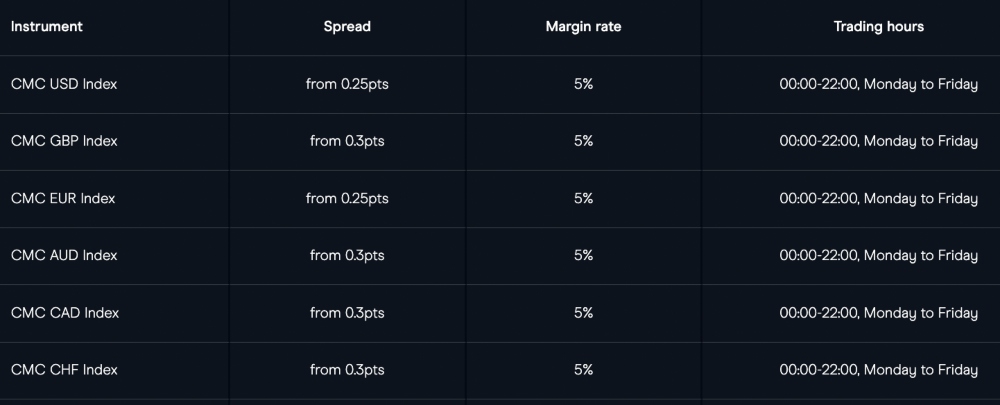
When looking to trade major forex indices through more traditional methods such as mutual funds or ETFs, costs are also low. This is because these instruments are passive tracker funds rather than actively managed funds that command higher commissions.
Pros Of Forex Index Trading
- Single Currency Trading – While forex pairs allow investors to pit two currencies against each other, forex index trading allows investors to speculate on a more balanced overall value of a single currency.
- Simple – When trading forex pairs, investors are very exposed to fluctuations in two currencies, rather than one. For example, a trader that believes the Euro will weaken can speculate on EUR/USD, but shall be vulnerable to USD changes as well. However, the balanced basket of currencies used in forex indices helps reduce exposure to base currency changes.
- Low Costs – Forex indices tend to have competitive spreads and commissions from forex day trading platforms, whether these are for forex-style CFD trades or other vehicles.
- Range Of Instruments – From CFDs to spread bets and futures, forex index trading is available through a range of vehicles, suiting various trading styles and strategies.
Cons Of Forex Index Trading
- Low Volatility – When trading leveraged derivatives such as options and CFDs, volatility can send profits spiralling. The more balanced values of forex indices can curtail this profit potential due to comparatively lower volatility.
- High Single Pair Exposure – The component forex pairs weightings are supposed to offer a diversified method of providing a value for a currency. However, this is not always achieved in practice. For example, due to the advent of the Euro and the consolidation of European currencies into one, the US Dollar Index has a 57.6% exposure in EUR/USD.
- Limited Markets – While hundreds of forex pairs offer investors the chance to speculate on minor and exotic currencies, comparatively few forex indices currently exist.
- Reduced Trading Hours – The forex markets benefit from 24/5 trading thanks to the use of several global trading hubs, including London and New York. Unfortunately, forex indices do not benefit from this system and have significantly reduced trading hours compared to forex currency pairs.
Forex Index Trading Strategies
There are different strategies for live forex index training. Ultimately, experienced traders will draw upon a combination of leading forex indicators and signals to predict trades.
Rumours & News
Seasoned forex investors will know the power of breaking news on the value of a currency. Traders can capitalize on this trading opportunity using forex indices, which filter out the effects of other currencies through their diversification.
One popular strategy is to “buy the rumour and sell the news”. This hinges on getting your position locked in before the market reacts to the upcoming news to maximize profits. However, this is a risky strategy as rumours can often be incorrect. Additionally, there is no guarantee that news will affect markets in the way that investors predict.
Breaking news to look out for includes inflation and interest rate announcements as well as high-profile currency interventions, such as in late 2022 when the Bank of England stepped in to purchase long-dated gilt bonds.
This was to contain the mass sell-off that occurred after the government’s short-lived mini-budget, which affected the 30-year gilt yield by as much as 1% as well as the value of the pound against the dollar.
Fundamentals
Long-term investments in a forex index will often be driven by fundamental analysis. These are the economic and political factors that influence the value of a currency.
Examples of fundamentals include economic growth, as tracked by GDP and employment rates. Political stability is also a crucial fundamental, with markets notoriously sensitive to political changes. The balance of trade is also important, with high exports generally strengthening a currency.
Investors will often look at historical data to find trends in a currency’s fundamentals to make predictions as to its future value. However, if an investor believes that an upcoming event will change the pattern of fundamentals, a reversal trade is always a lucrative form of investing, especially when using options.
Technical Analysis
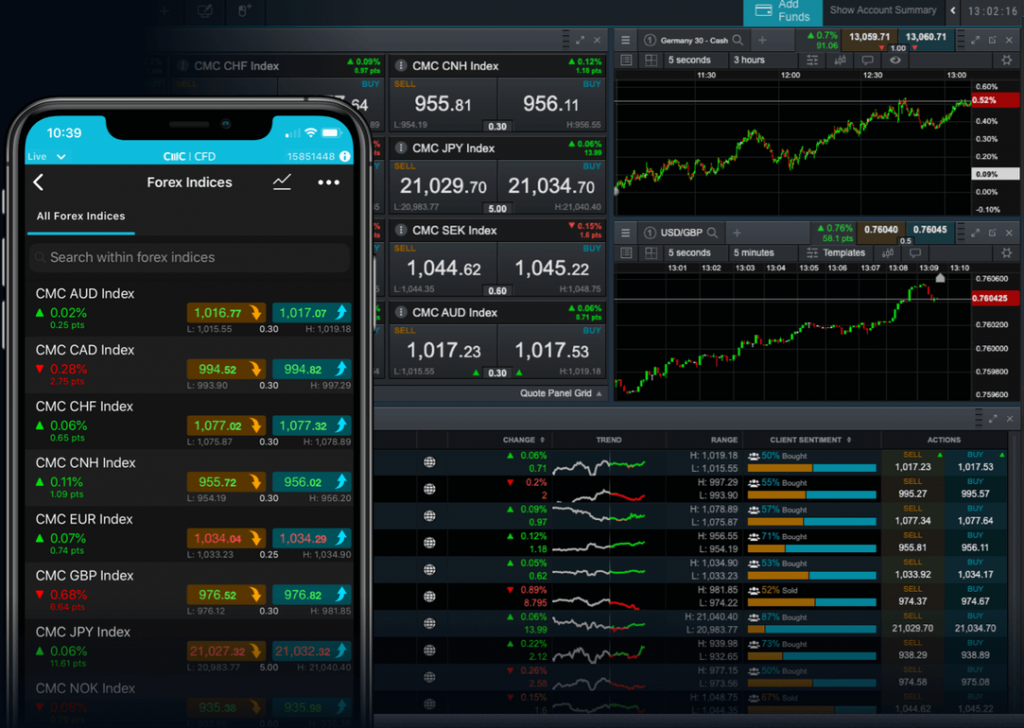
Thanks to the wide availability of retail analysis and platforms such as TradingView and MetaTrader 4, powerful technical analysis is more accessible to investors than ever.
Users may want to look at trend lines such as the relative strength index (RSI) in forex index trading or other leading indicators such as support and resistance lines and Fibonacci overlays.
Technical analysis can be done through various time frames, with short-term forex trading instruments such as binary options and CFDs able to analyse patterns on 1-minute or 5-minute charts.
How To Trade Forex Indices
Decide On Your Market & Instrument
While many brokers offer several currency indices, it is a good idea to decide on your favoured trading assets first. This is to ensure your chosen broker supports these assets before signing up and depositing funds.
It is also important to decide on your preferred trading vehicles, as most brokers support just one or two, for example, CFDs, ETFs, binary options or futures.
Choose A Broker
When it comes to trading forex indices, choosing a reputable and low-cost broker is key. Here are our top tips for finding the best forex index broker:
- Regulated by a reputable body, such as the FCA or CFTC
- Provides competitive trading and payment fee structures, such as a zero-commission account
- Supports your favoured payment methods, such as PayPal or wire transfer
- Supports reliable and user-friendly trading platforms such as MT4 or NinjaTrader
- Offers helpful and accessible customer support, available 24/5 via live chat or phone
Create An Account
Now, create an account. This is usually a simple process, but firms often require verification details for regulatory purposes, such as IDs, passports or bank statements.
Next up is to fund your forex index trading account. If you plan to trade a leveraged forex index market, ensure that you have sufficient capital to avoid a quick stop-out or margin call.
Find Your Market
Once your account is set up and funded, it is time to start trading forex indices. Download one of your broker’s supported trading platforms (some brokerages offer web-based platforms too) and navigate to your chosen product.
If your trading will centre around a small number of markets, most platforms allow traders to bookmark or favourite these asset pages for quick navigation in the future.
Make A Trade
Once you have conducted analysis of your forex index, it is time to make the trade.
As well as selecting your position, set stop-loss and take-profit levels, with advanced “trailing” tools available on some platforms. This will help keep a handle on your risk exposure.
Close Your Position
Monitor the market for the best opportunity to close your trade, taking your profit or closing out your losses.
With that said, some instruments like binary options may not offer an early cash-out opportunity. In these instances, hedging a trade to either lock in a profit or minimize losses may be possible.
Final Word On Trading Forex Indices
Forex index trading is a good choice for investors that wish to speculate on the value of a currency with less exposure to individual currency pairs. There are plenty of available forex index trading instruments, and these markets are largely low-cost. However, there is limited choice for exotic markets and trading hours are reduced compared to traditional currency pairs.
Use our list of the top forex index brokers to start trading.
FAQs
What Is An Index In Forex Trading?
A forex index is a basket of currency pairs with a common currency, such as the US Dollar. This provides a diversified measure of the value of this common currency.
Forex index trading essentially offers a means to speculate on the value of a single currency, such as the USD, EUR or GBP.
What Are The Best Currency Indices To Trade?
Forex indices such as the US Dollar Index, British Pound Index and Euro Index are highly liquid. However, a solid strategy can make any forex index a profitable trading market.
Head to our tutorial on forex index trading to find a suitable broker and get started.
What Is The Best Time To Trade Forex Indices?
The best forex index trading opportunities will occur around significant news, such as interest rate announcements, changes in government monetary policy and new global trade relationships.
Note that unlike trading standard forex pairs, FX indices may not be available 24/5.
Is Trading Forex Indices Better Than Forex Pairs?
Forex index trading allows investors to speculate on a single currency more reliably and stably than by using a single currency pair. However, currency pair trading can be more lucrative due to its comparative volatility, and investors have more options when it comes to available currencies.