




Brokers with low leverage enable traders to manage risk when trading derivatives. Higher leverage means greater risk. This guide explains how trading with low leverage works and examines common leverage ratios and models. Read on for a list of the benefits and drawbacks of trading using lower leverage accounts. We have also ranked and compared the best companies and brokers with low leverage in 2026.
Brokers With Low Leverage
-
- Demo account
- Regulator: FCA, ASIC, CMVM , FSCA, SCB, FSA
- Platforms: TN Trader, MT4, TradingView
-
- Demo account
- Min. deposit: $0
- Min. trade: 0.01 Lots
73-89% of retail investor accounts lose money when trading CFDs -
- Demo account
- Regulator: FCA, ASIC, CySEC, FSC, SCB, FSA
- Platforms: MT4, MT5, TradingView, TradeLocker
71.28% of retail traders lose money when trading CFDs -
- Demo account
- Platforms: eToro Web, CopyTrader, TradingCentral
- Min. deposit: $50
61% of retail CFD accounts lose money. eToro is a multi-asset investment platform. The value of your investments may go up or down. Your capital is at risk. -
- Demo account
- Regulator: FCA, ASIC, FSCA, VFSC, CIMA
- Min. deposit: $50
-
- Demo account
- Platforms: xStation
- Min. deposit: $0
69-80% of accounts lose money when trading CFDs with this provider.




Learn how we test brokers and why you can trust our ratings.
Here is a short summary of why we think each broker belongs in this top list:
- Trade Nation 4.4/5 Trade Nation is a top FX and CFD broker regulated in multiple jurisdictions including the UK and Australia. The firm offers low-cost fixed and variable spreads on 1000+ assets with robust trading platforms and training materials. The Signal Centre can also be used for trade ideas.
- Pepperstone 4.8/5 Established in Australia in 2010, Pepperstone is a top-rated forex and CFD broker with over 830,000 clients worldwide. It offers access to 1,400+ instruments on leading platforms MT4, MT5, cTrader and TradingView, maintaining low, transparent fees. Pepperstone is also regulated by trusted authorities like the FCA, ASIC, and CySEC, helping to ensure a secure environment for day traders at all levels.
- Eightcap 4.6/5 Eightcap is a multi-regulated forex and CFD broker established in Australia in 2009. The broker has proven popular with active day traders, providing 800+ instruments with tight spreads and notable improvements in recent years, integrating the leading TradingView platform, alongside AI-powered financial calendars and algo trading tools with zero coding experience required.
- eToro 4.0/5 eToro is a top-rated multi-asset platform which offers trading services in thousands of CFDs, stocks and cryptoassets. Launched in 2007, the brand has millions of active traders globally and is authorized by tier one regulators, including the FCA and CySEC. The brand is particularly popular for its comprehensive social trading platform. Crypto investments are risky and may not suit retail investors. You could lose your entire investment. Understand the risks here. 61% of retail CFD accounts lose money.
- Vantage 4.7/5 Founded in 2009, Vantage offers trading on 1000+ short-term CFD products to millions of clients. You can trade Forex CFDs from 0.0 pips on the RAW account through TradingView, MT4 or MT5. Vantage is ASIC-regulated and client funds are segregated. Copy traders will also appreciate the range of social trading tools.
- XTB 4.8/5 Founded in 2002 in Poland, XTB now serves more than 1 million clients. The forex and CFD broker combines a heavily regulated trading environment with an extensive selection of assets and a commitment to trader satisfaction, featuring an intuitive in-house platform with superb tools to support aspiring day traders.
Community Sentiment
See how users rate these brokers based on the average customer ratings submitted on DayTrading.com, plus ratings from Trustpilot, the Apple App Store and Google Play.
| Broker | Our Users' Rating | Trustpilot Score | Trustpilot Reviews | iOS App Rating | Android App Rating |
|---|---|---|---|---|---|
| Trade Nation | 2170 | ||||
| Pepperstone | 3703 | ||||
| Eightcap | 3908 | ||||
| eToro | 32244 | ||||
| Vantage | 15759 | ||||
| XTB | 3022 |
Trade Nation
Trade Nation suits discretionary traders who want to speculate on major indices like the US 500 or liquid FX pairs, and want the predictable all-in costs of fixed spreads. In tests, we found the fixed-spread TN Trader environment particularly useful for trading around scheduled economic releases owing to its reliable charting environment and because published spreads stayed capped.
 Christian Harris, Reviewer
Trade Nation quick facts
- Demo Account
- ✔Yes
- Instruments
- CFDs, Forex, Indices, Shares, Commodities, Futures, Bonds, Spread Betting (UK and Ireland only), Cryptos (Bahamas entity only)
- Regulator
- FCA, ASIC, CMVM , FSCA, SCB, FSA
- Platforms
- TN Trader, MT4, TradingView
- Minimum Deposit
- $0
- Minimum Trade
- 0.1 Lots
- Account Currencies
- USD, EUR, GBP, AUD, ZAR, SEK, NOK, DKK
Pros
- Trade Nation's 2026 partnership with Volt has sped up payments for Australian traders, who can now make instant deposits and withdrawals using PayID, with the faster payout capabilities planned for clients in the UK and EU.
- In testing of the TN Trader account under normal market conditions, fixed spreads held while fills were prompt on major forex pairs, with a slight drift in the entry level as price ticked between click and fill.
- The demo comes with a $5,000 practice account and you can request a one-on-one platform walkthrough by callback - this level of personal help is rare.
Cons
- Offshore SCB and FSA entities allow retail clients up to 1:200 and 1:500 leverage compared to 1:30 in regions like the UK, Europe and Australia, so an FSA client can have 16 times the exposure of a UK retail client on the same trade, but with less oversight and no compensation scheme.
- There is no raw or ECN pricing tier, which are often prefered by day traders. No matter how much you deposit or trade, you use the same fixed (or variable on MT4) pricing as beginners, making it unsuitable for scalpers especially.
- The 2–20% rebate scheme is closed to FCA, CMVM, and ASIC clients, meaning active day traders in these regions who would benefit from transaction rebates cannot claim them.
Pepperstone
Pepperstone stands out as a top choice for day trading, offering razor-sharp spreads, ultra-fast execution, and advanced charting platforms for experienced traders. New traders are also welcomed with no minimum deposit, extensive educational resources, and exceptional 24/5 support (18h a day on weekends).
Christian Harris, Reviewer
Pepperstone quick facts
- Demo Account
- ✔Yes
- Instruments
- CFDs, Forex, Currency Indices, Stocks, Indices, Commodities, ETFs, Crypto CFDs, Spread Betting
- Regulator
- FCA, ASIC, CySEC, BaFin, DFSA, SCA, SCB, CMA-Kenya
- Platforms
- Pepperstone Trading Platform, MT4, MT5, cTrader, TradingView
- Minimum Deposit
- $0
- Minimum Trade
- 0.01 Lots
- Account Currencies
- USD, EUR, GBP, CAD, AUD, NZD, JPY, CHF, HKD, SGD
Pros
- After adding spread betting through TradingView, Pepperstone provides a seamless, tax-efficient trading experience with advanced analysis tools for financial spread bettors in supported countries.
- There’s support for a range of industry-leading charting platforms including MT4, MT5, TradingView, and cTrader, catering to various short-term trading styles, including algo trading.
- Pepperstone has greatly improved the deposit and withdrawal experience in recent years, adding Apple Pay and Google Pay in 2025, as well as PIX and SPEI for clients in Brazil and Mexico in 2024.
Cons
- Overnight holding fees are higher than that found with some Market Maker brokers (usually Benchmark + 2.5%). This makes pepperstone an ideal broker for day traders and forex scalpers but less suitable for swing traders who often keep position open overnight.
- Execution may not feel as reliable in fast markets as headline speeds suggest. In our own testing, execution was fast at desired prices, but some community complaints focus on slippage, stop-loss fills and spread-sensitive order triggers during volatile conditions.
- Despite improvements to its range of markets, crypto CFD offerings are still fairly limited compared to other brokers who focus on this area, such as Eightcap, and there's no option to invest in real coins.
Eightcap
Eightcap delivers in every area for day traders with a growing selection of charting platforms, education via Labs, and AI-powered tools. Now sporting 120+ crypto CFDs, it's also become a stand-out choice for crypto trading, winning our 'Best Crypto Broker' award two years in a row.
Christian Harris, Reviewer
Eightcap quick facts
- Demo Account
- ✔Yes
- Instruments
- CFDs in Forex, Stocks, Indices, Commodities, Crypto
- Regulator
- FCA, ASIC, CySEC, FSC, SCB, FSA
- Platforms
- MT4, MT5, TradingView, TradeLocker
- Minimum Deposit
- $100
- Minimum Trade
- 0.01 Lots
- Account Currencies
- USD, EUR, GBP, CAD, AUD, NZD, SGD
Pros
- With tight spreads from 0 pips, low commission fees, Eightcap provides cost-effective and flexible trading conditions that can accommodate an array of strategies, including day trading and scalping.
- Eightcap added TradeLocker in 2026 for certain regions, marking it out as the best regulated TradeLocker broker, while still delivering Eightcap's ultra-fast execution and low fees for active traders on the charting software.
- Having excelled across all key areas for day traders, Eightcap outperformed every competitor to win our 'Best Overall Broker' award for 2024, also securing our 'Best Crypto Broker' title for 2025 and 'Best TradingView Broker' for 2025.
Cons
- Eightcap needs to continue bolstering its suite of 800+ instruments to match category leaders like Blackbull Markets with its 26,000+ assets, featuring a particularly weak selection of commodities.
- Despite a useful library of educational guides and e-books in Labs, Eightcap still trails IG’s comprehensive toolkit for aspiring traders with its dedicated IG Academy app and 18 course categories.
- In spite of an increasing variety of tools, Eightcap doesn't offer industry favorites like Autochartist or Trading Central, which offer cutting-edge charting analytics, live news, and market insights for short-term traders.
eToro
eToro's social trading platform leads the pack with a terrific user experience and active community chat that can help beginners find opportunities. There are also competitive fees on thousands of CFDs and real stocks, plus excellent rewards for experienced strategy providers.
Christian Harris, Reviewer
eToro quick facts
- Demo Account
- ✔Yes
- Instruments
- CFDs, Forex, Stocks, Indices, ETFs, Smart Portfolios, Commodities, Futures, Crypto, NFTs
- Regulator
- FCA, CySEC, MiCA, MFSA, FSRA, ASIC, FSAS, MAS, GFSC
- Platforms
- eToro Web, CopyTrader, TradingCentral
- Minimum Deposit
- $50
- Minimum Trade
- $10
- Account Currencies
- USD, EUR, GBP, AUD, DKK
Pros
- In 2025, eToro stopped including all crypto trading fees within the spread - instead, the same commission is now charged separately and shown as a clear line item, giving active traders more transparency without increasing overall costs.
- The copy trading app facilitates a best-in-class social environment, with an engaging social feed and community chat that we love using.
- eToro picked up second place in DayTrading.com's 'Best Crypto Broker' for 2025 with its huge range of tokens, reliable service and competitive fees.
Cons
- There is a $30 minimum withdrawal amount and a $5 fee, which will affect novices with low capital.
- There are limited contact methods aside from the in-platform live chat.
- The lack of additional charting platforms like MT4 will reduce the appeal for seasoned day traders accustomed to using third-party software.
Vantage
Vantage remains an excellent option for CFD traders seeking a tightly-regulated broker with access to the reliable MetaTrader platforms. The fast sign-up process and $50 minimum deposit make it very straightforward to start day trading quickly.
 Jemma Grist, Reviewer
Vantage quick facts
- Demo Account
- ✔Yes
- Instruments
- CFDs, Forex, Stocks, Indices, Commodities, ETFs, Bonds
- Regulator
- FCA, ASIC, FSCA, VFSC, CIMA
- Platforms
- ProTrader, MT4, MT5, TradingView, TradingCentral, DupliTrade
- Minimum Deposit
- $50
- Minimum Trade
- 0.01 Lots
- Account Currencies
- USD, EUR, GBP, CAD, AUD, NZD, JPY, HKD, SGD, PLN
Pros
- It’s quick and easy to open a live account – taking less than 5 minutes
- The broker has made efforts to expand its suite of CFDs providing further trading opportunities
- The app was upgraded in 2026 with wider asset visibility bringing together balances across Contract, Copy, and Funding accounts on one screen
Cons
- The average execution speeds of 100ms to 250ms are slower than alternatives based on tests
- It's a shame that some clients will need to register with the offshore entity, which offers less regulatory protection
- A steep $10,000 deposit is needed for the best trading conditions, which include the $1.50 commission per side
XTB
XTB stands out as a top choice for new day traders with the terrific xStation platform, low trading costs, no minimum deposit, and excellent educational tools, many of which are seamlessly integrated into the platform.
Christian Harris, Reviewer
XTB quick facts
- Demo Account
- ✔Yes
- Instruments
- CFDs on shares, Indices, ETFs, Raw Materials, Forex currencies, cryptocurrencies, Real shares, Real ETFs
- Regulator
- FCA, CySEC, KNF, DFSA, FSC, SCA, CMF, Bappebti
- Platforms
- xStation
- Minimum Deposit
- $0
- Minimum Trade
- 0.01 Lots
- Account Currencies
- USD, EUR, GBP
Pros
- Opening an XTB account is a hassle-free, entirely online process that takes just a few minutes, making the entry into day trading smooth for new traders.
- The xStation platform continues to impress with its user-friendly interface and intuitive features, including customizable news feeds, sentiment heatmaps, and trader calculator, reducing the learning curve for newer traders.
- XTB offers fast withdrawals with payment within 3 business days, depending on the method and amount.
Cons
- The demo account expires after just four weeks, a serious limitation for traders who wish to thoroughly test the xStation platform and practice short-term strategies before committing real funds.
- The research tools at XTB are good but could be great if they went beyond in-house features with access to leading third-party tools such as Autochartist, Trading Central and TipRanks.
- XTB discontinued support for MT4, limiting traders to its proprietary platform, xStation, potentially deterring advanced day traders familiar with the MetaTrader suite.
How Does Leverage Work?
In basic terms, leverage trading works in a similar way to borrowing. Your broker lends you money to open larger position sizes, and in turn, you can make a greater profit.
Leverage is often shown as a ratio which represents the balance of the loan capital (from the broker) to the value of the full equity (the amount the trader invests).
For example, a broker offering 1:5 leverage means for every $10 invested, you can borrow up to $50. This gives traders the chance to multiply the results of a trade.
Importantly however, trading on leverage can magnify losses. So in highly volatile markets, such as cryptos, you can use lower leverage to protect yourself from losing money quickly. This is also why brokers with low leverage are popular with traders starting out.
Examples
Let’s say a trader starts with a $100 deposit, and their broker offers a 1:10 leveraged ratio on commodities. This means that they can trade in positions up to ten times the value of their available balance, so a maximum of $1000.
They invest $1000 in crude oil and the value of crude oil rises by 10%, so the trader earns $100 in profit ($1000 * 1.1 = $1100). However, if they had purchased $100 worth of crude oil without leverage on the same trade, their profit would be $10 ($100 * 1.1 = $110).
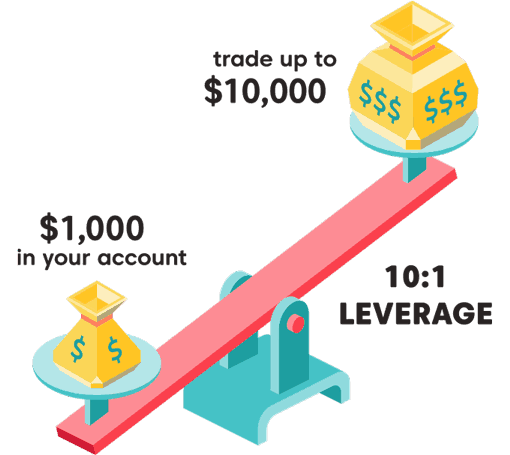
Alternatively, say a trader has a $100 deposit and their broker offers higher leverage at 1:100. They invest $10,000 ($1000 * 100) in Apple stocks but the value of the stock plummets by 10% so the trader loses $1000 ($10,000 * 0.9 = $9,000), 10 times their initial deposit.
So, while leveraged trades can magnify your profits, brokers with low leverage can help avoid larger losses.
Note, the examples above do not take into account any fees you may have to pay to trade on margin.
What Is Considered Low Leverage?
Generally, low leverage is considered to be below 1:30. However, leverage can vary depending on the markets you’re investing in.
The most trusted brokers that offer lower leverage are regulated by the FCA (UK), ASIC (Australia) and CySEC (Europe). These financial watchdogs typically limit leverage rates based on the market in question. Common leverage ratios include:
- 1:30 – Major forex pairs, for example, EUR/USD and GBP/USD
- 1:20 – Gold, minor forex pairs, major stock market indices, for example, NYSE and FTSE 100
- 1:10 – Commodities and minor indices, for example, energies like oil
- 1:5 – Stocks and shares, for example, Amazon, Microsoft, and Tesla
- 1:2 – Cryptocurrency assets, for example, Bitcoin, Ethereum and Litecoin
Pros Of Brokers With Low Leverage
- Gains With Reduced Risk – Using smaller leverage can benefit traders by slightly increasing their position size, and thus increasing their potential profits. With low leverage, the risk is minimized but bigger profits are still achievable.
- Lower Charges – Because leverage means that you borrow money, the broker can charge you fees for holding positions overnight or completing transactions. However, the cost structure with lower leverage means that you borrow less, and therefore you pay less in fees.
- Fewer Losses – As leverage boosts capital, it will also magnify any gains and losses. Choosing a broker with a lower rate of leverage will help to mitigate your losses, as you are exposed to less risk overall.
- Beginner-Friendly – Using brokers with low leverage is a more risk-conscious strategy, which makes it ideal for beginners who are still becoming familiar with a given market.
Cons Of Brokers With Low Leverage
- Limited Profits – When using a broker with lower leverage, your profit potential is limited by the rate of leverage they offer. There is no opportunity to make higher-risk trades that offer potentially larger returns.
- Restricts Your Portfolio – Signing up to a broker with low leverage means you may have fewer opportunities to diversify your portfolio. A trader using high leverage is more likely to have the capital to invest in multiple assets like REITs, CFDs, bonds, or cryptos.
How To Choose Brokers With Low Leverage
The key factors to consider when selecting a trading account with lower leverage include:
- Fees – Research the broker’s overall fee structure. Look for leverage transaction costs and any fees charged for keeping positions overnight.
- Available Assets – Ensure that your desired asset is available, whether that’s forex, equities, commodities or cryptocurrencies.
- Minimum Leverage – Check the level of minimum leverage offered on your chosen asset. Alternatively, we have compiled a list of the top brokers with low leverage.
- Negative Balance Protection – This is a useful feature offered by most regulated brokers. It protects your account from going negative even if the markets change rapidly. This is especially beneficial for new traders.
- Demo Account – Demo accounts enable you to practice trading with low leverage, and to establish if you are happy with the trading software offered by the brokerage. Free practice accounts are often the sign of a trusted broker.
- Supported Countries – Ensure that you’re allowed to use the broker in question. Whether you’re from the US, Canada or elsewhere, different brokers will only accept traders from certain jurisdictions.
Final Word On Brokers With Low Leverage
Brokers with low leverage offer clients the opportunity to benefit from trading on margin without the risks that higher leverage can bring.
It’s important to remember, however, that any form of leveraged trading can result in unpredictable losses. Beginners should open demo accounts to practise trading on margin, and ensure that they select the most trusted broker to protect their capital.
Nevertheless, low leverage is ideal for cautious investors looking to steadily build profits. See our list of the best brokers with low leverage trading to get started.
FAQs
Is Low Leverage Better For Beginners?
Whether you’re trading crypto, forex, stocks or bonds, for beginners a lower leverage ratio is good. This helps to reduce losses, which are more expected with newcomers who may make mistakes. Fortunately, most EU, UK and Australian-regulated trading brokers cap leverage for retail traders to 1:30.
Who Are The Top Regulated Brokers With Low Leverage?
Many of the best brokers offer low leverage options, and choosing a platform will depend on your individual needs. Some of the top low leveraged trading firms include XM, AvaTrade, eToro, Pepperstone and IG.
What Does Low Leverage Vs Low Margin Mean?
Leverage and margin both involve borrowing funds to trade. A leveraged position means a trader has taken on debt, while the margin is the actual money/ratio i.e loan taken to invest in financial markets. Both terms are often used interchangeably.
What Countries Allow Low Leveraged Trading?
Leveraged trading is regulated and legal in numerous countries across the globe. For example:
- US – National Futures Association (NFA)
- Australia – Australian Securities and Investments Commission (ASIC)
- UK and Europe – Financial Conduct Authority (FCA), the European Securities and Markets Authority (ESMA), Cyprus Securities & Exchange Commission (CySEC)
- Singapore – Monetary Authority of Singapore (MAS)
Note, in 2021 India banned the retail trading of many leveraged products.